Showing posts with label norwegian. Show all posts

Saturday, 15 September 2012

Review: Canned Dreams

Säilöttyjä Unelmia (c) 2012 Oktober / FS Film Oy. Also on display at Love & Anarchy September 27.

The 1st ever Finnish Film Market (attached to Helsinki International Film Festival - Love & Anarchy) is going to start in one week. As foreign buyers browse through the catalogues of Finnish films of recent years, they often may not have heard of the movies before. I thought it would be a good idea to provide a review in English of one of the best films of recent years this country has to offer. I saw it way back in spring and it has since been in plenty of foreign festivals as well. But I digress.


Globalization affects our lives a lot more than we could ever imagine. Most of the food on the shelves at your local grocery store comes from sources hard to track. In Katja Gauriloff's documentary we follow the ingredients of one tin can of mystery food all through the world. But the film isn't so much about how the food is produced, but about the people that make it. One can metaphorically includes also the lives of all the people that have contributed to making of the goods.

The film has been realized in a similar style to Michale Glawogger's Workingman's Death. Scenes of people working have dream-like quality and the people on present say what's on their mind on the soundtrack. Gauriloff's film isn't quite on par with Glawogger, but at least she has found planty of interesting personalities to showcase.
  
People working with pigs seem to be the most interesting people. We have a kind but a bit slow Danish pig farmer that's taken up the family business. He treats the animals nice, and joys when they have piglets. But his animals are sent elsewhere to be killed and cut into pieces. This is contrasted by a far more sinister Eastern European butcher who has to do the dirty work. His marriage has crumbled due to his wife's (and his own) infidelity. So, he lets out his gloom by threatening violence to her and her new lover, and having some quite alarming misogynist views on things. Props to Gauriloff for not presenting the working class as purely idealistic, good people being forced to serve under richer masters.

Nevertheless, these old ladies are the cutest!
The imagery also works quite well for this theme. Heikki Färm and Tuomo Hutri have photographed all the farms, mines, factories and shops with almost surreal close ups and cropped images. At times the film looks like a living painting. The somewhat slow pace also emphasizes this. Yet the film isn't one minute too long. In fact, it could've used a scene or two more. Some people you just would like to know more about. And telling about the origin of the food you eat is one of the most important messages one can get across us westerners.

There are limitations to this kind of film, and Gauriloff has admitted in interviews that the crew could not shoot all the material to cover every one of the ingredients in the can. Some, such as the poultry farm, are quite clearly polished images. The small room where thousands of chickens are housed on ground is actually luxury compared to the caged meat/and/or egg factories these birds usually have to live in. Since the ingredients in canned food are hardly from a farmer's market and possibly form wherever one can get them the cheapest, it's quite clear that the eggs come from elsewhere.

Yet the images of pigs getting sent to a convoyer belt to first get electrocuted and then slaughtered are still quite disturbing. No one can claim that the meat they're eating did not suffer before death when these sort of methods are in use all across the EU.

This is by no means just a national project. It has been shot in eight countries and is at its core a Irish/Norwegian/Portuguese/French/Finnish co-operation. But the tin can in this case is a sort of tower of Babel being built – it brings together a lot of different kind of people who one would not believe to have anything in common otherwise.

★★★★


CANNED DREAMS (Säilöttyjä unelmia)
Finland, 2012
Language: Various
Director: Katja Gauriloff

Screenplay: Katja Gauriloff, Joonas Berghäll, Jarkko T. Laine
Cinamatography: Heikki Färm, Tuomo Hutri


Further reading: The Best Poker Movies

http://www.pokerlistings.com/pop-poker-poker-and-the-titanic-46900
http://www.pokerlistings.com/pop-poker-is-kaleidoscope-among-best-poker-movies-66526

Saturday, 10 December 2011

International Films for the rest of the year, or: PÖFF 2011

"I hear Tallinn has a pretty groovy film festival. Let's meet at the harbor." Le Havre (c) 2011 Sputnik Oy.

The biggest film festival in Estonia, Tallinna Pimedate Ööde Filmifestival (Tallin Black Nights Film Festival, or PÖFF) turned 15 this fall. The prestigious international film festival was held 16.-30. November. I only had time to visit the festival for one weekend, even though it would've offered a lot of highly interesting international films. Luckily, a lot of them I had already seen or had the chance to see back in Finland. So here is an end-of-the-year roundup of interesting films from PÖFF's lineup.

Le Havre (Finland/France)
Director: Aki Kaurismäki

Le Havre (c) 2011 Sputnik Oy.
The pitiful Finnish film industry always gets a boost whenever our last and only recognized auteur, Aki Kaurismäki makes a new film. Nevermind that this one was shot in France and in French, Le Havre will win multiple Finnish Film Awards, and is our country's contender for the Oscars. But while it's a good film, it is a small disappointment and nowhere near Kaurismäki's finest.

Le Havre is about the inhabitants in a small coastal town in Northeast France. The old shoe-shiner Marcel Marx's (André Wilms) life is shaken as his wife Arletty (Kati Outinen) falls ill and is hospitalized. The grief-stricken elder gentleman finds it hard to function without his wife. He happens to come across the young immigrant Monet (Jean-Pierre Daroussin) hiding from the police in the harbour. The kind-hearted Marcel takes pity on the boy and gives him shelter in his home. It also allows him to get his mind off worrying about the fate of his wife. He gets the support of his entire comminity to keep the boy from getting to the cold hands of the law.

Le Havre is first and foremost a fairy tale for grown ups. Its humanism is strongly influenced by the silent films of Charlie Chaplin, and Kaurismäki also uses about as much dialogue in his films as well. But nevertheless, the film feels a bit too naïve and predictable for its own good. The message is of course good and pure, and as important today as it was in the 1930's when the right-wing chains of thought swept through Europe the last time. But Kaurismäki doesn't really get a good hold at his characters, which feel like rough drafts compared to his previous body of work. Marcel, for instance, is pretty one-dimensionally good. More time is spent on the nostalgia of the old town, where old people take care of old bars and old grocery stores, soon to vanish. The imagery itself is familiar to the point of clichés. Kaurismäki goes through a checklist of his usual trademarks, and thus, for instance, a rock show is tacked on (by the French old school rocker Little Bob). All in all, it feels a lot like a film fastly done in between other films with more gravitas.

★★★

Poongsan (South Korea)
Director: Juhn Jaihong


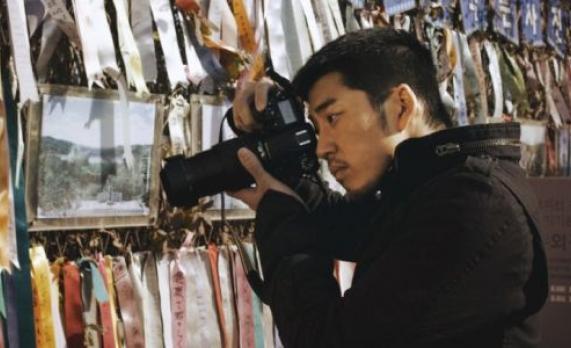
The formerly prolific Kim Ki-Duk has had trouble doing films lately. He's suffered from depression and a writer's block, that is all delved into in his latest film Arirang. But luckily Kim has shown signs of getting better, and now he has managed to script and produce another film that isn't about himself. Instead, is a action thriller about the conflict between North and South Korea and one smuggler between them.

The mute smuggler, known only by his cigarrette brand as Poongsan (Kye Sang Yoon), silently takes on jobs left on a note by grief-stricken families. He can bring anything and anyone across the borders of the two Koreas. While his reputation grows and grows, eventually he gets a job from a wealthy Southern businessman to bring back his Northern girlfriend In-ok (Guy-ri Kim). The job proves harder than usual, as the saucy woman proves to be more than a match to Poongsan's finely-tuned tactics. At the same time the South Korean police has set up a trap to catch Poongsan and to find out whether he comes from the North or the South. But also North Korean Agents have their eyes on Poongsan and sinister plans for him.

The fast-moving movie has a huge cast of characters and so many allegiances that it's difficult to keep track of all of them. The middle of the film in particular, is quite confusing. At the centre of the movie there is a triangular romance, that feels quite forced considered from any angle. But at least things aren't as black and white as they initially seem. Director Juhn Jaihong excels as an action director. The scenes of running through the border area are brisk, exciting and innovative, if not very realistic. Likewise, Juhn and Kim have also deviced some very twisted and nasty ideas for the film, which one can take chuckling. The whole ordeal is a kind of a modern western, if such a common comparison can be excused. The mute stranger playing two sides against each other for profit is the exact plot of A Fistful of Dollars. Poongsan is a sort of superhero, as he seems almost invunerable. He's a symbolic person, the spirit of the Korean soul that doesn't look whether you come from the nort or the south. The film deals with subjects that must be painful to the Koreans, but does it in an exciting, innovative way. The script could've used another polish, though.

★★★ 1/2

Attack the Block (Great Britain/France)
Director: Joe Cornish


A new generation of video-raised Brits have recently started to make more interesting genre pictures. With his debut, Joe Cornish goes to the same league with Neil Marshall, Edgar Wright and Ben Wheatley. Cornish's master idea was to combine a silly alien invasion idea with a coming-of-age tale of a hoodlum. A teen gang has to face responsibilities for the first time in their life to survive and protect their home block.

The story begins on New Year's eve as the gang led by Moses (John Boyega) mugs a nurse on her way home. While the gang's making their escape, a small furry alien attacks Moses. He decides to beat it to death as revenge. But this turns out to be a mistake, as bigger, nastier aliens soon start to appear and killing off people. They seem to have some beef with Moses and his past deeds. In the mids of all the fireworks they have come on Earth undetected and because of the block is seething with crime, few authorities want to check on it. One of the gang members gets injured and needs mediacal attention. Luckily at their home block the ruffians realize that the nurse they robbed is actually living as their neighbour. Sam (Jodie Whittaker) therefore has to choose whether to trust the hoodlums to survive or to try to make it on her own.

Attack the Block's biggest problem is that it's marketed as a comedy, but it really isn't all that funny. Little wannabe gangsters Probs and Mayhem do raise a few giggles, but Nick Frost as a lazy fat drug dealer feels mostly wasted (in the bad way). The film's aliens are cool, dark furry things with glow-in-the-dark teeth. When their mission is revealed, it seems plausible, and thus they would've fitted well with my recent list of best movie aliens. There is also the stretch that one has to symphatize with some nasty underage hoodlums to enjoy the film. But hey, the same is true with Akira. Like the anime classic, this is a little anarchistic and anti-authority, but also stretches the need to take responsibility of one's own actions.

★★★

Sons of Norway (Sønner av Norge, Norway)
Director: Jens Lien


Sons of Norway takes us back to the golden days of the late 1970's in the concrete suburbs of Oslo. The adolescent Nikolaj (Åsmund Høeg) is raised in a family of free-thinking radicals (in a word, hippies). Nothing is shunned upon, and his parents have an open mind toward everything. It all changes when Nikolaj's mother Lone (Sonja Richter) dies in a tragic accident. Living with just his grief-stricken widowed dad Magnus (Sven Nordin) is a real pain. So when Nikolaj gets his first teenaged needs to rebel, he needs to take it to the extreme. Luckily, punk rock and The Sex Pistols have just risen, so Nikolaj bases his life on their teachings. He gets a new punk look, acts rude toward authorities and starts his own garage band with his friends. But then Magnus decides he wants to party and join in the movement as well.

The film is certainly quite funny, as much comedy can be done on the expense of the 70's Nordic liberals. For instance, we are taken to a nudist camp, and Nikolaj gets to witness more sex than should be good for a boy too young to actually do it himself. As everything is looked through nostalgic lenses, rather than looking forward, the film isn't that punk in actuality. It pronounces the joy of life rather than nihilism. I should hate it then, but I don't. After all, there is a late cameo by Johnny Rotten himself. The film is quite episodic, which makes me feel it is based on a book or on actual events. It would benefit from having a stronger sense of the story rather than having just one set piece after another. But the father-son relationship is realized in a funny and never preachy way.

★★★

Inní: Sigur Rós (Iceland)
Director: Vincent Morrisset


I didn't know much about Iceland's gift to progedelic rock, Sigur Rós, before seeing this film. I feel like I still don't. It's a documentary film about the band, which utilizes a lot of concert footage, but also some interviews from the course of their career. But very few of them, in fact. Too bad, because they are easily the most interesting thing in the movie. Most of the time is spent on gigs, with the camera hugely close to the players and obscuring much. The film is black-and-white and grainy, allowing viewers either to interpret the film as they please or get nauseous. As for Sigur Rós's music, I feel it is quite nice to listen for a song or two, but I get annoyed by its slowness and lack of any hooks after 1,5 hours. If you're a fan, this is a must. Otherwise, I suggest to avoid this.

★★

Killing Bono (Ireland/Great Britain)
Director: Nick Hamm


Based on a memoir that every one that has ever talked about has described as "almost too weird to be true", Killing Bono tells the story of Bono's doppelgänger. The man in question is the Irish rocker Neil McCormick (Ben Barnes) who went to the same school as Bono, The Edge and friends way back when before they were famous as U2, in the late 70's. Neil's younger brother Ivan (Robert Sheehan) was in fact asked to be in the band lare named U2, but the jealous big brother never allowed for this to happen.

The film deals with the two brothers' struggling to have some sort of success with their own band, while U2 goes on to be the biggest band in the world. The McCormick ordeal features gangsters, record company executives, loose women and other deadly combinations of weird Irish people. Sex, drugs and rock and roll are all present, but don't feel glamorous but a little worn out and with a tiny hint of melancholic sadness within them. Neil makes a huge string of bad decisions and usually keeps them from Ivan. When Ivan finds out brotherly feuds so harsh follow even the Gallaghers would find them a little excessive. The ever-awesome Pete Postlethwaite makes his final appearance on the screen as the boys' gay landlord. The still-awesome Twitter superstar Peter Serafinowicz plays a sleazy and foul-mouthed record company owner. The film is quite funny, but more than anything, it made me interested in reading Neil McGormick's book. I'd like to find out just how much of it was made in the sake of cinematic storytelling and how much does McGormick claim is true.

★★★

Code Blue (Netherlands)
Director: Urszula Antoniak

 
Urszula Antoniak is known from her debut feature film Nothing Personal. Code Blue is similar in the slow pace and lack of dialogue. Antoniak trusts the images to tell the story. Another thing that is similar is that they both are stories about love and sexuality, but go across painful limits, making the stories all the more tragic. Code Blue is much more violent, almost sadistic in its outcome.

Nurse Marian (Bien de Moor) tends to appears to be emphatetic and good at her job, taking care of terminally ill and old patients. But she harbors more sinister feelings among herself. She's a loner and become more than a little twisted from being around death all the time. She also has voyeristic urges, and with binoculars witnesses a man in the next building doing violent acts to women. Rather than calling the authorities, she becomes fascinated and a bit aroused by this man. And the man also starts to spy on her. It is inevitable that these two shall meet.

Code Blue is slow to the point of coma. But nevertheless Antoniak is good at building pressures, which burst out at a few shocking scenes. Her film's protagonists are pretty rotten to the core, which makes the film feel a tad nihilistic. It's certainly arty, to the point when a lot of people won't stand the film. But I've got to say, once I got over my initial confusement, I kind of liked it.

★★★ 1/2

She Monkeys (Apflickorna, Sweden)
Director: Lisa Aschan


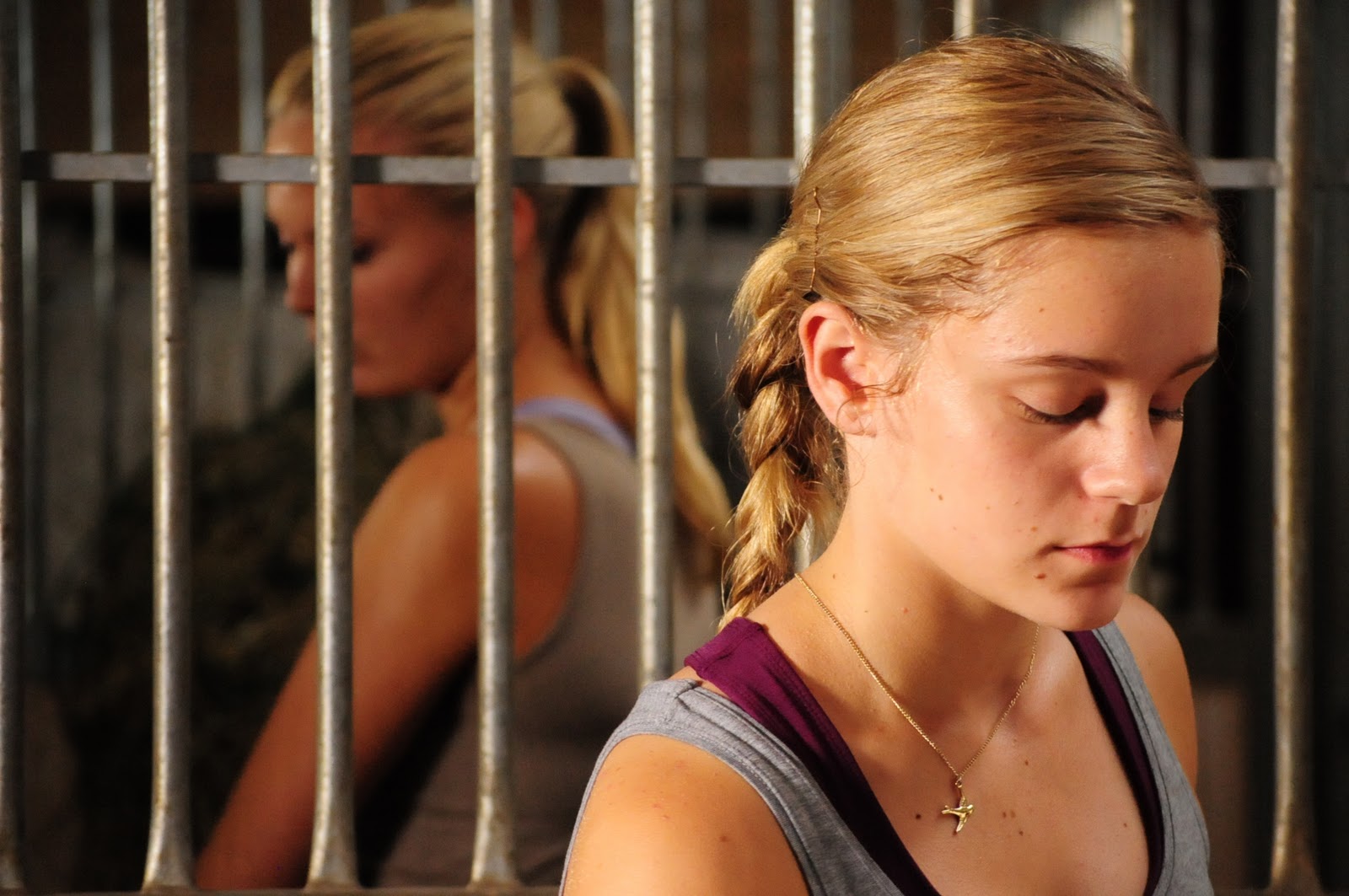
One of this autumn's biggest surprises comes from Sweden of all places. To be fair, it's no wonder I was t first dismissive of a film that was said to be like "a new Fucking Åmal". In actuality She Monkeys is a lot more. It shares it's slow, almost documentaristically still style with films like Play. In fact it works very well as a companion piece of that film. Whereas Play had some good ideas of how to present male adolescence, peer pressure and the spread of anti-immigrant views on cinema, She Monkeys delves on the development of female sexuality, unrequited love, mood swings and physicality.

The teenaged Emma (Mathilda Paradeiser) is accepted to a school for circus acrobats. She soon makes friends with another schooler, Cassandra (Lena Molin). They soon become inseperable, doing everything together. But it soon turns out that one of the girls feels a lot stronger towards the other than the other does. Nevertheless, the scenario is allowed to go all through to its breaking point. Meanwhile, Emma's little sister Sara (Isabella Lindquist) gets her first taste of developing into an adult as a swim school instructor tells her mom that she needs a bikini top to swim there. Sara harbors a crush on her cousin Sebastian, and plans to woo her.

All information we viewers gain in the film is based on what Emma and Sara experience on screen. There's not a lot told about what's happening outside. It keeps the film fresh and pulls the rug out from under the viewer's feet a few times. She Monkeys isn't afraid to surprise or even shock. For a debut director, Lisa Aschan has astonishingly good sense of cropping the image and allowing us to read things on almost still faces. The film also has a strong sound design, with breathing and other small sounds turning out to be vital for the storytelling. The film is cut surprisingly short and when it ends, the viewer is left wanting for more. While all threads are tied in this film, maybe we're just left to wait what Aschan does next.

★★★★

In A Better World (Hævnen, Denmark)
Director: Susanne Bier


Susanne Bier's films are basically very good, but I somehow mostly see them as somewhat off-putting. I don't know what it is, certainly not the thematic darkness, since I'm used to that as a Scandinavian. Her films tend to have depressed people be miserable amid the Scandinavian welfare state. That's by no means a wholly unique theme in Scandinavian cinema. So is the case with Hævnen, which actually means Revenge. It has won multiple awards, including the Academy Award for Best Foreign Film at this year's Oscars.

Hævnen has several stories going on at once, but the central one concerns the budding friendship between Elias (Markus Nygaard), who is bullied at school and Christian (William Nielsen), who has a lot of personal problems as well. Both come from fractured families. Elias' parents are on the border of breaking up and his father Anton (Mikael Persbrandt) spends a lot of time abroad, at work at an African refugee camp. Christian has lost his mother to cancer and is having a hard time adjusting to life with his dad Claus (Ulrik Thomsen). Christian starts behaving aggressively, almost sociopathically, and he pulls Elias with him to his dangerous shenanigans.

Bier has a pretty good idea of male adolescence and what pulls boys to dangerous shenanigans. The actors are superb and are particularly well in scenes filled with melancholia and sorrow. Audio-visually, the film is also top notch. Yet I still feel as if the film is missing an edge or some other major spice. The whole thing feels like playing a bit too safe to create exactly the kind of film that Scandinavians appereciate. For one thing, I don't feel the scenes in African add too much to the story. They are interesting and all, but seem like they would better suit another kind of film. Perhaps it is Bier's way to show that the Nordic angst actually is nothing compared to the problems that a lot of other countries have to deal with every day. That would explain the English title, at least.

★★★ 1/2

Superclásico (Denmark/Argentine)
Director: Ole Christian Madsen


In a Better World was Denmark's representative at the Oscars last year. This year they've sent a more comedic film, which is actually still a very similar story at core. It's also about a dysfunctional family on the verge of breaking up that faces grievances, angst and sorrow. It is probably because of Lars von Trier's controversial Nazi statements that they wouldn't dare to send the much superior Melancholia. But while Superclásico is pretty predictable, there's loads of fun to be had with the film.

Christian (Anders W. Berthelsen) is a wine shop owner, that has been trying to cope with his wife Anna (Paprika Steen) leaving him. Anna is a football manager and has fallen in love with her protegé, the famed Argentinian soccer player Juan Diaz (Sebastián Estavanez). Anna needs Christian to sign the divorce papers so he can marry Juan. Christian decides to do that in person in Argentine to get one last chance of rescuing his and Anna's marriage. Their recluctant, laconic teenaged son Oscar (Jamie Morton) is taken along. On the trip the Nordic and fiery latino sensibilities clash, but the boys also get their own taste of passion form Argentine women.

Like it's name implies, Superclásico is a pretty basic story about a divorce. There's only a few small surprises along the way, but the film's real trick is to do the most worn-out elements so well as to make them seem fresh. First of all, the film is very well acted. Everyone from the main roles to small ones do a great job, have just the right comedic timing, and create multidimensional characters that feel very real in the context. Second is that the sunny Buenos Aires is shot with care, an eye for detail and, in a word, with love. It feels like one of the main characters of the film. We scarcely get postcard monuments, the film takes us more to tiny wine bars, carages and seedy hotels. So all in all, while there's nothing to write home about, it is a pleasant enough trip.

★★★

50/50 (USA)
Director: Jonathan Levine


An even more unlikely concept for a comedy than a painful divorce, is deadly cancer. But dark subjects are usually the most ripe for comedic treatment. The approach here is to do it as adorable as possible. So we have adorable Joseph Gordon-Levitt getting deadly cancer. Helping him are the adorable Anna Kedrick, Bryce Dallas Howard and Anjelica Huston. Perky pop and old classics are playing on the background. There's an adorable dog named Skeletor tilting his head at appropriate times. The film even features the adorable Philip Baker Hall as an adorable older cancer sufferer with a potty mouth and an appreciation of weed.

But anyway, the film is based on an (inspirational) true story. The 27-year-old Adam (Gordon-Levitt) finds out that he has back pains because he has a rare form of spinal cancer. He's given a 50/50 chance of making through it. So, naturally he also starts to go through what is important in his life. He comes to terms with his overly-worrying mother (Huston), and deals with his artist girlfriend (Howard) who has started to drift away. Along the way he meets new friends at cemotheraphy and strikes a friendship with his young therapist Katherine (Kendrick).

While 50/50 is quite symphatetic, it doesn't work that well as a comedy. Most of the fault lies in Seth Rogen's performance as the cancer-sufferer's best friend Kyle. Rogen's shtick is as tired as ever, and starting to really get on my nerves. Kyle is a generally unlikeable radio host that thinks about himself before others. He only talks about getting laid and smoking weed, and never, ever shuts up. And he's ever-present in many scenes that would do a lot better without him. I get that he's supposed to be a bit of an asshole, but still have a heart of gold. That's what friends sometimes are, particularly if you're in a tricky situation. I'd still like to avoid Rogen from now on, if he doesn't attempt to evolve one bit either as an actor or a comedian. But the film at least made me reflect on my own life.

★★ 1/2

Tuesday, 30 August 2011

Espoo Ciné 2011


The festival season began again by me taking a bus (or a couple) to visit the neighboring city of Espoo. The annual Espoo Ciné festival offered once again a solid set of the best cinema from Europe and elsewhere, as well as a couple of fine genre films I'll deal with soon enough. But in the meantime, here's what I gathered from the more "arthouse" wing of the program: 

The Opening Film:
The Tree of Life (USA)
Director: Terrence Malick


The new film by the hermit director Terrence Malick is always a big deal, and this was surely one of the most awaited films of the year among true cinema buffs. It's actually been made relatively fast, as it's only been six years since Malick's last film. Although the film has won the prestigious Palm d'Or award at Cannes film festival, it has still divided audiences. Some critizice Malick from going too far into christian pseudo-philosophies, and having the message of the film fall flat. Others see a vivid film that's bustling with ideas and deep symbolism, and is ambitious enough to explain the entire universe with it. All can agree that this is a one-of-a-kind film that's made with an amazing visual style.

It is a bit hard to summarize the film's plot. Everything in it is connected to an idea that everyone on Earth must follow one of two paths in their life's every decision: either they follow nature and do things from selfish reasons, or they follow mercy and do things out of love. First, we follow the grief in an American family as one of their three boys has died from reasons not explained. From the grief we take off to the beginning of life itself billions of years ago in the sea. One-celled organisms eventually become dinosaurs, which concieve the concept of mercy (!). We come to the modern day where the architect Jack O'Brien (Sean Penn) broods and thinks about his past. Then we're back with the O'Brien family in the 50's or early 60's, before the upcoming tragedy. The eldest son Jack (Hunter McCracken) lives and plays with his two brothers in the nature, often somewhere near water. His strict but loving father (Brad Pitt), and gentle mother (Jessica Chastain) embody the two life paths, and try to get Jack to follow them.

Either way you choose, life may have infinite sadness waiting for you. The reason is never explained to you, as only God knows how it all fits in his Divine plan. But Malick does offer hope with the ending. Everyone will get a chance for redemption. Too bad it's presented so it makes the whole thing a little cheesy and underlines the religious reading of the film. Otherwise one could read the Tree to be whatever one likes.


While Tree of Life might not be the best work from Malick, it is surely his most ambitious. It's no wonder the film has mostly been compared to 2001: A Space Odyssey, that's the only other film that dares to tell the story of the entire human development. But no one else but Malick would have the idea to connect his autobiographical childhood nostalgia to various christian dogmas and multilayered symbolism. When the viewer leaves the theatre, he most likely has his head all blurry from this whole cornucopia of unforgettable images, unique ideas, colorful boyhood nostalgia, great underplayed acting, and, in two words, pure cinema.

★★★★


The Closing Film:

The Kid With A Bike (Le gamin au vélo, France/Belgium/Italy)
Directors: Jean-Pierre & Luc Dardenne


The Belgian Dardenne brothers make engaging films about drifting lower class people. Their films contain no music and are often shot with a hand-held camera. They are among the best portrayers of social realism working today. The brothers are also true Cannes festival darlings, having won the top gong twice, and now picking up the Grand Prix with their last effort. And deservedly so, because their latest film is nothing short of brilliant.

The young Cyril (Thomas Doret) has been abandoned by his father, who has also sold Cyril's beloved bicycle. The kid lives in a learning institution, from which he escapes, and eventually gets his bike back. Cyril gets a chance for happiness when the kindly hairdresser Samantha (Cécile de France) agrees to give him a home during the weekends. But Cyril's having a hard time adjusting, and he's still pining for his father. When Cyril eventually finds him, dad (Jérémie Renier) tells him that he wants to start a new life without his son and thus doesn't want to see him again. The broken Cyril meets the nice-seeming juvenile criminal Wes (Egon di Mateo) and falls to the wrong tracks.

Altough the film's plot as laden out here resembles an after-school special, it is actually played out a lot smarter. There's a good reason Cyril is driven to each bad decision he makes. He's not a pure victim, but actually a pretty admirable character as he's relentless, tenacious, and ready to fight for his own rights. He just doesn't always understand what's best for him. The understanding extends to most other characters as well, who are well fleshed out with the time they are given. They have three-dimensional motifs, and more than a hint of tragedy in them. The film's plot moves steadily forward, and manages to be both exciting, and truly surprising at times. It's neither a moral lesson, nor a feel-good film, but works in so many levels, it can easily pass as either.

★★★★★


Special Screening:
When You're Strange (USA, 2009)
Director: Tom DiCillo


There was an outdoor screening of the Johnny Depp-narrated documentary about the legendary band The Doors. The film's catch is the recently discovered rare footage, that frontman Jim Morrison shot  himself. As one can imagine, the film is much more about Morrison and his persona, than The Doors as an entity or the other members of the band. The over-emphasis of Morrison's importance married to a lack of criticism of his horrible poetry make this a bit kiss-ass to my taste. Some critical voices of Morrison't behaviour towards the other band members are heard, but it is marked as a quirk of a struggling artist, who's having it rough. After 40 years of personal worship, wouldn't it be about time someone took a more critical, or even neutral approach to the whole Morrison persona? But anyway, I knew little about Doors before seeing this documentary and it did manage to spark interest in some of the band's back catalogue. There's nothing wrong at the film's pace and the story itself is interesting, warts and all. The new footage itself is pretty cool, but wouldn't you know it, it's used to build Morrison's legend and to imply that he might've faked his death and still be alive.

★★★

Tales of the Night (Les Contes De La Nuit, France)
Director: Michel Ocelot


Michel Ocelot is a French animator who makes films that don't really resemble any other animations I've seen. Their style is somewhere between silhouette animation and Flash animation. His latest work has been made in 3D, which is a bad decision. Ocelot's style is to have flat characters, and bringing depth into their environment diminishes this style. There are a couple of nice-looking wide shots, such as a tree reflecting from water, but mostly 3D in here is just a waste of everyone's time.

Tales of the Night is about a strange (movie?) theatre during one night. Inside the theatre a boy, a girl, and an elderly animator are working. They come up with several stories during the night, coming from all over the world, and act them out in a stage. All the stories have familiar fairy tale elements, whether they are about werewolves, wizards, talking horses or magic drums. Usually they are about a boy and a girl falling in love and the boy overcoming the obstacles for the pair to be together.

The biggest problem with the film is that the stories feel too familiar, and thus there are too many. Four stories would still be fine, five is pushing it, but the sixth feels boring already. As the stories work well alone, it is no surprise that most of them are actually episodes of a TV series Dragons et princesses. Thus also the scenes in between them start to feel really repetitive. The whole thing would probably work better as a TV series. Nevertheless, the stories, uneven as they are, have big amounts of charm and have cute ideas. My favorite is the one set to Jamaica, where the boy feeds a giant bee, iguana and mongoose in order to gain entrance to a wizard's castle, only to get caught and sentenced to death. The animals then help our hero out to escape and to win the princess's heart. But in the end lurks an actually pretty surprising reveal.

★★★


David Wants to Fly (Germany)
Director: David Sieveking


This German documentary about Transcendental Mediatation is made in the style of Morgan Spurlock, in that the director is the main character in the film. We see what happens to his personal life during his search for answers. That is not a style that works for everyone. It is also the film's biggest downfall, but luckily, the rest of it is from an interesting subject.

I've been wondering about transcendential mediation at one point myself. The meditation seems to do a whole lot of good for one's peace of mind, yet the TM association only allows for you to learn the proper skills by purchasing a preposterously expensive course. The film reveals just to what extent the study branch started out by Maharishi Mahesh Yogi is a money-making scheme. The young documentarist David Sieveking starts out by listening to the praise for TM given by director David Lynch. As Sievekind becomes interested, he starts to dig deeper into the subject. Lynch's image as a wise teacher of meditation is soon shattered. He's shown as just a brand, promoting the bigger corporation. And make no mistake, the international TM movement is a multinational corporation, putting up brances all over the world and getting celebrities to sing their praises. The most hilarious parts of the film reveal that they offer courses costing a million dollars, that are claimed to teach flight to the meditators. TM has also built an expensive model village as a so-called centre for their way of thought. It is also proven scientifically that the patented TM is no better way of relaxation than any other way of meditation.

The film is more a story of the nerdy Sieveking's difficult relationship with his girlfriend, than a revelatory document about cashing in on people's search for inner peace. I'm not really that interested on finding out why the couple breaks up and eventually comes together again. But Sieveking does have a nice dry sense of humour, and even dares to make fun of the most emotional scene of the movie. Still, most of the film feels like filler to the real meat. The main message is still that the ways to achieve peace of mind should be given, not sold like any merchandize.

★★★

Aurora (Romania)
Director: Cristi Puiu


Director Cristi Puiu is notorious from making mammoth-length films. It's not that the films' stories are so epic that they need three hours to be told. Quite the contrary, the films have very simple stories, but time is an essential element in how they are told. The audience is constantly lulled into feeling a false security by showing long, ordinary commonplace events. But then the sudden bursts of violence, turning points, or great dialogue comes from out of nowhere. If one is not an ADD case (like me), these are highly reccommended for the long-winded. Of course even I liked this.

Aurora is a story about Viorel (Cristi Puiu himself), an estranged father of two young children in modern Bucharest. We follow him around in his mundane, day-to-day routines. He takes his children to daycare, has sex with the woman next door, and argues with his ex-wife. Somewhere along the way, one gets the feeling that everything is not all right with Viorel. He's loading a big shotgun, and then proceeds to murder two people in a parking carage. And he has plans to do a lot more, too.

The pulsating city of Bucharest is an important character itself. It is portrayed as a seedy and gloomy place, holding in violent thoughts and deep depression. Not even the childlike innocence of little children can redeem the evil that builds inside here. But the resulting film really isn't as dark as you'd imagine. The Romanians seem to have a knack for dry, black humour, which comes through from little things, such as a bath tub flowing over or a policeman trying to symphatize with a criminal. Altough the dialogue is scarce, it is very well written. But I won't lie, there are boring parts, and I even fell asleep for a while, during which nothing happened.

★★★★

Amnesty (Amnistia, Albania/Greece/France)
Director: Bujar Alimani


By contrast to Aurora, the albanian Amnistie is told in the speed of a train. But it requires even more attention from the viewer, as one needs to fill in gaps between some scenes himself. It is a film about passions and love, a bit like In the Mood For Love in that it concerns a lonely man and a woman, who are both married, but their spouses are away. In this case, they are in prison.

So, Elsa (Luli Bitri) and Sheptim (Karafil Shena) meet in a waiting room while going to meet their spouses every month. The monthly meeting allows for marital couples to carry out the carnal part of their union. Yet neither Elsa nor Sheptim are satisfied by this. Sheptim spends his time at his house watching porn and masturbating, while Elsa is a real cold fish in the sack, and rather uses her time caring for her children and doing the laundry. The two lonely souls start to slowly find each other. Yet, fate has an ironic twist to the affair, as the government allows pardon for a large number of prisoners.

The irony of the situation does become apparent pretty soon. However, director Alimani has a wicked storytelling style, that goes in the style of a spiral. So, repeating the same kind of situations, the whole thing seems more and more desperate and ludicrous at the same time. As it happens, such a love story can never work out, and the bitter end leaves one wordless.

★★★★

Route Irish (UK/France/Italy/Belgium/Spain)
Director: Ken Loach


Ken Loach's latest film doesn't represent him at his best. It is still a solid pseudo-thriller, but one gets the feeling someone else could've also directed it. Fergus (Mark Womack) and Frankie (John Bishop) have always been best friends and done everything together. When they served time in Iraq it eventually led to Fergus leaving and Frankie staying. When Frankie is killed during his service, the devastated and angry Fergus refuses to believe the official explanation of his friend's death. He sets to get to the bottom of the things what happened.

Conspiracy thrillers involving soldiers in the war against terrorism are becoming somewhat of a cliché. Loach does carry the familiar story with enough virtuoso skills, and an eye to the local side of the war, to keep things relatively interesting. But the best thing about the film are the way relationships between Fergus and Frankie, and Fergus and Frankie's widow Rachel (Andrea Lowe) are presented. They all border somewhere between utter love and ultimate contempt towards each other, and it's intriguing to see their tides shift back and forth. The backstory of the characters is told in the lines, not in flashbacks, and they colors the entire story in such a way that everything in the films feels more tragic for it. Loach overdoes this in the end, as a little more open ending would've made the thing a lot more devastating.

★★★ 1/2

Sleeping Sickness (Schlafkrankheit, Germany/France)
Director: Ulrich Köhler

 
An idealistic german doctor Ebbo Velten (Pierre Bokma) is recluctant to go home as his command in Cameroon is coming to an end. He wants to cure the entire village of sleeping sickness, whatever the cost. His family doesn't enjoy Africa, and begs him to come home to Germany with them. But Velten quickly finds also multiple other excuses to not return to Europe: humanitarian, financial, natural, etc. He simply likes it too much in the tropic and starts to detest Europe. He even goes so far as to not care whether his family is breaking up as long as he can stay.  Three years later the new doctor Alex Nzila (Jean-Christophe Folly) arrives to the same village, but is finding it hard to adjust. Eventually he finds Velten as well. But being mentally torn between his old and new home has damaged Velten's mind.

The film won a Silver Bear at the Berlin Film Festival for best directing. I find the film to be uneven, altough it has a few flashes of brilliance. There is light symbolism, and an unpredictable story arc. The film really doesn't have as strong a humanitarian subtext as one would think. The result is rather a modern version of Heart of Darkness: an European man getting lost inside his head in the Darkest Africa. Nzila is Velten's opposite in every way: black, gay, prissy and French, but his discomfort in Africa helps him keep his head cool. The film raises questions about the European identity, but I feel it could've amounted to a lot more with its running time. All the ingredients for a really multi-layered story are present, after all.

★★★


The Mountain (Fjellet, Norway)
Director: Ole Giæver 


The Mountain is a minimalistic film with only two actors. The story is told bit by bit, never emphasizing anything. I'm telling this in the forehand, because probably the best way to enjoy this film is to know as little as possible before watching it. So, you can skip the next chapter, which deals with the film's plot.


Two women are hiking the mountains in the Norwegian Lapland. Solveig (Ellen Dorrit Petersen) is grumpy, and has disdain towards the entire trip. Nora (Marte Magnusdotter Solem) insists that they go on to reach the mountain they are headed. Bit by bit we learn a little of why the couple are there. They are a lesbian couple who had a small child with them in their previous hiking trip to the same mountain. That trip ended tragically, scarring both. Nora wants them to come to terms with their past and to pick up the pieces of their crumbling relationship. They need to do it, because Nora is pregnant for their second child.


The performances by the women carry this film, and both manage to create convincing multilayered personalities. Small gestures tell a lot about them. The majestetic nature around them turns colder at the same time as the women's feelings towards each other do too. Still, the lofty mountains and the vast landscapes make the grieves of people seem petty. What is one brief human life, when compared to an eternal mountain?


★★★★

Short Films:

Garcia Ibarra: Protoparticulars
A fun and innovative film about a man that has turned to prime matter and is thus confined in a diver's suit. The film has an air of melancholia as death in that form is invevitable, but it's reaffirming to see the main character continue living as he was in the meantime. The film won an Méliés d'Argent award for best short film in the festival.

Wessels: Valdrift 
A cute shortie about an accident that moves a normal office drone's point of gravity. Eventually he starts to become horizontal in stead of vertical. Altough he starts out hopeless from his situation, he finds that even such a desperate situation has its up-sides (or should I say, side-sides? (No.))

Rosenlund: Sudd
A creepy as hell silent black-and-white film that plays like a survival horror film. Only in this case it's not the zombie virus that's destroying the world, it's a sort of pencil-doodle that spreads around. The only way of destroying it is to use an eraser, which are desperately scarce. The weird premise is played suitably straight-faced, and it manages to give the chills. The end scene is still odlly beautiful.

Sunday, 10 April 2011

Night Visions Back To Basics 3011 - Night 2

I had loads of fun at Night Visions as always, but I think I'm getting too old to stay awake two nights in a row. So unless I discover the joys of crystal meth, this'll be the only NV report I'll write in two parts. Enjoy the second one! This night's theme seemed to be ugly moustaches as nearly every film had at least one. Italian ones had several.

Cold Fish (Tsumetai nettaigyo)
Director: Sion Sono
Japan, 2010


The story behind Sion Sono's latest film, Cold Fish, is based on actual facts. Only dog kennel keeping is switched to having an aquarium in this thriller about business brutality. Two aquarium keepers become friends after the friendly-seeming Mr. Murata (Denden) hires the thieving teenaged daughter of Mr. Shamoto (Mitsuru Fukikoshi) in his shop. But it soon turns out that Murata is in fact a cruel psychopath, dealing with the yakuza and officials both with brutal ways. Shamoto is soon tangled to Murata's web of lies and nasty businesses, but is too much of a pushover to oppose his dominance. But like one can see from films like Straw Dogs, you can only push one so far, until he has to bite back. Yet on the line are not only his oppressor, but also his dysfunctional family, over which he wants to take on a new dominance.

The character of Murata is a fascinating and memorable villain. In the beginning he seems genuinely excited in seeing exotic fishes and joking around with people he barely knows. Yet he is a lot colder than would seem on the outside. He truly cares more for fish than people, as he has a talent of pulling people's strings to do his bidding. People are objects to him, and able to be disposed of when they outlive their usefulness. His aquarium shop is filled with teenaged girls in skimpy costumes and he can take any woman he wants with a mixture of lies of understanding them and taking what he wants with force. His sense of humour extends to the dirty part of his business and he derives great joy in chopping his victim's corpses and plays around with different organs. Veteran character actor Denden does great job in bringing this human monster to life and his character is one of the greatest criminal characters seen in recent years.

Sono's latest film takes a big leap into a darker territory. Unlike the preceding 4-hour Love Exposure, Cold Fish runs on a little bit too long, and feels repetitive. It deals with many of the same themes, such as the state of families, the unfairness of Japan's society which pushes people to do deperate things and one person's decision to fight for a more pleasant ending. One still can't claim that this tale filled with hopelessness, fear and pain isn't gripping. Cold Fish is also trencehed in black humour Sion handles very well. He also utilizes a lot of the familiar Christian imagery in the background of its violent atrocities. By delivering another corker, Sono is well on his way of becoming his native country's most interesting  modern filmmaker.

★★★★

The Troll Hunter (Trolljegeren)
Director: André Øvredal
Norway, 2010


As much as I'd like to think this kind of "lost footage", handheld camera fantasy film has seen its heyday, every once in a while comes along a truly fun one. This plays like the mixture of Cloverfield and Rare Exports, all the while staying decidedly Norwegian. I especially enjoy how straight-faced the director Øvredal depicts his really ridiculous fantasy story. 

While looking to do a documentary film about bear pouchers, film students Finn, Kalle and Johanna stumble upon a fact hidden by the Norwegian government. The huge trolls from folk tales do exist! They begin to follow a troll ranger Hans (the kick-ass Otto Jespersen) around, doing his daily job. Hans has a problem at his hands as more and more trolls have broken their habitat and eaten cattle. The poor chap is in charge of all the trolls in the whole country and has to execute the most dangerous specimen. Tired of his dangerous and dreadful job, he plans to unveil the truth about how trolls are handled, and thus helps the students to finish their film by taking them along.

There's been so many re-imaginings about vampires and such common folk tale-creatures that one has to wonder why no one thought of doing the same for trolls before. In Øvredal's version, trolls can smell the blood of a Christian (not atheists or apparently muslims) and turn to stone or explode by sunlight (or the UV light equivelent). And they look as silly with their big noses and beady little eyes, as they would in an illustration in a children's book. The trolls do not, however talk, or have eating contests with people. A lot of time is to create the athmosphere of changing places, so there's a lot of shots of people sitting in cars, listening to a Norwegian easy listening radio and looking at the landscape. There's a lot of road movie in the film. The Troll Hunter is a little bit overlong and would need tightening up from here and there. But when it is funny, it is inventive and exciting and thus well worth a watch for all genre-fans.

★★★ 1/2


Violent Naples (Napoli Violenta)
Director: Umberto Lenzi
Italy/France, 1976

I was informed only later on that this Eurocrime film is in fact a direct sequel, to a film called Violent Rome. This might explain why it seemed to take off so soon in the beginning. It's not a hard film to follow, after all. Violent policemen chase after even more violent criminals to bring down their organization.

The moustached inspector Betti (Maurizio Merli) arrives to Naples and seems to be pissed off about it. The crime boss Comandante welcomes him into town by attempting to kill him right from the start. Criminals are afraid of the tough, uncompromaising yet fair and untouchable one-man army. Betti wovs to bring down the town's mafia and starts to systematically bring down crime Poor petty riminals get to feel his wrath as he is a man who will smash their faces into car windows to get answers.

Like is usual for an European crime film of that era, the corruption goes to every branch of the society and it can be weeded out only by being tougher than the toughies and squarer than a mathemathician's window frame. There's also a fine chase scene or two through the picturesque streetviews of the city of Naples. This one ends on a Unibahn track. It's a pity I had just previously seen the brilliant Fear Over the City, after which almost anything would seem more boring. Violent Naples is a fine basic genre piece, yet there is very little to bring it forward among its peers. Of course, this view might also be because of my tiredness.

★★★

Love Camp 7
Director: Lee Frost
USA, 1969

Love Camp 7 is apparently a pioneer of nazi prison camp exploitation films. This sub-genre was at its peak from the golden age of grindhouse cinemas in the 70's to the video nasty times of the 80's. They offer some cheap tits, bush and sadism, and pass it all claiming to be based on actual events. This all seemed to begin in the summer of '69.

One can see Love Camp 7 comes from more innocent times. Sex scenes comprise of Nazis kissing and squeezing naked women above the waist with their pants on. The violence is not really any more harsh than in mainstream war movies of the time. Some nazi punishments would be cruel in real world, but the sets and actors all are so fake, I wouldn't think anyone would mistake this for being based on any reality. Indeed, most of the nazis were played by jews. And the women by unnaturally fit and big-boobed specimen who seem more comfrotable with their clothes off than with reciting dialogue. The film copy showed in NV seemed to be cut, as we never saw the camp's female doctor even though there was a lot of talk about her.

The story, in case it interests anyone is that two female commandoes are sent to infiltrate the Nazi Camp #7. It is set as a relaxation point for tired soldiers, and houses a bunch of well-built jewish women that Nazi officers and guards are free to rape. The women are in the camp to find a jewish scientist who has an invention that could change the course of the war. Funnily enough, this invention is soon forgotten amid all the sexing.

★★★

Night Of Bloody Horror
Director: Joy N. Houck Jr.
USA, 1969

I'll have to admit that I slept through most of this film and thus am not qualified to give it a rating. It seemed to be a carbon-copy of Psycho, with some really psychedelic imagery. The raw violence is also ahead of its time.

The Late Great Planet Earth
Director: Robert Amram
USA, 1979


Orson Welles hosts this pseudo-documentary by weird cultists that tries to convince us that the End is Nigh. According to the film's logic, since many prophecies in the Bible came true in the early centuries, the Book of Revelations must come true, too. The film goes on to try to prove parts of Revealations to point to modern issues and news items of the 70's. Boy, how the maker's faces must have been red when the Soviet Union broke down before no one had the idea of rebuilding Solomon's castle in Israel. Conviniently the film passes some of the most unbelievable parts of the Book, such as extremely odd-looking angels blowing horns and bringing destruction and Death deciding to avoid the people seeking him.

Welles himself appears in person only in the beginning, picking up a prophet's skull. At the point of late 70's the bloated cinema genius had already sunken to new lows to pay for his whiskey habit. Yet he does bring dignity to this piece that seriously needs it. The filmed filler sequences in the beginning with silly prophets and their misadventures are like something out of Life of Brian. The overuse of similar stock footage, such as missiles getting send up in the air or bombs exploding in a desert, effectively destroy all the poignancy the film is seeking. Although the documentary's claimes are filled with holes, it is not that funny after all. But still a weird enough sign o' the times already passed to bring out a chuckle or two in the middle of the night.

★★

Pieces (Mil gritos tiene la noche)
Director: Juan Piquer Simon
Spain/USA, 1982


Pieces may be my favorite slasher film of all time, so it was a hoot to see it on big screen with an appreciative audience. The film's style and story owes a lot to Italian giallo films of the time, as well as the countless Halloween ripoffs with teens getting killed produced in the US. It's a nice exploitation cocktail, then. But with a lot weirder sequences than one would be used to.

In the 40's a devout Christian mother beats and belittles her child for solving a filthy pin-up jigsaw puzzle. The boy takes revenge by killing the mother with an axe and sawing up her body. 40 years later in a local college, someone is pretending to be a gardener so he has an excuse to run around with a chainsaw and cut teenage girls to bits. On the case are Det. Lt. Bracken (Christopher George), Det. Sgt. Holden (Frank Brana) and undercover setective Mary Riggs (Lynda Day George). For some reason they all seem really adamant of getting help from frat boy stud Kendall (Ian Sera). The school's real gardener (who looks exactly like Bud Spencer) is out of the question even though he happens to be on the crime scene and likes to brawl with arresting police men Incredible Hulk -style. The real murderer must be discovered before he can complete his ultimate goal – a human jigsaw puzzle made out of body parts of women!

Although I love Pieces to pieces, I must admit that it's not the most coherent film of all time. Characters come and go inexplainably and some scenes seem to have little to do with the film's plot, nevermind sense. In one of the best scenes the tennis teacher is attacked by a Bruce Lee clone for no reason. When Kendall arrives on the scene, the karateka shrugs the whole affair off saying he must've eaten bad chop suey. Instead of building a threatening athmosphere or shocking with brutality (of which there is a fine amount), the real strength of Pieces is its talent of really surprising viewers. When the whole film doesn't have to worry about making any sort of sense, it becomes pretty clear that anything can and will happen. This goes on until the final seconds with one of the most WTF endings the horror genre has ever seen.

I am tempted to give Pieces a ★★★★ for it is clearly one of the best slasher films I've ever seen. Yet, I think the Trash film rating does it more favours.

★ or ★★★★★

So this was heaps of fun this time around. Looking forward to the next time. In the words of a dick hungry bimbo in Pieces; I promise to control myself if we do it again.

Sunday, 15 November 2009

Night Visions & Hurme This Season

Let's take a look at the horror film festivals we had this autumn. The Biggest and oldest in Finland is of course Night Visions, which I attended for the main night. I would've liked to see many more but at least Hurme festival helps me out with that.

The Box
Directed by: Richard Kelly
Starring: Cameron Diaz, James Marsden, Frank Langella
There might be something interesting coming from Richard Kelly yet. This one overstays its premise for a bit too long. Also I would've liked more mysteries left unsolved like in the original Donnie Darko. Nevertheless, the athmosphere is creepy and the mind games get ugly. Kind of like God playing Saw with people.
***
Best part: Freaky half-face telling Diaz the offer.

Count Dracula (Nachts, wenn Dracula erwacht, Verenhimoinen Dracula)
Directed by: Jesus Franco
Starring: Christopher Lee, Herbert Lom, Klaus Kinski
At times a serious, athmospheric vampire horror. And at better times, a hilarious camp classic. The extremely awkward finnish subtitles (placed in the middle of the screen) help this to fall more into the latter one. Features a weird action sequence where stuffed animals are supposed to come alive (according the dramatic music and the faces of the actors) and just wobble around a bit.
*** 1/2
Best bit: The marveloussly anti-climatic ending where a horse gets hit in the head by a giant boulder and doesn't mind, the heroes teleport from the road to the castle to the top of the castle, and Dracula is dropped down burning.

Jesus Christus Erlöser
Directed by: Peter Geyer
Starring Klaus Kinski
Maniac movie star Klaus Kinski tries to shout some teachings of Jesus, but gets irritated and stopped by some heckling hippies that don't agree with him. Hilarity ensues as Kinski gets mad and stops the show for hours and then begins again at the very beginning. Fascinating footage that tells a lot about its time, about Kinski's mentality and about how we actually treat religion. I don't believe Kinski has any better idea about Jesus as anyone, and he certainly doesn't act the way Christ suggest you should. The cameraman isn't always filming the action, so that takes away a whole star.
****
Best bit: Kinski refuses a hippie to speak by whisking the microphone away from him.

The Human Centipede
Directed by: Tom Six
Starring: Dieter Laser, Ashley C. Williams, Ashlyn Yennie, Akihiro Kitamura
Fucked-up and silly exploitation. Doesn't play it too rough or too camp. Dieter Laser as the mad doctor is my new hero. For a movie this rude it wastes too much time on the crying victims, though.
*** 1/2
Best bit: The mad doctor explains his plans to his helpless victims.

Hanuman, the White Monkey Warrior (Hanuman klook foon)
Directed by:
Sakchai Sribonnam
Starring: Shothanya Chitmanlee, Selina Lo, Dean Alexandrou, Sornram Theppitak
For the first half this is unbelievably boring and bad. But when they brutally murder the comical sidekicks (fat guy and retarded guy) at the end of act 2, this gains some heat. The end scenes are superstupid and jaw-dropping. Not very good as a whole, but has some great scenes.
** 1/2
Best bit: I was hoping for the sidekicks to die whenever they were on screen, so when it happened, I rejoiced.

Vampire Girl vs. Frankenstein Girl (Kyûketsu Shôjo tai Shôjo Furanken)
Directed by: Yoshihiro Nishimura, Naoyuki Tomomatsu
Starring: Takumi Saito, Yukie Kawamura, Eri Otoguro
Has some suitably nasty remarks about japansee youth culture but in the end this is a predictably lame high school comedy. The massive amounts of gore are always fun, but this is nowhere near as inventive or funny as Tokyo Gore Police.

**
Best bit: The wannabe-black gangur girls with their unbelievably racist amsks and zulu-props.

Super Typhoon (Chao quiang tai feng)
Directed by: Xiaoning Feng
Starring: Gang Wu, Xiaowei Liu, Xiaoying Song
Now we're talking! One of the cheesiest things I've ever seen! A Chinese catastrophe film that is bigger and more patriotic and emotional than everything Roland Emmerich has ever done put together. Also very trusting towards authorities. If a city mayor can't solve something, then it's not worth solving. Also the military provides people with much needed muscle, help and blood. All in the name of the Great China! Battling against a supermassive typhoon, flying cars and boats and even sharks, the mayor's nobility brings tears to the eyes of the common people. All while the special effect scenes are repeated over and over again and a super-cheesy soundtrack plays its two different songs. Hilarious, non-stop laughs.
* or *****
Best bit: A shark flies in from a hole in the wall. The mayor shouts: Let me take care of this! I was in the special forces! And proceeds to battle with it.

Night Visions was as much fun as always, but Hurme proved to be... not as much fun.

Tetsuo the Bullet man
Directed by: Shinya Tsukamoto
Starring: Eric Bossick, Akiko Monou, Shinya Tsukamoto
The first Tetsuo was a nightmarish surrealistic film with little sense but lots of memorable scenes. The decisions in this third one include bringing a useless plot to the picture and changing the language into english. A bad move, since many of the main actors barely speak the language. And the rest are just bad actors. Has not even any great new visuals, everything is just badly remade from the first one.
*
Best bit: The end credits

Dead Snow
Directed By: Tommy Wirkola
Starring: Vegar Hoel, Stig Frode Fredriksen, Charlotte Fregner
The beginning in this is just awful as they try to flesh out characters nobody cares about. But from the stupid stupid sex scene onwards it's a real rollercoaster ride with plenty of yuks. The fact that we are dealing with NAZI zombies is not properly utilized, though. But it would be a crime to dismiss this film just because everything here is already made much better.
***
Best bit: Dangling from zombie guts over a cliff while fighting another

Skeleton Crew
Directed by: Tommi Lepola, Tero Molin
Starring: Rita Suomalainen, Steve Porter, Jonathan Rankle
I'm a bit ashamed that I enjoyed this finnish amateur pic more than it deserves. I found it cool that they managed to surprise me a couple of times and when they annoyingly flirted with the meta level at first, at last they took the baton and ran with it. Still, the acting is horrendous even though you reference at it in your movies, and the main point about all these seems to be missing. But one day maybe these guys will get it right.
** 1/2
Best bit: Finding the film they're in a'la Spaceballs

Nightmare
Directed by: Romano Scavolini
Starring: Baird Stafford, Sharon Smith, C.J. Cooke, Mik Cribben
A Halloween copy is a Halloween copy however you cut it. I was annoyed that the annoying kid didn't get his comeuppance but turned into a Death Wish vigilante. Mostly dull, but has a few highlights. Still, it's not even anywhere near anything psychological in case someone told you otherwise.
** 1/2
Best bit: The opening scene is pretty cool.

LinkWithin

Related Posts Plugin for WordPress, Blogger...