Showing posts with label kinski. Show all posts

Monday, 12 March 2012

Spaghetti Westerns I


The blog post I did about the films of Sergio Leone has been quite popular. I hope all of Leone's friends are aware that spaghetti westerns as a genre do not begin and end with Leone. True, he was a genius at the epic scale of the stories he was telling. But there are a number of italian westerns that were more cynical, comical, political, brutal and rebellious of the norms connected to westerns as a genre. And at least as action-packed, too. The best directors of these films were directors named Sergio. Alongside Leone his name-sakes Sergio Corbucci and Sergio Sollima made some ground-breaking and pretty darn good films. Let's take a look.

Django (1966)
Director: Sergio Corbucci


For a clear contrast between the styles between Leone and Corbucci, look no further than the latter's most well-known film. It basically utilizes the same story as Leone's A Fistful of Dollars, mainly the one from Akira Kurosawa's Yojimbo. In both, a stranger walks into a town ruled by two rival gangs. The stranger decides to play the two gangs against each other for profit.

As to where the two films differ. Well, for starters, the protagonist of Corbucci's film, Django (Franco Nero) is a tad grimmer than Clint Eastwood's Joe. So grim, in fact, that he drags a coffin through mud and the prairie. He won't reveal anyone what's in the coffin, leading them to think he's some sort of a vampire or some other undead angel of death. But Django still has a beating heart, as he saves the prostitute Maria (Loredana Nusciak) from the clutches of Mexican bandits. Django takes her to the nearby town, where the Mexicans are in an open war with the local KKK branch. The leader of the bandits, General Hugo Rodriguez (José Bodalo) allows Django to show his worth by taking out a group of his KKK rivals. He also sees Django and his secret weapon as a road to gaining a revolution back in Mexico. But Django himself is only in it for the gold.

So, Corbucci takes the brutality of spaghetti westerns to the max, and people are getting mudered by the tenfold, if not hundredfold. The hero himself won't escape untouched. In fact, the brutally tortured Django may have the worst fate of them all. The raw violence has put off a lot of people, that have dubbed the film sadistic. At least the film is murderingly ironic. There's little to no place in classic heroism in Corbucci's west. Franco Nero with his baby blue eyes and seeming naïvety mixed with his brutal determinism fits the image like a glove. It's no wonder Nero is second only to Eastwood in the most legendary of spaghetti western leading men.

★★★★

The Mercenary (Il Mercenario, 1968)
Director: Sergio Corbucci


Django became a character recycled in countless unofficial sequels (particularly in Germany, where even non-related western films were translated to be Django films). Franco Nero rose into cult stardom and starred again in this, another Corbucci corker. This one was also wildly popular on its day, but nowadays its been overshadowed by other films, and best remembered from Ennio Morricone's score which was (as a lot of others) swiped by Quentin Tarantino for his own films.

Nero stars as the Polish bounty hunter Kowalski (still one of the toughest names anyone ever came up with, thanks to Vanishing Point). Again, he's tough and ruthless, only in the game for his personal gains, but this time his character also has a sense of humour. The film was made in a period where political undertones started to take over the spotlight from spaghetti westerns' cynicism, irony and shattering of genre imagery of traditional westerns. The other protagonist is the poor Mexican worker Paco Roman (Tony Mustante). The poor miner is mistreated at his work, and thus decides to humiliate his boss and rise to rebellion. Paco is soon wanted for murder, and also the notorious mercenary Curly (Jack Palance) has a score to settle with him. To survive, Paco must raise a group to fight alongside him against the capitalist landowners and the government who gives them their power.

The film mostly takes place in a flashback. Kowalski, masqueraded as a rodeo clown faces off against Paco in a bull-fighting arena, and we then get to see how things developed to this point. This solution would work, if the arena showdown were the actual climax or the last scene of the film. But as it's only a major turning point, the effect is less functional, as the film has to continue in real time afterwards. All in all, the film features plenty of memorable scenes, showdowns, some good action scenes and a couple of actually funny jokes (witness the roulette table scene). But as a whole it is an uneven film that feels like some powers that be got to have a shot at the editing room. All the three leads are excellent, but The Good, The Bad & The Ugly, this ain't.

★★★

The Great Silence (Il grande silenzio, 1968)
Director: Sergio Corbucci


Even though the film wasn't very popular when it was first made, The Great Silence has since become Corbucci's most respected and beloved work. It is certainly a sort of peak in this phase of spaghetti western filmmaking. More cynical and cold-hearted films are hard to come by, at least. Rarely for a western film, this takes place in a snowy wilderness, rather than hot deserts. This emphazises the film's icy look at the world and it's unfairness.

The villages of the valleys of Nevada mountains are suffering from food shortage and famine. The people must resort to petty crimes to survive. This makes many an easy target to  a group of bounty hunters, led by the cold-blooded, sadistic, no-nonesense misanthrope called Loco (Klaus Kinski). The gang has no restrains in killing a black man, who happens to be the husband of the young Pauline (Vonetta McGee). The law can't do anything to help her case, but lucky for her, another strangers wanders off to the area. The mute gunslinger known as Silence (Jean-Louis Trintignant) is seeking vengeance on bounty hunters working above the law and has thus taken the law into his own hands. His plan is to provoke them to a duel, and then draw faster, to avoid complications with the law. Silence has long since lost his will to live. But he strikes a relationship with Pauline, due to them both having an interest in killing Loco.

While I think the film is very good, I still don't quite feel it's a masterpiece. The pacing is a little off, and there are certain boring parts in the movie. The relationship between Silence and Pauline in particular isn't quite as warm as it should be for the full effect. But nevertheless, Corbucci turns around some of the tropes of spaghetti westers, having the bounty hunter be the main villain and the murdering outlaw the only way to bring peace into the community. The film is melancholic by nature and no amount of violence can seem to upset its determined, cynical core. Law is as useless as ever, as evidenced by the character of the hopelessly outgunned Sheriff Burnett (Frank Wolff), and the west seems like a hellish place where even the rule of the survival of the fittest is too fair. The characters are manipulative, attempting to gain the upper hand in the upcoming showdown. The one who is the most ruthless will fare well in the game. It's an astonishingly pessimistic film about the human nature. Don't watch it if you're pondering whether life is worth living.

★★★★

The Specialist (Gli specialisti, 1969)
Director: Sergio Corbucci


The 60's were a time where pop culture spread its wings and crossed multiple boundaries. Comic book panels became highly regarded art, and especially pop music and cinema intertwined to promote both of them. Movie soundtracks became popular records, and popular artists started to become also popular film actors. Italians also wanted a slice of that pie, and thus Sergio Corbucci decided to cast the French pop star Johnny Hallyday as a spaghetti western antihero. This decision works better than you'd think, as the actor doesn't need to speak much, but act ruthlessly and cynically, which seems to come naturally to Hallyday.

Hallyday plays Hud, an outlaw looking for the murderer of his brother. In the process he gets tangled in a three-way power-struggle. At one point is the corrupt law-enforcer of the town of Blackstone, known as The Sheriff (Gastone Moschin). There's also the notorious bandit leader hiding in the wilderness outside the town, El Diablo (Mario Adorf). And there is a group of young drifters, who don't swear allegiance to anyone, and just do nasty things for kicks. Evil western hippies, so to speak. All try to get Hud's shooting skills to meet their own ends, yet Hud only cares to find out what happened to his brother. And thus makes some very powerful people angry.

This film is not very widely seen, which is a shame. The film not only provides a good sense of what was going on at the time, but it's roaring good fun, too. The saloon fight is one of the best I've ever seen. The villains are lovably sleazy, particulaly Mario Adorf loves to chew the scenery. He also has a kick-ass fight scene with The Sheriff. And for all blood-thirsty spaghetti western fans the grande finale may come out as a surprise. In a way, that's Corbucci commenting on the genre that made his career. The film is as self-referential to spaghetti westerns as a genre as Leone's Once Upon A Time In The West was to John Ford's classic westerns.

★★★★

Compañeros (Vamos a matar, compañeros, 1970)
Director: Sergio Corbucci


Another film at the crossroads of the genre developing, one can't say that Corbucci wasn't able to develop with the times. At this point, political westerns were still going strong, but also more comedic spaghettis (in the vein of Terence Hill & Bud Spencer buddy movies) were beginning to take hold. So, Corbucci managed to mix both of these distinct flavours up pretty decently. Corbucci seems to handle a revolutionary western a lot more confidently this time around than two years prior – and with some of the same key cast members, too.

Franco Nero stars again, this time as a Swedish gun dealer, Jolaf Petterson, better known as The Penguin because of his dandy wardrobe in the beginning. But Nero also can shut up hecklers, even if they are notorious Mexican bandits. He hands their leader El Vasco (Tomas Milian) a coin. Exactly why is a mystery for The Penguin to know and for Vasco and the audience to find out. The Penguin has arrived to Mexico to make a major deal, but as luck would have it, can't get his money from the city's safe. The only one to know the combination is Professor Xantos (Fernando Ray), a rebellious academic, who has been kidnapped by American troops. But as it turns out, El Vasco is a revolutionary, too, albeit a recluctant one. To save his hide from the wrath of the rebel general, Vasco agrees to lead The Penguin to find The Professor. But at their tail is also the greedy one-armed mercenary John (Jack Palance), Jolaf's former business partner out for revenge.

The film has a real buddy-film formula, with the two leads initially disliking each other, but growing more close on the battlefield on their way to riches and fame. In fact, the film is quite a clear predecessor to Sergio Leone's later Duck, You Sucker (or A Fistfull of Dynamite). However, this treats the subject with a lot more lightness and the comedic portions make up the majority of the film. For such cynicalism in The Great Silence, Corbucci surely bounced back, and made a western with more traditional characters that are easier to root for. In fact, the film is seething with warm humanism. There are still plenty of good shootouts to remind that Corbucci hasn't gone too soft on his audiences. But this time around, there's an actual heart of brotherhood beating in the middle of it all.

★★★1/2

Sonny & Jed (La banda J.S.: Cronaca ciminale del Far West, 1972)
Director: Sergio Corbucci
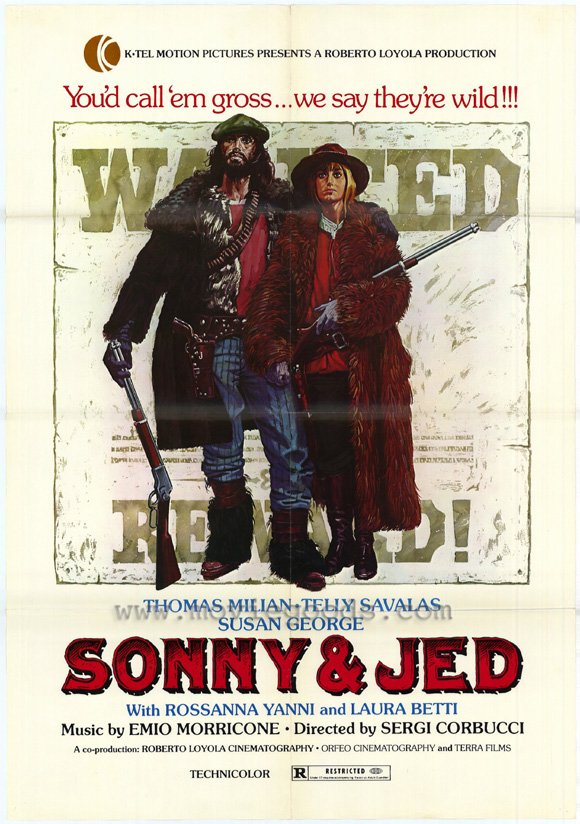

From bromance to romance, Corbucci took a page from the book of Bonnie & Clyde for his next western. Basically it is a story of an abusive relationship set on the spaghetti western world. The film has an irrestistible Finnish title, along the lines of "The Beagle Boys of the West", but sadly the film can't live up to that title. Nevertheless it has a few good moments, too.

Corbucci regular Thomas Milian plays Jed Trigado, a bandit who only steals from the rich – and keeps the profits to himself. He is being chased by the hard-nosed Sheriff Franciscus (Telly Savalas), and only escapes when the young girl Sonny (Susan George) helps him. He subsequently kidnaps the girl. Sonny herself wants to become an outlaw, too and falls for the original bandit. Jed himself can barely stand the girl, and doesn't think she's worth much as a partner. He devices schemes to get rid of her, but eventually starts to fall for her, too. But are his former instincts still more powerful than love? More determined is Franciscus on catching the pair, and doesn't even let the fact that he loses his eyesight stop him on getting revenge.

The film borders on the boundaries of good taste. Corbucci isn't above laughing at attempted rape, or weird fetishes towards drinking breast milk. It's a little sad much of the style and determinism of his former work has switched to aimless blundering around for cheap laughs by now. The film is Sonny's story about growing up. Since Jed himself is so despicable from the beginning, we keep rooting for her to gain the moxie to stand on her own. Francisco is a good and a little intimidating villain, but in the end can't amount to much, and Telly Savalas feels wasted in the role. Sadly, at 98 minutes, this still feels a tad overlong. It could've used a few more action scenes, I think.

★★1/2

The Big Gundown (La resa dei conti, 1966)
Director: Sergio Sollima


Leone was the master of Epic, while Corbucci was the master of cynicalism and brutality. That leaves Sollima, the master of political allegories. Sollima often refuses to have clear-cut, good or bad characters in his films. Rather, all the characters represent an idea, and work according to it. The shades of grey he gives to his multidimensional cast overshadows anything seen in the works of Leone or Corbucci. And The Big Gundown, his first western, may also be his best.

Lee Van Cleef starts as a famous bounty hunter John Corbett. In fact, Corbett has brough so many low-lifes to justice that the powers-that-be start to plan a campaign for him to run for the US senate. Corbett agrees, as he sees that as a way to weed out crime. For his campaign, it is suggested that Corbett catches the notorious knife-throwing bandit Cuchillo (Tomas Milian). The Mexican is being blamed of raping and murdering a little girl. Cuchillo is easy enough to find, and not that hard to capture either. But he's as slippery as an eel and manages to escape time after time. At first glance Corbett thought the Mexican to be a little slow, but he starts to realize he's actually a lot brighter than he first figured. He also starts to suspect that perhaps Cuchillo is not as guilty to the crimes he's wanted for, after all. But every time Cuchillo manages to escape, he can't keep himself hidden for long, and always indulges into his favorite vices: women, drinking and stealing.

Like said, the film's strength is it's strong characterizations, and that leads all the way to the colorful cast of secret villains. Ennio Morricone's score is as strong here as ever, as has been recognized by Tarantino and others who have pilfered from the soundtrack. As the background of the film is in a chase, the scenery also changes often. The great American wilderness has rarely been shown as this vast in Italian westerns. Alongside with it, Corbucci contrasts different pilgrims living in various settlements. The point of the film is that laws and values may change, but they may not always seek for what is best for the individual. Man should trust more on his moral compass than to the values others put upon you.

★★★★1/2

Face to Face (Faccia a faccia, 1967)
Director: Sergio Sollima


Boston University's history professor Brett Fletcher (Gian Maria Volonté) travels to the west to get over his lung disease. However, his vacation changes drastically when the bandit Solomon Bennett (Tomas Milian) kidnaps him. Pairing up with an outlaw brings new life force for the professor, particularly as he watches the impulsive Bennett lose his temper and kill people. The pair become accomplices and form a big band of bandits. Soon the student starts to become even blood-thirstier than the master. But unknown to the bandits, the Pinkerton detective Charles Siringo (William Berger) has gone undercover to the gang and is looking for the right moment to capture Bennett and to take Fletcher back to civilization.

Sollima's film, written by himself and Sergio Donati, is a morality play, looking at the thin line between romantic outlaws and murderous sociopathic bandits. But the side of the law isn't necessarily any better, either. The characters are three-dimensional, and all quite unpredictable. The film certainly has the rebellious attitude of many political westerns, but plot-wise certainly doesn't thread the same tracks as most other spaghetti westerns. The film is reportedly slashed down from its orginal three hour running time to a measly 97 minutes. It would benefit to develop some of its themes with a little more time. Now it seems like Fletcher turns to a life of crime a little too easily and other changes in the act of the characters aren't grounded up well enough, either. The extra running time would turn this small stage play into a true western epic, but the missing scenes have long vanished to the sands of time. The short end result isn't Sollima's best, but that's probably because of the producer Alberto Grimaldi's strict rules about running time.

★★★1/2

Run Man Run! (Corri uomo corri, 1968)
Director: Sergio Sollima


Sollima concluded his trilogy of political westerns with a sequel to The Big Gundown, featuring the return of Tomas Milian's Cuchillo. He meets the revolutionary Ramirez (José Torres) in prison and hears from him about a treasure of 3 million dollars, reserved for the Mexican revolution. Ramirez fears for his life, and even though Cuchillo manages for them to escape, Ramirez is soon shot dying with the secret of the treasure's whereabouts. Cuchillo does get a clue, and goes to get rich. But there are also plenty of other shady characters interested in the treasure on his tail, most notably the ominous gringo Cassidy (Donal O'Brien). Cuchillo resorts to his throwing knives only as an extreme measure, but with a combination of luck, and Cassidy watching out for him, he manages to survive to the treasure. But the long road there has made him change his mind about how to spend the money.

Run Man Run! is certainly the most comedy-filled of Sollima's westerns. The bumbling, thick Cuchillo was quite unusual for a leading man still in the 60's, before the comedic westerns took over. The more stoic Cassidy is left to a lot smaller role. Donal O'Brien's role was originally reserved for Face to Face's William Berger, making Sollima's trilogy conclusion a meeting point for characters from both of his earlier westerns. Scheduling conflicts made Berger drop out, and Sollima to write the role smaller. But Milian isn't a bad lead himself, I figure it's about time for sleazy Mexican thieves to be on the spotlight for once. For a revolutionary western, this makes the development from down-on-their-luck bandits to freedom fighters seem most natural and fluid. Indeed, Sollima himself happily considered the film to be his most revolutionary and anarchistic.

★★★★

Thursday, 26 May 2011

Giallo, Krimi, Policier, pt. 1

 
I'm really into Italian horror movies that work more as hugely visual mood pieces than rational stories. The term Giallo is thrown often to describe this genre but actually it only covers half of the truth. Giallo, which means yellow in Italian, is originally used to describe cheap pulp novels one could get from his local piazza's newsagent. Because of the literature genre, giallo really covers also detective stories, crime and vigilantist thrillers and sexploitation besides horror. In Helsinki tehere was a brilliant retrospective of the genre in the National Film Archives. For this first post of this three-part series, I reflect on some of the thrillers and horror films I saw during the spring.


Death Laid an Egg
(a.k.a. Plucked / La morte ha fatto l'uovo, Italy/France 1968)
Director: Giulio Questi


I put the films to this post in chronological order and it seems that perhaps the most difficult and avant-garde of these films was the first to be produced. I had real trouble comprehending the plot and the content of this movie. I later found out that this was the so-called American cut of the film that is more based on the spiralling madness of a hen-house owner's husband. The Italian cut reportedly has more exposition, consumer critique and comedy. Either way, the film can hardly be said to be straight-forward. It is often psychedelic and scenes seem to have few connections to each other.

So the story seemingly is that the farm owner's husband Marco (Jean-Louis Trintignant) has real jealousy issues towards his wife, Anna (Gina Lollobrigida). He manifests this by brutally murdering prostitutes in a hotel room. Anna, not knowing of this, starts to renovate her farm to become a more efficient meat-producing plant and hiring a beautiful new secretary Gabrielle (Ewa Aulin). But they both are in grave danger when Marco begins to give more and more to his primal emotions.

All of the blood work is contrasted with the modern chicken-house where the life of feeling animals has little value anyway and the efficiency just adds up to the brutality of it all. The mutant chickens without a head or wings sadly predict pretty much where meat-processing has actually lead us to.

The stars for the film comes from me not knowing whether this is utter garbage or real art. It is not an entertaining trash-film, although it has plenty of really weird scenes. I will need to see the different cut of this film to make up my mind. It seems that it at least has a pretty humane message, which of course can balance it a bit more to the art side.

★ or ★★★★★

Double Face
(A doppia faccia, Germany/Italy 1969)
Director: Riccardo Freda


Klaus Kinski, that old bastard, plays the wealthy John Alexander in his first leading role. Alexander loathes his wife Helen (Margaret Lee). However, when Helen dies in a freak accident, John is devastated. It seems someone murdered her, and John isn't sure whether it was him or not. He comes across a seedy party in Soho, where LSD is consumed and finds out there is a lesbian porn film seemingly starring his late wife. And then it seems Helen also rises from the dead. Has someone decieved him or is he really losing his mind?

Double Face has all the ingredients of an awesome movie. I could watch Kinski even cutting his toenails for an hour and a half and he does very good work here. Us viewers are kept on the edge of our seats about whether he is the film's villain or not. Thus the confusing plot structure also works fine, and the drug-parties in swinging '60s London create a fine point-in-time athmosphere. Yet the plot unravels way too slowly and there are plenty of dragging parts and repetition. There are also problems with the film's limited budget, which results in pretty visible models being used in the car crash in the beginning and the end of the end. The overall plot is a little clumsy and the actors ham it up occasionally, but that's all part of the deal, of course.

★★★

Hatchet For the Honeymoon
(Il rosso segno della follia, Italy/Spain 1969)
Director: Mario Bava


Mario Bava's filmmaking is one of the cornerstones of giallo cinema. I'm sad I didn't get a chance to see Blood and Black Lace on the big screen. The other Bava film in the retrospective was a little more modest but still a lot of fun. Bava seems to have created a Patrick Bateman-like character moe than 20 years before the publishing of American Psycho. But Bava also guarentees his anti-hero won't get away with his actions as easily.

A sadistic and narcisstic bridal gown stylist John Harrington (Stephen Forsyth) loathes his wife Mildred (Laura Batti) although she repeatedly tells him that she won't agree to file for a divorce. So, John brutally murders her as that is nothing new to him. He has made a habit of murdering brides-to-be because of a mysterious drama that keeps bugging him. But these traumas multiply by tenfold as Mildred herself still refuses to let John go and haunts him.  Harrington also has the trouble of the Colombo-like Inspector Russell (Jesús Puente) always returning to ask him one more question about the death of Mildred.

The film's story is not that special as we've all seen the guilt-bothered murderer crack up a billion times before. But Bava's skills as a filmmaker can't be denied. His way of flying the camera up and down and sometimes focusing on little details, is almost worthy of Kubrick. A well-realized '60s cinematography helps a lot, too. The main actors also pull their roles very well. If the film had more of a subtext beyond its conventional story, this could be a masterpiece. Now it's just a very entertaining giallo film, but that's really all we need.

★★★ 1/2

The Forbidden Photos of a Lady Over Suspicion
(Le foto proibite di una signora per bene, Italy/Spain 1970)
Director: Luciano Ercoli

 
This film is like a sister-piece to both Double Face and Hatchet for the Honeymoon.  It stars the stylish young lady, Minou (Dagmar Lassander), who's just married the wealthy businessman Peter (Pier Paolo Capponi). She gets a blackmailing phone call that tells that Peter has killed a man and unless his demands are met, the info will leak to the police. Believing Peter to have done the deed because he was forced to, Minou tries to meet the demands and agrees to meet the caller. But the caller won't settle for a sum of money, and rapes Minou. He won't even stop calling after this, as his calls get ever more threatening and he blackmails Minou with photographs from the affair.  The growing terror of the stalker getting ever more aggressive drives her to the brink of madness. Will it consume her or can she pull herself together to fight her nemesis?

Besides a growing fear and blackmail, this film is all about sex. Even for a film made in the afterglow of the swingin' 60's, it's quite progressive filmmaking. For one, it features a bisexual femme fatale Dominique, who is hinted to having been (and maybe still being) the lover of both Peter and Minou. It's just sad that the film doesn't really do anything interesting about this info but rather keeps it as a mere possibility. The female point-of-view is refreshing, but the film itself threads on a bit too familiar paths for the genre. The villains have schemed a plot that's way too similar to other earlier giallo films. But the style and cinematography as well as the snappy storytelling at least keep this interesting.

★★★

Don't Look Now
(a.k.a. Decembre rosso shocking, Italy/UK 1973) 
Director: Nicholas Roeg


The most widely acclaimed film of the retrospective is without doubt Nicholas Roeg's magnum opus, which was recently selected as the best british film of all time by Time Out Magazine. Pretty good for a film half made in Italy. Personally, I love the film but don't even consider it to be Roeg's best, let alone the whole country's.

The sorrow of the death of their oldest daughter shadows the trip to Venice of John (Donald Sutherland) and Laura Baxter (Julie Christie). John is in the city for business, as he's restoring a canvas in a church. Laura meets two sweet old ladies who claim to be psychic and tell her they can see their lost daughter. But they don't bring mere happy news from the afterlife, they also have a grave warning for the couple to leave the town. Can they be trusted or why can John also see a familiar-looking little girl running around the town? And who is the mysterious serial killer wreaking havock around the town?

The film uses a lot of little, subtle things to bring out a crushingly bleak athmosphere. John and Laura don't see the beauty of the city, they only see dirt, dark tiles and evidence of death surrounding them. Laura is eager to cling on to any sort of shred of hope as John tries to maintain a rational facade. The couple is drifting apart by this even though they themselves may not realize it. It is also evident in the famous sex scene, which is cross-cut with the couple already dressing up. It is a film that has inspired countless filmmakers from its striking visual world to the thematics (Von Trier's Antichrist reheats many of the themes). Plus, it has a whopper of an ending. a true classic.

★★★★★


The House With The Laughing Windows
(La casa dalle finestre che ridono, Italy 1976)
Director: Pupi Avati

 
The most perfect giallo experiment from the films of the retrospective was this masterpiece by the Italian director Giuseppe "Pupi" Avati, who is most known for his teen films and screenwriting work. In fact, Avati contributed to the script of the all-round outrageous film Saló, or the 120 Days of Sodom. The same kind of blasphemy and turning conventional and familiar customs to twisted obscenities. The Catholic imagery and ethos in particular is on line to be demolished by Avati's film.

The young art expert Stefano (Lino Capolicchio) is summoned to a small Italian town to restore an old fresco of Saint Sebastian. He is told that the original fresco was the work of a raging lunatic. He most often liked to paint mages of peope in agony or about to die, yet is long dead by this point. Stefano stays at the house of the artist's two sisters. This legend seems to come to life as more and more villagers are brutally killed. Stefano and his girlfriend Francesca (Francesca Marino) must find out the truth before they're next in line.

The film is one of those delirious films that have an imagery that seemingly mixes truth and reality. The athmosphere creeps in slowly and slowly yet keeps the viewer interested enough to be on the edge of his seat for the whole duration of the film. It achieves quite a lot with very little bloody effects or such that other Italian directors spur excessive amounts in their films. The cinematography of House also utilizes the violence in old icons depicting the violent deaths of various saints. However, the film keeps its best surprises to the final moments where the madness really overcomes. Some imagery won't leave the viewer for weeks.

★★★★1/2

Tenebre
(Italy 1982)
Director: Dario Argento


The works of Dario Argento are of course essential to giallo. This retrospective focused on two pieces from his silver age in the early- to mid-80's. I will look at some of his earlier works in other parts of this series. Tenebre, however should be put in its place at the point in Argento's career, where he's becoming self-conscious about his direction. It is a story about a brutal serial killer running loose in Rome, in which Argento has placed a lot of self-observed viewpoints to his own life and perhaps an alter-ego as well. The killer seemingly bases all of his murders on the works of a popular horror novelist Peter Neal (Anthony Franciosa). When Neal arrives in Rome for the publicity tour for his latest novel, the killer begins to taunt him and to pull him into the investigation.

As is appropriate for many of Argento's film, Tenebre is absolutely brutal, yet at the same time gorgeously beatifully shot. The fine film print also emphasizes all the stark color schemes and the terrible imagery. Tenebre is not one of Argento's haunting masterpieces, and doesn't play with mood or expectation as much as it could. Anyway, it is a very good slasher that has a neat enough twist.

★★★ 1/2

The New York Ripper
(Lo squartatore di New York, Italy 1982)
Director: Lucio Fulci

 
Every good retrospective should have one film by Lucio Fulci, but not one more. His films are not consistent or in any way rational, but unlike Argento or Bava, he really can't create a threat-filled athmosphere but rather likes to play with excessive amounts of gore. New York Ripper is one of his most notorious films. 

The film follows Lt. Fred Williams, a burnt-out cop who likes prostitutes. He's facing the challenge of a lifetime as a weird murderer starts offing young girls in New York and making phone calls talking with a Donald Duck voice.

The film's New York is clearly the same as in Taxi Driver, so it's filled with filth and scum. Even the police aren't above this, but are still a million times better than the twisted maniacs that stalk the streets. Fulci does have one or two fine-looking scenes but mostly the film is just dire guessing of who the serial killer might be or nastily violent kills. Only for gorehounds.

★★

Phenomena
(Italy 1985)
Director: Dario Argento


I've had a soft spot in my heart for Phenomena ever since I first saw it on TV years ago. As those were the early days of digital broadcasting, the subtitles didn't work, but I watched the whole thing in Italian anyway. And as many know, in Argento's films the plot or dialogue is often insignificant. And none more than in this, an operatic sendoff to his most prolific and masterful giallo era.

If the plot does interest someone, it involves the young Jennifer (Jennifer Connelly), a new student in a ballet school in Switzerland. Jennifer doesn't get along with her classmates very well and feels more akin to the insect kingdom. She also befriends the wheelchari-bound professor John McGregor (Donald Pleasance) living nearby. McGregor has been assisting the police investigating a series of murders that have happened nearby with his knowledge of the insect larvae. He encourages Jennifer to also look into the mystery as she seems to have a supernatural power of controlling the insects by her will. But will even that be enough to protect her from the murderer?

Phenomena is one of the most dividing films in Argento's career. Most arguments against the film pick up the film's score as a complain. For such an athmospheric mood-piece that even begins with a sole image of the wind gushing in the countryside treetops, Phenomena uses a lot of heavy metal in its soundtrack. Personally, I think it is kind of kick ass, and more often strenghtens the delirious athmosphere, rather than wrecks it. In addition to Iron Maiden and Motörhead, the film also has probably the best theme of all time, by Goblin and Claudio Simonetti:


Nothing makes much sense in Phenomena, but it is a sort of stream of consciousness film. Thus it has such memorable imagery as a chimp wielding a razor blade, a bath with rotting corpses full of maggots, and of course the murderer himself, which I won't spoil here. Suffice to say, some good ideas seem to go round in the giallo circle and come back even more twisted and weird as before. This is a good place to stop and start waiting for the next installment. Pleasant dreams!

★★★★

Sunday, 15 November 2009

Night Visions & Hurme This Season

Let's take a look at the horror film festivals we had this autumn. The Biggest and oldest in Finland is of course Night Visions, which I attended for the main night. I would've liked to see many more but at least Hurme festival helps me out with that.

The Box
Directed by: Richard Kelly
Starring: Cameron Diaz, James Marsden, Frank Langella
There might be something interesting coming from Richard Kelly yet. This one overstays its premise for a bit too long. Also I would've liked more mysteries left unsolved like in the original Donnie Darko. Nevertheless, the athmosphere is creepy and the mind games get ugly. Kind of like God playing Saw with people.
***
Best part: Freaky half-face telling Diaz the offer.

Count Dracula (Nachts, wenn Dracula erwacht, Verenhimoinen Dracula)
Directed by: Jesus Franco
Starring: Christopher Lee, Herbert Lom, Klaus Kinski
At times a serious, athmospheric vampire horror. And at better times, a hilarious camp classic. The extremely awkward finnish subtitles (placed in the middle of the screen) help this to fall more into the latter one. Features a weird action sequence where stuffed animals are supposed to come alive (according the dramatic music and the faces of the actors) and just wobble around a bit.
*** 1/2
Best bit: The marveloussly anti-climatic ending where a horse gets hit in the head by a giant boulder and doesn't mind, the heroes teleport from the road to the castle to the top of the castle, and Dracula is dropped down burning.

Jesus Christus Erlöser
Directed by: Peter Geyer
Starring Klaus Kinski
Maniac movie star Klaus Kinski tries to shout some teachings of Jesus, but gets irritated and stopped by some heckling hippies that don't agree with him. Hilarity ensues as Kinski gets mad and stops the show for hours and then begins again at the very beginning. Fascinating footage that tells a lot about its time, about Kinski's mentality and about how we actually treat religion. I don't believe Kinski has any better idea about Jesus as anyone, and he certainly doesn't act the way Christ suggest you should. The cameraman isn't always filming the action, so that takes away a whole star.
****
Best bit: Kinski refuses a hippie to speak by whisking the microphone away from him.

The Human Centipede
Directed by: Tom Six
Starring: Dieter Laser, Ashley C. Williams, Ashlyn Yennie, Akihiro Kitamura
Fucked-up and silly exploitation. Doesn't play it too rough or too camp. Dieter Laser as the mad doctor is my new hero. For a movie this rude it wastes too much time on the crying victims, though.
*** 1/2
Best bit: The mad doctor explains his plans to his helpless victims.

Hanuman, the White Monkey Warrior (Hanuman klook foon)
Directed by:
Sakchai Sribonnam
Starring: Shothanya Chitmanlee, Selina Lo, Dean Alexandrou, Sornram Theppitak
For the first half this is unbelievably boring and bad. But when they brutally murder the comical sidekicks (fat guy and retarded guy) at the end of act 2, this gains some heat. The end scenes are superstupid and jaw-dropping. Not very good as a whole, but has some great scenes.
** 1/2
Best bit: I was hoping for the sidekicks to die whenever they were on screen, so when it happened, I rejoiced.

Vampire Girl vs. Frankenstein Girl (Kyûketsu Shôjo tai Shôjo Furanken)
Directed by: Yoshihiro Nishimura, Naoyuki Tomomatsu
Starring: Takumi Saito, Yukie Kawamura, Eri Otoguro
Has some suitably nasty remarks about japansee youth culture but in the end this is a predictably lame high school comedy. The massive amounts of gore are always fun, but this is nowhere near as inventive or funny as Tokyo Gore Police.

**
Best bit: The wannabe-black gangur girls with their unbelievably racist amsks and zulu-props.

Super Typhoon (Chao quiang tai feng)
Directed by: Xiaoning Feng
Starring: Gang Wu, Xiaowei Liu, Xiaoying Song
Now we're talking! One of the cheesiest things I've ever seen! A Chinese catastrophe film that is bigger and more patriotic and emotional than everything Roland Emmerich has ever done put together. Also very trusting towards authorities. If a city mayor can't solve something, then it's not worth solving. Also the military provides people with much needed muscle, help and blood. All in the name of the Great China! Battling against a supermassive typhoon, flying cars and boats and even sharks, the mayor's nobility brings tears to the eyes of the common people. All while the special effect scenes are repeated over and over again and a super-cheesy soundtrack plays its two different songs. Hilarious, non-stop laughs.
* or *****
Best bit: A shark flies in from a hole in the wall. The mayor shouts: Let me take care of this! I was in the special forces! And proceeds to battle with it.

Night Visions was as much fun as always, but Hurme proved to be... not as much fun.

Tetsuo the Bullet man
Directed by: Shinya Tsukamoto
Starring: Eric Bossick, Akiko Monou, Shinya Tsukamoto
The first Tetsuo was a nightmarish surrealistic film with little sense but lots of memorable scenes. The decisions in this third one include bringing a useless plot to the picture and changing the language into english. A bad move, since many of the main actors barely speak the language. And the rest are just bad actors. Has not even any great new visuals, everything is just badly remade from the first one.
*
Best bit: The end credits

Dead Snow
Directed By: Tommy Wirkola
Starring: Vegar Hoel, Stig Frode Fredriksen, Charlotte Fregner
The beginning in this is just awful as they try to flesh out characters nobody cares about. But from the stupid stupid sex scene onwards it's a real rollercoaster ride with plenty of yuks. The fact that we are dealing with NAZI zombies is not properly utilized, though. But it would be a crime to dismiss this film just because everything here is already made much better.
***
Best bit: Dangling from zombie guts over a cliff while fighting another

Skeleton Crew
Directed by: Tommi Lepola, Tero Molin
Starring: Rita Suomalainen, Steve Porter, Jonathan Rankle
I'm a bit ashamed that I enjoyed this finnish amateur pic more than it deserves. I found it cool that they managed to surprise me a couple of times and when they annoyingly flirted with the meta level at first, at last they took the baton and ran with it. Still, the acting is horrendous even though you reference at it in your movies, and the main point about all these seems to be missing. But one day maybe these guys will get it right.
** 1/2
Best bit: Finding the film they're in a'la Spaceballs

Nightmare
Directed by: Romano Scavolini
Starring: Baird Stafford, Sharon Smith, C.J. Cooke, Mik Cribben
A Halloween copy is a Halloween copy however you cut it. I was annoyed that the annoying kid didn't get his comeuppance but turned into a Death Wish vigilante. Mostly dull, but has a few highlights. Still, it's not even anywhere near anything psychological in case someone told you otherwise.
** 1/2
Best bit: The opening scene is pretty cool.

LinkWithin

Related Posts Plugin for WordPress, Blogger...