Showing posts with label night visions. Show all posts

Saturday, 1 December 2012

Night Visions Maximum Halloween 3012


Night Visions Maximum Halloween 3012. Even writing the name of the festival makes me tremble. It was very, very cool. I wrote several extensive reviews already for the Elitisti web magazine, so check those out if you happen to know Finnish. But since I hadn't the time or the resources to write about every single film I saw at that festival, I'll leave the scraps here. But never fret, for since the festival's quality this year was nothing short of brilliant, there were plenty of interesting new genre pieces to go here, too. This year at Night Visions saw a rise of thrillers that didn't quite fit the regular horror form the festival is known for, but won audiences over by their sheer inventiveness and quality.


Berberian Sound Studio (Great Britain, 2012)
Director: Peter Strickland


This Italian-shot Brit thriller had plenty of positive buzz surrounding it. And I was both disappointed and satisfied with the resulting film simultaneously. Director Strickland plays with the sort of mental breakdown story that horror fans know by heart from the films of classic directors from Polanski to Cronenberg. The difference here is that Strickland isn't twisting the screw of suspense as tightly as those two masters. But audio-visually his film is on par with those masterpieces.

The timid sound engineer Gilderoy (the sublime Toby Jones) is summoned to Italy to work on a movie he knows nothing about beforehand. The middle-aged man is still a real mama's boy, and pines for peace and nature. But his work requires him to stay at an artificial environment at all times, working with artificial sounds. To top all that, he finds the Italian film producers, led by Francesco (Cosimo Fusco) sleazy and unpleasant. The film he is working turns out to be a simple-minded torture-porn, all squishes, slashes, burning flesh and screaming young ladies. So Guilderoy's sanity slowly begins to crumble.


The film homages the old genre films made in the 70's. For fans of giallo and other violent Italian film, there are plenty of references to classics. But generally, the film resembles more artistic thrillers such as Blow Out or The Conversation, as the plot moves forward very slowly, and at first only tiny, almost insignificant little signals hint that something is very wrong.

The film tricks the viewer himself by mixing up timelines, fact and fiction and various layers of the story. These methods bring to mind Oliver Assayas's Irma VepBerberian is very confidently handled, and in a way that doesn't give any sense of catharsis or ending. This leaves the viewer hugely unsatisfied, which makes for the biggest flaw and the biggest strength of the film at the same time. Sometimes we need something to irk ourselves a little.


In the end technology destroys the nature-minded main character. He begins to infuse together with the very machines he works with. Mark Kermode compared the film to Videodrome. This comparison didn't cross my mind watching the film because there are so many more obvious (visual) inspirations. But that comparison is in fact perfectly apt. In both films, our subconscious, it's worst fears and greatest desires fuse together with an obsession to the means of a technology to create a hideous mutant.


Subsequent viewings may raise this film's score considerably in my mind. One thing is clear, the audio-visual strength on display here is so powerful, it is a pure waste of time to even attempt to watch this anywhere else than at a proper cinema.

★★★ 1/2

Tulpa (Italy, 2012)
Director: Federico Zampaglione


From one tribute to old Italian horror cinema to the other. Whereas Berberian attempts to say something about old movies and their technology, Tulpa is more pure regurgitation. It has the same inherent sadism than the films of the likes of Lucio Fulci, and the same obsessions with sexual perversions, laced with violence. But story-wise it fumbles up even worse.


Lisa Boeri (Claudia Gerini) is a tough-as-nails business woman by day. At night she likes to head off to an underground sex club to bang masked strangers. But it appears that a mysterious black-gloved stranger is following the club patrons home, and murdering them in the most brutal fashions. Ever-growing worry of her own survival starts to ruin Lisa's daily businesses, and she attempts to find out the identity of the killer before she gets offed too.

The film has at times a very odd, dreamlike quality, best presented by the creepy thin butler of the club (Nuot Arquint). This is contrasted by the very violent, pitch-black humour and sadism-laced murders. the best among them is a young lady's horrible merry-go-round trip around a ball of barbed wire. Even the strongest violence does have a surreal quality and doesn't feel like sheer torture-porn.


But the film loses steam as it goes along. The final act is a mess, with nothing remaining to hold the audience's interest in the mystery.

The film had it's first screenings at this year's FrightFest and Sitges festivals. After those screenings, the film was reported to be ludicrously bad, with its hokey dialogue and inexplicable plot-holes. After a frantic re-cut, the movie is mostly just dull. I probably would have greeted the stupider and sillier version more warmly.

★★

The Seasoning House (Great Britain, 2011)
Director: Paul Hyett


A feminist thriller from the Balkan war would seem to fit Love & Anarchy or Artisokka better than Night Visions. Still, the resulting film was still one of the most suspenseful of this year's lineup. The film is the feature debut of special effects wizard Paul Hyett, and very surprisingly it relies more on stark characterizations, moods and athmosphere than buckets of gore or any supernatural scares. The film is very realistic in all its violence, which makes it all the more scary.


In 1996, soldiers have locked the young ladies of a occupied village into a house where they come to rape them. The captive girls are kept under strict order by the house's master Viktor (Kevin Howarth), so as to please their clientele. But there is one girl that Viktor has spared form sexual violence, the deaf and mute Angel (Rosie Day). Viktor hasn't got anything good in store for her either, he just likes to torment her and keep her in fear as to when he will violently pop her cherry. But Angel has got an ace up her sleeve, she is small enough to fit into the ventilation shafts and crawlspaces of the house.

Much of the time the silent Angel goes around offering to help her fellow captives however she can. They are tortured, tied to beds and brutalized on a constant basis. As Viktor and the visiting soldiers get more and more ruthless and brutal, she makes up her mind to have her bloody vengeance on the lot.


Hyett utilizes the blueprints and the cross-cut of the house rather brilliantly. The viewer follows Angel through wall-busting transitional shots. The character moves from being a victim to being a vengeful, unreachable ghost to become hunted like an animal. Hyett's cynical and gray-scaled photography is hopless and cynical. The film piles up ghastly things so thickly and often that the viewer becomes numb to its horrors before the end. But the film is still very close of becoming a future classic. The only thing stopping it is that a film this harsh and brutal isn't one anyone would want to return to.

★★★ 1/2

Shogun Assassin (Japan/USA 1972/1980)
Directors: Kazuo Koike, Robert Houston


Roger Corman's film releasing company bought the rights to Kazuo Koike's classic Japanese samurai/ninja series Lone Wolf & Cub in the late 70's. Producers David Weisman and Robert Houston realized a super-violent serial hinging so tightly in Japan's history, and so purposefully repeating itself, wouldn't be a success in the west. So they had a bright idea to cut the first two films of the series into a new one, thus giving the film more of a dramatic ark and making it resemble a revenge western more. The film was also laced with modern synthesizer music and English dubbing. Against all odds, the end result was quite good, and became a classic among gore-hungry action fans.


The small boy Daigorō (Akihiro Tomikawa) narrates the story of how his father became a wandering ronin, a samurai without a master, home or honor. The executioner Ōgami Ittō (Tomisaburo Wakayama) is the right hand of the shogun of the Yagyu clan. The cruel, power-hungry shogun brings hundreds of prisoners of war for him to kill, but at the same time becomes fearful of his servant's skills and brutality. He orders his ninja assassins to kill Ōgami  but they only manage to murder his wife. The furious Ōgami makes his infant son Daigorō choose between life and death. Since the boy chooses the way of the sword, Ōgami doesn't gain straight revenge on his former master which would be suicidal. Instead, he sets off to walk around Japan and live by accepting the odd assassination job. The shogun's pursuing henchmen he can off one by one if he has to. And he is totally able to, too.


The cinema hasn't really seen a protagonist as bad-ass as Wakayama before or since. The stoic, chubby man appears to be always carrying grudges, yet can have surprising scenes of tenderness and care when taking care of his son. At the same time he suffers no remorse in cutting his enemies into tiny pieces and letting blood flow like geysers  The comically overblown amounts of splatter and inventive fight scenes make the film exciting. But the real value is in the surprisingly poetic, quiet scenes just before the slaughter. The film thus shares something with the films of Sergio Leone.

In the end, like in a true serial, Ōgami's exploits have no proper end. The wandering knight and his son just wander on to new adventures, on their never-ending walk to hell.

★★★★

Seeding of A Ghost (Zhong gui, Hong Kong 1983)
Director: Chuan Yang


At first glance, this year's final film of the festival didn't seem to be as insane and hilarious as previous Night Visions closers. But this Shaw Brothers horror classic gets crazier and crazier as it goes on, to the point where the oddity is so mind-blowing one has trouble keeping up with all its twists and turns. The early screening after a night of staying awake might be to blame. But more probably it's the fact that this film is so sprawling with ideas that the viewer has no time to recover until the next one comes from out of nowhere.

Why hello there! Am I delirious or is this really happening?
A regular Hong Kong taxi driver Anthony Fang (Norman Chu) hits a man while driving in a dark and gloomy street. He is relieved to see the man survived, but then the victim reveals himself to be an evil sorceror and promises that Anthony is cursed from there on. Anthony shrugs this off since he has a beautiful young wife (Mi Tien) to go home to. But soon, she grows ever more restless and embarks on a relationship with the card shark Fong (Norman Tsui). Coming home from her lover, she ventures into a dangerous neighborhood and is raped and murdered by hoodlums.


The broken Anthony seeks the evil sorceror to help him. The wizard promises to bring her back to life, but swears to use dark forces with will fare badly on the man already jinxed with bad luck. Anthony doesn't care. So, the wife is brought back as a supernatural zombie, but she's not particularly happy about it. The evil magic zombie starts to have her revenge on everyone who irked her, as well as their whole families, her former lover first and foremost. The resulting havoc destroys everything it comes across.


While the first half of the film is sold on ridiculous soft porn sex scenes, and stupidly melodramtic romance, the real fun begins when black magic comes properly into the picture. The resulting fight between the forces of good and evil are nothing short of spectacular, and feature a lot of actually quite good effects work. Blood and guts are pumped out ridiculous amounts. The film also develops the then-popular themes of body horror by featuring plenty of odd mutilations and human body parts turning into bloody, monstrous appendixes.

The film plays a lot on the presumed fairy take ending of love and goodness triumphing over hate and vengeance. But the film packs a mean punch, and its final scene in particular is deliciously wicked. I am not an expert on Chinese folklore, but I would have to say, if this represents it, the country is a lot more insane than I ever imagined.

★ or ★★★★★

So that was that. I hear the theater itself is calling me to return again and again. It's saying... I've always been at Night Visions.

Wednesday, 28 November 2012

Night Visions MH12: Werewolves Too


Aroo! It's another full moon tonight. Since during the last one I wrote a little about werewolf cinema through the ages, it comes to reason to use this opportunity to write about the three werewolf movies screened at Night Visions Maximum Halloween Festival this year. Just don't allow my animal instincts to take over or anything.

The Howling (USA, 1981)
Director: Joe Dante


The Howling is probably the most serious horror film in director Joe Dante's career. That doesn't mean the movie would be entirely without Dante's trademarks, such as sly media satire, cartoonish gags and a Dick Miller cameo. It's just that they are less in-your-face in this one than most of his other work. This was his first foray outside the safety of Roger Corman's production facilities, and Dante set out to make a name for himself. By strange coincidence, a kindred spirit in John Landis was also working at the same time to make a loving horror-comedy homage to the scary movies of the olden times. Both were successful, but Dante's film was the one that gained a big string of sequels (that had little to nothing to do with the first film). So that goes to show at least which the audiences dug more.

Ace reporter Karen White (Dee Wallace) is burned out by the hectic nature and ruthless story hunting that comes along with the job. She gains the affections of the brutal, animalistic serial killer Eddie Quist (Robert Picardo). Karen attempts to help the police capture him by luring him into a trap, and plans to gain a new story for her trouble. Yet the plot backfires and she has to come face to face with evil. Luckily Eddie is shot by the cops before he has a chance to hurt Karen. The reportress finally has enough of everything and takes off with her boyfriend Bill (Christopher Stone) to a couples' resort in the middle of a dark forest. Yet even the hard-nosed journalist has little idea of what she's in for, when the odd stalker hasn't really dies, and follows her to the resort. But he may not be the only beast around, either.


As many post-modern horror films would do since then, The Howling rewrites several rules of used by classic horror films. It also makes the characters aware of the previous body of work. The Wolf Man is watched on TV and ancient lycantrophy myths repeated by the characters. Yet the movie also differentiates from the norm in that werewolves in here are not just psychologically repressed, primal animals. They are highly sexual beasts. The monsters may reveal themselves during sex, and to every one of them is attached a strong sexual urge the conventional white-bread couples can't satisfy with their shallow imaginations.

Dante's satire's main target are modern people, who have little room for superstition and legends and has thus turned into cynical, boring yuppies, husks of people. The very 80's ideas of thinking psychiatry and self-help could cure deep psychological problems better than old-timey ways, earn Dante's bitter dismissal. He's all for old tales, mysticism and romanitiscm as opposed to a narrow world view. Every person has already seen enough on TV to not take anything seriously any more.

 
Most of the film relies on old-time moodness, dark shots, misty moors and eloquent set design. As such the ending that's crawling with rubber-suited werewolf monsters feels a bit overblown and even anticlimatic. When dealing with werewolves, the transformation scenes are usually a lot more terrifying than the appear of the actual monster, just growls and bad postures. The climax echoes the ending of David Cronenberg's Shivers a little. Sexually liberated people have overthrown the masses and the regulars are in the minority now, making a hasty escape.

Like his subsequent work would prove, Dante often prefers to take the side of the free-minded monsters rather than white-bread "normal" people. Perhaps there's a liberation coming up after the credits have rolled.
★★★ 1/2

Game of Werewolves (Lobos de Arga, Spain 2011)
Director: Juan Martínez Moreno


This Spanish film movie is known in Japan as Wolfman Village: The Worst Countryside Ever!  As one can guess, this one keeps things quite silly. A lot of the comedy is based on the fact that the film is set on the most backwards and superstitious of Spanish regions. The villagers of the small village of Argahave a lot to hide from the outside world, not limited to the major plot-driving curse. A bastard son of a rich marquis and a gypsy becomes a werewolf that would terrorize the village for hundreds of years. The family of Mariño carries the cursed blood and triggers the horror while present.

The modern-day descendent of Mariño, Tomás (Gorka Otxoa) is a horror writer who is suffering from a writer's block. He grew up in Arga, and has inherited the house he lived in as a child, so after a bitter divorce, he arrives with his dog to reclaim his old possessions and memories. He hits up with his two old friends, Calisto (Carlos Areces) and Mario (Secun de la Rosa). But the anger-ridden and fearful villagers don't take kindly to Tomás's arrival and plan to sacrifice him to the beast in order to finally get rid of the curse. Sure enough, since Tomás wants to live, and the misfortune of the villagers, the plan backfires and soon the whole village is infested with furry beasts.


The Howling and several other classic horror comedies are a clear inspiration for the movie in general. It can be seen in the film's humor, that manage to be somewhat cute, a little icky and even quite mean in turn. The most egregious jokes are the gross-out buddy comedy bits, often quite tackily inserted among all the action. If one is running from werewolves, a good main character should not start reminiscing about the time his best childhood buddy fucked a sheep but keep his mind on the point. Also, one fat and dumb sidekick should be enough for one comedy film. This one has two.


A much better comic character is the kick-ass police officer played by Luis Zahera. Logical and quick-witted to the max, he is also used sparingly enough for the audience to want more.

A nice touch to all the action and running around is that the werewolves themselves are made with actual prosthetics and masks rather than CGI-rendered. The Hammer-like set design also works wonders for the mood and the contrasting crass comedy and traditional horror imagery play together quite well for the most part. Props also to director Moreno for not going too easy with his characters. In a true Sam Raimi fashion, they have to suffer severe injuries and humiliations throughout the film to survive, especially in the wickedly mean final scene.

★★★

The Werewolf vs. The Vampire Woman (La noche de Walpurgis, 1971)
Director: Léon Klimovsky


Night Visions also offered a look into the major Spanish horror series about Count Waldemar Daninsky. The Count is better known as The Werewolf, or El Hombre Lobo, and battled with his curse and various other monsters in 12 films through the decades. Thus, he was clearly one of the most popular Spanish movie characters of all time, shadowing even Torrente.

That is even though he looks more like a werespaniel or a were-guinea pig.

The 5th movie of the series boasts the simultaneously odd, dumb and cool tagline: See it with someone you hate. Alas, I didn't have any enemies close by, or even people I was mildly disapproval of. Whether this would have improved on the movie, I couldn't say.

In the beginning Daninsky's (played by Paul Naschy) supposedly dead body is investigated in the morgue by two coroners. Since one is superstitious and the other a hard-nosed man of science, the latter attempts to prove that it's not possible for Daninsky to have actually been a werewolf. So, he removes the silver bullets from his heart, which of course makes the body come alive, turn into a monster, kill the doctors and escape to the woods. The shots of kind-of silly Wolf Man knock-off wandering around the forest growling and drooling are quite amusing for a while.

Meanwhile, two young and beautiful students, Elvira (Gaby Fuchs) and Genevieve (Barbara Capell), spend their summer vacation in a castle in Transylvania. To pass the time, they look for an ancient tomb, where, legend has it, the Vampire Countess Wandessa is buried. Bumbling around, they manage to find the corpse and drop some blood into her mouth, reviving her. But luckily Elvira stumbles upon the human-formed Daninsky, and the pair fall in love. To prove to Elvira that he's not just a murderous, brutal beast, Danisnsky takes it to his heart to protect the girls from the blood-thirsty Countess and her vampiric minions.


I've got to say, I couldn't manage to keep awake through the whole thing (it was 5 in the morning), so actually I missed the part when the monsters actually met and battled. My friend informed me that I didn't miss much, it mostly involved hokey special effects and throwing people around the room. So it sounds a bit like pro wrestling, then. The film had a few gigglesome scenes, due to the odd behavior of various characters. The set design and overall feel wasn't bad, but not that special, either. All together the movie is not something I would go out of my way to find anywhere.

Since I didn't see the whole movie, it's stars could go anywhere between ★ and ★★★★★.

Saturday, 10 November 2012

All Cops Are Bastards

Or are they?
One curious theme on this year's festivals is the overflow of gritty crime films which look at the never-ending struggle between the police and thieves, hooligans, gang members, drug trafficers and terrorists. Some have bad policemen working in a morally grey area, while some are just ordinary workers doing the best they can in tough situations. It's not easy to match the smartly built world and explosive action of Tropa de Elite — the go-to modern classic of the genre. But that didn't mean that these films weren't captivating to watch. I already reviewed No Rest For The Wicked from Love & Anarchy, which would also otherwise be included here.

A.C.A.B. - All Cops Are Bastards (Italy/France)
Director: Stefano Sollima
Love & Anarchy - Helsinki International Film Festival 2012


Not that many interesting films come from Italy these days (I wonder if this could be because someone has a monopoly on all media and won't fund movies unless they are made for his own TV networks). Occasionally, when a decent one comes around, it's a news item in itself. When the director is also the son of the legendary Leftist spaghetti western director Sergio Sollima, everyone pays twice as much attention.


Nevertheless, the story of riot cops could perhaps find no better setting than modern Italy. With the economy in shambles thanks in large parts with the insider deals of fat cats, the hot-headed Mediterranean national character, and the large-spread passion for football, makes a riot police force's job more than necessary in a day-to-day basis. Yet as it is often with autorities, these cops are also more than willing to misuse their power, take down people who they don't like and reap other benefits attached to their job. We know from the news that for instance the 2001 Genoa G8 meeting resulted in large-spread police brutality around protesters. The movie challenges the viewer to ponder whether there is truth in the name of the film.


Thus we are also thrust into the world by the viewpoint of a rookie, Adriano (Domenico Diele). An idealistic young cop, he at first idolizes the more experienced members of his new squad. Cobra (Pierfrancesco Favino), Nero (Filippo Nigro) and Mazinga (Marco Giallini) are a tight-knit group that doesn't allow outsiders, and who are used to do things their way without anyone telling them to soften up. Adriano must choose whether to corrupt himself as another force-using aggressive power abuser, or to stand the contempt and wrath of the rest of the group. Or die.


The film depicts the riot police to be sort of the society's garbageman, being sent out to take care of major social and structural problem by hitting angry people on the head. The cops have to endure open hatred, for example in a football match where everything that's available to throw at them, is threwn at them. The film doesn't pick favorites among cops and rioters, but makes it clear on why either of them is working the way they do. The film is a tad too long and obvious, without major surprises. It's also a major draw that the societal critique seen through the eyes of a tough-as-nails police unit was so perfected by Tropa de Elite, that while this covers a bit of a different area, comparisons are inevitable.

★★★

End Of Watch (USA)
Director: David Ayer
Night Visions Maximum Halloween 3012


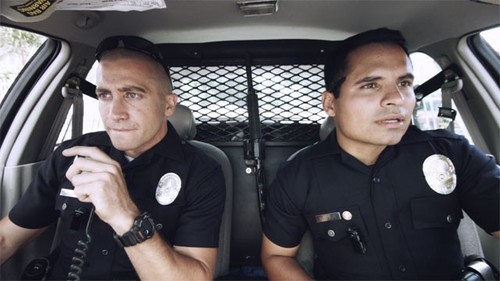
For a lot more positive portrayal of cops, there's the first feature film of the screenwriter of Training Day, David Ayer, seen (a bit surprisingly) at Night Visions Festival. Brian Taylor (Jake Gyllenhaal) and Mike Zavala (Michael Pena) are policing partners that are also best friends in their civilian lives. As anyone who has listened to their share of west side gangsta rap knows, the restless area around South Central L.A. is ruled by gangs and mexican drug cartels.


We follow the two cops around as they do their best to catch dangerous people around the area, usually who hate cops right down to their bones. In the middle Taylor and Zavala bicker, and talk about their love lives and mundane things. The single Taylor is starting to get involved on a new girl (Anna Kendrick) and their relationship is deepening. But once, on a routine call Taylor and Zavala stumbe upon an old house that hids brutally murdered bodies and major amounts of dope. Reporting on the place makes them heroes, but gets them on the Mexican drug cartel's Most Wanted list.

The film starts out by being based on the material that the cops themselves are shooting, whether for a TV show or whatever the in-story purpose. The actual purpose of Ayer is clear, to depict the police as both ordinary people, who live and laugh and love. And on the other hand, as heroic people who are willing to risk their neck out protecting the innocent, and doing what is morally right. These ideas are manufactured to give resonance on the tragedy about to unfold. It's a bit sad that Ayer cops out (har, har) on the last minute to make the ending a real gut-punch.


There's not much on display here that hadn't been done as good or better in numerous modern quality TV cop shows. Taylor and Zavala are quite well-rounded characters that have their good and bad sides, and are expertly acted out by Gyllenhaal and Pena. It's sad that the script over-emphasizes their heroism, and for instance the scene where they risk their lives rushing into a burning building to rescue children, goes a little over-the-top.

Along the way, the camera as an element within the story is more and more forgotten, we get fewer scenes of the characters talking straight to us, and more clearly directed angles. But the most important element in hand-held camera footage movies, the immersion tho the film's world and characters, has already been achieved.

★★★

Policeman (Ha-shoter, Israel)
Director: Nadav Lapid
Love & Anarchy - Helsinki International Film Festival 2012 


The most innovative police thriller I've seen in a while comes from Israel of all places. It's an action movie without a single action scene. It's also a two-sided movie, telling two vastly different but interlaying stories that comes together in the end. Many of the major scenes are not shown, but left to the audience to deduce. Most people walking in on a cop thriller would probably not expect such an intellectual, almost Haneke-styled approach, but it is very refreshing to see a genre movie thet relies on the intelligence of its audiences.


The first act of the film introduces us to the cops. Most of the time with them is spent at a barbecue with their families, or recreational activities, all smiles and happiness. Once in a while a racist comment pops up which makes it clear the speaker would like to shoot Arabs, but no one bats an eyelid. The cops clearly have rubber-band morality, since even with all the happiness of their family lives they are sex-hungry enough to go pick on random girls they encounter. It's revealed that one of them is having trouble with the higher-ups due to an act of violence on the job that is not specified. But all of them stick together and in the hearing all the other defend the accused. They all are eagerly awaiting for their next assignment, as they are the anti-terrorist assault squad.


The next act features ideological (Jewish) young people getting together to discuss the state of the world, how capitalism is ravaging the society, and their disdain for authorities. The youngsters are nice to help out a man playing guitar in the street corner by busting out some jams. They harbor secret crushes to each other. They seem like well-rounded nice people until it becomes clear that they idolize the Beider-Meinhof Complex. They are planning an act of terrorism, to kidnap several people at a rich woman's wedding and execute them if their radical leftist demands are not met.

In the third act, this plan is carried out, and the scenario followed to the end.

Policeman is an amazingly mature work from a first-time director, Nadav Lapid. The cold approach to major issues emphasizes a world where discussion is rueld out from the get-go and both sides believe the excessive use of force is the only way to get things across. The camera follows around coldly, only getting more dynamic in the very end, which makes the ending even more harrowing. This is a depiction of a society in a cul-de-sac, but it works. As such, it would deserve a less generic english name, though.

★★★★

Saturday, 3 November 2012

Night Visions MH12: The Future of Law Enforcement


Just when you thought it was safe to take it easy with festival movies and go early to bed, comes once again the devastator of minds and sleeping rhythms. But this year Night Visions Festival is clearly bigger, faster and stronger than ever before. The greatest genre classics and the most interesting new films come thick and often, so who needs sleep?

This year has also seen its share of incredible guests, the most notable being the legendary directors John waters and Paul Verhoeven, both of whom were nice enough for their fans to switch a few words with me, shake my hand and pose for a picture.

I'm currently preparing for the traditional all-nighter, during which I aim to watch a whopping nine films, from 4PM's End of Watch to the ending film The Seeding of a Ghost, set to start at 8.45 AM. It gives me time to reflect on the two futuristic police satires that served as the opening of the festivities.

RoboCop (1987)
Director: Paul Verhoeven


The warm-up show for the festival was arranged around Paul Verhoeven's visit to plug his book Jesus of Nazareth. Which was all the more fitting to show the uncut original version of his sci-fi action masterpiece for the first time on Finnish screens. Verhoeven calls the film both his "American version" of the life of Jesus, and also his best success while making films in Hollywood.

The futuristic Detroit is a city ruled by rich executives, while regular people live in squalor. Crime rates are through the roof, and the city's small police force can't handle all the heat. That's why they resort to private funding for a new kind of, more effective law enforcement. Yet Dick Jones (Ronny Cox) has cut corners with the design of his robot ED-209, and it kills everyone in its path, whether committing a crime or not. The young opportunist yuppie Bob Morton (Miguel Ferrer) has an idea to create a cyborg, half-man half-machine, to get better results.

Meanwhile, young police officer Alex Murphy (Peter Weller) attempts a massive drug bust on his first day working at a new precinct. But the precinct is ruled by crime boss Clarence Boddicker (Kurtwood Smith) and his gang, who don't like cops. While Murphy's partner Anne Lewis (Nancy Allen) manages to escape relatively unscathed, Murphy is brutally shot to pieces and left fighting for his life. He dies on the operating table, but Morton saves him by adding cybernetic parts to him. He also erases his memory to allow a computer program to take over his thoughts. He becomes RoboCop, the scourge of crime in Detroit and the unemotional law-giver, the ultimate straight man cop.


So the meat of the film is Murphy slowly starting to fight his program and recalling his past life. It is a quest for humanity, and fighting against corporate powers attempting to make a profitable product out of an individual. At the same time the more Murphy regains his consciousness, the more he is willing to step outside the boundaries of law to get brutal revenge on Boddicker, the man who already once killed him.


Verhoeven directs with a firm tongue-in-cheek, as evidenced by the satirical television programmes of the future, that sadly are not that far-fetched from our reality. News anchors gloss over horrible items with a smiling face to make time for commercials that make family time fun out of nuclear war and make a car's huge size (and presumably high gas mileage) it's most alluring attribute. The best satiric touch is the crass, Benny Hill-like comedian Bixby Snyder, enjoyed immensily by the lower class, while being hilariously stale and repetitive even with the few second-long glimpses we witness.

"I'd buy that for a dollar!"

For an action film, Verhoeven's big money scenes are usually over quite quick and very, very violent and bloody. He gleefully shoots various kinds of massacres where one side can't hold their own against and overwhelming enemy. The long camera drives move with almost a robotic fashion. It's funny that the film has so few sets, with three major scenes taking place in abandoned factories (it's not entirely clear whether it's the same factory). These are issues of budgetary limits, but Verhoeven certainly works them for his advantage.

Since in Detroit everything is in ruins, and blue-collar workers are put up against the wall, Verhoeven also finds time to ponder the issues of privatization and strike-driven union activities. His main sympathies lie among the working guys, the cops, yet he also manages to give them a whiff of fascistic following of orders since they are willing to attempt to kill a fellow officer on grounds of a say-so. Verhoeven develops some of the ideas he would later have for Starship Troopers here, including the unisex locker-rooms and showers, though glimpsed only for a second.

By contrast, the upper-class yuppies are as slimy as they come, only caring about upping their own position, cocaine and whores. They have no regard for the smaller pawns and don't care if their aiming for their own goals causes a major strike that allows crime to flourish all across the city. Hell, crime is what makes them money! Verhoeven's satirical ideas of power have grown even fresher by today's neo-liberal climate.


Last but definitely not least, the film is perfectly cast. Allen's Officer Lewis is for once a great strong female lead that gets along while not being sexualized, or having a romantic tie to her partner Murphy. they are just friends, pulling together because if they don't the world gets them. Likewise Weller is excellent as a man torn between the roles of a TV cowboy he's emulating and a feeling human being, a good father and a husband, and later a man who has lost it all, even his memories. he also has the proper chin for the part, as well as a flat, laconic sound of his voice to shout lines like "Your move, creep".

The best however, is Kurtwood Smith in a career-best turn in the most hilariously dickish main villain put to film. Whether he's discussing with accomplishes or taking care of his enemies, he usually does a small asshole move at the same time, like sticking his gun to a glass name plate or dipping his fingers into his business partner's wine glass and sniffing them. His anger, ruthlessness and risregard for human life in general and to all sorts of decency ensure that he goes far even while being too low-class to work with the yuppies rather than behind the curtains.

Bitches leave!

Oh, Verhoeven also can't resist to have a Troma movie sort of toxic waste mutation scene in the movie, for no other reason but to gain laughs for all the gore.

This is a masterpiece. Thank you for your co-operation.

★★★★★

Dredd (2012)
Director: Pete Travis


RoboCop has a certain cartoonish quality to it, even though it wasn't based on any comic book. A high inspiration, however came from the british comic book 2000AD and it's headlining hero Judge Dredd. He is the toughest law-giver in the futuristic Mega-City 1. With five billion people in the densely populated area, crime rates are through the roof. That is why the policing Judges have the privilege to hand out judgements on field. Basically every law-breaker either gets years of isolation in prison cubes, or a death sentence.

While the cheesy Sylvester Stallone vehicle in 1995 pissed on the legacy of the character, it is actually not that bad (or rather, not among the worst) of the 90's Stallone movies. But clearly a rethink was in order, and the new super-violent filmatization finally gives the fans what they want. Karl Urban's leaner, stringier Dredd reminds more of the character in his original late-70's, early-80's adventures than the mountain of muscle from the 90's. He also has the scowl right, but to my taste his voice is quite not tough enough.


In the new, 3D Dredd, our favorite Judge is paired with a rookie Judge Anderson (Olivia Thrilby) to evaluate her, and to determine whether she has what it takes to be a Judge. Anderson has psychic qualities, which has made the higher-ups disregard a few of her previous misgivings. While investigating a triple homicide, Dredd and Anderson get locked up in the huge city complex of Peach Trees. On the top floor lurks the crime boss Ma-Ma (Lena Headey), who rules the entire building. Dredd must fight floor by floor to reach the top and to apprehend the villain or perish. So far, so Raid: Redemption.


Dredd also has a near-future that mostly looks like our modern day. Stallone's Judge Dredd did have quite astonishing city shots, where it seemed Mega-City 1 was crawling with life everywhere. In the concrete behemoths of Dredd, it seems most of the citizens tend to hide in their apartments, and not go out. A bot more dwelling into the city would've done marvels, since all the best Dredd comics tend to have him as just an observer of the odd micro- and macrocosmos of habits, events and phenomena in the gigantic city.


The film is superbly violent, however, particularly a scene early on, where Dredd's bullets pierce hoodlums in super slow-motion. But the best set-pieces are used in the beginning and the climax itself is oddly underwhelming and repeating things already seen. Nevertheless, it's good that the film doesn't take a too big a bite to chew on Dredd's first adventure, like having Judge Death or Judge Child in the film. A single small crime boss suffices very well for now. It's a sad thing this has been somewhat of a flop, so we probably won't get to see any more. Drokk.

★★★ 1/2

LinkWithin

Related Posts Plugin for WordPress, Blogger...