Showing posts with label satire. Show all posts

Monday, 31 August 2020

Three laughs: The Texas Chainsaw Massacre 2

 It is hard to rate some trashy films. Films can be really good entertainment in spite of the quality of the filmmaking. In fact, it might be even harder to create unique trash that keeps surprising you than most "quality" films with which you know what you are going to get. It certainly is an even better pleasure to watch them. My friend says that he knows a trash film is worth something if it gets three laughs out of me. I mean proper, good belly laughs when you just can't believe what the film is showing to you, scene after scene. That's as good a rating as any for these movies. Any film that has these three laughs has a special place in my heart.  

★ or ★★★★★


Three laughs case file #34:
The Texas Chainsaw Massacre 2 (USA, 1986)
Director: Tobe Hooper

It's strange how some horror sequels can get away with a more silly tone, such as Evil Dead 2 or, to lesser extent, Phantasm II (maybe one could also argue Dawn of the Dead). Some that try out similar things are reviled, such as The Texas Chainsaw Massacre 2. To be fair, Evil Dead 2 sets a gold standard in horror-comedy filmmaking and others that go that route aren't nearly as good or funny. But that's not to say they are bad movies, far from it!

Director Tobe Hooper has insisted that even the first one is a sort of black comedy. There are perhaps some chuckles to be had from the mad exploits of the Hitch-hiker or the dinner scene late in the movie. Nevertheless, the sequel goes a lot further in this aspect.  The film was made as a part of the director's deal with Cannon Group, which has brought up suspicions that it was made in order to secure funding to the more ambitious Lifeforce (1985), or perhaps earn back a little of what it lost.

The sequel sets out to skewer much more of the Americana than the previous did, with digs about the state of consumerism, media, sexual repression, dual moralism and 80's eat-or-get-eaten capitalism in general. It also dives deeper into distorted ideas of family values. Cannibalism and murder is a way of life, but the film's insane characters also revel in and enjoy it.

Basically the film's plot (such as there is one) is very similar to the one in the previous film. The lady DJ Vanita Brock, or "Stretch" (Caroline Williams) gets kidnapped by Leatherface and his family and must fight to survive in their secret lair, now close to Dallas in order to easier capture victims. Meanwhile Sheriff Lt. Lefty Enright (Dennis Hopper) is out to avenge the disappearance of his son in the previous film. This time, though having a "Chainsaw" massacre is not just empty talk, and power-tools buzz for a lengthy part of the movie. It's also made pretty clear on which body part these long blades are meant to be an extension of.


Three laughs (SPOILERS):

1. The very first scene makes clear the intentions and approach of the sequel as opposed to the first. A bunch of obnoxious yuppie teens hoot and holler, and blow people's mailboxes as they're driving to a party on their minivan. But when the night falls, they get a taste of their own medicine as a zombie geek jumps on the youngsters' car. In fact it's leatherface doing a bit of a puppet show with a corpse and soon gives them a show in the use of a massive chainsaw as well. Oingo Boingo is playing on the background for this scene.

2. The film's biggest new character, Chop-Top (Bill Moseley) is a truly slimy and obnoxious dude, out to make Stretch as uncomfortable as possible. It's almost a relief when suddenly Leatherface burtsts through the door. But the clumsy oaf can't catch Stretch as she makes good use of a fire distinguisher runs through a safety door.  Instead, he manages to injure Chop-Top's head, revealing the metal plate he got in 'Nam. But he woes more of the destruction of his terrible Sonny Bono wig.

3. Towards the end there's a touching but blackly comedic scene of Lt. Enright finding the remains of his son, which happen to be a gruesome skeleton on a wheelchair. He proceeds to destroy the entire lair with his own chainsaw. He comes to Stretch's rescue later on and declares himself "The Lord of the Harvest". But Leatherface isn't going to let the guy threaten his family, culminating in a once-in-a-lifetime duel with chainsaws. This was this franchise's high point. It was all downhill from there on.

Wednesday, 3 June 2020

Three laughs: Crazy World


It is hard to rate some trashy films. Films can be really good entertainment in spite of the quality of the filmmaking. In fact, it might be even harder to create unique trash that keeps surprising you than most "quality" films with which you know what you are going to get. It certainly is an even better pleasure to watch them. My friend says that he knows a trash film is worth something if it gets three laughs out of me. I mean proper, good belly laughs when you just can't believe what the film is showing to you, scene after scene. That's as good a rating as any for these movies. Any film that has these three laughs has a special place in my heart. 


Three laughs case file #25:
Crazy World (Ani Mulalu? - Crazy World), Uganda 2019
Director: Nabwana I.G.G.

Times are tough and what the world needs now is some mirth and laughter. A gathering of the world's most prestigious film festivals are currently having a streaming festival called We Are One. Most of the festival's programme doesn't exactly capture my fancy, execpt when I noticed that Toronto International Film Festival has presented us a new "supa action" movie straight outta Wakaliwood, Uganda. It was Crazy World Time!

Now, one might need a bit of background of these films. In the poor village of Wakali a group of local filmmakers have taken it to themselves to create movies with what they have. Thus these movies put on screen every villager from small kids to elders, and have some very creative solutions in terms of technics. They never take themselves too seriously, as every movie also includes a VJ, a video joker, making fun of characters and scenes as a running commentary. That's also how one doesn't feel like laughing at people living in the 3rd world, but rather, sharing a joke with some people from a totally different background. It's no wonder Wakaliwood has found fans all over the world.

I'd also like to add that the films keep also getting more inventive and have some clever in-joking as well. The 4th wall is blown up in gags so inspiring, they remind me of the ending of Mel Brooks' Blazing Saddles. The first worldwide sensation was Who Killed Captain Alex?, then came Bad Black and now Crazy World. Each of these movies also touches upon more serious aspects of life in Uganda, including militarization, organized crime and kidnappings. But these ideas are more made fun of and thus also laughed at the poor image Uganda may have in western eyes. It's not hard to fall in love with Wakali with its sense of community and love for filmmaking after viewing these.


Three laughs (SPOILERS)

1. The star of this film is Isaac Newton Kizito, as noted by the VJ, the son of the director. Together with some other small kids they form Wakas Stars United! In the film's plot, they are kidnapped children plotting for their escape from the Tiger Mafia. But this plot is only needed to showcase the kids throwing kung fu kids at gun-toting adults. It is clear they are having the time of their lives.

2. There's an anti-piracy PSA in the middle of the movie. In a radar they notice that someone somewhere is pirating the film, and thus they send out the robotic Piracy Hunter to capture them. After some bloody inserts of Piracy Hunter getting rid of fans out in Canada and Paris, it turns out that the culprit is actually the film's director himself, showing his creation to his family. Piracy Hunter doesn't feel any remorse, though.

3. In one scene a gangster discovers that the big wad of money is only colored from the other side. The VJ gives a memorable one-liner to this: "See kids, adults, too, can be stupid."

Sunday, 23 March 2014

Death of the Bohemian: The Great Beauty and Only Lovers Left Alive


I saw two movies this week that dealt with similar kinds of subject matters: Paolo Sorrentino's The Great Beauty (La grande bellezza) and Jim Jarmusch's Only Lovers Left Alive are both movies about the connection between historical art and the modern day. Both feature bohemians that have lost their way somewhere along the way. And they are not so much plot-driven films as mood pieces, dashing out various scenes presenting ideas and pondering them. So, I thought it would be interesting to take a look at both movies from these angles. Since this analyzing means dealing with some plot points, it should be reminded here that this post may contain spoilers.

The Great Beauty opens with a scene showing Japanese tourist so overwhelmed by the ancient city of Rome that he has a heart attack. This is cut to a outrageous megaparty where tattood strippers lure men in glass booths and drunken upper-class art connisseurs dance in line to the music of hot DJ's mixing traditional sounds to modern beats. In the middle of all this hullabaloo, the birthday-celebrating Jep Gambardella (Toni Servillo) is introduced smiling with a cigar in his mouth, looking like Silvio Berlusconi. He has done this kind of partying for a long time.


Not until someone close to him dies does he realize that he should perhaps want to spend his life also as a creator, not just a partyer. He starts to consider writing another book, but he has trouble getting the inspiration, which he calls "The Great Beauty". But he has trouble spotting it, due to the banality of the performance pieces he tends to visit, and being so used to classical architecture (his own penthouse apartment has a view over the Colosseum).

Only Lovers Left Alive deals with two immortal vampires, Adam (Tom Hiddleston) and Eve (Tilda Swinton) who have been lovers for centuries. At the start of the film they are "living" seperately, however. While Eve binges on old literature and lives somewhat happily in Tangier, Adam is brooding in his Detroit home, composing music but sheltering himself away from fans. In his desperation he has produced himself a possible exit from this bleak world: a bullet made out of hard wood, that would effectively work like a stake when shot through the heart of the vampire. When the pair reunites, there's plenty of discussion on whether the world has gone astray or if the world's problems are just a permanent glitch.


Adam has a bleak outlook on the future. Humans (or zombies, as vampires call them) are on the verge of self-destruction which has manifested itself also in contaminating their blood. Eve, as an elder vampire, has seen the worst history has to offer from floods and plagues. She shrugs off the problems as long as she herself is living comfortably. The brooding Adam, however is waiting for the global climate crisis to reach the point humans start World War III over fresh water. He has lost his faith on humanity, his idolized poets, authors and scientists throughout the ages being mostly long gone, and left only humanity's self-doubt over their abilities and their subsequent refusal to figure out a way to save themselves.


During The Great Beauty, Jep keeps being disappointed when a potential source of beauty turns sour. A grace-fallen love interest he seeks to redeem dies on him, modern art consists of meaningless performances trying to gain the attention of rich buyers and even spirituality is reduced to status-seeking. People don't pray but rather take similar photographies of themselves with a priest that's to be a strong contender to be a pope or an ancient nun that's to be pronounced a saint after her death, Jep's companions try to hint to him to try to search the Great Beauty from within, not just looking from the outside. It isn't until the grotesquely old nun spells out to him how important "roots" are, does he fully get it and remembers entirely the night he lost his virginity.

So, The Great Beauty has an optimistic look that one may find one's muse when looking at moments of beauty at one's roots. Only Lover Left Alive is far more pessimistic. Art-loving vampires have trouble functioning at a celebrity-crazed culture that insists every popular creator is to be fitted into a spotlight. It prevents the sort of art bohemia of yesterday when poets could feed from one another (so to speak). Even though Adam tries to keep his musical creations to himself, they seem to find a way to leak out and to be played in underground clubs around the world, much to his dismay. He is in it purely from a love of the instruments. He also helds a popular hipster opinion that nothing popular can't be too good, since at the end he hears a Morroccan singer, he comments that she's far too good for fame. Adam seems to find that the more attention things get, the easier it is for money-hungry people to push it to the limits and totally ruin it.


During OLLA, the vampires suffer one indignity under another and are increasingly pushed to the edge. As much as they loathe the modern humans, the more they find themselves to resemble them as their back is pushed against the wall. Even Eva's comforting outlook starts to show cracks. They can't plan for the future when their current needs start to weigh too heavily. Blood is a sort of drug in the movie. When the supply of pure, good stuff runs dry, the desperate vampires have to start taking risks in acquiring it on the streets. The safest bet seems to be drinking from young lovers, since what else is pure in this world any more?


In the end, The Great Beauty is a movie looking back, trying to get people to make the right choices to feel good about their lives in general. It has the stance that happiness can't come from mere self-indulgence or hedonism, one has to have spiritual experiences as well and remember the parts of life that matter. But if this balancing act is reached, it doesn't see why a rich life can't go on as it used to.  


Only Lovers Left Alive has a much bleaker outlook.It sees that the fractured world can't anymore produce a sphere for artists to meet and discuss and create. The future of the vampires is either self-destructive retroactivity (as with Mia Wasikowska's Ava) or death. The demise of John Hurt's cultural vampire Marlowe (revealed to have ghost-written Hamlet as well as other world-famous writings and poems over his multiple lifetimes) represents the death of the culture. This is a sign of how dog-eat-dog the world is about to get as things get more and more difficult for everyone. There's no room for new ideas in the world if the only idea that's going to matter is the instinct for survival. Jarmusch's film is nothing short of heralding total apocalypse. it's a good thing that the film has a sense of humor about it too, or it might be harder to swallow.

Sunday, 3 March 2013

The New Batch Revisited


Fed up with Hollywood right now? I know I am. And I know another who most certainly was in 1990: Joe Dante. So, what better time to join us all together for the first installment of a new recurring series in this blog. The Revisited takes a look at a cult movie I've already seen multiple times and picks out the elements that make it work so good. The series also takes a look on how the movie holds up today. The best way to begin this series is to take a look at one of the most unusual, and best, movie sequels ever made. So here you go: Gremlins 2: The New Batch!


The Face Value

Joe Dante is a director straight outta Roger Corman's stable. He's an exploitation filmmaker that found fame and fortune waiting in Hollywood, mostly thanks to his peers like Steven Spielberg and Robert Zemeckis who had risen in power and were able to produce any kind of films they wanted. With Dante, it was his unique mix of slapstick humor straight from Looney Tunes and Tex Avery cartoons, monsters and set ups from 50's science fiction, and biting satire of the good old', red-bloded mom's apple pie Americana. While such subjects undoubtedly sold in the golden age of Amblin entertainment and VHS horror films, studios tended to not quite get Dante's unique visions. One of his better-fared, however, was the anarchic Christmas tale of 1984: Gremlins.


The movie the director himself calls "The Muppet Show on Acid" showed another side to the kind of cute and cuddly plush toy critters the public of the 80's was lapping up. It's also a parody of Christmas movies, what with magic being brought to a small town consequently wrecks everybody's lives rather than brings them together. Dante clearly had a lot of fun with cartoon violence and havoc wrecking little monsters but he felt that the entire story was there. But studio execs had another idea. Ironically, the movie set to destroy the idyllic image and the cutesy feel-good everyone was selling, turned out to be a profitable machine in its own right.


Since Dante didn't want to do a sequel, the producers searched around. No one was eager to follow Dante's footsteps, and Spielberg stuck to his friend's side. So, finally the negotiations got Dante back, but also gave him more free hands to play around with the concept. As it happened, Dante had already planned to do a satire of movie sequels and how useless they are at core. The director's idea was to wreck the entire franchise to the ground before the studio could find someone to direct Gremlins 3. And he was about to have the time of his life doing it.

The Plot


The old Chinatown block where Mr. Wing (Keye Luke) keeps shop is set to be demolished in way of a hyper modern office block built by businessman Daniel Clamp (John Glover). While Wing opposes, his health is in a bad condition, and the property passes on as he dies. After that, his pet mogwai Gizmo runs away from home. He gets captured by the scientists Martin & Martin who bring him to their lab. But Gizmo manages to escape again before they find out that mogwais breed by getting them wet.

Meanwhile, Billy Peltzer (Zach Galligan) has moved into New York with his girlfriend Kate Beringer (Phoebe Cates) to build a career as an illustrator in Clamp's company. He founds the wandering Gizmo in the building and promises to keep him safe. But of course a freak accident gets the mogwai to breed and soon there's a whole new batch of Gremlins growing. They make a mess of Clamp's building first, and then plan to take over the whole of New York.


The Contents

The characters of the film are quite wise to how the whole ordeal is going down, going from rememberance of the first film to a whole new meta-level of consciousness. The scene where John Astin's clumsy janitor fixes a water fountain with Gizmo attempting to dodge the spraying water is played out purely for laughs. Likewise Dante makes fun of the two other rules. The characters get into an argument of the vagueness of the eating rule: how soon after midnight can mogwais start eating again without turning into gremlins? Also, gremlins can't be beaten by luring them into the sunshine since it happens to be a rather cloudy day. Plenty of scenes show them in quite bright environments anyway.

No "bright light?"

Most of the film works as a bitter letter to plastic capitalism, with gremlins standing in as ravenous consumers, always wanting more and more. But the thing is, the creatures won't succumb to society's norms and act all meek in front of rich people. They do what they want and have no need for hierarchies. Yuppie bistros, late night cable shows, even Leonard Maltin and his damning movie reviews - all get parodied in a machine gun pace.


The building itself has a lot of places set up for various types of comedy. There's a tv station for media satire, a sci-fi lab for some B-movie shenanigans and a food court for some old-school slapstick. A movie theatre set hosts the most meta joke of the movie, with Hulk Hogan appearing to break the fourth wall in order to stop gremlins from wrecking the movie they're starring in and the audience is watching! Did I mention this movie is really, really awesome?


An interesting character is that of Daniel Clamp, a clear stand in for the likes of Donald Trump and Ted Turner. In the beginning of the film he's played off as a villain, a ruthless magnate who won't allow tradition get in his way of progress. He's always seen through a monitor, video-conferencing from his office rather than to appear in place. Later on, small-time bosses in his building have ridiculously tight standards of appearance that they rule to minute detail.


But when Clamp makes his full appearance, he really isn't such a bad guy. He's a clueless buffoon that doesn't fully realize the consequences of his business decisions, yes. The real villains are his underlings, trying to suck up to the billionaire by trying to please him in the most absurd fashions possible. During the gremlin ordeal, Clamp gets a whiff of the old-timey Americana he had so forgotten, and plenty of his yes-men get their punishments in the forms of various gremlin skits.

The crudest and one of the funniest being saved for last.
As sequels often have more marketability, they usually need a host of new, marketable characters. Dante takes this idea to ridiculous lengths by having a cast of gremlins with various powers and personalities. On the monster side, there are an electric, spider- and bat-gremlin as well as an acid-scarred Phantom Gremlin and the grotesque female gremlin. In accordance there's also a googly-eyed daffy gremlin, a buck-toothed dum-dum gremlin, a Jimmy Cagney-looking gangster gremlin and, most memorably of all, the Brain Gremlin, voiced with an obnoxious Australian upper-class accent by Tony Randall.


In the midst of such a colorful cast, the human actors can't help but to feel like staticians. And that is, even though the actors are awesome. Veterans like Christopher Lee and Robert Prinsky do their outrageous roles with both grace and glee. Dick Miller, a xenophobic and a little racist all-American fruitcake in the first, has transformed into an unlikely action hero for this one. My favorite is still kathleen Freeman's Microwave Marge, a hysterical woman bringing the same kind of layers of camp to this as Una O'Connor did for James Whale's monster movies back in the day. In the nastiest, most vicious blow to the original movie, Dante even undermines its blackest, darkest scene, with Phoebe Cates having a pervertedly tragic reason for hating President's Day as much as she does Christmas.


It's American pop culture and consumerism thrown into a blender and dyed colorful and splashed to screen. Dante evokes the cartoons of old with the same kind of fast-moving never-stopping energy. Which is why it's so apt that the film begins with a short Bugs & Daffy segment animated by none other than Chuck Jones himself. Here's a clear changing of the guards if I ever saw one. It's a shame the studio interfered with Dante's actual Looney Tunes movie so much. That film has several segments good enough to make the viewer wonder if corporate culture cost us another as big a masterpiece in mischief as Gremlins 2 is.


The Legacy

Or: Why the world doesn't need Gremlins 3

Gremlins was a big hit of its time, and there were plenty of films that replicated its formula, such as Critters, GhouliesTroll, Hobgoblins and so on. While most of these were aimed at children or pre-teens, Gremlins had an unique nastiness that worked well on adults too, that proved hard to replicate. Seeing it as a child was actually as exciting as watching a grown-ups horror film. And there are so many pop-culture riffs and spoofs, it's impossible for children to catch them all. I only got the Public Enemy -referencing grapefruit squeeze the last time I watched it, and I've probably seen the movie 10 times.


While Gremlins 2 doesn't have as many horror elements as its predecessor (save perhaps the scene with Spider-Gremlin), it did everything else bigger and bolder. And inexplicably, fell short on the earnings. Perhaps it was due to audience's tastes having modified. Joe Dante himself believes he waited too long after the first movie. Nevertheless, that fact served Dante's ultimate goal of preventing further sequels. Nevertheless, the auteur has now and then toyed with the idea of doing another, simply because, well, the director hasn't had the kind of freedom in his work since.

But having celebrity cameos and broadening the scope just wouldn't work any more. The reason is because there eventually was a bigger film, Tim Burton's underrated 1996 film Mars Attacks! The movie plays out much like Gremlins would if they had access to ray-guns and flying saucers. Mars also takes a step further into mean-spiritedness. While the body count in Gremlins 2 is relatively low, Burton gleefully executes celebrities by the hoardes. His offs include A-listers such as Michael J. Fox, Danny DeVito, Pierce Brosnan, Glenn Close, Martin Short, and Jack Nicholson twice! Burton also plays out with an all-you-can-eat buffet of disposable plastic pop culture relics, and has silly cameos from such unlikely sources as Pam Grier, Paul Winfield, Christina Applegate and Tom Jones.


Since Mars Attacks! still isn't quite as good as either Gremlins movie, I'm thinking the most important thing is that Gremlins are hand-crafted works of love. Mars Attacks! is "just" a silly little catastrophy movie parody and a cartoon movie with plenty of now-shoddy mid-90s computer effects. At best, that's what any new version would be, since Hollywood execs think computer effects are the only way to go now. While that could bring an impressive Gremlin army to the screen, it wouldn't have the same soul.

They should rather remake Critters.


Monday, 31 December 2012

Best of 2012


Hoo-hah! What a year, amirite? I hope it's been as good for you as it's been for me. In retrospect, I can see that 2011 in particular was a great movie year, since so much of its best flooded our Finnish cinemas this past year. I've yet to see so many films that were produced this year that I don't really know about 2012, but I got a very good hunch about it. A surprisingly good amount of fine films made my shortlist to make one of these top lists for your pleasure.

Keep in mind that I only include films that got their premieres during 2012 in Finland. That's why the list may include films produced in 2011, or even 2010. Festival and straight-to-dvd -lists will follow later on.

To be seen top 5: Deep Blue SeaFaust, Magic Mike, Pirates!, The Snows of Kilimanjaro


Runners-up


This year, it was so hard to choose which films to raise to the top 12, that I included no fewer than ten runners up. Rather than to have a few words of explanation, for the most part I'm going to allow the reviews of these films speak for themselves. The runners up are:

The Artist
Brave
The Cabin in the Woods
Canned Dreams (Säilöttyjä unelmia)
Call Girl
Cosmopolis - The smartest film of the year by far, but perhaps a tad too analytical to be enjoyable. I wrote a review in Finnish for Elitisti.
Hugo
Martha Marcy May Marlene
Moonrise Kingdom
We Need to Talk About Kevin

The top 12 films released in 2012


12. Skyfall (USA/UK)
Director: Sam Mendes


Sam Mendes balanced the nigh-impossible odds of bringing the fun back to Bond without sacrificing too much of the feet-on-the-ground approach people have enjoyed in Craig's previous outings (well, in Casino Royale at least). Sure, there are several gaping plot-holes and odd character decisions, but keep in mind that this is a film series about a secret agent that tells everyone his real name, and saves the world from domination by being really, really good at poker. Now, while there are komodo dragon-jumping and bazar motocross scenes a-plenty, the threat of violence and death makes the film exciting.

Much of the thanks belongs to DoP Roger Deakins, whose stunning work has created one of the most visually striking blockbusters in a long while.

(few minor spoilers ahead)

A lot of people have problems with the final act of the film, which I can't understand. It's good for the Bond franchise to try something new once in a while. Plus, it has a lot of my favorite parts: Bond's reaction shot when the main villain explodes his car,  the montage of Bond booby-trapping chandeliers and floor-boards with cluster bombs, "Welcome to Scotland", that helicopter explosion...

11. Wuthering Heights (UK)
Director: Andrea Arnold


As you might guess, costume dramas really aren't my cup of tea. but when one is done in such a unique way as Andrea Arnold has here, I'm bound to take notice. A silent, meditative look at inner turmoils, Arnold bases much of the emphasis on nature, how it withers and dies away each year yet comes back the next spring.

The story of Heathcliff (James Howson / Solomon Glave), his thirst for vengeance for those that mocked and punished him as a child, the whole class system, and his doomed love with Catharine Earnshaw (Kaya Scodelario / Shannon Beer) has all the weight and melodrama you'd expect from such a story. The reason this film is ranked so low is the overflow of this super-intense relationship drama into ridiculousness in the final act. But the slow, meditative opening is still mesmerizing.

10. The Descendants (USA)
Director: Alexander Payne


Not the best film in Payne's resumé, but even the least-good Payne is better than the best Wes Anderson film (Moonrise Kingdom). The Descendants is still a funny, tragic and heart-warming film, and earnest in a way very few such high-profile American films can manage to be. Clooney's fake tear nonwithstanding. Back in February, I wrote:

The Descendants is more melancholy-filled than funny. Altough it does offer a few hilarious scenes as well. By first glance the film's characters are clichéd, but Payne has written the film intelligently enough to give each of them some surprising depth, and making them integral to the story he's unfolding. It also allows him to have various different viewpoints into one tragedy, and ways of coping with it. 

9. Argo (USA)
Director: Ben Affleck


A surprise final-minute addition to the list, but Argo managed to be one of the year's most exciting films. The super-intense thriller about rescuing American ambassadors from the Ayatollah's Iran in 1980 reaches almost Hitchcock-levels in building up tensions and letting the viewer worry about the outcome. Ben Affleck has grown better and better with each of his directing duties. This nails-to-the seats thriller pines for the days America solved international conflicts creatively, instead of resorting to violence, arrogance and civilian casualities. It's also a tribute to the hands-on approach to filmmaking, craftsmanship and B-movies of old. Really, how could you dislike a movie, where Michael Parks cameos as comics master Jack Kirby?

The film does depict iranians as straight-up villains (although it lays the groundwork on why they are so upset of America's policies, what with all the hated Shah's protection and spying). As such, it probably won't do any favors for the already icy relationship between USA and Iran. But Affleck does offer as apolitical approach to the historical subject as is possible in such a real-life situation. The final scenes have little to do with reality, but as a climax to the tension, as well as a tribute to the little-cheesy American blockbusting filmmaking the movie celebrates, it works.

8. Rust & Bone (De Rouille et d'Os; France/Belgium)
Director: Jacques Audiard


Again, not the director's best work, but dang if this very physical love story couldn't touch the viewer like few other films could. Just in November, I wrote:

(The film is) shot at times as naturally as to be almost like a nature documentary about the hard knock lives of these people. Audiard is as masterful in compressing everything that needs to be said in just a few sentences as Aki Kaurismäki. One also has to give due to the magnificent actors. Cotillard and Schoenaerts are at career-best form here, taking their abilities for emotional performances and imposing physicality (respectively) to whole new heights.

For those awaiting a clear love story, the film might be too distant, even cold. For those awaiting for the brutally violent boxing matches, they are quite sidelined and only featured in two bigger scenes. But for anyone looking for a good drama that makes one ponder about the human vunerability, and how it affects our own humanity, this is a bullseye.

7. Take This Waltz (Canada/Spain/Japan)
Director: Sarah Polley


Another devastating "romance" film, although much in a different way. It is also a comedy of sorts, with a lot of jokes opening up only in symbolism and perhaps opens even better at subsequent viewings. The film isn't afraid to position some very difficult questions like how far do we have the right to pursue our own love and happiness. Blinded by her emotions as she is by the light in the very first scene, Michelle Williams's Margot ends up peeing in the pool of all of her closest friends and new family. And at first tormented, she ends up enjoying doing it for a while. But the rudest awakening is in store for her.

The script is expertly crafted, with call-backs and payoffs to short scenes we almost forgot about in this rollercoaster ride of emotions. The lighting, the music choices, the acting... it all works. The film's symbolism is quite telegraphed, and easy to follow (as with the runners-up list's We Need To Talk About Kevin), but in these cases it's not an entirely bad thing. The year's feel-bad relationship movie.

6. The Raid: Redemption (Serbuan maut, Indonesia/USA)
Director: Gareth Evans


Aw, c'mon. You really didn't think I was going soft on you, did you? For all the well-crafted romance movies I liked, I enjoy a good ass-kicking action movie even more. And for a long time we haven't had as thoroughly enjoyable, kick-punchingly brutal, explosion- and body-count heavy and crucially, totally non-ironic, earnest action film as The Raid. It figures it couldn't have been made straight-out in Hollywood, but rather in Indonesia. Going to South-East Asia to shoot the wildest action scenes imaginable has been an industry haystay from Corman's glory days onwards.

Dredd delivered another tough building-raid movie this year, but this one has a clear advantage on that. The geography and floor plan of the movie are more carefully thought-out, making the rise to the top advance more steadily and logically. At the same time different floors don't feel just like different stages of a video game, but people get thrown from windows and switch floors by quick thinking. The whole thing is crowned with some truly brutal fighting choreography that utilizes the environment in an inventive way. And with the thin, bearded fellow Mad Dog, one of the year's best movie villains as well.

5. Killer Joe (USA)
Director: William Friedkin


Director William Friedkin didn't really make a comeback with this film since he hasn't really been anywhere. Viewing 2006's Bug recently, also based on Tracy Letts's play, made me realize how good his films have still been but no one has taken notice. Well, Friedkin now forced people to take notice, by having Matthew McCounaghey deliver the iciest, evilest, but at the same time oddly logical and twisted morale-following character. Who would've thought that guy could deliver one of the performances of the year! Friedkin's film is wickedly mean, totally brutal, and very unforgiving for the stupidity of its central characters. It's truly devastating, and as a black comedy, not even too funny. It's a lot more complex than that. It could reasonably be called a satire on the American vanishing morales and takeover of greed. And it's a lot more sharp in this aspect than the disappointing Killing them Softly.

Back in August, I wrote:

The film has a down-to-earth aspect, yet some bizarrely delirious ideas, such as a pizza cook being the most notorious gangster boss of the town, or Juno Temple doing nude kung fu moves in the middle of the night for the hell of it. (...) Friedkin stages most of the conflict inside an extended trailer. The movie is at parts laugh-out-loud hilarious, at parts gut-wrenchingly vile and unrelenting. Friedkin hasn't eased his standards one bit while all these years have passed from his magnum opuses.

4. The Punk Syndrome (Kovasikajuttu, Finland)
Directors: Jukka Kärkkäinen, Jani-Petteri Passi


The year's Finnish film, bar none, is this optimistic documentary that follows Pertti Kurikan Nimipäivät, The Name Day, one of the top punk rock acts of our country. It just so happens that all the band members suffer from developmental disabilities. But they won't let their Syndromes slow them down. The band members quarrel, rebel and go on their daily lives openly in front of the camera. Never apologising, feeling inferior or pandered, the film teaches new ways on how to view the disabled. And it rocks, too!

Back in March, I wrote:
The film raises some questions about how the society treats the handicapped, but it isn't preachy and doesn't rub the viewer's face with them. One also gets a few good laughs at the silly stuff the punk rockers are up to, such as the race Kari loses when he drops his pants, or when the group gets a little too excited with the strip club windows in Hamburg's Reeperbahn. (...) The spotlight is kept promptly on the band, and rightfully so. They are people to easily identify with, to laugh and cry with. The biggest strength of the film is the same as with the band: it feels very real, as opposed to staged. It's a real slice of life with its ups and downs, highs and lows.

3. Carnage (France/Germany/Poland/Spain)
Director: Roman Polanski


For my money, the funniest film of the year. It's another play-based film, and another that takes place solely in a closed environment. Just like the bourgeois in Luis Bunuel's The Exterminating Angel, the rich couple of Cowans (Christoph Waltz and Kate Winslet) seem unable to leave the apartment of The Longstreets (Jodie Foster and John C. Reilly). They have to come to terms with a schoolyard incident of their children, when one child has hit another with a stick. Turns out, the adults are a lot more savage than to just settle in using sticks as weapons. Closed inside, even the similar-minded people come at each other's throats. At the same time their carefully-constructed images begin to fall apart, so they form unions against each others in an attempt to win moral superiority against each other. The nasty, assholish personalities on display here are perfectly acted.

It's not too far-fetched to see the film as Polanski's own comment on his recent house arrest in Switzerland, waiting for trial. As tensions build and no one is willing to take responsibility, the worst in people comes out. The film's cynical look at human nature married to the fact that it has the most hilarious vomiting scene I've seen in a long while had me howling with laughter. A true gem, and the best Polanski in a long while.

2. The Elite Squad 2: The Enemy Within (Tropa de Elite 2: O InimigoAgora É Outro, Brazil)
Director: José Padilha


The best sequel of the year bar none, the follow-up to the toughest brazilian action film is the Godfather II for violent, political thrillers. It's cynical view sees Rio caught in a maelstrom of violence, with armed police strikes at the homes of the poor drug dealers solving little. The corruption that begins from the top has twisted the system so far, that it takes huge feats to be fixed ever again. During which a lot of innocent people are in the firing line. It's a huge, sprawling epic on the many forms corruption can take in a truly rotten society. Back in January, I wrote:
As it is, the film follows a large number of characters, each representing a layer of the society and/or a level of corruption. Although all of their approaches to corruption are cynically viewed as unfunctional, the characters aren't all clearly set to be only right or wrong. Some of their ideas don't work in practice but some do. Most of the film's characters are three-dimensional, with also ulterior motives regardless of their political alignment.  The main focus is in Nascimento, who while still maintaining some of his moral complexity, also comes into his own terms as a character here. Nascimento starts to feel old and weary by the end of the film, and loses some of his will to fight wrongs. Surprisingly, he has a strong end speech about the human values, and he also sees some error on his own ways. He sees that weeding out upper-level corruption would have helped his cause a lot more than shooting poor people in slums, but by now it is already too late. 

1. Tinker, Taylor, Soldier, Spy (UK/France/Germany)
Director: Thomas Alfredson


Another epic that depicts the tentacles of corruption tighten up their grip on the pillars of society. It took me two viewings to truly get into the film's carefully-constructed web of lies and the number of elements in its vast storytelling. After that I read the novel, which was even more complicated. But each viewing or reading rewarded me handsomely with some new layers in this story. It is, by far the most rewarding film of the year.

The spies, depicted here as clerks, pencil-pushers and grey officials, are so far up their own game that they can't function without playing the cat-and-mouse game at all times. The mixture of family life and high-espionage blinds George Smiley (Gary Oldman) so much he is having trouble doing his daily work. Even the tiniest shred of trust has to be built and built for years on end. When even that comes shatteringly down, it feels devastating. Back in February, I wrote:

The film's aesthetic is such that it's easy to find oneself lost on its world. Even the smallest details are made important, and the film's rainy cinematography and 70's design aesthetics are well-realized enough to get the viewer easily lost among them. The real treat here are the performances. As good as Gary Oldman is (and he's really, really good.), the whole film is an ensemble piece, starring a cast of the best British talent to die for. With Oldman and Hurt, there's also great performances Tom Hardy, Colin Firth, Mark Strong, Kathy Burke, Toby Jones and Ciarán Hinds. One feels that these actors actually inhabit the jobs of their characters and have actually been spying on us with their other film roles. One does get a paranoid feeling from out of all this, but I would've still wanted to see the film again as soon as I walked out of the theatre.

I'm looking forward in seeing the upcoming follow-up, based on another John Le Carré novel. That's the first recap of the year, next up is a look at the films of 2013.

Thursday, 27 December 2012

PÖFF 2012


The always-charming Pimedate Ööde Filmfestivaali (Dark Nights Film Festival) in Tallinn this year's November was as full interesting programme as ever. While it offered some treats that have not yet been shown anywhere in Finland, most of the programme was familiar to Helsinki's avid festival-goers and arthouse cinema fans. But no matter, it will once again give me an excuse to take a look back at this year's offerings before the annual Best Of -lists.

Pieta (Hangul, South Korea)
Director: Kim Ki-duk


It seems that following his recovery from nervous breakdown, director Kim Ki-duk has started to shift away from his trademarked slow, artistic storytalling and more towards the Korean mainstream. His latest film is a Revenge Thriller, much in the vein of Park Chan-Wook's Vengeance Trilogy or Bong Joon-Ho's Mother. The film is based on a very fucked-up morality idea, which Korean films seem to specialize in. At least it doesn't go as far as Kim Jee-woon's I Saw The Devil.

Lee Kang-do (Lee Jung-jin) is the most violent and ruthless debt collector in mafia's paycheck. He hasn't any emphaty for anyone, and is glad to maim his "customers" for insurance money. Back home he usuallu spends time sleeping or masturbating. One day, a strange woman follows him home. He tries to drive her away, but she enters his house by force, and insists on cleaning up. She reveals herself to bee Kang-do's long-lost mother, Jang Mi-sun (Jo Min-su).


Initially Kang-do refuses his mother, and acts as if she's not there. He goes on his work, even though she insists on taging along. of course, she doesn't approve of the violence, but nevertheless attempts to win her son over by helping along. Slowly, Kang-do starts to warm up to Mi-sun. But she did have another reason to return to him after so many years, and this is just one step in her major plan.

Kim uses a lot of Christian iconography in the film, making a stark contrast on the people who certainly aren't living by Jesus's Golden Rule. He also doesn't spare the audience in awkward sexual content nor bone-crunching or skin-frying violent scenes. Yet for all the effectiveness of the cinematography and sheer skill in the storytelling, the whole film has a very slight feeling. As if the master is afraid to bring on his A-game. There have been good thrillers that have pondered the same sort of questions between family, morality, duty, sexuality and politics before. Pieta for all it's worth, can't really bring that much new things in the mix.

★★★

Call Girl (Sweden)
Director: Michael Marcimain


The most talked-about film this year in Sweden was this intriguing political thriller that is based on several real life scandals from the 1970s. While the film certainly takes some liberties to fill in some gaps, and makes some indirect accusations on past politicians, the depiction of 70's Sweden is noticeably realistic. The result is something like The Wire meets Tinker Taylor Soldier Spy in the Red Lights district.

Iris (Sofia Karemyr) and Sonja (Josefin Aspelund) are two misbehaving 14-year-olds living in a school home. The rebellious teens tend to run away to meet boys, drink alcohol and trick themselves into bars. But they run into a wrong crowd of girls who seem to have it all; a free apartment where to party, free alcohol with no questions asked, and plenty of money to use. The girls fall down deeper and deeper into the rabbot hole, until they find themselves to be in the service of bordello keeper Dagmar Glans (the magnificent Pernilla August).


Meanwhile, the small-time government clerk and pencil-pusher John Sandberg (Simon J. Berger) runs an operation to check Dagmar's shady business. He taps phones, plants tails and reads everything connected to her. Soon he starts to realize that Dagmar's clients aren't just faceless rich people, they are socialites from the very top of the Swedish society. Included might even be the rising Minister of Justice (Claes Ljungmark). But in trying to expose this scandal, Sandberg runs into a lot of trouble. But election day is coming and he remains adamant that the people will have to know the truth about their minister, who at the same time is strongly preaching about democracy and women's rights.

The film has three viewpoint characters, Iris, Dagmar and John. Each one has an intriguing story that has a lot of nuances and insights. It seems that the Swedes really like the archetypal characters of heroic jounalist finding the black spots in Social democracy, as well as the young girl who gets mistreated by misogynists working within the social norms. At times the film almost feels like it has too much content. A lot of these nuances get lost from the viewer when the story is suddenly skipping from one main plot to another. This approach would work better in a television series or a book.


In the end this society-shaking thriller is still superbly exciting stuff. The retro-styled electronic music, as well as pop hits from the era make a perky soundtrack, that houses a much more sinister core. While Swedish spying within the country in the 70's wasn't as large-scaled as in the Cold War setting, the stakes were still quite high. The film contains the idea that the country is willing to turn a blind eye on injustice, while at the same time the country poses as the moral superior and forerunner in the world. I'm almost certain I will enjoy the film more on subsequent viewings, since it contains so much to chew.

★★★★

God Bless America (USA)
Director: Bobcat Goldtwaith


Could it be the Western civilization is nearing its end? At least it seems that our mutual culture has reached some lows that aren't easy to climb back up, as well as the political system is bitter, feuded and utterly divided, particularly in America. Stand up comedian Bobcat Goldthwait's satire attempts no less to be a Natural Born Killers for the Naughties, a satire about a kill spree that reveals all that's wrong with the world today.


Sad-sack middle-ager Frank (Joel Murray) hates his job, neighbors, television programmes and life in general. He has to see his estranged daughter grow up to be just another prissy little asshole, living with his ex-wife and her new husband. The final straw is drawn when Joel is diagnosed with a fatal brain tumor. So, before ending his miserable days, he takes a last-ditch effort to make the world a better place by getting rid of his daughter's role-model, a spoiled rich brat whining on MTV about the wrong-colored car her parents got her as a birthday present. But by killing her, Joel also attracts the attention of her class-mate Roxy (Tara Lynn Barr), who insists they should go on a kill-spree to rid the world of assholes.


I suppose everyone has had fantasies of brutally executing parking violators, loudmouthed teens at movies, fugly screaming babies, uncompromising extreme-right wing politicians or douchebag tween stars. Goldthwait's murder fantasy balances on a fine line, particularly since America has had their share of tragic gun mishaps lately. But while the assholes in the film are really obnoxious, this is also a film smart enough to constantly question the morales and minds of its protagonists. While Joel is symphatetic, Roxy in particular often comes across just as bad and annoying as everyone she would like to end.

But all in all, as a satire, this is a bit slight. It really targets just one side of a culture and doesn't offer much in the way of analyzing how the society has come to this. It's more of a check list of everything annoying it's eccentric screenwriter/director. However, the film's main question on whether people can't be nice to each other any more, is a very valid one nowadays.

★★★

Caesar Must Die (Cesare deve morire, Italy)
Directors: Paolo & Vittorio Taviani


This year's Berlinale's top prize went to this sort-of docu-drama by Italian filmmakers Paolo and Vittorio Taviani. I say "sort of" because this certainly isn't an easy film to be comfortably fit in any pre-given characterization. Shot mostly in black-and-white, and in flashback, the film chronicles inmates at a high-security prison staging a play of William Shakespeare's Julius Caesar.

We get to know the inmates for the most part only from the short scenes of the applying for a part in the play. They tell what they are in prison for, and at the same time heaps of their back story. The major flaw in the film is that one would like to learn to learn more of them. Now watching interviews for a long period of time is a little exhausting, and one can't remember most of it for what comes next. There are mafiosos, hotheads and people just trying to make ends meet, and the only thing that really connects them is the punishment at first, and the play later on.


Practicing for their roles, the inmates become to utterly inhabit their roles. Since there isn't much else to do in prison, the play becomes the sole reason for their existence. The prison architecture begins to look like a huge stage, and the similarities of Ancient Rome and the hierarchy at the Big House begin to get mixed together. But what comes after the play is done? The film is very experimental, twisting a famed tale to have a couple of layers more, but it is captivating to watch.

★★★★

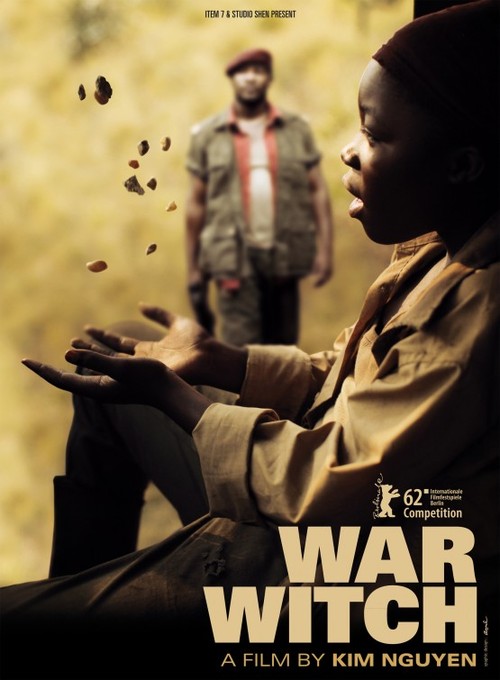
War Witch (Rebelle, Canada)
Director: Kim Nguyen


The film's two names tell a lot of it's two sides. It's about a girl who is a Soldier and a Magician at the same time, but fights constantly against the poor lot given to her in life. Komona (Rachel Mwanza) lives in the civil war-ridden Sub-Saharan Africa. At the age of 13, she sees her home village destroyed, and her being forced to murder her own parents. But this scarring experience seemingly also gives her the ability to communicate with the dead and stay out of harm's way. The invading soldiers equip her to fight for the Rebellion, but soon find that her abilities have better use to them as an Oracle, predicting the course of fighting.


The film chronicles Komona's life for three cricial years, during which she leaves her home, fights as a soldier, falls in love with a fellow wizard, the albino known as Magician (Serge Kanyinda), gets married and pregnant, and seeks to please the spirits of the dead by giving her parents a proper burial. Her life has several tragic twists for the worse, but adamant she keeps on going, even against the odds.


For all its darkness, War Witch embraces the African way of life from multiple angles. The belief in magic and mysticism isn't drawn out, but rather a comfortable part of all human interaction. At peaceful time, people are willing to help each other, and not taking worries of any petty details. When the Magician goes on a search of a rooster, people have a good laugh at his expense, even if he's pointing an AK-47 at their faces. His eagerness to find an extremely rare creature for love is endearing to people, even if he threatens their very lifes. People living in the war-ridden territories are well used to it.

★★★★

Marley (USA/UK)
Director: Kevin McDonald


This two-and-ahalf hour documentary chronicles no less than the whole life of Bob Markey, poet and a prophet. The most popular reggae star of all time had a bumpy career, with success that didn't come overnight but which was fought for years. The documentary gathers an impressive cast of interviewees, from Marley's immidiate family (mother, sons) to close friends and co-workers (including Lee "Scratch" Perry and Jimmy Cliff). The film also captures the rise of Marley-mania, beginning from Jamaica and taking over the whole world from teh United Kingdom to Japan to the United States.

The film is all business, to the point where it starts to resemble a historical documentary more than a mere music biography. The basics of Marley's life are well-covered all around, but at the same time, the movie also doesn't go very intimately into any subject. Any new revealations are scarce, even if Marley's sons remembering him as a father, and his beloved remembering his final days are quite touching. Altogether this works as a good 101 on Bob Marley's music, but I would always like that a biography film would look more like its central subject. This is a bit too distant and the cinematic tricks generic to reflect a truly innovative artist.

★★★

The Thieves (Dodookdeul, South Korea)
Director: Choi Dong-Hoon


The English subtitles didn't work on the PÖFF screening of this South Korean caper film, so I have little to say about it's plot. But it's a colorful, fast-paced film, with kinetic action scenes, globe-trotting exotiscm in the vein of the best James Bond flicks, plenty of sexy ladies and double-crossing. It seems like the cast is filled with colorful characters as well. Mark this one a prime candidate for a proper rewatch at some point in the future.

Captive (France/Philippines/USA/UK)
Director: Brillante Mendoza


The latest film by Brillante Mendoza is a naturalistic look into the captivity endured by western tourists in the hands of Abu Sayyaf guerrilla fighters in  . The film is mostly told through the eyes of the French schoolteacher Thérèse (Isabelle Huppert). She had come to Palawan for humanitarian aid, yet goes into long-winded soul-searching after her kidnapping and harsh life hiding out in the jungle. She does fill the role of taking care of the elderly and the sickly among other captives. Yet the terrorists have little use to any hostages that can't manage to flee any spot as quickly as possible to avoid capture.


The film is repetitive and harsh, although this does reflect the nature of the situation the main characters are in. At several points, mednoza winds down, and offers some magificent jungle footage. The flora and fauna live on, caring little about the quarrells of people. In this nature, the clear predecessor of this film is Terrence Malick's The Thin Red Line. However, Mendoza is not capable of balancing the poeticism and harsh realities as masterfully. The film drags often, and its characters remain quite thin, even if they are tried to flesh out now and then. The resulting film is a pick-and-mix bag, sometimes quite good, some times dull.

★★★

Shame (UK/USA)
Director: Steve McQueen


Director Steve McQueen's look into sex addiction has reaped a lot of critical acclaim. A lot of this comes from his quiet, slow-moving and very visual style, even though the filmmaker doesn't always seem to think it through on what kind of storytelling the style would fit best. But Shame is certainly a better told story than McQueen's previous, too-experimental-for-its-own-good debut Hunger. Michael Fassbender does a good, convincing main role as Brandon. The 30-something stock-broker is udes to picking up girls at bars, subways or really, everywhere he might run into a flirt. He also has huge stacks of porn, a subscription to live internet sex camera sites, and a tendency to hire call girls for his pleasure.

When Brandon's younger sister Sissy (Carey Mulligan) comes to an unexpected visit, he has to start rethinking his life. The shame of his condition forces him to move his sexual activities out of his apartement. At the same time he is disgusted when his boss picks up Sissy and the pair have sex. Brandon has serious problems with intimacy and angrily and bitterly refuses any close contact with Sissy. It appears that he's overcompensating for some guilty feelings, and the movie suggests he has trouble seeing women in anything other than sex objects.


Sex addiction is not an easy subject to make a film about, since it often falls into the pit of exploitation (as in the notorious Finnish film Levottomat 3) or moralization. McQueen does manage to have a cold, distant view on the films for the majority of the running time, but falls head first into the latter by the end. The cheesy pouting and extremities that are on offer put some unnecessary weight, when McQueen had put so much weight into individual images earlier. When Brandon's hedonism also goes way overboard, the film starts bordering on the line of exploitation after all. McQueen's hard-pressed style doesn't stay intact throughout the film, which is a true shame.

★★★

LinkWithin

Related Posts Plugin for WordPress, Blogger...