Showing posts with label swedish. Show all posts

Sunday, 29 March 2020

Bloody Vikings


Vikings has very rarely gotten their due in cinema history, which I find it a bit odd. Even though a complex Nordic culture with interesting gods and a drive for both exploration and pillaging in early Medieval settings might seem like prone for exciting historical adventure movies, more often than not, something goes awry with these. Anyway, let's take a look at several of the more interesting ones.

Erik the Viking (UK/Sweden 1989)
Dir. Terry Jones


Freed from obligations from Monty Python, director Jones was free to do whatever he wanted. His interests in medieval history, comedy and children's books met with an adaptation of his own book. He should have aimed the film more obviously for children. As it is now, the film has problems with its tone, as there are parts where there's too few jokes to be a comedy, and parts where the adventure doesn't advance at all. As a visualist or a mythic world-builder, Jones is clearly secondary to Terry Gilliam and doesn't quite get how to work his more fantastic ideas into the story properly.

The worst thing about it is that the comedy itself is often lacking. The movie opens with some rape humor which certainly hasn't aged well. Jones seemed to have made the same mistake as Graham Chapman with Yellowbeard thinking that rape is a good source of laughs. It does introduce us to the timid lead character, but it is a bit of a cheap way to get sympathy when he has performance issues during a pillaging event, and have him turn on some of the more rapey vikings.

Tim Robbins does do a good job, and there are some actual good laughs to be had from Tim McInnery's childish viking complaining about sitting arrangements to John Cleese's cheery sociopath order people getting flayed. The contrast between the awfulness of the violence and people might have worked better today as a kind of parody of Game of Thrones -like sadist entertainment. Jones himself pops as a clueless leader of a lost continent. I admit I have a soft spot for the film and have seen it a lot more times than its actual qualities would warrant.

★★1/2

Erik the Conqueror (Gli invasori, Italy/France 1961)
Dir. Mario Bava


Bava's historically inaccurate film sees Vikings clash against the Brits in the 8th century. This is contrasted by having one of orphaned twin boys being raised by the Brits and the other by Vikings. A fate of countries laying on the schism between siblings of course has been seen used from the Book of Moses to New Gods by Jack Kirby. It is a reasonably epic, if not terribly original way of presenting conflict.

As is often the case in the director's works, visually it is purely stunning, with elaborate color lights and psychedelia. There are many Technicolor epics with a lot bigger budgets that never were this inventive in their visuals. The film was mostly shot in a studio, but several battles are also shot on location with natural light and the landscapes a Medieval Nordic adventure warrants. These scenes bring a little contrast, but are just as good-looking, with merciless natural powers highligting the brutality of the warriors fighting on the same canvas.

But Cameron Mitchell is not a very interesting leading man, and in the film his voice is in fact dubbed. I like him better on 80's trash movies phoning it in while visibly drunk.


★★★ 1/2

Knives of the Avenger (I coltelli del vendicatore, Italy 1966)
Dir. Mario Bava


Bava did another viking picture, with his star Cameron Mitchell also attached. As the audience's tastes have swithed from large epics to smaller, more spaghetti western -like character studies, this one is more akin a western set in the viking era. The obvious comparison is 1953's Shane from which the movie's plot is pilfered. A disgraced viking warrior becomes a protector of a woman and her child when a group of more violent warriors come calling for his past mistakes. If the previous film was about brotherhood, this one circles again around family, with its themes finding redemption in adopted fatherhood.

The film's look is decidedly more down-to-earth in tones and settings than his previous viking film. Nevertheless the gloomy athmosphere is strong and Bava has a knack for keeping things interesting with some wild camera angles and a nice sense of misé-en-scene. A lot of the action is set on limited sets, darkly-lit farmhouses, taverns and even caves. The pacing is quite slow and one does get a bit bored in the meantime, whereas Erik moved along quite swiftly.

I feel Mitchell has a better role here, having him act more of a stone-faced loner with undelying guilt and growing warmth, is more suited to his talents, as he manages to give his character an air of mystery. In action scenes, though Bava can still play gritty and dirty even if its not quite the blood bath that would warrant such a title in my opinion.

★★★

Viking (Russia, 2016)
Dir. Andrei Kravchuk


With several popular tv series set on either the viking era (Vikings) or a mythical age quite similar to it (Game of Thrones), there has been several small-budget films that have tried to capture that same audience. Some of them are laughable (like 2014's Northmen - a Viking Saga), and many of them have a similar boring gray scale, predictably boring plots and nothing interesting to say. From modern viking films I remember Nicolas Wingding Refn's Valhalla Rising to at least try a little as compared to most of them.

I feel the Russian Viking is a case in point. I would have wanted to like this a lot more since it took seven years to make, and expected more of a Russian flavour to the story, as opposed to just do the same thing everyone else is. It sells itself for being historically accurate, which is itself a very dubious claim, and doesn't really do the boring story any favours. In many parts it is confusing and goes off in rails when compromised would have at least made the plotline somewhat understandable. Plus, it's nearly 2,5 hours long so there's an extra hour of suffering through this when compared to most other films on this post.

The title in and of itself is false marketing. While it takes place roughly in the Viking era, it is more concerned with the goings-on in Russian Novgorod in Prince Vladimir's reign, his brother, the warlord Kievan Rus and the Slavonic wars during that era. The virtues of the film are firstly to generate interest in Russian history, and secondly of its (very expensive-looking) battle scenes, which are in parts very impressive looking. If you really want to see the movie, read up on history before viewing, so the logic between characters making decisions and the context of many actions are more easily understood.

★★

The Raven Flies (Hrafninn flýgur, Iceland/Sweden 1984)
Dir. Hrafn Gunnlaugsson


My favorite Viking film comes from Iceland, which I feel is the best-suited country in the world to tackle the history, since most of the country's occupants are descendants anyway. I wouldn't call this any truer to history, though, even if more care than usual is made to the Medieval costumes and armors. The film is basically a spaghetti western revenge story, with tiny ponies instead of horses, and I love the film for it.

The film captures the dark and gloomy nature of Nordic countries in a way a film like Knives of the Avenger attempted, but didn't quite feel genuine. Life is hard, cheap, brutal and over in an instant. Blood feuds reign from generation to generation. Yet the film concerns ways of trying to break a never-ending cycle of violence. It sees a Celtic underdog prevail by using his wits and knowledge of viking's superstitions against his enemies. With plenty of close-up shots and ugly glances.

The genuinety from the actual settings makes this feel a lot more down-to-earth and less exoticized than most viking movies. It pays a lot to show the real Icelandic shore line and the right kind of houses so it doesn't feel like a general Hollywood epic. One can practically feel the cold wind and the dread of the upcoming winter.

The film spawned a number of sequels, none of which I have sadly seen.

★★★★

Thursday, 27 December 2012

PÖFF 2012


The always-charming Pimedate Ööde Filmfestivaali (Dark Nights Film Festival) in Tallinn this year's November was as full interesting programme as ever. While it offered some treats that have not yet been shown anywhere in Finland, most of the programme was familiar to Helsinki's avid festival-goers and arthouse cinema fans. But no matter, it will once again give me an excuse to take a look back at this year's offerings before the annual Best Of -lists.

Pieta (Hangul, South Korea)
Director: Kim Ki-duk


It seems that following his recovery from nervous breakdown, director Kim Ki-duk has started to shift away from his trademarked slow, artistic storytalling and more towards the Korean mainstream. His latest film is a Revenge Thriller, much in the vein of Park Chan-Wook's Vengeance Trilogy or Bong Joon-Ho's Mother. The film is based on a very fucked-up morality idea, which Korean films seem to specialize in. At least it doesn't go as far as Kim Jee-woon's I Saw The Devil.

Lee Kang-do (Lee Jung-jin) is the most violent and ruthless debt collector in mafia's paycheck. He hasn't any emphaty for anyone, and is glad to maim his "customers" for insurance money. Back home he usuallu spends time sleeping or masturbating. One day, a strange woman follows him home. He tries to drive her away, but she enters his house by force, and insists on cleaning up. She reveals herself to bee Kang-do's long-lost mother, Jang Mi-sun (Jo Min-su).


Initially Kang-do refuses his mother, and acts as if she's not there. He goes on his work, even though she insists on taging along. of course, she doesn't approve of the violence, but nevertheless attempts to win her son over by helping along. Slowly, Kang-do starts to warm up to Mi-sun. But she did have another reason to return to him after so many years, and this is just one step in her major plan.

Kim uses a lot of Christian iconography in the film, making a stark contrast on the people who certainly aren't living by Jesus's Golden Rule. He also doesn't spare the audience in awkward sexual content nor bone-crunching or skin-frying violent scenes. Yet for all the effectiveness of the cinematography and sheer skill in the storytelling, the whole film has a very slight feeling. As if the master is afraid to bring on his A-game. There have been good thrillers that have pondered the same sort of questions between family, morality, duty, sexuality and politics before. Pieta for all it's worth, can't really bring that much new things in the mix.

★★★

Call Girl (Sweden)
Director: Michael Marcimain


The most talked-about film this year in Sweden was this intriguing political thriller that is based on several real life scandals from the 1970s. While the film certainly takes some liberties to fill in some gaps, and makes some indirect accusations on past politicians, the depiction of 70's Sweden is noticeably realistic. The result is something like The Wire meets Tinker Taylor Soldier Spy in the Red Lights district.

Iris (Sofia Karemyr) and Sonja (Josefin Aspelund) are two misbehaving 14-year-olds living in a school home. The rebellious teens tend to run away to meet boys, drink alcohol and trick themselves into bars. But they run into a wrong crowd of girls who seem to have it all; a free apartment where to party, free alcohol with no questions asked, and plenty of money to use. The girls fall down deeper and deeper into the rabbot hole, until they find themselves to be in the service of bordello keeper Dagmar Glans (the magnificent Pernilla August).


Meanwhile, the small-time government clerk and pencil-pusher John Sandberg (Simon J. Berger) runs an operation to check Dagmar's shady business. He taps phones, plants tails and reads everything connected to her. Soon he starts to realize that Dagmar's clients aren't just faceless rich people, they are socialites from the very top of the Swedish society. Included might even be the rising Minister of Justice (Claes Ljungmark). But in trying to expose this scandal, Sandberg runs into a lot of trouble. But election day is coming and he remains adamant that the people will have to know the truth about their minister, who at the same time is strongly preaching about democracy and women's rights.

The film has three viewpoint characters, Iris, Dagmar and John. Each one has an intriguing story that has a lot of nuances and insights. It seems that the Swedes really like the archetypal characters of heroic jounalist finding the black spots in Social democracy, as well as the young girl who gets mistreated by misogynists working within the social norms. At times the film almost feels like it has too much content. A lot of these nuances get lost from the viewer when the story is suddenly skipping from one main plot to another. This approach would work better in a television series or a book.


In the end this society-shaking thriller is still superbly exciting stuff. The retro-styled electronic music, as well as pop hits from the era make a perky soundtrack, that houses a much more sinister core. While Swedish spying within the country in the 70's wasn't as large-scaled as in the Cold War setting, the stakes were still quite high. The film contains the idea that the country is willing to turn a blind eye on injustice, while at the same time the country poses as the moral superior and forerunner in the world. I'm almost certain I will enjoy the film more on subsequent viewings, since it contains so much to chew.

★★★★

God Bless America (USA)
Director: Bobcat Goldtwaith


Could it be the Western civilization is nearing its end? At least it seems that our mutual culture has reached some lows that aren't easy to climb back up, as well as the political system is bitter, feuded and utterly divided, particularly in America. Stand up comedian Bobcat Goldthwait's satire attempts no less to be a Natural Born Killers for the Naughties, a satire about a kill spree that reveals all that's wrong with the world today.


Sad-sack middle-ager Frank (Joel Murray) hates his job, neighbors, television programmes and life in general. He has to see his estranged daughter grow up to be just another prissy little asshole, living with his ex-wife and her new husband. The final straw is drawn when Joel is diagnosed with a fatal brain tumor. So, before ending his miserable days, he takes a last-ditch effort to make the world a better place by getting rid of his daughter's role-model, a spoiled rich brat whining on MTV about the wrong-colored car her parents got her as a birthday present. But by killing her, Joel also attracts the attention of her class-mate Roxy (Tara Lynn Barr), who insists they should go on a kill-spree to rid the world of assholes.


I suppose everyone has had fantasies of brutally executing parking violators, loudmouthed teens at movies, fugly screaming babies, uncompromising extreme-right wing politicians or douchebag tween stars. Goldthwait's murder fantasy balances on a fine line, particularly since America has had their share of tragic gun mishaps lately. But while the assholes in the film are really obnoxious, this is also a film smart enough to constantly question the morales and minds of its protagonists. While Joel is symphatetic, Roxy in particular often comes across just as bad and annoying as everyone she would like to end.

But all in all, as a satire, this is a bit slight. It really targets just one side of a culture and doesn't offer much in the way of analyzing how the society has come to this. It's more of a check list of everything annoying it's eccentric screenwriter/director. However, the film's main question on whether people can't be nice to each other any more, is a very valid one nowadays.

★★★

Caesar Must Die (Cesare deve morire, Italy)
Directors: Paolo & Vittorio Taviani


This year's Berlinale's top prize went to this sort-of docu-drama by Italian filmmakers Paolo and Vittorio Taviani. I say "sort of" because this certainly isn't an easy film to be comfortably fit in any pre-given characterization. Shot mostly in black-and-white, and in flashback, the film chronicles inmates at a high-security prison staging a play of William Shakespeare's Julius Caesar.

We get to know the inmates for the most part only from the short scenes of the applying for a part in the play. They tell what they are in prison for, and at the same time heaps of their back story. The major flaw in the film is that one would like to learn to learn more of them. Now watching interviews for a long period of time is a little exhausting, and one can't remember most of it for what comes next. There are mafiosos, hotheads and people just trying to make ends meet, and the only thing that really connects them is the punishment at first, and the play later on.


Practicing for their roles, the inmates become to utterly inhabit their roles. Since there isn't much else to do in prison, the play becomes the sole reason for their existence. The prison architecture begins to look like a huge stage, and the similarities of Ancient Rome and the hierarchy at the Big House begin to get mixed together. But what comes after the play is done? The film is very experimental, twisting a famed tale to have a couple of layers more, but it is captivating to watch.

★★★★

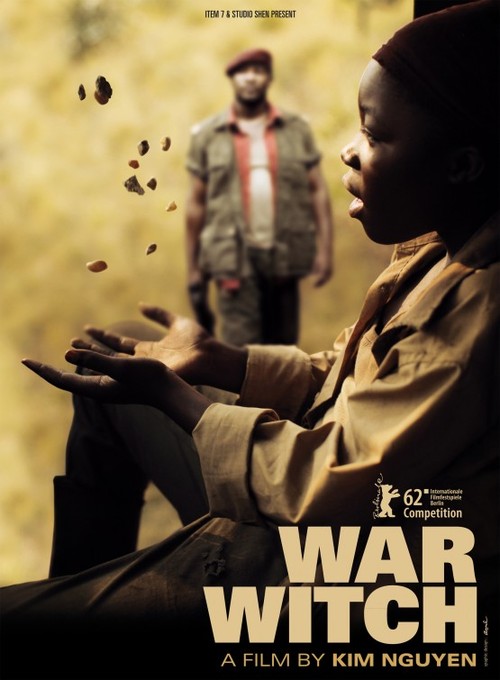
War Witch (Rebelle, Canada)
Director: Kim Nguyen


The film's two names tell a lot of it's two sides. It's about a girl who is a Soldier and a Magician at the same time, but fights constantly against the poor lot given to her in life. Komona (Rachel Mwanza) lives in the civil war-ridden Sub-Saharan Africa. At the age of 13, she sees her home village destroyed, and her being forced to murder her own parents. But this scarring experience seemingly also gives her the ability to communicate with the dead and stay out of harm's way. The invading soldiers equip her to fight for the Rebellion, but soon find that her abilities have better use to them as an Oracle, predicting the course of fighting.


The film chronicles Komona's life for three cricial years, during which she leaves her home, fights as a soldier, falls in love with a fellow wizard, the albino known as Magician (Serge Kanyinda), gets married and pregnant, and seeks to please the spirits of the dead by giving her parents a proper burial. Her life has several tragic twists for the worse, but adamant she keeps on going, even against the odds.


For all its darkness, War Witch embraces the African way of life from multiple angles. The belief in magic and mysticism isn't drawn out, but rather a comfortable part of all human interaction. At peaceful time, people are willing to help each other, and not taking worries of any petty details. When the Magician goes on a search of a rooster, people have a good laugh at his expense, even if he's pointing an AK-47 at their faces. His eagerness to find an extremely rare creature for love is endearing to people, even if he threatens their very lifes. People living in the war-ridden territories are well used to it.

★★★★

Marley (USA/UK)
Director: Kevin McDonald


This two-and-ahalf hour documentary chronicles no less than the whole life of Bob Markey, poet and a prophet. The most popular reggae star of all time had a bumpy career, with success that didn't come overnight but which was fought for years. The documentary gathers an impressive cast of interviewees, from Marley's immidiate family (mother, sons) to close friends and co-workers (including Lee "Scratch" Perry and Jimmy Cliff). The film also captures the rise of Marley-mania, beginning from Jamaica and taking over the whole world from teh United Kingdom to Japan to the United States.

The film is all business, to the point where it starts to resemble a historical documentary more than a mere music biography. The basics of Marley's life are well-covered all around, but at the same time, the movie also doesn't go very intimately into any subject. Any new revealations are scarce, even if Marley's sons remembering him as a father, and his beloved remembering his final days are quite touching. Altogether this works as a good 101 on Bob Marley's music, but I would always like that a biography film would look more like its central subject. This is a bit too distant and the cinematic tricks generic to reflect a truly innovative artist.

★★★

The Thieves (Dodookdeul, South Korea)
Director: Choi Dong-Hoon


The English subtitles didn't work on the PÖFF screening of this South Korean caper film, so I have little to say about it's plot. But it's a colorful, fast-paced film, with kinetic action scenes, globe-trotting exotiscm in the vein of the best James Bond flicks, plenty of sexy ladies and double-crossing. It seems like the cast is filled with colorful characters as well. Mark this one a prime candidate for a proper rewatch at some point in the future.

Captive (France/Philippines/USA/UK)
Director: Brillante Mendoza


The latest film by Brillante Mendoza is a naturalistic look into the captivity endured by western tourists in the hands of Abu Sayyaf guerrilla fighters in  . The film is mostly told through the eyes of the French schoolteacher Thérèse (Isabelle Huppert). She had come to Palawan for humanitarian aid, yet goes into long-winded soul-searching after her kidnapping and harsh life hiding out in the jungle. She does fill the role of taking care of the elderly and the sickly among other captives. Yet the terrorists have little use to any hostages that can't manage to flee any spot as quickly as possible to avoid capture.


The film is repetitive and harsh, although this does reflect the nature of the situation the main characters are in. At several points, mednoza winds down, and offers some magificent jungle footage. The flora and fauna live on, caring little about the quarrells of people. In this nature, the clear predecessor of this film is Terrence Malick's The Thin Red Line. However, Mendoza is not capable of balancing the poeticism and harsh realities as masterfully. The film drags often, and its characters remain quite thin, even if they are tried to flesh out now and then. The resulting film is a pick-and-mix bag, sometimes quite good, some times dull.

★★★

Shame (UK/USA)
Director: Steve McQueen


Director Steve McQueen's look into sex addiction has reaped a lot of critical acclaim. A lot of this comes from his quiet, slow-moving and very visual style, even though the filmmaker doesn't always seem to think it through on what kind of storytelling the style would fit best. But Shame is certainly a better told story than McQueen's previous, too-experimental-for-its-own-good debut Hunger. Michael Fassbender does a good, convincing main role as Brandon. The 30-something stock-broker is udes to picking up girls at bars, subways or really, everywhere he might run into a flirt. He also has huge stacks of porn, a subscription to live internet sex camera sites, and a tendency to hire call girls for his pleasure.

When Brandon's younger sister Sissy (Carey Mulligan) comes to an unexpected visit, he has to start rethinking his life. The shame of his condition forces him to move his sexual activities out of his apartement. At the same time he is disgusted when his boss picks up Sissy and the pair have sex. Brandon has serious problems with intimacy and angrily and bitterly refuses any close contact with Sissy. It appears that he's overcompensating for some guilty feelings, and the movie suggests he has trouble seeing women in anything other than sex objects.


Sex addiction is not an easy subject to make a film about, since it often falls into the pit of exploitation (as in the notorious Finnish film Levottomat 3) or moralization. McQueen does manage to have a cold, distant view on the films for the majority of the running time, but falls head first into the latter by the end. The cheesy pouting and extremities that are on offer put some unnecessary weight, when McQueen had put so much weight into individual images earlier. When Brandon's hedonism also goes way overboard, the film starts bordering on the line of exploitation after all. McQueen's hard-pressed style doesn't stay intact throughout the film, which is a true shame.

★★★

Sunday, 30 September 2012

HIFF 2012: Stranger than Fiction

 
Man, I've seen so many Love & Anarchy movies this year that it's going to take a while to get through them all. But it has been quite a festival with loads and loads of interesting cinema to discuss about. I'll open this, the first of my Reports from this year's Helsinki International Film Festival, with a look at three quite extraordinary true stories. As you may recall, I already wrote about Erroll Morris' Tabloid in my pre-festival picks. The weirdness on our documentary-screening cinemas continued deep into the festival.

The Ambassador (Ambassadoren, Denmark)
Director: Mads Brügger


One of the most hyped movies on this year's festival was this Danish pseudo-documentary. It's about the Danish journalist Mads Brügger who fakes and pays his way to become a consul (a diplomat without the immunity) in the Central-African Republic. This position opens opportunities for some very shady side-jobs, and Brügger becomes a smuggler of blood diamonds (diamonds that can't be traced and thus may have been mined at a quarry which uses slave labour).

Brügger attempst to show what kind of a wild west Africa still is, and how dirty western diplomats' hands over there still are. Much has been discussed whether it's really true or just a mockumentary. I think it's safe to say, there are certainly scenes that have been staged, so it's not a full-fledged documentary.

This uncertainty of methods works against the film itself. The biggest reveals in the film don't have the necessary weight into them, when the scenes surrounding them have Brügger just talking bullshit. It's also weird that supposed "hidden cameras" have multiple angle shots. Crucially, in order this to work as any sort of public service announcement, it would need to be a lot more informative and factual. The connections within Africa and the tentacles of international crime are briefly explained but not in a way an audience member could grasp them and digest the info.

While several scenes in the film are quite funny in their politically incorrectness and manage to unveil the racism still inherent in African politics, the jokes don't come very often and even then, don't necessarily work. Brügger's on-screen persona isn't ruthless nor outrageous enough to be enjoyable, and one can't really emphasize with him.

All that adds to the point that the film's pacing is way off, and it never reaches the levels of interest it should. It's a noble effort, with several great scenes (pygmy party, everyone!), but in the end, feels a bit lacking.

★★1/2

Grandma Lo-Fi: The Basement Tapes of Sigrídur Nielsdóttir (Amma Lo-Fi: Kjallaraspólur Sigrídar Níelsdóttur, Iceland)
Directors: Ingibjörg Birgisdóttir, Orii Jónsson, Kristin Björk Kristjánsdóttir


This Islandish doc is about how one is never too old to be creative. Sigrídur Nielsdóttir got a synthesizer as a 70th birthday present from her friends. She soon became enthralled with the thing and started to compose some music of her own, based on the base lines and background beats found in the machine itself. She had a knack for it and in the end, taped 59 recordings. Initially for her friends and family, they were found by a larger audience and she became an inspiration for a whole generation of musicians. The cute old granny is likeable enough to pull the documentary by herself.

The documentary is only 62 minutes long and, focuses heavily on Sigríd. It's all well and good, but the viewer gets a feeling that another side of the story is blocked altogether. It would pay to feature some of the musicians inspired by Sigríd's music in the doc. Also missing are any fans or third parties, like friends and family, enjoying Ingrid's music. Only text screens and tie-in animation scenes put the artist herself in the right context.

There's no need to underline the quirkiness of the subject, but in doing so, the film goes to kitchy lengths. This starts to get annoying after a while. Paper clip animations, singing ballerinas and cute animals picture some of Ingrid's best songs. Ingrid would be sweet enough on her own, whether blowing a whistle, telling about her youth or bringing in a new batch of cassettes with her wheeled grocery bag. Not much time is dwelled on any (minor) negative aspects of the artist, only her stage fright is mentioned in one text screen.

Perhaps the artist died before the documentarists could achieve everything they aimed for, but one got the feeling the subject matter would deserve a film that would go a bit deeper

★★1/2

The Imposter (UK)
Director: Bart Layton


The portrait of a liar is one of the most interesting stories one can tell, and even moreso in documentaries, where one has to be a bit wary whether to take the things stated with a grain of salt or not.

Frédéric Bourdin, a French-born con man, had no family growing up, so he made a career in attempting to steal that unit from others. His biggest con involved the Barclays, a grieving Texan family, pining for their missing teenaged child Nicholas. Bourdin successfully stole Nicholas' identity and cheated his way into the family for years. The Barclays wouldn't question whether he really was their long-lost son. This is although he had the wrong hair color, wrong facial characteristics, wrong eye color, and to top it all, a thick accent.
This documentary goes through the whole ordeal from start to finish. It collects a frankly impressive array of interviewees, since basically all parties still alive from the case are in the film. And this is even though the subject matter must not be the easiest thing for all parties involved to talk about. Not only did they lose a family member to mysterious circumstances, they got their hopes crushed and in a way, lost their son again when Bourdin's hoax was revealed.

Re-enacting a past crime in the beginning seems to be like an episode of True Crimes in the beginning. But one becomes enthralled since the interviewees seem to be so open, telling their inner thoughs and feelings with seemingly alarming accuracy. The eccentric person of Bourdin  is well-realized in the doc. One starts to like him a little bit, even though it is made clear that he is unable to stop trying to take advantage of any situation by spinning more of a web of lies.

Towards the end of his con, Bourdin gets suspicious himself as to why his new family doesn't realize anything to be wrong with him. FBI agents still studying the case have dug up enough info to put him behind bars for fraud, yet the family defends him and insists he is who he says he is. Bourdin comes to the conclusion that they have something to hide themselves, and the arrival of is convinient for their own plans. Namely, hiding the death of Nicholas in their hands.

The question here isn't, who's lying, but rather, who is the crucial liar. The film doesn't offer any easy answers, but it does have some good social criticism and insights on an inner rot eating an deal suburban Americana inside out. It's a suspensful and thought-provoking film, and that's as much as one can hope for.

★★★★

Searching For Sugar Man (Sweden, the UK)
Directors: Malik Bendjelloul


Fame is a difficult beat to capture. It may even be hard to tell whether it exists in the first place or is just good enough at hiding.

Sixto Rodriguez was a creative folk artist in the late 60's, early 70's America, that never got the break he deserved. He played in the seedy clubs at his native Detroit and released two albums, produced by Motown mogul Clarence Avant. Even though record executives figured he'd be huge with his talents, nobody bought his albums in his home land. Rodriguez vanished into thin air after the commercial failure of his latter album.

But the story of the artist only begins there. For the record made its way into South Africa, and the locals over there became crazy over it. In the narrow-minded apartheid culture of that time, political protest songs captured something about the native psyche. Rodriguez was also deemed dangerous by the government and censored, which made him an even more important underground figure. The artist became as popular in the country as Elvis Presley or the Beatles. But nobody in South Africa knew anything about their idol. Wild rumours started to circulate, like that the artist had burned himself alive on stage since he didn't get the appreciation he wanted.

Tracking down what happened to Rodriguez has been a process that has lasted for years. South African music fans Simon Chinn and Dennis "Sugar Man" Coffey tried to track the artist down through years of research and calls to record executives. The documentary follows their detective work for the first half and it is some very intriguing stuff. Going in the movie without knowing anything about Rodriguez also makes new listeners instant fans and terribly interested in the fate of the artist. I'd recommend everyone to see the film to have this curiosity for themselves before reading any further. The latter half of the doc is a very different beast and in order to assess it, one must write a spoiler or a few. So look away.

Like Rodriguez used to look away from his audience back in the day.
Rodriguez didn't commit suicide nor die of a drug overdose, but decided to take life by the balls and went to do some easy storage works. The artist is found alive, but without a single bitter bone in his body. He's happy with where he was at life, even though he lived in poverty due to the royalty checks from South Africa never reaching him. He didn't do it for the money, he did it for love, as he has done everything since. At Detroit, he was a well-known man, friend to many, but nobody had any idea he had been a recording artist.

The Swedish film is unbelievably well-directed, with just the right amount of talking heads, investigative journalism, and music thrown in the mix, visualized with scenery shots and occasionally animated montages. The film basically does two seperate stories, one a detective story and a mystery, which gets a satisfying ending but with some of the bad guys (like the ones who pocketed Rodriguez's royalty money) walking away scot free.

The second half is more of a philosophical character piece, with an unbelievably easy-going, mellow and friendly musician coming to terms with his newfound fame. Rodriguez is so zen in his approach, he isn't afraid to play to thousands of people, but film interviews seemingly scare him a little. It is clear that this guy is as happy as doing odd jobs at a storage than playing his old songs, which he has never forgotten. For South Africans (and music fans) the climax is seeing Rodriguez finally climbing on the stage of a concert hall.

The moral of the story is, never forget your past, but don't hold grudges against it, but take the good things with you. Important movies such as this one can change your life. And at the very least teach you something interesting about music on the side.

★★★★ 1/2

Saturday, 10 December 2011

International Films for the rest of the year, or: PÖFF 2011

"I hear Tallinn has a pretty groovy film festival. Let's meet at the harbor." Le Havre (c) 2011 Sputnik Oy.

The biggest film festival in Estonia, Tallinna Pimedate Ööde Filmifestival (Tallin Black Nights Film Festival, or PÖFF) turned 15 this fall. The prestigious international film festival was held 16.-30. November. I only had time to visit the festival for one weekend, even though it would've offered a lot of highly interesting international films. Luckily, a lot of them I had already seen or had the chance to see back in Finland. So here is an end-of-the-year roundup of interesting films from PÖFF's lineup.

Le Havre (Finland/France)
Director: Aki Kaurismäki

Le Havre (c) 2011 Sputnik Oy.
The pitiful Finnish film industry always gets a boost whenever our last and only recognized auteur, Aki Kaurismäki makes a new film. Nevermind that this one was shot in France and in French, Le Havre will win multiple Finnish Film Awards, and is our country's contender for the Oscars. But while it's a good film, it is a small disappointment and nowhere near Kaurismäki's finest.

Le Havre is about the inhabitants in a small coastal town in Northeast France. The old shoe-shiner Marcel Marx's (André Wilms) life is shaken as his wife Arletty (Kati Outinen) falls ill and is hospitalized. The grief-stricken elder gentleman finds it hard to function without his wife. He happens to come across the young immigrant Monet (Jean-Pierre Daroussin) hiding from the police in the harbour. The kind-hearted Marcel takes pity on the boy and gives him shelter in his home. It also allows him to get his mind off worrying about the fate of his wife. He gets the support of his entire comminity to keep the boy from getting to the cold hands of the law.

Le Havre is first and foremost a fairy tale for grown ups. Its humanism is strongly influenced by the silent films of Charlie Chaplin, and Kaurismäki also uses about as much dialogue in his films as well. But nevertheless, the film feels a bit too naïve and predictable for its own good. The message is of course good and pure, and as important today as it was in the 1930's when the right-wing chains of thought swept through Europe the last time. But Kaurismäki doesn't really get a good hold at his characters, which feel like rough drafts compared to his previous body of work. Marcel, for instance, is pretty one-dimensionally good. More time is spent on the nostalgia of the old town, where old people take care of old bars and old grocery stores, soon to vanish. The imagery itself is familiar to the point of clichés. Kaurismäki goes through a checklist of his usual trademarks, and thus, for instance, a rock show is tacked on (by the French old school rocker Little Bob). All in all, it feels a lot like a film fastly done in between other films with more gravitas.

★★★

Poongsan (South Korea)
Director: Juhn Jaihong


The formerly prolific Kim Ki-Duk has had trouble doing films lately. He's suffered from depression and a writer's block, that is all delved into in his latest film Arirang. But luckily Kim has shown signs of getting better, and now he has managed to script and produce another film that isn't about himself. Instead, is a action thriller about the conflict between North and South Korea and one smuggler between them.

The mute smuggler, known only by his cigarrette brand as Poongsan (Kye Sang Yoon), silently takes on jobs left on a note by grief-stricken families. He can bring anything and anyone across the borders of the two Koreas. While his reputation grows and grows, eventually he gets a job from a wealthy Southern businessman to bring back his Northern girlfriend In-ok (Guy-ri Kim). The job proves harder than usual, as the saucy woman proves to be more than a match to Poongsan's finely-tuned tactics. At the same time the South Korean police has set up a trap to catch Poongsan and to find out whether he comes from the North or the South. But also North Korean Agents have their eyes on Poongsan and sinister plans for him.

The fast-moving movie has a huge cast of characters and so many allegiances that it's difficult to keep track of all of them. The middle of the film in particular, is quite confusing. At the centre of the movie there is a triangular romance, that feels quite forced considered from any angle. But at least things aren't as black and white as they initially seem. Director Juhn Jaihong excels as an action director. The scenes of running through the border area are brisk, exciting and innovative, if not very realistic. Likewise, Juhn and Kim have also deviced some very twisted and nasty ideas for the film, which one can take chuckling. The whole ordeal is a kind of a modern western, if such a common comparison can be excused. The mute stranger playing two sides against each other for profit is the exact plot of A Fistful of Dollars. Poongsan is a sort of superhero, as he seems almost invunerable. He's a symbolic person, the spirit of the Korean soul that doesn't look whether you come from the nort or the south. The film deals with subjects that must be painful to the Koreans, but does it in an exciting, innovative way. The script could've used another polish, though.

★★★ 1/2

Attack the Block (Great Britain/France)
Director: Joe Cornish


A new generation of video-raised Brits have recently started to make more interesting genre pictures. With his debut, Joe Cornish goes to the same league with Neil Marshall, Edgar Wright and Ben Wheatley. Cornish's master idea was to combine a silly alien invasion idea with a coming-of-age tale of a hoodlum. A teen gang has to face responsibilities for the first time in their life to survive and protect their home block.

The story begins on New Year's eve as the gang led by Moses (John Boyega) mugs a nurse on her way home. While the gang's making their escape, a small furry alien attacks Moses. He decides to beat it to death as revenge. But this turns out to be a mistake, as bigger, nastier aliens soon start to appear and killing off people. They seem to have some beef with Moses and his past deeds. In the mids of all the fireworks they have come on Earth undetected and because of the block is seething with crime, few authorities want to check on it. One of the gang members gets injured and needs mediacal attention. Luckily at their home block the ruffians realize that the nurse they robbed is actually living as their neighbour. Sam (Jodie Whittaker) therefore has to choose whether to trust the hoodlums to survive or to try to make it on her own.

Attack the Block's biggest problem is that it's marketed as a comedy, but it really isn't all that funny. Little wannabe gangsters Probs and Mayhem do raise a few giggles, but Nick Frost as a lazy fat drug dealer feels mostly wasted (in the bad way). The film's aliens are cool, dark furry things with glow-in-the-dark teeth. When their mission is revealed, it seems plausible, and thus they would've fitted well with my recent list of best movie aliens. There is also the stretch that one has to symphatize with some nasty underage hoodlums to enjoy the film. But hey, the same is true with Akira. Like the anime classic, this is a little anarchistic and anti-authority, but also stretches the need to take responsibility of one's own actions.

★★★

Sons of Norway (Sønner av Norge, Norway)
Director: Jens Lien


Sons of Norway takes us back to the golden days of the late 1970's in the concrete suburbs of Oslo. The adolescent Nikolaj (Åsmund Høeg) is raised in a family of free-thinking radicals (in a word, hippies). Nothing is shunned upon, and his parents have an open mind toward everything. It all changes when Nikolaj's mother Lone (Sonja Richter) dies in a tragic accident. Living with just his grief-stricken widowed dad Magnus (Sven Nordin) is a real pain. So when Nikolaj gets his first teenaged needs to rebel, he needs to take it to the extreme. Luckily, punk rock and The Sex Pistols have just risen, so Nikolaj bases his life on their teachings. He gets a new punk look, acts rude toward authorities and starts his own garage band with his friends. But then Magnus decides he wants to party and join in the movement as well.

The film is certainly quite funny, as much comedy can be done on the expense of the 70's Nordic liberals. For instance, we are taken to a nudist camp, and Nikolaj gets to witness more sex than should be good for a boy too young to actually do it himself. As everything is looked through nostalgic lenses, rather than looking forward, the film isn't that punk in actuality. It pronounces the joy of life rather than nihilism. I should hate it then, but I don't. After all, there is a late cameo by Johnny Rotten himself. The film is quite episodic, which makes me feel it is based on a book or on actual events. It would benefit from having a stronger sense of the story rather than having just one set piece after another. But the father-son relationship is realized in a funny and never preachy way.

★★★

Inní: Sigur Rós (Iceland)
Director: Vincent Morrisset


I didn't know much about Iceland's gift to progedelic rock, Sigur Rós, before seeing this film. I feel like I still don't. It's a documentary film about the band, which utilizes a lot of concert footage, but also some interviews from the course of their career. But very few of them, in fact. Too bad, because they are easily the most interesting thing in the movie. Most of the time is spent on gigs, with the camera hugely close to the players and obscuring much. The film is black-and-white and grainy, allowing viewers either to interpret the film as they please or get nauseous. As for Sigur Rós's music, I feel it is quite nice to listen for a song or two, but I get annoyed by its slowness and lack of any hooks after 1,5 hours. If you're a fan, this is a must. Otherwise, I suggest to avoid this.

★★

Killing Bono (Ireland/Great Britain)
Director: Nick Hamm


Based on a memoir that every one that has ever talked about has described as "almost too weird to be true", Killing Bono tells the story of Bono's doppelgänger. The man in question is the Irish rocker Neil McCormick (Ben Barnes) who went to the same school as Bono, The Edge and friends way back when before they were famous as U2, in the late 70's. Neil's younger brother Ivan (Robert Sheehan) was in fact asked to be in the band lare named U2, but the jealous big brother never allowed for this to happen.

The film deals with the two brothers' struggling to have some sort of success with their own band, while U2 goes on to be the biggest band in the world. The McCormick ordeal features gangsters, record company executives, loose women and other deadly combinations of weird Irish people. Sex, drugs and rock and roll are all present, but don't feel glamorous but a little worn out and with a tiny hint of melancholic sadness within them. Neil makes a huge string of bad decisions and usually keeps them from Ivan. When Ivan finds out brotherly feuds so harsh follow even the Gallaghers would find them a little excessive. The ever-awesome Pete Postlethwaite makes his final appearance on the screen as the boys' gay landlord. The still-awesome Twitter superstar Peter Serafinowicz plays a sleazy and foul-mouthed record company owner. The film is quite funny, but more than anything, it made me interested in reading Neil McGormick's book. I'd like to find out just how much of it was made in the sake of cinematic storytelling and how much does McGormick claim is true.

★★★

Code Blue (Netherlands)
Director: Urszula Antoniak

 
Urszula Antoniak is known from her debut feature film Nothing Personal. Code Blue is similar in the slow pace and lack of dialogue. Antoniak trusts the images to tell the story. Another thing that is similar is that they both are stories about love and sexuality, but go across painful limits, making the stories all the more tragic. Code Blue is much more violent, almost sadistic in its outcome.

Nurse Marian (Bien de Moor) tends to appears to be emphatetic and good at her job, taking care of terminally ill and old patients. But she harbors more sinister feelings among herself. She's a loner and become more than a little twisted from being around death all the time. She also has voyeristic urges, and with binoculars witnesses a man in the next building doing violent acts to women. Rather than calling the authorities, she becomes fascinated and a bit aroused by this man. And the man also starts to spy on her. It is inevitable that these two shall meet.

Code Blue is slow to the point of coma. But nevertheless Antoniak is good at building pressures, which burst out at a few shocking scenes. Her film's protagonists are pretty rotten to the core, which makes the film feel a tad nihilistic. It's certainly arty, to the point when a lot of people won't stand the film. But I've got to say, once I got over my initial confusement, I kind of liked it.

★★★ 1/2

She Monkeys (Apflickorna, Sweden)
Director: Lisa Aschan


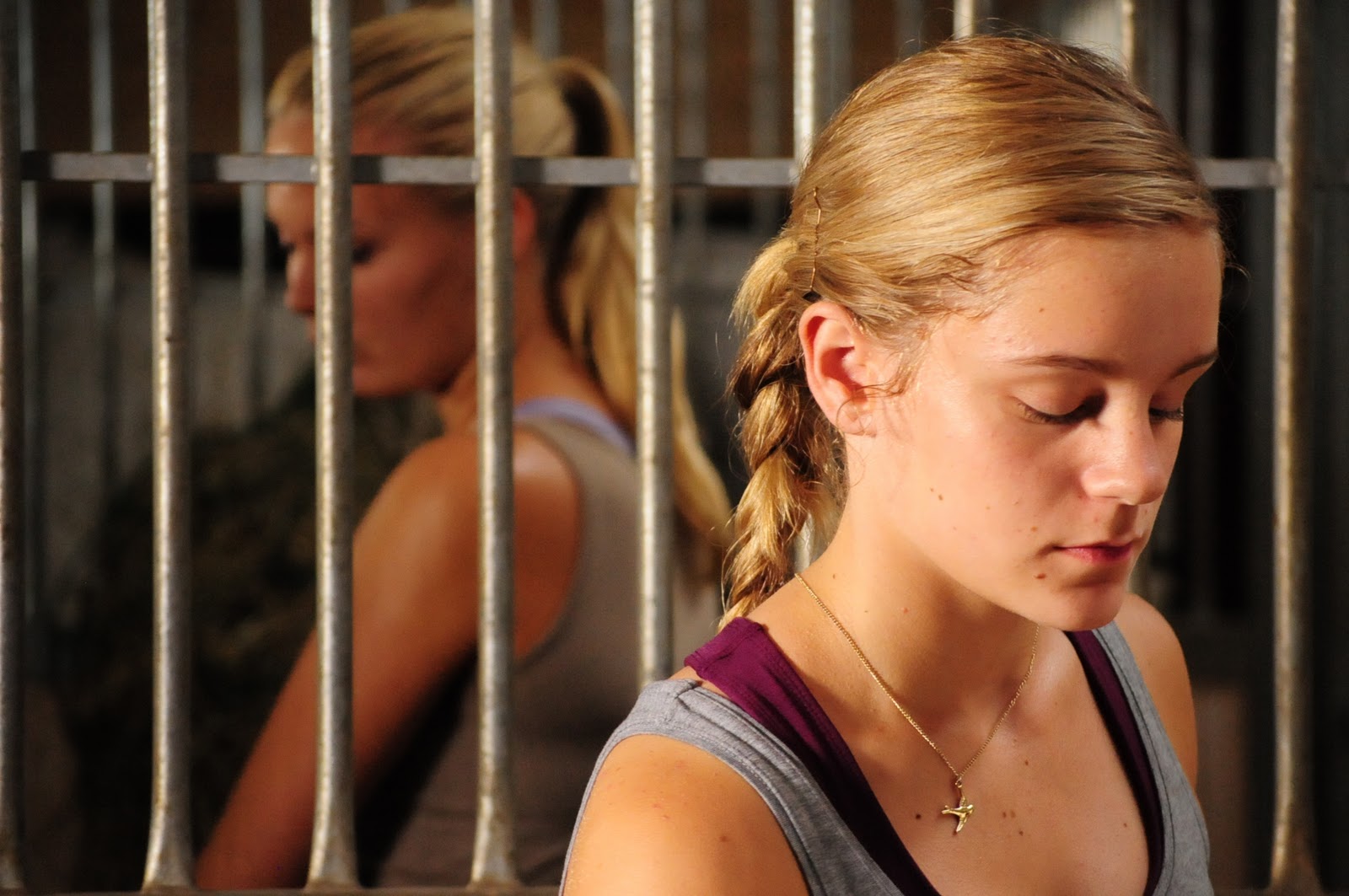
One of this autumn's biggest surprises comes from Sweden of all places. To be fair, it's no wonder I was t first dismissive of a film that was said to be like "a new Fucking Åmal". In actuality She Monkeys is a lot more. It shares it's slow, almost documentaristically still style with films like Play. In fact it works very well as a companion piece of that film. Whereas Play had some good ideas of how to present male adolescence, peer pressure and the spread of anti-immigrant views on cinema, She Monkeys delves on the development of female sexuality, unrequited love, mood swings and physicality.

The teenaged Emma (Mathilda Paradeiser) is accepted to a school for circus acrobats. She soon makes friends with another schooler, Cassandra (Lena Molin). They soon become inseperable, doing everything together. But it soon turns out that one of the girls feels a lot stronger towards the other than the other does. Nevertheless, the scenario is allowed to go all through to its breaking point. Meanwhile, Emma's little sister Sara (Isabella Lindquist) gets her first taste of developing into an adult as a swim school instructor tells her mom that she needs a bikini top to swim there. Sara harbors a crush on her cousin Sebastian, and plans to woo her.

All information we viewers gain in the film is based on what Emma and Sara experience on screen. There's not a lot told about what's happening outside. It keeps the film fresh and pulls the rug out from under the viewer's feet a few times. She Monkeys isn't afraid to surprise or even shock. For a debut director, Lisa Aschan has astonishingly good sense of cropping the image and allowing us to read things on almost still faces. The film also has a strong sound design, with breathing and other small sounds turning out to be vital for the storytelling. The film is cut surprisingly short and when it ends, the viewer is left wanting for more. While all threads are tied in this film, maybe we're just left to wait what Aschan does next.

★★★★

In A Better World (Hævnen, Denmark)
Director: Susanne Bier


Susanne Bier's films are basically very good, but I somehow mostly see them as somewhat off-putting. I don't know what it is, certainly not the thematic darkness, since I'm used to that as a Scandinavian. Her films tend to have depressed people be miserable amid the Scandinavian welfare state. That's by no means a wholly unique theme in Scandinavian cinema. So is the case with Hævnen, which actually means Revenge. It has won multiple awards, including the Academy Award for Best Foreign Film at this year's Oscars.

Hævnen has several stories going on at once, but the central one concerns the budding friendship between Elias (Markus Nygaard), who is bullied at school and Christian (William Nielsen), who has a lot of personal problems as well. Both come from fractured families. Elias' parents are on the border of breaking up and his father Anton (Mikael Persbrandt) spends a lot of time abroad, at work at an African refugee camp. Christian has lost his mother to cancer and is having a hard time adjusting to life with his dad Claus (Ulrik Thomsen). Christian starts behaving aggressively, almost sociopathically, and he pulls Elias with him to his dangerous shenanigans.

Bier has a pretty good idea of male adolescence and what pulls boys to dangerous shenanigans. The actors are superb and are particularly well in scenes filled with melancholia and sorrow. Audio-visually, the film is also top notch. Yet I still feel as if the film is missing an edge or some other major spice. The whole thing feels like playing a bit too safe to create exactly the kind of film that Scandinavians appereciate. For one thing, I don't feel the scenes in African add too much to the story. They are interesting and all, but seem like they would better suit another kind of film. Perhaps it is Bier's way to show that the Nordic angst actually is nothing compared to the problems that a lot of other countries have to deal with every day. That would explain the English title, at least.

★★★ 1/2

Superclásico (Denmark/Argentine)
Director: Ole Christian Madsen


In a Better World was Denmark's representative at the Oscars last year. This year they've sent a more comedic film, which is actually still a very similar story at core. It's also about a dysfunctional family on the verge of breaking up that faces grievances, angst and sorrow. It is probably because of Lars von Trier's controversial Nazi statements that they wouldn't dare to send the much superior Melancholia. But while Superclásico is pretty predictable, there's loads of fun to be had with the film.

Christian (Anders W. Berthelsen) is a wine shop owner, that has been trying to cope with his wife Anna (Paprika Steen) leaving him. Anna is a football manager and has fallen in love with her protegé, the famed Argentinian soccer player Juan Diaz (Sebastián Estavanez). Anna needs Christian to sign the divorce papers so he can marry Juan. Christian decides to do that in person in Argentine to get one last chance of rescuing his and Anna's marriage. Their recluctant, laconic teenaged son Oscar (Jamie Morton) is taken along. On the trip the Nordic and fiery latino sensibilities clash, but the boys also get their own taste of passion form Argentine women.

Like it's name implies, Superclásico is a pretty basic story about a divorce. There's only a few small surprises along the way, but the film's real trick is to do the most worn-out elements so well as to make them seem fresh. First of all, the film is very well acted. Everyone from the main roles to small ones do a great job, have just the right comedic timing, and create multidimensional characters that feel very real in the context. Second is that the sunny Buenos Aires is shot with care, an eye for detail and, in a word, with love. It feels like one of the main characters of the film. We scarcely get postcard monuments, the film takes us more to tiny wine bars, carages and seedy hotels. So all in all, while there's nothing to write home about, it is a pleasant enough trip.

★★★

50/50 (USA)
Director: Jonathan Levine


An even more unlikely concept for a comedy than a painful divorce, is deadly cancer. But dark subjects are usually the most ripe for comedic treatment. The approach here is to do it as adorable as possible. So we have adorable Joseph Gordon-Levitt getting deadly cancer. Helping him are the adorable Anna Kedrick, Bryce Dallas Howard and Anjelica Huston. Perky pop and old classics are playing on the background. There's an adorable dog named Skeletor tilting his head at appropriate times. The film even features the adorable Philip Baker Hall as an adorable older cancer sufferer with a potty mouth and an appreciation of weed.

But anyway, the film is based on an (inspirational) true story. The 27-year-old Adam (Gordon-Levitt) finds out that he has back pains because he has a rare form of spinal cancer. He's given a 50/50 chance of making through it. So, naturally he also starts to go through what is important in his life. He comes to terms with his overly-worrying mother (Huston), and deals with his artist girlfriend (Howard) who has started to drift away. Along the way he meets new friends at cemotheraphy and strikes a friendship with his young therapist Katherine (Kendrick).

While 50/50 is quite symphatetic, it doesn't work that well as a comedy. Most of the fault lies in Seth Rogen's performance as the cancer-sufferer's best friend Kyle. Rogen's shtick is as tired as ever, and starting to really get on my nerves. Kyle is a generally unlikeable radio host that thinks about himself before others. He only talks about getting laid and smoking weed, and never, ever shuts up. And he's ever-present in many scenes that would do a lot better without him. I get that he's supposed to be a bit of an asshole, but still have a heart of gold. That's what friends sometimes are, particularly if you're in a tricky situation. I'd still like to avoid Rogen from now on, if he doesn't attempt to evolve one bit either as an actor or a comedian. But the film at least made me reflect on my own life.

★★ 1/2

Friday, 30 September 2011

HIFF - Love & Anarchy Report 2011

Whew! The 24th Helsinki International Film Festival was exhausting for me, with most of my free time having been spent at a movie theatre or waiting to go to a movie theatre. I'm also still recovering from the profound effect the 24 films I saw this year had on me. Now, luckily I already did a post with some of the most notable films of the festival, so I don't have to write 24 reviews. Thing is, 18 is a bit too much too. I'll aim for 14. You can thank me later. I'll include the most notable ones so you can seek them out or nod in agreement.

Opening Film:
The Skin I Live In (La piel que habito, Spain)
Director: Pedro Almodóvar


The spanish director Pedro Almodóvar seems to want to return to his early days judging by his latest film. Not only does it star Antonio Banderas like so many times in the golden years, but the film itself isn't a multi-dimensional drama about humane relationships. Well, not conventionally anyway. Instead we have got the wild and crazy Almodóvar back, the one that had outrageous ideas about the natures of sexuality and no shame in splashing them all across screens.

Banderas plays the brilliant plastic surgeon Robert Ledgard, who has huge ambitions, not all of which are recognized as ethical by his colleagues. He has recently created a sort of indestructible skin by splicing human genes with pig's. Years ago, Ledgard lost his first wife. She burned in a house fire so bad, she preferred to commit suicide rather than look at herself in the mirror. Currently Ledgard lives at his mansion with his housekeeper and his new girlfriend Vera (Elena Anaya), who strangely spends most of her time locked up in a single room. Her face also closely resembles Ledgard's late wife's, and Ledgard uses her as a human guinea pig for his new skin. When Ledgard's no-good long-lost brother Zeca arrives to the house, it triggers a chain of events that will reveal the real deal about the affair and Ledgard's depravity.


This is exactly the sort of film I had been waiting for Almodóvar to make. However, while I had loads of fun with this one, it is actually just an entertaining piece. Almodóvar doesn't actually have much new to say about sex, gender and the ways one can lose both of them. All in all, it is either a strange thriller or a horror movie without big scares. Almodóvar does create the tension and the athmosphere of weirdness well throughout the film. So while it's one of his lesser efforts, it is still well worth watching, particularly if one likes his earlier films.

★★★

Gala Film:
Drive (USA)
Director: Nicolas Winding Refn


Praise has been flowing through doors and windows for this gritty crime drama. Is it worth it all? The answer is yes. Yes it is. Drive is one of the best films of the year, and personally I think it flew straight to my all-time top 10. I actually prefer it to a lot of other pulp fiction crime films it has been compared to, such as To Live And Die In L.A. or Collateral. Like those films, this is also both a love letter to Los Angeles, as well as a depiction of it as the worst nest of corruption, seediness, betrayal, brutality and greed on the planet.

The unnamed Driver (Ryan Gosling) does two jobs. At day he's a stuntman for the film industry, which doesn't really recognize his talents. But at nighttime he's a tough-as-nails getaway car driver, that promises to get criminals out of a jam in five minutes. And does deliver on that promise too, in the film's gorgeous first chase scene. However, in person Driver is a little shy and anti-social. His only friend is his boss and culprit Shannon (Bryan Cranston), and he hangs around in his garage. Shannon does business with some pretty seedy mob guys, such as Nino (Ron Perlman). Driver is a gentleman so he helps out his neighbour Irene (Carey Mulligan) on a shopping trip. He starts to develop a friendship with her and her young son Benicio. Eventually, Irene's husband Standard (Oscar Isaac) is released from prison. He owes a lot of protection money to the mob, and to help the family out, Driver agrees to do a heist job. But one double-cross later he's left with a bag full of money, no idea where to leave it, and a pack of killers on his trail.


Director Refn approaches the film with a no-nonsense attitude like was the standard in the 70's, and with the strong audiovisual sense of the 80's. Both of those choices reflect the film's tone perfectly. The film doesn't have to explain every damn thing thoroughly, and there's not a snippet of dialogue that's not important for the advancement of the plot or to build characters. But where the film excels is the use of violence. It comes by fast, unexpected and brutal. It's not entertaining but feels a little sick. When Driver kills the first people in the film we are actually not rooting for him, but a little scared that the man we've grown to like is capable for such deeds. Indeed, Gosling stone-faced performance really drives the film forward (I'll never apologize for such puns). He's vunerable like a lost child, yet ruthless and determined at the same time. The scorpion on the back of his jacket isn't just for show.


Refn's wonderful choices in music also work like a charm and the film's synteziser score is also one of the year's best. The film is a story of unrequited love and how even a hope for redemption can make an individual drift ever further from it. There are no clean getaways, says the tagline. How rarely are those so spot on for the film in multiple levels.

★★★★★

Festival Favorites:

Play (Sweden)
Director: Ruben Östlund


As the European societies become more and more firmly aligned to the right, immigration is a problem that is widely pondered. It does create a number of problems, but xenophobia and straight-out racism only manage too feed them further. Östlund ponders these problems multi-dimensionally in his film Play. It is based on the real-life events where a group of black immigrant children managed to play with the fears of white-bread suburban children so skillfully that they could rob them of all valuables without resorting to violence or straight-forward threats. In the end, the angry adults go on to blame any dark-skinned immigrant that can be found, even though these culprits are first and foremost bullies that pick on smaller children just because they can. The bullies torment their victims and force them to play an increasing number of humiliating games for them. It is like a more realistic Funny Games that doesn't wipe your face with its message. The film is mostly improvised, but for one that has been grown in the suburbs of a major Northern European City, such as me, the characteristics are familiar and spot-on. Östlund does have a sense of humour about the thing and a wicked sense of irony, portrayed by in-between shots of a cradle being stuck on a train. The film is shot laconically, with the camera barely moving, and much of the action happening just outside the screen. It is a clear message that the issues on hand here are bigger than just the events portrayed in the movie.


★★★★

Guilty of Romance (Koi no tsumi, Japan)
Director: Sion Sono


Sion Sono sure is as fast as he is talented. This is the third movie he's made in the time of two years, and the third to have festival screenings in Finland during one year. But he has to be a bit more careful to not go in the way of Takashi Miike. For while Guilty of Romance is good, it is nowhere near the madcap inventiveness and solid storytelling of Love Exposure.

A group of detectives are investigating a particularly cruel and twisted murder. As the events starts to unfold, we flash back to the beginning. The timid housewife Izumi (Megumi Kagurazaka) is bored to serving her husband all day and not even getting sex as a reward. Thus, she gets a job as a sausage saleswoman. She is spotted by Mitsuko (Makoto Togashi), who is a cunnng and calculating woman that makes her living as a prostitute. She sucks Izumi into living life her way. Izumi first gains a boost of confidence. Yet selling sex is a business that has a dark side beneath any glamour as Izumi will discover.

Sono is as great at unfolding tales of ever increasing cruelty as always. The film's actresses also portray the strain they have to endure really well. Sono's studies about the nature and meaning of sexuality make this more than just the female version of Cold Fish. There is a strong sense of losing traditional values while looking for sexual liberation. Sono aims to shock and has suitable amounts of full frontal nudity, perversions and sick gore to achieve this. GoR also has big amounts of Sono's trademark black humour and many times the film is so comical to be almost a black comedy. The cinametography bathes in neon lights in the dark. But it is all uneven and repeats itself a bit.

★★★

Arrietty (Kari-gurashi no Arietti, Japan)
Director: Hiromasa Yonebayashi


The latest Ghibli film as charming and visually stunning as always. Papa Miyazaki has contributed to the script, which shows in well-rounded character work. A terminally ill boy is sent to his aunt's country home to rest. There, he discovers the excistence of Borrowers, tiny people that live by stealing tiny objects from people. He is especially taken upon Arrietty, the 14-year-old feisty girl borrower that seeks to learn the trade from her father. The Borrowers are a dying breed and during the course of the film they have to ponder whether they can live with people any more. Thus, the film also touches on Miyazaki's basic theses such as the fragile relationship between people and nature and the nostalgic final days of innocence before taking responsibility. The biggest downside of the film is that it actually has a villain that has motivations that are clearly sinister. Is Ghibli going turn to the black-and-white of Disney movies? I really hope not. A toady old she-male prone to catching and collecting tiny people isn't eactly Maleficent, but a Gargamel rip-off is a start...

★★★ 1/2

The Bengali Detective (Great Britain/India)
Director: Philip Cox


This certainly was one of the strangest documentaries in a while. In modern Kolkata (former Calcutta) the police force is quite corrupt and unreliable. That's why the locals turn to private detectives to solve crimes. We follow one of these detective agencies, Always, while they solve crimes. And the crimes vary from selling counterfit products to infidelity cases to tough murder cases. The detectives are a happy bunch. They practice their fighting moves at the park and watch Indian Dance shows on YouTube. The main character is the tubby leader of the agancy, Rajesh Jin. While he has a lot of stress from trying a solve a triple homicide and treating a terminally ill wife, he still manages to keep his sunny side up. That's why he orders all of the detectives to take part in the dance contest with him. And that's not a negotiable term. The film is quite silly, but has really tragic and sad life stories to tell, too. The problem is that director Cox can't quite balance them in the right order. That's why the viewer is confused a lot of time of what he should feel. But nevertheless, the film has a lot of great footage, and most of the time it is a spot-on documentary. Recommended, but with caution.

★★★

This Is Not A Film (In film nist, Iran)
Director: Jafar Panahi


Jafar Panahi is an internationally acclaimed director and a damn skillful one, too. It's too bad he has to live in Iran, where the authorities won't take kindly to any artist who dares to ask questions. That's why Panahi has been sentenced to jail and forbidden from making movies for an absurdly long time. But the anarchist Panahi is, he made a giant Fuck You to the iranian authorities: a film that can hardly be called a film. Panahi wasn't forbidden from acting, so he gave a camera to his friend and started reciting pieces from his upcoming script. Thrilling! We also see him make telephone calls about his situation. Exciting! He also gives us a brief lesson in film directing. The director can't really control everything, and the end result is both a compromise and a collaborative piece to which each part brings something essential. I appreciate the gesture, like Panahi, and won't give out stars because This Is Not A Film. But I will say that the end sequence where Panahi takes an elevator down with his building's garbageman is one of the greatest I've seen in a long time. Like Dante, Panahi ascends to the hell that is Teheran at New Year's Eve. The local people have a bonfire on the street and get their explosions by throwing gasoline into the fire. The accidental metaphor couldn't be more poignant.

Detective Dee and the Mystery of the Phantom Flame (Di Renjie, China)
Director: Tsui Hark


Director Tsui Hark used to be the go-to guy of chinese epic adventures. He is best known from the Once Upon A Time in China films, as well as A Better Tomorrow III. But something happened in the late 90's that resulted in Hark to produce mostly boring garbage. His latest film proves that his comeback with 2005's Seven Swords wasn't a fluke. In fact, the latest adventure of the classic pulp hero Dee is a lot more fun than that stuffy epic. China is preparing for the crowning of its first female Emperor. The Empress has ordered to build a giant statue of Buddha for the ceremonies. Yet in the construction site, high-ranking officials start to spontaneously combust. The only one that can crack the case is Dee (Andy Lau), a detective and a rebel that's been jailed for life. Dee gets his pardon in order to solve the mystery, which makes him ponder about where his allegiances lie. The semi-mythical adventure takes Dee to weird places, such as underground Beijing and to a temple dedicated to a talking deer god. He must use all his wits and fighting skills to solve the mystery and make it out alive. Treachery is afoot and he can't really trust anyone.

As much fun as all this is, like many modern Chinese films you feel a bit guilty as the message is that resisting the authorities is wrong, and it is noble to take orders from higher-ups. Fortunately the action scenes coreographed by the legendary Sammo Hung are good enough to not ponder on such issues. And the whole thing ends with a truly legendary battle.

★★★ 1/2

Tatsumi (Singapore)
Director: Eric Khoo


Yoshihiro Tatsumi is one of the most beloved manga artists of all time, and a crucial artist in creating the manga for adults, gekiga. His autobiographical graphic novel A Drifting Life is an Eisner-award -winning masterpiece. So it was intriguing that it would, along with some of Tatsuki's greatest short stories be made into an anime film. Alas, the film is little more than motion-comics, those barely animated panels that form a film that's for people that are too lazy to read. Tetsuki's visual style is of course stunning, and the bittersweet tragedies of his wonderful short stories still poignant. But all of it is animated switching between a powerpoint presentation and a cheap flash animation. The short stories are glum and fit the crucial parts in the life story poorly. It is not a whole waste of time, because of the quality of Tatsumi's body of work. But, y'know, I would've rather spent the time reading A Drifting Life. And that's a really bad sign for an adaptation.

★★

Hesher (USA)
Director: Spencer Susser


Every year I try to watch at least one quirky american indie comedy at the festival. Of course their quality varies a lot. I'm happy to report that Hesher kicks ass. A pre-teen kid, T.J. (David Brochu) and his father are living with grandma, trying to cope with the grief of losing the family's mother. T.J. can't deal with school and rather wanders around, going to forbidden places. At a building up for demolition he finds Hesher (Joseph Gordon-Levitt), anarchist, loner and rocker. Hesher starts following T.J. around, even moving in with his family by his own invitation. Although he is seen as a nuisance at first, it turns out that even such a misanthropic character might have a word or two of wisdom behind his crude words. He also teaches T.J. to fight for himself, and that you can't always get what you crave. Of course, a dysfunctional family coming together and a coming-of-age tale aren't the most original of indie film tropes. Luckily Gordon-Levitt's outrageous central character and awesome performance pull the film forward, making it funny and heartdfelt in an equal measure. It also helps that Natalie Portman has a cute bit-part as a cute cashier.

★★★ 1/2
Robot (Endhiran, India)
Director: S. Shankar


At this point the YouTube video of the collected action scenes from the end of this Indian epic action film has become a viral meme. Yet the movie itsef has so much more to offer that I would rather suggest watching the whole thing than to spoil yourself by just eating the sweet, sweet dessert. Endhiran is the most expesive film ever made in the Tamil territories of India (Tollywood), and stars the area's biggest film star, Rajinikanth. He has a dual role as the robot engineer Dr. Vaseegaran, and the super-powered robot Chitti that's his latest, greatest creation. The Doc's girlfriend Sana (Aishwarya Rai) feels neglected, because he is so dedicated to his work. But when she meets Chitti she is smitten and grows to love the robot as company and a protector. Vaseegaran's former tutor, the jealous Dr. Bohra (Danny Denzongpa) is less endeared of the multi-tasking robot, and plans to steal its blueprints to create his own 'bots. That's why he manipulates Chitti's tryouts to get into the Army (!) and the fire departement, claiming that the unfeeling machine can easily kill his friends. Dr. Vaseegaran installs Chitti with emotions, which results in him falling in love with Sana and going rogue.


The three-hour epic is filled with everything you could hope for in a movie: romance, comedy, action (the fights were coreographed by Yuen Woo-ping himself), nutty musical scenes (shot in Sahara and the Machu Picchu, for no apparent reason), and of course robots. Lots, and lots of robots. Altough a lot of money were at play here, director Shankar wasn't afraid one bit to try out different feverish ideas that drop the viewer's jaw to the floor before the uncontrollable cheering and laughing begins. James Cameron should take notice. Rajni in particular is awesome, and perfectly capsulates both a nerdy scientist and a supercool no-nonsense robot. Chitty's billions of abilities and dance moves make Inspector Gadget die in shame. Which is why it's strange that Vaseegaran insists that he is built only for military purposes. There is certainly an Indian nationalistic theme underplaying here. As strange from the viewpoint of a westerner is that apparently it is better to die burning in flames than to appear naked in public in India. In the film are a few dragging parts and a few unnecessary comic sidekicks. But all in all, this was by far the most entertaining film of the festival.

★★★★

In Cold Blood 2 (Yksinteoin kaksi, Finland)
Director: Jussi Parviainen


Jussi Parviainen is an Artist with a capital A. The theatre legend has never been shy about his private life and has always openly incorprated it into his art. I'm one of the select few who have seen the original, uncencored documentary film Yksinteoin (directed by Pekka Lehto) on a big screen. In that film, Parviainen rages to the camera about the break-up of his then-wife, and his worries about losing custody of his children. The result was one of the most harrowing, the most controversial, and the best Finnish films ever made. History tends to repeat itself, and thus Parviainen also had to manage another painful divorce. This time, Parviainen directed the film himself and took on a lot more artistic way of making it.

Parviainen catched his astrologist wife Satu Ruotsalainen cheating on him. Soon after that they divorced. On the interviews of women's magazines Ruotsalainen told that she was happy that the relationship came to an end. According to Parviainen, she also straight-out lied that there was violence in the relationship. In the film, Parviainen splits into two persons, his regular, rational half, and the jealous, ranting, crazy Black Jussi. For the role of Black Jussi, Parviainen gained 47 kilograms and lived half a year in an abandoned mental institution. As you can probably guess, Parviainen is a couple of sandwiches short of a picnic.

Whereas the original Yksinteoin felt like raw, pure burst of anger, regret and pain, the sequel is a bit more tricky. Parviainen adds so many artistic filters into the film, it feels like a product of an over-eager film student at times. This time, the film isn't exactly a documentary, but a fictional film that takes its inspiration from real-life events. It recreates a few of the original film's setpieces. It's actually a wonder that such similar circumstances have happened to Parviainen again. The custody of a small child is again at hand here. Most of the film is reserved for monologues of Black Jussi, that are done straight to the camera. With this Parviainen spits out everything that he feels was wrong with his ex-wife. Amid all the self-pity and the accusal the viewer starts to feel more than a little uneasy of all the dirty laundry made public.   

In advance, Parviainen bragged that this film would end on a better note than its predecessor, and he had a real-life victim of brutal violence in a relationship to tell her story on the film. Annika Sirén plays Parviainen's psychiatrist and has one heart-breaking scene where she tells it how it is. Too bad it fits poorly amids all of Parviainen's misanthropy and self-loathing. There is also a graphich oral sex scene between the leads, but it has been cencored since the film's NSFW trailer. It's probably because the TV network MTV3 has financed the film and perhaps wants to show it at some point (although I can't imagine where it would fit in an over-commercialized channel that mostly broadcasts reality TV). All in all, the film is confusing and more than a little self-centered around Parviainen's own ideas of his grandieur. But still, one can't claim that listening to the Finnish Klaus Kinski rant on front of the camera for 75 minutes isn't captivating to see.

★ or ★★★★★

So, that was this year's set. Thanks a billion times to everyone at Rakkautta & Anarkiaa Ministry. I'm already looking forward to next year! 
Cartoons: Ville Tiihonen

LinkWithin

Related Posts Plugin for WordPress, Blogger...