Showing posts with label pop. Show all posts

Thursday, 15 November 2012

HIFF2012: On the Side of the Angels


 It's about time I finished off this year's reporting on the Love & Anarchy Festival. It was swell and all, but I've got other festivals to write about too. On this last look at the festival's films, I've selected several feel-good films, all of them about underdogs of sorts who strive to enjoy their lives and to greatness by doing whatever it is they love. Kind of a good life lesson, and one that encapsulates Love & Anarchy within it. So, until next year, Helsinki International Film Festival!

The Angels' Share (UK/France/Belgium/Italy)
Director: Ken Loach


The acclaimed director Ken Loach tries out a more comedic approach to his latest film. Make no mistake, it is still about the hardships of lowe-class Scots in a society that can't really fit them anywhere. The ensuing adventure or heist may not be very believable, but the film lives and dies by its cast of characters.

The young Robbie (Paul Brannigan) tries to walk the line, leaving his brawling past behind him to become a good husband and a father to his girlfriend Leonie (Siobham Reilly) and his newborn son. But he has problems with both an old family enemy and Leonie's father, who both attack him constantly. Robbie, along with a group of other minor offenders, are given community service renovating a house. During the job they start to bond with each other and their supervisor Harry (John Henshaw). Harry may be the only authority figure to treat these people with any sort of respect.


The film shifts gear when Harry takes the crew to a whisky tasting, where Robbie learns of a highly expensive old whisky being auctioned soon. A caper to earn money to get out of his rat race of a life starts to form in his life. As funny it is to follow the story, it relies in a few too many happy coincidences. One of them is Robbie's almost supernatural born gift of tasting various whiskys.


But as said, the film is as good as its characters, and the cast here is quite well-rounded with memorable characters and good actors. Stealing scenes is the dumb-as-a-bag-of-hammers Albert (Gary Maitland). Loach himself may have figured this out, too, since he gives him all the funniest lines, and even the opening scene of the movie. In that Albert is too dumb to realize he's being asked to move from railroad tracks due to an upcoming train. Such is the problem of many of the individuals on display here. They don't have the capacity to deal with the hostile world around them and consequently they don't realize how self-destructive they are. Only when they figure out a way to pull together and learn to cheat the system for their own ends, does a happy ending arrive (although it's almost sickeningly happy in this case).

Loach is hard-pressed to prove how big a humanist he is, understanding everyone around. The bone-crunching, sickeningly violent fight scenes contarst the happy-go-lucky fairy tale adventure of the rest of the movie, but don't always hit well together. If consequences are real, then the plot hinges on becoming totally unbelievable.

★★★

Gimme the Loot (USA)
Director: Adam Leon


Sold-out screenings sometimes open one's schedule for something else, something totally new. That was the case when I walked totally oblivious to see Adam Leon's independent teen movie about low-class kids hanging out in New York. It's a clever piece of work, selling that it's story is going to be about something in the very beginning when it's more about loitering, hanging around, plotting, and lusting. Really nothing much happens or even advances. Such is life and matched to a good perception of the poorer neighbourhoods in NYC we have a fun, breezy summer flick for the kids. And adults find plenty to enjoy, too.
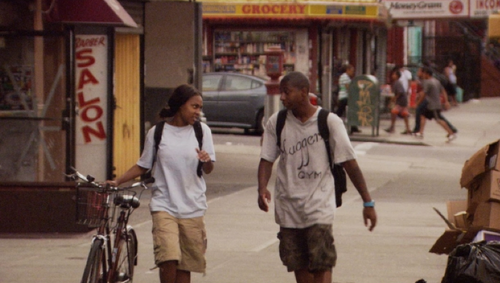

Malcolm (Ty Hickson) and Sofia (Tashiana Washington) are wannabe graffiti artists who dream of gaining massive street respect, and to get back to their rivals who cover all their best work. They aim to achieve this by bombing the NY Mets Apple, a mascot that is raised every time there's a home run on a baseball game. No one has previously succeeded in this, and Malcolm and Sofia would need some money to successfully complete the job. Malcolm plans to do this by wooing a rich, idle teenager Ginnie (Zoë Lescaze) and stealing money from her parents' apartement.


Leon makes his hard-luck protagonists likeable, even if they are thieving and conning little losers. Such is the might of featuring good bullshitting scenes, and believable street-level transitional scenes. The characters feel real and like they belong to the environment. Leon also has a few brief scenes of underground parties and graffiti-making but these are by no means emphasized and are just there to give a better idea of the life the main characters are living.


The downside of the film is that it features very little in particular in terms of content, so the viewers thoughts about this are in the end kind of a breeze. But the film helps one pass the time until the next screening in a very pleasurable way. You feel as if you had just spent some time with some good friends.

★★★ 1/2

Corman's World: Exploits of a Hollywood Rebel (USA)
Director: Alex Stapleton


This documentary chronicles the incredible career of a true Hollywood rebel and an individual. Roger Corman has shaped so much of how movies have developed from the 50's to the 70's that it's almost impossible to overestimate his influence on American Movie industry in general. He's most beloved by people such as me, who enjoy schlock and exploitation, the films that tend to our most primal needs. But he has also funded and given a much-needed film-school in action to a number of auteurs so large, it's pointless to list them all here. Plus, Corman's own directions, such as his delightfully far-fetched adaptations of Edgar Allan Poe's novellas, are quite good in themselves.

We also get to see Corman on the set of his latest movie, going straight-to-DVD or worse, to be a SyFy channel original. It's another cheapo killer crocodile movie, featuring babes, carnage and rubber beasts just like in the good old days. Old clips make even the most tedious films of Corman's back catalogue seem exciting.


The biggest problem with the documentary is that Corman is such a larger-than-life character with such an amazing career full of twists and turns that it's almost impossible to fit it all comfrotably into 100 minutes. As such, it skips over lengthy creative periods I would've enjoyed hearing a lot more about. This project would have worked better as a television series than just a short biopic.

The strength of the film is that Corman is a very rare breed of person in Hollywood, in that you can say whatever's on your mind about him. He won't sue or even mind, because most of the stories are true anyway, and at the core he's always had a big heart. A large cast of Hollywood's whos-who has participated, including Joe Dante, Martin Scorsese, Pam Grier, Eli Roth and Robert De Niro. Bonus points for leaving motor-mouthed walking film encyclopedia Quentin Tarantino merely to a cameo role as Corman's Oscar presenter. There's plenty of story available here otherwise, as the end credits featuring a large list of interviewees cut out for time, prove.


Jack Nicholson is the most fun interviewee on display here. Thinking about his past with Corman he in turn is laughing, bitching, giving a "fuck you" or two to Roger and seemingly seething with joy over the good old days of youth, drugs and innovative filmmaking. Most surprisingly, he starts crying spontaneously. It doesn't feel staged, and wisely Stapleton directing won't linger or underline the importance of the scene. It really seems like the old actor is moved to tears while thinking about his old friend and mentor.

★★★ 1/2

Shut Up and Play the Hits (UK)
Directors: Will Lovelace, Dylan Southern


Somehow a major portion of rock documentaries these days seem to deal with midlife crises of rock stars. Case in point is the film chronicling the final concert of LCD Soundsystem, the electronic project by James Murphy. The film leaves it unclear as to why Murphy has suddenly grown tired of his stardom, but hints its all due other problems concerning him feeling himself too old to be in the middle of a scene or an idol to millions of hipsters (or, granted, fans of good music in general). And leaving his popular band behind doesn't seem like a solution to these problems anyway.


While a lot of the first act of the film deals on the identity crisis the recluctant rock star Murphy lives with, the real meat of the film is of course on the high-def concert footage of the band's final show in Madison Square Garden. It takes strangely long to get that far, given that the film opens on the day after, seeing Murphy going through mundane everyday things just like any one of us. But when we finally get the flashback of the night before, he's an angel, singing from all his heart and more perfectly than ever. The music doesn't feel melancholic, mechanic or forced, but as one big happy jam, created only through a close collaboration with a big band filled with talented musicians.


While shooting the gig, cameras swoop and swoosh, showing both incredibly close footage of Murphy and his minstrels playing, and the grandiose hall filled with an audience and drowning in light, confetti and the overwhelming emotions. The selection of muisc is a good one, emphasizing songs from the band's best album Sound of Silver.


So with a grandiose ending that leaves a good taste on everyone's mouth, and perhaps a tear or two, it was more than fitting to close this festival. Good show. Very good.

★★★★

Wednesday, 10 October 2012

Rock 'N Roll Party Monsters


Movie monsters usually represent the raging id fighting the boring mainstream middle-class values. Thus, they tend to get to have all the fun. Monsters are often sexual creatures, and thus also know how to party. In the hedonistic 70's this was over-emphasized as the growing affection and gentle lampoon of the monster-movies of yester-years grew. That's why the flamboyant, colorful new breed of movie monsters were a clear sexual threat as well as unreliable beings capable of destruction and murder.

Also this was the time when rock music adapted horror movie imagery. It was a clear step beyond the limits of mainstream boundaries, as rock was deemed dark, forbidden and dangerous at the time. It soon was also clear that new monster movies had to adapt rock music vice versa. The combination of the might brought out some very unexpected monsters, sensual and threatening in the very sense of the word. The combining of powers also allowed for some quite vivid and formerly tabu sensual desires to have a new form. It was no wonder several of these rock musicals became beloved cult classics.

Rocky Horror Picture Show (1975)
Director: Jim Sharman


Based on Richard O'Brien's famed stage play, RHPS is a cult film like no other. The devotion the film's fans have over it is almost fanatic and goes way past just knowing the lines and songs of the movie by heart and chanting them aloud. Screening RHPS with the right audience is a pre-packaged party in itself. There are plenty of rules and ways to experience the ultimate Rocky viewing party, but one just can't sit still at one's seat. Much like the maniac mansion it features, the movie has long since left the realm of being "just a movie".


Brad (Barry Boswick) and Janet (Susan Sarandon) are a bland, white-bread couple who decide to get hitched. They rush off to announce the news to their friend Dr. Scott, whose science exhibit was once the place where they found each other. But driving on a dark night in a dreadful storm, they get lost and must take shelter on a nearby castle. The odd servants Riff-Raff (Richard O'Brien) and Magenta (Patricia Quinn) allow them in but reveal that the castle is hosting a party for oddball Transylvanians. When the Time Warp dance is on, there's no turning back.


The lord of the manor is Dr. Frank-N-Furter (Tim Curry), a transvestite scientist on the verge of creating a new boy toy for him, Rocky (Peter Hinwood). But Frank's sexual appetite is not that easily satisfied, and during the night he manages to seduce both Brad and Janet separately. While Brad tries to still keep up appearances, the experience is a true eye-opener for Janet who has her own sexual revolution. But this may all be playing into the bigger plans of Frank-N-Furter.


As a film, RHPS is actually is nothing very innovative and at times, it shows its stage-bound origins. It's more a cavalcade of macabre style than a coherent movie. But the film has several other things going for it that have clearly fed its cult status. The movie's humour is silly, fast and surprising, often relying on quick-witted dialogue. It seems to have been heavily influenced by the films of the Marx brothers. The simple staging, which often has only a few colors (most often red) as a leading theme, is a big part of the draw. But the biggest asset of the film is its magnificent cast which inhabits their strange roles perfectly, and have their inner workings pinned to even the smallest gesture. It's sad most of them were more or less typecast after this.


What starts out as a parody of cheesy old-time sci-fi/horror films, becomes a fetishist fantasy, and furthermore a bizarre burlesque cabaret. Screenwriters/masterminds behind the entire scheme, Richard O'Brien and Jim Sharman blow raspberries in the faces of modesty and chastity. Like the time it was made, the film features as hedonistic events as they come. The message of the film is to enjoy a healthy sexuality (nevermind the gender of your partner) but not to cheat, force or otherwise become "too extreme". This can be also seen as a call-back to the lost ideals of the hippie movement.

★★★★

Labyrinth (1986)
Director: Jim Henson


Okay, bear with me here. This is not a horror movie or even a musical per se, but it does have monsters and musical sequences in it. Plus, if the sex appeal of Tim Curry in tight leather clothes didn't do anything for ya, we have Sexy David Bowie starring in here. Things couldn't get much more sexy, and though at a surface level this is a children's movie, the theme of sexual awakening is pretty obvious here.

I would've written a Twilight joke here, but I bored myself to death thinking about it.

The early-teens Sarah (Jennifer Connelly) feels threatened by the arrival of a new baby boy in her family. Frustrated and furious, she wishes her loudly crying brother would be taken away by goblins. Thanks to the puppetry of Jim Henson and the Goblin King (Sexy David Bowie), this wish soon comes to pass and Sarah realizes it's up to her to travel to a magical land to get the baby back. But the Sexy Goblin King won't allow here to just come and go to his kingdom. He challenges her to clear his labyrinth, and makes sure every turn is filled with perils and temptations. If she can't make it before midnight, the baby shall become a goblin.

One of these guys, not one looking like Sexy David Bowie.
It isn't until long that Sarah has a party of misfit creatures to accompany her on her quest. The film is really creatures galore, and the vivid imagination of Jim Henson is beautifully realized in the sets and visuals otherwise as well. Too bad the puppetry feels a bit cheap at times. Although the supporting characters are pretty much your basic fantasy/fairy tale archetypes, the world created by Henson has a sort of threatening mood, which makes everyone's loyalty is suspect. As one tends to have in fairy tales, victory can only be achieved when one lets go of selfishness and learns to put others' needs before oneself.


But really, the sexual aspect is the more interesting part in this. The Goblin King announces that he's after Sarah's dreams, and is able to invade them as well. The famous ball-room scene features Connelly staring slack-jawed at smart-dressed Sexy Bowie at his most charming and handsome. The dance the two do is unnervingly alluring, but luckily Henson has good taste and we won't have to see Bowster get his mack on with a 14-year-old. I bet his performance here helped a lot of pre-teen girls reach puberty back in the day. In the end Sarah chooses to party with various-sized goblins, which does feel like an unbelievably perverted choice, particularly when put together with lines such "I learned that I really need you."

Oh, but does Sexy David Bowie sing? Sure.


★★★

Phantom of the Paradise (1974)
Director: Brian DePalma


When looking for the most colorful, inventive and crazy monster musical, one doesn't need to look further than Brian DePalma's ingenious effort. It just may be the auteur's best movie. Mixing classic gothic horror fiction such as The Phantom of the Opera, Frankenstein, Faust, Paradise Lost and The Portrait of Dorian Gray laced with popular glam rock music, satire and the director's own angers with authority and big businesses while also adding a good dose of pure silliness. With these ingredients DePalma was able to create a film so vivid it's hard to digest with one viewing. But it really makes subsequent screenings all the more rewarding and the film just seems to get better and better with time.


Warning, this clip spoils. But rush off to see the movie, I'll wait.

The movies main monster isn't the Phantom but Swan (Paul Williams), the leading record producer in the business and a worshipped musician. He's been on the top of his game for a long time, yet he harbors a terrible secret to his success. He is also a hedonistic asshole, who lives from other people's hopes and dreams yet finds it amusing to crush them. He also invites young girls to his mansion to audition, only to give them to his second-in-command, Philbin (George Memmoli) for sex.

What he lacks in outer sexiness, Paul Williams makes up with a sleazy performance and some magnificent songwriting.

When looking for some new music for the opening of his new rock club, the Paradise, he steals the music of a young aw-shucks musician Winslow (William Finley). The skilled young composer and piano player is a true artistic soul, but timid, shy and adamant to not let everyone else play his music other than himself.


But Swan cruelly cheats Winslow out of his own copyright. When the young artist comes to demand his share, Swan has him imprisoned. A desperate rush for freedom and his rights at Swan's record-pressing plant leaves Winslow scarred, mute and as good as dead. But he manages to rise up and get himself the gear to hide in the back stages of the Palace. There he will fight against the misuse of his music as The Phantom. But Swan is a devious person, and he may find a way to tame even the raging Phantom. A key figure is the beautiful young singer Phoenix (Jessica Harper), whom The Phantom believes is the only one with a voice beautiful enough to sing his greatest work; the rock opera Faust.


DePalma plays a lot with his main themes of voyeurism and the other side of it, reliving life through various medias. The source of Swan's evil is found on the fact that he records everything around him. Swan  He likes to replay the tapes of himself and finds satisfaction mostly from the time he mistreats hopeful young people. The bitter image the film gives on the music industry, which devours its innovators, is quite clearly also something young DePalma felt was evident in the way major studios dealt with oddball young directors.

The film is at times hilariously funny, at times edge-of-your seat exciting and at times heart-breakingly sad. The scene featuring the love-struck Phantom watching through roof window as Swan seduces Phoenix and his cries in the rain and thunder are truly the mark of a tragic monster.


The film something very unique, the only thing even close to this film's mixture of colorful sets, music, the speed and the overflow of unordinary visual ideas, are the rock musicals of Ken Russell. Although Russell liked to have fun as well and throw bizarre visual images into the mix, he never really seemed to have so much substance within the movie as DePalma has. And Brian's script is funny as hell to boot. The scene-stealing flamboyant rock star Beef (Gerrit Graham) and his narcissist, cowardly ways are a laugh riot every time he's on the screen. DePalma had a good eye on what was going on in the world of rock at that time, since glam and stadium rock would only get more ridiculous from there on.

Here's the Beef!

The movie is worth seeing just for DePalma's incredible homage to A Touch of Evil, with a long take from two different perspectives follows a bomb being planted and blowing up a car. It also has the evil version of The Beach Boys called The Beach Bums, who get blown to smithereens. Genius.

★★★★★

Sunday, 30 September 2012

HIFF 2012: Stranger than Fiction

 
Man, I've seen so many Love & Anarchy movies this year that it's going to take a while to get through them all. But it has been quite a festival with loads and loads of interesting cinema to discuss about. I'll open this, the first of my Reports from this year's Helsinki International Film Festival, with a look at three quite extraordinary true stories. As you may recall, I already wrote about Erroll Morris' Tabloid in my pre-festival picks. The weirdness on our documentary-screening cinemas continued deep into the festival.

The Ambassador (Ambassadoren, Denmark)
Director: Mads Brügger


One of the most hyped movies on this year's festival was this Danish pseudo-documentary. It's about the Danish journalist Mads Brügger who fakes and pays his way to become a consul (a diplomat without the immunity) in the Central-African Republic. This position opens opportunities for some very shady side-jobs, and Brügger becomes a smuggler of blood diamonds (diamonds that can't be traced and thus may have been mined at a quarry which uses slave labour).

Brügger attempst to show what kind of a wild west Africa still is, and how dirty western diplomats' hands over there still are. Much has been discussed whether it's really true or just a mockumentary. I think it's safe to say, there are certainly scenes that have been staged, so it's not a full-fledged documentary.

This uncertainty of methods works against the film itself. The biggest reveals in the film don't have the necessary weight into them, when the scenes surrounding them have Brügger just talking bullshit. It's also weird that supposed "hidden cameras" have multiple angle shots. Crucially, in order this to work as any sort of public service announcement, it would need to be a lot more informative and factual. The connections within Africa and the tentacles of international crime are briefly explained but not in a way an audience member could grasp them and digest the info.

While several scenes in the film are quite funny in their politically incorrectness and manage to unveil the racism still inherent in African politics, the jokes don't come very often and even then, don't necessarily work. Brügger's on-screen persona isn't ruthless nor outrageous enough to be enjoyable, and one can't really emphasize with him.

All that adds to the point that the film's pacing is way off, and it never reaches the levels of interest it should. It's a noble effort, with several great scenes (pygmy party, everyone!), but in the end, feels a bit lacking.

★★1/2

Grandma Lo-Fi: The Basement Tapes of Sigrídur Nielsdóttir (Amma Lo-Fi: Kjallaraspólur Sigrídar Níelsdóttur, Iceland)
Directors: Ingibjörg Birgisdóttir, Orii Jónsson, Kristin Björk Kristjánsdóttir


This Islandish doc is about how one is never too old to be creative. Sigrídur Nielsdóttir got a synthesizer as a 70th birthday present from her friends. She soon became enthralled with the thing and started to compose some music of her own, based on the base lines and background beats found in the machine itself. She had a knack for it and in the end, taped 59 recordings. Initially for her friends and family, they were found by a larger audience and she became an inspiration for a whole generation of musicians. The cute old granny is likeable enough to pull the documentary by herself.

The documentary is only 62 minutes long and, focuses heavily on Sigríd. It's all well and good, but the viewer gets a feeling that another side of the story is blocked altogether. It would pay to feature some of the musicians inspired by Sigríd's music in the doc. Also missing are any fans or third parties, like friends and family, enjoying Ingrid's music. Only text screens and tie-in animation scenes put the artist herself in the right context.

There's no need to underline the quirkiness of the subject, but in doing so, the film goes to kitchy lengths. This starts to get annoying after a while. Paper clip animations, singing ballerinas and cute animals picture some of Ingrid's best songs. Ingrid would be sweet enough on her own, whether blowing a whistle, telling about her youth or bringing in a new batch of cassettes with her wheeled grocery bag. Not much time is dwelled on any (minor) negative aspects of the artist, only her stage fright is mentioned in one text screen.

Perhaps the artist died before the documentarists could achieve everything they aimed for, but one got the feeling the subject matter would deserve a film that would go a bit deeper

★★1/2

The Imposter (UK)
Director: Bart Layton


The portrait of a liar is one of the most interesting stories one can tell, and even moreso in documentaries, where one has to be a bit wary whether to take the things stated with a grain of salt or not.

Frédéric Bourdin, a French-born con man, had no family growing up, so he made a career in attempting to steal that unit from others. His biggest con involved the Barclays, a grieving Texan family, pining for their missing teenaged child Nicholas. Bourdin successfully stole Nicholas' identity and cheated his way into the family for years. The Barclays wouldn't question whether he really was their long-lost son. This is although he had the wrong hair color, wrong facial characteristics, wrong eye color, and to top it all, a thick accent.
This documentary goes through the whole ordeal from start to finish. It collects a frankly impressive array of interviewees, since basically all parties still alive from the case are in the film. And this is even though the subject matter must not be the easiest thing for all parties involved to talk about. Not only did they lose a family member to mysterious circumstances, they got their hopes crushed and in a way, lost their son again when Bourdin's hoax was revealed.

Re-enacting a past crime in the beginning seems to be like an episode of True Crimes in the beginning. But one becomes enthralled since the interviewees seem to be so open, telling their inner thoughs and feelings with seemingly alarming accuracy. The eccentric person of Bourdin  is well-realized in the doc. One starts to like him a little bit, even though it is made clear that he is unable to stop trying to take advantage of any situation by spinning more of a web of lies.

Towards the end of his con, Bourdin gets suspicious himself as to why his new family doesn't realize anything to be wrong with him. FBI agents still studying the case have dug up enough info to put him behind bars for fraud, yet the family defends him and insists he is who he says he is. Bourdin comes to the conclusion that they have something to hide themselves, and the arrival of is convinient for their own plans. Namely, hiding the death of Nicholas in their hands.

The question here isn't, who's lying, but rather, who is the crucial liar. The film doesn't offer any easy answers, but it does have some good social criticism and insights on an inner rot eating an deal suburban Americana inside out. It's a suspensful and thought-provoking film, and that's as much as one can hope for.

★★★★

Searching For Sugar Man (Sweden, the UK)
Directors: Malik Bendjelloul


Fame is a difficult beat to capture. It may even be hard to tell whether it exists in the first place or is just good enough at hiding.

Sixto Rodriguez was a creative folk artist in the late 60's, early 70's America, that never got the break he deserved. He played in the seedy clubs at his native Detroit and released two albums, produced by Motown mogul Clarence Avant. Even though record executives figured he'd be huge with his talents, nobody bought his albums in his home land. Rodriguez vanished into thin air after the commercial failure of his latter album.

But the story of the artist only begins there. For the record made its way into South Africa, and the locals over there became crazy over it. In the narrow-minded apartheid culture of that time, political protest songs captured something about the native psyche. Rodriguez was also deemed dangerous by the government and censored, which made him an even more important underground figure. The artist became as popular in the country as Elvis Presley or the Beatles. But nobody in South Africa knew anything about their idol. Wild rumours started to circulate, like that the artist had burned himself alive on stage since he didn't get the appreciation he wanted.

Tracking down what happened to Rodriguez has been a process that has lasted for years. South African music fans Simon Chinn and Dennis "Sugar Man" Coffey tried to track the artist down through years of research and calls to record executives. The documentary follows their detective work for the first half and it is some very intriguing stuff. Going in the movie without knowing anything about Rodriguez also makes new listeners instant fans and terribly interested in the fate of the artist. I'd recommend everyone to see the film to have this curiosity for themselves before reading any further. The latter half of the doc is a very different beast and in order to assess it, one must write a spoiler or a few. So look away.

Like Rodriguez used to look away from his audience back in the day.
Rodriguez didn't commit suicide nor die of a drug overdose, but decided to take life by the balls and went to do some easy storage works. The artist is found alive, but without a single bitter bone in his body. He's happy with where he was at life, even though he lived in poverty due to the royalty checks from South Africa never reaching him. He didn't do it for the money, he did it for love, as he has done everything since. At Detroit, he was a well-known man, friend to many, but nobody had any idea he had been a recording artist.

The Swedish film is unbelievably well-directed, with just the right amount of talking heads, investigative journalism, and music thrown in the mix, visualized with scenery shots and occasionally animated montages. The film basically does two seperate stories, one a detective story and a mystery, which gets a satisfying ending but with some of the bad guys (like the ones who pocketed Rodriguez's royalty money) walking away scot free.

The second half is more of a philosophical character piece, with an unbelievably easy-going, mellow and friendly musician coming to terms with his newfound fame. Rodriguez is so zen in his approach, he isn't afraid to play to thousands of people, but film interviews seemingly scare him a little. It is clear that this guy is as happy as doing odd jobs at a storage than playing his old songs, which he has never forgotten. For South Africans (and music fans) the climax is seeing Rodriguez finally climbing on the stage of a concert hall.

The moral of the story is, never forget your past, but don't hold grudges against it, but take the good things with you. Important movies such as this one can change your life. And at the very least teach you something interesting about music on the side.

★★★★ 1/2

Thursday, 23 August 2012

Old Old School Hip-Hop


On the streets of late 70's New York, poverty reigned and crime was at an all-time high. But the seedy athmosphere did create the whole hip hop culture, with rap, graffiti and breakdancing becoming different aspects of the urban culture. Even though it began as an underground, barely legal subculture, by the early 80's it became so popular that movie makers eager to catch on to the latest trend, started churning out movies. Of course this helped feed the culture even more and to turn the subculture into mainstream. But the fact that these movies present the post between these two parts of the phenomena, make them all the more interesting.

Wild Style (1983)
Director: Charlie Ahearn


The film which is most famous of first depicting hip hop culture to mainstream audiences, mixes documentary footage of the New York subculture in South Bronx with acted dramatic material. Real-life hip hop cultural icons play similar characters to themselves, and the film's plot is somewhat based on reality.  The underground rap gigs, the dancers and the taggers are to some extend filmed as they actually happened, on tiny underground clubs and behind fences events. There's also a whiff of hustling, such as illegal card flip games, in the film. Real social problems, such as alcohol, drugs or underage sex aren't dealt with, however. But in any case, it's a good period piece on how underground culture was in New York once everybody and their granny had heard of punk rock.


Zoro (Lee Quinones) is a graffiti artist, well known by reputation, but less so by appearance. He hangs around with a girl, Rose (Sandra Fabara), who he's secretly harboring a crush. He teaches her everything he knows, how to make good street art, where to strike, and how not to get caught. Zoro wants to express himself, but he also wants something more from his life. Not figuring out what it could be, he sort of drifts along, tormented. When Rose gets her shit better together, and gets acceptance from the New York art circles, their relationship becomes more strained. Most of the time, however, is spent on just depicting the culture as it unfolds.


You might be a famous and undeniably talented graffiti artist or rapper, but that doesn't make you a good actor. The dramatic parts of the film are ludicrously horribly acted. Luckily most of the time the movie plays it cool and keeps up with its authenticity. Not only the street art is impressive in this film, the rap scenes also feature mad improvisation skills and wicked mixing with old-school equipment. Ahearn's movie doesn't explain everything about the sub-culture from the ground up to anyone. You either get it going in or don't. It is what it is, which is why this is a clear cult movie. The soundtrack of this film is almost equally famous to the film, since it features rap artists the likes of Busy Bee, Fantastic Freaks, Fab 5 Freddie, and Grandmaster Flash and The Furious Five.

It turned out there were more than plenty of eager-minded people who did get it. The movie proved to be successful enough to make movie producers take notice.


★★★

Beat Street (1984)
Director: Stan Lathan


The following year, there were two other hip hop movies aimed for bigger audiences. The other was a straight-out dramatization of the things presented in Wild Style, the other focused on Breakdancing and became the bigger hit. The former, which was the better film, also took into focus graffiti artists, yet also emphasized rap music more, and works more or less as a musical. The film's soundtrack, starring the likes of Grandmaster Melle Mel, Kool Moe Dee, Us Girls and Rock Steady Crew, is perhaps even better than Wild Style's.


Kenny "Double K" (Guy Davis) and Ramon (Jon Chadriet) are best friends, and graffiti artists living in the seedy parts of New York. Ramon is more down-to-earth of the duo, but respects his art more than anything and wants to spraypaint a train that would take his graffiti out for all of New York to see. Kenny has rap skills and dreams of becoming a famous MC, playing at the hottest clubs of NYC. He meets Tracy (Commando's Rae Dawn Chong), who comes from a better neighborhood and upper class, but still becomes interested in music and breakdancing. The two start to get interested in each other, which inspires Double K also to aim his ambitions high.


As musicals tend to be, this is quite a melodramatic story. But not so much concerning the love story, more on Double K's troubles with his background and ambitions, the conflict between his family and his hobbies, and his relationship with his friends. Still, there's a clear West Side Story vibe here, with dueling gangs and such. The main villain turns out to be a sort of vandal to the vandals, an asshole who messes huge artistic graffiti murals by spraypainting all over them. Whatever one's stance on street art is, I think we can all agree that that's not a nice thing to do.

Warning! While the rap performance in this clip kicks ass, it also contains major movie spoilers.


"If art is a crime, may God forgive me". - Ramo

★★★ 1/2

Breakin' (a.k.a. Breakdance, 1984)
Director: Joel Silberg


Whereas the two other hip hop films were still fresh and more or less authentic-feeling, it didn't take long before the first cash-in on the phenomenon appeared. And it came from Cannon Group of all production companies. Not known from their subtlety, this effort takes the largest page from the West Side Story book in that, it's basically a street fighting film with the fighting switched to dancing. It's a formula that can still be seen in films such as Step Up! or You Got Served. A big difference is also that Breakin' takes place in LA instead of NYC. Somehow, New York represents to me striving to rise from poverty and squalor, whereas LA only represents surface, fake smiles and proper image.


Ozone (Adolfo Quiñones) and Turbo (Michael Chambers) are talented breakdancers, who work at the local supermarket and dream of hitting it big. The dancers have a bitter rivalry with a competing group Electro Rock. The buddies usually display their moves for some tourist cash on the streets of Malibu. They meet a young and aspiring Jazz dancer Kelly (Lucinda Dickey), who becomes interested in the breakdance culture. She gets the name Special K and starts to practice with the boys. But her strict instructor doesn't like her hybrid style that starts to infuse moves she learned from the street. Special K will prove him wrong as she will lead the Dance trio to the top and bring breakdance to the mainstream at the same time.


Of course, the film is Super Cheesy. There's not a hint of authenticity in any of this, and particularly the overly 80's fashions in the film are over-the-top and hilarious. Even the movie's breakout star, Ice-T (playing a Club DJ) considers this to be wack. And knowing what kind of films Ice-T has made in his career, that's saying something. Alongside Mr. Ice, the Soundtrack includes the likes of Kraftwerk, Rufus and Chaka Khan, and The Bar-Keys. The film did capture something of the zeitgeist since it proved to be popular. But the producers already were certain of it. They were so sure of it's success it even advertized its direct sequel in the closing credits. Today, the movie series is probably best known for the ridiculous name of part II. But Breakin' 2: Electric Boogaloo is a story for another time.

★ or ★★★★★

Sunday, 5 August 2012

Dragon By Name...


Dragons are majestic creatures (or would be, if there were any). However, the word itself is one of the most misused in motion picture history. I'd wager there are more movies with "dragon" on the title that don't feature any dragons whatsover, than there are those that do. I wrote about actual Dragon movies a while ago, and it seemed to go down well with the audience. That's also why The Last Movieblog is now ready to take a look at four of false advertisement Dragon-movies and tell what the Dragon in the title is supposed to symbolize.

The Last Dragon (1985)
Director: Michael Schultz


The nickname for Bruce Lee was "The Dragon", which is why his two movies were titled "Enter The Dragon" and "Way of The Dragon". Because of the classic status of these two so it's no wonder a significant part of Dragon-titled movies are kung fu flicks, made to cash in the impression. One of the weirdest ones (that was not Bruceploitation per se, at least) of them was this kung fu parody, produced by Motown records to sell some pop hits to the 80's youth. The premise is by far not the only odd choice in this cheesefest.

Say what?! Cheesefest?

The protagonist, "Bruce" Leroy Green (Taimak), is The Last Dragon. This in the sense that he is the last student of kung fu that still trusts to chivalry and being pure of heart, living in the notoriously seedy New York area of Harlem. This infuriates the local gang boss, Sho'Nuff (Julius Carry), who wants to challenge Leroy to a fight to the death. But Leroy escapes his clutches again and again, refusing to fight for no good reason. The would-be Bruce Lee also attempts to reach the final level of martial arts mastery, "the glow", yet is unsure how to reach it. But then he happens to save a famous VJ and aspiring pop star Laura Charles (Vanity) from thugs sent by greedy record mogul Eddie Arkadian (Christopher Murney). The pair begins to fall for each other. But can even Laura break through the tough shell of the stoic hero?

The film is at the same time one big pop video, and a parody of such. The odd style choices bring to mind the starlet Vanity's then-boyfriend Prince's fims and music video stylings. But Prince rarely seemed to be able to have as much fun in his own videos. The goofy fashions, the ridiculous dialogue, the colorful cast of characters... But overall, the film is also a bit messy, as it can't really decide on whether it wants to be a kung-fu adventure, a pop love story, or a parody of both. The jokes are from time to time oddly weak. There's also the matter of a super-annoying kid brother of Leroy's, Richie (Leo O'Brien). He belittles Leroy all the time, while thinking he's a street-savvy big-time ladies' man. Much of the plot hinges on his desire to get in Laura Charles' panties.

"I'm so ashamed at you right now."
Equally odd character is Arkadian's girlfriend, Angela Viracco (Faith Prince), a screechy bimbo whose music videos, set to replace Laura's from the TV, are hilariously terrible. She seems oblivious from all that goes on around her. But the film's biggest asset, one could almost say savior, is Carry's Big Bad, The self-appointed Shogun of Harlem. Carry chews the scenery with every scene he's in, dicking around in a movie theatre, killing non-chalantly burly attackers, and constantly seething with barely contained fury and rage, and cackling maniacally from time to time. He also gets all the best lines:
"Kiss my Converse!"

Maybe the time of dragons has passed and the time of mutant alligators has come.

★★★

Kiss of the Dragon 
Director: Chris Nahon


After Bruce Lee, "Dragon" in the movie title evolved into a word that generally means "Chinese", often with kung fu skills. This movie is also titled thus, because it features a romance between Jet Li's Chinese police officer and a caucasian woman, played by Bridget Fonda. As Jet Li's Hollywood films tend to be, it is sort of entertaining, yet contains little to nothing so special that would make the film memorable. I know I've seen this film multiple times, yet it's hard to remember anything from it without resorting to doublechecking, courtesy of IMDb.

The Chinese intelligence officer Liu Jian (Li) arrives to Paris to capture a notorious drug lord Mr. Big (Ric Young). But it turns out the Paris police force's Inspector Richard (Tchéky Karyo) has been working with the Triad drug trafficers. Now he attempts to capture the entire drug operation by killing Big, and blaming it on Liu. But Liu escapes with his life, and runs into Jessica (Fonda), one of the prostitutes Richard is also pimping. Jessica's daughter is kept by the gangsters to ensure her loyalty to Richard. So, the pair starts to plan a way to strike back and to get Jessica and her daughter free.

This is one of those Luc Besson-penned action movies, and it really shows. He is quite unrelentless in depicting Paris, since in his films they are always packed with higly armed gangsters at every corner. The parisian police are unwilling to stop the violent crimewaves, but rather encourage it by taking a lot of illegal activities of their own. Talk about an American tourist anxiety movie! Besson seems to want to cut down the flock of US tourists flowing into his home town. Besson is also quite shameless in repeating some of his own past glories for profit. The main bad guy here, Karyo's rotten-to-the-core cop Inspector is such a big clone of Léon's Stansfield that Karyo should send Gary Oldman a royalty check from his performance.


Jet Li's high-kicking stunts are fun to behold, and some daring escapes make this a worthy contender for a Friday night movie with the Boys. But at the same time, everything is paper-thin and clichéd. Like said, this is a 13-in-a-dozen bargain bin film, even though the production values are surprisingly high. There's absolutely nothing special about it.

★★ 1/2
The Year of the Dragon (1985)
Director: Michael Cimino


The director Michael Cimino has had to deal with his share of hardships during his long career. One of the biggest was the utter flop of his epic Heaven's Gate (1980). He returned with this hard-boiled crime/action story dealing with the Chinese mafia, the Triads. The end result is a true mixed bag. Cimino does have a string of tropes that make one figure he might have caused some of his problems by his own relentnessness for the content of his films.


The decorated cop, detective Stanley White (Mickey Rourke) is given a new assignment to keep peace at Chinatown, as a punishment for constantly breaking police procedures. White is a former Vietnam vet, which has caused him to hate all Asians with a passion. At the same time White's marriage is crumbling, since he only thinks about his work. But White won't have it easy, since Joey Tai (John Lone) is named the Head of the Triads. Tai is tough and ruthless, and ready to use quite a lot of the ol' ultra violence to reach his goals.

While trying to catch Tai red-handed and to stop all the blood-shed, White also makes aquaitance with an Asian-American reporter Tracy Tzu (Ariane). A fierce love-hate relationship starts. Tzu is the only major Asian character in the film portrayed in any way in a positive light. All others are either savage, violent, uncompromizing and all-around evil, or feeble victims, whether Chinese or Vietnamese. Cimino has had racial issues in all of his films, and they are not uncommon for screenwriter Oliver Stone, either, himself a Vietnam vet like White. And Tzu is a problematic character in her own right, an alluring would-be femme fatale, who is likely to hop in the sack with any man who roughs her up a bit. Thus, she exists in the film merely to be a rug for White to walk all over through this picture.

And in a pervy, voyeuristic fashion. Yet she insists on showing him her lady parts when answering the door.
The strength of the movie lies in the accurate setting, smart cinematography and big, big, big scenes! A lot of money has been used for the sets and Cimino shows this by setting his camera to any corner he can. When Cimino opens the flood gates, he can deliver gut-wrenchingly violent, chaotic and mind-bogglingly big action. And the impact is grown that they often come totally unexpected. The big shootout at a Chinese restaurant is only in the beginning of this film, and hundreds of people lose their lives in that alone. As the film goes on, the violence gets more and more intimate, yet still nasty and (deliberately) hard to watch.

Like many of Cimino's films, this one also starts up slowly, and by the end develops into a real sacrifice story for a misunderstood hero. You can see Christopher Nolan has been watching a lot of his films before making The Dark Knight Rises. Of course, in this case it's a bit problematic that the suffering Christ-figure is not only a huge racist, he's a big asshole from whatever angle one looks at it. Others are merely vehicles for him, and he doesn't respect neither authority nor common human rights. Rourke can play this kind of a conflicted character in his sleep. The problem is that while it's at times fun to watch him pigging it up, it's hard to really give oneself into a hero's journey when it's obvious that White refuses to develop as a character.

★★★

The Girl With The Dragon Tattoo (2011)
Director: David Fincher


This thriller is an adaptation of Stieg Larsson's famed detective novel, which originally was written as Män, som hatar kvinnor, "The Men Who Hate Women". Since the book introduces the hard-luck heroine Lisbeth Salander, who steals the spotlight from the protagonist Mikael Blomqvist, the translations seem to underline the strong female lead. This is a small, and weak-looking girl who will strike back like a tiger, if bothered or attacked.

Fincher improves upon the hugely overrated and uneven novel by spades. Yet it is very clear that this steamlined Hollywood thriller is only an in-between project to pay the bills and save some money for a truly inspiring project for him. But the film didn't perform as expected at the box office, most likely because cinema-goers have already had enough of Stieg Larsson's novels and couldn't be arsed to see another adaptation. I'm told the Swedish TV mini-series cut-into-a-movie is also a faithful adaptation, if not as flashy and cinematic.

The famed Swedish economy reporter Blomqvist (Daniel Craig) loses a court case against a seedy billionaire, and must withdraw from public life. He is hired by an oldindustrial patriarch Henrik Vanger (Christopher Plummer) to dig his family's dark and dirty past. To the outside Blomqvist tells he's writing a biography, when in actuality he's attempting to solve the 50-year-old disappearance of Henrik's granddaughter. Meanwhile, Lisbeth Salander (Rooney Mara) works as an information specialist at a computer security company. She is the best at what she does, since she's in actuality a world-class hacker. When digging for Blomqvist's records, she herself becomes interested in his case. yet she also has other problems to deal with, as she's deemed mentally challenged by court order and must check in with a guardian, the misogynist Hans-Erik Wennerström (Ulf Friberg) who's looking for a bit of young ass and not getting caught. But as he will see, Lisbeth is more than capable of defending herself.

Yes, they even meet at one point, nearing the end.

The film opens with a sequence with Atticus Finch's and Trent Reznor's cover of Led Zeppelin's Immigrant Song, while oily figures form symbols of the film's themes. It is fast-cut and jaw-droppingly awesome. It's also apt since it also gives an unrelenting feel of dread that surrounds the gloomy, melancholy cinematography of modern-day Sweden. The film follows suit, with particularly Larsson's forever-dragging opening and closing glossed over as quickly as possible. The only flaw is that Fincher also limits the time where the actual murder investigation takes place, which is the most interesting part of the book. Sure, it is a bit difficult to get across, cinematically, but Fincher has done it before, excellently, in his Zodiac.

Fincher doesn't just run through the book, however. He also gives suitably time to get to know it's main players. Craig is surprisingly good as an anti-Bond, a man whose more common and likely to think his way through than to go blasting. But the real star-making turn of the film belongs to Rooney Mara, who brings some vunerablity and sympathy to the hard-boiled cover of Salander. Critics have noted she has softened the heroine too much. Yet performing her as a straight-up sociopath as in the novel, would make it harder to root for her, even if she has to go through hell. Another thing criticized often is a certain rape scene. I think Fincher attempts to emphasize more of the humiliation connected to such a vile act, than the physical pain. It is not easy to look at, yet also not tastelessly explicit. As for suspense, Fincher also knows how to tighten the screws enough to make the ordeal exciting and anxious. It is truly a work of the modern master of suspense. Not even near his best, but it'll do more than well.

★★★ 1/2

LinkWithin

Related Posts Plugin for WordPress, Blogger...