Showing posts with label HIFF. Show all posts

Wednesday, 2 December 2020

Love & Anarchy Advent Calendar


So, we had a Love & Anarchy Film Festival this year as well. I was taking it slow in covering it, but then I realized it was over two months ago. But perhaps by starting an Advent Calendar I can cover 24 movies that were seen at the festival. They had chosen a really good program, and kept the audience as safe as possible in these circumstances. Check back to this post on every day of December to catch up on reviews.

1. First Cow (USA, 2019)
Director: Kelly Reichardt


Kelly Reichardt is known for making slow, quiet and ponderous movies, so it's kind of a jump when the new one is basically a buddy comedy of two grifters in the Old West. It's the kind of western that follows on the footsteps of McCabe & Mrs Miller and the like, everything is grey, brown, dirty, flimsily built and wooden. There's no glory or romanticism involved, even if the framing story tells of a modern woman finding out about the history involved.

The movie is a good, multilayered depiction of the friendship between two underdogs, played by John Magaro and Orion Lee. It also has some critique of the American Dream and drive towards entrepreneurship, which proves impossible for even the skilled ones if enough odds are against them right from the start. That's why they have to resort to cheating, stealing milk from the prize cow to improve their cakes and thus bake sales. The film has a cold, unflinching look at nature, which is at the same time utterly ruthless and oddly comforting. we are all parts of the woods in the end.

★★★★

2. Wendy (USA, 2019)
Dir. Benh Zeitlin


The impressionistic director Benh Zeitlin with his crew has prepared his follow-up to Beasts of a Southern Wild for seven years. While that one saw wonder and childlike amazement in poor and devastated Southeast terriories, this one takes a jump toward even more fantastic storytelling. It's a reworking of the story of Peter Pan.

The film is again visually stunning, and the locations in the Pacific Islands with an active volcano are nothing short of breathtaking. This time around, Zeitling guides a larger cast of child actors, none of which are as strong to carry a movie as Quvenzhané Wallis was. It also seems that the long production period and kids growing up so fast has made it necessary to tell the story fragmented and disjointed. It may be argued that its due to the logic following children's playtimes, but it makes for a tedious thing to follow. There are some kind of cool reworkings of the Pan story set to a more modern backdrop, but some are basically terrible. Mostly anything to do with Captain Hook and his pirates. Beasts of a Southern Wild was not without its problems, but it had a more clear purpose, now it seems it's a bit too childish and dumbed down for adults and not exciting enough for kids, satisfying no one.

★★

3. Lost Boys (Finland/Thailand 2020)
Dirs. Joonas Neuvonen, Sadri Cetinkaya


The documentary film Reindeerspotting made waves a decade ago, and also became a big hit in Finland. The movie depicted a group of drug addicts from Lapland in their daily lives, fighting against their urges, boredom, and the system. From the profits of the film, the real-life buddy group got enough money to fly to Thailand for the winter. After a few months of pure hedonism, sex, drugs and all other vices, only the film's director Joonas Neuvonen returned home. Soon after, one of the group was missing and the first film's main character Jani was found dead in shady circumstances.

The sequel film is of Neuvonen's attempts to recollect, what went wrong and to try to find out what exactly happened to his friends. The material he had for this film were fragmented, some in pooor quality. The reason the film took a decade was that it needed multiple screenwriters, editors and even co-directors to make sense of all this. Considering this, the resulting film is a wonder, a docufiction that is both a horrifying psychedelic nightmare in the vein of Gaspar Noé and Nicolas Winding Refn. On the other hand, it is also a sad look at the dead end facing the first film's characters. They might get some fleeting moments of happiness late in their lives, but it's all a illusion and the ground is approaching fast. This time around, Neuvonen puts himself more to under the magnifying glass, emphasizes his own bad feelings about the case and maybe his own fractured psyche.

★★★★

4. Radioactive (UK, Hungary, China, France, USA 2019)
Dir. Marjane Satrapi


The author of Persepolis, Marjane Satrapi, hasn't had the most successful career as a film director. His previous film, Voices, flopped in the Stateside, so she has had to resort to having an easy-to-sell biography project made with funding from around the world as her next project. The film tells the life story of chemist Marie Curie, discoverer of Radioactive elements. As it is, Radioactive has many moments of visual intrigue and good acting, but it can't avoid all the major pratfalls of the biography genre.

Rosamund Pike carries the film as headstrong Curie. As Satrapi tends to do with her comics work, she also intercuts the story with asides that show consequences of the discoveries, both good (radiation treatments) and bad (the Chernobyl accident). Those asides however reveal the film's limited budget, even if it's stretched admirably to fit these parts. The major problem is, however, that like most scientists, the life story by itself isn't really that captivating, and showing of all the various awards and stuff seems like reading from a Wikipedia page. The center is the relationship between Marie and Pierre (Sam Riley), but it lacks tension since Pierre is doing his best to share credits and help Marie as much as he can. The adventures in World War I with her daughter, shrugged off in the film's last 20 minutes, would have been more interesting to follow than focusing on the early parts.

★★

5. Nomadland (USA, Germany 2020)
Dir. Chloé Zhao


Director Zhao once again finds a way to make a western that's relevant to the themes for today. And she does it with a docufiction style, having plenty of people with the nomad lifestyle essentially play themselves. It's a touching film about the inability to find one's place in the world, but for once, not through the eyes of a teen or a young adult, but an actual adult, magnificently portrayed by Frances McDormand.

McDormand's Fern is tossed out after the closure of a major factory and an entire town's livelyhood. She does meaningless part-time work for Amazon and lives in her trailer, traveling the Great Plains of USA.  On her way, she tries developing relationships, but everything seems fleeting and avoid her grasp. The film has an anti-capitalist sting, but I feel the film could have had more brutally honest things to say about Amazon's worker practices, which were only alluded to here. It may be due to the realities of releasing such a melancholic film for adults, one can't rule out Amazon by biting the hand that may feed you. It's a shame Zhao herself seems to accept the odd job here and there, since she's moving on to the MCU. I think certain rising talents could produce incredible movies elsewhere, whereas with Marvel they'll probably do something reasonably entertaining but forgettable. But that's late-stage capitalism for you. It maximises profits, not art.

★★★★ 1/2

6. Dogs Don't Wear Pants (Koirat eivät käytä housuja, Finland, Latvia 2019)
Dir. J-P Valkeapää


I had actually seen this last year in festival screenings, but since then this movie has become a bit notorious abroad, so it warrants a mention. It's a sort of dark comedy of a man (Pekka Streng) struggling with grief finding a new lease in life with kinky sex and especially with a blossoming relationship with a dominatrix (Krista Kosonen).

Valkeapää is perhaps the most gifted visualist of the new generation of Finnish filmmakers. Here he has some shades of neon noir or the films of the likes of Noé and Friedkin, but manages to do something unique and undoubtedly his. It's a considerable step up of his previous work that had clearer pastiches. It's not as rough and kinky as one might expect, but it's also no surprise that some things get taken a bit far. The key of the movie is in its central triangle drama of sorts with a father being drawn into a sexy underworld, but his daughter also needing him in her struggles.

★★★★

7. My Octopus Teacher (South Africa 2020)
Dirs. Pippa Ehrlich, James Reed

Filmmaker Craig Forster recalls an unusual encounter with an octopus in an underwater kelp forest. Octopi are as intelligent as house cats, so the fil m goes out its way to show how they too can act as personally, gracefully and smartly as any pet, with footage to support it. I'm usually wary of films that make of animal behaviour to be to human-like, and there are some interpretations here that near the line. As it is however, is a reminder that we have incredible species around the world that have their own emotions, and we just can't go on destroying the landscapes in which they live in.  

★★★

Thursday, 5 September 2013

Tips for Love & Anarchy Festival


The most important time of the year is nigh, and the Helsinki International Film Festival is almost upon us. There are more than 300 films on display there, so many readers might have a hard time choosing what to see. I did a short list on Twitter, but since Tweets tend to get lost in the waves of the sea of information, I got requests to do more. So, blogging is a bit more substantial. Here's my top 10 tips.

1. The Life of Adélé, parts 1 & 2 (a.k.a. Blue Is The Warmest Color)
Dir. Abdellatif Kechiche

Ever since this film debuted in Cannes to the ecstatic reactions of French film aficionados, there's been little doubt that this comic book adaptation about a girl's first love (that happens to be another woman) would be perhaps THE biggest event movie of the year. The fact that this 3-hour mammoth was chosen as the opening film of the festival seems to confirm this notion. I simply cannot wait.

At the moment, the official Finnish premiere date of the film is 13th December.

2. Nebraska
Dir. Alexander Payne

Payne is back to doing what he does best, so this is another tragi-comical road trip through America, starring a curmudgeonly old man (Bruce Dern), and his estranged, clueless middle-aged son (Will Forte). Maybe this is Payne going through the motions, but he hasn't failed me yet, so I won't miss this.

3. Stories We Tell 
Dir. Sarah Polley

After seeing the brilliant Take This Waltz last year, I became convinced that the future belongs to Sarah Polley. The biggest young hope American cinema has, has directed a documentary about her own family, about her actress mother who died at an early age, and her foster parents. Reports have so far said the film is sufficiently warm without being schmaltzy, so I'm in.

4. No
Dir. Pablo Larraín

Mark Kermode has been raving about this story, based on true facts, about an ad executive running a campaign against the Chilean dictator Augusto Pinochet. An exciting political thriller, with a story almost too weird to be true. Yes.

5. Stoker
Dir. Park Chan-Wook

This was almost a DVD premiere here, but luckily we also get a cinema screening or few of the Korean mastermind Park's first English language film. And a good thing too, since Park's slow-moving films are always best screened at a theatre, not at home. This twisted, dry horror-comedy seems very intriguing, but I've been avoiding reading too much about the plot.

6. Sightseers / A Field In England
Dir. Ben Wheatley

Two new films from the genre-bashing English director have generated plenty of positive buzz. I liked Kill List plenty, although did not hail it as good as many others. But from what I've heard, the director has just gotten more unpredictable, twisted and skillful since. These are also films I figure it's best not to know too much beforehand.

7. The Act Of Killing - Director's Cut
Dirs. Joshua Oppenheimer, Christine Cynn, Anonymous

In what's surely to be the most talked-about documentary of the year, we get a chance to look the closest appromination of human evil straight in the eye. Indonesian death squad leaders talk about their past homicides and cruelties open, as if there was nothing wrong with it.

The TV version of the film will be shown in Finland in YLE TV2's Docventures series on 6th of November. The version at Love & Anarchy is the longer Director's Cut, and director Joshua Oppenheimer will also be present at several screenings.

8. Monsoon Shootout
Dir. Amit Kumar

HIFF doesn't really offer as many groovy exotic action movies these days as it did in its heyday. But from this year's crop, it's easy to pick this Indian cop thriller as the most promising one. This is no Bollywood song-and-dance number. It's based on true brutal police shootings, but doesn't spare on the guns, bullets and chase scenes. Yeah!

9. Bastards (Les salauds)
Dir. Claire Denis

This French movie won the audience award at Midnight Sun Film Festival this year. This is another depressing crime flick, but those thrillers seem to be the most interesting when all of its main characters are several levels of assholes. Morally grey is the way to go, and I trust Denis's experience as a director.

10. The Past / The Future
Dir. Asghar Farhadi / Alicia Scherson

Here's a bit of a cheat, but considering the names of these two films, I couldn't resist putting them to the same slot. The Past is A Separation's director Farhadi's latest film. It's a Mystery film about a runaway Iranian man to return home after a long absence to find his wife remarried. It seems Farhadi has another story of the difficulty of maintaining a nuclear family, even in a state that officially warrants it. If you liked Farhadi's previous film, it seems you can't go wrong with this one.

The Future is the story of two idling teenagers, off to a criminal path, until they come across the former muscle movie hero Maciste. The latter is played by Rutger Hauer himself. It seems the film has plenty of Neo Noir influences, but it appears to be hard to grasp, which always makes for an intriguing experience.

So are you Traditional or a Futurist? Never mind, I'm sure you'll find plenty to see at Love & Anarchy. The entire programme is now open at the official web site.

Thursday, 15 November 2012

HIFF2012: On the Side of the Angels


 It's about time I finished off this year's reporting on the Love & Anarchy Festival. It was swell and all, but I've got other festivals to write about too. On this last look at the festival's films, I've selected several feel-good films, all of them about underdogs of sorts who strive to enjoy their lives and to greatness by doing whatever it is they love. Kind of a good life lesson, and one that encapsulates Love & Anarchy within it. So, until next year, Helsinki International Film Festival!

The Angels' Share (UK/France/Belgium/Italy)
Director: Ken Loach


The acclaimed director Ken Loach tries out a more comedic approach to his latest film. Make no mistake, it is still about the hardships of lowe-class Scots in a society that can't really fit them anywhere. The ensuing adventure or heist may not be very believable, but the film lives and dies by its cast of characters.

The young Robbie (Paul Brannigan) tries to walk the line, leaving his brawling past behind him to become a good husband and a father to his girlfriend Leonie (Siobham Reilly) and his newborn son. But he has problems with both an old family enemy and Leonie's father, who both attack him constantly. Robbie, along with a group of other minor offenders, are given community service renovating a house. During the job they start to bond with each other and their supervisor Harry (John Henshaw). Harry may be the only authority figure to treat these people with any sort of respect.


The film shifts gear when Harry takes the crew to a whisky tasting, where Robbie learns of a highly expensive old whisky being auctioned soon. A caper to earn money to get out of his rat race of a life starts to form in his life. As funny it is to follow the story, it relies in a few too many happy coincidences. One of them is Robbie's almost supernatural born gift of tasting various whiskys.


But as said, the film is as good as its characters, and the cast here is quite well-rounded with memorable characters and good actors. Stealing scenes is the dumb-as-a-bag-of-hammers Albert (Gary Maitland). Loach himself may have figured this out, too, since he gives him all the funniest lines, and even the opening scene of the movie. In that Albert is too dumb to realize he's being asked to move from railroad tracks due to an upcoming train. Such is the problem of many of the individuals on display here. They don't have the capacity to deal with the hostile world around them and consequently they don't realize how self-destructive they are. Only when they figure out a way to pull together and learn to cheat the system for their own ends, does a happy ending arrive (although it's almost sickeningly happy in this case).

Loach is hard-pressed to prove how big a humanist he is, understanding everyone around. The bone-crunching, sickeningly violent fight scenes contarst the happy-go-lucky fairy tale adventure of the rest of the movie, but don't always hit well together. If consequences are real, then the plot hinges on becoming totally unbelievable.

★★★

Gimme the Loot (USA)
Director: Adam Leon


Sold-out screenings sometimes open one's schedule for something else, something totally new. That was the case when I walked totally oblivious to see Adam Leon's independent teen movie about low-class kids hanging out in New York. It's a clever piece of work, selling that it's story is going to be about something in the very beginning when it's more about loitering, hanging around, plotting, and lusting. Really nothing much happens or even advances. Such is life and matched to a good perception of the poorer neighbourhoods in NYC we have a fun, breezy summer flick for the kids. And adults find plenty to enjoy, too.


Malcolm (Ty Hickson) and Sofia (Tashiana Washington) are wannabe graffiti artists who dream of gaining massive street respect, and to get back to their rivals who cover all their best work. They aim to achieve this by bombing the NY Mets Apple, a mascot that is raised every time there's a home run on a baseball game. No one has previously succeeded in this, and Malcolm and Sofia would need some money to successfully complete the job. Malcolm plans to do this by wooing a rich, idle teenager Ginnie (Zoë Lescaze) and stealing money from her parents' apartement.


Leon makes his hard-luck protagonists likeable, even if they are thieving and conning little losers. Such is the might of featuring good bullshitting scenes, and believable street-level transitional scenes. The characters feel real and like they belong to the environment. Leon also has a few brief scenes of underground parties and graffiti-making but these are by no means emphasized and are just there to give a better idea of the life the main characters are living.


The downside of the film is that it features very little in particular in terms of content, so the viewers thoughts about this are in the end kind of a breeze. But the film helps one pass the time until the next screening in a very pleasurable way. You feel as if you had just spent some time with some good friends.

★★★ 1/2

Corman's World: Exploits of a Hollywood Rebel (USA)
Director: Alex Stapleton


This documentary chronicles the incredible career of a true Hollywood rebel and an individual. Roger Corman has shaped so much of how movies have developed from the 50's to the 70's that it's almost impossible to overestimate his influence on American Movie industry in general. He's most beloved by people such as me, who enjoy schlock and exploitation, the films that tend to our most primal needs. But he has also funded and given a much-needed film-school in action to a number of auteurs so large, it's pointless to list them all here. Plus, Corman's own directions, such as his delightfully far-fetched adaptations of Edgar Allan Poe's novellas, are quite good in themselves.

We also get to see Corman on the set of his latest movie, going straight-to-DVD or worse, to be a SyFy channel original. It's another cheapo killer crocodile movie, featuring babes, carnage and rubber beasts just like in the good old days. Old clips make even the most tedious films of Corman's back catalogue seem exciting.


The biggest problem with the documentary is that Corman is such a larger-than-life character with such an amazing career full of twists and turns that it's almost impossible to fit it all comfrotably into 100 minutes. As such, it skips over lengthy creative periods I would've enjoyed hearing a lot more about. This project would have worked better as a television series than just a short biopic.

The strength of the film is that Corman is a very rare breed of person in Hollywood, in that you can say whatever's on your mind about him. He won't sue or even mind, because most of the stories are true anyway, and at the core he's always had a big heart. A large cast of Hollywood's whos-who has participated, including Joe Dante, Martin Scorsese, Pam Grier, Eli Roth and Robert De Niro. Bonus points for leaving motor-mouthed walking film encyclopedia Quentin Tarantino merely to a cameo role as Corman's Oscar presenter. There's plenty of story available here otherwise, as the end credits featuring a large list of interviewees cut out for time, prove.


Jack Nicholson is the most fun interviewee on display here. Thinking about his past with Corman he in turn is laughing, bitching, giving a "fuck you" or two to Roger and seemingly seething with joy over the good old days of youth, drugs and innovative filmmaking. Most surprisingly, he starts crying spontaneously. It doesn't feel staged, and wisely Stapleton directing won't linger or underline the importance of the scene. It really seems like the old actor is moved to tears while thinking about his old friend and mentor.

★★★ 1/2

Shut Up and Play the Hits (UK)
Directors: Will Lovelace, Dylan Southern


Somehow a major portion of rock documentaries these days seem to deal with midlife crises of rock stars. Case in point is the film chronicling the final concert of LCD Soundsystem, the electronic project by James Murphy. The film leaves it unclear as to why Murphy has suddenly grown tired of his stardom, but hints its all due other problems concerning him feeling himself too old to be in the middle of a scene or an idol to millions of hipsters (or, granted, fans of good music in general). And leaving his popular band behind doesn't seem like a solution to these problems anyway.


While a lot of the first act of the film deals on the identity crisis the recluctant rock star Murphy lives with, the real meat of the film is of course on the high-def concert footage of the band's final show in Madison Square Garden. It takes strangely long to get that far, given that the film opens on the day after, seeing Murphy going through mundane everyday things just like any one of us. But when we finally get the flashback of the night before, he's an angel, singing from all his heart and more perfectly than ever. The music doesn't feel melancholic, mechanic or forced, but as one big happy jam, created only through a close collaboration with a big band filled with talented musicians.


While shooting the gig, cameras swoop and swoosh, showing both incredibly close footage of Murphy and his minstrels playing, and the grandiose hall filled with an audience and drowning in light, confetti and the overwhelming emotions. The selection of muisc is a good one, emphasizing songs from the band's best album Sound of Silver.


So with a grandiose ending that leaves a good taste on everyone's mouth, and perhaps a tear or two, it was more than fitting to close this festival. Good show. Very good.

★★★★

Sunday, 11 November 2012

Review: Rust & Bone


Happy father's day! What better way to celebrate than to take a look at a recent film featuring, among other things, a man learning how to be a father? Jacques Audiard's latest film was screened as the Closing film of this year's Love & Anarchy - Helsinki International Film Festival. It is also on the programme of Pimedate ööde filmfestivaal - PÖFF, or the Tallinn International Film Festival, opening tomorrow.

So, as in many of the director's previous movies, Audiard's new protagonist is a man of few words, that is more used to violence than being a normal member of the society. Ali (Matthias Schoenaerts) is a man arriving to Paris to try to make a living supporting his 5-year-old son and staying at his sister's house. The man is struggling to get by, since he isn't too good working at normal jobs, but since he is imposingly large, he gets hired to be a bouncer at a night club.

One night at work he meets Stéphanie (Marion Cotillard), a whale trainer at the local dolphinarium, who also has a tempered violent side. When she gets kicked out of the club, Ali sees her safe back home to his boyfriend. Both sides have a small romantic crush on each other. Stéphanie's boyfriend, however, has had enough of her hard-drinking ways and leaves.


Trying not to spoil too much, but Ali and Stéphanie will eventually become even closer due to a horrific accident that cripples her for life. A major problem, however is that Ali isn't a very emotional individual, and sees no problem screwing around with every woman he encounters. All the while taking care of Stéphanie. The man will eventually learn to take part in brutal underground boxing matches to earn some better money.

For quite a long time, it seems that Audiard is attempting to build a portrait of a true sociopath who is incapable for any feelings whatsoever. Ali doesn't seem to care much for his son, and beats him up for misbehaving. While he connects with Stéphanie on a surface level, can't figure out her deeper feelings for him. But Audiard is a director capable of surprising the audience and by the end it becomes clear Ali does have his sensitive side.

The film's title refers to its themes of disfigurement, while Ali and Stéphanie both have serious personality defects that eventually cause harm to their bodies. He has the willpower and the physical strength, while she has the emotional, even spiritual side. Together they resemble more of a complete person, as evidenced by the scene where Ali takes her swimming by carrying her on his back. But the title may also refer to the emotional side, on how the film's themes may go way beyond of the surface level all the way to the core.

The film also contrasts the human tendency to tame nature and how it problematizes our way to behave. While Stéphanie's attempts to tame a killer whale are futile, she also grows to believe that taming a wild, uncontrollable muscle machine such as Ali is as impossible. But she won't give him, because of the hot, hot sex they're having. Thus she begins to communicate with him only through a very short acronym text message or through body language.


It is a very physical film, shot at times as naturally as to be almost like a nature documentary about the hard knock lives of these people. Audiard is as masterful in compressing everything that needs to be said in just a few sentences as Aki Kaurismäki. One also has to give due to the magnificent actors. Cotillard and Schoenaerts are at career-best form here, taking their abilities for emotional performances and imposing physicality (respectively) to whole new heights.

For those awaiting a clear love story, the film might be too distant, even cold. For those awaiting for the brutally violent boxing matches, they are quite sidelined and only featured in two bigger scenes. But for anyone looking for a good drama that makes one ponder about the human vunerability, and how it affects our own humanity, this is a bullseye.

★★★★


DE ROUILLE ET D'OS
France/Belgium, 2012

Language: French
Director: Jacques Audiard
Screenplay: Jacques Audiard, Thomas Bidegain, Craig Davidson
Cinamatography: Stéphane Fontaine
Starring:
Marion Cotillard, Matthias Schoenaerts, Armand Verdure, Céline Sallette, Corinne Masiero

Saturday, 10 November 2012

All Cops Are Bastards

Or are they?
One curious theme on this year's festivals is the overflow of gritty crime films which look at the never-ending struggle between the police and thieves, hooligans, gang members, drug trafficers and terrorists. Some have bad policemen working in a morally grey area, while some are just ordinary workers doing the best they can in tough situations. It's not easy to match the smartly built world and explosive action of Tropa de Elite — the go-to modern classic of the genre. But that didn't mean that these films weren't captivating to watch. I already reviewed No Rest For The Wicked from Love & Anarchy, which would also otherwise be included here.

A.C.A.B. - All Cops Are Bastards (Italy/France)
Director: Stefano Sollima
Love & Anarchy - Helsinki International Film Festival 2012


Not that many interesting films come from Italy these days (I wonder if this could be because someone has a monopoly on all media and won't fund movies unless they are made for his own TV networks). Occasionally, when a decent one comes around, it's a news item in itself. When the director is also the son of the legendary Leftist spaghetti western director Sergio Sollima, everyone pays twice as much attention.


Nevertheless, the story of riot cops could perhaps find no better setting than modern Italy. With the economy in shambles thanks in large parts with the insider deals of fat cats, the hot-headed Mediterranean national character, and the large-spread passion for football, makes a riot police force's job more than necessary in a day-to-day basis. Yet as it is often with autorities, these cops are also more than willing to misuse their power, take down people who they don't like and reap other benefits attached to their job. We know from the news that for instance the 2001 Genoa G8 meeting resulted in large-spread police brutality around protesters. The movie challenges the viewer to ponder whether there is truth in the name of the film.


Thus we are also thrust into the world by the viewpoint of a rookie, Adriano (Domenico Diele). An idealistic young cop, he at first idolizes the more experienced members of his new squad. Cobra (Pierfrancesco Favino), Nero (Filippo Nigro) and Mazinga (Marco Giallini) are a tight-knit group that doesn't allow outsiders, and who are used to do things their way without anyone telling them to soften up. Adriano must choose whether to corrupt himself as another force-using aggressive power abuser, or to stand the contempt and wrath of the rest of the group. Or die.


The film depicts the riot police to be sort of the society's garbageman, being sent out to take care of major social and structural problem by hitting angry people on the head. The cops have to endure open hatred, for example in a football match where everything that's available to throw at them, is threwn at them. The film doesn't pick favorites among cops and rioters, but makes it clear on why either of them is working the way they do. The film is a tad too long and obvious, without major surprises. It's also a major draw that the societal critique seen through the eyes of a tough-as-nails police unit was so perfected by Tropa de Elite, that while this covers a bit of a different area, comparisons are inevitable.

★★★

End Of Watch (USA)
Director: David Ayer
Night Visions Maximum Halloween 3012


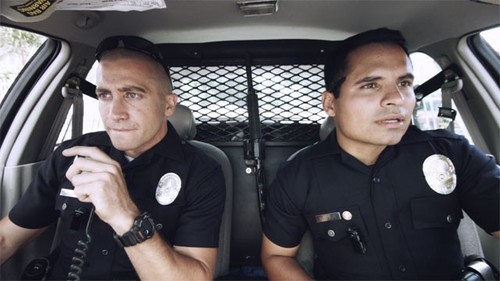
For a lot more positive portrayal of cops, there's the first feature film of the screenwriter of Training Day, David Ayer, seen (a bit surprisingly) at Night Visions Festival. Brian Taylor (Jake Gyllenhaal) and Mike Zavala (Michael Pena) are policing partners that are also best friends in their civilian lives. As anyone who has listened to their share of west side gangsta rap knows, the restless area around South Central L.A. is ruled by gangs and mexican drug cartels.


We follow the two cops around as they do their best to catch dangerous people around the area, usually who hate cops right down to their bones. In the middle Taylor and Zavala bicker, and talk about their love lives and mundane things. The single Taylor is starting to get involved on a new girl (Anna Kendrick) and their relationship is deepening. But once, on a routine call Taylor and Zavala stumbe upon an old house that hids brutally murdered bodies and major amounts of dope. Reporting on the place makes them heroes, but gets them on the Mexican drug cartel's Most Wanted list.

The film starts out by being based on the material that the cops themselves are shooting, whether for a TV show or whatever the in-story purpose. The actual purpose of Ayer is clear, to depict the police as both ordinary people, who live and laugh and love. And on the other hand, as heroic people who are willing to risk their neck out protecting the innocent, and doing what is morally right. These ideas are manufactured to give resonance on the tragedy about to unfold. It's a bit sad that Ayer cops out (har, har) on the last minute to make the ending a real gut-punch.


There's not much on display here that hadn't been done as good or better in numerous modern quality TV cop shows. Taylor and Zavala are quite well-rounded characters that have their good and bad sides, and are expertly acted out by Gyllenhaal and Pena. It's sad that the script over-emphasizes their heroism, and for instance the scene where they risk their lives rushing into a burning building to rescue children, goes a little over-the-top.

Along the way, the camera as an element within the story is more and more forgotten, we get fewer scenes of the characters talking straight to us, and more clearly directed angles. But the most important element in hand-held camera footage movies, the immersion tho the film's world and characters, has already been achieved.

★★★

Policeman (Ha-shoter, Israel)
Director: Nadav Lapid
Love & Anarchy - Helsinki International Film Festival 2012 


The most innovative police thriller I've seen in a while comes from Israel of all places. It's an action movie without a single action scene. It's also a two-sided movie, telling two vastly different but interlaying stories that comes together in the end. Many of the major scenes are not shown, but left to the audience to deduce. Most people walking in on a cop thriller would probably not expect such an intellectual, almost Haneke-styled approach, but it is very refreshing to see a genre movie thet relies on the intelligence of its audiences.


The first act of the film introduces us to the cops. Most of the time with them is spent at a barbecue with their families, or recreational activities, all smiles and happiness. Once in a while a racist comment pops up which makes it clear the speaker would like to shoot Arabs, but no one bats an eyelid. The cops clearly have rubber-band morality, since even with all the happiness of their family lives they are sex-hungry enough to go pick on random girls they encounter. It's revealed that one of them is having trouble with the higher-ups due to an act of violence on the job that is not specified. But all of them stick together and in the hearing all the other defend the accused. They all are eagerly awaiting for their next assignment, as they are the anti-terrorist assault squad.


The next act features ideological (Jewish) young people getting together to discuss the state of the world, how capitalism is ravaging the society, and their disdain for authorities. The youngsters are nice to help out a man playing guitar in the street corner by busting out some jams. They harbor secret crushes to each other. They seem like well-rounded nice people until it becomes clear that they idolize the Beider-Meinhof Complex. They are planning an act of terrorism, to kidnap several people at a rich woman's wedding and execute them if their radical leftist demands are not met.

In the third act, this plan is carried out, and the scenario followed to the end.

Policeman is an amazingly mature work from a first-time director, Nadav Lapid. The cold approach to major issues emphasizes a world where discussion is rueld out from the get-go and both sides believe the excessive use of force is the only way to get things across. The camera follows around coldly, only getting more dynamic in the very end, which makes the ending even more harrowing. This is a depiction of a society in a cul-de-sac, but it works. As such, it would deserve a less generic english name, though.

★★★★

Sunday, 28 October 2012

HIFF 2012: Horrors For Halloween


Although this wasn't the best year for genre cinema, Love & Anarchy still managed to show several films worthy of your ravenous hunger for Halloween-related films. Hell, the film's poster had a ghost in it. Woo-oo-oooo.

Grabbers (Ireland)
Director: Jon Wright


If there's something the Irish can do it's take the piss. Ahem, in more ways then one. But the occupants of the Green Island are known not only by their high alcohol consumption, but also their good-natured sense of humor and willingness to laugh at themselves. thus, it makes sense that the following high concept would stem from these people: vampiric aliens attack a small village. While they feed on human blood, they are allergic to alcohol, so everyone must start drinking to stay alive through the night. A concept can't get much better than that.

But let's look at the film a bit more closely. Having a strong affection to 80's comedic genre films such as Gremlins, An American Werewolf in London and The Evil Dead, Jon Wright's film's style heavily reminds viewers of last year's Attack The Block. In both an alien invasion makes unexpected heroes of an archetype you'd believe to be as unsuitable for the role as they come. Rather than pre-teen gangsters, however, this time our hero is the bored and alcoholic Erin island policeman Ciarán O'Shea (Richard Coyle)


As in numerous buddy cop movies before, O'Shea is on the edge and gets a new no-nonsense, by-the-book partner. This time it's Dubliner Lisa Nolan (Ruth Bradley). Unsurprisingly, extreme conditions make both of them smoothen the edges of their personas and they meet in the middle ground. But rather than with the leads, the film shines more brightly when concerning its bit-characters. They are also somewhat stock characters from countryside TV dramedys, but since you don't often get to see the vicar getting pissed in a pub, they work wonders here.


As for the aliens themselves, they are suitably icky creatures, a little bit like blue octopuses or starfishes with suitable grabbing tentacles. They provide a good enough threat to create some suspense into this thing, and it often seems our heroic Gardas are battling overwhelming odds. While the film can't be called a splatter by any means, the sudden bursts of violence have much more effect.

All in all, the film is silly, but doesn't overemphasize its ridiculousness. It's a bit more clearly a comedy than Attack the Block, but still not really a laugh-riot. Since that film (which I could have given more stars to, BTW) was as urban as they come, it feels apt that this one has a clear countryside vibe. All in all, it feels authentic and considering it's a quite stupid genre piece, it's quite an achievement.

★★★ 1/2

Shopping Tour (шопинг-тур, Russia)
Director: Mikhail Brashinsky

A lot of Russian tourists do short shopping trips to Finland, although I've never quite understood why. Our shops are not even near anything you'd call cheap and I'd figure most of everything we have is also available in Russia. Perhaps the shoppers are looking for some sort of status symbols, expensive luxury items to brag to their friends. Anyway, a horror film featuring a Russian shopping team coming to Finland for bargains but finding only carnage sounded like another great idea on paper.


Shopping Tour is another one of the handheld camera footage boom. A middle-aged woman (Tatyana Kolganova) takes her teenaged son (Timofei Eletsky) to a fateful one-night tour to Finland. The pair have their own quarrels, and we learn that it's not been long since the family's father has deceased. In Finland, the tourists are informed that they get to be the very first ones to shop at a brand new electronics supermarket, which is open all night. But once the Russians are packed in the store, the doors are locked. The cannibal feeding frenzy of ravenous Finns can begin.


This is quite a cheap film, and it shows. While the two lead actors are quite good in their roles, it becomes apparent (to a native Finnish speaker at least), that all the extras have been hired on a pittance. Nothing else could explain the horrendous acting in Finnish on display here. The script isn't too sharp, either. Exposition and back story is spurted at very unlikely moments when people should be fighting for their lives. Still, this is a one-joke movie and at least I find that joke funny. To delve into it deeper is to SPOIL so look away for the last chapter, sensitive ones.

There's no big reason for the Finns to start eating Russians. They aren't worshipping Satan, or secret vampires or zombies or anything. Rather, it is just a tradition, and one which we Finns hold as dear as a Sauna and a cottage on Midsummer's Eve. Some light fun is poked at the fact that Finland tends to come on top of all the lists of the best societies and best places to live, yet our people are sad and suicide-prone. Mean humor is often the best humor.

★★

Crawl (Australia)
Director: Paul China


The dubious honor of being the only Love & Anarchy film I wished I would've skipped goes to this Australian shocker. I mean, I probably would've walked out but I had some time to pass before the next screening. As it is, Crawl is a dire attempt to capture some of the slow-building tension and macabre bloodshed of several new wave horror films (such as Ti West's House Of The Devil, and from non-horror, The Coen Brothers' No Country For Old Men). It attempts to make some sort of statement about gender politics, but comes off just misogynistic. And not in a fun way.


The sleazy bar owner Slim Walding (Paul Holmes) is tired of an accomplice that hasn't paid back a shady loan. Thus, he turns to a quiet Croatian hitman, known only as The Stranger (George Shevtsov) to finish the guy off. But The Stranger has plans of his own, and plans to turn the tables on Slim. The young waitress Marilyn (Georgina Haig), who has plans to quit working for Slim gets caught in the battle of wills. She is soon taken hostage and must fight for her life to survive.


True to its name, Crawl moves very, very slowly forward. Director Paul China, a former cinematographer, likes to keep things quiet and THEN SHOCK SCARE YOU WITH LOUD NOISES. The imagery is OK, but can't hide how cheap this has been made. The sets in particular look like they have been recovered from a failed stage play. Shevtsov's performance is a bit ominous, yet it takes a bit more than long shots of a quiet drowsy-eyed hitman to make up a good performance. As a contrast, ost of the other cast are just abysmal. The film feels like it has been dropped from teh cliché tree and hit every branch on the way down. It makes a lot more sense to just stay home and watch Blood Simple on DVD. There's nothing on display here that that movie wouldn't have done 10 times better already.

★ 1/2

Saturday, 20 October 2012

HIFF 2012: Is this the real life? Is this just fantasy?


Not that it matters much, but I'll try to pick up on Love & Anarchy reporting for this year. After all, I'm not even halfway through all the films I saw in there. But no matter, plenty of them were good enough to digest for a while and to report through a longer stretch of a time allows for a deeper look into them. This post focuses on the films that lingered on somewhere between reality ond pure fantasy, whatever that may mean.

Beasts of the Southern Wild (USA)
Director: Benh Zeitlin


This year's Love & Anarchy opening film gathered a lot of buzz at Cannes this year, and was praised from Earth to Heaven. With such an overkill on praise, it's easy to be disappointed in the end result. It's a very good film and more than suitable for the choice of opening film of the festival. But while it was praised for being a wholly original piece of filmmaking, it's more or less the same story as Terry Gilliam's Tideland had a few years back, albeit with with more grace and with subtler mentally handicapped people.


In a fictional Deep Southern village of Washtub, lives the six-year-old Hushpuppy (Quvenzhané Wallis) in a run-down shack. Her mother has long since left so she attempts to bond with her father Wink (Dwight Henry). Unfortunately, Wink has severe mental and heath problems, and isn't too happy about them and is prone to bursts of anger. Hushpuppy has learned to more or less take care of herself, with the help of the other villagers. Hushpuppy has an active imagination and gets lost inside it from time to time. When a tornado threatens the village, Wink and Hushpuppy rekindle their relationship, but the desperate situation also calls for desperate acts. Hushpuppy also ventures on an adventure to find her mother.

The film is visually very inventive, with some amazing sets that look like they've been lying around for years having actually been created from scratch. The overwhelming flood of striking imagery makes the viewer feel like a six-year-old him- or herself, being amazed of the vastness of the world and all the things in it. That's probably why the film had such a strong response.


But this in turn also brings with it a sense of helplessness. We can't do anything to hold Hushpuppy's family together, or even to make her act sensibly to grow up to be a proper adult in time. Basically the characters are archetypes, but have enough flaws within them to make them somewhat well-rounded and interesting. The main problem however, seems to be that it throws so many things in the air and quickly ties up the knots at the end. For instance, there isn't enough on he community and it's coping by the end, although it seemed like a major element in the beginning.

But nevertheless, for a first-time director, Benh Zeitlin has created an amazingly confident piece of work. It has been helping that the director and the crew form a strong creative collective that have supported each other with their decisions and visions. I'm looking forward on what this group creates next.

★★★ 1/2


Love or Anarchy: Mostly Love, but with a big dose of Anarchy thrown in for good measure

Chicken with Plums (Poulet aux prunes, France/Germany/Belgium)
Directors: Marjane Satrapi, Vincent Paronnaud


This film was first screened at Espoo Ciné, and after Love & Anarchy it was chosen as Film theater Orion's Movie of the month, so there have been plenty of times to see Marjane Satrapi's adaptation of her own comic book. I'm a bit ashamed I haven't read the comic this is based on, although even the film version is unmistakably of the comic artist's signature style.

The film tells the story of the final days of the famed violinist Nasser Ali Khan (Mathieu Amalric).  He decides to die when he can't find pleasure in life any more. Initially, it appears that his reasons are purely due to him hating his family and his displeasure of getting a new violin after his old one is destroyed. But cut scenes to the future, to the past and to Iran's mysterious legends reveal new sides to Ali's character and his story.


The film opens a bit slowly, but once it gets going it grows on the viewer more and more. It's easy to symphatize with Nasser Ali, since he hates his own obnoxious kids. This is basically a romantic film masqueraded as a fairy tale. For all the imaginary characters, basically this is a story about a broken heart and an unrequited love, much in the same way as, say The Umbrellas of Cherbourg. Since I'm a totally cynical bastard, this is the sort of romance I like.  The little comic touches and segments are just the plums to sweeten the already tasty dish of chicken.The film sells itself well as unpredictable and a little anarchistic in that most anything can happen at any given time.

There are several cool animated sequences thrown in for good measure.

The hilarious parody of American sitcoms is of course the easiest possible target, alike to shooting fish in the barrel, but it still made me laugh to my tears. The mythological side is also well-realized, with a suitably mixed style of comic book art and reality. The most memorable of these scenes is wonderful Angel of Death, Azraël, played with curiosity and mellowness by Edouard Baer. But make no mistake, this is Amalric's time to shine. At times, it feels like he's in every French film made these days, but watching his subtle performance here, one can't help but to admire the sheer skill and nuance he brings to his best performances.

★★★ 1/2


Love or Anarchy: 50-50 on this.

Holy Motors (France/Germany)
Director: Leos Carax


Cranky old French auteur Carax has crawled back from the sewer he has dwelled for at least four years (it's been 13 years since his last feature film). And his new film has created a lot of buzz, for it is something not often seen. A purely art house film consisting of mostly sketches and sequences with only a very loose thread tying them together. It does seem the director would be more comfortable with short films and segments in anthology films today.

Stating the plot of Holy Motors is to do an interpretation of sorts, so here's how I see it. Monsieur Oscar (Denis Levant) is a prolific, rich man going to work on a limo one day. His job requires him to wear masks and make up and to do odd tasks around Paris. His first job requires him to dress up as a beggar, and his second as a degenerate sewer-dweller, eating flowers at a graveyard, and to disrupt a fashion photo shoot. He kidnaps the model (Eva Mendés) and takes her to his lair in the sewers.

She'll sing a lullaby to him.

But he still hasn't lost it and is soon back to business. We begin to get the hang of what's going on as he does movements in a motion capture suit, and proceeds to have sex with a woman walking in in a similar suit. Riding inside the limo, it is revealed that invisible cameras are following him around the day. His jobs get more and more intensive, and he is, for instance, required to brutally murder a few people. Truth and fiction are at all times hard to separate, even when M. Oscar goes to pick up his daughter at a friend's party. Finally, he settles home with a bunch of chimpanzees. But what does his limo think about all of this?


Carax is commenting on the state of cinema today, looking for a realistic digital shooting style, while aiming for more and more extreme situations and preposterous stories. Every time the audience is able to grasp an even small strand of plot, Carax destroys it by reminding we are watching a movie. This bitter love letter is at times hysterically funny, but it gets repetitive and pretentious towards the end. There's no good reason half an hour couldn't be trimmed from this.

It's basically a development of some of the ideas Carax has already done. For instance, the monsieur Merde sequence is a clear development of the director's segment in Tokyo! That doesn't make it any less funny, although this is a comedy clearly aimed at high-brow cinema buffs that can reflect their own disgust with modern films through this anarchic piece. Carax doesn't solve any of the problems he posits, and certainly doesn't save cinema with this work, although some of the more eager critics have suggested such.

★★★

Love or Anarchy: Pure Anarchy

Himizu (Japan)
Director: Sion Sono


Sion Sono's new film has become an annual event as much as Takashi Miike's at Love & Anarchy. The prolific director is always able to comment on Japan's recent events, national psyche and culture in surprising, shocking and innovative ways. After two darker psychological thrillers, Sono returns (in a way) to the twisted teenage romance of Love Exposure with his latest film. It brings a welcome emphasis on his wicked black humor, but overlays the melodrama by the end.


At another village ravaged by natural disasters, this time in shantytown in the seaside Tokyo suburbs, lives the only child of a family disintegrating. The teenaged Yuichi (Shota Sometani) finds he has to support himself since his mother is whoring around, and his father has disappeared since becoming seriously indebted to yakuza. He begins a string of shady businesses and lending out his beach house, but he's having trouble collecting money fast enough for the yakuza still feels he owes them for his father's loans. Back at school, quirky girl Keiko (Fumi Nikado) has grown an obsession on Yuichi, and notices his absence from school. She will stop at no ends in following him around and attempting to help him cope in his ever-growing desperation.

Whereas most American post-apocalyptic (that is to say, post-9/11) films had an uplifting theme of uniting people to cope with their losses, Sono has a lot more cynical outlook on human nature here. He argues that our so-called civilization hangs by a threat and a strong enough catastrophy may bring out desperation that allows violent impulses to take over people. The desperation tears us even further apart from our already disconnected lives. Yuichi becomes tangled in a web of violence, murder and vigilantism.


But Sono does believe in certain goodness in people nevertheless. He is a firm believer on love for redemption of people. In the end, Yuichi can't manage his situation by himself, he realizes he needs Keiko and his foster-father figure Shozo (Tetsu Watanabe). Shozo is the film's most interesting character, a self-claimed former millionaire eccentric, who has lost everything. But his love for his friend Yuichi makes him go behind his back and risk his very life to save him from yakuza. It's really a shame the end half of the film focuses so much on Keiko's and Yuichi's relationship, with Shozo being sidelined.


As I mentioned, the teary-eyed melodrama and weltschmertz of the final scenes of this film fall a bit flat and leave a bad aftertaste in the mouth. Otherwise the film features many of Sono's great strengths - great characters, shocking brutality, surprising story developments, the satirizing of Japanese culture and a pitch black sense of humor. I'm particularly enamored by the scene of literal gallows humor - Keiko's parents building gallows in her room for her to kill herself and spare them from the high cost of her living.

★★★ 1/2

Love or Anarchy: Even though at the surface it may seem like an Anarchy-heavy piece, the heavy melodrama puts it firmly in the Love corner.

LinkWithin

Related Posts Plugin for WordPress, Blogger...