Showing posts with label australian. Show all posts

Sunday, 15 December 2013

Your Sister was a Werewolf and your Father Smelled of Elderberries!


Don't ask why, but I felt like writing about something and that something happened to be a variety of werewolf movie sequels from the 80's. And why not, it's not as if this blog's format wouldn't allow for me to fulfill such urges.

The Howling 2: Stirba the Werewold Bitch (USA/UK, 1985)
Director: Philippe Mora


There are several names for the sequel for Joe Dante's tongue-in-cheek cult film, and I of course use the one which I prefer. This film is also known as The Howling II: Return and The Howling II: Your sister is a Werewolf, which, while an actual quote from the film, doesn't quite have the same catchiness to it.

This is one of those cheapo films where they somehow had tricked Christopher Lee himself to act in, of which the legendary actor has felt nothing but regret since. Lee is one of my very favorite actors of all time, since there isn't a title so lowly that he couldn't liven it up with his undeniable charisma, grace and style. The film returns the favor by having him go to a punk rock club incognito and dressing him up in silly new wave sunglasses. The film is perhaps even a bit more clearer a comedy than its predecessor.


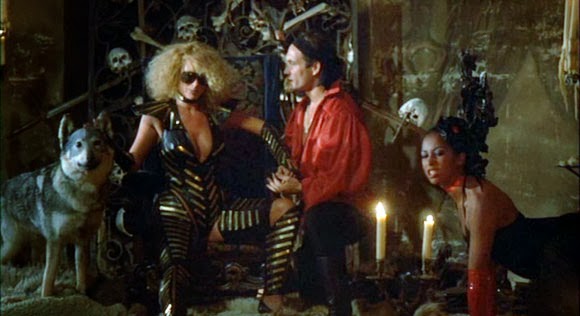
The film begins with the funeral of Karen White, the main character from Dante's film. Karen's brother Ben (Reb Brown) hears the truth from an attending werewolf hunter, Stefan Crosscoe (Lee). He convinces Ben to travel to Transylvania, along with his new girlfriend Jenny (Annie McEnroe) to kill the werewolf pack alpha bitch, the 10,000-year-old Stirba. She (in the form of Sybil Danning) hosts occult bisexual orgies at her castle and spreads werewolfism around the globe. Unless she's destroyed, she'll take over the world!

There's no denying this film's cheesiness, but there's a lot of an endearing quality to it. The film views all of the Balkans as a backwater area, where people still live like in Mediaval times and have an ethnic festival going all year. There's a good Euro-sleaze athmosphere going on in the scenes taking place in Stirba's castle.


There's lesbian undertones, dwarves, spanking, a horrible giant bat effect and other craziness going on all around. It's all in good fun and one can't help being entertained by all these horror tropes done suitably well and rolling along in a fast enough pace. The actors (sans Lee) are of course atrocious. Just as you think the film has ended and ran out of ideas, they have a final one in their bag: As the post-punk band Babel reprises their song The Howling during the end credits, footage of Sybil Danning revealing her massive breasts, cut next to various characters in the film reacting in humorous ways. Incredible.

★ or ★★★★★

The Howling III: The Marsupials (Australia, 1987)
Director: Philippe Mora


It seems Philippe Mora still had plenty of more ideas on where to take his werewolf franchise. It also seems he may have had too many ideas about the matter. The third Howling is shot entirely in good ole Australia, and in the patented ozploitation style.

While the werewolf population of Earth suffered a massive blow in the previous installment, some still survive. Case in point is Australia, which has evolved a wholly seperate population of werewolves that have pouches. The anthropologist Professor Harry Breckmeyer (Barry Otto) sees odd wolf-like creatures in old-time footage of aborigine rituals. So he naturally goes to The President Of United States to tell his suspicions of a weird, wolf-like tribe living in the bush.


Meanwhile, among the real wolf tribe, a young girl named Jerboa (Imogen Annesley) flees to Sydney. She catches the eye of a movie producer Donny (Lee Biolos) and is soon picked as a lead for a cheap horror movie. Jerboa and Donny fall in love. But she has to flee again as he realizes she's a bit hairier than he originally saw.

All sorts of crazy bullshit goes on. The film has poor grasp of a central story and there's ever-more left-wing twists to take the film to unsuspected territories. It gives an expression of a formless blob of a movie rather than a quirky comedy with surprises. While there are many fun parts early on (like the movie shoot and wrap-up party), sadly the film's additional scenes are often boring, such as the extended time jump of a werewolves raising a family in the woods. The final scenes bring the film full circle, but it's a bit too little, too late.


The film is admirably crazy, though and at least it's closer to Dante's original than either the first or second sequel in the same series.

★★


The Howling IV: The Original Nightmare (USA, 1988)
Director: John Hough


Let's not even go there. Attempts to be a more serious werewolf affair, fails in almost every aspect. Save for a puddle-based transformation scene, a total waste of time.


★

Teen Wolf Too (USA, 1987)
Director: Christopher Leitch


Rather, let's talk about the sequel to Michael J. Fox's on-the-nose puberty metaphor movie, shall we? It is considered to be one of the worst sequels of all time, and it's not hard to see why. For a comedy, it sure is an unfunny affair, and often doesn't seem to be trying that much.

The movie follows the cousin of Fox's Scott, Todd Howard (Jason Bateman). Everyone is aware that the Howards are werewolves, his uncle Harold (James Hampton) for instance being rather open about it. Rather than fearing the undead, unholy bloodthirsty beasts, this awakens curiosity and enthusiasm in normal people. Todd has gotten a college scholarship in order to bring the Hamilton University's boxing team some fame and glory. But Todd would rather just focus on his studies to become a veterinarian.

Yeah, the puberty undertones aren't that under in this one, either.

For one, the film forgot to add any jokes into its supposedly funny set-up. Scenes have incredibly poor comic timing. Often times it seems that the set up is going towards a punchline, but since the writers couldn't come up with anything humorous, the cast members just react a while and the scene moves on to the next one. It is a bit silly seeing Jason Bateman as a teen heart-throb and a lot of space is given shooting his cute smile spreading to his face. Less funny are the rubberfaced antics of his buddy Chubby (Mark Holton) that soon grow tiresome. John Astin as the cruddy old dean comes across as creepy as he can for no proper reason.


Boxing is an odd choice for the sport to be featured in a college comedy. Here it functions basically the same as in the Rocky movies: all punches, little moving around or blocking. The matches themselves feel like re-hashes of Karate Kid movies with their snooty rivals and whatnot, and not even the good ones. The most memorable thing about the movie is the godawful female mullett on Kim Darby, playing Todd's professor.

★★

Sunday, 28 October 2012

HIFF 2012: Horrors For Halloween


Although this wasn't the best year for genre cinema, Love & Anarchy still managed to show several films worthy of your ravenous hunger for Halloween-related films. Hell, the film's poster had a ghost in it. Woo-oo-oooo.

Grabbers (Ireland)
Director: Jon Wright


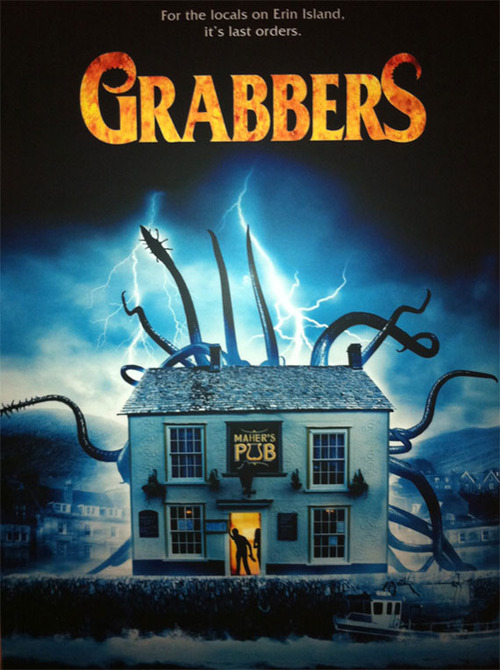
If there's something the Irish can do it's take the piss. Ahem, in more ways then one. But the occupants of the Green Island are known not only by their high alcohol consumption, but also their good-natured sense of humor and willingness to laugh at themselves. thus, it makes sense that the following high concept would stem from these people: vampiric aliens attack a small village. While they feed on human blood, they are allergic to alcohol, so everyone must start drinking to stay alive through the night. A concept can't get much better than that.

But let's look at the film a bit more closely. Having a strong affection to 80's comedic genre films such as Gremlins, An American Werewolf in London and The Evil Dead, Jon Wright's film's style heavily reminds viewers of last year's Attack The Block. In both an alien invasion makes unexpected heroes of an archetype you'd believe to be as unsuitable for the role as they come. Rather than pre-teen gangsters, however, this time our hero is the bored and alcoholic Erin island policeman Ciarán O'Shea (Richard Coyle)


As in numerous buddy cop movies before, O'Shea is on the edge and gets a new no-nonsense, by-the-book partner. This time it's Dubliner Lisa Nolan (Ruth Bradley). Unsurprisingly, extreme conditions make both of them smoothen the edges of their personas and they meet in the middle ground. But rather than with the leads, the film shines more brightly when concerning its bit-characters. They are also somewhat stock characters from countryside TV dramedys, but since you don't often get to see the vicar getting pissed in a pub, they work wonders here.


As for the aliens themselves, they are suitably icky creatures, a little bit like blue octopuses or starfishes with suitable grabbing tentacles. They provide a good enough threat to create some suspense into this thing, and it often seems our heroic Gardas are battling overwhelming odds. While the film can't be called a splatter by any means, the sudden bursts of violence have much more effect.

All in all, the film is silly, but doesn't overemphasize its ridiculousness. It's a bit more clearly a comedy than Attack the Block, but still not really a laugh-riot. Since that film (which I could have given more stars to, BTW) was as urban as they come, it feels apt that this one has a clear countryside vibe. All in all, it feels authentic and considering it's a quite stupid genre piece, it's quite an achievement.

★★★ 1/2

Shopping Tour (шопинг-тур, Russia)
Director: Mikhail Brashinsky

A lot of Russian tourists do short shopping trips to Finland, although I've never quite understood why. Our shops are not even near anything you'd call cheap and I'd figure most of everything we have is also available in Russia. Perhaps the shoppers are looking for some sort of status symbols, expensive luxury items to brag to their friends. Anyway, a horror film featuring a Russian shopping team coming to Finland for bargains but finding only carnage sounded like another great idea on paper.


Shopping Tour is another one of the handheld camera footage boom. A middle-aged woman (Tatyana Kolganova) takes her teenaged son (Timofei Eletsky) to a fateful one-night tour to Finland. The pair have their own quarrels, and we learn that it's not been long since the family's father has deceased. In Finland, the tourists are informed that they get to be the very first ones to shop at a brand new electronics supermarket, which is open all night. But once the Russians are packed in the store, the doors are locked. The cannibal feeding frenzy of ravenous Finns can begin.


This is quite a cheap film, and it shows. While the two lead actors are quite good in their roles, it becomes apparent (to a native Finnish speaker at least), that all the extras have been hired on a pittance. Nothing else could explain the horrendous acting in Finnish on display here. The script isn't too sharp, either. Exposition and back story is spurted at very unlikely moments when people should be fighting for their lives. Still, this is a one-joke movie and at least I find that joke funny. To delve into it deeper is to SPOIL so look away for the last chapter, sensitive ones.

There's no big reason for the Finns to start eating Russians. They aren't worshipping Satan, or secret vampires or zombies or anything. Rather, it is just a tradition, and one which we Finns hold as dear as a Sauna and a cottage on Midsummer's Eve. Some light fun is poked at the fact that Finland tends to come on top of all the lists of the best societies and best places to live, yet our people are sad and suicide-prone. Mean humor is often the best humor.

★★

Crawl (Australia)
Director: Paul China


The dubious honor of being the only Love & Anarchy film I wished I would've skipped goes to this Australian shocker. I mean, I probably would've walked out but I had some time to pass before the next screening. As it is, Crawl is a dire attempt to capture some of the slow-building tension and macabre bloodshed of several new wave horror films (such as Ti West's House Of The Devil, and from non-horror, The Coen Brothers' No Country For Old Men). It attempts to make some sort of statement about gender politics, but comes off just misogynistic. And not in a fun way.


The sleazy bar owner Slim Walding (Paul Holmes) is tired of an accomplice that hasn't paid back a shady loan. Thus, he turns to a quiet Croatian hitman, known only as The Stranger (George Shevtsov) to finish the guy off. But The Stranger has plans of his own, and plans to turn the tables on Slim. The young waitress Marilyn (Georgina Haig), who has plans to quit working for Slim gets caught in the battle of wills. She is soon taken hostage and must fight for her life to survive.


True to its name, Crawl moves very, very slowly forward. Director Paul China, a former cinematographer, likes to keep things quiet and THEN SHOCK SCARE YOU WITH LOUD NOISES. The imagery is OK, but can't hide how cheap this has been made. The sets in particular look like they have been recovered from a failed stage play. Shevtsov's performance is a bit ominous, yet it takes a bit more than long shots of a quiet drowsy-eyed hitman to make up a good performance. As a contrast, ost of the other cast are just abysmal. The film feels like it has been dropped from teh cliché tree and hit every branch on the way down. It makes a lot more sense to just stay home and watch Blood Simple on DVD. There's nothing on display here that that movie wouldn't have done 10 times better already.

★ 1/2

Thursday, 24 May 2012

In The Year 2000


Welcome back! The world of movies is moving so fast currently that it's hard to keep on top of things. That's why I figured that right now its time to look....into the future!
"The future, Paavo?"
Yes that's right (enter guest's name here)! Its time to look all the way... to the year 2000! Even the ancient Mayans prophecized that the year 2000 would be the time in which the world comes to an end. Undoubtedly this is why 2000 has inspired so many filmmakers unleashing various visions of dystopian futures upon us. We should be fearful when looking forward to 2000. Surely, the nuclear war between the United States and Soviet Union will become before that futuristic year.

Joking aside, not just cheesy 70's and 80's sci-fi flicks have taken the number 2000 to imply futurism. When the year 2000 actually was upon us, a number of sequels also put two extra zeroes to basically say that this is not your dad's Blues Brothers or something to a similar effect. This kind of market-oriented thinking usually tells what you should expect the film's quality to be. 

Heavy Metal 2000 (2000)
Director: Michael Coldeway, Michel Lemire


The sequel to the classic 1980's adult cartoon anthology takes a different route from it's predecessor and features only a single, long story. It is based on a graphic novel by Teenage Mutant Ninja Turtles co-creator Kevin Eastman, made with Simon Bisley and Eric Talbot. But in effect, it is one of those sequels that pretty much misses the point of the original movie altogether and just makes a broad-stroked caricature of it as a result. Heavy Metal 2000 is crass, loud, obnoxious, dumb and clichéd.

An ancient, evil force that manifests itself as a glowing green object (that's different in every way from the one in the previous movie), takes over a nasty space pirate/miner named, um, Tyler. As a result, Tyler goes power-mad, kills his co-worker for no reason, and attempts to seek out the secret of immortality. For some reason he stumbles upon a planet called Eden and kills everyone. Well, not everyone as he kidnaps the beautiful young Kerrie, as he believes her blood will somehow help him discover some secrets of immortality. But Kerrie's older sister, the fierce warrior Julie isn't too happy that her home planet has been freshly labeled F.A.K.K.2 (Federation-Assigned Ketogenic Killzone) and starts to pursue Tyler and attempts to find out a way to kill him. Those retarded acronyms are a source of the film's retarded sense of humor, although otherwise it is all played overtly serious. But still not serious enough for it to be funny.

Gone are the beautiful, stylized, and differing animation styles from the first Heavy Metal. In the sequel, the animation looks like a bastardized version of Titan A.E. Particularly the film's computer effects are horrendous, and the long space scenes showcasing them are dreadfully boring. They are balanced by scenes of carnage or Julie showing her boobs for no good reason. The film doesn't deliver on the second half of its name, either. All the cool 80's rock from the previous film has been switched to dreadful turn-of-the-millennium nu-metal. When the soundtrack's high point is the Billy Idol track from the end credits, you know you're in trouble. As a matter of fact, when your voice cast's most famous member is Billy Idol, you're also in a a lot of trouble. If ever there was a film for dumb assholes who only care about tuning cars and getting laid, I'd rather they watched this abomination than the original Heavy Metal.

★1/2

Holocaust 2000 (1977)
Director: Alberto DeMartino


Satanic horror films were all the rage in the 70's, and of course cheapo Italian producers decided they wanted their slice of the cake. Thus, they hired the acclaimed screenwriter Sergio Donati and director Alberto Martino to basically rip off The Omen, which had premiered the previous year. The resulting film is a sort of mirror of it's time, threatening us with the loss of tradition in order to earn money, and the risks of nuclear power.

Kirk Douglas stars as the construction magnate Robert Caine, who's on the verge of the deal of his life when he makes a deal to build a nuclear power plant in the Middle East. From the constructs he discovers some ancient ruins and writings about someone called "Iesus", but he doesn't pay much attention. But he then starts to get haunted by Doomsday prophets, mysterious ill-meaning bearded men, bad omens and horrifying dreams. When he sees in his dream that his power plant is actually the seven-headed Beast of the Apocalypse he realizes what's going on. His son Angel (Simon Ward) is actually the Antichrist, trying to bring out Armageddon using his plant. And Robert's pregnant lover Eva (Virginia McKenna) and his wife Sara (Agostina Belli) also play major parts in this plan.

Despite some delirious imagery, the film doesn't really pick up steam enough to be very interesting. Some odd madhouse scenes aside, this isn't even outrageous enough to be a good camp movie. Violence comes as some friends of Caine get killed while trying to figure out Angel's plans or stopping them. Their demises are quite familiar for those having seen The Omen. Even the presence of Douglas doesn't help too much, as he seems to be on auto-pilot and his only expression seems to be worry. He does burst into violent rage in a couple of key scenes that are welcome change to the boredom of him being undecided on what to do next. A rich tycoon is also not a very good movie protagonist, even if he is flawed and sinful, as he's hard to sympathize with. All in all, I figure these sort of films work better in Catholic countries, where people are scared with the wages of sins and the upcoming Apocalypse and Hell for all their lives. There's not much to get worked up in it here in liberal protestant Finland. Other than the possibility that a nuclear power plant might go off, but since the government didn't understand that from Fukushima, it wouldn't get it by watching this, either.

★★

Escape 2000 a.k.a. Turkey Shoot (1982)
Director: Brian Trenchard-Smith


I have a soft spot for films where hunters chase after the Most Dangerous Gama – man. This Australian schlock classic offers that and much, much more. In Ozploitation movies, anything truly goes, and so the film doesn't mind cheerfully drawing parallels to the Holocaust and stealing good bits from the likes of A Clockwork Orange, Logan's Run or The Man With The Golden Gun.
The film also throws some completely bonkers ideas to the mix, such as a sadistic mute Wolfman joining the hunt without much further explanation.

The film is set in the post-apocalyptic future, where a dystopian government clears up all members of resistance, advocates of free speech and other deviants to prison camps. They are told they are there for re-education and behavior modification, when in fact they are there to fill the sadistic urges in the camp staff (and the audience). The camp is run by the laconic Charles Thatcher (Michael Ritter) and his main underling Ritter (Roger Ward), who isn't afraid to get his hands dirty. But since prisoners flow into their camp faster than they can be whipped to death, Thatcher has an idea to organize a game to get rid of some extra prisoners who are becoming a nuisance. Thus, he gathers high-ranking government officials (and their pets) and sets few key prisoners into the woods. The hunt can begin.

I think this poster depicts much better of what's going on in the film than the faux-futuristic Escape 2000 one.
For a film using real prison camp footage in its opening credits, Turkey Shoot is decidedly cartoonish. The film has colorful imagery and frankly the violence seems quite stylized. For a film that's supposedly very low-budget exploitation, it actually looks quite impressive. Particularly the explosive ending wouldn't be too out of place from a Roger Moore Bond film. Sadly, the British director Brian Trenchard-Smith didn't share his contemporary Ozploitation directors George Miller's or Russel Mulcahy's career developments and didn't get any major Hollywood work after this one. Instead, he has since directed more exploitation, such as BMX Bandits, Dead-End Drive-In and two sequels to Leprechaun. But if you've never known that you wanted to see a circus freak squished against a tree trunk by a dune buggy before now, this is your film.

★★★★

Equalizer 2000 a.k.a. Defender 2000 (1988)
Director: Cirio H. Santiago


I'll say it straight away: The Equalizer 2000 is one of the most infantile films I've ever seen. Seriously, this thing makes the likes of G.I. Joe – The Rise of Cobra look like a high-brow study of the ills of modern warfare and it's effects on the psyche of soldiers. But being childish is not necessarily a bad thing. Basically, this is a post-apocalyptic barbarian flick that's 80 minutes of one big sandbox action figure battle.

The plot revolves around two fighting teams – The men of the evil Military Government, and the Rebels fighting for their freedom from tyranny (of course). You can tell the bad guys from their Nazi-like armored uniforms, whereas most good guys wear surplus western movie clothing. As oil has become rarer and rarer the sides mostly fight over gasoline. Some oil fields in the scorching desert are valuable to both and that's why the major battles are settled there. While fighting, huge showers of bullets are fired, but with anything particular very rarely being hit. So much for the shooting skills of the Army of Tomorrow. To help the rebels actually hit their enemies, a B.F.G. named Equalizer 2000 is built by a gunsmith. The weapon is basically what Tony Montana carried, an oversized assault rifle that can also shoot rockets. The protagonist Slade (Richard Norton) is a leather vest, a beard and a mullet-donning stranger, a true western archetype of a neutral who gets tangled in with the action, but brings order to untamed areas. Norton seems to attempt to channel Clint Eastwood, but can't even reach Brian Botswick's levels. For the ladies, there's a lengthy scene where he sharpens blades without his shirt on. He's also skillful enough to manage to avoid getting shot by machine guns by doing little skips on desert rocks.

The film's budget is so low, they couldn't even buy convincing paint to put over all the plastic, tin plate and plywood. The toy guns are quite cute, particularly the bazookas that go "Ploomp!" There's some car chasing, torture scenes and of course, lots and lots of desert battles. Nothing seems to matter that much, since the audience couldn't give a rat's ass which team will win. But if you only love the action and explosions in action movies, and too much talking and plot development makes you drowsy, this is basically porn for you.

★★ 1/2

Fantasia 2000 (1999)
Directors: Don Hahn, Pixote Hunt, Hendel Butoy, Eric Goldberg, James Algar, Francis Gebas, Paul & Gaëtan Brizzi


At the turn of the millennium there was actually at least one interesting 2000-movie project which had the ingredients to be much more than just a cheap cash-in. When Walt Disney envisioned the classical music animation Fantasia back in the early 1940's, he figured that the film could have segments removed and added every couple of years to give the movie-goers different sort of animated concerts. This ambitious idea was thwarted by Fantasia being an expensive flop when it was first released, and the Disney company struggling to recover from it for a decade. 50 years later, Disney's nephew Roy Disney had also dreamed about completing this plan for a long time. The step to create an artistically ambitious film among the animated films of the late 90's (which were still kind of decent with Mulan and Tarzan) was to him to be the crowning achievement of his career. Of course, the younger Disney eventually also had a flop in his hands, and Disney's animations sunk to depths it still haven't quite recovered from (Altough John Lasseter has helped to take a turn for the better. Hopefully Wreck-A Ralph will remedy the situation further).

But to get to the film itself, it is quite a mixed bag. As a whole, it is at least easier to watch from beginning to end than it's predecessor. The running time of 75 minutes is suitably short and there are fewer abstract animations. However, the film does have a weird fundamentalist Christian vibe, as at least three segments seem to be about Rapture. Compare this to the original which had pagan gods, mythological creatures, dinosaurs and demons – but ended with people walking to church with Ave Maria. It seems Disney in the 1940's was more open with various views of the world. 2000 has a forest spirit in the end, but it seems like something that writers came up with rather than an actual legend.

Show me people worshiping this and I'll show you Disney shareholders.

Also unconvincing is to have celebrities hosting the segments. I hate the modern Steve Martin and his horrible attempts at being funny make me in a such a bad mood I wouldn't want to watch anything he's trying to sell. The film does attempt to do its segments in very different animation styles, and at points it does show the majesticity of classic hand-drawn animation at the edge of its demise. The best segment is the one featuring George Gerswin's Rhapsody in Blue. The kind of 1930's newspaper-cartoon inspired style with splashes of primary colors depicting various depression-era New Yorkers going about their business is the sort of unbiased work the whole sequel should have been full of. Also fun is Camille Saint-Saëns's The Carnival of the Animals, which channels classic Looney Tunes with it's fast pace and gags aplenty. And Donald Duck's Pomp And Circumstance manages to mix the epicness of the tale of Noah's Ark convincingly with Donald's slapstick antics. I also got weirdly emotional at the end when Donald is reunited with Daisy.
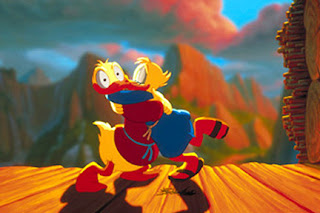
The greatest romance of all time?

My least favorite segments are the ones where unconvincing computer animation is showcased or mixed with classic animation. The grandiose of The Pines of Rome doesn't quite come through with stupid-looking CGI whales flying into heaven. The Tin Soldier segment looks so horrible that I can't even bear to watch it. It's a miracle this was made the same year as Toy Story 2. It also isn't a particularly good idea to recycle The Sorcerer's Apprentice to the new film, as it makes the audience see the difference of the grace and emotion of the classic 40's Disney showcased against some of its modern, soulless incarnations. The final segment – the aforementioned Tree spirit segment – lacks the punch it should have as the finale. All in all, the music played by The Chicago Symphony Orchestra is of course fantastic, but it seems that only half of the animated segments on display here can keep up with it. Perhaps Disney should have been developed this a few years more instead of rushing it to be released at the turn of the millennium.

★★★

Wednesday, 26 October 2011

The Horrible 00's, Part Deux

More Best Horror Films of the 2000s – The Cursed Number 15 in our ongoing series that just won't stay dead!


 I'm not often dissatisfied with my list type blog posts, but I did have the feeling that last years Best Horror Films of the 2000s was somewhat lacking. Never to back away from a challenge, I did realize there were a lot of other very fine horror films made in the last decade that deserved to be mentioned.

Tonight, Night Visions Maximum Halloween 3011 kicks off at Helsinki. So, to celebrate that and the upcoming Halloween, let me present to you the further top 10 of recent horror flicks:

[REC] (Spain, 2007)
Directors: Jaume Balagueró, Paco Plaza


Found footage horror flicks would've just be forgotten gimmicks in period pieces such as The Blair Witch Project and Cannibal Holocaust if it weren't for this highly innovative film. A spanish news crew happens to be with the fire departement as they are called in on a block of flats. Some rage-infusing disease is spreading among the inhabitants. Soon the entire area is quarantined, leaving the crew stuck inside the building with blood-thirsty monsters. For a modern zombie film, there isn't any tongue-in-cheek humour, just fighting for survival. This sort of film works best in the cinema, because it allows you to feel dropped in the middle of the critcal situation yourself and start to feel the panic. It's a real roller-coaster ride, fast and unrelentless with scares coming in thick.

To be fair, I saw the film's American remake Quarantine first and I kind of like it more, because it allows us to spend a little more time with the characters before everything goes to hell and doesn't have as clear reason for all of the things to happen. If you haven't seen either one, pick that, but if you've seen [REC] alreaady, don't bother. It recreates most of the film in a shot-by-shot fashion.


American Psycho (USA, 2000)
Director: Mary Harron


Bret Easton Ellis' masterpiece novel of the same name must've been one of the most difficult books ever to turn into a film. The novel's first 150 pages follow the sleazy rich yuppie businessman Patrick Bateman as he goes through business lunches in high-end restaurants with his obscenely rich "friends" who he secretly loathes. Bateman notices all the luxury product brands around him and gets insanely jealous if someone's wearing something more expensive than he is. After excruciatingly long scenes of upper-class assholism, it is revealed that Bateman is also a blood-thirsty psychpath, bent on torturing and killing (especially women) in a most violent way possible.

The film, of course, makes this revealation much sooner. It does feel like a quick run-through of the novel's events, but it does manage to reveal the obscenity of having it all. Christian Bale made his first truly iconic performance as Bateman, a guy who can go from charming to petty to a douchebag to a dangerous lunatic in seconds. The violence is also toned down from the novel, but director Harron allows much of it happen off-screen, making the viewer's imagination make the worst out of the scenes. Bateman's paranoia of getting caught is increased, but really the world around him isn't interested in his blood work, and sees no difference in his victims. The possibility of it all happening inside his head is also open. Like the novel, the film offers no exit when the credits start to roll.

Antichrist (Denmark/Germany/Poland/France/Sweden/Italy, 2009)
Director: Lars von Trier


Leave it to Lars von Trier to transcend genre lines. Horror is what this film mostly resembles, even though it really doesn't belong to any genre. It's just pure Trier. I don't necessarily think this is his very best film (altough a number of reasonable people would also argue so), but at least it is his most raw, most powerful and most shocking work. It is a manifesto of his own depression and the feelings of inadequacy, guilt and gloom, and the dismissal of trying to alnalyze them rationally and cold. See, you get a lot more out of this than your generic slasher flick.

A couple (Charlotte Gainsbourg and Willem Dafoe) have suffered the death of their firstborn child. They were having steamy hot sex while he jumped out the window. Later on, the couple retreats on a distant cabin to find redemption in their devastating feelings. But when the civilized way to look at the thing runs against the sher forces of nature itself, things are bound to get messy.

Trier's symbolism is a little on the nose here, a little inpenetrable there. Like in many of his work, it's impossible to decide whether he's pulling the collective leg of his entire audience. Yet the odd little film is like none other and its devastating athmosphere more horrifying than in any other film of last decade. The film also needs a little time to grow on the viewer. At first viewing I was disappointed in it, but it has grown on me. Mostly because its haunting imagery will never leave the viewer alone.

Eden Lake (United Kingdom, 2008)
Director: James Watkins


Seemingly normal people, not possessed by any kind of demons or rabies etc. are often the most frightening antagonists in horror films. In this film we have teenage hooligans who have been so spoiled that they grow ever more blood-thirsty when they don't get what they want. A young couple (Michael Fassbender and Kelly Reilly) take off to a romantic weekend in the British countryside but run into these sorts of little beasts. Refusing to allow the obnoxious, loud ruffians to spoil their weekend, they resort to threats, which the teens respond ever more harshly. The teens start to dare each other to step over lines, which leads to real brutalities, while the adults respond the same way. Soon both sides have blood on their hands.

The film's subject is handled with some weightm, as the problem isn't solely with the youth, but in their parents' empty lifestyles and disinterest in their doings as well. In this world, the nice die first. The community doesn't care much for the weak and the wounded, but a dog's death brings great sorrow. The movie's violence is really sadistic, but it can also be really pressuring, not just disgusting. The film is also the first annual Night Visions Audience Award Winner.

House of the Devil (USA, 2009)
Director: Ti West


In the 80's, there was a wide-spred scare that Satanic cults thirsting on innocent blood may hide in any neighbourhood without a trace to the outside. Ti West's film works great as a tribute to both that era's panic-driven news items and the good old-fashioned horror films. College student Samantha (Jocelin Donahue) opts to become a babysitter to an odd family living in the middle of nowhere. She and her sassy friend Greta Gerwig (Megan) are no fools and the girls take off to the house together to avoid any psychopath shenanigans. Yet as it turns out, there is foul play going on and the girls are soon separated and scared.

Unlike many other nostalgic horror directors, West hasn't chosen the campiest and silliest aspects of the 70's and 80's to replicate. The setting, the music and clothing do bring back those times, but not in an in-you-face or over-the-top style. Instead, the film is a welcome return of the kind of horror films that play on having a disturbing mood to them and are constantly one-upping the feeling of paranoia shared by the main characters as well as the audience. The film is created with seemingly small resources, as you don't really need more than a small scratch or a moving shadow to scare the audience if it's played right. So good is the first part of the film that the ending is a clear let-down of panicky running around. It's not that bad per se, as the most obvious clichés are avoided, yet still feels too conventional for a movie that started this good. But as a whole, it is a really spine-tingling work that doesn't explain everything in it through and through.

Open Water (USA, 2003)
Director: Chris Kentis


This minimalistic horror film really divided the audiences. I happened to love it. A scuba-diving couple (Blanchard Ryan and Daniel Travis) are left in the middle of the ocean, when their boat has sailed off. So they just have to float around the ocean, figuring out what there is to do about their situation. And then the sharks come around. When they only need to survive the ordeal, they start to realize how little the daily woes in their rat race life actually matter.

I really like the kind of horror films where the situation is plausible, but you couldn't figure out how you would save yourself in the same situation. This whole scenario scares the living shit out of me, and knowing it's based on actual events makes it all the more horrible. There isn't a single special effect used on this film and its shows in unrelenting realism. Of course, this sort of film is pulled off by the actors and their characters and I must say that I could hope for a little more convincing performances from the main pair. But as a bickering married couple in a jam, blaming each other, they are believable enough. One cares about what's going to happen to them. The stylish ending doesn't spell it out for us viewers, altough there really was no escape at any point anyway.

The Others (USA(Spain/France/Italy 2001)
Director: Alejandro Amenábar


Grace Stewart (Nicole Kidman) lives with her two children, who are sensitive to light, in a large mantion. The Second World War is about to end and Grace is waiting for her husband to return home from the front. He has strict rules for her children, in fear that they hurt themselves by coming in contact with the sunlight. But it seems the house is also inhabitetd by malicious others, who attempt to break those rules, apparently to drive the family out.

The Others is easy to dismiss on these sorts of lists because the sort of filmmaking it represents was farmed to death in the early 2000s and seems like it has run  its course by now. But nevertheless it is a powerful piece of cinema that left an impression me on the only time I've seen it. It is spooky and its mysteriousness tingles the imagination.

Shadow of the Vampire (USA/UK/Luxembourg 2000)
Director: E. Elias Merhige


Horror films are often about other horror films. But rarely do they go as far into that field as here. This is seemingly a drama about the time F.W. Murnau (John Malkovich) shot his classic silent horror film Nosferatu, eine Symphonie des grauens (1922). Murnau is a true perfectionist, wanting to create the ultimate horror film. That's why he has hired Max Schreck (Willem Dafoe) in the lead role. Schreck is, after all, an actual vampire. The death and disappearance of multiple crew members doesn't worry Murnau at all, as long as he gets everything he wants on film. But what to do when Schreck sets his eyes on the lead actress when there is still a lot of film to be shot?

The film's plot is, of course, utter baloney, as Schreck was already an acclaimed stage actor when he was cast in Murnau's film in the real life. But that hardly matters. What matters is that it's plausible. Schreck's vampire is one of the most terrifying in the history of cinema, because it has been shot so it moves unnaturally. It doesn't matter that his make up looks ridiculous by today's standards. The film does a good job depicting the spiralling madness concerning ambitious cinema auteurs. Malkovich and Dafoe make a good lead pair, almost as much at each other's throats as Kinski and Herzog. The film is actually pretty light on actual horrors, but as a mind game, it is quite swell.

Slither (Canada/USA 2006)
Director: James Gunn


If horror films of the 70's and 80's are hard to emulate on the modern day, even harder are the B-movies of the 1950's. But even that wouldn't be difficult enough for director-screenwriter James Gunn. No, he emulates the kind of outrageous B-movie parodies they had in the 80's (as well as work from such horror maestros as Romero or Carpenter in the 70's and 80's). So the end result's a sort of double-parody. No wonder it tanked at the box office. But that was just the fault of the movie-going public, because Gunn's film is actually both extremely creepy and pretty darn funny.

A meteor hits the outskirts of a small American town. It contains parasitic worms that can take over people or turn them into gruesome monsters. Cool B-list actors such as Nathan Fillion and Elizabeth Banks try to salvage the town from the alien rampage and possible taking over the world. As one can witness from the film's awesome poster, there is a strong sexual sense in the penile aliens, and the R this movie got was well justified. But it works as well to parody the sex-hungriness and boozehoundiness of the American midlands. Of course, this doesn't reach the lofty qualities of Cronenberg's Shivers, which has been a major influence, but it is one of the best horror comedies of the last decade that too few people have actually seen.


Wolf Creek (Australia, 2005)

Director: Greg McLean


Horror genre also likes to play with stupid gimmicks time and time again. It's no wonder the Australian Greg McLean's stripped first feature film was hailed exceptionally good by horror experts around the globe. Seemingly, it's a really back-to-basics horror film. Three young backpackers go on a trip to a middle of nowhere. Their car has trouble. A friendly-seeming stranger offers them help and towes their car to his far-away ranch. You can see how it plays out. But, at the risk of SPOILING the film for those who haven't seen it, the real strength of the film is in the end. McLean refuses to play out to the genre's convictions any more. So whenever we think that a strong, pure heroine is emerging that will survive the whole ordeal, our hopes are shattered. The serial killer Mick Taylor (the wonderful John Jarratt) is so relentless, ruthless and merciless that he will use any chance to off them. People don't do moronic horror movie mistakes in this, they only come unprepared to what Taylor has in his bag. There isn't going to be a purifying catharsis in the end of this film and that's why it feels all the more harrowing.

McLean shoots everything in a matter-of fact way. He doesn't build a threatening athmosphere but rather gives out some magnificent postcard views of the Australian Outback. It doesn't seethe with evil, but all it needs is one apple rotten to the core that can hide very easily in the middle of nowhere.


Bubbling Under: The Devil's Rejects, Dog Soldiers, Hierro, The Human Centipede, Session 9

To Be Seen: Hard Candy, Hatchet, May, A Tale of Two Sisters, Them


Have a Happy Halloween and if you're coming to Night Visions, I'll see you there!

Friday, 25 March 2011

The Secret Life of Vegetables

Le scaphandre et le papillon (c) 2007 Pathé Renn production

What would it be like, tied to a bed, not being able to move a muscle? Ever? Many people say that if they ever turn into vegetables, being able to only live through machines, they'd want to be killed. It seems reasonable, after all, you can't really do anything you used to enjoy anymore. But that's only from looking at the point of view of someone healthy. What would you actually want to do, were you in such a position? And how would that affect those around you? A few films from various countries address this kind of living each in their own way.

The Diving Bell and the Butterfly (Le schaprande et le papillon)
Director: Julian Schnabel
France, 2007


First, we have two real-life stories of paraglecic people. One learns to live, the other wants to die. This film is about the former. It tells the story of fashion magazine editor Jean-Dominique Bauby, who suffered a stroke. As a result he can only move his eyelids. This horrifying situation is referred to being a Butterfly inside a Diving Bell by Bauby (Mathieu Amalric). The film's director Julian Schnabel shoots the first act of the film straight from Bauby's eyes, which creates a sense of helplessness and claustrophobia also for the viewer. But even though it all seems hopeless, being that fragile, the movie gives Bauby eventually a reason to keep on living and fighting for a recovery.

Bauby learns to spell by blinking his eyes. As he gets a skill of self-expression, we as viewers are also rewarded by getting to see some of his dreams in images, and even the man himself from another point of view. We get to see glimpses of his past life and understand the full-scale feel of loss of never being able to embrace those that love him again.

The film is very touching and inventively shot. It's one of those very few films that you get the feeling you feel through your whole body, not just with your eyes and brain. Mathieu Amalric is not exactly one of my favorite actors, but in a role as subdued, he does terrific work. If one has lived life to the fullest, and has to live the last few years of one's life on borrowed time, shouldn't one make the most of it?

★★★★

The Sea Inside (Mar adrento)
Director: Alejandro Amenábar
Spain, 2004


Well, to answer the final question of the last movie, Spaniard Ramon Sampedro (Javier Bardem) says no. He was also a real person, and in Spain a celebrity for fighting to court for 30 years to get himself a chance for euthanasia. I'm all for a mercy killing for people in excruciating pain, but Sampedro really doesn't have it that bad. He can at least talk and move his head so he really doesn't have to look at the same ocean view opening from his bedroom.

Sampedro is also a ladies' man. Being played by Javier Bardem of course does that to you. His relationship with two women nurturing him drives him to the solutions he eventually chooses. Julia (Belén Rueda) is his lawyer who supports his cause, whereas Rosa (Lola Dueñas) is his nurse that wants to convince him to reconcider his death wish. Both women will have major developments in their life during the course of the movie, which make them see Sampedro's problem from another angle.

Unlike The Diving Bell and Butterfly, The Sea Inside is melodramatic and filled with sap. Sampedro is supposedly a wise man charming everyone he meets and teaching them lessons in life. To me he's just a cranky bald man who's bitching about how he can't change himself. So one really shouldn't watch this after the French masterpiece. But actually both are still well worth watching, as one can see from them the different attitudes people from different countries may have about the same subject. The French are eager to rebel against bad conditions, so Bauby rises against his oppressing situation and nihilism as well. Whereas the Spanish are so passionate about living life for the fullest, they are willing to go to war to end it if they can't do it anymore. I think it's pretty clear with which I symphatize more.

★★★

Patrick
Director: Richard Franklin
Australia, 1978


As a counteweight for such heavy dramas, we have an australian exploitation movie that takes the permise of Carrie and moves her powers to the body of a creepy coma patient. Patrick (Robert Thompson) is someone who always keeps his eyes open, yet never needs anyone to moisture them á la A Clockwork Orange. He is hinted at having done something evil to get to that condition as his mother and her lover had died brutally at the same time he went into coma.

The film follows nurse Kathy (Susan Penhaligon) as she's hired to work at the hospital where Patrick is situated. She has recently divorced from her husband, yet the pair still has lingering feelings towards each other. She confines in Patrick, believing he can't hear her deepest emotions. Yet at the same time, weird paranormal activities wreck havock and seem to be bent on destroying everytone Kathy holds dear.

Speaking at the point of view of the vegetable, Patrick is all about bottled up rage. To certain extent it's also about sexual frustration of a feeble individual that really can't do that much about it. In exploitation films it always has to go all Freudian at some point. It is the rage rather than the will to live that keeps Patrick going. Like many frustrated people, he hopes to release the power of the id to do destruction in his bidding. This mind power is shown as being concrete here. In the end it's even questionable whether Patrick really was comatose or if he was just so in control of his mind as to be able to fake it all the way through.

Patrick is a clear cult movie. It is mostly remembered by horror film aficionados and less known by the general public. Some of this may be because of the film's Australian origin. It was a huge hit in the country at the time and even spawned an Italian rip-off/sequel Patrick Still Lives (1980). For an exploitation flick, it does play a lot with different moods rather than gory sequences. The athmosphere in Patrick creates different kinds of unease at each point. The actors are not half bad for such a film, either and the film's plot doesn't follow the most trodden paths of horror films. Yet director Franklin is still not good enough to completely avoid silly jump-scares and going over-the-top at times. But that's what horror film fans want, right?

A lot of interest towards the film has awoken as Quentin Tarantino recommended it in the documentary Not Quite Hollywood. Tarantino has also expressed his love in Kill Bill vol. 1. In that film, Uma Thurman's still able to spit upon people she doesn't like, while being in a coma, just like Patrick.

★★★ 1/2

Follow my blog through Bloglovin

Tuesday, 22 February 2011

Berlinale 2011

 
I recently visited one of Europe's biggest film festivals for the first time. I probably should've made a habit of going to Berlinale a little earlier, as I heard a lot of grumbling from veteran festivalgoers that things just weren't as good as they used to anymore. Ticket prices had gone soaring up, and getting the tickets to the screening you wanted proved to be tricky to say the least. Also the programme didn't seem as high-quality as it had been on previous years. But I've got no beef as I got to see the one film I eagerly awaited, and got a lot of information about interesting films which will probably crop up later on in interesting places. Thus, after a few reviews, I also have a MIWS section at the end of this post.

The Devil's Double
Director: Lee Tamahori


Since his most acclaimed film, Once Were Warriors, director Lee Tamahori has made a career in Hollywood directing shitty action films. His latest, The Devil's Double, is at least a little more ambitious, although it's by no means a masterpiece itself. The film tells the story of iraqi Latif Yahia, a man who was forced to act as Uday Hussein's doppelganger. Uday, son of Saddam, was a person who was directed by his impulses. He could brutally murder on a whim, pick up underage schoolgirls from the street for just feeling horny, and generally acted like a threatening lunatic. It's no wonder Latif starts to develop a plan to escape from him in one piece.

The main thing I got from the film was interest in the actual historical facts, upon which the film is based on. I wonder if there really had been so many double-crossings and all-round spy stuff surrounding the court of Saddam. In the case of Uday Hussein, I'm willing to accept any kind of mad ramblings as being actually true. Dominic Cooper does a terrific dual role as both Uday and Latif. The film obviously portrays Uday as a stone-cold psychopath, like he really was. This is balanced by Latif being shown as almost inhumanely virtuous and righteous. I get that the film tries to create the Freudian analogy of Id and Ego running around personified. But I would just feel a little more morally dubious main character would've been more interesting. As the real-life Latif has been closely tied to the filming of the movie and was present at the screening himself, they wouldn't do this to taint his reputation, of course. This is why biographies should be made only after the subject has died, or as thinly-veiled analogies.

★★★

Griff the Invisible
Director: Leon Ford


The director-screenwriter Leon Ford was also present at the screening of this symphatetic drama-comedy. He explained that the idea for the film became from observing a 5-year-old acting out his superhero fantasies. The film itself is a study on what would happen if an adult would never abandon these fantasies, but would go on playing a hero in his everyday life. Griff (Ryan Kwanten) is a timid and shy young man, teased by his co-workers. His friend is worried that he doesn't go out enough, and intoduces him to a young girl, Melody (Maeve Dermody). Melody becomes intrigued by Griff's fantasies and wants to start participating in them. But is it really healthy to live in one's own world or is growing up required for everyone?

Griff the film is a little hard to get a grip on. Parodying the modern superhero films, it has a dark colour pallette and athmosphere, which makes Griff's loneliness seem crushing. But one really can't think of him as a pure victim, as he fights secretly back to his office bullies and creates nasty ways to mess with them. In theory I like that such a silly premise is played so seriously. Yet, the film made me laugh very scarcely, but ponder the relationships adults have on their daydreams and their values all the more. It's a good thing, I suppose, but a whole different kind of film than I was expecting.

★★★

The Black Power Mixtape 1967-1975
Director: Göran Olsson


Sweden, about as white-bread as countries get, had a strange fascination on the Black Panther movement in the USA in the late 60's and early 70's. Many reporters were working in the country shooting the everyday life in Harlem, interviewing movement leaders and of course reporting on the most important events. Director Göran Olsson has recently found these tapes and cut them together as a movie that tells a story about the Civil Rights Movement from a little different perspective than usual.

The material's strength is in the multiple interview tapes of important Civil Rights protesters that were not that well known outside America. As Olsson said in the film's Q&A, the media in the US was more interested in the violence and other concrete acts the Movement was able to do. They never asked too many questions about their ideology, unlike the Swedes. The political viewpoint is nicely formed in the various interviews of the film. Olsson has also peppered his film also with modern interviews with people linked to the movement. As he's out to create an image of the past times, he only uses the modern interviews in audio, letting the contemporary images tell another half of the story. This is a stylish idea and works incredibly well. The only quarrel with the film is that one must know the main details about the American history in those years beforehand. The most important leaders such as Martin Luther King and Malcolm X are ever-present in the background, but their basic ideas and means are dealt with only briefly in the film.

★★★★

The Cave of Forgotten Dreams
Director: Werner Herzog


My most awaited film of the festival was somehow also the easiest to get tickets for, too. So, I got to walk the red carpet to my favorite director's latest documentary's world premiere. Herzog has decided to shoot a film about the oldest cave-paintings found on this Earth, at Cave Chauvet in Southern France. This is the cradle of our culture, yet it's not available for just everyone to see nowadays. Thus, it makes sense that Herzog's film has been converted in 3D as the paintings have been made to a certain uneven canvas and make good use of the varying depths. Other mediums wouldn't be able to recreate the paintings as accurately. The paintings themselves are marvelously beautiful, deeply mysterious and they do feed one's imagination quite a bit. I almost dropped from my seat as Herzog revealed a painting of a half-bull half-naked woman - the same kind of themes Pablo Picasso used in his work. The Human Culture certainly carries similar themes along it through the ages. It's miraculous to think how old these paintings are, ranging from 26,000 to 32,000 years.

The only fears I had towards this film beforehand were whether Werner would be able to fill up 1,5 hours of running time by just shooting cave walls. But one needn't worry. Herzog has again found his trademark eccentrics to interview about the subject. There's a computer expert that used to be a circus performer, an ancient weapon-maker who demonstrates ancient spears and a fellow who feels he should dress in the same kind of furs the stone-age people had. Herzog also allows himself to have some poetic monologues of himself. Only at the very last scene does this go a little over the top, but otherwise the questions he raises on the dreams that create culture and whether it is possible to have a relationship with the past are very relevant.

★★★★  1/2

The Advocate For Fagdom
Director: Angélique Bosio


The films of Bruce La Bruce are always fun to see at various film festivals because they at least stir controversy and it's fun to see when other people walk out of the theatre. They like to mix hardcore gay sex with gory subjects, such as zombies and skinheads. At core, they are simple romantic love stories. In the end, his films are not that good, alas. They are made pretty cheaply and keep the fucking around with genres as the most important thing rather than a story or a multi-dimensional message. It's still a lot of fun to see La Bruce talk about his own work and his peers on his merits in this documentary film. Like one would guess, John Waters pops by to praise La Bruce from the earth to the sky. The man should make a truly shocking trash movie after a while himself, instead of always just encouraging others. But mostly the interviews are poignant enough and it's interesting to see La Bruce's orgins as one of the first people to embrace a gay punk scene. It's also respectable that to this day he makes his own kind of films and has never sold out to make more easily distributable films, like so many of his peers.

What I would've hoped for this film would've been to pin La Bruce's part in the American underground filmmaking a bit more precise. For instance, we don't hear a lot from his influences, besides the general American drive-in -culture. I wonder what kind of influence the Kuchar brothers and Kurt McDowell must've had on him, as their earlier work, such as Thundercrack, already has a mixture of horror themes and outrageous hardcore sex, like is evident in La Bruce's films as well.

★★★  1/2

Mishen - Target
Director: Alexandr Zeldovich


I closed my festival with its most difficult film. Mishen is a Russian sci-fi film set in the near future. It uses elements from such Russian classics as Stalker and Anna Karenina to create something entirely different. In its world, the rich are even more priveledged than today. The women use age-constraining masks every morning and stay looking like 19-year-olds long after their prime. But it can't be maintained forever. A group of these snobs travel to a mysterious target that supposedly has the ability to give immortality as well. But of course this comes with a price of one's humanity for good.

Most clearly the film is an attack on the new-found upper class running rampant in Russia. In the satirical film, the rich really have almost no limits, and are able to treat poorer people, especially immigrants, as they please. Yet fortune is not consistent. People are willing to gamble and in weird TV shows they might lose their entire fortune by losing one crucial bet. Hilariously the same logic is applied also to elections which are handled by advocates shouting their policies in the middle of a cooking match. Politics is reduced to nothing, the real value in Mishen's world is found in business.  China is the country to suck up to and a lot of effort is being put to please the Chinese businessmen, because a deal with them can resolve a lot from one's future.

The rich people in the film may have strong passions, but in the end, they have problems coming up with real emotions. When everything is handed to you on a platter for all eternity, it is hard to act humane at the point of defeat. The rich do try to act as if they act by their emotions as hard as possible. Sometimes they must go to extremities to accomplish this. That makes it so chilling when the tables are inevitably turned and all the coldness gets to shine out. Mishen doesn't spell everything out and it's scenes can sometimes feel inconsistant. It is a mammoth of bitterness, a fight against the unfair modern world. And that's what I got from it from a single screening. It would deserve to be seen again as there is so much more going on.

★★★★

Missed, but eagerly awaited:

Like I said, I missed a lot of interesting films in the festival, but would like to list them here so you'll remember where you first heard about these when they come to the cinema near you.

Tropa de Elite 2 - The Elite Squad 2

The sequel to the southamerican drug film that goes a little like The Wire times City of God. The drug business has roots in almost every major part of the society, and thus is almost undefeatable. Familiar characters are put on a surprising bend on the sequel. I haven't seen the first one, so I missed the sequel on purpose. Nearly everyone who saw it hailed is as one of the best of the festival. As soon as I returned home, I put the first one on order and eagerly await a new chance to see this.

Submarine

I hear it's a fantastic romantic drama, like Scott Pilgrim but a little more down to earth. It also won the main award at Sundance earlier this year.

Viva Riva! 

This Congoan thriller reportedly has a strange, upbeat feeling in it. It was a sure hit with the audience, with huge lines flocking to see it.

Khodorowsky

One of the most talked-about films of the festival, this is a documentary about the Russian billionaire, who dared to face up against Vladimir Putin. Sure enough, he's now in prison, but this controversial film tells his story about fighting the Russian windmills.

Pina

Wim Wenders directed a 3D ballet movie about the dancer Pina Bausch. This attracted a lot of older dames that didn't seem to go to the movie often. Oh, well. Even though I was intrigued by the director and the 3D, I wasn't that interested in the subject matter.

Gandu - Asshole

This Indian avantgarde film has cult already written on it. Directed by a fellow named Q, it seems to channel a lot of the nightmarish surrealism like the Tetsuo films. I heard it wasn't that good as a whole, but some strange scenes were definately worth watching.

Kampf die Königinnen (The Fight of the Queens)

Having witnessed the cow-fights in the Lausanne region in western Switzerland, I would've been interested in seeing the documentary made about this brutal sport. Each year, the cows fight to find out who's the Queen that will lead the others to the summer herds. The Swiss have made this into a sport, betting on different cows and having a true festival around the happening. Alas, I wasn't present on the viewing days and I fear my chances of seeing this elsewhere are pretty slim.

Arrietty

I really had no idea that this was even playing at the festival. Yet it is a new Studio Ghibli movie and thus a must-see in my books. This one is a remake of The Borrowers, a story about tiny pixies, who tend come out at night to borrow stuff. Doesn't sound that cool, but I bet the Japanese studio can pull off a charming tale out of that.

LinkWithin

Related Posts Plugin for WordPress, Blogger...