Showing posts with label irish. Show all posts

Wednesday, 28 August 2013

Espoo Ciné 2013


The annual international film festival at Espoo didn't have a very interesting programme this year, but I still managed to miss several of the most interesting films on display there. Oh well, if they really are good, I'm sure I'll come by them eventually. I managed to catch a number of films there, most of which were rather good, so it certainly was worth the bus trip there.

Blue Jasmine (USA)
Dir. Woody Allen


The most notable premiere of the festival was the new Woodsy Allen movie. I've never been a big fan of the bespectacled auteur, although I do like a few of his best, and his films of recent years which I've caught in the recent years have been cute but dismissible fluff at best. So color me surprised that he still managed to deliver a fine movie with some gravitas.


At its core Blue Jasmine is a modernization of Tennessee Williams' A Streetcar Named Desire, with Cate Blanchett as Blanche, Andrew Dice Clay as Marlon Brando (if you can believe that) and San Fransisco as New Orleans. But it strays from the material enough to able Allen to be in the race for the "best original screenplay" at next year's Oscars. It's a story of losing everything and deluding yourself that it's just a phase before a new step back up. An important part of the movie are flashbacks to old days where Blanchett's Jasmine turns a blind eye to her husband's (Alec Baldwin) shady business deals and sex-hungry flirtation with other women for her own luxury and idle happiness. In the modern day, Jasmine slowly loses her mind over dating issues, seething hate for her sister's boyfriend, and most of all her newly found poverty. The two timelines run parallel to each other, coming to her breaking point at the same time.


The acting in the film (particularly the incredible Blanchett) is top-notch, and at best points a little rough around the edges to feel more authentic. Actors stammer and sob in their anger. Yet the visual side with its golden autumn-colored visual world is a tad tired. The film is staged as if it's a stage adaptation, perhaps deliberately, but doesn't entirely work to underline the performances as probably intended. At least Allen doesn't take us through sheer tourist-baiting cityscape porn this time around. The story is touching and somewhat topical. And the bittersweet comedy oftentimes makes the audience cringe and giggle at the same time. Nicely done.

★★★ 1/2

The Paradise Trilogy (Austria/Germany/France 2012-2013)
Dir. Ulrich Seidl

The festival screened the entire Austrian trilogy of pining and crushing disappointment back-to-back. They each are fine films in their own right, but together they form symmetries of how human beings are at lost with their emotions and lives, whatever their problem, age or worldview is. It's a story of one family, each film following one female member struggle through life.

Paradise: Love (Paradies: Liebe)
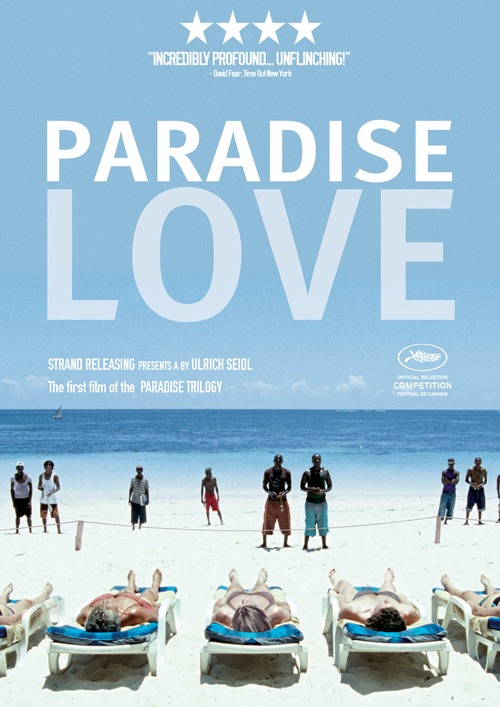


The entire trilogy begins with a shot of physically challenged persons driving around in bumper cars in an amusement park and this sums pretty aptly what all three films are about. Looking for love, or any content to life, is like bumbling around in the dark, and you might easily be hurt. Love concerns the love-lorn middle-aged Teresa (Margarete Tiesel) going to a holiday in Kenya. Yet she is not so much interested in Safaris or games at the hotel poolside than finding a boyfriend from the local men.


Teresa's friend compliments her holiday boy-toy and she becomes curious for some local meat as well.  Teresa has a low self-esteem and opens up to men complimenting her looks and dismissing her age. Even though she is after sex, she wants her boyfriends to be interested in her because of her personality, not her wallet. And thus she finds crushing disappointments time and again. The poor local people are only after monetary support from rich white ladies, not an equal relationship. Seidl doesn't shy away from any aspect of these unequal, partially racist interactions, spicing his film with plenty of black humor and cringe-worthy scenes.

The problem with the trilogy opener is pretty much the same as with all Paradise films. They are clear arthouse films, slow-moving and aesthetically strong. While the ideas and the message are incredibly easy to get and understand, there aren't any layers or anything to ponder afterwards. And once you figure out the central ideas of the movie, the rest is sort of inevitable and at times even a drag. Love has plenty of nice, static shots of tourist beaches and African reality so it's at least easy to look at but sometimes feels like a way too personal holiday diorama. It's a nice film but hardly a groundbreaking masterpiece.

★★★ 1/2

Paradise: Faith (Paradies: Glaube)


Nurse Anna Maria (Maria Hofstätter), sister of Terese, is a hardcore Catholic. Hardcore, as in she whips herself in front of a crucifix, and goes around the houses of immigrants and the unemployed to deliver statues of the Virgin Mary and to talk about (her interpretation of) the Bible. It's not an easy job, as many of her "customers" are dismissive or otherwise hard to deal with. But AM's life becomes even more difficult than that, when his paralyzed (and randy) ex-husband (Nabli Saleh) comes to stay at her place.


Making fun of devout Christians is something akin to shooting fish in a barrel. But Seidl isn't so much interested in mocking (although AM's obsessiveness does generate plenty of laughs), but rather in the hopelessness to try to keep a strict set of rules one sets to yourself and the world. One won't come out a decent human being, no matter how hard one tries.


What sets this installment above the rest of the trilogy is the grotesque cast of characters. Particularly memorable is Herr Rupnik, an obese man who tends to misplace his pants and lives in an apartment akin to a huge pile of garbage. Maria's sanity is put into question several times, as her obsession deepens, so does her affection to Jesus, represented by a big crucifix. Perhaps the reason she detests Nabil so is the fact that he's a Muslim. All in all, it's a trashy, borderline uncruciable account of becoming too blind on one's own acts and too focused on one view into the world.

★★★★

Paradise: Hope (Paradies: Hoffnung)


The final film sees Terese's teenaged daughter Melanie (Melanie Lenz) go to a Fat Camp to lose weight. But being a girl in a delicate age, she's not that interested in the daily exercise routines, but rather talking about sex experiences with her campmates, stealing food, alcohol and cigarettes, and running away to go to a club.


But the thing she is most interested is the middle-aged doctor (Joseph Lorenz) of the camp. She soon develops fake symptoms to go see him every day, much to his delight. Lorenz plays the Doc suitably sleazy and creepy. One is not quite sure whether he's going to act out on his instincts or not. One scene sees her follow her into the woods like the wolf following Red Riding Hood. They end up hugging. Or at least that is what is shown on screen.

Seidl has veered a little close to familiar patterns with his previous films, and this one veers a bit too close into the well-trodden coming-of-age path. As I implied, many of the films most interesting parts are the ones you don't see. Indeed, it is about a half-hour shorter than the other Paradise films. Yet it does feel equally long, so perhaps the storytelling isn't quite as leisurely forward-moving here. The film feels a bit fractured, and it is its greatest asset as well as its downfall. The acting, again, is superb.

In this case, it is not quite as clear as what the Hope in the title refers to. Melanie doesn't seem too interested in the Hope of becoming thin, after all. The Hope of becoming a woman? Perhaps this left a bit more to ponder about than its predecessors, after all.

★★★ 1/2

I Am Divine (USA)
Dir. Jeffrey Schwartz


It's about damn time the legendary drag queen actor/disco music star got her own documentary! It's one of those subjects that is so interesting in itself that it's hard to fail, at least with the right audience. As a documentary, this is far from perfect, but it's still a really fun ride alongside one of the most outrageous figures in pop culture.


Jeffrey Schwartz's film was funded by crowdraising the money. The lack of budget shows off here and there, since several photographs pixelate visibly when zoomed into (not that zooming into photos repeatedly isn't a tired cliché in documentaries anyway). However, all the right people are interviewed, including John Waters, Mink Stole, Mary Vivian Pierce and even Divine's dear old mother. One would have hoped to hear some more outrageous, weird and wonderful stories from those that knew him best, but the film is a bit shy on them, whether it's because of respect for the deceased star or for a lower rating.

Still, it's a heartfelt retread of the life of a huge icon with several rather moving testimonies from family and friends. It offers little new information for connisseurs (some longer clips from early, rare John Waters shorts would have been fine, too), but it works as a passable introduction to the world of Divine.

★★★

Blancanieves (Spain)
Dir. Pablo Berger


I found this film's title impossibly difficult to remember until I watched the movie and found out what the title meant. Basically, this is a story of an orphaned girl who follows on her father's footsteps into becoming a popular matador, bullfighter. Any mythological parallels are hidden a bit deeper.

There are dwarves, though.

This is also a brand spanking new silent movie, much in the vein of The Artist. This tries to be charming and touching, like that film, but ultimately left me cold. There are bits and pieces to be enjoyed for sure, and visually it doesn't look half-bad. But I had problems identifying with the main character, who kind of bumbles through weird mishaps without a proper arc or a character to speak of. It also doesn't help that the main characters are bullfighters, which I find to be kind of horrible assholes. Anyone who thinks it's sort of glamorous to slowly butcher and torture an animal to death, deserves to be murdered by a gold-digging witch.


Unlike The Artist, which dealt with the development of cinema anyway, there's scarcely a good reason for this to be a silent pic other than to cash in on the success of others, and to utilize a nifty trick to gain attention to a hallow shell of a movie. The main villainess (Maribel Verdú) is kind of cute, though. She kind of looks like Bérénice Béjo.

★★

Byzantium (UK/USA/Ireland)
Dir. Neil Jordan


Neil Jordan has gained reputation along the years to be a feminist genre movie director. His latest film could be seen as a response to the Twilight crowds, who crave bloodsucker romance so hard they forget that the female characters in it are virtual non-entities. Jordan has plenty of good ideas and tricks up with his sleeve on this one, but somehow lacks any grip on the direction, so the end result is a boring and shapeless mess.


Two women seek refuge to a small coastal town. Clara (Gemma Arterton) gains money from prostituting herself, while the younger Eleanor (Saoirse Ronan) helps euthanize elder people and goes to the local schools writing class to show off her skills. The latter falls for a classmate, Frank (Caleb Landry Jones), and reveals that they are actually Lhiannan Shee, vampire-like creatures who survive during the day but need blood to live.


The character of Eleanor is way too dull for the role of the protagonist. Thus, when the film spends the most time developing her and Frank's relationship, the audience falls into a coma. All flashbacks to ye olden tymes are infinitely more interesting, even if they slowly start to form a picture which I certainly didn't quite understand or manage to put the pieces together. Plenty of the most interesting elements of the film are woefully underutilized, including Arterton's sexier and more femininely threatening spirit, and the pursuers of the pair. The final act of the film takes on a whole new gear, but still offers little new to a market packed to the rafters with monster-romances. Jordan is so much in love with his idea of a blood-filled waterfall that he uses it plenty of times, never mind that the water is more pink than blood red, and that that welcomes unwelcome comparisons to the elevator shot in The Shining.


Watching the movie, I came up with several good ideas on how some of the central ideas could be utilized to make a more interesting film. When this inevitably gets remade in 5-20 years, Hollywood, you know who to call.

★★

Tuesday, 26 March 2013

Docpoint 2013

Room 237

Not too long ago, another of Helsinki's biggest film festivals took place. As always with DocPoint, the focus was on the year's most exciting, thought-provoking documentary films from around the world. There were several interesting movies to be seen, and it's took a while, but here's a brief look into this year's crop.

The Gatekeepers (Israel/France/Germany/Belgium)
Director: Dror Moreh


Will there ever be a chance for peace in the Middle East? Impossible to say, but at least not if one doesn't study both points of view of Israelites and Palestines. While at first glance this documentary about Israeli chiefs of Security seems to be on Israel's side, it provides criticism to the endless cycle of violence as well.

The film succeeds in contrasting the personalities of all the former leaders of Shoh Bet, or Shabak, the Central Israeli Security Agency. They provide insights on how the nation viewed various threats and wars. The endless cycle of violence has made the men develop a hard shell around them, yet there are points of them reminiscing bloodshed that are quite emotional nevertheless.

The stories of these men are filled with exciting details, confidential information, intrigue and contradiction. Their stories help one to understand at least Israel's dire need to keep its face and appear threatening and all-powerful. It's one of the reasons why the two sides can't really come to terms. This is an important reminder of how a life of ordering massacres affects the human psyche, and what comes from a nation that treats each of its foreign problems by reacting with more violence.

★★★★

The Queen of Versailles (USA/UK/Netherlands/Denmark)
Director: Lauren Greenfield


Here's a story of a wealthy family that lost everything. While this story's true, it might as well be a sitcom. The main characters are self-centered, dim, greedy, oblivious to any realities in life, and, sure enough, in a constant state of Arrested Development.

Before 2008, real estate billionaire David Siegel and his trophy wife Jacqueline loved to flash around their cash. They build skyscrapers, pay to have their daughter win beauty pageants and in the most outrageous move, build a multi-billion dollar mansion in the same vein as Louis XVI's Versailles Palace in France. Yet with the economic collapse, the Siegels lose their fortune. For the most part the film features them grasping onto last remaining shreds of their wealth.


Since the Siegel's are rich sleazebags, they refuse to recognize the moral of the story - the gambling, borderline illegal actions and political horsetrade having gotten them into the mess they are in. When the shoe's on the other foot, they blame others for destroying them and attempt to bounce back by doing the same mistakes again and again. It's incredible how dumb, vain and all-around unlikeable the main couple comes off, but it just makes the movie more intriguing. They don't care the least.

This movie is a testament to this age, a story on how people overemphasize surfaces, appearances and superficial values. They delude themselves to think they are happy when they can raise envy and outrage. But underneath all that surface is but a husk of a soul, one that has a child's idea on how society works, refuses to take responsibility and is doomed to repeat the same mistakes.

★★★★

The Pervert's Guide to Ideology (UK/Ireland)
Director: Sophie Fiennes


Leftist philosophy superstar Slavoj Žižek delivers another video essay using film clips from old movies, self-irony and societal critique. And, as always it is highly entertaining. This time around the lovable lisping Slovak talks about how Ideology has shaped the world around us, and can be seen in various cultural product we wouldn't necessarily expect to. Case in point are movies, both old and new, obscure and blockbusters, documentaries and fantasy.

While The Pervert's Guide to Cinema had (albeit a flimsy) thread with which to follow, this time around Žižek seems to ramble on whatever comes to mind. That's not to say the film is sloppy, on the contrary the scenes replicationg various film styles are done carefully and to a good comical effect. A lot of the things discussed are quite familiar to anyone who has ever read an article by him, seen his lecture or the documentary film Žižek! I, of course am guilty of all three, but still I enjoyed immensely to hear these theories again in another, more entertaining format. Whether I agree or not is another thing, but the strength of Žižek is that he doesn't pander but provokes and speaks out his mind. Thus, it's up to the viewer to decide what to make of it.

★★★ 1/2

Marina Abramović: The Artist is Present (USA)
Directors: Matthew Akers, Jeff Dupre


The conceptual performance artist Marina Abramović has had a long career of putting herself into her art since the 1970s. She has done this to such extent that without art at 63 years of age, she feels like a quite lonely, vunerable and uncertain person. The film chronicles her preparation fot the retrospective of her career at New York's MoMA. But it isn't just a case of putting art work on a gallery. Abramović also prepares to sit and stare at the museum guests all day, every day for three whole months.

Abramović's career has much been characterized by the search for boundaries of art. Not only allowing art lovers to look at art, but looking personally back at them is a concept as simple as there is. On a smaller scale, it could be done by anyone. Doing it with thousands of museum-goers day in, day out takes a lot of courage and endurability. But when does meeting another person, not saying one word, become art? Is it only when the other party is a respected artist by profession? The surrounding of a retrospective adds up plenty to the work, it puts on the emphasis that the artist is still present in all of her past work.

The film is ponderous and heartfelt, and like its focus, almost unbearably intimate. Just the sight of Abramović's stare brings some guests to the brink of tears. Documentarists Akers and Dupre explain Abramović's history extensively and understandably. The film is not qute as experimental as its subject matter, but it does feel like a real experiment, and makes ponder both the nature of art and humanity by itself. Not a small feat.

★★★★

Room 237 (USA)
Director: Rodney Ascher


The ominous, creepy atmosphere of the 1980 film The Shining, as well as the well-known perfectionism of director Stanley Kubrick, have made the movie larger than life. Since Kubrick tended to refuse to put all the pieces together, there was much left for individual interpretations. Thus, there are plenty of people obsessing over the film and coming up with several outlandish renditions of its meaning.

The documentary is illustrated almost solely with film clips, mostly from The Shining, but also from Kubrick's other films, as well as unrelated movies which deal with cinema-viewing and audience perception like Lamberto Bava's Demons. The interviewees are only present by sound and they are not recognized with texts or anything. It is a democratic approach, putting all the interpretations to the same line, whether observant or bug-out crazy.

Obsessing over the movie, some people have spotted out odd visual clues that provoke imagination, such as the unnatural geography of the Overlook Hotel. The theories surrounding the film's horrors sexual nature, or the retread of American bloodshed from history, seem kind of plausible. And then again, there are people who insist Kubrick framed the moon landings and uses the film to confess this to his wife. Danny's Apollo 11 sweater on one scene is the key proof of this cuckoo theory. Nevertheless, it is intriguing to hear both these accounts, and all in all the film both puts The Shining into a new light, all the while not taking anything from the mystical aura of the masterpiece. On the contrary, adding up to it!

★★★★

Roman Polanski: A Film Memoir (UK/Italy/Germany)
Director: Laurent Bouzereau


As controversial as directors come, there's no denying Roman Polanski is a character as fascinating as his films. This documentary is an attempt by his long-time friend Laurent Bouzereau to allow the man to speak his mind himself. Polanski spills his life story while on house arrest in Switzerland, waiting whether he will be handed over to US authorities for imprisonment or not.

Predictably, the story hinges on the major three disasters of Polanski's life: Fleeing the Nazi regime as a child, the relationship with his wife Sharon Tate and her consequent brutal murder by the Manson Family, and the director's actions on Jack Nicholson's house with a drugged-up minor, as well as the travesty of a trial that followed. Polanski is a humble man who doesn't attempt to shine his own shield too much and carries his tragedies as well as his successes like his current wife and children. Yet for a film titled Film Memoir, the movie glosses over Polanski's body of work in favor of a character study. His films stem from his private life, so you can't entirely seperate them, but I for one would've been eager to hear more insights on making a large number of brilliant films that disturb and challenge to this day.

★★★

Something From Nothing: The Art of Rap (UK/USA)
Directors: Ice-T, Andy Baybutt


The rapper that brought you Cop Killer is convinced that hip hop saved his life from life on the streets. Since Ice-T owes the music a debt, he attempts to serve it by going around his peers, rap legends and super stars, asking what makes the music matter. The array of artists is quite impressive, from MC Melle Mel through Ice Cube and Chuck D all the way to superstars of the modern era like Kanye West and Eminem.

This is another one in the series of music documentaries that attempt to serve as a gateway to a world of certain genre. It attempts to serve the field as evenly as possible (yet focuses on the most commercial side), leaves out niche groups and offers little information to true aficionados of rap's history. It's always nice to see music legends talk about their work and how they create their verses, so it's an entertaining piece but far from true art mastery.

★★★

Men At Lunch (Ireland, 2012)
Director: Seán Ó Cualáin


The famous photograph about the building of New York, hanging on the walls of bars around the world, has inspired this historical documentary. The movie attempts to find out who were the men sitting on a girder on top of the Big Apple eating their lunch without any fear of falling. Thus, it is a story about labor in the time of the Great Depression, and by extent, immigration.

Unfortunately, since the film is Irish, it is very biased. It attempts to prove a confession heard in one pub to be conclusive, while newspapers and competitions have come to different solutions that are dismissed entirely. Likewise, the story is quite thin since there is little evidence on who's who in the picture. The lazy, archival storytelling style is one for sunday afternoon TV documentaries, but doesn't really work on a big canvas. This could've been an interesting detective story, now it's as bland and unjournalistic as they come.

★ 1/2

Sunday, 28 October 2012

HIFF 2012: Horrors For Halloween


Although this wasn't the best year for genre cinema, Love & Anarchy still managed to show several films worthy of your ravenous hunger for Halloween-related films. Hell, the film's poster had a ghost in it. Woo-oo-oooo.

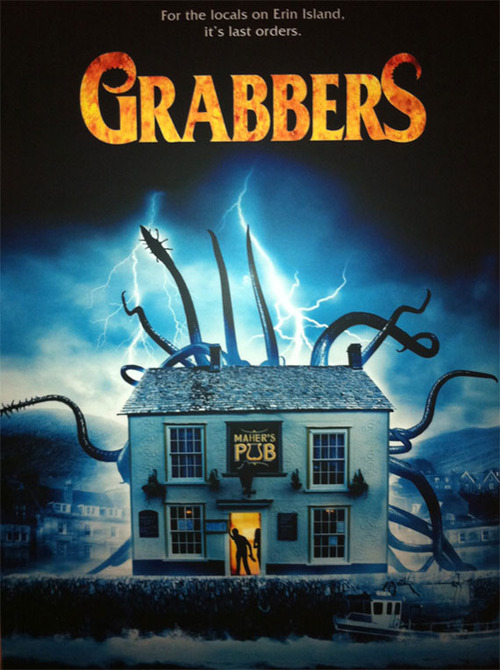
Grabbers (Ireland)
Director: Jon Wright


If there's something the Irish can do it's take the piss. Ahem, in more ways then one. But the occupants of the Green Island are known not only by their high alcohol consumption, but also their good-natured sense of humor and willingness to laugh at themselves. thus, it makes sense that the following high concept would stem from these people: vampiric aliens attack a small village. While they feed on human blood, they are allergic to alcohol, so everyone must start drinking to stay alive through the night. A concept can't get much better than that.

But let's look at the film a bit more closely. Having a strong affection to 80's comedic genre films such as Gremlins, An American Werewolf in London and The Evil Dead, Jon Wright's film's style heavily reminds viewers of last year's Attack The Block. In both an alien invasion makes unexpected heroes of an archetype you'd believe to be as unsuitable for the role as they come. Rather than pre-teen gangsters, however, this time our hero is the bored and alcoholic Erin island policeman Ciarán O'Shea (Richard Coyle)


As in numerous buddy cop movies before, O'Shea is on the edge and gets a new no-nonsense, by-the-book partner. This time it's Dubliner Lisa Nolan (Ruth Bradley). Unsurprisingly, extreme conditions make both of them smoothen the edges of their personas and they meet in the middle ground. But rather than with the leads, the film shines more brightly when concerning its bit-characters. They are also somewhat stock characters from countryside TV dramedys, but since you don't often get to see the vicar getting pissed in a pub, they work wonders here.


As for the aliens themselves, they are suitably icky creatures, a little bit like blue octopuses or starfishes with suitable grabbing tentacles. They provide a good enough threat to create some suspense into this thing, and it often seems our heroic Gardas are battling overwhelming odds. While the film can't be called a splatter by any means, the sudden bursts of violence have much more effect.

All in all, the film is silly, but doesn't overemphasize its ridiculousness. It's a bit more clearly a comedy than Attack the Block, but still not really a laugh-riot. Since that film (which I could have given more stars to, BTW) was as urban as they come, it feels apt that this one has a clear countryside vibe. All in all, it feels authentic and considering it's a quite stupid genre piece, it's quite an achievement.

★★★ 1/2

Shopping Tour (шопинг-тур, Russia)
Director: Mikhail Brashinsky

A lot of Russian tourists do short shopping trips to Finland, although I've never quite understood why. Our shops are not even near anything you'd call cheap and I'd figure most of everything we have is also available in Russia. Perhaps the shoppers are looking for some sort of status symbols, expensive luxury items to brag to their friends. Anyway, a horror film featuring a Russian shopping team coming to Finland for bargains but finding only carnage sounded like another great idea on paper.


Shopping Tour is another one of the handheld camera footage boom. A middle-aged woman (Tatyana Kolganova) takes her teenaged son (Timofei Eletsky) to a fateful one-night tour to Finland. The pair have their own quarrels, and we learn that it's not been long since the family's father has deceased. In Finland, the tourists are informed that they get to be the very first ones to shop at a brand new electronics supermarket, which is open all night. But once the Russians are packed in the store, the doors are locked. The cannibal feeding frenzy of ravenous Finns can begin.


This is quite a cheap film, and it shows. While the two lead actors are quite good in their roles, it becomes apparent (to a native Finnish speaker at least), that all the extras have been hired on a pittance. Nothing else could explain the horrendous acting in Finnish on display here. The script isn't too sharp, either. Exposition and back story is spurted at very unlikely moments when people should be fighting for their lives. Still, this is a one-joke movie and at least I find that joke funny. To delve into it deeper is to SPOIL so look away for the last chapter, sensitive ones.

There's no big reason for the Finns to start eating Russians. They aren't worshipping Satan, or secret vampires or zombies or anything. Rather, it is just a tradition, and one which we Finns hold as dear as a Sauna and a cottage on Midsummer's Eve. Some light fun is poked at the fact that Finland tends to come on top of all the lists of the best societies and best places to live, yet our people are sad and suicide-prone. Mean humor is often the best humor.

★★

Crawl (Australia)
Director: Paul China


The dubious honor of being the only Love & Anarchy film I wished I would've skipped goes to this Australian shocker. I mean, I probably would've walked out but I had some time to pass before the next screening. As it is, Crawl is a dire attempt to capture some of the slow-building tension and macabre bloodshed of several new wave horror films (such as Ti West's House Of The Devil, and from non-horror, The Coen Brothers' No Country For Old Men). It attempts to make some sort of statement about gender politics, but comes off just misogynistic. And not in a fun way.


The sleazy bar owner Slim Walding (Paul Holmes) is tired of an accomplice that hasn't paid back a shady loan. Thus, he turns to a quiet Croatian hitman, known only as The Stranger (George Shevtsov) to finish the guy off. But The Stranger has plans of his own, and plans to turn the tables on Slim. The young waitress Marilyn (Georgina Haig), who has plans to quit working for Slim gets caught in the battle of wills. She is soon taken hostage and must fight for her life to survive.


True to its name, Crawl moves very, very slowly forward. Director Paul China, a former cinematographer, likes to keep things quiet and THEN SHOCK SCARE YOU WITH LOUD NOISES. The imagery is OK, but can't hide how cheap this has been made. The sets in particular look like they have been recovered from a failed stage play. Shevtsov's performance is a bit ominous, yet it takes a bit more than long shots of a quiet drowsy-eyed hitman to make up a good performance. As a contrast, ost of the other cast are just abysmal. The film feels like it has been dropped from teh cliché tree and hit every branch on the way down. It makes a lot more sense to just stay home and watch Blood Simple on DVD. There's nothing on display here that that movie wouldn't have done 10 times better already.

★ 1/2

Saturday, 15 September 2012

Review: Canned Dreams

Säilöttyjä Unelmia (c) 2012 Oktober / FS Film Oy. Also on display at Love & Anarchy September 27.

The 1st ever Finnish Film Market (attached to Helsinki International Film Festival - Love & Anarchy) is going to start in one week. As foreign buyers browse through the catalogues of Finnish films of recent years, they often may not have heard of the movies before. I thought it would be a good idea to provide a review in English of one of the best films of recent years this country has to offer. I saw it way back in spring and it has since been in plenty of foreign festivals as well. But I digress.


Globalization affects our lives a lot more than we could ever imagine. Most of the food on the shelves at your local grocery store comes from sources hard to track. In Katja Gauriloff's documentary we follow the ingredients of one tin can of mystery food all through the world. But the film isn't so much about how the food is produced, but about the people that make it. One can metaphorically includes also the lives of all the people that have contributed to making of the goods.

The film has been realized in a similar style to Michale Glawogger's Workingman's Death. Scenes of people working have dream-like quality and the people on present say what's on their mind on the soundtrack. Gauriloff's film isn't quite on par with Glawogger, but at least she has found planty of interesting personalities to showcase.
  
People working with pigs seem to be the most interesting people. We have a kind but a bit slow Danish pig farmer that's taken up the family business. He treats the animals nice, and joys when they have piglets. But his animals are sent elsewhere to be killed and cut into pieces. This is contrasted by a far more sinister Eastern European butcher who has to do the dirty work. His marriage has crumbled due to his wife's (and his own) infidelity. So, he lets out his gloom by threatening violence to her and her new lover, and having some quite alarming misogynist views on things. Props to Gauriloff for not presenting the working class as purely idealistic, good people being forced to serve under richer masters.

Nevertheless, these old ladies are the cutest!
The imagery also works quite well for this theme. Heikki Färm and Tuomo Hutri have photographed all the farms, mines, factories and shops with almost surreal close ups and cropped images. At times the film looks like a living painting. The somewhat slow pace also emphasizes this. Yet the film isn't one minute too long. In fact, it could've used a scene or two more. Some people you just would like to know more about. And telling about the origin of the food you eat is one of the most important messages one can get across us westerners.

There are limitations to this kind of film, and Gauriloff has admitted in interviews that the crew could not shoot all the material to cover every one of the ingredients in the can. Some, such as the poultry farm, are quite clearly polished images. The small room where thousands of chickens are housed on ground is actually luxury compared to the caged meat/and/or egg factories these birds usually have to live in. Since the ingredients in canned food are hardly from a farmer's market and possibly form wherever one can get them the cheapest, it's quite clear that the eggs come from elsewhere.

Yet the images of pigs getting sent to a convoyer belt to first get electrocuted and then slaughtered are still quite disturbing. No one can claim that the meat they're eating did not suffer before death when these sort of methods are in use all across the EU.

This is by no means just a national project. It has been shot in eight countries and is at its core a Irish/Norwegian/Portuguese/French/Finnish co-operation. But the tin can in this case is a sort of tower of Babel being built – it brings together a lot of different kind of people who one would not believe to have anything in common otherwise.

★★★★


CANNED DREAMS (Säilöttyjä unelmia)
Finland, 2012
Language: Various
Director: Katja Gauriloff

Screenplay: Katja Gauriloff, Joonas Berghäll, Jarkko T. Laine
Cinamatography: Heikki Färm, Tuomo Hutri


Further reading: The Best Poker Movies

http://www.pokerlistings.com/pop-poker-poker-and-the-titanic-46900
http://www.pokerlistings.com/pop-poker-is-kaleidoscope-among-best-poker-movies-66526

Wednesday, 5 October 2011

Review: The Guard

The Guard (c) 2011 Reprisal Films.

 Martin McDonagh directed one of my favorite gangster films of recent years in 2008, In Bruges. The new film The Guard is written and directed by his brother, John Michael McDonagh. I'm mentioning this trivia tidbit because the brothers seem to share both a great sense of humour as well as true directing and screenwriting skills. There are also a lot of other similarities. These two films are both the debut features of the brothers, who have made their skills as playwrights. Both films are crime stories that seem like comedies laughing at crime genre's conventions at first, but turn out to harbor a dark, melancholy punch in them. But as a filmmaker shouldn't be judged by his family, let's take a closer look at John Michael's film.

In the Irish coastal town of Connemara the local police ("Garda") sargeant Gerry Boyle (Brendan Gleeson) is taking it easy. He steals LSD from car crash victims, goes to the pub in the middle of his working day to get wasted and play video games, and uses his day off to buy services from two prostitutes. His new partner Aidan McBride (Rory Keenan) would have him rather try to solve the horrifying murder of a low-life thug. Also the FBI has sent the American agent Wendell Everett (Don Cheadle) to the village to investigate drug-trafficing set to happen. Boyle still doesn't care. He doesn't just have an authority problem, he likes to piss everyone off. The big city cop Aidan and the black American agent Wendell only listen to him continuously insult them, because Boyle actually could solve both cases if he would just bother to do it.

The film is mostly Brendan Gleeson's time to shine, and he does seem to have a lot of fun in his role as a foul-mouthed, jaundiced, but also very intelligent crime-solver. Boyle has seen all the movies before, and is quick to give a tongue-lashing to anyone using clichéd police dialogue. He actually has a lot in common with the film's villains,  the smugglers played by Mark Strong and Liam Cunningham. They also like to insult their co-workers and take the piss off their profession, but are still book-smart enough to discuss philosophy when we first meet them. The only difference is that the smugglers are cold-blooded murderers that enjoy killing, while deep down Boyle does have some ethics. Boyle is the way he is because his life is in the autumn years and everything he feels has an air of melancholia in it. He also likes to play dumber than he is. The moments where he pretends to be a huge racist just to try get Everett to lose his temper, are among the film's funniest.

McDonagh does know his genres, and shamelessly mixes them up. The laughing at crime film clichés is reminiscent of Hot Fuzz and Kiss Kiss, Bang Bang, and the bad police character is almost like Torrente's smarter Irish cousin. The film is often shot like a spaghetti western, with big close-ups and Morricone-like mariachi music. But there are no wide scenery shots. McDonagh keeps all the film's action happening close to the characters.

And you know what I mean by 'action'.
The western thematic works well, because McDonagh pictures Connemara to be just as lawless as a frontier city. Criminals are allowed to play around the city as they please and the low amount of police forces can't do much to help it. And as it turns out, Boyle is actually among the more honest of them anyway. When a new sherrif enters to clean the corrupt town, he is met with contempt by the locals (also probably because of his race). It certainly isn't a nice town, which is why McDonagh shoots it in gloomy shades of grey. All of it is already dead.

Rather than in the fate of his village, Boyle is a lot more concerned about his terminally ill mother (Fionnulla Flanaghan). They both try to take their final meets with their brand of humour, altough they both know the time is short. In a way, Boyle's grief is also a big block in the way that stops him to do what he can to help. It is left for the viewer to decide whether the character has lost his original ideals, or whether he became a cop just for the power, but has gotten bored with it. Either way, Boyle has also the same kind of disregard for himself as he has for others. It is not maybe surprising that such a character would get a chance of redemption, but at least it is well grounded in the script.

The film was premiered at Love & Anarchy festival this year, but lucky for us, it also got a wider release. We can expect the McDonagh brothers to do grand things.

★★★★

THE GUARD
IRELAND, 2011
Director & Screenwriter: John Michael McDonagh
Director of Photography: Larry Smith
Starring:
Brendan Gleeson, Don Cheadle, Rory Keenan, Liam Cunningham, Mark Strong, David Wilmot, Fionnulla Flanagan

Friday, 2 September 2011

Love & Anarchy Tips 2011

Image source: Rakkautta & Anarkiaa -blogi
 It's the happiest time of the year for us film fans in Helsinki. The biggest international film festival in Finland is soon coming to our town for another ten glorious days. You can check out the entire programme here. I have seen a number of films shown at the festival beforehand so it's time again to do some recommedations. I'll have to add that I wrote for both the festival tabloid and the film catalogue. So I hope you'll forgive me if I shamelessly steal ideas from my own texts. The following films are ordered from most to less recommeded.


Bullhead (Rundskop, Belgium)
Director: Michael R. Roskam
Good to see if: You feel dirty play makes your work way too hard and hope you could take action against that.

These days pitch black crime thrillers seem to sprung up from all over the world where ever you'd least expect. Michaël R. Roskom's debut film takes place in the countryside of Flander in Belgium. The place is depicted almost as a mythical realm of all that is evil and wrong in the world. Violence, prostitution, murders, gambling and drug deals flourish. The film is a steroid- and testosterone-filled revenge thriller with brutal violence, so it's not for the faint of heart.

Such shady affairs also draw in the cattle farmer Jacky Vanmarsenille (Matthias Shoenaerts). He is accustomed to pump his meat full of hormones working for his uncle. So when a shady vetinarian suggest that he should work for a local hormone smuggler Marc (Sam Louwyck), Jacky accepts. The deal would open all new markets for Jacky's beef, but he doesn't know that Marc coldly disposes of people who ask too many questions. Getting in Marc's way also ended the life of a local policeman recently. Jacky's deal gets the authorities to look for his businesses a little closer, and also brings back traumatic memories from Jacky's past. The farmer may get a chance to have revenge on people that horrifyingly mutilated him as a child, but is it worth it?

There's no doubt that two things push the film forward: amazingly confident direction from first-timer Roskam, and the excellent performance by Shonenarts. The latter's as convincing as can be as a tough-as-nails muscleman that has been beaten down all his life. This does makes him quite withdrawn. In the beginning, he has moral conflicts, but does mostly aim to do good. Yet, like the name suggest, he is stubborn, and won't give up when he's made up his mind. This makes him a little unpredictible, to both the audiences and also the characters in the film. As for the direction, the countryside bathes in dark colours, and thus makes it seem that all the evil on screen could be from anywhere in the world. Even your backyard. Roskam builds up tensions beat by beat, and also brings psychological layers into his story. I'm left waiting to see what he does next. Let's hope we have the new Nicolas Winding Renf here in him.

Kill List (Great Britain)
 Director: Ben Wheatley
Good to see if: You love gritty crime movies, family dramas and weird horror films, but can only afford one movie ticket.

Praise has been flowing through windows and doors to this British wonder that seemingly effortlessly mixes popular film genres and creates an unique cocktail. And much of the praise is deserved, because Kill List is exciting, creepy, and leaves the viewer pondering the morally grey areas where it dwells. Director Ben Wheatley has clearly been watching a few classic British genre films, but doesn't steal, but rather borrows themes and images to enhace his very own story.

Jay (Neil Maskell) and his wife Shel (MyAnna Buring) are in a difficult point in their marriage. Arguments rage and dishes get broken on a regular basis. Yet the pair still has love towards each other and especially to their son, Sam (Harry Simpson). Much of the arguments are about Jay loafing around the house, and his unemployment. This is why Shel is OK when Jay goes off with his friend Gal (Michael Smiley) to a business trip. Even though she knows very well that their area of expertize isn't exactly legal. It seems this time their assignment makes them meet some truly evil people...

Much like my beloved Disappearance of Alice Creed before, Wheatley's film manages to pull the rug under the viewers a few times during the course of the movie and take the whole thing to an entirely new level. These turning points are not just cheap twists, but bringing forward elements within the film's world that fit the story to be told. That is not to say that everything in the film is easily explained, since it contains a lot of weird, creepy scenes. The violence is used sparingly, which makes all the brutal bursts all the more horrifying. I hope we are witnessing the rise of a new wave of talented Brit horror directors. It's great that film festivals allow us to see this sort of events as they unfold in front of us.

The Other Side of Sleep (Ireland)
Director: Rebecca Daly
Good to see if: You're afraid to be alone at night.

The year's theme seems to be loners in a rural setting. Well, never mind that, because Rebecca Daly's debut feature film seperates from the others by being a real one of a kind gem. It is the kind of film which mixes reality and dream, yet it is not us viewers who may think we are dreaming, it is the young factory worker Arlene (Antonia Campbell Hughes). Arlene is having trouble sleeping, but when she does fall asleep, she walks around her town. She may wake up from weird places with her fingers and skin all bloody and other weird stuff having happened. Hughes plays her part mostly expressionless, like hypnotized. That's why it's really hard to tell the difference of when Arlene is awake and when sleeping.

When another young girl is killed in her village, Arlene becomes interested. There's two reasons for his fascination. First, if someone is stalking young girls at night, she may be a suitable target while sleepwalking or coming home from work. Second, when she isn't sure what she does at night, she herself might be the killer! Arlene starts to pay close attention to the case, saves newspaper articles about it, and visits the crime scene. She also starts to see the persons close to the victim, whether unconsciously or to get clues.

Daly's film mixes up a lot of things that European art cinema is good at. There are shots in the textile factory where Arlene works that are reminiscent of social realist films such as the work of Ken Loach. Some moody thriller scenes, like lonely walks on the road at night, remind of giallo thrillers. And the dream-like quality of many scenes in the central plot have traces of the modern expressionism and surrealism. There's also a seemingly undefined wild card in the mix, which makes the film's mood calm and threatening at the same time. In the film, the mystery comes second in how the film is told, and the viewer gets rather sucked in by the sheer mysticism of it all. That's good, because the film doesn't offer straight answers, and a lot, like Arlene's thoughts behind her expressionless face, is left to be decided by the viewer him/herself.

Cold Fish (Tsumetai nettaigyo, Japan)
 Director: Sion Sono
Good to see if: You hate your boss and wonder if he (or she) is as two-faced elsewhere as in your workplace.

The story in Sion Sono's film Cold Fish is announced to be based on actual events. This thriller about business brutality is claimed to follow reality pretty closely, only having switched dog kennel keeping to owning an aquarium shop. I'm not sure whether to believe that, because the whole story feels so imaginary, poignant, and clever, just like Sono's films at best do. Two aquarium keepers, the friendly-seeming Mr. Murata (Denden) and the timid family man Mr. Shamoto (Mitsuru Fukikoshi) become friends after Murata hires the thieving teenaged daughter of Shamoto to work in his shop. The men become fast friends. But it soon turns out that Murata is in fact a cruel psychopath, dealing with the yakuza and officials both with brutal ways. Shamoto is soon tangled to Murata's web of lies and nasty businesses, but is too much of a pushover to oppose his dominance over him. But like one can see from films like Straw Dogs, you can only push one so far, until he has to bite back. Yet on the line is not only his oppressor, but also Shamoto's dysfunctional family, over which he wants to take on a new dominance.

The character of Murata is a fascinating and memorable villain. In the beginning he seems genuinely excited in seeing exotic fishes and joking around with people he barely knows. Yet he is actually a lot more cruel than would seem on the outside. He truly cares more for fish than people, as he has a talent of pulling people's strings to do his bidding. People are objects to him, and able to be disposed of when they outlive their usefulness. His aquarium shop is filled with teenaged girls in skimpy costumes, and he can take any woman he wants with a mixture of lies of understanding them and taking what he wants with force. His sense of humour extends to the dirty part of his business and he derives great joy in chopping his victim's corpses and plays around with different organs. Veteran character actor Denden does great job in bringing this human monster to life and his character is one of the greatest criminal characters seen in recent years.

Unlike Sono's 4-hour Love Exposure from last year's Love & Anarchy, Cold Fish runs on a little bit too long, and feels repetitive. It deals with many of the same themes, such as the state of families, the unfairness of Japan's society which pushes people to do deperate things, and one person's decision to fight for a more pleasant ending for himself. One still can't claim that this tale filled with hopelessness, fear and pain isn't gripping. Cold Fish is also trencehed in black humour that Sono handles very well. He also utilizes a lot of the familiar Christian imagery in the background of its violent atrocities. By delivering another corker, Sono is well on his way of becoming his native country's most interesting  modern filmmaker.

Sensation (Ireland)
 Director: Tom Hall
Good to see if: You feel today's society is over-sexualized and pine for some basic values such as love and respecting one another.

Sensation
isn't really a love story, even though it's about a boy meeting a girl. This drama, laced with dry black humour, has much too dark themes to be a feel-good movie. Director Tom Hall takes an ironic look at modern loneliness. The film is set in the Irish countryside where unmarried old bachelors deal with their farms alone. The only way to get release is to wank off to porn magazines in the field with the sheep watching or to hire a call girl.

The young Donal's (Domhnall Gleeson) father doesn't take this kind of life any more and takes his own life. Donal inherits the farm and a sum of money, but doesn't really know what to do with it. Being horny as hell, he decides to invest in a prostitute. Thus he meets the new-zealandese Kim (Luanne Gordon). The couple hit it off very well, and come up with an idea to invest the money. They start a pimping circle in the countryside for other lonely men around. This proves to be a successful idea, but has strains on the relationship between the pair.

The film ponders the question whether everyone really needs sex to be a balanced individual. Sex itself is treated like a trade, and the performance doesn't initially hold any significance in the minds of the characters. Yet because they focus too much on only the intercourse, the characters forget a lot of other important things in relationships, and life in general. Getting sex won't give the characters any respect from anyone, nor any skills to respect anyone else. The blame falls to the fractured modern life: internet makes pimping easy, but earning any love hard.

7 Sins Forgiven (7 Khoon Maaf, India)
 Director: Vishal Bhardwaj
Good to see if: You're a romantic, but feel that true love evades you

We westerners often have a stereotypical idea of what a Bollywood film is: a formulaic 3-hour romance story with superficial song and dance numbers erupting every now and then. Altough 7 Sins is a long, melodramatic and epic drama that contains a lot of romance and music, it breaks every cliché it can find. The film is also filled with black humour, and the music varies from tango to acid rock. Instead of a full color pallette, the film is shot in dark blue, brown and grey-tones. The film's plot may initially feel predictable, but even though it is told in flashbacks, it still has a few tricks up its sleeve with which to genuinely surprise the audience.

Susanna Johannes (Priyanka Chopra) has been unlucky with love all her life. It seems this drove her to suicide. The shocked
Arun Kumar Singh (Vivaan Shah) is ordered to do the autopsy. He tells her wife that he used to secretly pine for Susanna years ago, as he grew in her farm and she later worked as his mentor. Susanna's story is heard in a flashback. She has tried to find a man to love that would love her unconditionally, and thus has gone through seven husbands. Six of the first have been a sinful bunch, being full of self-obsession, wrath, vanity, greed and other mortal sins. They all, from an army general through a rock musician to a hippie professor, treat her badly. Thus, Susanna comes up with clever ways to kill them to go searching for the next husband.

Chopra's performance as Susanna is the backbone of the film. Even though her character is ruthless and cunning, her unlucky exploits looking for love in all the wrong places make her symphatetic. She also has a great deal of determination, even though she ages from a teen to an old crone during the course of the movie, and turns to a little bitter. Chopra also brings a little eerie mystique to her performance, making watching her enchanting. 


The Enemy (Neprijatelj, Serbia, Bosnia-Hertzegovina, Croatia, Hungary)
 Director: Dejan Zecevic
Good to see if: You ponder what makes perfectly normal people into beasts during the wartime.

Films from the Balkans often deal with the horrifying violence the young countries had to endure not too long ago, whether directly or indirectly. The resulting films have been pretty grim, and The Enemy is no exception. This horror film by Dejan Zecevic approaches the subject from both directions at once. It is set on the battlefields of the Bosnian war, and the characters witness mass graves and varous other horrors that were realities back then. But the film's story does also seem to have some supernatural elements in it. Whether they are real or just psychological delusions of the characters is left to the viewer to decide.

A group of Serbian soldiers on a scouting mission comes upon a contry house and discovers that a man has been laid inside the wall. The man acts oddly and seems to have been peacefully waiting to be discovered. The patrol is commanded to stay to wait for back up, but it wouldn't be much worth to leave anyway, as the area is filled with mines. But the patrol isn't alone in the area, and has to deal with both civilians and enemies moving around the area. Everything doesn't work out, and the stress gets to the men.

The director Dejan Zecevic knows that the best horror films often work with a slowly building tension. It is also a clever idea to reflect contemporary war history with a story confined in a small space. The war crime sin the Balkans certainly are much more scary than any fantastical monsters one might come up with. The film doesn't dwell on the cruelties, or stare at its own navel, but flows along smoothly as the tension builds layer by layer. A big part of the excitement comes from the good characters getting distrustful towards each other, and eventually ending up on each other's throats. The Serbians know all too well, that the cruellest mass murderer might be a normal-seeming friend.   

The Black Power Mixtape 1967-1975 (Sweden)
 Director: Göran Olsson
Good to see if: You dream of a better world and aren't afraid to take action when necessary.

Sweden, about as white-bread as countries get, had a strange fascination on the Black Panther movement in the USA in the late 60's and early 70's. Many reporters were working in the country shooting the everyday life in Harlem, interviewing movement leaders and of course reporting on the most important events. Director Göran Olsson has recently found these tapes and cut them together as a movie that tells a story about the Civil Rights Movement from a little different perspective than usual. The material's strength is in the multiple interview tapes of important Civil Rights protesters that were not that well known outside America. The media in the US was more interested in the violence and other concrete acts the Movement was able to do. They never asked too many questions about their ideology, unlike the Swedes.

The political viewpoint is nicely formed in the various interviews of the film. Olsson has also peppered his film with modern interviews with people linked to the movement. As he's out to create an image of the past times, he only uses the modern interviews in audio, letting the contemporary images tell another half of the story. This is a stylish idea and works incredibly well. The only quarrel with the film is that one must know the main details about the American history in those years beforehand. The most important leaders such as Martin Luther King and Malcolm X are ever-present in the background, but their basic ideas and means are dealt with only briefly in the film.

My Neighbors the Yamadas (Hôhokekyo tonari no Yamada-kun, Japan, 1999)
  Director: Isao Takahata
Good to see if: You love your family deeply, even though sometimes they drive you crazy.

Isao Takahata's 1999 family comedy is based on a popular Japanese comic strip, and is often said to be the most un-Ghibli of Ghibli's films. I agree to this claim concerning the film's sketch-like animation style. But at core, Yamadas is as fitting to the Ghibli stable as any of their films. Altough it concerns the mundane lives of a middle-class Japanese family, occasionally it allows for their imaginations to run wild and that results in fine fantasy sequences, beautifully relized in the minimalistic style.

The Yamadas are a happy family. There's the pre-teen Noburo, Takashi and Matsuko (mom and daddy), little Nonoko, grumpy dog Pochi, and the eccentric grandma Shige, who's too old to be polite. The film doesn't so much have a plot as a series of skits of the family's ordinary problems. Nonoko gets lost in the mall, Noburo falls in love with a school friend, Matsuko wants to watch a film on TV while Takashi wants to watch sports, or Takashi must give a speech at work. All problems are chaotic at first as the family reacts in their personal ways. In the end, everything is solved with the Yamadas' unique style. The film is a little uneven, even if it is cheerful and happy-go-lucky by nature. Some of the jokes work depending on whether you care for the various family comic strips on newspapers. It's not to say the film is bad, as it certainly has that Ghibli charm. The Yamadas love each other, and thus the film is an ode to the nuclear family. If you have similar memories from growing up, or have a similar family of your own, it is easy to find something to like here.  

Griff the Invisible (Australia)
Director: Leon Ford
Good to see if: You feel lonely, and sometimes hope you could be someone else. And you love quirky indie comedies.

According to director-screenwriter Leon Ford, the idea for this romantic fantasy movie came from observing a 5-year-old acting out his superhero fantasies. Griff the Invisible is a study on what would happen if an adult would never abandon these fantasies, but would go on playing a hero in his everyday life.

Griff (Ryan Kwanten) is a timid and shy young man, teased by his co-workers. His only friend is worried that he doesn't go out enough, and introduces him to a young girl, Melody (Maeve Dermody). Melody becomes intrigued by Griff's fantasies and wants to start participating in them. As the romance starts to bloom, the simple superhero fantasies grow ever more elaborate and start to have strange turns. In the end, it is not clear whether the company of the two lovers is good for either of them. The film asks the question whether growing up required for everyone.

Griff
parodies modern superhero films by its dark colour pallette and athmosphere. This in turn makes Griff's loneliness in the story seem a lot more crushing. But one really can't think of him as a pure victim, as he does fight back to his office bullies. I like that such a silly premise is played so seriously. Yet, the film made me laugh very scarcely, but ponder the relationships adults have on their daydreams and their values all the more. It's a good thing, I suppose, but all in all, the film is a little conventional for a quirky independent love story. Still by far worth seeing if you're into these sort of films.

----------------

So there you have my picks from the things I've seen. There's a lot of good stuff in the festival as always. I eagerly await to see at least the LA neo-noir-action Drive in a special Gala screening, Paddy Considine's tough-as-nails directing debut Tyrannosaur, Takashi Miike's return to form in 13 Assassins, and the mad Indian action film Robot (Endhiran), which you may remember as one of my MIWS. The festival takes place from 15th to 25th of September. Be sure to read a lot more film introductions and reviews here as the festival kicks off!

LinkWithin

Related Posts Plugin for WordPress, Blogger...