Showing posts with label silent. Show all posts

Wednesday, 26 August 2020

The Best of Laurel & Hardy (shorts)


This is the 250th post on this blog. It looked pretty unlikely for years that we would ever get this far. But now we have the familiar swing back for a while, and if you have followed my back catalogue, some old story formats will make a comeback in the near future. We'll see how long this will last, but let's just make the most of what we have now.

One of the first films "reviewed" here was a short film of Stan Laurel and Oliver Hardy called Laughing Gravy. It's certainly among their best, and features a truly nasty ending gag. Recently, I realized that this was just in the two-reel version of the short. There's also a three-reeled version that replaces the end gag with minutes of Laurel & Hardy arguing about their friendship. It's really limp compared to the tight gag-fest of the shorter version, and of course not nearly as funny gallows humour.

Since I've been watching a few Laurel & Hardy compilation dvd's while in quarantine, I thought it would be of good public interest to make a list out of my favorite shorts. After all, while they were prolific and usually maintained a good quality throughout their team-up with producer Hal Roach, there are some gems that warrant a more closer look.


Big Business
(1929)
Directors: James W. Horne, Leo McCarey

This silent-era flick has basically everything you would want from a L&H short. It has an interesting premise, snowballing situations and lots of property damage. Moreover, the film pits the duo against the hot-tempered moustache-man James Finlayson, who had a supporting role in many of the Roach-era films. He had a very silly bug-eyed rage face, which made him an excellent foil to Laurel & Hardy's tomfoolery.

In this story, sales tactics for a christmas tree fail to impress Finlayson, but L&H keep pushing it, making the angered customer destroy one of the trees. This causess L&H to retort and begin to do damage on the occupant's house, which in turn makes Finlayson attack Laurel & Hardy's car. At the point where the car is exploded and half the neighborhood is out to see the epic battle, a policeman arrives. 

A lot of laughs are mined out of the characters trying to appear innocent as they have just busted a window wide open and destroyed just about everything inside. The cop is portrayed here as a mere observer, not even attempting to stop the wonton destruction but just biding their time to get to punish the people responsible.


Liberty (1929)
Dir. Leo McCarey

Probably taking a page from the book of Harold Lloyd, this silent one sees the pair escape the police in a skyscraper construction site. But what really drives the plot is the fact that the pair has dressed each other's pants on and they try to switch them back.

The gag-work is beautifully laid-out, with Ollie getting a live lobster in his pants near the beginning, that snips his bottom at key turns, making him almost drop again and again. The film works as a time-piece of a time where cities were building up almost overnight, and the unexpected adventures they could provide for the hapless wanderer. The cop chasing them with quite lethal means also gets his comeuppance in the end with a supermarioesque squashing.


Brats (1930)
Dir. James Parrott

There are several films like Twice Two (1933) that see the actors do a dual role as their usual characters, and in that case both of their wives. But I find it funnier when grown men play children than women. It also requires a bit of trick photography as Stan & Ollie's kids in this one are a lot smaller than their grown-up counterparts.

Juniors won't go peacefully to bed, running amuck and pulling pranks well after their bedtime. Meanwhile, their dads attempt to play billiards and of course wreck their own story as well. Upstairs, Ollie Jr. gets shot in the butt and Stan Jr. makes the batroom overflow. The end gag could have been an even bigger one, with some consequences shown, but it is splendidly set up with Ollie's usual dismissiveness of Stan and cocky demeneour.


The Music Box
(1932)
Director: James Parrott

One of their best-known films, this one sees Stan & Ollie as movers, set to deliver a piano into a fancy hilltop mansion. Of course even the staircase to the house proves to be a big obstacle, never mind getting the box containing the instrument inside the house. It is a good example of the farcical nature of snowballing destruction, as well as utilizing all manners of sight gags as well as the knowledge of the myth of Sisyphos.  

The film's lofty reputation would let one to expect an even more outrageous finale as the owner of the house arrives to find a piano he didn't want as well as most of his property demolished. While this is one of the smoother-running shorts with good gags throughout, I also have a soft spot of shorts that have an even more outrageous ending. For instance, the silent short Wrong Again (1929) has a landowner fed up with shenanigans take out his shotgun and say to his mother to read about the murder (of Stan & Ollie) in tomorrow's newspaper. 


Busy Bodies (1933)
Director: Lloyd French

This one sees Stan & Ollie in a new job at a woodshop. They soon annoy their co-workers and bumble about cluelessly as to make the whole plant turn against them.

It is a great piece of prop comedy that uses all sorts of power tools and building materials to make Ollie's day worse and worse. It even has a more painful version of Chaplin's Modern Times gag where Ollie is sucked into the gears of a major machine and spat out. And as I love the destruction of cars in particular, the final gag sees their car being sawed in half by a giant buzz-saw. It has been said that the filming of this stunt was dangerous as all hell and could have easily killed our beloved duo.


Dirty Work (1933)
Dir. Lloyd French

Now, having Laurel and Hardy act as chimney-sweeps that manage to soot up the house and demolish the chimney is by itself funny, but not that remarkable. What makes this short so notable is that the house they're called to is also the house where a mad professor is acting out some strange experiments on a formula that rejuvenates ducks back into eggs.

These two sides of the movie have very little to do with one another, mainly a disgusted butler going in an out of the two ordeals going on at the time. Intercut together they create quite a lot of intrigue and even suspense. It's obvious Stan & Ollie will mess up the place and get turned into test subjects, and the waiting is a part of the fun, as well as all shotgun-related shenanigans. It does pay off in the end. It was rare for the Laurel & Hardy films to turn to straight-out science fiction, but in this case it makes for a memorable experience. Beyond that, "I have nothing to say!"


Thicker Than Water (1935)
Dir. James W. Horne

As moviegoing changed, there was no more need for short films and Laurel & Hardy moved on to feature-length films. But they gave their one last shot in this one, that is probably the best one that deals with martital troubles and the friendship between the two characters. I often find the nagging wife -films to be a bit too much like boomer humor for my tastes, even if (or especially when) they get cartoonishly violent. But they also tend to give the impression that Ollie prefers Stan over his wife, which causes jealousy. Read what you will out of that.

Nevertheless, this film is conceptually quite inventive. Characters break the 4th wall literally, since the only way they can move from one location to another is to physically drag out the next scene over the screen. The film also has a quite unpredictable plot; from marital woes and money troubles we move on to an auction of a grandfather clock, and there to some hospital humor as Ollie needs a blood transfusion.

This is a bit of a SPOILER, but the last scene is something special as the transfusion switches the pairs personalities, and we see the respective actors try each others maneurs on for size. Truly this was well ahead of its time, long before anyone had the idea of Face/Off in mind.

Do you have a favorite Laurel & Hardy joint? I would like to hear from them, so I might maybe make a sequel to this post some day.

Wednesday, 28 August 2013

Espoo Ciné 2013


The annual international film festival at Espoo didn't have a very interesting programme this year, but I still managed to miss several of the most interesting films on display there. Oh well, if they really are good, I'm sure I'll come by them eventually. I managed to catch a number of films there, most of which were rather good, so it certainly was worth the bus trip there.

Blue Jasmine (USA)
Dir. Woody Allen


The most notable premiere of the festival was the new Woodsy Allen movie. I've never been a big fan of the bespectacled auteur, although I do like a few of his best, and his films of recent years which I've caught in the recent years have been cute but dismissible fluff at best. So color me surprised that he still managed to deliver a fine movie with some gravitas.


At its core Blue Jasmine is a modernization of Tennessee Williams' A Streetcar Named Desire, with Cate Blanchett as Blanche, Andrew Dice Clay as Marlon Brando (if you can believe that) and San Fransisco as New Orleans. But it strays from the material enough to able Allen to be in the race for the "best original screenplay" at next year's Oscars. It's a story of losing everything and deluding yourself that it's just a phase before a new step back up. An important part of the movie are flashbacks to old days where Blanchett's Jasmine turns a blind eye to her husband's (Alec Baldwin) shady business deals and sex-hungry flirtation with other women for her own luxury and idle happiness. In the modern day, Jasmine slowly loses her mind over dating issues, seething hate for her sister's boyfriend, and most of all her newly found poverty. The two timelines run parallel to each other, coming to her breaking point at the same time.


The acting in the film (particularly the incredible Blanchett) is top-notch, and at best points a little rough around the edges to feel more authentic. Actors stammer and sob in their anger. Yet the visual side with its golden autumn-colored visual world is a tad tired. The film is staged as if it's a stage adaptation, perhaps deliberately, but doesn't entirely work to underline the performances as probably intended. At least Allen doesn't take us through sheer tourist-baiting cityscape porn this time around. The story is touching and somewhat topical. And the bittersweet comedy oftentimes makes the audience cringe and giggle at the same time. Nicely done.

★★★ 1/2

The Paradise Trilogy (Austria/Germany/France 2012-2013)
Dir. Ulrich Seidl

The festival screened the entire Austrian trilogy of pining and crushing disappointment back-to-back. They each are fine films in their own right, but together they form symmetries of how human beings are at lost with their emotions and lives, whatever their problem, age or worldview is. It's a story of one family, each film following one female member struggle through life.

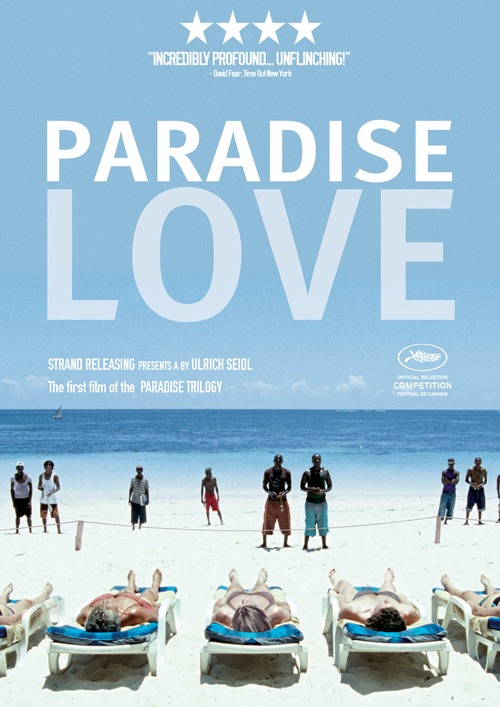
Paradise: Love (Paradies: Liebe)


The entire trilogy begins with a shot of physically challenged persons driving around in bumper cars in an amusement park and this sums pretty aptly what all three films are about. Looking for love, or any content to life, is like bumbling around in the dark, and you might easily be hurt. Love concerns the love-lorn middle-aged Teresa (Margarete Tiesel) going to a holiday in Kenya. Yet she is not so much interested in Safaris or games at the hotel poolside than finding a boyfriend from the local men.


Teresa's friend compliments her holiday boy-toy and she becomes curious for some local meat as well.  Teresa has a low self-esteem and opens up to men complimenting her looks and dismissing her age. Even though she is after sex, she wants her boyfriends to be interested in her because of her personality, not her wallet. And thus she finds crushing disappointments time and again. The poor local people are only after monetary support from rich white ladies, not an equal relationship. Seidl doesn't shy away from any aspect of these unequal, partially racist interactions, spicing his film with plenty of black humor and cringe-worthy scenes.

The problem with the trilogy opener is pretty much the same as with all Paradise films. They are clear arthouse films, slow-moving and aesthetically strong. While the ideas and the message are incredibly easy to get and understand, there aren't any layers or anything to ponder afterwards. And once you figure out the central ideas of the movie, the rest is sort of inevitable and at times even a drag. Love has plenty of nice, static shots of tourist beaches and African reality so it's at least easy to look at but sometimes feels like a way too personal holiday diorama. It's a nice film but hardly a groundbreaking masterpiece.

★★★ 1/2

Paradise: Faith (Paradies: Glaube)


Nurse Anna Maria (Maria Hofstätter), sister of Terese, is a hardcore Catholic. Hardcore, as in she whips herself in front of a crucifix, and goes around the houses of immigrants and the unemployed to deliver statues of the Virgin Mary and to talk about (her interpretation of) the Bible. It's not an easy job, as many of her "customers" are dismissive or otherwise hard to deal with. But AM's life becomes even more difficult than that, when his paralyzed (and randy) ex-husband (Nabli Saleh) comes to stay at her place.


Making fun of devout Christians is something akin to shooting fish in a barrel. But Seidl isn't so much interested in mocking (although AM's obsessiveness does generate plenty of laughs), but rather in the hopelessness to try to keep a strict set of rules one sets to yourself and the world. One won't come out a decent human being, no matter how hard one tries.


What sets this installment above the rest of the trilogy is the grotesque cast of characters. Particularly memorable is Herr Rupnik, an obese man who tends to misplace his pants and lives in an apartment akin to a huge pile of garbage. Maria's sanity is put into question several times, as her obsession deepens, so does her affection to Jesus, represented by a big crucifix. Perhaps the reason she detests Nabil so is the fact that he's a Muslim. All in all, it's a trashy, borderline uncruciable account of becoming too blind on one's own acts and too focused on one view into the world.

★★★★

Paradise: Hope (Paradies: Hoffnung)


The final film sees Terese's teenaged daughter Melanie (Melanie Lenz) go to a Fat Camp to lose weight. But being a girl in a delicate age, she's not that interested in the daily exercise routines, but rather talking about sex experiences with her campmates, stealing food, alcohol and cigarettes, and running away to go to a club.


But the thing she is most interested is the middle-aged doctor (Joseph Lorenz) of the camp. She soon develops fake symptoms to go see him every day, much to his delight. Lorenz plays the Doc suitably sleazy and creepy. One is not quite sure whether he's going to act out on his instincts or not. One scene sees her follow her into the woods like the wolf following Red Riding Hood. They end up hugging. Or at least that is what is shown on screen.

Seidl has veered a little close to familiar patterns with his previous films, and this one veers a bit too close into the well-trodden coming-of-age path. As I implied, many of the films most interesting parts are the ones you don't see. Indeed, it is about a half-hour shorter than the other Paradise films. Yet it does feel equally long, so perhaps the storytelling isn't quite as leisurely forward-moving here. The film feels a bit fractured, and it is its greatest asset as well as its downfall. The acting, again, is superb.

In this case, it is not quite as clear as what the Hope in the title refers to. Melanie doesn't seem too interested in the Hope of becoming thin, after all. The Hope of becoming a woman? Perhaps this left a bit more to ponder about than its predecessors, after all.

★★★ 1/2

I Am Divine (USA)
Dir. Jeffrey Schwartz


It's about damn time the legendary drag queen actor/disco music star got her own documentary! It's one of those subjects that is so interesting in itself that it's hard to fail, at least with the right audience. As a documentary, this is far from perfect, but it's still a really fun ride alongside one of the most outrageous figures in pop culture.


Jeffrey Schwartz's film was funded by crowdraising the money. The lack of budget shows off here and there, since several photographs pixelate visibly when zoomed into (not that zooming into photos repeatedly isn't a tired cliché in documentaries anyway). However, all the right people are interviewed, including John Waters, Mink Stole, Mary Vivian Pierce and even Divine's dear old mother. One would have hoped to hear some more outrageous, weird and wonderful stories from those that knew him best, but the film is a bit shy on them, whether it's because of respect for the deceased star or for a lower rating.

Still, it's a heartfelt retread of the life of a huge icon with several rather moving testimonies from family and friends. It offers little new information for connisseurs (some longer clips from early, rare John Waters shorts would have been fine, too), but it works as a passable introduction to the world of Divine.

★★★

Blancanieves (Spain)
Dir. Pablo Berger


I found this film's title impossibly difficult to remember until I watched the movie and found out what the title meant. Basically, this is a story of an orphaned girl who follows on her father's footsteps into becoming a popular matador, bullfighter. Any mythological parallels are hidden a bit deeper.

There are dwarves, though.

This is also a brand spanking new silent movie, much in the vein of The Artist. This tries to be charming and touching, like that film, but ultimately left me cold. There are bits and pieces to be enjoyed for sure, and visually it doesn't look half-bad. But I had problems identifying with the main character, who kind of bumbles through weird mishaps without a proper arc or a character to speak of. It also doesn't help that the main characters are bullfighters, which I find to be kind of horrible assholes. Anyone who thinks it's sort of glamorous to slowly butcher and torture an animal to death, deserves to be murdered by a gold-digging witch.


Unlike The Artist, which dealt with the development of cinema anyway, there's scarcely a good reason for this to be a silent pic other than to cash in on the success of others, and to utilize a nifty trick to gain attention to a hallow shell of a movie. The main villainess (Maribel Verdú) is kind of cute, though. She kind of looks like Bérénice Béjo.

★★

Byzantium (UK/USA/Ireland)
Dir. Neil Jordan


Neil Jordan has gained reputation along the years to be a feminist genre movie director. His latest film could be seen as a response to the Twilight crowds, who crave bloodsucker romance so hard they forget that the female characters in it are virtual non-entities. Jordan has plenty of good ideas and tricks up with his sleeve on this one, but somehow lacks any grip on the direction, so the end result is a boring and shapeless mess.


Two women seek refuge to a small coastal town. Clara (Gemma Arterton) gains money from prostituting herself, while the younger Eleanor (Saoirse Ronan) helps euthanize elder people and goes to the local schools writing class to show off her skills. The latter falls for a classmate, Frank (Caleb Landry Jones), and reveals that they are actually Lhiannan Shee, vampire-like creatures who survive during the day but need blood to live.


The character of Eleanor is way too dull for the role of the protagonist. Thus, when the film spends the most time developing her and Frank's relationship, the audience falls into a coma. All flashbacks to ye olden tymes are infinitely more interesting, even if they slowly start to form a picture which I certainly didn't quite understand or manage to put the pieces together. Plenty of the most interesting elements of the film are woefully underutilized, including Arterton's sexier and more femininely threatening spirit, and the pursuers of the pair. The final act of the film takes on a whole new gear, but still offers little new to a market packed to the rafters with monster-romances. Jordan is so much in love with his idea of a blood-filled waterfall that he uses it plenty of times, never mind that the water is more pink than blood red, and that that welcomes unwelcome comparisons to the elevator shot in The Shining.


Watching the movie, I came up with several good ideas on how some of the central ideas could be utilized to make a more interesting film. When this inevitably gets remade in 5-20 years, Hollywood, you know who to call.

★★

Saturday, 20 April 2013

I don't like drugs (but the drugs like movies)


Happy 4/20! I don't do drugs (though I'm still far from being a winner), but plenty of filmmakers either have, or have been inspired by drug-usage to create some perplexing visions. I take a look at four cult films that vary, whether their portrayal of drugs is the cause of, or solution to life's bigger problems.

Reefer Madness, a.k.a. Tell Your Children (USA, 1936)
Director: Louis J. Gasnier


The original anti-drug "educational" film gained a huge cult following in the following decades. Potheads from all over the world, and of all times gathering around to giggle at the stern image this film gives about their culture. There has also been a colorized version of the film which has the added interest in having different-colored pot smoke to come out of different characters, all relying on their mood.


At a local high school, Dr. Carroll (Joseph Forte) narrates a tale to a PTA meeting of how easily the youth can be corrupted. Drug pushers Mae (Thelma White) and Jack (Carleton Young) lure high school students to drop by at Mae's to smoke some "reefer cigarettes". This drug-smoking has various horrifying effects on the teens. One leaves the apartment intoxicated with his car and runs over a pedestrian. A girl is almost raped at a wild drug party. Sex-crazed potheads battle over girls, which causes a gun to go off. Won't somebody please think of the children!


The film is definitely a C-grade product of its time, with which I mean it moves along with a glacier's speed, the acting is hammy and the entire ordeal repetitive and quite boring. The funniest parts involve the straight-out finger pointing, hammering home the message to speak to the kids about the dangers of drugs. Which, of course have been wildly exaggerated and their portrayal hardly based on any empirical evidence. Yet still, you'd probably have to be stoned to enjoy this properly.

★★

Mystery of the Leaping Fish (USA, 1916)
Directors: Christy Cabane, John Emerson


Of course, American attitude over drugs hasn't always been as stern. In the early 20th century you could buy even hard drugs at a pharmacist's. A hilarious relic of this time is this short film, starring Douglas Fairbanks himself. Also appearing is Lupe Velez, best remembered from wanting to have a suicide that would give the press a field time and then dying with her head on the toilet. This comedy features the coke-fiend private detective Coke Ennyday (really!), who actually gets plenty of help to solving a case from chasing the horse. Regular cocaine ingestion also helps his crippling depression.

The Leaping Fish of the title refers to a sort of surfboard / blow-up toy.


There are several quite perplexing visions throughout the film. Ennyday is a sort of an inventor, having several odd inventions in his home, such as a clock on his wall, that tells him when it's time to shoot dope. Money launderers iron out a whole mountain dollar bills. Ennyday's car has the same chess-pattern as his costume. Surfers lie on silly-looking blow-up fish dolls. The movie does run out of steam after a while, which makes it good it's only 25 minutes long. The end twist is a bit dumb, but it gives Fairbanks a chance to really parody his image as a clean-cut hero.

As if taking this role wasn't enough by itself.
The film was co-written by Tod Browning and D.W. Griffith of all people, which makes one ponder how much of their own films were directed under the influence.

★★★ 1/2

Side note: These two older movies are public domain by now, so they can be legally watched all over the internet by now.

Liquid Sky (USA, 1982)
Director: Slava Tsukerman


Aesthetically beautiful, but somewhat incomprehensible plot-wise, this psychedelic epic has truly earned its cult-movie status. Pity it seems director Tsukerman had to return to his home planet in the vastness of space soon after this was finished. This product is truly one of a kind. The film has clearly inspired Gaspar Noe on his work.

Frames tell a lot more about this film than words ever could.

Checking out what it's supposed to be about, microscopic aliens arrive on Earth on a flying dinner plate to seek for the chemical construction that makes heroin. Spying out the hedonistic life of a New York penthouse, the aliens realize that sexual pheromones are a lot more potent drug. A German scientist and an androgynous model follow the aliens and their ordeals nearby.

But all that nonsense is irrelevant. This is a steamy, sweaty film for a hot summer night. It's a vibrant, vivid, colorful piece of art that awakens emotions on a larger scale. It's a twisted, dark and sometimes nightmarish movie. The film's synthesizer soundtrack is perhaps even more iconic than the movie itself. The whole ordeal taps into New York City subculture of the times, when punk aesthetics were swept away in the wake of New Wave, and the hedonism and self-centerdness of the 80s was truly setting in. And before the discovery of AIDS, when coke-fiends were banging each other without a care in the world.


Now, since I watched it drunk, the film might have taken place in my fever dreams at least a bit. that's why I hesitate to give it the full ★★★★★ score. But when I get a chance to see it again, it may rise to new heights.

★★★★

Blue Sunshine (USA, 1978)
Director: Jeff Lieberman


For an even more sinister look at the drug-usage, this sci-fi thriller is fearful of the loss of control connected to drug usage. So much so that it warns the threat to be so vast as to be able to cross even a long period of time. Even worse than acid flashbacks, the users of the form of LSD known as Blue Sunshine, lose their minds years after having taken the drug. They lose their hair and grow an urge to murder. And murder just anyone in their vicinity, family member, random stranger or authority figure. Jerry Zipkin (Zalman King) is falsely accused of a mass murder at a party. On the run, he must gather evidence of the secret behind Blue Sunshine to clear his name and save the life of a presidential candidate.

A plot ripped straight from the headlines!

It's another drug film that's definitely a product of its time. The paranoia and cynicism of the 70s saw that the carefree 60s had caused a lot of dangers to the modern world. These threats would blossom when erstwhile hippies have grown adult and risen to the position where they rule the world. Seedy discos, corrupt politicians and untrustworthy former friends occupy the modern world.

And nobody still thinks of the children!
The film is quite offbeat and bald mass murderers that cross their eyes when flipping out, look quite silly. Still, everything is played out with a straight face, which works better for the threatening athmosphere than a tongue-in-cheek approach would. The film is unevenly paced, with long stretches of time running on empty, and with important scenes, like the climax, taking place in a flick of the wrist. It's a deliberate exercise in tricking the audience's exceptions, but still it causes the film to be quite uneven in interest at times as well. But it's still well worth a check if you fear for the acid flashbacks to come.

★★★ 1/2

Now, if you'll excuse me, I think I hear a bell toll.


Saturday, 25 February 2012

Academy Award Nominated Films 2012


The point of award seasons should be to raise awareness to some truly unique film experiences of the past. Of course, when Hollywood is concerned, the quality varies from here to there. Last year, miraculously all Oscar nominees were at least decent. This year, however...


The only way I'll ever watch The Help. Also, a message to anyone thinking I'll watch the ceremony tomorrow.


Okay, now that I've opened yet another blog post with a Legolambs musical, let's take a look at six Best Picture Nominees. I've arranged them according how much you need to see them from unmissable to time-filler. And I haven't still seen War Horse, The Help nor Extremely Loud And Incredibly Close. Looks as if I won't either. Can't imagine they would offer anything for me.


Best Picture Nominees:

The Tree of Life
Director: Terrence Malick


I've written about the film so many times for various mediums (and at least twice in this blog alone) that I'm finding it hard to have new things to say about it. Suffice to say that this is by far the most arty of the nominees because it has no clear plot running through it, just imagery circling around the film's main themes. It's an unique piece of work, unlike any other film nominated this year. While it's overall message might be a little on the naïve side, I'd urge anyone to see this and with an open mind. That's why it's hard to see the film win, no matter how much Hollywood respects Terrence Malick and his life work. And even for a movie about memories and coming to terms with the past, I figure most of the Academy's elder members will fall alsleep to. But at least Emmanuel Lubezki's wonderfully beautiful cinematography should bring in the bust. I'll get back to it after the next rewatch.

The Artist
Director: Michel Hazanavicius


As the film has grown more and more probable as this year's Best Picture Oscar winner, it has prompted a lot of people to wonder how was this ever possible for a silent, black-and-white French movie. Yet one look at the film itself and it becomes quite clear why. The Artist is as Hollywood as they come, a feel-good melodrama with plenty of comedy and romance in the mix, lovingly made in the shape of classic movies of yesteryear. And it's about Hollywood itself!

The romantic silent movie star George Valentin (Jean Dujardin) is a darling of the crowds. Also in love with the star is up-and-coming actress Peppy Miller (Bérénice Bejo), who gets a job as a dancer in Valentin's new film. Valentin is endeared by the young woman and offers her a secret to success. But Valentin himself is facing rough times as the producer Al Zimmer (John Goodman) introduces Sound Film. Valentin refuses to do talking pictures, and soon finds himself out of work. As Valentin circles toward total poverty, it is left for Miller, who has found her fame in movies since, to rescue her old idol and mentor.

The movie is like a puppy, cute as a bug's ear and impossible to hate. Even though it is very calculated. The symbolic imagery in the scenes is easy to spot and underlines the emotions the characters go through. The story is about how we must innovate and develop ourselves according to what we love, in order to progress. There's also a good reason for Valentin to refuse to work in sound, but that's a mystery left to the very last scene. Hazanavicius teases the audience by casting a number of famous actors known for their distinctive voices, such as Goodman, Missi Pyle, James Cromwell and Malcolm McDowell, and not allow them to speak. But they do prove that there's more to their acting than just their voices, and deliver great performances. The film still revolves around Dujardin and his problem-struck movie star. Luckily, he is charismatic enough to pull it off. Like the film, it is hard not to symphatize with Valentin even if he is bull-headed, self-absorbed and later, wallowing in self-pity. Of course it helps that he owns such a cute dog.

The Descendants
Director: Alexander Payne


It has been rightfully argued that this year's nominees are mostly about rich white people and their problems. Furthermore, The Descendants is about a flawed family, featuring a troubled teenager and a spunky little-un, coming together against all odds. For an American independent movie game, that's a full Bingo right there. Luckily, this is being handled by Alexander Payne, who is the sharpest dramedy-maker in Hollywood right now.

Elizabeth King, the wife of a Hawaiian land owner and real estate magnate, has a boating accident and goes into a coma. The doctor's prognosis is negative. Thus Matt (George Clooney), her husband, brings their two daugthers together and begins to pick up the pieces of their lives. At the same time Matt has a major deal going down, as old native Hawaiian's lands are about to get sold, making him a millionaire. But Matt's mind is elsewhere as he hears from her daughter Alex (Shailene Woodley) that Elizabeth was having an affair behind his back. He attempts to seek out her lover to tell him the bad news as well.

Payne hasn't filmed a movie since 2004's modern classic Sideways, so a new film was eagerly awaited in film circles. But it turned out to be more akin to 2002's About Schmidt, a film about coming to terms with loss andfinding a new way forward. The Descendants is more melancholy-filled than funny. Altough it does offer a few hilarious scenes as well. By first glance the film's characters are clichéd, but Payne has written the film intelligently enough to give each of them some surprising depth, and making them integral to the story he's unfolding. It also allows him to have various different viewpoints into one tragedy, and ways of coping with it. Clooney truly is career-best here, his vunerable, confused character having none of his trademarked suave charm. Here is another rich guy, whose fate is told so well, one can't help but to become engulfed in it. It's not Payne's finest, but still better than most similar directors could even dream of.

Hugo
Director: Martin Scorsese


Martin Scorsese isn't afraid to step outside his comfort zone. I had bad premonitions of his kid's film, partly because the film's trailer made it seem like a quite horrible film where Sacha Baron Cohen chases kids around and runs into a large cake. Well, in actuality Scorsese brought a film for children that refuses to look down on its audience. There's actually precious few or virtually none action scenes, loud noises and moronic humour. That's why the resulting film is also good entertainment for adults.

In Paris in the 1930's, Hugo Cabret (Asa Butterfield) is a resourceful orphan living in the Grand Station. As a son of a clocksmith, he makes sure that the station's clocks are up and running, but still has to steal to live. He also has to avoid the Station Manager (Baron Cohen), who is bent on capturing any orphans loitering in his station and delivering them to the nearest Dickensian orphanage. Hugo also has a secret project left by his project, which requires various parts from toys and such. He pilfers them from the elder toymaker Papa Georges (Ben Kingsley), who eventually catches Hugo in the act, and then confiscates the blueprints Hugo needs to complete his father's work. To get them back, he makes friends with Georges' foster daughter Isabelle (Chloë Grace Moretz). Together, they set out to solve the mystery of Papa Georges' past, which takes them through a journey through the history of cinema itself.

As Scorsese has done plenty of culturally significant work in preservation and refurbishing classic films, the film is a sort of letter to the world on why this work is so important. Scorsese also manages to use a fantastic movie to teach children a thing or two about the history of cinema and the work of its pioneers. In fact, he uses so many montages consisting of footage of old films that these scenes resemble some of his documentary work. The central story is heartfelt enough, altough initially the mystery unfolds a little slow, and doesn't quite captivate as much as it should in the beginning of the film. But when the mystery starts to unfold and we start to get answers, the viewer starts to move towards the edge of the seat. The fact that this sort of film, that isn't noisy, based on a pre-existing films, and is frankly difficult to market (as evidenced by that bad trailer) can be successful, reinstores some of my faith in humanity. Another thing restored is the fact that 3D can be used as a good storytelling device. The sense of milieu, and the blueprints of the entire train station are laid out exceptionally well.

Midnight in Paris
Director: Woody Allen


Woody Allen keeps churning a movie a year. I myself have never been very interested in his work (even though I've watched the films which are generally recognized as his most essential). I also allowed this to fall through the cracks when it was first released. But when it began creating buzz and making money, I started to become intrigued. But in the end, all of it is a whole lot of hot air. While Midnight in Paris is by no means a bad film, it is quite flimsy and slight, so much so that there's little that lingers on in the film. This one is not for the ages, then.

Basically, Allen's stand-in is a neurotic writer, working on his first novel after a career writing screenplays. he is visiting Paris with his fiancée, and finds the city's heart to be helpful for his creativity. She, however, along with her parents, despise the city and can't wait to get back to America. That's why after an evening at a wine-tasting, wanders off on his own. This enables him to time-travel to meet a lot of his favorite cultural heroes who have shared time in the city in the past. From F. Scott Fitzgerald to Ernest Hemingway, and from Pablo Picasso to Salvador Dalí and Luis Bunuel, he finds fellowship in his kin, and necessary instructions on how to improve his work, and in the end, life.

I like the whimsiness of the film and that it has the crucial fantasy element of never explaining its core mystery to the audience. nevertheless, it is pretty clear how this will play out once the set up has been layed out. Allen starts the film with a montage of Paris so long, that the film resembbles more a travel advertisement than a narrative. I'm glad I already had booked a trip to the city before viewing this film. This one is most on the money for Original Screenplay, which is a wonder since Allen goes through is normal tropes, but never really delivers anything genius, super memorable, or even laugh-out-loud funny. It's smart, but never as clever as it thinks it is, or how much the Academy seems to think it is, for that matter.

Moneyball
Director: Bennett Miller


A lot of critics I admire have praised this Sports drama. Personally, I'm not very interested in sports (at least in any that don't frequently feature brutal violence), particularly baseball, but I had heard that the core of the film is set on the backstages and manager's offices of baseball stadiums. That is true, but I still couldn't work out much interest in those goings-on. You see, it doesn't make a difference to me who wins or who loses some stupid match, or even a whole season. So when the stakes are that low, personally I had a pretty boring experience with the film. But that doesn't mean it's totally without merit or wouldn't be a good film for someone else.

The Oakland Athletics baseball team's manager Billy Beane (Brad Pitt) is struggling with low salaries. His team losing an important match doesn't really help things for him. Star players are threatening of leaving the team, and there is little hope of turning his string of losses into vitories when he can't recruit any new talents either. But then he discovers the young analyst Peter Brand (Jonah Hill), who has deviced an economic theory in assessing the player's value. This schematic turns out to work well in recruiting new players and Beane is soon in the centre of a rags-to-riches story.

Aaron Sorkin is a great screenwriter, and his cooperation with Steve Zaillan here provides some good dialogue and moves the plot forward. The problem is that it's all played so low-key. The conversations have few high-points. The precious few times when Pitt expresses total anger at his team and the entire system he's playing in are high points, but don't pace the film well enough for it to capture the viewer's interest. Likewise, the film is overlong, as anyone who has ever seen a sports movie probably knows the basics of the plot from the get-go. Also the clichéd scenes with his estranged family and young daughter are way too familiar, even if they are based on a true story. But at least that gives an excuse to have a catchy acoustic song in the film.

Best Actor, Best Adapted Screenplay

Tinker, Taylor, Soldier, Spy
Director: Thomas Alfredson


The Swedish director Thomas Alfredson's film is smarter and better than any of the Best Picture  Nominees, yet it has had to suffice on being nominated for smaller awards, which is a shame. This cold war spy thriller strips away all the glamour from the espionage business. It is a twist-filled whodunnit mystery and a slide into paranoia at the same time. It's a demanding film, which requires the viewer to stay awake for every single minute of its running time. I will see this film again in the theatre, which I haven't done once since The Human Centipede. I simply feel that Tinker, Taylor rewards repeat viewings handsomely.

A British MI6 agent is mudered on a business in Budapest. This causes the Minister of Defence to fire the Head of the British Intelligence, Control (John Hurt), and his right-hand man George Smiley (Gary Oldman). Off the record, Control gives the retired Smiley the task of finding out who among their inner circle has betrayed their trust and is in actuality a mole for the Soviet Union. Smiley won't have it easy as he himself is among the five main suspects and thus isn't trusted among his peers. The only one helping him in his investigations at first is the eager young agent Peter Guillam (Benedict Cumberbatch). Smiley will have to see rogue agents, men on the run, shady figures and many other shady figures to find out the betrayer. If he himself is not killed before that.

The film's plot is a complicated web of conspiracies and lies. This would be challenging enough, but the narrative isn't straight-forward, and jumps back and forth in time. Also, there are plenty of characters to keep track of. In the end, the main plot isn't that hard, but to find out all the nuances and the whereabouts and goings-on of various characters, one must concentrate considerably. The film's aesthetic is such that it's easy to find oneself lost on its world. Even the smallest details are made important, and the film's rainy cinematography and 70's design aesthetics are well-realized enough to get the viewer easily lost among them. The real treat here are the performances. As good as Gary Oldman is (and he's really, really good.), the whole film is an ensemble piece, starring a cast of the best British talent to die for. With Oldman and Hurt, there's also great performances Tom Hardy, Colin Firth, Mark Strong, Kathy Burke, Toby Jones and Ciarán Hinds. One feels that these actors actually inhabit the jobs of their characters and have actually been spying on us with their other film roles. One does get a paranoid feeling from out of all this, but I would've still wanted to see the film again as soon as I walked out of the theatre.

History will prove that these sort of films will last, while no matter how many Oscars a certain film wins, it may still fall into obscurity. Hell, it happened to the last silent movie that won, Wings.

LinkWithin

Related Posts Plugin for WordPress, Blogger...