Showing posts with label spanish. Show all posts
Friday, 7 August 2020
H is for Hill and Spencer
Some people love 'em, some loathe 'em. But there's no denying the films of Terence Hill and Bud Spencer aren't some of the most essential if one wants to understand Italian Genre Cinema. For one, their punching-and-burping brand of humour brought down the spaghetti western. In some ways the overly cynical subgenre was a parody in itself, but after these guys were done with it, it was impossible to take seriously any more.
So let's take a look at the work done by them in the spaghetti western play field. Hill in particular was used quite a lot as a cowboy, as you might remember. As this post takes its H from his name, it shall focus more on his work, though Spencer was also alnong for the ride in most cases.
The Colizzi Trilogy
(Director: Giuseppe Colizzi)
God Forgives, I don't
(Dio perdona... Io no!, Italy/Spain 1967)
The first starring role of the Hill/Spencer duo. At this point their mishaps were still a bit more violent and cynical than later on, reminiscent of the rivalry of Blondie and Tuco in The Good, The Bad and the Ugly. Colizzi's tongue in cheek approach was to create a sort of animal fable in the west, with Hill and Spencer taking attributes of a cat and a dog, respectively, and the main villain played by Frank Wolff being, of course, a wolf. Or maybe a cunning fox.
The film's plotting is divided into several viewpoints, but the core is that two buddies with a dangerous bandit on their tails, are traveling across the west to find loot that has gone from person to person after a train robbery. As it's a study of power dynamics, cheating to win, gambling and poker are also very important aspects of the film.
This was the point still when spaghetti westerns were racing to have ever more epic scopes and bigger action scenes. As a spectacle, the movie also delivers, even though the wandering across deserts takes a bit too much of the running time. The film is explodable and at times even brutal, which makes for an odd cocktail with all the animal-based slapstick, but it holds together surprisingly well.
★★★ 1/2
Ace High
(I quattro dell'Ave Maria, Italy 1968)
This film starts off straight from where the last one left off. The two buddies are wandering across the desert, with their loot packed in. But things get complicated when they meet up with a bandit (Eli Wallach) who has survived from a hanging, and starts to swindle them out of their earnings and perhaps enlist them to help him get revenge.
It's the longest and limpest part of the trilogy, that allows Wallch's Leone-tested maneurs and charisma to drive the film rather than more intricate plotting, humour or character dynamics. But . this time around the film's balancing of epic action, cynical brutality and comedy doesn't fit together as well, leaving a taste a bit too dry.
Once again there's a long heist sequence, here saved toward the end of the film, that shines as the best part of the movie.
★★ 1/2
Boot Hill
(La collina degli stivali, Italy 1969)
As the trilogy closes, the film explores more themses such as aging and settling down. Hill's scoundrel has a new get-rich plane, but he has to try to convince Spencer who has settled as a gold-digger with a new partner, to join him and a grizzled gun-fighter (Woody Strode) to battle a bandit (George Eastman) who has taken over an entire town.
At this point the comedy aspects are starting to take hold, and there are more jokes here than in the previous two films. The film's major plot concerns a traveling circus that is used as a Trojan Horse in order to gain access to the closed city. But the film works mostly as a cavalcade of nice stunts and gun-fights, it doesn't have the well-thought out plotting and character work of the first film in trilogy.
The circus acts foreshadow the reliance of slapstic and acrobatics in lieu of gunfire later on, but in here the bodies still pile up and people get a proper lead poisoning.
★★★
They Call Me Trinity
(Lo chiamavano Trinita..., Italy 1971)
Director: Enzo Barboni (E.B. Clucher)
This was a turning point for the spaghetti western genre and a major box-office hit. I would think audiences were getting tired of the over-the-top cynicism on offer in so many spaghetti westerns (that were done in just an 8-year stretch of time. The intended audience for this one were born around the same time as the whole sub-genre.
The plot concerns the lazy bounty hunter Trinity meet up with his brother Bambino who has escaped the law in plain sight and become a sherriff for a small town. A rich dandy hires a group of Mexican thugs to create trouble, which threatens to hit also the small religious community out on the prerie, trying to build their own town. Trinity and Bambino, who walk on a morally grey line, must decide who they want to help build the west.
As a film, Trinity is overlong and uneven. The best secenes see Trinity and Bambino bickering, but neither is much fun by themselves. Barboni's greatest invention was to replace the final gundown with a beat-em-up free-for-all. This has since been topped in many ways and many times.
★★ 1/2
A Man From the East
(E poi lo chiamarono il magnifico, Italy/France 1972)
Director: Enzo Barboni
Hill is playing solo here, as a New York dandy who gets an inheritance. It turns out to be not that much in money, but more in cameraderieship with a gang of rootin'-tootin' frontier men. They are in turn tasked to grow the young greenhorn into a real man. On the way, Hill also falls in love with a beautiful young lady (Yanti Somer).
So it's more or less a romantic comedy that's only set in the old west. Even though the films with Spencer weren't exactly that raunchy, this one has even less edges than them. The most memorable things regarding this film are a quite good barroom brawl scene, and a nice scenery-chewing turn of the film's villain, gunslinger Morton Clayton (Ricardo Pizzutti). Most of the actors playing Hill's gang members do their best to even out the buddy-comedy partnership, but none of them can really hold a candle to Spencer's irritability and Obelix-level imperviousness to any physical harm.
★★
My Name is Nobody
(Il mio nome è Nessuno, Italy/France/West Germany 1973)
Director: Tonino Valerii
Sergio Leone himself executive produced another spaghetti vehicle to his favorite star, Henry Fonda, and also secretly co-directed several scenes in the film. It turns out he preferred to do the more comedic parts of the film. Most of the film's more stylized scenes were done by the dependably talented director Tonino Valerii.
Hill plays a wild west weirdo who happens upon an old gunslinger Jack Beauregard (Fonda) who thinks of peaceful retirement. Much as the Italians had done in real life, he decides to stage a final showdown so that legends might be written in his name. In doing so, he messes up with some powerful enemies, and soon Beauregard and Nobody are facing the men of the Wild Bunch alone.
Fonda being more of a straight man requires Hill to play his basic character shtick even more unhinged (and annoying) than usual. The film has its share of cool setpieces, including a comicbooky Funhouse shootout. But the movie also had the bad luck to come out the same year than Mel Brooks' Blazing Saddles, which had plenty of more insightful ideas on comedically deconstructing the westerns. But it's still one of the better films Hill ever did, and Ennio Morricone's theme song is an ear-worm for the ages.
★★★ 1/2
Wednesday, 28 August 2013
Espoo Ciné 2013
The annual international film festival at Espoo didn't have a very interesting programme this year, but I still managed to miss several of the most interesting films on display there. Oh well, if they really are good, I'm sure I'll come by them eventually. I managed to catch a number of films there, most of which were rather good, so it certainly was worth the bus trip there.
Blue Jasmine (USA)
Dir. Woody Allen
The most notable premiere of the festival was the new Woodsy Allen movie. I've never been a big fan of the bespectacled auteur, although I do like a few of his best, and his films of recent years which I've caught in the recent years have been cute but dismissible fluff at best. So color me surprised that he still managed to deliver a fine movie with some gravitas.
At its core Blue Jasmine is a modernization of Tennessee Williams' A Streetcar Named Desire, with Cate Blanchett as Blanche, Andrew Dice Clay as Marlon Brando (if you can believe that) and San Fransisco as New Orleans. But it strays from the material enough to able Allen to be in the race for the "best original screenplay" at next year's Oscars. It's a story of losing everything and deluding yourself that it's just a phase before a new step back up. An important part of the movie are flashbacks to old days where Blanchett's Jasmine turns a blind eye to her husband's (Alec Baldwin) shady business deals and sex-hungry flirtation with other women for her own luxury and idle happiness. In the modern day, Jasmine slowly loses her mind over dating issues, seething hate for her sister's boyfriend, and most of all her newly found poverty. The two timelines run parallel to each other, coming to her breaking point at the same time.
The acting in the film (particularly the incredible Blanchett) is top-notch, and at best points a little rough around the edges to feel more authentic. Actors stammer and sob in their anger. Yet the visual side with its golden autumn-colored visual world is a tad tired. The film is staged as if it's a stage adaptation, perhaps deliberately, but doesn't entirely work to underline the performances as probably intended. At least Allen doesn't take us through sheer tourist-baiting cityscape porn this time around. The story is touching and somewhat topical. And the bittersweet comedy oftentimes makes the audience cringe and giggle at the same time. Nicely done.
★★★ 1/2
The Paradise Trilogy (Austria/Germany/France 2012-2013)
Dir. Ulrich Seidl
The festival screened the entire Austrian trilogy of pining and crushing disappointment back-to-back. They each are fine films in their own right, but together they form symmetries of how human beings are at lost with their emotions and lives, whatever their problem, age or worldview is. It's a story of one family, each film following one female member struggle through life.
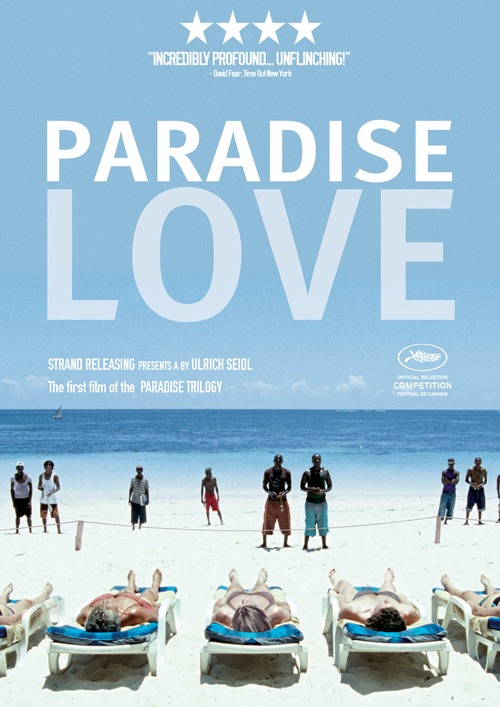
Paradise: Love (Paradies: Liebe)
The entire trilogy begins with a shot of physically challenged persons driving around in bumper cars in an amusement park and this sums pretty aptly what all three films are about. Looking for love, or any content to life, is like bumbling around in the dark, and you might easily be hurt. Love concerns the love-lorn middle-aged Teresa (Margarete Tiesel) going to a holiday in Kenya. Yet she is not so much interested in Safaris or games at the hotel poolside than finding a boyfriend from the local men.
Teresa's friend compliments her holiday boy-toy and she becomes curious for some local meat as well. Teresa has a low self-esteem and opens up to men complimenting her looks and dismissing her age. Even though she is after sex, she wants her boyfriends to be interested in her because of her personality, not her wallet. And thus she finds crushing disappointments time and again. The poor local people are only after monetary support from rich white ladies, not an equal relationship. Seidl doesn't shy away from any aspect of these unequal, partially racist interactions, spicing his film with plenty of black humor and cringe-worthy scenes.
The problem with the trilogy opener is pretty much the same as with all Paradise films. They are clear arthouse films, slow-moving and aesthetically strong. While the ideas and the message are incredibly easy to get and understand, there aren't any layers or anything to ponder afterwards. And once you figure out the central ideas of the movie, the rest is sort of inevitable and at times even a drag. Love has plenty of nice, static shots of tourist beaches and African reality so it's at least easy to look at but sometimes feels like a way too personal holiday diorama. It's a nice film but hardly a groundbreaking masterpiece.
★★★ 1/2
Paradise: Faith (Paradies: Glaube)
Nurse Anna Maria (Maria Hofstätter), sister of Terese, is a hardcore Catholic. Hardcore, as in she whips herself in front of a crucifix, and goes around the houses of immigrants and the unemployed to deliver statues of the Virgin Mary and to talk about (her interpretation of) the Bible. It's not an easy job, as many of her "customers" are dismissive or otherwise hard to deal with. But AM's life becomes even more difficult than that, when his paralyzed (and randy) ex-husband (Nabli Saleh) comes to stay at her place.
Making fun of devout Christians is something akin to shooting fish in a barrel. But Seidl isn't so much interested in mocking (although AM's obsessiveness does generate plenty of laughs), but rather in the hopelessness to try to keep a strict set of rules one sets to yourself and the world. One won't come out a decent human being, no matter how hard one tries.
What sets this installment above the rest of the trilogy is the grotesque cast of characters. Particularly memorable is Herr Rupnik, an obese man who tends to misplace his pants and lives in an apartment akin to a huge pile of garbage. Maria's sanity is put into question several times, as her obsession deepens, so does her affection to Jesus, represented by a big crucifix. Perhaps the reason she detests Nabil so is the fact that he's a Muslim. All in all, it's a trashy, borderline uncruciable account of becoming too blind on one's own acts and too focused on one view into the world.
★★★★
Paradise: Hope (Paradies: Hoffnung)
The final film sees Terese's teenaged daughter Melanie (Melanie Lenz) go to a Fat Camp to lose weight. But being a girl in a delicate age, she's not that interested in the daily exercise routines, but rather talking about sex experiences with her campmates, stealing food, alcohol and cigarettes, and running away to go to a club.
But the thing she is most interested is the middle-aged doctor (Joseph Lorenz) of the camp. She soon develops fake symptoms to go see him every day, much to his delight. Lorenz plays the Doc suitably sleazy and creepy. One is not quite sure whether he's going to act out on his instincts or not. One scene sees her follow her into the woods like the wolf following Red Riding Hood. They end up hugging. Or at least that is what is shown on screen.
Seidl has veered a little close to familiar patterns with his previous films, and this one veers a bit too close into the well-trodden coming-of-age path. As I implied, many of the films most interesting parts are the ones you don't see. Indeed, it is about a half-hour shorter than the other Paradise films. Yet it does feel equally long, so perhaps the storytelling isn't quite as leisurely forward-moving here. The film feels a bit fractured, and it is its greatest asset as well as its downfall. The acting, again, is superb.
In this case, it is not quite as clear as what the Hope in the title refers to. Melanie doesn't seem too interested in the Hope of becoming thin, after all. The Hope of becoming a woman? Perhaps this left a bit more to ponder about than its predecessors, after all.
★★★ 1/2
I Am Divine (USA)
Dir. Jeffrey Schwartz
It's about damn time the legendary drag queen actor/disco music star got her own documentary! It's one of those subjects that is so interesting in itself that it's hard to fail, at least with the right audience. As a documentary, this is far from perfect, but it's still a really fun ride alongside one of the most outrageous figures in pop culture.
Jeffrey Schwartz's film was funded by crowdraising the money. The lack of budget shows off here and there, since several photographs pixelate visibly when zoomed into (not that zooming into photos repeatedly isn't a tired cliché in documentaries anyway). However, all the right people are interviewed, including John Waters, Mink Stole, Mary Vivian Pierce and even Divine's dear old mother. One would have hoped to hear some more outrageous, weird and wonderful stories from those that knew him best, but the film is a bit shy on them, whether it's because of respect for the deceased star or for a lower rating.
Still, it's a heartfelt retread of the life of a huge icon with several rather moving testimonies from family and friends. It offers little new information for connisseurs (some longer clips from early, rare John Waters shorts would have been fine, too), but it works as a passable introduction to the world of Divine.
★★★
Blancanieves (Spain)
Dir. Pablo Berger
I found this film's title impossibly difficult to remember until I watched the movie and found out what the title meant. Basically, this is a story of an orphaned girl who follows on her father's footsteps into becoming a popular matador, bullfighter. Any mythological parallels are hidden a bit deeper.
![]() |
| There are dwarves, though. |
This is also a brand spanking new silent movie, much in the vein of The Artist. This tries to be charming and touching, like that film, but ultimately left me cold. There are bits and pieces to be enjoyed for sure, and visually it doesn't look half-bad. But I had problems identifying with the main character, who kind of bumbles through weird mishaps without a proper arc or a character to speak of. It also doesn't help that the main characters are bullfighters, which I find to be kind of horrible assholes. Anyone who thinks it's sort of glamorous to slowly butcher and torture an animal to death, deserves to be murdered by a gold-digging witch.
Unlike The Artist, which dealt with the development of cinema anyway, there's scarcely a good reason for this to be a silent pic other than to cash in on the success of others, and to utilize a nifty trick to gain attention to a hallow shell of a movie. The main villainess (Maribel Verdú) is kind of cute, though. She kind of looks like Bérénice Béjo.
★★
Byzantium (UK/USA/Ireland)
Dir. Neil Jordan
Neil Jordan has gained reputation along the years to be a feminist genre movie director. His latest film could be seen as a response to the Twilight crowds, who crave bloodsucker romance so hard they forget that the female characters in it are virtual non-entities. Jordan has plenty of good ideas and tricks up with his sleeve on this one, but somehow lacks any grip on the direction, so the end result is a boring and shapeless mess.
Two women seek refuge to a small coastal town. Clara (Gemma Arterton) gains money from prostituting herself, while the younger Eleanor (Saoirse Ronan) helps euthanize elder people and goes to the local schools writing class to show off her skills. The latter falls for a classmate, Frank (Caleb Landry Jones), and reveals that they are actually Lhiannan Shee, vampire-like creatures who survive during the day but need blood to live.
The character of Eleanor is way too dull for the role of the protagonist. Thus, when the film spends the most time developing her and Frank's relationship, the audience falls into a coma. All flashbacks to ye olden tymes are infinitely more interesting, even if they slowly start to form a picture which I certainly didn't quite understand or manage to put the pieces together. Plenty of the most interesting elements of the film are woefully underutilized, including Arterton's sexier and more femininely threatening spirit, and the pursuers of the pair. The final act of the film takes on a whole new gear, but still offers little new to a market packed to the rafters with monster-romances. Jordan is so much in love with his idea of a blood-filled waterfall that he uses it plenty of times, never mind that the water is more pink than blood red, and that that welcomes unwelcome comparisons to the elevator shot in The Shining.
Watching the movie, I came up with several good ideas on how some of the central ideas could be utilized to make a more interesting film. When this inevitably gets remade in 5-20 years, Hollywood, you know who to call.
★★
Wednesday, 28 November 2012
Night Visions MH12: Werewolves Too
Aroo! It's another full moon tonight. Since during the last one I wrote a little about werewolf cinema through the ages, it comes to reason to use this opportunity to write about the three werewolf movies screened at Night Visions Maximum Halloween Festival this year. Just don't allow my animal instincts to take over or anything.
The Howling (USA, 1981)
Director: Joe Dante
The Howling is probably the most serious horror film in director Joe Dante's career. That doesn't mean the movie would be entirely without Dante's trademarks, such as sly media satire, cartoonish gags and a Dick Miller cameo. It's just that they are less in-your-face in this one than most of his other work. This was his first foray outside the safety of Roger Corman's production facilities, and Dante set out to make a name for himself. By strange coincidence, a kindred spirit in John Landis was also working at the same time to make a loving horror-comedy homage to the scary movies of the olden times. Both were successful, but Dante's film was the one that gained a big string of sequels (that had little to nothing to do with the first film). So that goes to show at least which the audiences dug more.
Ace reporter Karen White (Dee Wallace) is burned out by the hectic nature and ruthless story hunting that comes along with the job. She gains the affections of the brutal, animalistic serial killer Eddie Quist (Robert Picardo). Karen attempts to help the police capture him by luring him into a trap, and plans to gain a new story for her trouble. Yet the plot backfires and she has to come face to face with evil. Luckily Eddie is shot by the cops before he has a chance to hurt Karen. The reportress finally has enough of everything and takes off with her boyfriend Bill (Christopher Stone) to a couples' resort in the middle of a dark forest. Yet even the hard-nosed journalist has little idea of what she's in for, when the odd stalker hasn't really dies, and follows her to the resort. But he may not be the only beast around, either.
As many post-modern horror films would do since then, The Howling rewrites several rules of used by classic horror films. It also makes the characters aware of the previous body of work. The Wolf Man is watched on TV and ancient lycantrophy myths repeated by the characters. Yet the movie also differentiates from the norm in that werewolves in here are not just psychologically repressed, primal animals. They are highly sexual beasts. The monsters may reveal themselves during sex, and to every one of them is attached a strong sexual urge the conventional white-bread couples can't satisfy with their shallow imaginations.
Dante's satire's main target are modern people, who have little room for superstition and legends and has thus turned into cynical, boring yuppies, husks of people. The very 80's ideas of thinking psychiatry and self-help could cure deep psychological problems better than old-timey ways, earn Dante's bitter dismissal. He's all for old tales, mysticism and romanitiscm as opposed to a narrow world view. Every person has already seen enough on TV to not take anything seriously any more.
Most of the film relies on old-time moodness, dark shots, misty moors and eloquent set design. As such the ending that's crawling with rubber-suited werewolf monsters feels a bit overblown and even anticlimatic. When dealing with werewolves, the transformation scenes are usually a lot more terrifying than the appear of the actual monster, just growls and bad postures. The climax echoes the ending of David Cronenberg's Shivers a little. Sexually liberated people have overthrown the masses and the regulars are in the minority now, making a hasty escape.
Like his subsequent work would prove, Dante often prefers to take the side of the free-minded monsters rather than white-bread "normal" people. Perhaps there's a liberation coming up after the credits have rolled.
★★★ 1/2
Game of Werewolves (Lobos de Arga, Spain 2011)
Director: Juan Martínez Moreno
This Spanish film movie is known in Japan as Wolfman Village: The Worst Countryside Ever! As one can guess, this one keeps things quite silly. A lot of the comedy is based on the fact that the film is set on the most backwards and superstitious of Spanish regions. The villagers of the small village of Argahave a lot to hide from the outside world, not limited to the major plot-driving curse. A bastard son of a rich marquis and a gypsy becomes a werewolf that would terrorize the village for hundreds of years. The family of Mariño carries the cursed blood and triggers the horror while present.
The modern-day descendent of Mariño, Tomás (Gorka Otxoa) is a horror writer who is suffering from a writer's block. He grew up in Arga, and has inherited the house he lived in as a child, so after a bitter divorce, he arrives with his dog to reclaim his old possessions and memories. He hits up with his two old friends, Calisto (Carlos Areces) and Mario (Secun de la Rosa). But the anger-ridden and fearful villagers don't take kindly to Tomás's arrival and plan to sacrifice him to the beast in order to finally get rid of the curse. Sure enough, since Tomás wants to live, and the misfortune of the villagers, the plan backfires and soon the whole village is infested with furry beasts.
The Howling and several other classic horror comedies are a clear inspiration for the movie in general. It can be seen in the film's humor, that manage to be somewhat cute, a little icky and even quite mean in turn. The most egregious jokes are the gross-out buddy comedy bits, often quite tackily inserted among all the action. If one is running from werewolves, a good main character should not start reminiscing about the time his best childhood buddy fucked a sheep but keep his mind on the point. Also, one fat and dumb sidekick should be enough for one comedy film. This one has two.
A much better comic character is the kick-ass police officer played by Luis Zahera. Logical and quick-witted to the max, he is also used sparingly enough for the audience to want more.
A nice touch to all the action and running around is that the werewolves themselves are made with actual prosthetics and masks rather than CGI-rendered. The Hammer-like set design also works wonders for the mood and the contrasting crass comedy and traditional horror imagery play together quite well for the most part. Props also to director Moreno for not going too easy with his characters. In a true Sam Raimi fashion, they have to suffer severe injuries and humiliations throughout the film to survive, especially in the wickedly mean final scene.
★★★
The Werewolf vs. The Vampire Woman (La noche de Walpurgis, 1971)
Director: Léon Klimovsky
Night Visions also offered a look into the major Spanish horror series about Count Waldemar Daninsky. The Count is better known as The Werewolf, or El Hombre Lobo, and battled with his curse and various other monsters in 12 films through the decades. Thus, he was clearly one of the most popular Spanish movie characters of all time, shadowing even Torrente.
![]() |
| That is even though he looks more like a werespaniel or a were-guinea pig. |
The 5th movie of the series boasts the simultaneously odd, dumb and cool tagline: See it with someone you hate. Alas, I didn't have any enemies close by, or even people I was mildly disapproval of. Whether this would have improved on the movie, I couldn't say.
In the beginning Daninsky's (played by Paul Naschy) supposedly dead body is investigated in the morgue by two coroners. Since one is superstitious and the other a hard-nosed man of science, the latter attempts to prove that it's not possible for Daninsky to have actually been a werewolf. So, he removes the silver bullets from his heart, which of course makes the body come alive, turn into a monster, kill the doctors and escape to the woods. The shots of kind-of silly Wolf Man knock-off wandering around the forest growling and drooling are quite amusing for a while.
Meanwhile, two young and beautiful students, Elvira (Gaby Fuchs) and Genevieve (Barbara Capell), spend their summer vacation in a castle in Transylvania. To pass the time, they look for an ancient tomb, where, legend has it, the Vampire Countess Wandessa is buried. Bumbling around, they manage to find the corpse and drop some blood into her mouth, reviving her. But luckily Elvira stumbles upon the human-formed Daninsky, and the pair fall in love. To prove to Elvira that he's not just a murderous, brutal beast, Danisnsky takes it to his heart to protect the girls from the blood-thirsty Countess and her vampiric minions.
I've got to say, I couldn't manage to keep awake through the whole thing (it was 5 in the morning), so actually I missed the part when the monsters actually met and battled. My friend informed me that I didn't miss much, it mostly involved hokey special effects and throwing people around the room. So it sounds a bit like pro wrestling, then. The film had a few gigglesome scenes, due to the odd behavior of various characters. The set design and overall feel wasn't bad, but not that special, either. All together the movie is not something I would go out of my way to find anywhere.
Since I didn't see the whole movie, it's stars could go anywhere between ★ and ★★★★★.
Wednesday, 26 October 2011
The Horrible 00's, Part Deux
More Best Horror Films of the 2000s – The Cursed Number 15 in our ongoing series that just won't stay dead!
I'm not often dissatisfied with my list type blog posts, but I did have the feeling that last years Best Horror Films of the 2000s was somewhat lacking. Never to back away from a challenge, I did realize there were a lot of other very fine horror films made in the last decade that deserved to be mentioned.
Tonight, Night Visions Maximum Halloween 3011 kicks off at Helsinki. So, to celebrate that and the upcoming Halloween, let me present to you the further top 10 of recent horror flicks:
[REC] (Spain, 2007)
Directors: Jaume Balagueró, Paco Plaza
Found footage horror flicks would've just be forgotten gimmicks in period pieces such as The Blair Witch Project and Cannibal Holocaust if it weren't for this highly innovative film. A spanish news crew happens to be with the fire departement as they are called in on a block of flats. Some rage-infusing disease is spreading among the inhabitants. Soon the entire area is quarantined, leaving the crew stuck inside the building with blood-thirsty monsters. For a modern zombie film, there isn't any tongue-in-cheek humour, just fighting for survival. This sort of film works best in the cinema, because it allows you to feel dropped in the middle of the critcal situation yourself and start to feel the panic. It's a real roller-coaster ride, fast and unrelentless with scares coming in thick.
To be fair, I saw the film's American remake Quarantine first and I kind of like it more, because it allows us to spend a little more time with the characters before everything goes to hell and doesn't have as clear reason for all of the things to happen. If you haven't seen either one, pick that, but if you've seen [REC] alreaady, don't bother. It recreates most of the film in a shot-by-shot fashion.
American Psycho (USA, 2000)
Director: Mary Harron
Bret Easton Ellis' masterpiece novel of the same name must've been one of the most difficult books ever to turn into a film. The novel's first 150 pages follow the sleazy rich yuppie businessman Patrick Bateman as he goes through business lunches in high-end restaurants with his obscenely rich "friends" who he secretly loathes. Bateman notices all the luxury product brands around him and gets insanely jealous if someone's wearing something more expensive than he is. After excruciatingly long scenes of upper-class assholism, it is revealed that Bateman is also a blood-thirsty psychpath, bent on torturing and killing (especially women) in a most violent way possible.
The film, of course, makes this revealation much sooner. It does feel like a quick run-through of the novel's events, but it does manage to reveal the obscenity of having it all. Christian Bale made his first truly iconic performance as Bateman, a guy who can go from charming to petty to a douchebag to a dangerous lunatic in seconds. The violence is also toned down from the novel, but director Harron allows much of it happen off-screen, making the viewer's imagination make the worst out of the scenes. Bateman's paranoia of getting caught is increased, but really the world around him isn't interested in his blood work, and sees no difference in his victims. The possibility of it all happening inside his head is also open. Like the novel, the film offers no exit when the credits start to roll.
Antichrist (Denmark/Germany/Poland/France/Sweden/Italy, 2009)
Director: Lars von Trier
Leave it to Lars von Trier to transcend genre lines. Horror is what this film mostly resembles, even though it really doesn't belong to any genre. It's just pure Trier. I don't necessarily think this is his very best film (altough a number of reasonable people would also argue so), but at least it is his most raw, most powerful and most shocking work. It is a manifesto of his own depression and the feelings of inadequacy, guilt and gloom, and the dismissal of trying to alnalyze them rationally and cold. See, you get a lot more out of this than your generic slasher flick.
A couple (Charlotte Gainsbourg and Willem Dafoe) have suffered the death of their firstborn child. They were having steamy hot sex while he jumped out the window. Later on, the couple retreats on a distant cabin to find redemption in their devastating feelings. But when the civilized way to look at the thing runs against the sher forces of nature itself, things are bound to get messy.
Trier's symbolism is a little on the nose here, a little inpenetrable there. Like in many of his work, it's impossible to decide whether he's pulling the collective leg of his entire audience. Yet the odd little film is like none other and its devastating athmosphere more horrifying than in any other film of last decade. The film also needs a little time to grow on the viewer. At first viewing I was disappointed in it, but it has grown on me. Mostly because its haunting imagery will never leave the viewer alone.
Eden Lake (United Kingdom, 2008)
Director: James Watkins
Seemingly normal people, not possessed by any kind of demons or rabies etc. are often the most frightening antagonists in horror films. In this film we have teenage hooligans who have been so spoiled that they grow ever more blood-thirsty when they don't get what they want. A young couple (Michael Fassbender and Kelly Reilly) take off to a romantic weekend in the British countryside but run into these sorts of little beasts. Refusing to allow the obnoxious, loud ruffians to spoil their weekend, they resort to threats, which the teens respond ever more harshly. The teens start to dare each other to step over lines, which leads to real brutalities, while the adults respond the same way. Soon both sides have blood on their hands.
The film's subject is handled with some weightm, as the problem isn't solely with the youth, but in their parents' empty lifestyles and disinterest in their doings as well. In this world, the nice die first. The community doesn't care much for the weak and the wounded, but a dog's death brings great sorrow. The movie's violence is really sadistic, but it can also be really pressuring, not just disgusting. The film is also the first annual Night Visions Audience Award Winner.
House of the Devil (USA, 2009)
Director: Ti West
In the 80's, there was a wide-spred scare that Satanic cults thirsting on innocent blood may hide in any neighbourhood without a trace to the outside. Ti West's film works great as a tribute to both that era's panic-driven news items and the good old-fashioned horror films. College student Samantha (Jocelin Donahue) opts to become a babysitter to an odd family living in the middle of nowhere. She and her sassy friend Greta Gerwig (Megan) are no fools and the girls take off to the house together to avoid any psychopath shenanigans. Yet as it turns out, there is foul play going on and the girls are soon separated and scared.
Unlike many other nostalgic horror directors, West hasn't chosen the campiest and silliest aspects of the 70's and 80's to replicate. The setting, the music and clothing do bring back those times, but not in an in-you-face or over-the-top style. Instead, the film is a welcome return of the kind of horror films that play on having a disturbing mood to them and are constantly one-upping the feeling of paranoia shared by the main characters as well as the audience. The film is created with seemingly small resources, as you don't really need more than a small scratch or a moving shadow to scare the audience if it's played right. So good is the first part of the film that the ending is a clear let-down of panicky running around. It's not that bad per se, as the most obvious clichés are avoided, yet still feels too conventional for a movie that started this good. But as a whole, it is a really spine-tingling work that doesn't explain everything in it through and through.
Open Water (USA, 2003)
Director: Chris Kentis
This minimalistic horror film really divided the audiences. I happened to love it. A scuba-diving couple (Blanchard Ryan and Daniel Travis) are left in the middle of the ocean, when their boat has sailed off. So they just have to float around the ocean, figuring out what there is to do about their situation. And then the sharks come around. When they only need to survive the ordeal, they start to realize how little the daily woes in their rat race life actually matter.
I really like the kind of horror films where the situation is plausible, but you couldn't figure out how you would save yourself in the same situation. This whole scenario scares the living shit out of me, and knowing it's based on actual events makes it all the more horrible. There isn't a single special effect used on this film and its shows in unrelenting realism. Of course, this sort of film is pulled off by the actors and their characters and I must say that I could hope for a little more convincing performances from the main pair. But as a bickering married couple in a jam, blaming each other, they are believable enough. One cares about what's going to happen to them. The stylish ending doesn't spell it out for us viewers, altough there really was no escape at any point anyway.
The Others (USA(Spain/France/Italy 2001)
Director: Alejandro Amenábar
Grace Stewart (Nicole Kidman) lives with her two children, who are sensitive to light, in a large mantion. The Second World War is about to end and Grace is waiting for her husband to return home from the front. He has strict rules for her children, in fear that they hurt themselves by coming in contact with the sunlight. But it seems the house is also inhabitetd by malicious others, who attempt to break those rules, apparently to drive the family out.
The Others is easy to dismiss on these sorts of lists because the sort of filmmaking it represents was farmed to death in the early 2000s and seems like it has run its course by now. But nevertheless it is a powerful piece of cinema that left an impression me on the only time I've seen it. It is spooky and its mysteriousness tingles the imagination.
Shadow of the Vampire (USA/UK/Luxembourg 2000)
Director: E. Elias Merhige
Horror films are often about other horror films. But rarely do they go as far into that field as here. This is seemingly a drama about the time F.W. Murnau (John Malkovich) shot his classic silent horror film Nosferatu, eine Symphonie des grauens (1922). Murnau is a true perfectionist, wanting to create the ultimate horror film. That's why he has hired Max Schreck (Willem Dafoe) in the lead role. Schreck is, after all, an actual vampire. The death and disappearance of multiple crew members doesn't worry Murnau at all, as long as he gets everything he wants on film. But what to do when Schreck sets his eyes on the lead actress when there is still a lot of film to be shot?
The film's plot is, of course, utter baloney, as Schreck was already an acclaimed stage actor when he was cast in Murnau's film in the real life. But that hardly matters. What matters is that it's plausible. Schreck's vampire is one of the most terrifying in the history of cinema, because it has been shot so it moves unnaturally. It doesn't matter that his make up looks ridiculous by today's standards. The film does a good job depicting the spiralling madness concerning ambitious cinema auteurs. Malkovich and Dafoe make a good lead pair, almost as much at each other's throats as Kinski and Herzog. The film is actually pretty light on actual horrors, but as a mind game, it is quite swell.
Slither (Canada/USA 2006)
Director: James Gunn
If horror films of the 70's and 80's are hard to emulate on the modern day, even harder are the B-movies of the 1950's. But even that wouldn't be difficult enough for director-screenwriter James Gunn. No, he emulates the kind of outrageous B-movie parodies they had in the 80's (as well as work from such horror maestros as Romero or Carpenter in the 70's and 80's). So the end result's a sort of double-parody. No wonder it tanked at the box office. But that was just the fault of the movie-going public, because Gunn's film is actually both extremely creepy and pretty darn funny.
A meteor hits the outskirts of a small American town. It contains parasitic worms that can take over people or turn them into gruesome monsters. Cool B-list actors such as Nathan Fillion and Elizabeth Banks try to salvage the town from the alien rampage and possible taking over the world. As one can witness from the film's awesome poster, there is a strong sexual sense in the penile aliens, and the R this movie got was well justified. But it works as well to parody the sex-hungriness and boozehoundiness of the American midlands. Of course, this doesn't reach the lofty qualities of Cronenberg's Shivers, which has been a major influence, but it is one of the best horror comedies of the last decade that too few people have actually seen.
Wolf Creek (Australia, 2005)
Director: Greg McLean
Horror genre also likes to play with stupid gimmicks time and time again. It's no wonder the Australian Greg McLean's stripped first feature film was hailed exceptionally good by horror experts around the globe. Seemingly, it's a really back-to-basics horror film. Three young backpackers go on a trip to a middle of nowhere. Their car has trouble. A friendly-seeming stranger offers them help and towes their car to his far-away ranch. You can see how it plays out. But, at the risk of SPOILING the film for those who haven't seen it, the real strength of the film is in the end. McLean refuses to play out to the genre's convictions any more. So whenever we think that a strong, pure heroine is emerging that will survive the whole ordeal, our hopes are shattered. The serial killer Mick Taylor (the wonderful John Jarratt) is so relentless, ruthless and merciless that he will use any chance to off them. People don't do moronic horror movie mistakes in this, they only come unprepared to what Taylor has in his bag. There isn't going to be a purifying catharsis in the end of this film and that's why it feels all the more harrowing.
McLean shoots everything in a matter-of fact way. He doesn't build a threatening athmosphere but rather gives out some magnificent postcard views of the Australian Outback. It doesn't seethe with evil, but all it needs is one apple rotten to the core that can hide very easily in the middle of nowhere.
Bubbling Under: The Devil's Rejects, Dog Soldiers, Hierro, The Human Centipede, Session 9
To Be Seen: Hard Candy, Hatchet, May, A Tale of Two Sisters, Them
Have a Happy Halloween and if you're coming to Night Visions, I'll see you there!
I'm not often dissatisfied with my list type blog posts, but I did have the feeling that last years Best Horror Films of the 2000s was somewhat lacking. Never to back away from a challenge, I did realize there were a lot of other very fine horror films made in the last decade that deserved to be mentioned.
Tonight, Night Visions Maximum Halloween 3011 kicks off at Helsinki. So, to celebrate that and the upcoming Halloween, let me present to you the further top 10 of recent horror flicks:
[REC] (Spain, 2007)
Directors: Jaume Balagueró, Paco Plaza
Found footage horror flicks would've just be forgotten gimmicks in period pieces such as The Blair Witch Project and Cannibal Holocaust if it weren't for this highly innovative film. A spanish news crew happens to be with the fire departement as they are called in on a block of flats. Some rage-infusing disease is spreading among the inhabitants. Soon the entire area is quarantined, leaving the crew stuck inside the building with blood-thirsty monsters. For a modern zombie film, there isn't any tongue-in-cheek humour, just fighting for survival. This sort of film works best in the cinema, because it allows you to feel dropped in the middle of the critcal situation yourself and start to feel the panic. It's a real roller-coaster ride, fast and unrelentless with scares coming in thick.
To be fair, I saw the film's American remake Quarantine first and I kind of like it more, because it allows us to spend a little more time with the characters before everything goes to hell and doesn't have as clear reason for all of the things to happen. If you haven't seen either one, pick that, but if you've seen [REC] alreaady, don't bother. It recreates most of the film in a shot-by-shot fashion.
American Psycho (USA, 2000)
Director: Mary Harron
Bret Easton Ellis' masterpiece novel of the same name must've been one of the most difficult books ever to turn into a film. The novel's first 150 pages follow the sleazy rich yuppie businessman Patrick Bateman as he goes through business lunches in high-end restaurants with his obscenely rich "friends" who he secretly loathes. Bateman notices all the luxury product brands around him and gets insanely jealous if someone's wearing something more expensive than he is. After excruciatingly long scenes of upper-class assholism, it is revealed that Bateman is also a blood-thirsty psychpath, bent on torturing and killing (especially women) in a most violent way possible.
The film, of course, makes this revealation much sooner. It does feel like a quick run-through of the novel's events, but it does manage to reveal the obscenity of having it all. Christian Bale made his first truly iconic performance as Bateman, a guy who can go from charming to petty to a douchebag to a dangerous lunatic in seconds. The violence is also toned down from the novel, but director Harron allows much of it happen off-screen, making the viewer's imagination make the worst out of the scenes. Bateman's paranoia of getting caught is increased, but really the world around him isn't interested in his blood work, and sees no difference in his victims. The possibility of it all happening inside his head is also open. Like the novel, the film offers no exit when the credits start to roll.
Antichrist (Denmark/Germany/Poland/France/Sweden/Italy, 2009)
Director: Lars von Trier
Leave it to Lars von Trier to transcend genre lines. Horror is what this film mostly resembles, even though it really doesn't belong to any genre. It's just pure Trier. I don't necessarily think this is his very best film (altough a number of reasonable people would also argue so), but at least it is his most raw, most powerful and most shocking work. It is a manifesto of his own depression and the feelings of inadequacy, guilt and gloom, and the dismissal of trying to alnalyze them rationally and cold. See, you get a lot more out of this than your generic slasher flick.
A couple (Charlotte Gainsbourg and Willem Dafoe) have suffered the death of their firstborn child. They were having steamy hot sex while he jumped out the window. Later on, the couple retreats on a distant cabin to find redemption in their devastating feelings. But when the civilized way to look at the thing runs against the sher forces of nature itself, things are bound to get messy.
Trier's symbolism is a little on the nose here, a little inpenetrable there. Like in many of his work, it's impossible to decide whether he's pulling the collective leg of his entire audience. Yet the odd little film is like none other and its devastating athmosphere more horrifying than in any other film of last decade. The film also needs a little time to grow on the viewer. At first viewing I was disappointed in it, but it has grown on me. Mostly because its haunting imagery will never leave the viewer alone.
Eden Lake (United Kingdom, 2008)
Director: James Watkins
Seemingly normal people, not possessed by any kind of demons or rabies etc. are often the most frightening antagonists in horror films. In this film we have teenage hooligans who have been so spoiled that they grow ever more blood-thirsty when they don't get what they want. A young couple (Michael Fassbender and Kelly Reilly) take off to a romantic weekend in the British countryside but run into these sorts of little beasts. Refusing to allow the obnoxious, loud ruffians to spoil their weekend, they resort to threats, which the teens respond ever more harshly. The teens start to dare each other to step over lines, which leads to real brutalities, while the adults respond the same way. Soon both sides have blood on their hands.
The film's subject is handled with some weightm, as the problem isn't solely with the youth, but in their parents' empty lifestyles and disinterest in their doings as well. In this world, the nice die first. The community doesn't care much for the weak and the wounded, but a dog's death brings great sorrow. The movie's violence is really sadistic, but it can also be really pressuring, not just disgusting. The film is also the first annual Night Visions Audience Award Winner.
House of the Devil (USA, 2009)
Director: Ti West
In the 80's, there was a wide-spred scare that Satanic cults thirsting on innocent blood may hide in any neighbourhood without a trace to the outside. Ti West's film works great as a tribute to both that era's panic-driven news items and the good old-fashioned horror films. College student Samantha (Jocelin Donahue) opts to become a babysitter to an odd family living in the middle of nowhere. She and her sassy friend Greta Gerwig (Megan) are no fools and the girls take off to the house together to avoid any psychopath shenanigans. Yet as it turns out, there is foul play going on and the girls are soon separated and scared.
Unlike many other nostalgic horror directors, West hasn't chosen the campiest and silliest aspects of the 70's and 80's to replicate. The setting, the music and clothing do bring back those times, but not in an in-you-face or over-the-top style. Instead, the film is a welcome return of the kind of horror films that play on having a disturbing mood to them and are constantly one-upping the feeling of paranoia shared by the main characters as well as the audience. The film is created with seemingly small resources, as you don't really need more than a small scratch or a moving shadow to scare the audience if it's played right. So good is the first part of the film that the ending is a clear let-down of panicky running around. It's not that bad per se, as the most obvious clichés are avoided, yet still feels too conventional for a movie that started this good. But as a whole, it is a really spine-tingling work that doesn't explain everything in it through and through.
Open Water (USA, 2003)
Director: Chris Kentis
This minimalistic horror film really divided the audiences. I happened to love it. A scuba-diving couple (Blanchard Ryan and Daniel Travis) are left in the middle of the ocean, when their boat has sailed off. So they just have to float around the ocean, figuring out what there is to do about their situation. And then the sharks come around. When they only need to survive the ordeal, they start to realize how little the daily woes in their rat race life actually matter.
I really like the kind of horror films where the situation is plausible, but you couldn't figure out how you would save yourself in the same situation. This whole scenario scares the living shit out of me, and knowing it's based on actual events makes it all the more horrible. There isn't a single special effect used on this film and its shows in unrelenting realism. Of course, this sort of film is pulled off by the actors and their characters and I must say that I could hope for a little more convincing performances from the main pair. But as a bickering married couple in a jam, blaming each other, they are believable enough. One cares about what's going to happen to them. The stylish ending doesn't spell it out for us viewers, altough there really was no escape at any point anyway.
The Others (USA(Spain/France/Italy 2001)
Director: Alejandro Amenábar
Grace Stewart (Nicole Kidman) lives with her two children, who are sensitive to light, in a large mantion. The Second World War is about to end and Grace is waiting for her husband to return home from the front. He has strict rules for her children, in fear that they hurt themselves by coming in contact with the sunlight. But it seems the house is also inhabitetd by malicious others, who attempt to break those rules, apparently to drive the family out.
The Others is easy to dismiss on these sorts of lists because the sort of filmmaking it represents was farmed to death in the early 2000s and seems like it has run its course by now. But nevertheless it is a powerful piece of cinema that left an impression me on the only time I've seen it. It is spooky and its mysteriousness tingles the imagination.
Shadow of the Vampire (USA/UK/Luxembourg 2000)
Director: E. Elias Merhige
Horror films are often about other horror films. But rarely do they go as far into that field as here. This is seemingly a drama about the time F.W. Murnau (John Malkovich) shot his classic silent horror film Nosferatu, eine Symphonie des grauens (1922). Murnau is a true perfectionist, wanting to create the ultimate horror film. That's why he has hired Max Schreck (Willem Dafoe) in the lead role. Schreck is, after all, an actual vampire. The death and disappearance of multiple crew members doesn't worry Murnau at all, as long as he gets everything he wants on film. But what to do when Schreck sets his eyes on the lead actress when there is still a lot of film to be shot?
The film's plot is, of course, utter baloney, as Schreck was already an acclaimed stage actor when he was cast in Murnau's film in the real life. But that hardly matters. What matters is that it's plausible. Schreck's vampire is one of the most terrifying in the history of cinema, because it has been shot so it moves unnaturally. It doesn't matter that his make up looks ridiculous by today's standards. The film does a good job depicting the spiralling madness concerning ambitious cinema auteurs. Malkovich and Dafoe make a good lead pair, almost as much at each other's throats as Kinski and Herzog. The film is actually pretty light on actual horrors, but as a mind game, it is quite swell.
Slither (Canada/USA 2006)
Director: James Gunn
If horror films of the 70's and 80's are hard to emulate on the modern day, even harder are the B-movies of the 1950's. But even that wouldn't be difficult enough for director-screenwriter James Gunn. No, he emulates the kind of outrageous B-movie parodies they had in the 80's (as well as work from such horror maestros as Romero or Carpenter in the 70's and 80's). So the end result's a sort of double-parody. No wonder it tanked at the box office. But that was just the fault of the movie-going public, because Gunn's film is actually both extremely creepy and pretty darn funny.
A meteor hits the outskirts of a small American town. It contains parasitic worms that can take over people or turn them into gruesome monsters. Cool B-list actors such as Nathan Fillion and Elizabeth Banks try to salvage the town from the alien rampage and possible taking over the world. As one can witness from the film's awesome poster, there is a strong sexual sense in the penile aliens, and the R this movie got was well justified. But it works as well to parody the sex-hungriness and boozehoundiness of the American midlands. Of course, this doesn't reach the lofty qualities of Cronenberg's Shivers, which has been a major influence, but it is one of the best horror comedies of the last decade that too few people have actually seen.
Wolf Creek (Australia, 2005)
Director: Greg McLean
Horror genre also likes to play with stupid gimmicks time and time again. It's no wonder the Australian Greg McLean's stripped first feature film was hailed exceptionally good by horror experts around the globe. Seemingly, it's a really back-to-basics horror film. Three young backpackers go on a trip to a middle of nowhere. Their car has trouble. A friendly-seeming stranger offers them help and towes their car to his far-away ranch. You can see how it plays out. But, at the risk of SPOILING the film for those who haven't seen it, the real strength of the film is in the end. McLean refuses to play out to the genre's convictions any more. So whenever we think that a strong, pure heroine is emerging that will survive the whole ordeal, our hopes are shattered. The serial killer Mick Taylor (the wonderful John Jarratt) is so relentless, ruthless and merciless that he will use any chance to off them. People don't do moronic horror movie mistakes in this, they only come unprepared to what Taylor has in his bag. There isn't going to be a purifying catharsis in the end of this film and that's why it feels all the more harrowing.
McLean shoots everything in a matter-of fact way. He doesn't build a threatening athmosphere but rather gives out some magnificent postcard views of the Australian Outback. It doesn't seethe with evil, but all it needs is one apple rotten to the core that can hide very easily in the middle of nowhere.
Bubbling Under: The Devil's Rejects, Dog Soldiers, Hierro, The Human Centipede, Session 9
To Be Seen: Hard Candy, Hatchet, May, A Tale of Two Sisters, Them
Have a Happy Halloween and if you're coming to Night Visions, I'll see you there!
Friday, 30 September 2011
HIFF - Love & Anarchy Report 2011
Whew! The 24th Helsinki International Film Festival was exhausting for me, with most of my free time having been spent at a movie theatre or waiting to go to a movie theatre. I'm also still recovering from the profound effect the 24 films I saw this year had on me. Now, luckily I already did a post with some of the most notable films of the festival, so I don't have to write 24 reviews. Thing is, 18 is a bit too much too. I'll aim for 14. You can thank me later. I'll include the most notable ones so you can seek them out or nod in agreement.
Opening Film:
The Skin I Live In (La piel que habito, Spain)
Director: Pedro Almodóvar
The spanish director Pedro Almodóvar seems to want to return to his early days judging by his latest film. Not only does it star Antonio Banderas like so many times in the golden years, but the film itself isn't a multi-dimensional drama about humane relationships. Well, not conventionally anyway. Instead we have got the wild and crazy Almodóvar back, the one that had outrageous ideas about the natures of sexuality and no shame in splashing them all across screens.
Banderas plays the brilliant plastic surgeon Robert Ledgard, who has huge ambitions, not all of which are recognized as ethical by his colleagues. He has recently created a sort of indestructible skin by splicing human genes with pig's. Years ago, Ledgard lost his first wife. She burned in a house fire so bad, she preferred to commit suicide rather than look at herself in the mirror. Currently Ledgard lives at his mansion with his housekeeper and his new girlfriend Vera (Elena Anaya), who strangely spends most of her time locked up in a single room. Her face also closely resembles Ledgard's late wife's, and Ledgard uses her as a human guinea pig for his new skin. When Ledgard's no-good long-lost brother Zeca arrives to the house, it triggers a chain of events that will reveal the real deal about the affair and Ledgard's depravity.
This is exactly the sort of film I had been waiting for Almodóvar to make. However, while I had loads of fun with this one, it is actually just an entertaining piece. Almodóvar doesn't actually have much new to say about sex, gender and the ways one can lose both of them. All in all, it is either a strange thriller or a horror movie without big scares. Almodóvar does create the tension and the athmosphere of weirdness well throughout the film. So while it's one of his lesser efforts, it is still well worth watching, particularly if one likes his earlier films.
★★★
Gala Film:
Drive (USA)
Director: Nicolas Winding Refn
Praise has been flowing through doors and windows for this gritty crime drama. Is it worth it all? The answer is yes. Yes it is. Drive is one of the best films of the year, and personally I think it flew straight to my all-time top 10. I actually prefer it to a lot of other pulp fiction crime films it has been compared to, such as To Live And Die In L.A. or Collateral. Like those films, this is also both a love letter to Los Angeles, as well as a depiction of it as the worst nest of corruption, seediness, betrayal, brutality and greed on the planet.
The unnamed Driver (Ryan Gosling) does two jobs. At day he's a stuntman for the film industry, which doesn't really recognize his talents. But at nighttime he's a tough-as-nails getaway car driver, that promises to get criminals out of a jam in five minutes. And does deliver on that promise too, in the film's gorgeous first chase scene. However, in person Driver is a little shy and anti-social. His only friend is his boss and culprit Shannon (Bryan Cranston), and he hangs around in his garage. Shannon does business with some pretty seedy mob guys, such as Nino (Ron Perlman). Driver is a gentleman so he helps out his neighbour Irene (Carey Mulligan) on a shopping trip. He starts to develop a friendship with her and her young son Benicio. Eventually, Irene's husband Standard (Oscar Isaac) is released from prison. He owes a lot of protection money to the mob, and to help the family out, Driver agrees to do a heist job. But one double-cross later he's left with a bag full of money, no idea where to leave it, and a pack of killers on his trail.
Director Refn approaches the film with a no-nonsense attitude like was the standard in the 70's, and with the strong audiovisual sense of the 80's. Both of those choices reflect the film's tone perfectly. The film doesn't have to explain every damn thing thoroughly, and there's not a snippet of dialogue that's not important for the advancement of the plot or to build characters. But where the film excels is the use of violence. It comes by fast, unexpected and brutal. It's not entertaining but feels a little sick. When Driver kills the first people in the film we are actually not rooting for him, but a little scared that the man we've grown to like is capable for such deeds. Indeed, Gosling stone-faced performance really drives the film forward (I'll never apologize for such puns). He's vunerable like a lost child, yet ruthless and determined at the same time. The scorpion on the back of his jacket isn't just for show.
Refn's wonderful choices in music also work like a charm and the film's synteziser score is also one of the year's best. The film is a story of unrequited love and how even a hope for redemption can make an individual drift ever further from it. There are no clean getaways, says the tagline. How rarely are those so spot on for the film in multiple levels.
★★★★★
Festival Favorites:
Play (Sweden)
Director: Ruben Östlund
As the European societies become more and more firmly aligned to the right, immigration is a problem that is widely pondered. It does create a number of problems, but xenophobia and straight-out racism only manage too feed them further. Östlund ponders these problems multi-dimensionally in his film Play. It is based on the real-life events where a group of black immigrant children managed to play with the fears of white-bread suburban children so skillfully that they could rob them of all valuables without resorting to violence or straight-forward threats. In the end, the angry adults go on to blame any dark-skinned immigrant that can be found, even though these culprits are first and foremost bullies that pick on smaller children just because they can. The bullies torment their victims and force them to play an increasing number of humiliating games for them. It is like a more realistic Funny Games that doesn't wipe your face with its message. The film is mostly improvised, but for one that has been grown in the suburbs of a major Northern European City, such as me, the characteristics are familiar and spot-on. Östlund does have a sense of humour about the thing and a wicked sense of irony, portrayed by in-between shots of a cradle being stuck on a train. The film is shot laconically, with the camera barely moving, and much of the action happening just outside the screen. It is a clear message that the issues on hand here are bigger than just the events portrayed in the movie.
★★★★
Guilty of Romance (Koi no tsumi, Japan)
Director: Sion Sono
Sion Sono sure is as fast as he is talented. This is the third movie he's made in the time of two years, and the third to have festival screenings in Finland during one year. But he has to be a bit more careful to not go in the way of Takashi Miike. For while Guilty of Romance is good, it is nowhere near the madcap inventiveness and solid storytelling of Love Exposure.
A group of detectives are investigating a particularly cruel and twisted murder. As the events starts to unfold, we flash back to the beginning. The timid housewife Izumi (Megumi Kagurazaka) is bored to serving her husband all day and not even getting sex as a reward. Thus, she gets a job as a sausage saleswoman. She is spotted by Mitsuko (Makoto Togashi), who is a cunnng and calculating woman that makes her living as a prostitute. She sucks Izumi into living life her way. Izumi first gains a boost of confidence. Yet selling sex is a business that has a dark side beneath any glamour as Izumi will discover.
Sono is as great at unfolding tales of ever increasing cruelty as always. The film's actresses also portray the strain they have to endure really well. Sono's studies about the nature and meaning of sexuality make this more than just the female version of Cold Fish. There is a strong sense of losing traditional values while looking for sexual liberation. Sono aims to shock and has suitable amounts of full frontal nudity, perversions and sick gore to achieve this. GoR also has big amounts of Sono's trademark black humour and many times the film is so comical to be almost a black comedy. The cinametography bathes in neon lights in the dark. But it is all uneven and repeats itself a bit.
★★★
Arrietty (Kari-gurashi no Arietti, Japan)
Director: Hiromasa Yonebayashi
The latest Ghibli film as charming and visually stunning as always. Papa Miyazaki has contributed to the script, which shows in well-rounded character work. A terminally ill boy is sent to his aunt's country home to rest. There, he discovers the excistence of Borrowers, tiny people that live by stealing tiny objects from people. He is especially taken upon Arrietty, the 14-year-old feisty girl borrower that seeks to learn the trade from her father. The Borrowers are a dying breed and during the course of the film they have to ponder whether they can live with people any more. Thus, the film also touches on Miyazaki's basic theses such as the fragile relationship between people and nature and the nostalgic final days of innocence before taking responsibility. The biggest downside of the film is that it actually has a villain that has motivations that are clearly sinister. Is Ghibli going turn to the black-and-white of Disney movies? I really hope not. A toady old she-male prone to catching and collecting tiny people isn't eactly Maleficent, but a Gargamel rip-off is a start...
★★★ 1/2
The Bengali Detective (Great Britain/India)
Director: Philip Cox
This certainly was one of the strangest documentaries in a while. In modern Kolkata (former Calcutta) the police force is quite corrupt and unreliable. That's why the locals turn to private detectives to solve crimes. We follow one of these detective agencies, Always, while they solve crimes. And the crimes vary from selling counterfit products to infidelity cases to tough murder cases. The detectives are a happy bunch. They practice their fighting moves at the park and watch Indian Dance shows on YouTube. The main character is the tubby leader of the agancy, Rajesh Jin. While he has a lot of stress from trying a solve a triple homicide and treating a terminally ill wife, he still manages to keep his sunny side up. That's why he orders all of the detectives to take part in the dance contest with him. And that's not a negotiable term. The film is quite silly, but has really tragic and sad life stories to tell, too. The problem is that director Cox can't quite balance them in the right order. That's why the viewer is confused a lot of time of what he should feel. But nevertheless, the film has a lot of great footage, and most of the time it is a spot-on documentary. Recommended, but with caution.
★★★
This Is Not A Film (In film nist, Iran)
Director: Jafar Panahi
Jafar Panahi is an internationally acclaimed director and a damn skillful one, too. It's too bad he has to live in Iran, where the authorities won't take kindly to any artist who dares to ask questions. That's why Panahi has been sentenced to jail and forbidden from making movies for an absurdly long time. But the anarchist Panahi is, he made a giant Fuck You to the iranian authorities: a film that can hardly be called a film. Panahi wasn't forbidden from acting, so he gave a camera to his friend and started reciting pieces from his upcoming script. Thrilling! We also see him make telephone calls about his situation. Exciting! He also gives us a brief lesson in film directing. The director can't really control everything, and the end result is both a compromise and a collaborative piece to which each part brings something essential. I appreciate the gesture, like Panahi, and won't give out stars because This Is Not A Film. But I will say that the end sequence where Panahi takes an elevator down with his building's garbageman is one of the greatest I've seen in a long time. Like Dante, Panahi ascends to the hell that is Teheran at New Year's Eve. The local people have a bonfire on the street and get their explosions by throwing gasoline into the fire. The accidental metaphor couldn't be more poignant.
Detective Dee and the Mystery of the Phantom Flame (Di Renjie, China)
Director: Tsui Hark
Director Tsui Hark used to be the go-to guy of chinese epic adventures. He is best known from the Once Upon A Time in China films, as well as A Better Tomorrow III. But something happened in the late 90's that resulted in Hark to produce mostly boring garbage. His latest film proves that his comeback with 2005's Seven Swords wasn't a fluke. In fact, the latest adventure of the classic pulp hero Dee is a lot more fun than that stuffy epic. China is preparing for the crowning of its first female Emperor. The Empress has ordered to build a giant statue of Buddha for the ceremonies. Yet in the construction site, high-ranking officials start to spontaneously combust. The only one that can crack the case is Dee (Andy Lau), a detective and a rebel that's been jailed for life. Dee gets his pardon in order to solve the mystery, which makes him ponder about where his allegiances lie. The semi-mythical adventure takes Dee to weird places, such as underground Beijing and to a temple dedicated to a talking deer god. He must use all his wits and fighting skills to solve the mystery and make it out alive. Treachery is afoot and he can't really trust anyone.
As much fun as all this is, like many modern Chinese films you feel a bit guilty as the message is that resisting the authorities is wrong, and it is noble to take orders from higher-ups. Fortunately the action scenes coreographed by the legendary Sammo Hung are good enough to not ponder on such issues. And the whole thing ends with a truly legendary battle.
★★★ 1/2
Tatsumi (Singapore)
Director: Eric Khoo
Yoshihiro Tatsumi is one of the most beloved manga artists of all time, and a crucial artist in creating the manga for adults, gekiga. His autobiographical graphic novel A Drifting Life is an Eisner-award -winning masterpiece. So it was intriguing that it would, along with some of Tatsuki's greatest short stories be made into an anime film. Alas, the film is little more than motion-comics, those barely animated panels that form a film that's for people that are too lazy to read. Tetsuki's visual style is of course stunning, and the bittersweet tragedies of his wonderful short stories still poignant. But all of it is animated switching between a powerpoint presentation and a cheap flash animation. The short stories are glum and fit the crucial parts in the life story poorly. It is not a whole waste of time, because of the quality of Tatsumi's body of work. But, y'know, I would've rather spent the time reading A Drifting Life. And that's a really bad sign for an adaptation.
★★
Hesher (USA)
Director: Spencer Susser
Every year I try to watch at least one quirky american indie comedy at the festival. Of course their quality varies a lot. I'm happy to report that Hesher kicks ass. A pre-teen kid, T.J. (David Brochu) and his father are living with grandma, trying to cope with the grief of losing the family's mother. T.J. can't deal with school and rather wanders around, going to forbidden places. At a building up for demolition he finds Hesher (Joseph Gordon-Levitt), anarchist, loner and rocker. Hesher starts following T.J. around, even moving in with his family by his own invitation. Although he is seen as a nuisance at first, it turns out that even such a misanthropic character might have a word or two of wisdom behind his crude words. He also teaches T.J. to fight for himself, and that you can't always get what you crave. Of course, a dysfunctional family coming together and a coming-of-age tale aren't the most original of indie film tropes. Luckily Gordon-Levitt's outrageous central character and awesome performance pull the film forward, making it funny and heartdfelt in an equal measure. It also helps that Natalie Portman has a cute bit-part as a cute cashier.
★★★ 1/2
Robot (Endhiran, India)
Director: S. Shankar
At this point the YouTube video of the collected action scenes from the end of this Indian epic action film has become a viral meme. Yet the movie itsef has so much more to offer that I would rather suggest watching the whole thing than to spoil yourself by just eating the sweet, sweet dessert. Endhiran is the most expesive film ever made in the Tamil territories of India (Tollywood), and stars the area's biggest film star, Rajinikanth. He has a dual role as the robot engineer Dr. Vaseegaran, and the super-powered robot Chitti that's his latest, greatest creation. The Doc's girlfriend Sana (Aishwarya Rai) feels neglected, because he is so dedicated to his work. But when she meets Chitti she is smitten and grows to love the robot as company and a protector. Vaseegaran's former tutor, the jealous Dr. Bohra (Danny Denzongpa) is less endeared of the multi-tasking robot, and plans to steal its blueprints to create his own 'bots. That's why he manipulates Chitti's tryouts to get into the Army (!) and the fire departement, claiming that the unfeeling machine can easily kill his friends. Dr. Vaseegaran installs Chitti with emotions, which results in him falling in love with Sana and going rogue.
The three-hour epic is filled with everything you could hope for in a movie: romance, comedy, action (the fights were coreographed by Yuen Woo-ping himself), nutty musical scenes (shot in Sahara and the Machu Picchu, for no apparent reason), and of course robots. Lots, and lots of robots. Altough a lot of money were at play here, director Shankar wasn't afraid one bit to try out different feverish ideas that drop the viewer's jaw to the floor before the uncontrollable cheering and laughing begins. James Cameron should take notice. Rajni in particular is awesome, and perfectly capsulates both a nerdy scientist and a supercool no-nonsense robot. Chitty's billions of abilities and dance moves make Inspector Gadget die in shame. Which is why it's strange that Vaseegaran insists that he is built only for military purposes. There is certainly an Indian nationalistic theme underplaying here. As strange from the viewpoint of a westerner is that apparently it is better to die burning in flames than to appear naked in public in India. In the film are a few dragging parts and a few unnecessary comic sidekicks. But all in all, this was by far the most entertaining film of the festival.
★★★★
In Cold Blood 2 (Yksinteoin kaksi, Finland)
Director: Jussi Parviainen
Jussi Parviainen is an Artist with a capital A. The theatre legend has never been shy about his private life and has always openly incorprated it into his art. I'm one of the select few who have seen the original, uncencored documentary film Yksinteoin (directed by Pekka Lehto) on a big screen. In that film, Parviainen rages to the camera about the break-up of his then-wife, and his worries about losing custody of his children. The result was one of the most harrowing, the most controversial, and the best Finnish films ever made. History tends to repeat itself, and thus Parviainen also had to manage another painful divorce. This time, Parviainen directed the film himself and took on a lot more artistic way of making it.
Parviainen catched his astrologist wife Satu Ruotsalainen cheating on him. Soon after that they divorced. On the interviews of women's magazines Ruotsalainen told that she was happy that the relationship came to an end. According to Parviainen, she also straight-out lied that there was violence in the relationship. In the film, Parviainen splits into two persons, his regular, rational half, and the jealous, ranting, crazy Black Jussi. For the role of Black Jussi, Parviainen gained 47 kilograms and lived half a year in an abandoned mental institution. As you can probably guess, Parviainen is a couple of sandwiches short of a picnic.
Whereas the original Yksinteoin felt like raw, pure burst of anger, regret and pain, the sequel is a bit more tricky. Parviainen adds so many artistic filters into the film, it feels like a product of an over-eager film student at times. This time, the film isn't exactly a documentary, but a fictional film that takes its inspiration from real-life events. It recreates a few of the original film's setpieces. It's actually a wonder that such similar circumstances have happened to Parviainen again. The custody of a small child is again at hand here. Most of the film is reserved for monologues of Black Jussi, that are done straight to the camera. With this Parviainen spits out everything that he feels was wrong with his ex-wife. Amid all the self-pity and the accusal the viewer starts to feel more than a little uneasy of all the dirty laundry made public.
In advance, Parviainen bragged that this film would end on a better note than its predecessor, and he had a real-life victim of brutal violence in a relationship to tell her story on the film. Annika Sirén plays Parviainen's psychiatrist and has one heart-breaking scene where she tells it how it is. Too bad it fits poorly amids all of Parviainen's misanthropy and self-loathing. There is also a graphich oral sex scene between the leads, but it has been cencored since the film's NSFW trailer. It's probably because the TV network MTV3 has financed the film and perhaps wants to show it at some point (although I can't imagine where it would fit in an over-commercialized channel that mostly broadcasts reality TV). All in all, the film is confusing and more than a little self-centered around Parviainen's own ideas of his grandieur. But still, one can't claim that listening to the Finnish Klaus Kinski rant on front of the camera for 75 minutes isn't captivating to see.
★ or ★★★★★
So, that was this year's set. Thanks a billion times to everyone at Rakkautta & Anarkiaa Ministry. I'm already looking forward to next year!
Opening Film:
The Skin I Live In (La piel que habito, Spain)
Director: Pedro Almodóvar
The spanish director Pedro Almodóvar seems to want to return to his early days judging by his latest film. Not only does it star Antonio Banderas like so many times in the golden years, but the film itself isn't a multi-dimensional drama about humane relationships. Well, not conventionally anyway. Instead we have got the wild and crazy Almodóvar back, the one that had outrageous ideas about the natures of sexuality and no shame in splashing them all across screens.
Banderas plays the brilliant plastic surgeon Robert Ledgard, who has huge ambitions, not all of which are recognized as ethical by his colleagues. He has recently created a sort of indestructible skin by splicing human genes with pig's. Years ago, Ledgard lost his first wife. She burned in a house fire so bad, she preferred to commit suicide rather than look at herself in the mirror. Currently Ledgard lives at his mansion with his housekeeper and his new girlfriend Vera (Elena Anaya), who strangely spends most of her time locked up in a single room. Her face also closely resembles Ledgard's late wife's, and Ledgard uses her as a human guinea pig for his new skin. When Ledgard's no-good long-lost brother Zeca arrives to the house, it triggers a chain of events that will reveal the real deal about the affair and Ledgard's depravity.
This is exactly the sort of film I had been waiting for Almodóvar to make. However, while I had loads of fun with this one, it is actually just an entertaining piece. Almodóvar doesn't actually have much new to say about sex, gender and the ways one can lose both of them. All in all, it is either a strange thriller or a horror movie without big scares. Almodóvar does create the tension and the athmosphere of weirdness well throughout the film. So while it's one of his lesser efforts, it is still well worth watching, particularly if one likes his earlier films.
★★★
Gala Film:
Drive (USA)
Director: Nicolas Winding Refn
Praise has been flowing through doors and windows for this gritty crime drama. Is it worth it all? The answer is yes. Yes it is. Drive is one of the best films of the year, and personally I think it flew straight to my all-time top 10. I actually prefer it to a lot of other pulp fiction crime films it has been compared to, such as To Live And Die In L.A. or Collateral. Like those films, this is also both a love letter to Los Angeles, as well as a depiction of it as the worst nest of corruption, seediness, betrayal, brutality and greed on the planet.
The unnamed Driver (Ryan Gosling) does two jobs. At day he's a stuntman for the film industry, which doesn't really recognize his talents. But at nighttime he's a tough-as-nails getaway car driver, that promises to get criminals out of a jam in five minutes. And does deliver on that promise too, in the film's gorgeous first chase scene. However, in person Driver is a little shy and anti-social. His only friend is his boss and culprit Shannon (Bryan Cranston), and he hangs around in his garage. Shannon does business with some pretty seedy mob guys, such as Nino (Ron Perlman). Driver is a gentleman so he helps out his neighbour Irene (Carey Mulligan) on a shopping trip. He starts to develop a friendship with her and her young son Benicio. Eventually, Irene's husband Standard (Oscar Isaac) is released from prison. He owes a lot of protection money to the mob, and to help the family out, Driver agrees to do a heist job. But one double-cross later he's left with a bag full of money, no idea where to leave it, and a pack of killers on his trail.
Director Refn approaches the film with a no-nonsense attitude like was the standard in the 70's, and with the strong audiovisual sense of the 80's. Both of those choices reflect the film's tone perfectly. The film doesn't have to explain every damn thing thoroughly, and there's not a snippet of dialogue that's not important for the advancement of the plot or to build characters. But where the film excels is the use of violence. It comes by fast, unexpected and brutal. It's not entertaining but feels a little sick. When Driver kills the first people in the film we are actually not rooting for him, but a little scared that the man we've grown to like is capable for such deeds. Indeed, Gosling stone-faced performance really drives the film forward (I'll never apologize for such puns). He's vunerable like a lost child, yet ruthless and determined at the same time. The scorpion on the back of his jacket isn't just for show.
Refn's wonderful choices in music also work like a charm and the film's synteziser score is also one of the year's best. The film is a story of unrequited love and how even a hope for redemption can make an individual drift ever further from it. There are no clean getaways, says the tagline. How rarely are those so spot on for the film in multiple levels.
★★★★★
Festival Favorites:
Play (Sweden)
Director: Ruben Östlund
As the European societies become more and more firmly aligned to the right, immigration is a problem that is widely pondered. It does create a number of problems, but xenophobia and straight-out racism only manage too feed them further. Östlund ponders these problems multi-dimensionally in his film Play. It is based on the real-life events where a group of black immigrant children managed to play with the fears of white-bread suburban children so skillfully that they could rob them of all valuables without resorting to violence or straight-forward threats. In the end, the angry adults go on to blame any dark-skinned immigrant that can be found, even though these culprits are first and foremost bullies that pick on smaller children just because they can. The bullies torment their victims and force them to play an increasing number of humiliating games for them. It is like a more realistic Funny Games that doesn't wipe your face with its message. The film is mostly improvised, but for one that has been grown in the suburbs of a major Northern European City, such as me, the characteristics are familiar and spot-on. Östlund does have a sense of humour about the thing and a wicked sense of irony, portrayed by in-between shots of a cradle being stuck on a train. The film is shot laconically, with the camera barely moving, and much of the action happening just outside the screen. It is a clear message that the issues on hand here are bigger than just the events portrayed in the movie.
★★★★
Guilty of Romance (Koi no tsumi, Japan)
Director: Sion Sono
Sion Sono sure is as fast as he is talented. This is the third movie he's made in the time of two years, and the third to have festival screenings in Finland during one year. But he has to be a bit more careful to not go in the way of Takashi Miike. For while Guilty of Romance is good, it is nowhere near the madcap inventiveness and solid storytelling of Love Exposure.
A group of detectives are investigating a particularly cruel and twisted murder. As the events starts to unfold, we flash back to the beginning. The timid housewife Izumi (Megumi Kagurazaka) is bored to serving her husband all day and not even getting sex as a reward. Thus, she gets a job as a sausage saleswoman. She is spotted by Mitsuko (Makoto Togashi), who is a cunnng and calculating woman that makes her living as a prostitute. She sucks Izumi into living life her way. Izumi first gains a boost of confidence. Yet selling sex is a business that has a dark side beneath any glamour as Izumi will discover.
Sono is as great at unfolding tales of ever increasing cruelty as always. The film's actresses also portray the strain they have to endure really well. Sono's studies about the nature and meaning of sexuality make this more than just the female version of Cold Fish. There is a strong sense of losing traditional values while looking for sexual liberation. Sono aims to shock and has suitable amounts of full frontal nudity, perversions and sick gore to achieve this. GoR also has big amounts of Sono's trademark black humour and many times the film is so comical to be almost a black comedy. The cinametography bathes in neon lights in the dark. But it is all uneven and repeats itself a bit.
★★★
Arrietty (Kari-gurashi no Arietti, Japan)
Director: Hiromasa Yonebayashi
The latest Ghibli film as charming and visually stunning as always. Papa Miyazaki has contributed to the script, which shows in well-rounded character work. A terminally ill boy is sent to his aunt's country home to rest. There, he discovers the excistence of Borrowers, tiny people that live by stealing tiny objects from people. He is especially taken upon Arrietty, the 14-year-old feisty girl borrower that seeks to learn the trade from her father. The Borrowers are a dying breed and during the course of the film they have to ponder whether they can live with people any more. Thus, the film also touches on Miyazaki's basic theses such as the fragile relationship between people and nature and the nostalgic final days of innocence before taking responsibility. The biggest downside of the film is that it actually has a villain that has motivations that are clearly sinister. Is Ghibli going turn to the black-and-white of Disney movies? I really hope not. A toady old she-male prone to catching and collecting tiny people isn't eactly Maleficent, but a Gargamel rip-off is a start...
★★★ 1/2
The Bengali Detective (Great Britain/India)
Director: Philip Cox
This certainly was one of the strangest documentaries in a while. In modern Kolkata (former Calcutta) the police force is quite corrupt and unreliable. That's why the locals turn to private detectives to solve crimes. We follow one of these detective agencies, Always, while they solve crimes. And the crimes vary from selling counterfit products to infidelity cases to tough murder cases. The detectives are a happy bunch. They practice their fighting moves at the park and watch Indian Dance shows on YouTube. The main character is the tubby leader of the agancy, Rajesh Jin. While he has a lot of stress from trying a solve a triple homicide and treating a terminally ill wife, he still manages to keep his sunny side up. That's why he orders all of the detectives to take part in the dance contest with him. And that's not a negotiable term. The film is quite silly, but has really tragic and sad life stories to tell, too. The problem is that director Cox can't quite balance them in the right order. That's why the viewer is confused a lot of time of what he should feel. But nevertheless, the film has a lot of great footage, and most of the time it is a spot-on documentary. Recommended, but with caution.
★★★
This Is Not A Film (In film nist, Iran)
Director: Jafar Panahi
Jafar Panahi is an internationally acclaimed director and a damn skillful one, too. It's too bad he has to live in Iran, where the authorities won't take kindly to any artist who dares to ask questions. That's why Panahi has been sentenced to jail and forbidden from making movies for an absurdly long time. But the anarchist Panahi is, he made a giant Fuck You to the iranian authorities: a film that can hardly be called a film. Panahi wasn't forbidden from acting, so he gave a camera to his friend and started reciting pieces from his upcoming script. Thrilling! We also see him make telephone calls about his situation. Exciting! He also gives us a brief lesson in film directing. The director can't really control everything, and the end result is both a compromise and a collaborative piece to which each part brings something essential. I appreciate the gesture, like Panahi, and won't give out stars because This Is Not A Film. But I will say that the end sequence where Panahi takes an elevator down with his building's garbageman is one of the greatest I've seen in a long time. Like Dante, Panahi ascends to the hell that is Teheran at New Year's Eve. The local people have a bonfire on the street and get their explosions by throwing gasoline into the fire. The accidental metaphor couldn't be more poignant.
Detective Dee and the Mystery of the Phantom Flame (Di Renjie, China)
Director: Tsui Hark
Director Tsui Hark used to be the go-to guy of chinese epic adventures. He is best known from the Once Upon A Time in China films, as well as A Better Tomorrow III. But something happened in the late 90's that resulted in Hark to produce mostly boring garbage. His latest film proves that his comeback with 2005's Seven Swords wasn't a fluke. In fact, the latest adventure of the classic pulp hero Dee is a lot more fun than that stuffy epic. China is preparing for the crowning of its first female Emperor. The Empress has ordered to build a giant statue of Buddha for the ceremonies. Yet in the construction site, high-ranking officials start to spontaneously combust. The only one that can crack the case is Dee (Andy Lau), a detective and a rebel that's been jailed for life. Dee gets his pardon in order to solve the mystery, which makes him ponder about where his allegiances lie. The semi-mythical adventure takes Dee to weird places, such as underground Beijing and to a temple dedicated to a talking deer god. He must use all his wits and fighting skills to solve the mystery and make it out alive. Treachery is afoot and he can't really trust anyone.
As much fun as all this is, like many modern Chinese films you feel a bit guilty as the message is that resisting the authorities is wrong, and it is noble to take orders from higher-ups. Fortunately the action scenes coreographed by the legendary Sammo Hung are good enough to not ponder on such issues. And the whole thing ends with a truly legendary battle.
★★★ 1/2
Tatsumi (Singapore)
Director: Eric Khoo
Yoshihiro Tatsumi is one of the most beloved manga artists of all time, and a crucial artist in creating the manga for adults, gekiga. His autobiographical graphic novel A Drifting Life is an Eisner-award -winning masterpiece. So it was intriguing that it would, along with some of Tatsuki's greatest short stories be made into an anime film. Alas, the film is little more than motion-comics, those barely animated panels that form a film that's for people that are too lazy to read. Tetsuki's visual style is of course stunning, and the bittersweet tragedies of his wonderful short stories still poignant. But all of it is animated switching between a powerpoint presentation and a cheap flash animation. The short stories are glum and fit the crucial parts in the life story poorly. It is not a whole waste of time, because of the quality of Tatsumi's body of work. But, y'know, I would've rather spent the time reading A Drifting Life. And that's a really bad sign for an adaptation.
★★
Hesher (USA)
Director: Spencer Susser
Every year I try to watch at least one quirky american indie comedy at the festival. Of course their quality varies a lot. I'm happy to report that Hesher kicks ass. A pre-teen kid, T.J. (David Brochu) and his father are living with grandma, trying to cope with the grief of losing the family's mother. T.J. can't deal with school and rather wanders around, going to forbidden places. At a building up for demolition he finds Hesher (Joseph Gordon-Levitt), anarchist, loner and rocker. Hesher starts following T.J. around, even moving in with his family by his own invitation. Although he is seen as a nuisance at first, it turns out that even such a misanthropic character might have a word or two of wisdom behind his crude words. He also teaches T.J. to fight for himself, and that you can't always get what you crave. Of course, a dysfunctional family coming together and a coming-of-age tale aren't the most original of indie film tropes. Luckily Gordon-Levitt's outrageous central character and awesome performance pull the film forward, making it funny and heartdfelt in an equal measure. It also helps that Natalie Portman has a cute bit-part as a cute cashier.
★★★ 1/2
Robot (Endhiran, India)
Director: S. Shankar
At this point the YouTube video of the collected action scenes from the end of this Indian epic action film has become a viral meme. Yet the movie itsef has so much more to offer that I would rather suggest watching the whole thing than to spoil yourself by just eating the sweet, sweet dessert. Endhiran is the most expesive film ever made in the Tamil territories of India (Tollywood), and stars the area's biggest film star, Rajinikanth. He has a dual role as the robot engineer Dr. Vaseegaran, and the super-powered robot Chitti that's his latest, greatest creation. The Doc's girlfriend Sana (Aishwarya Rai) feels neglected, because he is so dedicated to his work. But when she meets Chitti she is smitten and grows to love the robot as company and a protector. Vaseegaran's former tutor, the jealous Dr. Bohra (Danny Denzongpa) is less endeared of the multi-tasking robot, and plans to steal its blueprints to create his own 'bots. That's why he manipulates Chitti's tryouts to get into the Army (!) and the fire departement, claiming that the unfeeling machine can easily kill his friends. Dr. Vaseegaran installs Chitti with emotions, which results in him falling in love with Sana and going rogue.
The three-hour epic is filled with everything you could hope for in a movie: romance, comedy, action (the fights were coreographed by Yuen Woo-ping himself), nutty musical scenes (shot in Sahara and the Machu Picchu, for no apparent reason), and of course robots. Lots, and lots of robots. Altough a lot of money were at play here, director Shankar wasn't afraid one bit to try out different feverish ideas that drop the viewer's jaw to the floor before the uncontrollable cheering and laughing begins. James Cameron should take notice. Rajni in particular is awesome, and perfectly capsulates both a nerdy scientist and a supercool no-nonsense robot. Chitty's billions of abilities and dance moves make Inspector Gadget die in shame. Which is why it's strange that Vaseegaran insists that he is built only for military purposes. There is certainly an Indian nationalistic theme underplaying here. As strange from the viewpoint of a westerner is that apparently it is better to die burning in flames than to appear naked in public in India. In the film are a few dragging parts and a few unnecessary comic sidekicks. But all in all, this was by far the most entertaining film of the festival.
★★★★
In Cold Blood 2 (Yksinteoin kaksi, Finland)
Director: Jussi Parviainen
Jussi Parviainen is an Artist with a capital A. The theatre legend has never been shy about his private life and has always openly incorprated it into his art. I'm one of the select few who have seen the original, uncencored documentary film Yksinteoin (directed by Pekka Lehto) on a big screen. In that film, Parviainen rages to the camera about the break-up of his then-wife, and his worries about losing custody of his children. The result was one of the most harrowing, the most controversial, and the best Finnish films ever made. History tends to repeat itself, and thus Parviainen also had to manage another painful divorce. This time, Parviainen directed the film himself and took on a lot more artistic way of making it.
Parviainen catched his astrologist wife Satu Ruotsalainen cheating on him. Soon after that they divorced. On the interviews of women's magazines Ruotsalainen told that she was happy that the relationship came to an end. According to Parviainen, she also straight-out lied that there was violence in the relationship. In the film, Parviainen splits into two persons, his regular, rational half, and the jealous, ranting, crazy Black Jussi. For the role of Black Jussi, Parviainen gained 47 kilograms and lived half a year in an abandoned mental institution. As you can probably guess, Parviainen is a couple of sandwiches short of a picnic.
Whereas the original Yksinteoin felt like raw, pure burst of anger, regret and pain, the sequel is a bit more tricky. Parviainen adds so many artistic filters into the film, it feels like a product of an over-eager film student at times. This time, the film isn't exactly a documentary, but a fictional film that takes its inspiration from real-life events. It recreates a few of the original film's setpieces. It's actually a wonder that such similar circumstances have happened to Parviainen again. The custody of a small child is again at hand here. Most of the film is reserved for monologues of Black Jussi, that are done straight to the camera. With this Parviainen spits out everything that he feels was wrong with his ex-wife. Amid all the self-pity and the accusal the viewer starts to feel more than a little uneasy of all the dirty laundry made public.
In advance, Parviainen bragged that this film would end on a better note than its predecessor, and he had a real-life victim of brutal violence in a relationship to tell her story on the film. Annika Sirén plays Parviainen's psychiatrist and has one heart-breaking scene where she tells it how it is. Too bad it fits poorly amids all of Parviainen's misanthropy and self-loathing. There is also a graphich oral sex scene between the leads, but it has been cencored since the film's NSFW trailer. It's probably because the TV network MTV3 has financed the film and perhaps wants to show it at some point (although I can't imagine where it would fit in an over-commercialized channel that mostly broadcasts reality TV). All in all, the film is confusing and more than a little self-centered around Parviainen's own ideas of his grandieur. But still, one can't claim that listening to the Finnish Klaus Kinski rant on front of the camera for 75 minutes isn't captivating to see.
★ or ★★★★★
So, that was this year's set. Thanks a billion times to everyone at Rakkautta & Anarkiaa Ministry. I'm already looking forward to next year!
![]() |
| Cartoons: Ville Tiihonen |
Subscribe to:
Posts (Atom)