Showing posts with label finnish. Show all posts

Wednesday, 2 December 2020

Love & Anarchy Advent Calendar


So, we had a Love & Anarchy Film Festival this year as well. I was taking it slow in covering it, but then I realized it was over two months ago. But perhaps by starting an Advent Calendar I can cover 24 movies that were seen at the festival. They had chosen a really good program, and kept the audience as safe as possible in these circumstances. Check back to this post on every day of December to catch up on reviews.

1. First Cow (USA, 2019)
Director: Kelly Reichardt


Kelly Reichardt is known for making slow, quiet and ponderous movies, so it's kind of a jump when the new one is basically a buddy comedy of two grifters in the Old West. It's the kind of western that follows on the footsteps of McCabe & Mrs Miller and the like, everything is grey, brown, dirty, flimsily built and wooden. There's no glory or romanticism involved, even if the framing story tells of a modern woman finding out about the history involved.

The movie is a good, multilayered depiction of the friendship between two underdogs, played by John Magaro and Orion Lee. It also has some critique of the American Dream and drive towards entrepreneurship, which proves impossible for even the skilled ones if enough odds are against them right from the start. That's why they have to resort to cheating, stealing milk from the prize cow to improve their cakes and thus bake sales. The film has a cold, unflinching look at nature, which is at the same time utterly ruthless and oddly comforting. we are all parts of the woods in the end.

★★★★

2. Wendy (USA, 2019)
Dir. Benh Zeitlin


The impressionistic director Benh Zeitlin with his crew has prepared his follow-up to Beasts of a Southern Wild for seven years. While that one saw wonder and childlike amazement in poor and devastated Southeast terriories, this one takes a jump toward even more fantastic storytelling. It's a reworking of the story of Peter Pan.

The film is again visually stunning, and the locations in the Pacific Islands with an active volcano are nothing short of breathtaking. This time around, Zeitling guides a larger cast of child actors, none of which are as strong to carry a movie as Quvenzhané Wallis was. It also seems that the long production period and kids growing up so fast has made it necessary to tell the story fragmented and disjointed. It may be argued that its due to the logic following children's playtimes, but it makes for a tedious thing to follow. There are some kind of cool reworkings of the Pan story set to a more modern backdrop, but some are basically terrible. Mostly anything to do with Captain Hook and his pirates. Beasts of a Southern Wild was not without its problems, but it had a more clear purpose, now it seems it's a bit too childish and dumbed down for adults and not exciting enough for kids, satisfying no one.

★★

3. Lost Boys (Finland/Thailand 2020)
Dirs. Joonas Neuvonen, Sadri Cetinkaya


The documentary film Reindeerspotting made waves a decade ago, and also became a big hit in Finland. The movie depicted a group of drug addicts from Lapland in their daily lives, fighting against their urges, boredom, and the system. From the profits of the film, the real-life buddy group got enough money to fly to Thailand for the winter. After a few months of pure hedonism, sex, drugs and all other vices, only the film's director Joonas Neuvonen returned home. Soon after, one of the group was missing and the first film's main character Jani was found dead in shady circumstances.

The sequel film is of Neuvonen's attempts to recollect, what went wrong and to try to find out what exactly happened to his friends. The material he had for this film were fragmented, some in pooor quality. The reason the film took a decade was that it needed multiple screenwriters, editors and even co-directors to make sense of all this. Considering this, the resulting film is a wonder, a docufiction that is both a horrifying psychedelic nightmare in the vein of Gaspar Noé and Nicolas Winding Refn. On the other hand, it is also a sad look at the dead end facing the first film's characters. They might get some fleeting moments of happiness late in their lives, but it's all a illusion and the ground is approaching fast. This time around, Neuvonen puts himself more to under the magnifying glass, emphasizes his own bad feelings about the case and maybe his own fractured psyche.

★★★★

4. Radioactive (UK, Hungary, China, France, USA 2019)
Dir. Marjane Satrapi


The author of Persepolis, Marjane Satrapi, hasn't had the most successful career as a film director. His previous film, Voices, flopped in the Stateside, so she has had to resort to having an easy-to-sell biography project made with funding from around the world as her next project. The film tells the life story of chemist Marie Curie, discoverer of Radioactive elements. As it is, Radioactive has many moments of visual intrigue and good acting, but it can't avoid all the major pratfalls of the biography genre.

Rosamund Pike carries the film as headstrong Curie. As Satrapi tends to do with her comics work, she also intercuts the story with asides that show consequences of the discoveries, both good (radiation treatments) and bad (the Chernobyl accident). Those asides however reveal the film's limited budget, even if it's stretched admirably to fit these parts. The major problem is, however, that like most scientists, the life story by itself isn't really that captivating, and showing of all the various awards and stuff seems like reading from a Wikipedia page. The center is the relationship between Marie and Pierre (Sam Riley), but it lacks tension since Pierre is doing his best to share credits and help Marie as much as he can. The adventures in World War I with her daughter, shrugged off in the film's last 20 minutes, would have been more interesting to follow than focusing on the early parts.

★★

5. Nomadland (USA, Germany 2020)
Dir. Chloé Zhao


Director Zhao once again finds a way to make a western that's relevant to the themes for today. And she does it with a docufiction style, having plenty of people with the nomad lifestyle essentially play themselves. It's a touching film about the inability to find one's place in the world, but for once, not through the eyes of a teen or a young adult, but an actual adult, magnificently portrayed by Frances McDormand.

McDormand's Fern is tossed out after the closure of a major factory and an entire town's livelyhood. She does meaningless part-time work for Amazon and lives in her trailer, traveling the Great Plains of USA.  On her way, she tries developing relationships, but everything seems fleeting and avoid her grasp. The film has an anti-capitalist sting, but I feel the film could have had more brutally honest things to say about Amazon's worker practices, which were only alluded to here. It may be due to the realities of releasing such a melancholic film for adults, one can't rule out Amazon by biting the hand that may feed you. It's a shame Zhao herself seems to accept the odd job here and there, since she's moving on to the MCU. I think certain rising talents could produce incredible movies elsewhere, whereas with Marvel they'll probably do something reasonably entertaining but forgettable. But that's late-stage capitalism for you. It maximises profits, not art.

★★★★ 1/2

6. Dogs Don't Wear Pants (Koirat eivät käytä housuja, Finland, Latvia 2019)
Dir. J-P Valkeapää


I had actually seen this last year in festival screenings, but since then this movie has become a bit notorious abroad, so it warrants a mention. It's a sort of dark comedy of a man (Pekka Streng) struggling with grief finding a new lease in life with kinky sex and especially with a blossoming relationship with a dominatrix (Krista Kosonen).

Valkeapää is perhaps the most gifted visualist of the new generation of Finnish filmmakers. Here he has some shades of neon noir or the films of the likes of Noé and Friedkin, but manages to do something unique and undoubtedly his. It's a considerable step up of his previous work that had clearer pastiches. It's not as rough and kinky as one might expect, but it's also no surprise that some things get taken a bit far. The key of the movie is in its central triangle drama of sorts with a father being drawn into a sexy underworld, but his daughter also needing him in her struggles.

★★★★

7. My Octopus Teacher (South Africa 2020)
Dirs. Pippa Ehrlich, James Reed

Filmmaker Craig Forster recalls an unusual encounter with an octopus in an underwater kelp forest. Octopi are as intelligent as house cats, so the fil m goes out its way to show how they too can act as personally, gracefully and smartly as any pet, with footage to support it. I'm usually wary of films that make of animal behaviour to be to human-like, and there are some interpretations here that near the line. As it is however, is a reminder that we have incredible species around the world that have their own emotions, and we just can't go on destroying the landscapes in which they live in.  

★★★

Monday, 7 December 2015

Finnish Cult Movies V: Crime and Punishment


Crime and Punishment was the title of the first film by Aki Kaurismäki, Finland´s most acclaimed film director. It has also been said that the rest of his filmography follow the same theme. Now, in this article series, I haven´t featured too many of Aki´s films, since I prefer to showcase some stranger films that may or may not be familiar to international audiences. The theme is also very constant. There haven´t ever been many genre movies made in this country, but at least there have been several Crime films. And as it happens the handful of best ones also manage to take a look at the subject from a surprising point of view.

Jäähyväiset presidentille (1987)
Dir. Matti Kassila


"Farewell to the President" is a The Jackal-esque thriller, which concerns a far-leftist would-be assassin, and the policemen trying to capture him before he manages to murder president Urho Kekkonen. As he was the longest-running president in Finnish history in a pretty sensitive historical period, Kekkonen was not often featured in fictional films. Here, he is portrayed as a hedonistic old man, caring more of going to the sauna than his duties as the nation´s figurehead. No wonder the film was released only after he had already passed away.

Matti Kassila, known also for the beloved Komisario Palmu series, creates his crime films with his tongue firmly in cheek, as in here. There are cameos from popular comedians such as Mikko Kivinen and Aake Kalliala. These are intercut with some surprisingly brutal sniper murders.

Nevertheless, it is an action-packed film with a terrific main villain, played by Hannu Lauri. He shaves his head, Taxi Driver-like, and builds his body with Jean-Claude Van Damme´s picture hanging on the wall. While the audience knows he´s the culprit, the police detective in charge has no vlue. The opponents are directed at each other a few times, which give Lauri some great sneering lines at the representative of the system he so loathes.

The end chase in particular is a hoot, with cheap soviet-made cars chasing each other in countryside dirt-roads. While Kassila has admitted to attempting to create a more American-style crime thriller, this certainly has its roots firmly planted in Finland.

★★★ 1/2

Yön Saalistajat (1984)
Dir. Visa Mäkinen


Even further down the surreal line of staging Hollywood-style thrills and chills to our peaceful country, director Visa Mäkinen decided to try the same in his small home town of Pori. His films have a sort of infamy in Finland, but in fact with his small budgets and innovative filming style he managed to often be way more entertaining than the more serious finnish films of the same period.

Yön Saalistajat ("The Predators of the Night") is one of his most popular films. It concerns a policeman going undercover in a major crime league, operating in Pori. The film´s idea of criminal activity is straight out of Donald Duck comic books, while the delicious dialogue is some prime Chandleresque ham.

The title is misleading as most of the film is set on the most sunny days of the summer. The movie also has a villain for the ages, Matti Mäntylä´s Reuna ("The Edge"). This biker-like thug worships Satan, does drugs, has Psycho-like mommy issues, and of course treats every other character in the movie like dirt, save for his boss, the Boss.

Like Mäkinen´s films tend to be, it looks like an amateur film shot in each other´s homes. But one can´t deny it´s told smoothly, always running from one delightful scene to another.

★ or ★★★★★

Räpsy ja Dolly eli Pariisi odottaa (1989)
Dir. Matti Ijäs


Räpsy & Dolly is a film about a criminal (Matti Pellonpää) released from jail. His life afterwards is difficult and he is being tempted back into crime all the time. A blossoming relationship with a screwloose bar maid (Raija Paalanen) might help him keep in line, or his new job at a porno store under a crooked boss might push him over the edge.

Räpsy & Dolly represents the sort of Finnish film making that doesn´t shy away from looking at life as it actually looks. The cast doesn´t consist on sheer doll-faced people, but actors who look the sort that have seen life, and deperately try to avoid it from now on. Dolly in particular tries to keep up appearances and fool herself that the seediness around her is actually bohemian Parisian artstocracy.

Aki Kaurismäki´s most trusted actor Pellonpää is (of course) magnificent as the lead. He´s a bit weaselly, but still puppy-like enough that we as the audience keep rooting for him. We are not sure on how rooted into reality his relationship with Dolly is, until the film´s final moments. Director Ijäs is very gifted with comedy, and the film´s surprising zingers catch the viewers off-guard time and time again.

★★★ 1/2

Karvat (1974)
Dir. Seppo Huunonen


Finnish film industry didn´t really have a noveau vague period, but nevertheless we had some directors willing to test out filmmaking methods and break formulas. Karvat ("Hairs") was one, and as such, it was a lost film for decades until it resurfaced on dvd in 2011. The film is loosely based on the same novel as Jean-Luc Godard´s Pierrot le Fou.

The story´s about a criminal (Mikko Majanlahti, looking remarkably like The Smurfs villain Gargamel) that is involved in a successful heist. With all his money, he leaves his wife and runs away with a younger girlfriend (Arja Virtanen). The relationship has ups and downs, madness and uncertainty. In the end, the pair is forced to return to dangerous Finland where blood-thirsty assassins are waiting for them.

Huunonen has some very innovative ideas and choices, particularly concerning scenes of love and murder, two things that are often done in films in exactly the same way. A jazzy soundtrack also emphasizes his emphasis on testing different things out. But his comic sensibility keeps the film a bit too light and farcical and many of his experiments don´t serve the film as a whole. It would have the ingredients to be a truly gripping work, but sadly it doesn´t quite go as far as one could wish. Nevertheless, it is one of the most interesting films of it´s time.

Huunonen only made one another film, a more conventional Piilopirtti, which attempts to return to the comedic crowd-pleasing style of his debut, Lampaansyöjät.

★★★

Nyrölä 3 (2004)
Kissa ja varjo (1993)
Dir. Tapio Piirainen


Tapio Piirainen is best known for his succesful TV series Raid, as well as the feature film of the same name that continued the story. Piirainen has also done a few crime movie for television that share his laconic humor, some themes of crime and corruption, and often also the same actors (Kai Lehtinen and Oiva Lohtander seem to reappear).

Nyrölä 3 seems to be closer to Raid´s world. In it, a new police officer (Maija Junno) of the small town of Nyrölä tries to solve the murder of a middle eastern pizza cook. The film tries to deal with the inherent racism of the Finnish countryside, but also features Lehtinen in blackface as the friendly "Saddam". This makes the film feel quite uneasy and counter-intuitive, even if it has some snazzy dialogue and a fun role for Lohtander. At times, the movie also gets too farcical, as in the extended roles of Kummeli comedians Heikki Silvennoinen and Timo Kahilainen.

Kissa ja varjo is more based on Piirainen wanting to try out different styles. The movie is a spy chase, with also elements from spaghetti westerns, film noir and even war movies. Kissa and Varjo are private investigators who keep on screwing each other over, even though they both should aim for the same goal. As a whole, it feels very light and would require some dramatic weight. Nevertheless, it´s an entertaining enough TV movie for one-time viewing.

Nyrölä 3: ★★ 1/2
Kissa ja varjo: ★★★

Kujanjuoksu (1971)
Dir. Maunu Kurkvaara


Kujanjuoksu showcases a crime that must be the most common in this country; an act of fury done in unclear conditions, alcohol being involved, and that causes self-loathing and suicide attempts in heaps. Kurkvaara is one of the greatest directors this country has seen. Kujanjuoksu isn´t quite one of his best, but it is an innovative and progressive cinematic piece that´s well worth a look.

Ossi Virtanen (Aarre Karén), a drunkard,  is captured and blamed for a murder of a teenaged girl, for which we know another man is guilty. Ossi himself can´t remember anything. Flashbacks are shown in black-and-white, and they slowly start to complete Ossi´s evening, and shed light into the crime. But this may happen too slowly and Ossi is constantly in danger of being thrown to jail for the rest of his life. Karén with his wrinkly brow and large eyes can´t help but to awake our symphaties.

The film is a bleak look into the justice system, where a seemingly guilty person needs to prove his innocence instead of another way around. Death and violence are random things that may happen to anyone, particularly to women. At the same time, alcohol may arise unusual friendships for a period of time.

The film is based on a true crime that happened in Helsinki in the early 1960s.

★★★ 1/2

Deadline (Tie naisen sydämeen, 1996)
Dir. Pekka Parikka


Finally, a cult movie in the making. Tie naisen sydämeen ("The way to a woman´s heart") is a bit of a tricky film to recommend. The title and the very unappealing dvd cover make this seem to be a very different film than it really is. In fact the film is a delicious Film Noir -parody in the same vein as Kiss Kiss, Bang Bang.

Journalist Pentti Anttila (Timo Torikka) starts the film at a mental asylum. On his way out of there, he finds out one of the inmates is a woman being held there against her will. Outside, Anttila has to meet a Deadline, but decides instead to investigate the woman´s plea, which brings him to the totally corrupt countryside town of Järvensuu.

Director Pekka Parikka was known for his big national epics, such as Talvisota and Pohjanmaa. Deadline is an altogether different sort of film, and it turned to also be his last. As a final work, it reminds a bit of Charles Bukowski´s last book, Pulp, which is also a parody of a detective story with some surreal elements, over-the-top inner monologues and colorful characters.

The film´s script is intentionally filled with groan-worthy puns and figures of speech. Anttila seems to narrate his own story as if he was a hard-luck hero when in fact he is a nuisance to anyone he meets. Even his parents would rather they would have nothing to do with him, and his father is on his dying bed. Uncovering the truth of Järvensuu is not his main goal, he is only out to get a girl, as the title suggests.

The town of Järvensuu itself is so corrupt, it is totally hilarious. The locals held outsiders in total contempt, best put into flesh the rude barmaid (Ulla Tapaninen) that serves customers beer from a dirty dishrag. The mayor spends his days banging his secretary, and they both are so accustomed to this arrangement they don´t even quit their work to do so. And the town is secretly ran by a Mengele-like mad doctor (Vesa Vierikko).

It´s a film pulsating with ideas. It may require the viewer to put on a certain mindset, but when the jokes start rolling, they don´t really stop. It´s rewatchable, quotable and silly, all the things that tend to make a good cult film. Hopefully, it will gain some more notice.

★★★★

Friday, 6 December 2013

Finnish Cult Movies IV: Working Class Heroes (and Zeroes)


Happy First of May Independence Day! This day marks one of the biggest festivities of the year in Finland. It used to mark the day for the worker's, unions and students veterans, and while they have their share of partying, nowadays Mayday Independence Day is just a basic binge-drinking go-nuts hand-shakes and watch a war movie first day of Spring Christmas. So much so that it usually starts out way ahead of time. I'm actually a bit hung-over myself now so you'll excuse me as to why this post runs so late. Anyway, here are several films that celebrate the finnish working-class citizens by their own rights.

The Classic (Klassikko, 2001)
Director: Kari Väänänen


This classic by name already got a reputation back when it first came out and only grew in respect when it was broadcast on TV a while later. As such, I have fond memories of reciting lines with friends in my teens. But does the film hold up even today? Well, yes and no.

The movie is based on the cult novel by Kari Hotakainen, itself a comedic, exaggerated vision of the author's own bohemian life. A newspaper editor hints at Hotakainen (Martti Suosalo) that he should write autobiographical texts about real-world subjects. The lonely and quiet writer is confused since he has little life of which to write about. So he decides to buy a used car and write about the experience. But he has to meet some strange people such as the nihilistic salesman Kartio (Matti Onnismaa) and the jobless layabout Pera (Janne Hyytiäinen), in order to do so. Pera in particular will stop at nothing to get his hands on the same car Hotakainen has been viewing, which sparks up a huge rivalry. These flabby machos drive the disgruntled small guy over the edge.


Today, some aspects, such as the increasingly important role given to the (now retired) news anchor Arvi Lind are a bit old-fashioned. Likewise the ending isn't as sharp nor farcical as it attempts to be. Yet the film does uncover some universal truths from the behavior of Finnish men, particularly when automobiles are concerned. The men are all alcoholic sad sacks, failures in every aspect, yet they wish to have one field in which they shine and that is with cars.

The film has good characterization of its male leads, they are well-acted and spout on-the-nose dialogue straight from the pen of Hotakainen. The film is a bit more down-to-earth approach of the depressing rural Finland of yesteryear than that from the films of the Kaurismäki brothers. But there are clear similarities, since the cinematographer, editor and sound mixer are veterans of Kaurismäki productions. And of course the director Kari Väänänen is remembered from sleazy roles from many of the brothers' classic films.

★★★1/2

The Diary of a Worker (Työmiehen päiväkirja, 1967)
Director: Risto Jarva


From back when the division between the political Left and Right was the most important aspect in the Finnish culture, comes the classic Risto Jarva film, which takes three viewpoints into the subject; a worker, his middle-class wife and the bourgeoise father of the bride.

Juhani (Pauli Osipow) marries Ritva (Elina Salo), considered to be above his class. He works as a welder in a factory, while she is an office worker. The film follows the pair as they attempt to start their life anew and come to terms of the differences between their daily lives and all the aspects that come along with it. The relationship is strained by various problems, monetary, political and sexual alike. At one point infidelity also comes to the picture.


It's a rather realistic (and more than a bit depressing) image of a time when it was so hard to connect to anyone, even those closest to you. The passing of time is both deteministic and heartbreaking, as old ambitions and values slowly die out. Jarva's bleak black-and-white photography is sidelined by the inner monologues of its central characters.

★★★★

The Last Gig (Viimeinen keikka, 1984)
Director: Matti Ijäs


Matti Ijäs is another bleak humorist who has insight on how the melancholic Finnish male mind works. As anothe rof his TV films, The Last Gig isn't quite on par with Katsastus, but rather good anyway. It concerns a group of older gentlemen, who, much like The Blues Brothers (or rather, Blues Brothers 2000, but don't hold that against this film), plan to put their old band together. The last gig is to play at the funeral of one among their ranks.


Of course it is never that simple and the crew runs into hijinks and trouble. They also come to terms with their age and mortality and wrap up issues, relationships and loves, started decades ago. The melancholic film does have healthy amounts of gallows humour, but it also preaches about taking the most out of life while it still lasts. Plenty of good actors all around, and good funny dialogue.

★★★1/2

The Painting Sellers (Taulukauppiaat)
Director: Juho Kuosmanen


Can this 58-minute film from 2010 be said to be a cult film? Well, since almost nobody saw it at the time, but everyone who did, raved about it, it certainly fringes on the limit. In this one, the small-town salesmen come from one family, where the mother paints the pictures, the son drives the family around and the dad works as a manager, screwing everything up as best he can.

The film is set on Christmastime, which is the darkest and bleakest time of the year in all of Finland, particularly the more north you go. The sells of the paintings have been low, and in order to survive, the family needs money and fast. Not only the landscape is freezing, also the resentment met by the family and harbor towards each other comes through from time to time. The desperation seethes through every frame of the movie. There's a big amount of humor, but it is as pitch black as winter nights.


The film won first price at the Cannes Cinéfoundation young filmmakes's series. The major gripe with is is actually that it's so short and the characters would seem interesting enough to carry 30 more minutes of film easily. Kuosmanen's style is very naturalistic and at times one could almost mistake the film for a documentary. In fact there have been several work documents made through the years that are similar to this film on several levels. I will look into them next.

★★★1/2


"The Faces of Finland" Trilogy:
These three trilogies following up workers searching for their lost fortunes aren't connected per se, but since critic Antti Tohka reviewed them together in a legendary text 10 years ago, they have been labeled together. All of them are tragi-comedic stories of bubbly personalities who appear surprisingly honest and earnest in front of the cameras are filming them. Just because they aren't the sort that can or will put on an act, it all adds up to the shared sense of shame.


Suckers (a.k.a. Vacuum-Cleaner Salesmen, Pölynimurikauppiaat, 1993)
Director: John Webster

During the miserable days of the Finnish Recession of 1991-93 a lot of people were left without a job and had to take on new careers. And since work was scarce, many took on any opportunities they found. I find it hard to believe anyone would choose to be a door-to-door vacuum cleaner salesman otherwise. It's one of the sleaziest jobs there is, next to tax auditors, meter maids and petty bureaucrats.

So, we follow three new salesmen (and -women) who try to come to terms with their jobs and rise back to success. One is a hapless, uneducated chump, the woman a slimy neoliberal rogue, and the last one a countryside bachelor that's all about cheery moods and backstabbing. The whole trio consists of quite miserable people, but they are still not quite sympathetic, since they are willing to cheat and lie their way to profit. The items they are selling are inferior in quality, but their company feeds them bullshit to pass on to unsuspecting customers. The most horrible of all is their red-faced boss who will want better profits at any costs, shouting like a police chief in a buddy cop movie if enough cleaners aren't sold.

★★★★

Bussikavaljeeri (1996)
Director: Eeva Vuorenpää


A documentary about a cheerful bus driver from Savo is master-class in making the viewer cringe. The curly-haired Pentti Hartikainen wants to make his passengers to feel welcome and happy. He does so by using the intercom to chat about current affairs and singing songs. The unease of the passengers is well-earned, since people who take the bus in Finland generally don't want to socialize but to be left alone.

The film follows Hartikainen around and he's clowning around even when doing the most mundane, ordinary things. That's not to say that director can't find a more tragic side of the man, his separation from his past wife and leaving his child Matti clearly pains him. Pentti has met a nice woman while out on a cheap cruise, but since he forgot to get her contact info, he has to resort to futile newspaper advertisements. This film has a very Finnish message of no matter how much you try to appear positive and happy, life will screw you in the end anyway. This is a bit comforting thought to those of us who can't be bothered to fake.

Pentti tries to keep a close relationship to his son Matti, while at times it would seem to the viewer that even a little less closeness would suffice. Pentti doesn't seem to leave his son alone in a room once with his weekends with him. Amazingly, Matti does seem to like his father, as much of a clown he is. In the film's climax, the father and son get to visit Paris together. Of course, Pentti sees fit to sing out a traditional Finnish song out loud so that other tourists can glance at him disapprovingly.

★★★★

Car Bonus (Autobonus, 2001)
Director: Mika Ronkainen


If vacuum cleaner salesmen and passenger-bothering annoying servicemen are horrible people, they have nothing on pyramid schemers, particularly when their scheme revolves around selling useless vitamins and health products for children.

To be fair, the people the movie follows, Viljo and Kaisu Mikkonen, do live in desperate times. At the time of the Great Finnish Recession, plenty of people lost their jobs, and it's only natural for a middle class couple to try to think outside the box to try to keep up with their cost of living. They used to own an electric company, but lost it when banks came crashing down. Now the Mikkonens try to sell as much bullshit products to earn a "car bonus" from their employer, a new car as a thanks for spreading their products around.

Of coruse, this ambition makes them ruin every friendship and connections to family members they have left. If they are invited to a summer cottage, the first thing Viljo and Kaisu do is get out their box of vitamins and start preaching about their usefulness. They also attend a sleazy conference when predatory salesmen and slimy frauds teach their pyramid ideas to gullible people.

Thus there's sympathy for Kaisu and Viljo as well, since they have been cheated at the time where they have been the most vunerable. The film does have some insight on what makes bad people in the world. The world of marketing in general doesn't seem too good after viewing this film. Director Ronkainen uses the cheesy music from informercials well on the soundtrack, giving everything a bit more farcical nature.

★★★★

Thursday, 6 December 2012

Finnish Cult Movies III


Today is the Finnish Independence Day, and as promised, here is another installment of our ongoing look into Finnish films. The word "cult" on use here, is highly problematic, as most of native films have no following of any kind quite. But this time, there are at least fewer films that are obscure to us natives as well. This installment deals mostly with Finnish comedies, funny or not, and how they reflect our national identity. Happy Independence Day!

Numbskull Emptybrook (Uuno Turhapuro, 1973)
Director: Ere Kokkonen


The longest-running and perhaps the best-loved comedy characterin Finland's history is the loitering Numbskull Emptybrook (henceforth referred to in this text with his original name of Uuno Turhapuro), played by the legendary Vesa-Matti Loiri. The character debuted in the TV programme Spede Show in 1971, and proved to be so popular that co-creator Spede Pasanen as well as his go-to director Ere Kokkonen soon transformed the best sketches into a full-scale movie.

As with James Bond, the still-quite-tame first adventure tends to be forgotten when contrasted with flashier bigger adventures (such as (unofficial titles) Uuno in Psain, Uuno gets a job in the Army or Uuno as the President of Finland) steal the spotlight in people's minds. Uuno represents everything every spineless finnish male dominated by his stronger wife dreams to be: a master in his own rights, a man who survives in any situation and is pleased with little. The first Uuno movie was a massive hit of it's time, gathering over 600 000 viewers.


The formula of the movie is easily explained. Uuno (Loiri) is superbly lazy, greedy and hungry. His wife Elisabeth (Marjatta Raita) is cold, grumpy and bossy, the complete contrast. So, in order to get to eat, have some fun, or to get some loving, Uuno resorts to long-winded explanations and speeches that work within their own internal logic. We see Uuno try to survive through a diet, try to get out to go drinking with his pal Härski (Spede), and to go to his summer cottage.

The old sketches are repeated through two first acts. The last act deals with another of Uuno's main attributes: despite his piggish manners and ghastly appearance, he can be the master in anything when he so chooses. So, in this one it turns out Uuno is a master-class violinist, which is something his greedy neighbor Kotkala-Hammaslärvänen (Juhani Kumpulainen) attempts to exploit.


The early sketches feature some of the funniest Uuno material out there, but there's no hiding the fact that this is cut-and-paste filmmaking. The focus is also lost completely in the final act, which turns out to be quite dull. But the main actors are perfectly cast, even if the Turhapuro family hadn't yet cast some of its best players (such as Uuno's father-in-law, usually played by Tapio Hämäläinen). The scale of the film is refreshingly down-to-earth, mostly dealing with the relationship between one stereotypical married couple. Plus, there are several actually smart visual gags, such as Elisabeth piling up a pyramid of empty beer bottles during her introduction scene, which tells heaps on the conditions she lives in.

Sadly, the success of the first Uuno also changed the course of the careers of Spede and Ere. Where previously they had created quite inventive, unexpected and well-crafted comedy together, from there on out they relied in repeating gags and bits that people already knew. It also didn't help that they started to get less and less money for their projects. Uuno would go on to have 18 more cinematic adventures until the last one debuted in 2004.

★★★

Ripa ruostuu (1993)
Director: Christian Lindblad


The 80's and early 90's in Finnish cinema history were notorious times for two reasons. First and foremost, the country suffered from the tightest cencorship board in the whole Europe, which was notoriously bad for getting any movies featuring sex and violence released. For the finnish filmmakers, the National Film Foundation was a bigger problem, since it adamantly refused to give money to any project it deemed unworthwhile. All in all, it was a time when officials and authorities decided what was suitable as art and what wasn't. This Aki Kaurismäki-produced film stems from these problems.

Christian Lindbland's brainchild takes its form from the artiest of films. It is shot on grainy black-and-white tape and at times uses fast-cut collages or montages to advance its plot. Yet the film also ingrates within itself the shunned sex and violence, and a pulp fiction-styled story in a quite clever way. And also a year before Tarantino's big break! At the same time it is a film about filmmaking, which is balancing between the line of art and entertainment anyway.


The sleazy deadbeat Ripa (Sam Huber) wants to be a film director. Yet all his scripts are turned down for having too much sex and violence. He owes a large sum of money to his ex-wife, who pesters him about it constantly. But he also has no other source of income, so he's growing more and more desperate. But at the same time he's quite the ladies' man. A beautiful young bank clerk (Mari Vainio)
falls for him, but he is more interested in solving his monetary problems than to constantly have sex with her.

The film acknowledges it's debt to old film-noir classics when in reality it is more akin to being a Neo-New Wave film. But it manages not to fall into the pit of being too analytical or fancy-pants. It's first and foremost a tale of decadence, a bohemian life that destroys all artistic ambitions one may have. The sleaziness of Depression-era Finland, and common pulp archetypes are brought to life with a confident hand. The prize for the most hilarious character goes to Vesa-Matti Loiri, cameoing as Ripa's businessman father.


Telling anything more about him would be spoiling the film, so seek it out!

★★★ 1/2

Olympian Holiday (Loma, 1976)
Director: Risto Jarva


Of the final three of Jarva's comedies, Loma has been my least favorite. There's actually nothing wrong with the film itself, in fact I find it fairly accuratelly depicts what happens when you have a group of regular finnish folks on a vacation. And that disgust me at some extent. In the 70's mass tourism became more affordable for all finns, and thus Torremolinos, The Canary Islands and Madeira in particular had to suffer through hoardes of backwards finnish folk, warts and all.

The bank clerk Aimo Niemi (Antti Litja) plans to head off to the Innsbruck Winter Olympics on his holiday. But there's a mix-up at the airport and he flies to the Greek Island of Rhodes. He finds out he's been mixed with a woman that shares his surname and thus has been booked to share a hotel room with the cranky woman reporter Marjukka (Tuula Nyman). She rejects Aimo at the get-go, figuring he's up to some tricks to bed him. Aimo hower attempts to enjoy his accidental vacation, even though his suitcase is filled with winter clothes. He just needs to rely on some scissors and a lot of creativity.


Jarva as a filmmaker relies on not telling everything but leaving certain key points somewhere between the images. He trusts the audience to grasp what's going on fairly quickly, and spends more time on the holiday imagery and build-up to embarrassing situations. Litja is great as the quiet, timid and a little spineless archetype of a finnish man, who can't bring himself to complain even when others fumble and mix up things for him. He also gets caught in a triangle drama, since he starts to pine for a Greek woman he sees as a Goddess. At the same time his recluctant roommate slowly starts to warm to him.

But as I said, the main thing that I get from this is how being abroad can really bring up how much the Finns can be jerks. They sing in choir nationalistic Finnish songs all the time, insist on eating Finnish foods and demand to do things the Finnish way. The hard-drinking, partying way isn't depicted here so strongly, the viewpoint is decidedly middle-aged. I had to double-check the film takes place in Rhodes, since the tourist village featured in the film could have been shot anywhere in the world.

★★★

Sixpack Movie (Pussikaljaelokuva, 2011)
Director: Ville Jankeri


Only a year old, but since this film is based on the cult novel by Mikko Rimminen, about loitering 20-somethings, it has already gained a following. Rimminen's novel makes it a point to be mostly about nothing, just three buddies nearing 30 drifting along one day in Helsinki's Bronx, Kallio. The book's biggest problem is that every character in it sounds more or less like Mikko Rimminen. There's not a lot of diversity in speech patterns or anything. The book also relies much on long strains-of-thought which could be problematic in another medium. But the film adaptation manages to fix many flaws and work around the problems caused by the flimsy source material.


The tired Marsalkka (Jussi Nikkilä) would just want to sleep in his shoddy apartement, seething in self-pity. Yet his friends Lihi (Ylermi Rajamaa) and Henninen (Eero Milonoff) insist him to venture outside with them, have a few beers and perhaps shoot some dice. Something has also occured in the apartement above Marsalkka's which doesn't make him want to stay home. The trio goes around drinking, talking about this and that, trying to pick up some girls, looking for shoes and earning the anger of a pair of assholish police officers.


The film does reach at times the feeling of the early Seinfeld seasons, where it's about nothing, yet feels comfrotably familiar and is funny at the same time. The motivation for the dudes drifting around is given at certain points the search for an environment to shoot dice, sometimes the need to get away from Kallio. In both cases it does seem like the main characters aren't really trying. The questions on whether these unemployed men have it all right in their lives, is wisely not undelined that much and mostly left to the watcher's imagination.


The three main characters are perfectly cast, and all three make Rimminen's text sound like it could be actually spoken aloud by living persons. Not all the characters are as well-acted and particularly the young girls in the film give at times cringe-worthy performances. The real star of the film is however the neighborhood of Kaillio, a place where a lot of young folks live in seedy apartements and go to pubs in search for cheap beer. The milieu is lovingly shot, even if the geography doesn't make a lick of sense at times. The film can be seen to be a true experience for certain members of the same generation,

★★★ 1/2

Lapland Odyssey (Napapiirin sankarit, 2010)
Director: Dome Karukoski


Two years ago, this comedy was the most watched film in Finnish theatres so it might be too mainstream to warrant a "cult" status. But since somehow this has generated some interest abroad as well (it just received a release in Russian cinemas), it pays to deal with it anyway. At the film's core there is a want to bring a message abroad on how Finns are like, and how Lapland is like, anyway.


Janne (Jussi Vatanen) is a bit dim, jobless young man living in a small town in Lapland. His girlfriend Inari (Pamela Tola) demands that he goes to buy them a digital TV box to view television transmissions. As he just uses the money he's received on beer, Inari tells that she's had enough of his spinelessness and moves out of their home. Jussi promises that he will get a digibox before the night is over. He sets off with his friends Kapu (Jasper Pääkkönen) and Räihönen (Timo Lavikainen) to get such a gizmo from her father in Rovaniemi. But the night is long and the men face various incidents before they can get their hands on the box.


The film's biggest problem which it can't overcome is the fact that the film's central romance doesn't work. Janne is a dumb asshole, with a mean streak (like peeing in his rival's wine bottle) that no one in their right mind would want to succeed. Inari is no more symphathetic, as she's dumb enough to put her whole future and her relationship on such a trivial thing as whether she gets something or not. She harbors a certain secret which would be a lot more comfrotable to talk about face-to-face than to make up quests and send his man there. The film's gender views are aggressively conservative.


Karukoski shoots Lapland and the whole film in particular like ist's a plastic snow-globe, all back lit, colorful and fake-snowy. The rivalry between the main characters and "the wankers" from Kittilä seems to be stolen from The Wedding Waltz, yet is not even the tenth of as funny.


There are still various bits in the film that somewhat work, and are even funny. The momma's boy Räihönen tends to play a show-yer-tits arcade game at a local pub, and later happens to meet the model posing in the pictures at a bar. Marjukka (Miia Nuutila) is desperate enough to agree to have sex with a 20-something virgin creeper, but the pair is seperated because of Jussi's own needs. This sub-plot is quite funny, and would have made a good short film. It's too bad one has to take a lot of wannabe-O Brother Where Art Thou crap before that thing can comfrotably continue.

★★

Makkarakalakeittoa, sano Tympee Huttunen (1988)
Director: Kaarlo Kortelainen


On the most obscure part of this article is this straight-to-VHS sketch comedy that has seen by very few, and can't be said to really have a following, "cult" or otherwise. But dang if it isn't one of the strangest Finnish films, comedies or otherwise, I've ever come across.

The film stars Leo Lastumäki, best known from Sheep Eaters, dealt within this blog's last Cult Movies post. His major role here is "Tympee" Huttunen, a grumpy old man living in an almost desterted village in the middle of nowhere. Whatever happens to him, he describes it to be "Dreary" ("Tympeetä"). The movie's sketches showcase him and the other eccentric occupants of his village (played by such names as Aake Kalliala, Tuija Piepponen and Martti-Mikael Järvinen).

The film seems like it was shot by a number of friends during one drunken weekend at a summer cottage. It does have more professional people involved than that, but the whole thing is as badly scripted, acted and cut. The musical scenes take long, but the music is godawful. Many times the narrator's speak is put over characters talking, and the mumbling by itself is so quaint, one can't often tell what anyone is saying. That's probably for the best since the film's skits are horrible if you get them. When you can't tell what's going on, the film becomes almost surreal.

Huttunen watches his wife's butt as she's kneeling to pick some berries from a bush. The man sees bikini-clad ladies waving for him instead of his old lady. The next shot is the wife being tied and gagged on the back of a mini-tractor Huttunen uses to drive around the field. End skit. There's a musical number about rushing over to say hi to one's neigbors which as a looooong take of an actor saying hi to the camera by lifting each of his arms at times. End skit. Three different scenes of Leo Lastumäki berating a waitress in various ways at the local pub, back-to-back. End skit. Aake Kalliala playing a doctor who harrasses his secretary. Cut these along with very odd reaction shots about various characters that had nothing to do with the sketch, and you have the kind of disgusting sausage-fish-soup the film is named after.

These odd goings-on have nothing to do with each other, so when not understanding the sketch, this becomes an almost lynchian nightmare on how the deserting countryside breaks the last occupants' minds and spirits. That's why they become to act in feverish, odd ways. It may be just a Finnish country comedy at its worst, but it is so poorly made, it makes for all kinds of new interpretations.

★ or ★★★★★

Monday, 12 November 2012

Best Finnish Films of All Time


The Finnish national broadcasting service YLE recently asked a number of film journalists and bloggers to pick their favorite Finnish films - including yours truly. The results came back today. According to the professionals, the best Finnish film of all time is the 1960 crime/mystery Komisario Palmun erehdys ("Inspector Palmu is mistaken"). The whole list as following (the link takes to each film's IMDb page:
  1. Komisario Palmun erehdys (1960, Director: Matti Kassila)
  2. Drifting Clouds (Kauas pilvet karkaavat, 1996. D: Aki Kaurismäki)
  3. The White Reindeer (Valkoinen peura, 1952. D: Erik Blomberg)
  4. The Unknown Soldier (Tuntematon sotilas, 1955. D: Edvin Laine)
  5. Eight Deadly Shots (Kahdeksan surmanluotia, 1972. D: MIkko Niskanen)
  6. The Man Without a Past (Mies vailla menneisyyttä, 2002. D: Aki Kaurismäki); Frozen Land (Paha maa, 2005. D: Aki Louhimies)
  7. The Year of the Hare (Jäniksen vuosi, 1977. D: Risto Jarva)
  8. Sensuela (1973, D: Teuvo Tulio)
  9. Calamari Union (1985, D: Aki Kaurismäki); The Earth is a Sinful Song (Maa on syntinen laulu, 1973. D: Rauni Mollberg); The Unknown Soldier (Tuntematon sotilas, remake, 1985, D: Rauni Mollberg)
Inspector Palmu inspecting a suspect.
Now, as it is when national heritage is concerned, this list woke some heated discussions. Commenters attacked the "elitist" critics choices, even though reader polls have raised more or less the same films to the top, excluding several popular comedies. Among the critics themselves, the most controversial has been the position of Sensuela in the 9th place. Personally, it's my favorite Finnish film ever made and I'd rather watch that again than just about any of the other fims mentioned in this post. Yet I can't with good conscience compare its unintentional humour, misguided nostalgia and fashion choices or camp humor with some films that are actually well-made. It is an unforgettable film experience all the same, so every critic has had every bit the right to vote for it.


Personally, I think all of the films listed are good, or even great. To truly know Finnish cinema, one should watch each and every one of them (although there's two I've missed, myself. I won't tell you, which). Yet if one would want to list the truly best films Finland has ever made, I personally prefer to pick leftfield choices, films that dared to break norms and did not reach for the wide audience acceptance. Thus Mollberg's version of the Unknown soldier is the only one I picked myself. Here's my list, as well as a few words on why I made each pick. The list is in chronological order.

1. Käpy selän alla (1966, D: Mikko Niskanen)

One of the very few new wave films made in that time period. But Niskanen's film isn't tedious or pretentious, it showcases a group of young people out camping in the wild, who run into relationship problems with each other. It is ponderous and silly at the same time, sexy and awkward, beautifully shot, perfectly acted and very smartly realized. The basic ideas behind the film are grim as the grave:
"If being young is this difficult, however can we survive growing old".

2. Naisenkuvia (1970, D: Jörn Donner)

I wrote about this in the last Finnish cult movies post. Back then I wrote:

"(Jörn Donner) is willing to parody himself, his inflated ego and obsession to beautiful women and sex. Naisenkuvia is not only a razor-sharp, ponderous film, and a good time machine to the turn of the swinging 60's and 70's, but it's also hilarious as all hell."

And:
"The film is a challenge against censorship, for the free expression of everyone, however they might want to express themselves."

3. Crime and Punishment (Rikos ja rangaistus, 1983. D: Aki Kaurismäki)

The obligatory Kaurismäki. There are several of his films I could've picked, but I have a soft spot for this Dostoyevsky adaptation, that transforms the story to then-modern day Helsinki. And it's the best way my home town has been pictured on film before or since. The homely camera shots just lick up the streets and transform the quiet city into a character of its own, not judging, not commenting, just watching our main protagonist.

It is also the first feature-length fictional movie Kaurismäki made, so it's benefits also include allowing the auteur to develop his trademark laconic style, which is used to full effect here. You don't need melodrama, overacting or loads of dialogue to tell a story. Stone-faced, half-silent Finns allow you to adapt the story in your head, just like in a great novel.

4. The Unknown Soldier (Tuntematon sotilas, 1985. D: Rauni Mollberg)

The original 1955 Independence Day classic is too nationalistic for my tastes, and does little more than adapt Väinö Linna's book as it is written. It's not a bad film by any means, but over-emphasized in these sort of lists.

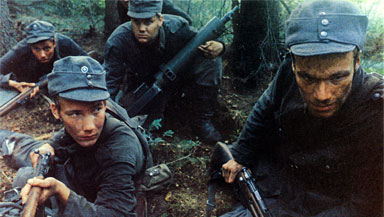
For a truly harrowing experience, Mollberg's remake, a more realistic vision of WWII raging in the Finnish forests, packs a lot more power. Mollberg brilliantly directs a cast of mostly amateurs, teenagers who perfectly encapsulate the futility of war, wasting away a generation before their prime. The book's name also finally gets its due by the horrific final image of dead bodies being loaded into a carriage.  

5. Back to the USSR (Takaisin ryssiin 1992, O: Jari Halonen)

We Finns have had a disturbing history living next to the Soviet Union, and it's politics have influenced us more than we care to admit. It's fall in particular took us off balance. A truly provocative satire by master teaser Halonen perfectly encapsulates the difficulty for any attempt towards Socialism in an agricultural capitalist country. Back in April 2011 I wrote:

"The anarchistic fim has been made with a pittance, but with so much imagination and inventiveness that it turns its downsides to its benefits. Thus the main village is built with shoddy houses that can fall apart in the middle of shenanigans. There's mud and filth everywhere and the society where everyone is bourgeoise can't be seen as any sort of ideal anyway. But communism is hardly a remedy."


Of course, being who I am, those five films weren't enough for me. So I also wrote out five bubbling underers. These were The Diary of A Worker (1967),  The Wedding Waltz (1988), Feast by the Sea (1963), It is written in the stars, Inspector Palmu (1962) and Sensuela, of course.

The list only took fictional films, which torpedoed some of the utmost worthy candidates chances to be crowned the Best Finnish Fim of All Time. I picked five noteworthy documentaries for Twitter. These were Yksinteoin, Reindeerspotting: Escape From Santa Land, Perkele! Images From Finland, The 3 Rooms of Melancholia, and Kovasikajuttu.

Only in recent years have I begun to appreciate the Finnish film legacy more. Our movie history is by no means as impressive as with the Danes or the Swedes, but there certainly is a lot of interesting stuff out there. I find it troublesome that so little of it circulates our TV screenings often, but luckily there are a few festivals and screenings at the National Film Archives that remedy the situation. Rest assured, this listing has taught me a lot of interesting new Finnish films to chack out and I intend to do so by Independence day (December 6th) with another installment of Finnish Cult Movies. Now, I'm off to watch Numbskull Emptybrook.

Yle's news about the matter (in finnish)

Wednesday, 26 September 2012

Finnish Cult Movies II

 
The first ever Finnish Film Affair opened today at Love & Anarchy. At the same time the Finnish Film Week presents festival-goers with Finnish films from the last year or so. I wrote about several of my favorite Finnish cult films a while ago, so since this period seems to be ripe with anticipation for Finnish films, I figure it's about time to do a sequel. This time around, the films circle around the archetypal Finnish males. Usually, they are a silent bunch, like their alcy-hol and are prone to do stupid things and make total fools of themselves by being too shy to say no. I know because I present this type myself.

The Dudesons Movie (Duudsonit elokuva, 2006)
Directors: Jarno Laasala, Tuukka Tiensuu


One of the most successful Finnish concepts abroad, The Dudesons were doing Jackass stunts before Jackass was even conceived. Basically it's about four buddies dare each other to do hurtful things to each other in the middle of nowhere, Finland.

There are several ways of making documentary-style real-life slapstick. Whreas Jackasses often rely on high production values and elaborate planning, the Dudesons are more down-to Earth, improvised and more self-satisfied. One could say the spirit is also a bit meaner, although this is merely a question of nuances.

The primary function of the Dudesons movie is to present the dudes to wider audiences abroad. It can also be said that the film works as a sort of pilot for their TV series. The guys speak English and there are cameos by familiar Jackasses, such as Bam Margera, Steve-O and such. Way too much time is wasted also on the Dudesons talking about each other to make themselves familiar with the viewer. This is absolutely futile. All we need to know about them are that they are idiots who like to hurt themselves for our amusement. One doesn't go to see a film like this to identify with the protagonists or anything.

Fortunately, the stunts themselves happen to be surprisingly funny. A baseball bat to an unsuspecting sleeper's crotch or testicles to a mouse trap are so cruel ideas they can't help but create glee in my inner sadist. Fun is also them picking on their neighbour, dubbed Mr. Hitler, by shitting on his mailbox or digging a big pit and covering it with leaves to get his car to fall down. With it being the Dudesons, some absolutely childish actions such as dicking around a supermarket at night or setting fire to their house, fall utterly flat. They attempt to emphasize their stupidity a bit too much.

It's a bag of hit-and-miss gags, but with enough good ones for me to give this a pass. It's a lot better than Dirty Sanchez to say the least.

★★★

The Wedding Waltz (Katsastus, 1988)
Director: Matti Ijäs


One of the purest examples of a Finnish cult movie is this originally made-for-TV movie. Not too many people know about it, but those who have seen it, worship it to almost fanatical points. The VHS version of the movie used to be always stolen from Finnish libraries. The newer DVD of the film comes with a copy of the script for Katsastus fans to read aloud to their friends to annoy them.

The film is about a group of middle-aged men in a small northern town, who act immaturely even at the beginning of their autumn years. The film begins as Viltteri (Vesa Vierikko) is celebrating his wedding to Mallu (Kaija Pakarinen), who is at her last stages of pregnancy. En route to the reception, Viltteri's car brokes down and he spends most of the night trying to fix it. While he's under the hood, his friends Öövini (Sulevi Peltola) and Junnu (Markku Mallasmaa) get heavily drunk. And Mallu goes into labour, taking a cab to the hospital. When Viltteri gets his car fixed he doesn't go to see his new bride and newborn, but takes the guys out cruising in the town center. The next day he and Mallu take off to Sweden to get the car properly fixed.

The film displays men who care a lot more about their cars than their women. Viltteri is a bit dumb and it's hinted he's been pressured into marrying Mallu even though she isn't carrying her child. When the child is born malformed Viltteri asks whether it could be taken to a carage to get fixed.  Later in the movie, he and Jannu come across another pair with a fate similar to Viltteri and Mallu. The husband is far more intrigued by mundane things and can't come to even fathom when her wife is giving birth to a new child. The blooming Midlife crisis manifests itself by the men being in a constant state of denial. When attached to the fact they act like trouble-making teenagers, comedy gold is born.

The pointless racing and cruising around in their old cars is a suitable metaphor for this sort of arrested development. A lot of the actions the men do, dumb or otherwise are done just to get a laugh out of one's pals. There's a weird fierce rivalry between cab drivers and our protagonists that's never explained but is bad enough for Öövini to lose his teeth in a fight. In one of the best scenes he's shown having trouble eating soup at a cafeé, while older people shunning his way of life around him, so he has to use a straw. If that's not a good depiction of hungover paranoia, I don't know what is. The film altogether is essential viewing for trying to figure out the Finnish national mentality.

★★★★

Damned Radicals (Saatanan radikaalit, 1971)
Directors: Heikki Huopainen, Timo Nissi, Heikki Nousiainen, Paavo Piiroinen


In Finland we had this Spede. Suffice to say, he produced a lot of movies, mostly comedies. It's good that he was able to get cheapo movies made when all other organizations funding films failed and thus he helped launch a large number of young talents. Sort of like a more comedic, Finnish Roger Corman, then. 

In this case this is a comedy written, directed and starring a quartet of young and eager actors; Heikki Huopainen, Timo Nissi, Heikki Nousiainen and Paavo Piiroinen. It is clear that these minds behind this loved the breaking of rules by the cinematic New Wave and underground cinema of those times. There's a sense of destroying any Finnish value held valuable at that time. A little anarchism could be nice and it sure hasn't been on display often in Finnish films.

Satan (Heikki Savolainen) is having trouble running hell, since all the Finns in there enjoy the warmth and use the whole place as a giant sauna. So the Prince of Darkness harbors a plan to get rid of the worst four of them, Pave, Hese, Timppa and Viiksi (the directors with their own nicknames). He offers the Finns a briefcase full of money and sends them into the world. But the Devil insists the money should not be used for honest living, which is why things soon go off the rails for the boys. He also takes away their ability to enjoy alcohol or women, just out of evilness.


The money case is soon lost. Due to these desperate circumstances, the quartet soon turns to crime and start to plan a bank heist. Soon, after them are not only the police, but angry motorists, clergymen and women as well. Things might have been easier had they decided to stay in hell.

For a movie with four directors, who also inhabit the main roles, it's no wonder the film is so inconsistent. Mostly the loose plot hinges on a single idea. The crew seems to have filmed any idea for the scene that popped into their head with little in the way of anything holding the thing together. The jazzy improvisational music emphasizes this.At least the film is mercifully short, stopping soon after the one hour mark.

Yet there are flashes of brilliance in the film as well, such as character actor Leo Jokela popping by to read the main credits aloud. Jokela is such a funny actor he can make reading names off a list hilarious - and this film proves this is no exaggeration.

★★

Naisenkuvia (1970)
Director: Jörn Donner


Jörn Donner is about as atypical as a Finnish man can be: smooth, flirtatious, sophisticated, good at making films, and brave enough to say whatever's on his mind. He's also willing to parody himself, his inflated ego and obsession to beautiful women and sex. Naisenkuvia is not only a razor-sharp, ponderous film, and a good time machine to the turn of the swinging 60's and 70's, but it's also hilarious as all hell.

Pertti (Jörn Donner) is a porn film producer, who secretly harbors a hope to create a truly artistic film within that genre. Yet he has plenty of troubles with the officials and the film censor board who don't understand his art. Pertti also lives like he's a character in one of his films, wooing the ladies and disposing of them afterwards. While scouting for a female lead for his ultimate masterpiece, he comes across Saara (Ritva Vepsä), a biology teacher. After they begin to have an affair, Saara agrees to play the role. But to his horror, Pertti starts to develop feelings for Saara, and thus jeopardizes his own vision.

Donner in the 60's and 70's was a fairly controversial figure in the already-narrow art circles of Finland. The officials did treat his art rather badly, and the general public didn't quite get his ideas. Naisenkuvia is more notorious in Finland for featuring an image where Donner's naked erect penis is shown than for its indubitable artistic merits. To this day Donner hasn't revealed whether it's really his johnson in the film (which would mean he's rather gifted in one more area) or whether the thing is merely a prop.

The film is a challenge against censorship for the free expression of everyone, however they might want to express themselves. Naturally, since expression is often based on feelings, the center romance carries much of the film. Yet there's also plenty of Nordic erotica for the raincoated men looking at Swedish films at porn theaters. The film repeats itself a lot, but there's a sort of inventiveness and joy in shooting ever more different copulation scenes that it more than merits for itself.

To me, the film is worth watching just for the scene where Donner berates with his sharp tongue a faux-arty sex scene, which is one of the most hilarious things ever done in Finnish cinema. The movie also heavily inspired an internet favorite, a redubbed porn video named Aitoa menoa, which heavily parodies Donner's persona and public image. Search that out, since for decency I'm too bashful to link to it here.

★★★★

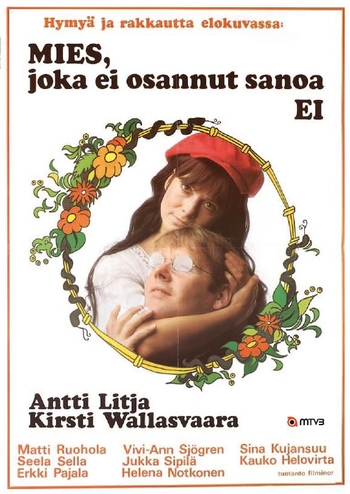
The Man Who Couldn't Say No (Mies, joka ei osannut sanoa ei, 1975)
Director: Risto Jarva


Risto Jarva was one of the most humane, quirky, inventive and smart directors this country has ever seen. He made a string of comedic films with his trusted actor Antti Litja, who was just perfect as a bit stiff, slow, shy, but nice everyman. And a total Finnish stereotype at that. The duo's films together had warmth and heart in them. Many of Jarva's movies have devoted followings. But since I myself saw this film as a child and liked it then, this is my preferred one. The film in question is a romantic comedy, but with a colorful, almost fairytale like storytelling.

Narrated by a horse, the film tells a story of the young reverend Aimo Niemi. Just out of the clergy school in America, he moves back to his old home neighbourhood of Kivimäki in Helsinki (a fictionalized version of Vallila), only to see it to be quite different yet at the same time quite the same. There's a feud going on of whether old wood houses should be torn down in the way of more modern buildings. Niemi's old friends and acquaintances are settled on both sides of the quarrel.

The most important is Niemi's childhood friend Milla Kurki (Kirsti Wallasvaara), taking an active role in the fight against losing all local flavour. Tough as Milla may be, she secretly harbors a crush and the hope to be Aimo's wife and for the pair to start a middle-class life together. But this is torpedoed by Niemi's bumbling, good-hearted nature and his obliviousness of her feelings for him. This is not a very gender-liberating by its script in any way. Yet Wallasvaara's performance is so sweet and adorable, one can't help but to fall for her a little. The other cast is as good as the leading pair with plenty of memorable characters throughout.

Jarva makes no mistakes about the fact that this is your basic farce in that a lot of comedy is mined about snowballing misunderstandings.  Litja's difficulties of saying "no" to any suggestion leave him in a lot of trouble. But even though the center of the movie is sweet, Jarva also has some jokes to be bit naughty and even shows off some skin. Yet he never crosses the line of being too raunchy so the film's tone is consistent.

Jarva was at the edge of the times with the theme of warm nostalgic togetherness put against cold, selfish progress. At that time, due to architects preferring functionalism to beauty, plenty of ugly concrete blocks of flats rose to Finnish cities while old-time neighborhoods disappeared. The film was well-received and rose discussion about maintaining Vallila as it was. Luckily, much of that particular part of the city has stayed looking the same as it did then.

★★★★

Sheep Eaters (Lampaansyöjät, 1972)
Director: Seppo Huunonen


Leo Lastumäki and Heikki Kinnunen play the main roles in this buddy comedy, based on the novel by beloved Finnish author Veikko Huovinen. The result is so much a cult movie, it's basically the Finnish equivalent of Easy Rider or Rocky Horror Picture Show. Back in the day it was made, screenings were constantly attended by fans who would shout out the lines to the screen while watching the film.

Valtteri and Sepe are businessmen in Helsinki, but when their summer vacation comes, they head off to the countryside to have their own sort of a road trip. They are true culinarists and believe that the best meal they could have would be a roast of lamb stolen from a herd and slowly cooked underground like old-time thieves used to do. While they commit their crimes and drive around they speak about things on their mind, about life, the universe, drinking and women.

If there's a pattern in the very best Finnish films it's that they have a very strong and funny script. But this movie also has a sort of New Wave sort of cinematic style, with a very loose plot thread, surprising jumps in time and space, and very improvisational style of dialogue scenes. It certainly also helps that Kinnunen and Lastumäki are both at career-best form here - and they aren't actually lightweight actors to begin with.


The film doesn't pester it's watchers by any morale or catharsis in the end. It is just an entertaining time with a couple of funny guys talking about this and that. It is sort of like going to a bar with friends, seeing as this film may also leave one intoxicated afterwards.

★★★★


LinkWithin

Related Posts Plugin for WordPress, Blogger...