Showing posts with label neo noir. Show all posts

Wednesday, 30 September 2020

Urban Gauntlets


One thing that gets lost amid all this quarantine is that major cities are seething hellholes. That's probably where I'm particularly drawn into the sort of neo noir films, where a hapless protagonist tries their best, but it seems the entire cities (usually NYC) are against them in every way. So, let's take a closer look at three of such examples.


Killing of a Chinese Bookie (USA, 1976)
Director: John Cassavetes


In the sweaty seventies, John Cassavetes was making his own minimalist art in between shoots of major big-budget Hollywood epics. He bled his own situation into his films, like here where an owner of a burlesque house (Ben Gazzara) strives to make art out of making middle-aged men horny.

He's also a gambling addict that gets into trouble with the local mob. The only way out is to do a favor, which in turn might suck out the last of humanity out of him. These kinds of films are basically tragedies about the failure of the American dream. The plucky underdogs dream of being big, but always have to face some harsh realities, and in the end, violence as well. Cassavetes didn't really like violence in films, so it's shot very discreetly, but the realities it causes changes the tone of the entire film. 


Unlike the two other films in this list, this one is set in Los Angeles. It can be seen in the greater emphasis on cars, distances, and heat eminating from the entire film. Cassavetes as a director usually had a very limited color palette to his films, this one also looks like the film was overexposed in the sun, even though it's mostly set during the night.

The film is mostly talk and no action. One shouldn't expect it to even have a climax of sort. Cassavetes is interested in the implications of the situation more than anything. The entire thing also works as a metaphor for the corruption of the power of money. How far are you willing to sell your soul?

★★★★

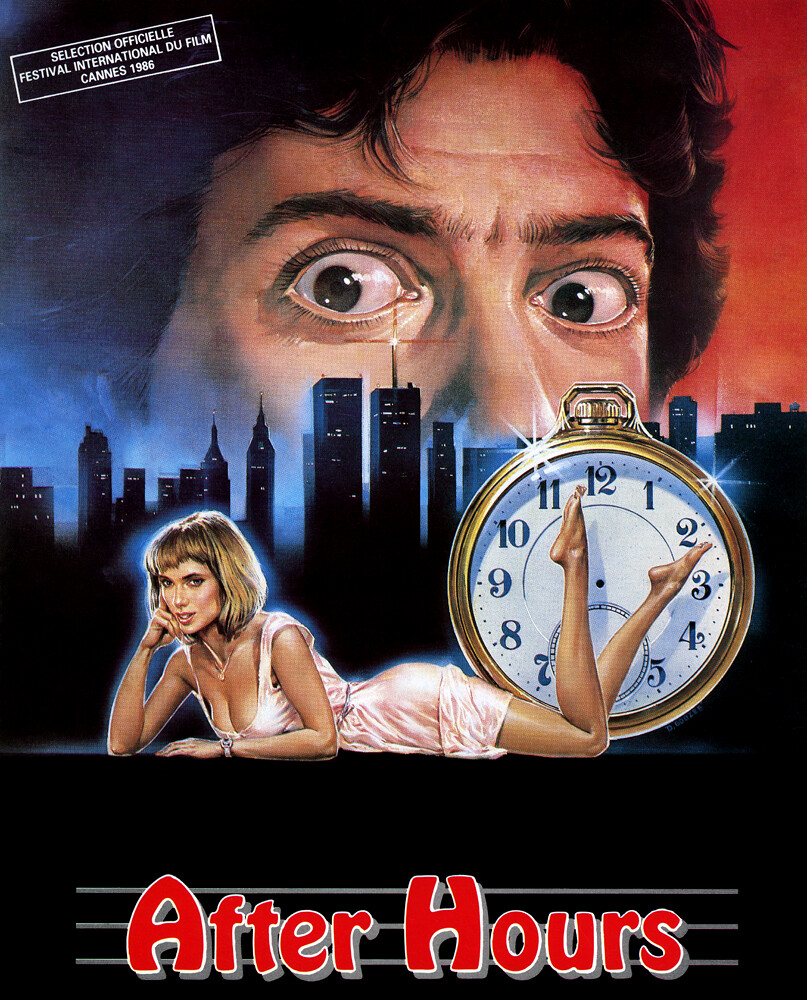
After Hours (USA, 1985)
Dir. Martin Scorsese


It used to be thought that the 1980's weren't really that good for the director Martin Scorsese. I beg to differ, I find he did some great work that riffed on ideas and themes he had set up in the previous decade. After Hours is one of his rare more comedic movies. But in fact, it's a thorough New York movie that sees the city, yuppified since the days of Taxi Driver, as dangerous as ever.

A hapless office worker (Griffin Dunne) is a regular young man but takes a few steps out of his comfort zone as he's looking for love. Out in the middle of the night in a weird part of the town alone and with no money seems to attract him to oddballs and authorities that don't mean him well and are out to get him. The neon-lit, cold and smoky New York never looked better but at the same time, more terrifying.


The film is emphatethic towards everyone who's down and out in the Big Apple, even if it casts most of the characters of the city with major mental issues and cynicism. But the key is that circumstantial setbacks can pile up and minor things like losing a $20 bill may cause a chain-reaction that only adds to the plight of the outcasts. It's a film that also gets to the heart of the loneliness felt in cities, even if there are plenty of people around. 

Scorsese has borrowed from Woody Allen a distrust of the city's intellectual and artistic class and mercilessly mocks it. He also manages to sneak in some of his personal obsessions, from late-night diners to talking about film classics to the mix as well, making this one of the movies surely influencing a young Quentin Tarantino. The only major problem with the movie is that it hits so close to truth it's not that funny as a comedy, but hey, you can't always have everything.

★★★★


Uncut Gems  (USA, 2019)
Dirs. Benny & Josh Safdie

The latest one, and the one that particularly inspired this writing comes from the arthouse cinema production house A24 and has Scorsese and Cassavetes in particular as influences. The seediness in the previous ones is now contrasted with more modern sports centers and auction houses. But even if it's not done in the open any more, the threat of violence looms even stronger behind every scene.

Lando Calrissian -styled gems dealer Howard Ratner (Adam Sandler) is at once a sleazy little rat, and a fast-talking trickster you can't help but to like even if his self-destructive adrenaline addiction is putting not only himself, but his his family and friends on harm's way. Ratner is about to make a huge sell on a particularly beautiful opal, which puts him in a position and mindset to make increasingly dangerous bets on sports. The movie follows as Ratner ups the ante again and again, always surviving by the skin of his neck, until finally the bets become way too big to handle.


For the fast-paced modern audiences, the movie is fast-cut and has plenty of side-plots going on at all times. The effect may be anxiety-inducing for some viewers, but the film also warrants repeat viewings if one is interested in seeing the strings of plotlines getting pulled. Given the chance, Sandler can be a great character actor, so it's a bit sad he didn't get the rcognition he deserved from this which will surely make him go back to making very half-assed comedies with no effort. But such are the joys and victories that the film presents, too. They are fleeting, and something much worse is yet to come soon enough.

 ★★★★ 1/2

Tuesday, 15 September 2020

Night Visions: The New Ab-normal

 
Things are different this year around, which meant for the regular spring edition of Night Visions film festival getting cancelled. But at least here in Finland things got a little better, so there was an opportunity to have a festival in August. Things are changing also in the way I'm writing a festival report after a long while.

Butt Boy (USA, 2019)
Director: Tyler Cormack

 
This is a movie about an obsession, addiction and the willingness to wreck lives to achieve it. It's also a serial-killer movie about a dude, who (SPOILER) sucks people and objects inside his cavernous butthole. As far as crazy premises go, this one takes itself as seriously as it physically can.

As a whole, this film moves quite slowly. It has some perks, like watching the slowly ravelling cat-and-mouse game between Tyler Cornack's perp and Tyler Rice's cop on the edge. When the actual reveal comes, it changes the film's dynamic entirely, making the last quarter or so a real blast of butt-jokes. It is not quite as crazy as I had hope it would be, but I got some good chuckles and the melancholic feel of the movie really got to me.

★★★

Luz: The Flower of Evil (Columbia, 2019)
Dir. Juan Diego Escobar Alzate


This latest word in folk horror sees a reclusive cult live off the land. The cult leader El Señor (Conrado Osorio) keeps multiple wives and declares his youngest child to be the next Messiah. The other children, three daughters, find an object of the outside world and have different reactions, from wanting to escape to undying loyalty and laboring hard for the cult. The film doesn't really manage to give a good athmosphere or raise the stakes as one would wish from a horror film. Visually, it's clearly a fan product of the works of Alejandro Jodorowsky. But the actors are quite good in their roles, and one manages to sit through the film woith relative ease, even if it doesn't ever really deliver as good as one would want.

★★ 1/2

Tezuka's Barbara (Japan, 2019)
Dir. Macoto Tezuka

 
The pinku film seems to follow pretty clearly the godfather of manga Osamu Tezuka's comics. It is a story of a regular guy becoming increasingly obsessed by a homeless girl he meets on the streets of Tokyo. Like most pinkus I've seen, this one is quite slow with very few and not very graphic sex scenes. The ideas and obsessions around sex are more important than the act itself. There are a few scenes of note here that remind of Tezuka's odd sense of humour and richness of his imagination. But as a whole, the film is quite stilted, not utilizing what film can bring to the table as opposed to manga. So, this one felt quite dull in the end.

★★

Klovn The Final (Denmark, 2020)
Dir. Mikkel Norgaard

 
After the bit disappointing Klovn Forever, it's fun to see the third part in a trilogy somewhat return to its roots. At this point, Frank Hvam and Casper Christensen's rowdy comedies know what audiences are expecting, and both tease them with it but in the end, also deliver. It's not quite as graphic as the two previous ones, but altogether it might be ruder. It's crazy funny, at least.

The movie opened in Denmark just before the Corona crisis, so it's weird to see it tackle self-isolation for a length of its time. However, since an embarrassing mishap has cost them their trip in Iceland, Frank and Casper have to hide out in a vacant house next door to Frank's family. One small lie leads to bigger and bigger ones, and the strain to Frank's marriage in particular is stretched to a breaking point. Casper works as a ruthless id, caring little about anything else besides getting laid and getting the two into bigger and bigger troubles.

Not all of the film's gags quite land, and they are eager to set up some scenes that they oddly drop off at the blink of an eye. But when a good joke is laid out, waiting and then suddenly given an unexpected punchline, one can't help but to fall over laughing. I laughed, I cried, I hurled.

★★★★

Rabid (Canada, 2019)
Dir. The Soska Sisters

 
Even if 1977's Rabid isn't the most popular film in David Cronenberg's filmography, it is still risky to even attempt to redo one of the corner stones of the body horror movement. The Soska Sisters realize this, and while the end result is definitely going to split viewers, I do think they managed to update the ideas to a modern setting quite well. Maybe this should be a Re:Make blog post later on?

The new version downplays sexuality and the inner shame caused by it, as seen in regular horror movie tropes. The idea this time around is more like a feminist satire showing a woman being punished by outside forces for showing initiative in general. Timid fashion designer Rose (Laura Vanderwoort) isn't getting the recognition she deserves until she has an accident and an experimental skin operation to fix it. Too bad it also makes her a Patient Zero in a vampiric disease that starts to wreack havock.


It's kind of a wonder how ahead the curve the Soskas were last year. The vampire disease and the reactions of it, ranging from trying to shrug it off and continuing as if nothing is happening to outright maliciousness of trying to benefit from people dying, seems like satire from the reactions to COVID-19. There's even a barb at the police violence against poor people that have the disease. The Soskas make plenty of changes to the original, with a lot of emphasis on a sisterly relationship, and a thoroughly bonkers final reveal to match. All the bitterness surrounding the depiction fashion industry don't quite work, but the film bursts with ideas enough that one can give or take a few clunkers as something entirely else is just around the corner.

★★★★

The Gangster, The Cop, The Devil (Akinjeon, South Korea, 2019)
Dir. Lee Won-tae

 
Supposedly this south korean crime actioner is based on actual events of a mob boss testifying in court against a serial killer. It does deliver some grisly violence, surprising twists and well-rounded characters. The actors are wonderful, especially Ma Dong-seok as the burly kingpin who has to revalue his pendant for violence and need for revenge as an even more ruthless murderer (Kim Sung-kyu) tries to kill him. There are only shades of grey here, as the cop (Kim Mu-yeol) himself is a corrupt gambler and a drunk, happily spending his spare time in mob-owned casinos. The film is well-done entertainment, but has a bit of an abrupt ending, like you would expect from a TV series, and it doesn't really feel to have a central idea strong enough to really elevate it into a classic. 

★★★

Dolls (USA/Italy 1987)
Dir. Stuart Gordon


Night Visions also paid tribute to the late horror master Stuart Gordon with a screening of his classic horror-comedy. Dolls may not be quite among the very best of Gordon's filmography, but as is usual for the director's oveure, it is better than you would think. And it's generally thought to be the best of producer Charles Band's various killer toy movies that also include the Demonic Toys and Puppet Master franchises.

For the hardcore horror buff, the film might be a bit childish, though. It's central character is a little girl (Carrie Lorraine) and all the adult characters are overplayed caricatures, like you would find in a Roald Dahl book. They also meet similar grisly ends in a magic mansion filled with creepy dolls, or getting turned into dolls themselves. There are a couple of rowdy punk girls, evil yuppie stepparents, a weird elderly couple, and a plump but well-meaning dweeb (Stephen Lee). 


While the plot isn't anything terribly extraordinary, nor scary, the film is kept reasonably short and gives a few good one-liners to chuckle now and again. The puppet effects are kind of crude, but kept in a way that makes them mysterious enough. That was some of the magic of Gordon's filmmaking, he always knew how to stretch his budgets to suit the storytelling he aimed for.

★★★

Sunday, 13 September 2020

DePalma x Hitchcock

 
Director Brian DePalma just turned 80 years old (yesterday, but I'm having trouble keeping schedules), so it's a good opportunity to take a look at three of his movies. Throughout his career, DePalma has been criticized for outright stealing scenes, set ups and camera angles from well-known directors, mainly Alfred Hitchcock. As a sort of postmodernist, both winking at people familiar with films and developing them into something new altogether, DePalma is a clear forerunner for filmmakers such as Quentin Tarantino or Ben Wheatley. So in this post, I have three thriller films of DePalma's that really go all in in swiping stuff from Ol' Hitch, and see whether the steal made for a better movie or whether it's just a lukewarm version of stuff better made before.

Obsession (1976)

Pilfers from: Vertigo (1958)

While Sisters (1972) was DePalma's calling card for the world of the thrillers, this was a certain turning point in his career. For one, he managed to snatch Hitchcock's frequent collaborator, composer Bernard Herrmann to do the music. For the other, he got ire from Hitch himself, who considered the film to be a remake of his own Vertigo. Both movies are stories of an obsessed man (played by Cliff Robertson here) losing his beloved, but later finding a doppelganger who he remakes in her image. But in both cases, the "new" woman has a secret and some knowledge of the past that comes to cost the protagonist.

The original script was done by Paul Schrader, who is an expert in having troubled characters with an inner life in total turmoil. It was extensively rewritten by DePalma to better touch upon what he wanted from the film. Schrader had different ideas for the entire ending, which probably would have been considerably different from Vertigo. It would have been interesting to see another time-hop, since the 16-year skip in the beginning takes us quite by surprise.

Robertson is perhaps not the most charismatic leading man, he does sell the inner anguish, but is like a cold fish in romantic scenes. DePalma has later said he didn't really buy his performance here, also perhaps due to the actor being difficult to work with. John Lithgow as his best friend and business partner steals a lot of the intrigue, and if you're familiar with some of DePalma's later efforts, you'll know what kind of a role he's playing here as well.


The film goes into a lot more taboo subjects Hitch couldn't, including incest. They both don't really care on whether the central criminal plot makes little sense, but Hitchcock as a more mature filmmaker can better drive the focus of the film to be solely of the central character's, well obsession. Both movies are interested in trauma being played out, surfacing as PTSD in sudden bouts of madness. But the film is also perhaps too slow for its own good. Vertigo packs a huge story in a very compact running time, but here one keeps hoping the film would roll along, having mainly an interesting ending. It also seems like the ideas of the pain of lost love being mirrored in art or restauration thereof, was approached with more sophistication by Hitchcock.

DePalma also takes cues from Dial M for Murder, Rope and Marnie.

★★★

Dressed to Kill (1980)

Lifts from: Psycho (1960)


This one starts and ends with a threatening shower scene. Also one of the key scenes of this film is a heavy reference of the seduction scene from Vertigo; both of the take place in an art museum, and use very little dialogue. DePalma can and will use a lot more explicit sex scenes. Classic Hollywood star Angie Dickinson is surprisingly game, even though in nude scenes she used a body double.

The most notable steal from Hitchcock's sole horror movie comes from the structire. Both films kill off the main female character midway through, and from thereon follow her sister trying to solve her murder, played here by Karen Allen. The film also uses other similar stock characters, such as a young man hung up on his mother, a sleazy private detective and a psychiatrist trying to find the reason on theories of sexual repression (played by Michael Caine). But DePalma also enjoys a bit of misdirection, having some familiar seeming roles be entirely red herrings. 

DePalma can easily be criticized for misogynist attitudes in films, and in here too, an adulterer woman gets her comeuppance very bloodily. It's a bit of a SPOILER, but the trans community has also heavily criticized the film's portrayal of transsexual tendencies and, having the early 60's Psycho-like idea of having them act as serial killers. There really isn't anything positive the film will say about any sexuality out of your basic monogamous cis-sexuality, but at least Allen's character is a sex worker who also works as an active protagonist.


The film also has a point in pointing how Hitchcock's voyeristic tendencies are obsessive, damaging and toxic, taking their ideas to their logical counterpoint. But it also revels in these very same tendencies. DePalma also plays on his own experiences, since the infidelity that starts out the film was something that was happening in his own family as well. The film has great camerawork and a beautiful soundtrack that makes murder of women highly aestethicized and thus making the audience complicit of the filmmaker's perversions. Also the film's ending is frustratingly bad, having odd conclusions and a dumb jump scare straight out of Carrie.

★★ 1/2

Body Double (1984)

Purloins from: Rear Window (1954)


The idea of duality of an identity or dual personas is very central in DePalma's filmography which probably explains why he's so obsessed with Vertigo in particular. This one dives also deep into ideas of voyerism, prevalent also in Hitch's Rear Window and Dial M for Murder. It makes Hitch's distrust of authorities also an aspect of shame and self-hatred following from obsessive and sexual thoughts.

The film has a cold open on a B-grade horror movie which reminds of Blow Out. The main character (played by Craig Wasson) here is an actor struggling with mental illnesses such as claustrophobia. He wanders off the set and notices a woman who does erotic dances in her apartement every night. Looking at her through telescope, he becomes somewhat obsessed, but also starts to suspect her life may be in danger, giving him an excuse to stalk her in the streets. But even as he witnesses more and more evidence of brutal crimes being committed, he is not believed by the authorities because they see him just a pervert.


At the time, DePalma was seen having gone too far with his use of sex and violence in his films. It's easy to see DePalma just following on with what the Italians were doing a little prior (even if he himself strongly denies it), yet his success opened doors for plenty of Hollywood Erotic thrillers in the late 80's and 90's (most of which were a lot more moralizing). Also DePalma was very much on top of the neo noir movement, making sleek, beautiful pictures to go with gritty stories he was telling. The film even incorporates a Frankie Goes to Hollywood music video in the middle of itself. It's all highly entertaining.


One can see how DePalma is working to solve some mysteries of film entertainment and its use in the world himself. With this and Blow Out a craftsman working in the film industry finds a "true life" plot which affects his way of working. Which is of course just as outlandish and over the top as anything else in Tinseltown. Is real world violence catching up, and does it have a symbiotic relationship with thriller films as well? Do they feed each other? In this case, the lines between movie and reality really fall apart in the 4th wall-breaking finale. Was all the suspense and thrills for nothing? Is the film completed?

When he worked these ideas into his Hitchcock thriller, I think his constant steals also started to actually work for the film's own benefit.

★★★ 1/2

Thursday, 23 July 2020

O is For Organized Crime


I haven't really honored an alphabetical order so far with our look into Italian genre cinema anyway, so let's just jump straight into O, shall we? There's a sub-sub genre of poliziottesci movies that focuses more on the underworld and various criminal gangs than the ruthless police chasing them. It was spawned mostly by the success of The Godfather films in the early 1970's, even though Italians were making films such as these before them as well. After all, the criminal clans and the pursuit to bring them to justice were all over the society at that time.

For blogging purposes, it would stand to reason to balance the last post with a look at some of the more notable of these. 

Sicilian Clan (France/Italy, 1969)
Director: Henri Verneuil


It's interesting to watch this Franco/Italian production today, as it was made in a time before the really hard-boiled 1970's crime movies kicked off. That's why, even though the name, it's not really a realistic depiction of organized crime by any means, but rather a tale of some gentleman thieves and their criminal family.

The film's most exciting scene comes right at the beginning, as we are introduced to jewel thief Roger Sartret (Alain Delon), who manages to escape from police custody from a moving vehicle. The Sicilian mafia, lead by Vittorio (Jean Gabin) help him out as he had learned information in jail that could help them pull off a major heist. Things are complicated as Vittorio's son's wife Jeanne (Irina Demick) starts to fall for Roger, as well as the commissioner Le Goff (Lino Ventura) following hot off their tail.

Verneuil is to me an underrated director who managed to create a nice filmography of exciting genre films in the 60's and 70's. The problem often is that even though the movies have all the elements of greatness, something stops them from being stone-cold classics. Here the problem is that Verneuil doesn't manage to keep the film's style compact. As an international heist movie, it entertains, but from a film titled like this, one would expect to see a more intimate depiction of a crime family, and not shy away from the brutalities they commit.

Now it's so casual it's basically a version of The Pink Panther without jokes. The film has a great cast, though and each makes their part a memorable one.

★★★

Gang War in Milan (Milano rovente, Italy 1973)
Dir. Umberto Lenzi


French drug couriers, led by Le Capitaine (Philippe Leroy) starts ruthlessly taking over Italy, first at small towns, then moving on to major cities like Milan. The owner of a local nightclub and pimp Salvatore "Toto" Cangemi (Antonio Sabato) resists both joining or working for the cartel, which leads to the increasingly violent feaceoffs between the French gangsters and Italian small-time crooks. One can see here as well that the Italians are worried thet their delicate balance of dealing with some criminal aspects in their society are about to blow in their faces with the advent of more brutal criminals from abroad.


Lenzi was one of the most prolific Eurocrime directors, and Gang War was his first shot at the genre. It's a seedy and confusing little film which had qualities the filmmaker would improve upon later on. As such, it works well as your average Eurocrime. It has little action scenes, shitty cars and slimy moustaches, but plenty of torture, abuse of women and other nastiness that guarantees its notoriety. Lenzi always had the most despicable central characters, but the film fails to give better reasons of following them.

 ★★ 1/2

From Corleone to Brooklyn (Da Corleone a Brooklyn, Italy 1979)
Dir. Umberto Lenzi


Lenzi is on hand again, as he was one of the most central directors of the genre. This time around the film's depicting a multilayered cat-an-mouse game on the run. Mobster Michele Barresi (Mario Merola) makes a play for more power and has his main rival gunned down, but has to escape with his life to New York. The tough, uncompromizing insperctor Berni (Maurizio Merli) hatches a plan to capture the fugitive, but this makes Barresi's girlfriend and a former mob assassin Salvatore Scalia (Biagio Pelligra), out to testify in court, moving targets.


From the setting of the story to both Sicilian village of Corleone to New York, it is obvious this has been majorly influenced by The Godfather, but also several other 70's New York mob flicks, like Mean Streets. Lenzi has learned to not overindulge in violence and brutality, centering more on the plot and the paranoid athmosphere this time around. It doesn't offer anything too spectacular or best of the genre, but a very solid entry into the genre itself, with some interesting depictions of the Mafia pulling strings across continents as well.

This one was Lenzi's last foray to poliziottesci for a decade, in the 1980's Italian genre cinema basically became a lot more horror-oriented and he started to churn out Cannibal movies. He returned to the genre in the early 90's, but without Merli.

The Milieu Trilogy, 
Dir. Fernando Di Leo:


Caliber 9
(Milano Calibro 9, Italy 1972)


Di Leo specializes in making crime films that are simultaneously operaticly tragic and caricaturized like fumetti comics. He also usually starts out with a bang, and the same thing happens here. A criminal syndicate sends a money package from person to person, gets betrayed, and then Mario Adorf's Rocco Musco acts swift revenge and blows them all up with dynamite.

Mostly the film moves more slowly, with tensions rising as we wait on violence to explode again. The film has a bleak look on the Italian society that has failed to stop the most ruthless and brutal to exact on their will. The main character Ugo Piazza (Gastone Moschin) tries to play straight after being released from prison, but is soon sucked in to criminal works since he is being blamed of embezzling the money. At the same time, the police also wants his help in order to find the stash.


The film has more double-crossings as a season of soap opera. Mostly everyone plays to their own interests, and Di Leo also has a cruel irony regarding the ideas of honor among thieves and respect within the crime family. He doesn't find much good about working within truly rotten apples and getting involved in crime has plenty of tragic consequences play out. The movie also has a banger of a theme song, which has been used by Di Leo several times after this one, too.

★★★★

The Italian Connection 
(La mala ordina, Italy 1972)


On my money, this is Di Leo's finest work, and also one of the all-timers for the greatest action movies ever made. To tell exactly why would be spoiling, but suffice to say, Di Leo doesn't put his most explosive scene in the film first, this time around.

A small-time Milanese pimp (played by incresing desperation by Mario Adorf) finds out there are two American hitmen (Henry Silva and Woody Strode) sent for his head. Even though he works within the mafia, he doesn't understand why they would threaten his life. He tries to find out who has set him up for stealing a shipment of heroin, until the hits get too personal, after which he sets out on a quest for vengeance.


It appears Di Leo got a hold of bigger budgets after the success of (the rather small-scaled) Caliber 9. The film has superb action scenes, from car chases along the streets to a final showdown at a junkyard. Action direction is clear and purposeful, and daring to go as far into the ridiculousness as one can. Though Di Leo finds the life-or-death situations of involvement in the organized crime tragic, he knows he's also an entertainer. That's probably also the reason why a major action scene ends up on an abandoned circus.

★★★★ 1/2

The Boss
(Il Boss, Italy 1973)
 

The capper of his trilogy has some of the biggest scenes the director ever did, and was probably intented to be the first of two parts. The film ends on a "To Be Continued" cliffhanger, so it's a shame we never got to see what Di Leo had in store for the latter part. But what we had is explosive and mesmerizing either way.


It has another explosive opening as Henry Silva's assassin kills a bunch of mob bosses in a movie theatre with a grenade launcher that also sets the screen on fire (Tarantino was probably taking notes for Inglourious Basterds). But the pace evens out a bit, with most of the movie being criminals arguing in small rooms. As the film was released after The Godfather, there are several scenes of murder that imitate the suave montages that one had.

The film may be a bit slighter, subtext-wise, than its two predecessors, but it is still tremendous fun and everything one could want from a film like this, right down to the angry police chief. It's still a bit cynical on the situation of the society and the criminal enterprises it lives in a symbiotic relationship with.

★★★★

Sunday, 31 May 2020

Re:Make - Maniac


In this new blogging series, I am contrasting a classic movie and its remake. This is to showcase that a remake is not always a bad thing. Very rarely do movie remakes attempt to do anything fresh with their concept, but usually just blandly redo every major scene. But sometimes this is not the case. A new director might find some new angles on the established IP and possibly given a totally new twist rather than same-old-same-old. Some great cinematic feats would not have been possible if there wasn't a rogue filmmaker ready to give a shot in redoing something beloved.

Maniac (1980)
Director: William Lustig

vs.

Maniac (2012)

Dir. Franck Khalfoun

The original Maniac was born out of the cheap grindhouse thrills of the late 70's, early 80's. It is a New York movie through and through, and so seedy you feel like you need a shower afterwards. This aesthetic is very particular, but it gives Maniac some edge its flawed realization might otherwise miss.

We are taken to a journey to a mind of an overweight, bug-eyed, bad-skinned and greasy haired loner who also happens to be a mentally ill serial killer (Joe Spinell). The character is clearly suffering from his conditions, having hallucinations and manic bursts, as well as the uncontrollable urge to date women with his knife. It would be easy to hate this pathetic creature, but there is some unwilling sympathy to found in him. As evil as he seems, at worst he is just lost in his delusions, as helpless to pull himself together as the audience is to stop his gruesome murders.


That's not to say there are misogynistic roots in this rotten apple. He is a total predator, unreleting and unforgiving when he gets his killer instincts on. The stalking scenes, culminating in gory effects by Tom Savini himself, are some very effective use of horror filmmaking. The film is sad and nihilistic, seeing the murders as unstoppable and the killer not even particularly wanted or searched. Just another sad story in a city full of them.

Though by the end the film breaks the main character's insanity twirling out of control into the storytelling as well, the grounded viewpoint was a clear pathfinder. In the film we are stuck to the killer's mind, whether we like it, or rather, not. More grounded serial killer fare followed this, like Angst and Henry - Portrait of a Serial Killer, which overemphasized the mundaness and banality of people like this.


After the Giuliani cleansing of New York, it stands to reason another Maniac could not have been updated to the same setting. Instead, screenwriter Alexandre Aja and director Franck Khalfoun decided to set the new version to Los Angeles, a city who gives even less of a fuck of the mentally ill and the unsuccessful sad souls. The viewpoint was then stuck even more inside the killer's head, to the point of shooting the entire thing in POV. These decisions work to show how the entire world in each of the citizens of LA revolves only around themselves.

Elijah Wood's Frank seems at points to be even too nice a soul to belong in the city where everything is sheer surface and real thoughts are kept tightly inside, to the point of bursting. The city of fake people can't help a soul just trying to find a connection. His work as a mannequin creator is an important metaphor to this as well.


But Frank is just as much a madman as his predecessor. When he can't relate to women, he resorts to stalking, killing and scalping them. Though his extreme misophobic deeds are horrifying and disgusting, this lost soul might be even more symphatetic this time around. The film wisely keeps Wood's face and doe eyes out of screen for the most part, telling the story more by just his voice. He doesn't do what he does out of evil, but because he has lost his sanity and is as terrified, unable to help himself and as lost as the audience.

In the end, the seedy and gory Grindhouse shocker was updated into a more clean but genuinely unnerving POV film. It allows perhaps a bit more insight into the mind of a titular maniac. Rather than going through motions, this one dares to surprise and take the story into unexpected territories.

Maniac (1980) ★★★ 1/2

Maniac (2012) ★★★★

Monday, 7 December 2015

Finnish Cult Movies V: Crime and Punishment


Crime and Punishment was the title of the first film by Aki Kaurismäki, Finland´s most acclaimed film director. It has also been said that the rest of his filmography follow the same theme. Now, in this article series, I haven´t featured too many of Aki´s films, since I prefer to showcase some stranger films that may or may not be familiar to international audiences. The theme is also very constant. There haven´t ever been many genre movies made in this country, but at least there have been several Crime films. And as it happens the handful of best ones also manage to take a look at the subject from a surprising point of view.

Jäähyväiset presidentille (1987)
Dir. Matti Kassila


"Farewell to the President" is a The Jackal-esque thriller, which concerns a far-leftist would-be assassin, and the policemen trying to capture him before he manages to murder president Urho Kekkonen. As he was the longest-running president in Finnish history in a pretty sensitive historical period, Kekkonen was not often featured in fictional films. Here, he is portrayed as a hedonistic old man, caring more of going to the sauna than his duties as the nation´s figurehead. No wonder the film was released only after he had already passed away.

Matti Kassila, known also for the beloved Komisario Palmu series, creates his crime films with his tongue firmly in cheek, as in here. There are cameos from popular comedians such as Mikko Kivinen and Aake Kalliala. These are intercut with some surprisingly brutal sniper murders.

Nevertheless, it is an action-packed film with a terrific main villain, played by Hannu Lauri. He shaves his head, Taxi Driver-like, and builds his body with Jean-Claude Van Damme´s picture hanging on the wall. While the audience knows he´s the culprit, the police detective in charge has no vlue. The opponents are directed at each other a few times, which give Lauri some great sneering lines at the representative of the system he so loathes.

The end chase in particular is a hoot, with cheap soviet-made cars chasing each other in countryside dirt-roads. While Kassila has admitted to attempting to create a more American-style crime thriller, this certainly has its roots firmly planted in Finland.

★★★ 1/2

Yön Saalistajat (1984)
Dir. Visa Mäkinen


Even further down the surreal line of staging Hollywood-style thrills and chills to our peaceful country, director Visa Mäkinen decided to try the same in his small home town of Pori. His films have a sort of infamy in Finland, but in fact with his small budgets and innovative filming style he managed to often be way more entertaining than the more serious finnish films of the same period.

Yön Saalistajat ("The Predators of the Night") is one of his most popular films. It concerns a policeman going undercover in a major crime league, operating in Pori. The film´s idea of criminal activity is straight out of Donald Duck comic books, while the delicious dialogue is some prime Chandleresque ham.

The title is misleading as most of the film is set on the most sunny days of the summer. The movie also has a villain for the ages, Matti Mäntylä´s Reuna ("The Edge"). This biker-like thug worships Satan, does drugs, has Psycho-like mommy issues, and of course treats every other character in the movie like dirt, save for his boss, the Boss.

Like Mäkinen´s films tend to be, it looks like an amateur film shot in each other´s homes. But one can´t deny it´s told smoothly, always running from one delightful scene to another.

★ or ★★★★★

Räpsy ja Dolly eli Pariisi odottaa (1989)
Dir. Matti Ijäs


Räpsy & Dolly is a film about a criminal (Matti Pellonpää) released from jail. His life afterwards is difficult and he is being tempted back into crime all the time. A blossoming relationship with a screwloose bar maid (Raija Paalanen) might help him keep in line, or his new job at a porno store under a crooked boss might push him over the edge.

Räpsy & Dolly represents the sort of Finnish film making that doesn´t shy away from looking at life as it actually looks. The cast doesn´t consist on sheer doll-faced people, but actors who look the sort that have seen life, and deperately try to avoid it from now on. Dolly in particular tries to keep up appearances and fool herself that the seediness around her is actually bohemian Parisian artstocracy.

Aki Kaurismäki´s most trusted actor Pellonpää is (of course) magnificent as the lead. He´s a bit weaselly, but still puppy-like enough that we as the audience keep rooting for him. We are not sure on how rooted into reality his relationship with Dolly is, until the film´s final moments. Director Ijäs is very gifted with comedy, and the film´s surprising zingers catch the viewers off-guard time and time again.

★★★ 1/2

Karvat (1974)
Dir. Seppo Huunonen


Finnish film industry didn´t really have a noveau vague period, but nevertheless we had some directors willing to test out filmmaking methods and break formulas. Karvat ("Hairs") was one, and as such, it was a lost film for decades until it resurfaced on dvd in 2011. The film is loosely based on the same novel as Jean-Luc Godard´s Pierrot le Fou.

The story´s about a criminal (Mikko Majanlahti, looking remarkably like The Smurfs villain Gargamel) that is involved in a successful heist. With all his money, he leaves his wife and runs away with a younger girlfriend (Arja Virtanen). The relationship has ups and downs, madness and uncertainty. In the end, the pair is forced to return to dangerous Finland where blood-thirsty assassins are waiting for them.

Huunonen has some very innovative ideas and choices, particularly concerning scenes of love and murder, two things that are often done in films in exactly the same way. A jazzy soundtrack also emphasizes his emphasis on testing different things out. But his comic sensibility keeps the film a bit too light and farcical and many of his experiments don´t serve the film as a whole. It would have the ingredients to be a truly gripping work, but sadly it doesn´t quite go as far as one could wish. Nevertheless, it is one of the most interesting films of it´s time.

Huunonen only made one another film, a more conventional Piilopirtti, which attempts to return to the comedic crowd-pleasing style of his debut, Lampaansyöjät.

★★★

Nyrölä 3 (2004)
Kissa ja varjo (1993)
Dir. Tapio Piirainen


Tapio Piirainen is best known for his succesful TV series Raid, as well as the feature film of the same name that continued the story. Piirainen has also done a few crime movie for television that share his laconic humor, some themes of crime and corruption, and often also the same actors (Kai Lehtinen and Oiva Lohtander seem to reappear).

Nyrölä 3 seems to be closer to Raid´s world. In it, a new police officer (Maija Junno) of the small town of Nyrölä tries to solve the murder of a middle eastern pizza cook. The film tries to deal with the inherent racism of the Finnish countryside, but also features Lehtinen in blackface as the friendly "Saddam". This makes the film feel quite uneasy and counter-intuitive, even if it has some snazzy dialogue and a fun role for Lohtander. At times, the movie also gets too farcical, as in the extended roles of Kummeli comedians Heikki Silvennoinen and Timo Kahilainen.

Kissa ja varjo is more based on Piirainen wanting to try out different styles. The movie is a spy chase, with also elements from spaghetti westerns, film noir and even war movies. Kissa and Varjo are private investigators who keep on screwing each other over, even though they both should aim for the same goal. As a whole, it feels very light and would require some dramatic weight. Nevertheless, it´s an entertaining enough TV movie for one-time viewing.

Nyrölä 3: ★★ 1/2
Kissa ja varjo: ★★★

Kujanjuoksu (1971)
Dir. Maunu Kurkvaara


Kujanjuoksu showcases a crime that must be the most common in this country; an act of fury done in unclear conditions, alcohol being involved, and that causes self-loathing and suicide attempts in heaps. Kurkvaara is one of the greatest directors this country has seen. Kujanjuoksu isn´t quite one of his best, but it is an innovative and progressive cinematic piece that´s well worth a look.

Ossi Virtanen (Aarre Karén), a drunkard,  is captured and blamed for a murder of a teenaged girl, for which we know another man is guilty. Ossi himself can´t remember anything. Flashbacks are shown in black-and-white, and they slowly start to complete Ossi´s evening, and shed light into the crime. But this may happen too slowly and Ossi is constantly in danger of being thrown to jail for the rest of his life. Karén with his wrinkly brow and large eyes can´t help but to awake our symphaties.

The film is a bleak look into the justice system, where a seemingly guilty person needs to prove his innocence instead of another way around. Death and violence are random things that may happen to anyone, particularly to women. At the same time, alcohol may arise unusual friendships for a period of time.

The film is based on a true crime that happened in Helsinki in the early 1960s.

★★★ 1/2

Deadline (Tie naisen sydämeen, 1996)
Dir. Pekka Parikka


Finally, a cult movie in the making. Tie naisen sydämeen ("The way to a woman´s heart") is a bit of a tricky film to recommend. The title and the very unappealing dvd cover make this seem to be a very different film than it really is. In fact the film is a delicious Film Noir -parody in the same vein as Kiss Kiss, Bang Bang.

Journalist Pentti Anttila (Timo Torikka) starts the film at a mental asylum. On his way out of there, he finds out one of the inmates is a woman being held there against her will. Outside, Anttila has to meet a Deadline, but decides instead to investigate the woman´s plea, which brings him to the totally corrupt countryside town of Järvensuu.

Director Pekka Parikka was known for his big national epics, such as Talvisota and Pohjanmaa. Deadline is an altogether different sort of film, and it turned to also be his last. As a final work, it reminds a bit of Charles Bukowski´s last book, Pulp, which is also a parody of a detective story with some surreal elements, over-the-top inner monologues and colorful characters.

The film´s script is intentionally filled with groan-worthy puns and figures of speech. Anttila seems to narrate his own story as if he was a hard-luck hero when in fact he is a nuisance to anyone he meets. Even his parents would rather they would have nothing to do with him, and his father is on his dying bed. Uncovering the truth of Järvensuu is not his main goal, he is only out to get a girl, as the title suggests.

The town of Järvensuu itself is so corrupt, it is totally hilarious. The locals held outsiders in total contempt, best put into flesh the rude barmaid (Ulla Tapaninen) that serves customers beer from a dirty dishrag. The mayor spends his days banging his secretary, and they both are so accustomed to this arrangement they don´t even quit their work to do so. And the town is secretly ran by a Mengele-like mad doctor (Vesa Vierikko).

It´s a film pulsating with ideas. It may require the viewer to put on a certain mindset, but when the jokes start rolling, they don´t really stop. It´s rewatchable, quotable and silly, all the things that tend to make a good cult film. Hopefully, it will gain some more notice.

★★★★

LinkWithin

Related Posts Plugin for WordPress, Blogger...