Showing posts with label manhunt. Show all posts

Friday, 7 August 2020

H is for Hill and Spencer


Some people love 'em, some loathe 'em. But there's no denying the films of Terence Hill and Bud Spencer aren't some of the most essential if one wants to understand Italian Genre Cinema. For one, their punching-and-burping brand of humour brought down the spaghetti western. In some ways the overly cynical subgenre was a parody in itself, but after these guys were done with it, it was impossible to take seriously any more.

So let's take a look at the work done by them in the spaghetti western play field. Hill in particular was used quite a lot as a cowboy, as you might remember. As this post takes its H from his name, it shall focus more on his work, though Spencer was also alnong for the ride in most cases.

The Colizzi Trilogy 
(Director: Giuseppe Colizzi)

God Forgives, I don't
(Dio perdona... Io no!, Italy/Spain 1967)


The first starring role of the Hill/Spencer duo. At this point their mishaps were still a bit more violent and cynical than later on, reminiscent of the rivalry of Blondie and Tuco in The Good, The Bad and the Ugly. Colizzi's tongue in cheek approach was to create a sort of animal fable in the west, with Hill and Spencer taking attributes of a cat and a dog, respectively, and the main villain played by Frank Wolff being, of course, a wolf. Or maybe a cunning fox.

The film's plotting is divided into several viewpoints, but the core is that two buddies with a dangerous bandit on their tails, are traveling across the west to find loot that has gone from person to person after a train robbery. As it's a study of power dynamics, cheating to win, gambling and poker are also very important aspects of the film.  

 
This was the point still when spaghetti westerns were racing to have ever more epic scopes and bigger action scenes. As a spectacle, the movie also delivers, even though the wandering across deserts takes a bit too much of the running time. The film is explodable and at times even brutal, which makes for an odd cocktail with all the animal-based slapstick, but it holds together surprisingly well.

★★★ 1/2

Ace High
(I quattro dell'Ave Maria, Italy 1968)


This film starts off straight from where the last one left off. The two buddies are wandering across the desert, with their loot packed in. But things get complicated when they meet up with a bandit (Eli Wallach) who has survived from a hanging, and starts to swindle them out of their earnings and perhaps enlist them to help him get revenge.

It's the longest and limpest part of the trilogy, that allows Wallch's Leone-tested maneurs and charisma to drive the film rather than more intricate plotting, humour or character dynamics. But . this time around the film's balancing of epic action, cynical brutality and comedy doesn't fit together as well, leaving a taste a bit too dry.

Once again there's a long heist sequence, here saved toward the end of the film, that shines as the best part of the movie.

★★ 1/2

Boot Hill
(La collina degli stivali, Italy 1969)


As the trilogy closes, the film explores more themses such as aging and settling down. Hill's scoundrel has a new get-rich plane, but he has to try to convince Spencer who has settled as a gold-digger with a new partner, to join him and a grizzled gun-fighter (Woody Strode) to battle a bandit (George Eastman) who has taken over an entire town.

At this point the comedy aspects are starting to take hold, and there are more jokes here than in the previous two films. The film's major plot concerns a traveling circus that is used as a Trojan Horse in order to gain access to the closed city. But the film works mostly as a cavalcade of nice stunts and gun-fights, it doesn't have the well-thought out plotting and character work of the first film in trilogy.

The circus acts foreshadow the reliance of slapstic and acrobatics in lieu of gunfire later on, but in here the bodies still pile up and people get a proper lead poisoning.

★★★

They Call Me Trinity
(Lo chiamavano Trinita..., Italy 1971)
Director: Enzo Barboni (E.B. Clucher)


This was a turning point for the spaghetti western genre and a major box-office hit. I would think audiences were getting tired of the over-the-top cynicism on offer in so many spaghetti westerns (that were done in just an 8-year stretch of time. The intended audience for this one were born around the same time as the whole sub-genre.

The plot concerns the lazy bounty hunter Trinity meet up with his brother Bambino who has escaped the law in plain sight and become a sherriff for a small town. A rich dandy hires a group of Mexican thugs to create trouble, which threatens to hit also the small religious community out on the prerie, trying to build their own town. Trinity and Bambino, who walk on a morally grey line, must decide who they want to help build the west.


As a film, Trinity is overlong and uneven. The best secenes see Trinity and Bambino bickering, but neither is much fun by themselves. Barboni's greatest invention was to replace the final gundown with a beat-em-up free-for-all. This has since been topped in many ways and many times.

★★ 1/2

A Man From the East 
(E poi lo chiamarono il magnifico, Italy/France 1972)
Director: Enzo Barboni


Hill is playing solo here, as a New York dandy who gets an inheritance. It turns out to be not that much in money, but more in cameraderieship with a gang of rootin'-tootin' frontier men. They are in turn tasked to grow the young greenhorn into a real man. On the way, Hill also falls in love with a beautiful young lady (Yanti Somer).

So it's more or less a romantic comedy that's only set in the old west. Even though the films with Spencer weren't exactly that raunchy, this one has even less edges than them. The most memorable things regarding this film are a quite good barroom brawl scene, and a nice scenery-chewing turn of the film's villain, gunslinger Morton Clayton (Ricardo Pizzutti). Most of the actors playing Hill's gang members do their best to even out the buddy-comedy partnership, but none of them can really hold a candle to Spencer's irritability and Obelix-level imperviousness to any physical harm. 

★★

My Name is Nobody
(Il mio nome รจ Nessuno, Italy/France/West Germany 1973)
Director: Tonino Valerii


Sergio Leone himself executive produced another spaghetti vehicle to his favorite star, Henry Fonda, and also secretly co-directed several scenes in the film. It turns out he preferred to do the more comedic parts of the film. Most of the film's more stylized scenes were done by the dependably talented director Tonino Valerii.


Hill plays a wild west weirdo who happens upon an old gunslinger Jack Beauregard (Fonda) who thinks of peaceful retirement. Much as the Italians had done in real life, he decides to stage a final showdown so that legends might be written in his name. In doing so, he messes up with some powerful enemies, and soon Beauregard and Nobody are facing the men of the Wild Bunch alone.

Fonda being more of a straight man requires Hill to play his basic character shtick even more unhinged (and annoying) than usual. The film has its share of cool setpieces, including a comicbooky Funhouse shootout. But the movie also had the bad luck to come out the same year than Mel Brooks' Blazing Saddles, which had plenty of more insightful ideas on comedically deconstructing the westerns. But it's still one of the better films Hill ever did, and Ennio Morricone's theme song is an ear-worm for the ages.

★★★ 1/2

Thursday, 23 July 2020

O is For Organized Crime


I haven't really honored an alphabetical order so far with our look into Italian genre cinema anyway, so let's just jump straight into O, shall we? There's a sub-sub genre of poliziottesci movies that focuses more on the underworld and various criminal gangs than the ruthless police chasing them. It was spawned mostly by the success of The Godfather films in the early 1970's, even though Italians were making films such as these before them as well. After all, the criminal clans and the pursuit to bring them to justice were all over the society at that time.

For blogging purposes, it would stand to reason to balance the last post with a look at some of the more notable of these. 

Sicilian Clan (France/Italy, 1969)
Director: Henri Verneuil


It's interesting to watch this Franco/Italian production today, as it was made in a time before the really hard-boiled 1970's crime movies kicked off. That's why, even though the name, it's not really a realistic depiction of organized crime by any means, but rather a tale of some gentleman thieves and their criminal family.

The film's most exciting scene comes right at the beginning, as we are introduced to jewel thief Roger Sartret (Alain Delon), who manages to escape from police custody from a moving vehicle. The Sicilian mafia, lead by Vittorio (Jean Gabin) help him out as he had learned information in jail that could help them pull off a major heist. Things are complicated as Vittorio's son's wife Jeanne (Irina Demick) starts to fall for Roger, as well as the commissioner Le Goff (Lino Ventura) following hot off their tail.

Verneuil is to me an underrated director who managed to create a nice filmography of exciting genre films in the 60's and 70's. The problem often is that even though the movies have all the elements of greatness, something stops them from being stone-cold classics. Here the problem is that Verneuil doesn't manage to keep the film's style compact. As an international heist movie, it entertains, but from a film titled like this, one would expect to see a more intimate depiction of a crime family, and not shy away from the brutalities they commit.

Now it's so casual it's basically a version of The Pink Panther without jokes. The film has a great cast, though and each makes their part a memorable one.

★★★

Gang War in Milan (Milano rovente, Italy 1973)
Dir. Umberto Lenzi


French drug couriers, led by Le Capitaine (Philippe Leroy) starts ruthlessly taking over Italy, first at small towns, then moving on to major cities like Milan. The owner of a local nightclub and pimp Salvatore "Toto" Cangemi (Antonio Sabato) resists both joining or working for the cartel, which leads to the increasingly violent feaceoffs between the French gangsters and Italian small-time crooks. One can see here as well that the Italians are worried thet their delicate balance of dealing with some criminal aspects in their society are about to blow in their faces with the advent of more brutal criminals from abroad.


Lenzi was one of the most prolific Eurocrime directors, and Gang War was his first shot at the genre. It's a seedy and confusing little film which had qualities the filmmaker would improve upon later on. As such, it works well as your average Eurocrime. It has little action scenes, shitty cars and slimy moustaches, but plenty of torture, abuse of women and other nastiness that guarantees its notoriety. Lenzi always had the most despicable central characters, but the film fails to give better reasons of following them.

 ★★ 1/2

From Corleone to Brooklyn (Da Corleone a Brooklyn, Italy 1979)
Dir. Umberto Lenzi


Lenzi is on hand again, as he was one of the most central directors of the genre. This time around the film's depicting a multilayered cat-an-mouse game on the run. Mobster Michele Barresi (Mario Merola) makes a play for more power and has his main rival gunned down, but has to escape with his life to New York. The tough, uncompromizing insperctor Berni (Maurizio Merli) hatches a plan to capture the fugitive, but this makes Barresi's girlfriend and a former mob assassin Salvatore Scalia (Biagio Pelligra), out to testify in court, moving targets.


From the setting of the story to both Sicilian village of Corleone to New York, it is obvious this has been majorly influenced by The Godfather, but also several other 70's New York mob flicks, like Mean Streets. Lenzi has learned to not overindulge in violence and brutality, centering more on the plot and the paranoid athmosphere this time around. It doesn't offer anything too spectacular or best of the genre, but a very solid entry into the genre itself, with some interesting depictions of the Mafia pulling strings across continents as well.

This one was Lenzi's last foray to poliziottesci for a decade, in the 1980's Italian genre cinema basically became a lot more horror-oriented and he started to churn out Cannibal movies. He returned to the genre in the early 90's, but without Merli.

The Milieu Trilogy, 
Dir. Fernando Di Leo:


Caliber 9
(Milano Calibro 9, Italy 1972)


Di Leo specializes in making crime films that are simultaneously operaticly tragic and caricaturized like fumetti comics. He also usually starts out with a bang, and the same thing happens here. A criminal syndicate sends a money package from person to person, gets betrayed, and then Mario Adorf's Rocco Musco acts swift revenge and blows them all up with dynamite.

Mostly the film moves more slowly, with tensions rising as we wait on violence to explode again. The film has a bleak look on the Italian society that has failed to stop the most ruthless and brutal to exact on their will. The main character Ugo Piazza (Gastone Moschin) tries to play straight after being released from prison, but is soon sucked in to criminal works since he is being blamed of embezzling the money. At the same time, the police also wants his help in order to find the stash.


The film has more double-crossings as a season of soap opera. Mostly everyone plays to their own interests, and Di Leo also has a cruel irony regarding the ideas of honor among thieves and respect within the crime family. He doesn't find much good about working within truly rotten apples and getting involved in crime has plenty of tragic consequences play out. The movie also has a banger of a theme song, which has been used by Di Leo several times after this one, too.

★★★★

The Italian Connection 
(La mala ordina, Italy 1972)


On my money, this is Di Leo's finest work, and also one of the all-timers for the greatest action movies ever made. To tell exactly why would be spoiling, but suffice to say, Di Leo doesn't put his most explosive scene in the film first, this time around.

A small-time Milanese pimp (played by incresing desperation by Mario Adorf) finds out there are two American hitmen (Henry Silva and Woody Strode) sent for his head. Even though he works within the mafia, he doesn't understand why they would threaten his life. He tries to find out who has set him up for stealing a shipment of heroin, until the hits get too personal, after which he sets out on a quest for vengeance.


It appears Di Leo got a hold of bigger budgets after the success of (the rather small-scaled) Caliber 9. The film has superb action scenes, from car chases along the streets to a final showdown at a junkyard. Action direction is clear and purposeful, and daring to go as far into the ridiculousness as one can. Though Di Leo finds the life-or-death situations of involvement in the organized crime tragic, he knows he's also an entertainer. That's probably also the reason why a major action scene ends up on an abandoned circus.

★★★★ 1/2

The Boss
(Il Boss, Italy 1973)
 

The capper of his trilogy has some of the biggest scenes the director ever did, and was probably intented to be the first of two parts. The film ends on a "To Be Continued" cliffhanger, so it's a shame we never got to see what Di Leo had in store for the latter part. But what we had is explosive and mesmerizing either way.


It has another explosive opening as Henry Silva's assassin kills a bunch of mob bosses in a movie theatre with a grenade launcher that also sets the screen on fire (Tarantino was probably taking notes for Inglourious Basterds). But the pace evens out a bit, with most of the movie being criminals arguing in small rooms. As the film was released after The Godfather, there are several scenes of murder that imitate the suave montages that one had.

The film may be a bit slighter, subtext-wise, than its two predecessors, but it is still tremendous fun and everything one could want from a film like this, right down to the angry police chief. It's still a bit cynical on the situation of the society and the criminal enterprises it lives in a symbiotic relationship with.

★★★★

Friday, 10 April 2020

Three laughs: Double Down


It is hard to rate some trashy films. Films can be really good entertainment in spite of the quality of the filmmaking. In fact, it might be even harder to create unique trash that keeps surprising you than most "quality" films with which you know what you are going to get. It certainly is an even better pleasure to watvh them. My friend says that he knows a trash film is worth something if it gets three laughs out of me. I mean proper, good belly laughs when you just can't believe what the film is showing to you, scene after scene. That's as good a rating as any for these movies. Any film that has these three laughs has a special place in my heart.


Three laughs case #15:
Double Down (2005)
Director: Neil Breen

It's about time to get to the filmography of one Neil Breen. Double Down may not be his best movie, but it is the first, so let's begin there. Breen began as an architect and a real-estate agent, but he had aspirations for a movie career. Nowadays he is a director, actor, writer, editor and a producer with a sizable internet following.

The reason for this is because his style is so unmistakable. Breen is both akin to Tommy Wiseau in his delusions of grandeur and acting style, and somehow totally unpredictable and weird, no matter how many movies he makes. He  likes thriller movies with little suspense and big stakes that are informed to the viewer mostly through dialogue or voice-over over some stock footage. Usually, Breen is out to save the world with his hidden knowledge, superior hacking skills and/or magic powers from evil and shady military, medical or financial institutions.

While all of Breen's films have been made on a pittance, here he basically doesn't even have money to any other actors save for a few cameos. A lot of the fun of Double Down is the ingenuity of getting past this fact. Breen is a former government agent and hacker, who has ran away from his former masters because they killed his fiancรฉe for some reason. Hiding out, he threatens the world with hidden biological weapons he has hidden in several cities and that he will kill hundreds of thousands of people if not left alone. Somehow, the film twists this premise so that he's the hero?

Logic is not big in these films, even though Breen likes to repeat lines and themes over and over again.


Three laughs (SPOILERS):

1. Breen's unenthusiastic line-reading is a thing to behold, it's like a parody of Steven Seagal done by Bob Odenkirk in a weird wig. Thus it's preposterous how he keeps finding even worse actors than himself. This film has plenty of flashbacks and so we are also treated to the scene where Breen's wife got killed in a pool. And boy, is she atrocious an actor. Even lines like YES! seem worse presented than in the cheapest porn you can find, no matter lines like "I can't wait to be your wife!" After this, she is shot by a sniper (though there's no wound on her back) and left to float on her face in the pool as Breen cries to some bloody orchids.

2. Between stock footage and Breen talking to powerful people with some dubious connections, every once in a while we have a scene with him either hacking on the laptops in his car, or killing an intruder. One of my favorites is when he announces, playground-style, that his desert base is protected by an invisible barrier. We then see a soldier walk awkwardly with an assault rifle. He suddenly falls down dead with blood in his ears.

3. There's a lengthy scene of Breen climbing a rock formation on the desert. The camera pans to show four AK-47's resting to a rock. Breen blurts out "Sorry to interrupt your lunch" and blasts away with his handgun with arcade machine sound effects and with blood sputtering to his face. It seems the scene means he managed to catch four mercenaries out to get him off-guard, yet without ever having one image of any of the would-be attackers. Avantgarde!

Thursday, 24 May 2012

In The Year 2000


Welcome back! The world of movies is moving so fast currently that it's hard to keep on top of things. That's why I figured that right now its time to look....into the future!
"The future, Paavo?"
Yes that's right (enter guest's name here)! Its time to look all the way... to the year 2000! Even the ancient Mayans prophecized that the year 2000 would be the time in which the world comes to an end. Undoubtedly this is why 2000 has inspired so many filmmakers unleashing various visions of dystopian futures upon us. We should be fearful when looking forward to 2000. Surely, the nuclear war between the United States and Soviet Union will become before that futuristic year.

Joking aside, not just cheesy 70's and 80's sci-fi flicks have taken the number 2000 to imply futurism. When the year 2000 actually was upon us, a number of sequels also put two extra zeroes to basically say that this is not your dad's Blues Brothers or something to a similar effect. This kind of market-oriented thinking usually tells what you should expect the film's quality to be. 

Heavy Metal 2000 (2000)
Director: Michael Coldeway, Michel Lemire


The sequel to the classic 1980's adult cartoon anthology takes a different route from it's predecessor and features only a single, long story. It is based on a graphic novel by Teenage Mutant Ninja Turtles co-creator Kevin Eastman, made with Simon Bisley and Eric Talbot. But in effect, it is one of those sequels that pretty much misses the point of the original movie altogether and just makes a broad-stroked caricature of it as a result. Heavy Metal 2000 is crass, loud, obnoxious, dumb and clichรฉd.

An ancient, evil force that manifests itself as a glowing green object (that's different in every way from the one in the previous movie), takes over a nasty space pirate/miner named, um, Tyler. As a result, Tyler goes power-mad, kills his co-worker for no reason, and attempts to seek out the secret of immortality. For some reason he stumbles upon a planet called Eden and kills everyone. Well, not everyone as he kidnaps the beautiful young Kerrie, as he believes her blood will somehow help him discover some secrets of immortality. But Kerrie's older sister, the fierce warrior Julie isn't too happy that her home planet has been freshly labeled F.A.K.K.2 (Federation-Assigned Ketogenic Killzone) and starts to pursue Tyler and attempts to find out a way to kill him. Those retarded acronyms are a source of the film's retarded sense of humor, although otherwise it is all played overtly serious. But still not serious enough for it to be funny.

Gone are the beautiful, stylized, and differing animation styles from the first Heavy Metal. In the sequel, the animation looks like a bastardized version of Titan A.E. Particularly the film's computer effects are horrendous, and the long space scenes showcasing them are dreadfully boring. They are balanced by scenes of carnage or Julie showing her boobs for no good reason. The film doesn't deliver on the second half of its name, either. All the cool 80's rock from the previous film has been switched to dreadful turn-of-the-millennium nu-metal. When the soundtrack's high point is the Billy Idol track from the end credits, you know you're in trouble. As a matter of fact, when your voice cast's most famous member is Billy Idol, you're also in a a lot of trouble. If ever there was a film for dumb assholes who only care about tuning cars and getting laid, I'd rather they watched this abomination than the original Heavy Metal.

★1/2

Holocaust 2000 (1977)
Director: Alberto DeMartino


Satanic horror films were all the rage in the 70's, and of course cheapo Italian producers decided they wanted their slice of the cake. Thus, they hired the acclaimed screenwriter Sergio Donati and director Alberto Martino to basically rip off The Omen, which had premiered the previous year. The resulting film is a sort of mirror of it's time, threatening us with the loss of tradition in order to earn money, and the risks of nuclear power.

Kirk Douglas stars as the construction magnate Robert Caine, who's on the verge of the deal of his life when he makes a deal to build a nuclear power plant in the Middle East. From the constructs he discovers some ancient ruins and writings about someone called "Iesus", but he doesn't pay much attention. But he then starts to get haunted by Doomsday prophets, mysterious ill-meaning bearded men, bad omens and horrifying dreams. When he sees in his dream that his power plant is actually the seven-headed Beast of the Apocalypse he realizes what's going on. His son Angel (Simon Ward) is actually the Antichrist, trying to bring out Armageddon using his plant. And Robert's pregnant lover Eva (Virginia McKenna) and his wife Sara (Agostina Belli) also play major parts in this plan.

Despite some delirious imagery, the film doesn't really pick up steam enough to be very interesting. Some odd madhouse scenes aside, this isn't even outrageous enough to be a good camp movie. Violence comes as some friends of Caine get killed while trying to figure out Angel's plans or stopping them. Their demises are quite familiar for those having seen The Omen. Even the presence of Douglas doesn't help too much, as he seems to be on auto-pilot and his only expression seems to be worry. He does burst into violent rage in a couple of key scenes that are welcome change to the boredom of him being undecided on what to do next. A rich tycoon is also not a very good movie protagonist, even if he is flawed and sinful, as he's hard to sympathize with. All in all, I figure these sort of films work better in Catholic countries, where people are scared with the wages of sins and the upcoming Apocalypse and Hell for all their lives. There's not much to get worked up in it here in liberal protestant Finland. Other than the possibility that a nuclear power plant might go off, but since the government didn't understand that from Fukushima, it wouldn't get it by watching this, either.

★★

Escape 2000 a.k.a. Turkey Shoot (1982)
Director: Brian Trenchard-Smith


I have a soft spot for films where hunters chase after the Most Dangerous Gama – man. This Australian schlock classic offers that and much, much more. In Ozploitation movies, anything truly goes, and so the film doesn't mind cheerfully drawing parallels to the Holocaust and stealing good bits from the likes of A Clockwork Orange, Logan's Run or The Man With The Golden Gun.
The film also throws some completely bonkers ideas to the mix, such as a sadistic mute Wolfman joining the hunt without much further explanation.

The film is set in the post-apocalyptic future, where a dystopian government clears up all members of resistance, advocates of free speech and other deviants to prison camps. They are told they are there for re-education and behavior modification, when in fact they are there to fill the sadistic urges in the camp staff (and the audience). The camp is run by the laconic Charles Thatcher (Michael Ritter) and his main underling Ritter (Roger Ward), who isn't afraid to get his hands dirty. But since prisoners flow into their camp faster than they can be whipped to death, Thatcher has an idea to organize a game to get rid of some extra prisoners who are becoming a nuisance. Thus, he gathers high-ranking government officials (and their pets) and sets few key prisoners into the woods. The hunt can begin.

I think this poster depicts much better of what's going on in the film than the faux-futuristic Escape 2000 one.
For a film using real prison camp footage in its opening credits, Turkey Shoot is decidedly cartoonish. The film has colorful imagery and frankly the violence seems quite stylized. For a film that's supposedly very low-budget exploitation, it actually looks quite impressive. Particularly the explosive ending wouldn't be too out of place from a Roger Moore Bond film. Sadly, the British director Brian Trenchard-Smith didn't share his contemporary Ozploitation directors George Miller's or Russel Mulcahy's career developments and didn't get any major Hollywood work after this one. Instead, he has since directed more exploitation, such as BMX Bandits, Dead-End Drive-In and two sequels to Leprechaun. But if you've never known that you wanted to see a circus freak squished against a tree trunk by a dune buggy before now, this is your film.

★★★★

Equalizer 2000 a.k.a. Defender 2000 (1988)
Director: Cirio H. Santiago


I'll say it straight away: The Equalizer 2000 is one of the most infantile films I've ever seen. Seriously, this thing makes the likes of G.I. Joe – The Rise of Cobra look like a high-brow study of the ills of modern warfare and it's effects on the psyche of soldiers. But being childish is not necessarily a bad thing. Basically, this is a post-apocalyptic barbarian flick that's 80 minutes of one big sandbox action figure battle.

The plot revolves around two fighting teams – The men of the evil Military Government, and the Rebels fighting for their freedom from tyranny (of course). You can tell the bad guys from their Nazi-like armored uniforms, whereas most good guys wear surplus western movie clothing. As oil has become rarer and rarer the sides mostly fight over gasoline. Some oil fields in the scorching desert are valuable to both and that's why the major battles are settled there. While fighting, huge showers of bullets are fired, but with anything particular very rarely being hit. So much for the shooting skills of the Army of Tomorrow. To help the rebels actually hit their enemies, a B.F.G. named Equalizer 2000 is built by a gunsmith. The weapon is basically what Tony Montana carried, an oversized assault rifle that can also shoot rockets. The protagonist Slade (Richard Norton) is a leather vest, a beard and a mullet-donning stranger, a true western archetype of a neutral who gets tangled in with the action, but brings order to untamed areas. Norton seems to attempt to channel Clint Eastwood, but can't even reach Brian Botswick's levels. For the ladies, there's a lengthy scene where he sharpens blades without his shirt on. He's also skillful enough to manage to avoid getting shot by machine guns by doing little skips on desert rocks.

The film's budget is so low, they couldn't even buy convincing paint to put over all the plastic, tin plate and plywood. The toy guns are quite cute, particularly the bazookas that go "Ploomp!" There's some car chasing, torture scenes and of course, lots and lots of desert battles. Nothing seems to matter that much, since the audience couldn't give a rat's ass which team will win. But if you only love the action and explosions in action movies, and too much talking and plot development makes you drowsy, this is basically porn for you.

★★ 1/2

Fantasia 2000 (1999)
Directors: Don Hahn, Pixote Hunt, Hendel Butoy, Eric Goldberg, James Algar, Francis Gebas, Paul & Gaรซtan Brizzi


At the turn of the millennium there was actually at least one interesting 2000-movie project which had the ingredients to be much more than just a cheap cash-in. When Walt Disney envisioned the classical music animation Fantasia back in the early 1940's, he figured that the film could have segments removed and added every couple of years to give the movie-goers different sort of animated concerts. This ambitious idea was thwarted by Fantasia being an expensive flop when it was first released, and the Disney company struggling to recover from it for a decade. 50 years later, Disney's nephew Roy Disney had also dreamed about completing this plan for a long time. The step to create an artistically ambitious film among the animated films of the late 90's (which were still kind of decent with Mulan and Tarzan) was to him to be the crowning achievement of his career. Of course, the younger Disney eventually also had a flop in his hands, and Disney's animations sunk to depths it still haven't quite recovered from (Altough John Lasseter has helped to take a turn for the better. Hopefully Wreck-A Ralph will remedy the situation further).

But to get to the film itself, it is quite a mixed bag. As a whole, it is at least easier to watch from beginning to end than it's predecessor. The running time of 75 minutes is suitably short and there are fewer abstract animations. However, the film does have a weird fundamentalist Christian vibe, as at least three segments seem to be about Rapture. Compare this to the original which had pagan gods, mythological creatures, dinosaurs and demons – but ended with people walking to church with Ave Maria. It seems Disney in the 1940's was more open with various views of the world. 2000 has a forest spirit in the end, but it seems like something that writers came up with rather than an actual legend.

Show me people worshiping this and I'll show you Disney shareholders.

Also unconvincing is to have celebrities hosting the segments. I hate the modern Steve Martin and his horrible attempts at being funny make me in a such a bad mood I wouldn't want to watch anything he's trying to sell. The film does attempt to do its segments in very different animation styles, and at points it does show the majesticity of classic hand-drawn animation at the edge of its demise. The best segment is the one featuring George Gerswin's Rhapsody in Blue. The kind of 1930's newspaper-cartoon inspired style with splashes of primary colors depicting various depression-era New Yorkers going about their business is the sort of unbiased work the whole sequel should have been full of. Also fun is Camille Saint-Saรซns's The Carnival of the Animals, which channels classic Looney Tunes with it's fast pace and gags aplenty. And Donald Duck's Pomp And Circumstance manages to mix the epicness of the tale of Noah's Ark convincingly with Donald's slapstick antics. I also got weirdly emotional at the end when Donald is reunited with Daisy.
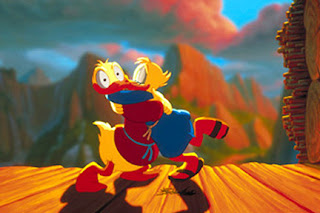
The greatest romance of all time?

My least favorite segments are the ones where unconvincing computer animation is showcased or mixed with classic animation. The grandiose of The Pines of Rome doesn't quite come through with stupid-looking CGI whales flying into heaven. The Tin Soldier segment looks so horrible that I can't even bear to watch it. It's a miracle this was made the same year as Toy Story 2. It also isn't a particularly good idea to recycle The Sorcerer's Apprentice to the new film, as it makes the audience see the difference of the grace and emotion of the classic 40's Disney showcased against some of its modern, soulless incarnations. The final segment – the aforementioned Tree spirit segment – lacks the punch it should have as the finale. All in all, the music played by The Chicago Symphony Orchestra is of course fantastic, but it seems that only half of the animated segments on display here can keep up with it. Perhaps Disney should have been developed this a few years more instead of rushing it to be released at the turn of the millennium.

★★★

Saturday, 14 April 2012

Them's fighting words!

 
Today is my birthday. I'm going to spend the night the best way I know how: at Night Visions Festival, enjoying a full night filled with horror, oddities and hilariously goofy old movies. But I'd also like to spread the cheer. After all, this blog recently topped 50,000 viewers so I figure I owe my loyal readers a treat (feel free to thank me in the comments). I'll take a page from Chris Sims and present several of the rootinest, tootinest, fightinest films known to man! If this doesn't grow hair to your bathing suit area, nothing will. Let's party for our right to fight!

Riki-Oh: The Story of Ricky (Lik Wong, 1991)
Director: Ngai Kai Lam


I like my fight scenes like I like my stake: RAW and with an obscene amount of killings. That is also why probably my favorite splatter film is this gloriously over-the-top Japanese manga-based prison flick. The titular Ricky is certainly a kind of a superhero – of beating people until there's nothing more than a pile of bloody goo! The super-powered youngster is sent to the big house for killing a crime boss responsible for the death of his girlfriend. Ricky always stands up for the down-trodden, the persecuted and the weak, and thus sets out to clean out the corruption and the gangs from the joint. Thus, his chief rivals are the joint's sadistic warden and The Gang of Four, a fearsome crime boss ring, each of which controls one wing of the prison.

Unlike other films listed on this post, Riki-Oh is clearly meant to be funny. But it does it so violently and with such an over-the-top mentality that one can't help but to love it. The film clearly has a comic book sensibility, and it tops the ante with each subsequent action scene. It's even just the right length so that when you feel that you're finally getting tired of the gore, the film ends.

Plenty of Japanese flicks (many made by the company Sushi Typhoon) have tried to imitate its madcap charm, but none have succeeded. It helps a lot that all the gore scenes in this are practical effects as opposed to computer-generated blood. Thus, stomachs get blown open, jaws disengaged, organs fall into meat grinders and heads explode a plenty. There still didn't seem to be enough in the effects budget to make a convincing dummy girlfriend to throw off the roof. And there are also other ridiculous scenes such as Ricky practicing with his sensei by punching through gravestones he's throwing at him. Or the downright nasty scene where Ricky is buried alive. Or, or...


If films like Evil Dead 2 and Braindead are your thing, you owe it to yourself to check Riki-Oh. It should be just as big as a splatter cult classic. It does have friends in high places, though, as director Edgar Wright has admitted loving the film.

★★★★★

Avenging Force (1986)
Director: Sam Firstenberg


American Ninja mastermind Sam Firstenberg reunites with his star Michael Dudikoff for this dumb-as-a-rock action flick. Dudikoff plays the ex-secret service man Matt Hunter (a great character name, by the way), who arrives to New Orleans to help his friend Larry Richards (Steve James) run for governor. But since Richards is both black and a democrat, he's also the target for the secret Nazi Illuminati called The Pentangle. Hunter attempts his best to keep Richards and his family alive from the hit attempts and hides them in his grandfather's farm where he lives with his sister Sarah. But The Pentangle can receive information of their whereabouts with their connections and do a major strike. Hunter soon becomes the hunted, but he's also going to make sure The Pentangle never hurts anyone any more.

The plot mashes it's perfectly serviceable espionage plot to a mind-bogglingly stupid manhunt plot. The Pentangle like to dispose of their victims by hunting them like animals through a large swampland area. The end fights there are what really make the film memorable. Hunter takes care of each Pentangle member in a hand-to-hand combat. The shirtless Dudikoff wrestling with various burly men (one of which is dressed like a gimp) in the mud is astonishingly homoerotic. In particular, Hunter likes to lock his enemies to the ground with his thighs, and penetrate them with a knife or some other phallic object. Each villain also has a orgasmic last gasp that Vernon Wells would see as a bit overdoing it. The film's uneasy sexuality also doesn't end there. Hunter has a bit too much affection to his 10-year-old sister. When The Pentangle's top members kidnap her, they threaten to take her virginity (!). She's later found among transvestite hookers in the red light district. Firstenberg doesn't strain himself much, and gleefully burns likeable characters to death and executes children. The end result is very special 80's cheese, and another evidence that Firstenberg is the man to go to when you want some so-bad-they-are-excellent action films.

The entire film is currently on YouTube, if you want to watch it.

★ or ★★★★★

Undefeatable (Cui hua kuang mo, 1993)
Director: Godfrey Ho


I'm not actually sure where this film is supposed to take place. It's in English, but the film crew is from Hong Kong. The American-seeming setting, however is some warped version of our reality, where every person, man and woman, is a musclebound martial arts expert. From the look of things, as well as the slowness of their thinking, it seems that steroids and other illegal substances seem to be legal in this world, too. And everyone is on drugs, all the time. The mafia, however, organizes illegal street brawls that the police are unable to stop. Kristi (Cynthia Rothrock) turns tricks at these fights to earn money. Hey, it beats being a crack whore.

Unbeknownst to her, Anna, the wife of the notorious underground fighter Stingray (Don Niam) leaves her abusive husband. This drives Stingray mad and into a frenzy. He starts a killing spree of kidnapping any women that come into his path and gouging out their eyes. If any men try to stop him, he beats them to a pulp. When Kristi's sister dies at the hands of this brutal mass murderer, it becomes personal. Kristi joins with detective Nick DiMarco (John Miller) to take down the killer – by any means necessary!

Undefeatable is a parade of hilariously awful acting, worse hair, mind-boggling stupidity and, in a word, insanity. But one can't say that there aren't a couple of nifty fight scenes in this. Hong Kong action director Ho knows how to make his actors do the splits. But he can't tell a story worth shit. In a Hong Kong-set film the context of the film's martial arts fighting would be right at home, but in an American film they feel really odd. It doesn't help (or rather, it does) that the film contains heaps of gore and brutal violence. It's more or less unexplained what makes Stingray so crazy as to kill people with his bear hands, other than misogynism and abandonment issues. Lucky for the viewers, most of the effects are cruddy and thus obscenely violent the murder scenes become quite funny as well.

The end fight of the film isn't the best choreographed in the film, but it is probably the most stupid, and definitely the most brutal. It's precisely because of clips like this why the film has gained new following from YouTube. Just don't spoil yourself if you intend to watch the loony film in its entirety.


★ or ★★★★★

Road House (1989)
Director: Rowdy Herrington


Easily the best-known of this post's films, Road House is a genuine cult classic about bouncers in a very seedy tavern somewhere in the midwest. Their leader, the New Yorker Jack Dalton (who incidentally shares his name with MacGyver's best friend) is played by the late, magnificent Patrick Swayze. And he's the toughest of the tough, cleaning the entire town when he was only assigned to clean up the local tavern The Double Deuce.

Dalton is an expert cooler, advising the other bouncers, and breaks up a number of violent bar fights before the property damage goes over $ 50,000. A lot of the fights are caused by the minions of local kingpin Brad Wesley (also the dearly departed Ben Gazzara), who has financial control over the town. When Dalton also becomes involved by his ex-girlfriend, the town's sexy female doctor "Doc" (Kelly Lynch), Wesley takes a personal vendetta to get rid of the man. But Dalton isn't one to be easily bullied, and as a student of philosophy, his conclusion is pain.

Road House would be memorable even from the odd table-turning of a film about bouncers turning into a modern western, where a stranger cleans up a corrupt city of criminals. The dialogue is deliciously foul-mouthed and the film's humor sexist and rowdy. But what really makes it a classic is Swayze's character. Always the philosopher, he delivers deadpan such incredible one-liners as "Pain don't hurt" or "Nobody ever wins a fight" (Both of which are rules he comes to break during the course of the movie). No wonder, he's been studying philosophy and that sort of shit. nevertheless, for all his zen approach, Dalton is basically just as vengeful and brutal as a Steven Seagal character when pushed too far.

The film is on this list because of the fight between Dalton and Wesley's right-hand man Jimmy (Marshall R. Teague). This is the scene where the film goes completely off the rails (although it had been odd before). First the homoerotic mouth-off, and finally the surprisingly brutal final blow, which would fit a low-budget splatter film better than a Hollywood high-concept movie. It's probably needless to say that this is one of my favorite films of all time.


★★★★★

Gymkata (1985)
Director: Robert Clouse


Last, but definitely not least we have the most Reaganist film ever created, and also one of the most awesomely 80's films. Someone had the bright idea to turn the Olympic gymnast Kurt Thomas into an action hero, and thus the film sends him out to fight for truth, justice and the American way.

In what has got to be one of the stupidest film plots ever written, the US secret service contacts Olympic medalist Jonathan Cabot (Thomas), because they need to set up a Star Wars -space programme weapons satellite in the eastern European nation of Parmistan. The way Cabot could handle this is to win the age old The Game, in which the Parmistans compete against a flock of ninjas. Whoever wins, gets one wish granted by the King of Parmistan. The only problem is that no-one has survived The Game alive in 400 years. So, Cabot goes through a frivolous training to win. During the course, he falls in love with his martial arts instructor, the princess of Parmistan, Rubali (Tetchie Agbayani).

Needless to say, the satellite plot is dropped pretty soon, and the film mostly concerns Cabot trying to survive in the hostile country. There just being an American is enough of a reason for everyone to try to kill him, whether part of The Game or not. Fortunately, his gymnast skills combined with the martial arts training prove to be so deadly, he can beat down huge crowds of people (some of which fall down without even being touched by him). The Parmistanian architecture favors elements on the streets that could as easily be used as gymnastic equipment. But he needs them, since The Game is even more deadly then the Hunger Games, and mostly involves ninjas shooting people running away with arrows.

The hilariously awful fight scenes are not even the stupidest thing of the film. The film is astonishingly racist, seeing as European countries still being in the Medieval times. Save for the country's princess, every single Parmistanian is a hideous old crone or old peasant without teeth, and frivolously hating America. Which is why it is hilarious that Cabot decides to wear his Stars 'n Stripes-coloured sweater when walking through the country's streets. Cabot also doesn't care much whether he accidentally beats some innocent people when taking care of his pursuers. Or some too touchy old women. Stupidly, the film also comes up with the idea of Cabot's father being missing while taking part of The Game in the middle of the film. He appears unharmed and almost unexplained and dies almost instantly by taking a few arrows in the back. This insanity is truly brain-meltingly strange. The film should be watched for the extended scene where Cabot wanders across a misty town, where every inhabitant seems to come out to laugh at him from the windows. Which is followed by this gem:


★ or ★★★★★

LinkWithin

Related Posts Plugin for WordPress, Blogger...