Showing posts with label rock n roll. Show all posts

Saturday, 22 February 2020

Three laughs: Miami Connection


It is hard to rate some trashy films. Films can be really good entertainment in spite of themselves, and it is an even better pleasure to find some trash that keeps surprising you than watching most "quality" films. My friend says that he knows a trash film is worth something if it gets three laughs out of me. I mean proper, good belly laughs when you just can't believe what the film is showing to you, scene after scene. That's as good a rating as any for these movies. Any film that has these three laughs has a special place in my heart.

Miami Connection (1987)
Director: Park Woo-sang

Lost for decades, the cheap 80's VHS movie Miami Connection was the first real gem discovered by the Alamo Drafthouse Cinema and restored for an audience hungry for some prime cheese and turkey action. Miami Connection mashes together a story of a teen rock band and a crime thriller about about drug-dealing ninjas. It's exactly as bonkers as it sounds. But really, the film is funniest when attempting to be "just another movie". Everyone on screen is extremely awkward, their lines don't sound like anything anyone has actually said in real life, and the basically very clichéd plot becomes more and more bizarre the more elements are thrown into the pot.

The star and producer Y.K. Kim later became some sort of inspirational speaker, and it can perhaps be seen from his script, since such wisdoms are seen in the film such as "Only through the elimination of violence can we achieve world peace". As an actor, he's something to see. It's a bit cheap to make fun of his thick accent, but it is really hard to understand what he's saying, even when it's over-the-top action movie clichés such as "You don't scare me at all. Goodbye!"

Three laughs (SPOILERS):

1. A lot of the film's fun hangs on how cheesily 80's the entire thing is. So I hope you like mullets, synth-music and godawful clothing. The biggest laugh comes from the great reveal of all of this - after a fight scene where a gang of ninjas have killed some drug dealers and split the loot we see the band Dragon Sound in all their glory. Playing shirtlessly their hit song "Friends Forever" at a smoky, blue-tinted club to some really white-bread audience having trouble clapping along.

2. It's always hilarious when Kim is showing off his tae kwon do skills with ridiculous Bruce Lee -poses and grunts. My favorite is the practice scene where he takes his friends to school by showing a fist to Jack's mouth and humiliating John by grabbing his nose by his toes.

3. The real star of the film is Maurice Smith's keyboard player Jim, who has the most soap opera -like arc which sees him being teased of sending out some mysterious letters. It turns out he's just trying to find his father, probably by mailing to every candidate he can think of. When he finally finds him, he lets out an incredible high-pitched yelp. But alas, fate has a real ironic twist in mind for him, which motivates the surprisingly brutal final fight, which sees Kim brandishing a machete, among other things. Against the Ninja!

Thursday, 15 November 2012

HIFF2012: On the Side of the Angels


 It's about time I finished off this year's reporting on the Love & Anarchy Festival. It was swell and all, but I've got other festivals to write about too. On this last look at the festival's films, I've selected several feel-good films, all of them about underdogs of sorts who strive to enjoy their lives and to greatness by doing whatever it is they love. Kind of a good life lesson, and one that encapsulates Love & Anarchy within it. So, until next year, Helsinki International Film Festival!

The Angels' Share (UK/France/Belgium/Italy)
Director: Ken Loach


The acclaimed director Ken Loach tries out a more comedic approach to his latest film. Make no mistake, it is still about the hardships of lowe-class Scots in a society that can't really fit them anywhere. The ensuing adventure or heist may not be very believable, but the film lives and dies by its cast of characters.

The young Robbie (Paul Brannigan) tries to walk the line, leaving his brawling past behind him to become a good husband and a father to his girlfriend Leonie (Siobham Reilly) and his newborn son. But he has problems with both an old family enemy and Leonie's father, who both attack him constantly. Robbie, along with a group of other minor offenders, are given community service renovating a house. During the job they start to bond with each other and their supervisor Harry (John Henshaw). Harry may be the only authority figure to treat these people with any sort of respect.


The film shifts gear when Harry takes the crew to a whisky tasting, where Robbie learns of a highly expensive old whisky being auctioned soon. A caper to earn money to get out of his rat race of a life starts to form in his life. As funny it is to follow the story, it relies in a few too many happy coincidences. One of them is Robbie's almost supernatural born gift of tasting various whiskys.


But as said, the film is as good as its characters, and the cast here is quite well-rounded with memorable characters and good actors. Stealing scenes is the dumb-as-a-bag-of-hammers Albert (Gary Maitland). Loach himself may have figured this out, too, since he gives him all the funniest lines, and even the opening scene of the movie. In that Albert is too dumb to realize he's being asked to move from railroad tracks due to an upcoming train. Such is the problem of many of the individuals on display here. They don't have the capacity to deal with the hostile world around them and consequently they don't realize how self-destructive they are. Only when they figure out a way to pull together and learn to cheat the system for their own ends, does a happy ending arrive (although it's almost sickeningly happy in this case).

Loach is hard-pressed to prove how big a humanist he is, understanding everyone around. The bone-crunching, sickeningly violent fight scenes contarst the happy-go-lucky fairy tale adventure of the rest of the movie, but don't always hit well together. If consequences are real, then the plot hinges on becoming totally unbelievable.

★★★

Gimme the Loot (USA)
Director: Adam Leon


Sold-out screenings sometimes open one's schedule for something else, something totally new. That was the case when I walked totally oblivious to see Adam Leon's independent teen movie about low-class kids hanging out in New York. It's a clever piece of work, selling that it's story is going to be about something in the very beginning when it's more about loitering, hanging around, plotting, and lusting. Really nothing much happens or even advances. Such is life and matched to a good perception of the poorer neighbourhoods in NYC we have a fun, breezy summer flick for the kids. And adults find plenty to enjoy, too.


Malcolm (Ty Hickson) and Sofia (Tashiana Washington) are wannabe graffiti artists who dream of gaining massive street respect, and to get back to their rivals who cover all their best work. They aim to achieve this by bombing the NY Mets Apple, a mascot that is raised every time there's a home run on a baseball game. No one has previously succeeded in this, and Malcolm and Sofia would need some money to successfully complete the job. Malcolm plans to do this by wooing a rich, idle teenager Ginnie (Zoë Lescaze) and stealing money from her parents' apartement.


Leon makes his hard-luck protagonists likeable, even if they are thieving and conning little losers. Such is the might of featuring good bullshitting scenes, and believable street-level transitional scenes. The characters feel real and like they belong to the environment. Leon also has a few brief scenes of underground parties and graffiti-making but these are by no means emphasized and are just there to give a better idea of the life the main characters are living.


The downside of the film is that it features very little in particular in terms of content, so the viewers thoughts about this are in the end kind of a breeze. But the film helps one pass the time until the next screening in a very pleasurable way. You feel as if you had just spent some time with some good friends.

★★★ 1/2

Corman's World: Exploits of a Hollywood Rebel (USA)
Director: Alex Stapleton


This documentary chronicles the incredible career of a true Hollywood rebel and an individual. Roger Corman has shaped so much of how movies have developed from the 50's to the 70's that it's almost impossible to overestimate his influence on American Movie industry in general. He's most beloved by people such as me, who enjoy schlock and exploitation, the films that tend to our most primal needs. But he has also funded and given a much-needed film-school in action to a number of auteurs so large, it's pointless to list them all here. Plus, Corman's own directions, such as his delightfully far-fetched adaptations of Edgar Allan Poe's novellas, are quite good in themselves.

We also get to see Corman on the set of his latest movie, going straight-to-DVD or worse, to be a SyFy channel original. It's another cheapo killer crocodile movie, featuring babes, carnage and rubber beasts just like in the good old days. Old clips make even the most tedious films of Corman's back catalogue seem exciting.


The biggest problem with the documentary is that Corman is such a larger-than-life character with such an amazing career full of twists and turns that it's almost impossible to fit it all comfrotably into 100 minutes. As such, it skips over lengthy creative periods I would've enjoyed hearing a lot more about. This project would have worked better as a television series than just a short biopic.

The strength of the film is that Corman is a very rare breed of person in Hollywood, in that you can say whatever's on your mind about him. He won't sue or even mind, because most of the stories are true anyway, and at the core he's always had a big heart. A large cast of Hollywood's whos-who has participated, including Joe Dante, Martin Scorsese, Pam Grier, Eli Roth and Robert De Niro. Bonus points for leaving motor-mouthed walking film encyclopedia Quentin Tarantino merely to a cameo role as Corman's Oscar presenter. There's plenty of story available here otherwise, as the end credits featuring a large list of interviewees cut out for time, prove.


Jack Nicholson is the most fun interviewee on display here. Thinking about his past with Corman he in turn is laughing, bitching, giving a "fuck you" or two to Roger and seemingly seething with joy over the good old days of youth, drugs and innovative filmmaking. Most surprisingly, he starts crying spontaneously. It doesn't feel staged, and wisely Stapleton directing won't linger or underline the importance of the scene. It really seems like the old actor is moved to tears while thinking about his old friend and mentor.

★★★ 1/2

Shut Up and Play the Hits (UK)
Directors: Will Lovelace, Dylan Southern


Somehow a major portion of rock documentaries these days seem to deal with midlife crises of rock stars. Case in point is the film chronicling the final concert of LCD Soundsystem, the electronic project by James Murphy. The film leaves it unclear as to why Murphy has suddenly grown tired of his stardom, but hints its all due other problems concerning him feeling himself too old to be in the middle of a scene or an idol to millions of hipsters (or, granted, fans of good music in general). And leaving his popular band behind doesn't seem like a solution to these problems anyway.


While a lot of the first act of the film deals on the identity crisis the recluctant rock star Murphy lives with, the real meat of the film is of course on the high-def concert footage of the band's final show in Madison Square Garden. It takes strangely long to get that far, given that the film opens on the day after, seeing Murphy going through mundane everyday things just like any one of us. But when we finally get the flashback of the night before, he's an angel, singing from all his heart and more perfectly than ever. The music doesn't feel melancholic, mechanic or forced, but as one big happy jam, created only through a close collaboration with a big band filled with talented musicians.


While shooting the gig, cameras swoop and swoosh, showing both incredibly close footage of Murphy and his minstrels playing, and the grandiose hall filled with an audience and drowning in light, confetti and the overwhelming emotions. The selection of muisc is a good one, emphasizing songs from the band's best album Sound of Silver.


So with a grandiose ending that leaves a good taste on everyone's mouth, and perhaps a tear or two, it was more than fitting to close this festival. Good show. Very good.

★★★★

Wednesday, 10 October 2012

Rock 'N Roll Party Monsters


Movie monsters usually represent the raging id fighting the boring mainstream middle-class values. Thus, they tend to get to have all the fun. Monsters are often sexual creatures, and thus also know how to party. In the hedonistic 70's this was over-emphasized as the growing affection and gentle lampoon of the monster-movies of yester-years grew. That's why the flamboyant, colorful new breed of movie monsters were a clear sexual threat as well as unreliable beings capable of destruction and murder.

Also this was the time when rock music adapted horror movie imagery. It was a clear step beyond the limits of mainstream boundaries, as rock was deemed dark, forbidden and dangerous at the time. It soon was also clear that new monster movies had to adapt rock music vice versa. The combination of the might brought out some very unexpected monsters, sensual and threatening in the very sense of the word. The combining of powers also allowed for some quite vivid and formerly tabu sensual desires to have a new form. It was no wonder several of these rock musicals became beloved cult classics.

Rocky Horror Picture Show (1975)
Director: Jim Sharman


Based on Richard O'Brien's famed stage play, RHPS is a cult film like no other. The devotion the film's fans have over it is almost fanatic and goes way past just knowing the lines and songs of the movie by heart and chanting them aloud. Screening RHPS with the right audience is a pre-packaged party in itself. There are plenty of rules and ways to experience the ultimate Rocky viewing party, but one just can't sit still at one's seat. Much like the maniac mansion it features, the movie has long since left the realm of being "just a movie".


Brad (Barry Boswick) and Janet (Susan Sarandon) are a bland, white-bread couple who decide to get hitched. They rush off to announce the news to their friend Dr. Scott, whose science exhibit was once the place where they found each other. But driving on a dark night in a dreadful storm, they get lost and must take shelter on a nearby castle. The odd servants Riff-Raff (Richard O'Brien) and Magenta (Patricia Quinn) allow them in but reveal that the castle is hosting a party for oddball Transylvanians. When the Time Warp dance is on, there's no turning back.


The lord of the manor is Dr. Frank-N-Furter (Tim Curry), a transvestite scientist on the verge of creating a new boy toy for him, Rocky (Peter Hinwood). But Frank's sexual appetite is not that easily satisfied, and during the night he manages to seduce both Brad and Janet separately. While Brad tries to still keep up appearances, the experience is a true eye-opener for Janet who has her own sexual revolution. But this may all be playing into the bigger plans of Frank-N-Furter.


As a film, RHPS is actually is nothing very innovative and at times, it shows its stage-bound origins. It's more a cavalcade of macabre style than a coherent movie. But the film has several other things going for it that have clearly fed its cult status. The movie's humour is silly, fast and surprising, often relying on quick-witted dialogue. It seems to have been heavily influenced by the films of the Marx brothers. The simple staging, which often has only a few colors (most often red) as a leading theme, is a big part of the draw. But the biggest asset of the film is its magnificent cast which inhabits their strange roles perfectly, and have their inner workings pinned to even the smallest gesture. It's sad most of them were more or less typecast after this.


What starts out as a parody of cheesy old-time sci-fi/horror films, becomes a fetishist fantasy, and furthermore a bizarre burlesque cabaret. Screenwriters/masterminds behind the entire scheme, Richard O'Brien and Jim Sharman blow raspberries in the faces of modesty and chastity. Like the time it was made, the film features as hedonistic events as they come. The message of the film is to enjoy a healthy sexuality (nevermind the gender of your partner) but not to cheat, force or otherwise become "too extreme". This can be also seen as a call-back to the lost ideals of the hippie movement.

★★★★

Labyrinth (1986)
Director: Jim Henson


Okay, bear with me here. This is not a horror movie or even a musical per se, but it does have monsters and musical sequences in it. Plus, if the sex appeal of Tim Curry in tight leather clothes didn't do anything for ya, we have Sexy David Bowie starring in here. Things couldn't get much more sexy, and though at a surface level this is a children's movie, the theme of sexual awakening is pretty obvious here.

I would've written a Twilight joke here, but I bored myself to death thinking about it.

The early-teens Sarah (Jennifer Connelly) feels threatened by the arrival of a new baby boy in her family. Frustrated and furious, she wishes her loudly crying brother would be taken away by goblins. Thanks to the puppetry of Jim Henson and the Goblin King (Sexy David Bowie), this wish soon comes to pass and Sarah realizes it's up to her to travel to a magical land to get the baby back. But the Sexy Goblin King won't allow here to just come and go to his kingdom. He challenges her to clear his labyrinth, and makes sure every turn is filled with perils and temptations. If she can't make it before midnight, the baby shall become a goblin.

One of these guys, not one looking like Sexy David Bowie.
It isn't until long that Sarah has a party of misfit creatures to accompany her on her quest. The film is really creatures galore, and the vivid imagination of Jim Henson is beautifully realized in the sets and visuals otherwise as well. Too bad the puppetry feels a bit cheap at times. Although the supporting characters are pretty much your basic fantasy/fairy tale archetypes, the world created by Henson has a sort of threatening mood, which makes everyone's loyalty is suspect. As one tends to have in fairy tales, victory can only be achieved when one lets go of selfishness and learns to put others' needs before oneself.


But really, the sexual aspect is the more interesting part in this. The Goblin King announces that he's after Sarah's dreams, and is able to invade them as well. The famous ball-room scene features Connelly staring slack-jawed at smart-dressed Sexy Bowie at his most charming and handsome. The dance the two do is unnervingly alluring, but luckily Henson has good taste and we won't have to see Bowster get his mack on with a 14-year-old. I bet his performance here helped a lot of pre-teen girls reach puberty back in the day. In the end Sarah chooses to party with various-sized goblins, which does feel like an unbelievably perverted choice, particularly when put together with lines such "I learned that I really need you."

Oh, but does Sexy David Bowie sing? Sure.


★★★

Phantom of the Paradise (1974)
Director: Brian DePalma


When looking for the most colorful, inventive and crazy monster musical, one doesn't need to look further than Brian DePalma's ingenious effort. It just may be the auteur's best movie. Mixing classic gothic horror fiction such as The Phantom of the Opera, Frankenstein, Faust, Paradise Lost and The Portrait of Dorian Gray laced with popular glam rock music, satire and the director's own angers with authority and big businesses while also adding a good dose of pure silliness. With these ingredients DePalma was able to create a film so vivid it's hard to digest with one viewing. But it really makes subsequent screenings all the more rewarding and the film just seems to get better and better with time.


Warning, this clip spoils. But rush off to see the movie, I'll wait.

The movies main monster isn't the Phantom but Swan (Paul Williams), the leading record producer in the business and a worshipped musician. He's been on the top of his game for a long time, yet he harbors a terrible secret to his success. He is also a hedonistic asshole, who lives from other people's hopes and dreams yet finds it amusing to crush them. He also invites young girls to his mansion to audition, only to give them to his second-in-command, Philbin (George Memmoli) for sex.

What he lacks in outer sexiness, Paul Williams makes up with a sleazy performance and some magnificent songwriting.

When looking for some new music for the opening of his new rock club, the Paradise, he steals the music of a young aw-shucks musician Winslow (William Finley). The skilled young composer and piano player is a true artistic soul, but timid, shy and adamant to not let everyone else play his music other than himself.


But Swan cruelly cheats Winslow out of his own copyright. When the young artist comes to demand his share, Swan has him imprisoned. A desperate rush for freedom and his rights at Swan's record-pressing plant leaves Winslow scarred, mute and as good as dead. But he manages to rise up and get himself the gear to hide in the back stages of the Palace. There he will fight against the misuse of his music as The Phantom. But Swan is a devious person, and he may find a way to tame even the raging Phantom. A key figure is the beautiful young singer Phoenix (Jessica Harper), whom The Phantom believes is the only one with a voice beautiful enough to sing his greatest work; the rock opera Faust.


DePalma plays a lot with his main themes of voyeurism and the other side of it, reliving life through various medias. The source of Swan's evil is found on the fact that he records everything around him. Swan  He likes to replay the tapes of himself and finds satisfaction mostly from the time he mistreats hopeful young people. The bitter image the film gives on the music industry, which devours its innovators, is quite clearly also something young DePalma felt was evident in the way major studios dealt with oddball young directors.

The film is at times hilariously funny, at times edge-of-your seat exciting and at times heart-breakingly sad. The scene featuring the love-struck Phantom watching through roof window as Swan seduces Phoenix and his cries in the rain and thunder are truly the mark of a tragic monster.


The film something very unique, the only thing even close to this film's mixture of colorful sets, music, the speed and the overflow of unordinary visual ideas, are the rock musicals of Ken Russell. Although Russell liked to have fun as well and throw bizarre visual images into the mix, he never really seemed to have so much substance within the movie as DePalma has. And Brian's script is funny as hell to boot. The scene-stealing flamboyant rock star Beef (Gerrit Graham) and his narcissist, cowardly ways are a laugh riot every time he's on the screen. DePalma had a good eye on what was going on in the world of rock at that time, since glam and stadium rock would only get more ridiculous from there on.

Here's the Beef!

The movie is worth seeing just for DePalma's incredible homage to A Touch of Evil, with a long take from two different perspectives follows a bomb being planted and blowing up a car. It also has the evil version of The Beach Boys called The Beach Bums, who get blown to smithereens. Genius.

★★★★★

Thursday, 24 May 2012

In The Year 2000


Welcome back! The world of movies is moving so fast currently that it's hard to keep on top of things. That's why I figured that right now its time to look....into the future!
"The future, Paavo?"
Yes that's right (enter guest's name here)! Its time to look all the way... to the year 2000! Even the ancient Mayans prophecized that the year 2000 would be the time in which the world comes to an end. Undoubtedly this is why 2000 has inspired so many filmmakers unleashing various visions of dystopian futures upon us. We should be fearful when looking forward to 2000. Surely, the nuclear war between the United States and Soviet Union will become before that futuristic year.

Joking aside, not just cheesy 70's and 80's sci-fi flicks have taken the number 2000 to imply futurism. When the year 2000 actually was upon us, a number of sequels also put two extra zeroes to basically say that this is not your dad's Blues Brothers or something to a similar effect. This kind of market-oriented thinking usually tells what you should expect the film's quality to be. 

Heavy Metal 2000 (2000)
Director: Michael Coldeway, Michel Lemire


The sequel to the classic 1980's adult cartoon anthology takes a different route from it's predecessor and features only a single, long story. It is based on a graphic novel by Teenage Mutant Ninja Turtles co-creator Kevin Eastman, made with Simon Bisley and Eric Talbot. But in effect, it is one of those sequels that pretty much misses the point of the original movie altogether and just makes a broad-stroked caricature of it as a result. Heavy Metal 2000 is crass, loud, obnoxious, dumb and clichéd.

An ancient, evil force that manifests itself as a glowing green object (that's different in every way from the one in the previous movie), takes over a nasty space pirate/miner named, um, Tyler. As a result, Tyler goes power-mad, kills his co-worker for no reason, and attempts to seek out the secret of immortality. For some reason he stumbles upon a planet called Eden and kills everyone. Well, not everyone as he kidnaps the beautiful young Kerrie, as he believes her blood will somehow help him discover some secrets of immortality. But Kerrie's older sister, the fierce warrior Julie isn't too happy that her home planet has been freshly labeled F.A.K.K.2 (Federation-Assigned Ketogenic Killzone) and starts to pursue Tyler and attempts to find out a way to kill him. Those retarded acronyms are a source of the film's retarded sense of humor, although otherwise it is all played overtly serious. But still not serious enough for it to be funny.

Gone are the beautiful, stylized, and differing animation styles from the first Heavy Metal. In the sequel, the animation looks like a bastardized version of Titan A.E. Particularly the film's computer effects are horrendous, and the long space scenes showcasing them are dreadfully boring. They are balanced by scenes of carnage or Julie showing her boobs for no good reason. The film doesn't deliver on the second half of its name, either. All the cool 80's rock from the previous film has been switched to dreadful turn-of-the-millennium nu-metal. When the soundtrack's high point is the Billy Idol track from the end credits, you know you're in trouble. As a matter of fact, when your voice cast's most famous member is Billy Idol, you're also in a a lot of trouble. If ever there was a film for dumb assholes who only care about tuning cars and getting laid, I'd rather they watched this abomination than the original Heavy Metal.

★1/2

Holocaust 2000 (1977)
Director: Alberto DeMartino


Satanic horror films were all the rage in the 70's, and of course cheapo Italian producers decided they wanted their slice of the cake. Thus, they hired the acclaimed screenwriter Sergio Donati and director Alberto Martino to basically rip off The Omen, which had premiered the previous year. The resulting film is a sort of mirror of it's time, threatening us with the loss of tradition in order to earn money, and the risks of nuclear power.

Kirk Douglas stars as the construction magnate Robert Caine, who's on the verge of the deal of his life when he makes a deal to build a nuclear power plant in the Middle East. From the constructs he discovers some ancient ruins and writings about someone called "Iesus", but he doesn't pay much attention. But he then starts to get haunted by Doomsday prophets, mysterious ill-meaning bearded men, bad omens and horrifying dreams. When he sees in his dream that his power plant is actually the seven-headed Beast of the Apocalypse he realizes what's going on. His son Angel (Simon Ward) is actually the Antichrist, trying to bring out Armageddon using his plant. And Robert's pregnant lover Eva (Virginia McKenna) and his wife Sara (Agostina Belli) also play major parts in this plan.

Despite some delirious imagery, the film doesn't really pick up steam enough to be very interesting. Some odd madhouse scenes aside, this isn't even outrageous enough to be a good camp movie. Violence comes as some friends of Caine get killed while trying to figure out Angel's plans or stopping them. Their demises are quite familiar for those having seen The Omen. Even the presence of Douglas doesn't help too much, as he seems to be on auto-pilot and his only expression seems to be worry. He does burst into violent rage in a couple of key scenes that are welcome change to the boredom of him being undecided on what to do next. A rich tycoon is also not a very good movie protagonist, even if he is flawed and sinful, as he's hard to sympathize with. All in all, I figure these sort of films work better in Catholic countries, where people are scared with the wages of sins and the upcoming Apocalypse and Hell for all their lives. There's not much to get worked up in it here in liberal protestant Finland. Other than the possibility that a nuclear power plant might go off, but since the government didn't understand that from Fukushima, it wouldn't get it by watching this, either.

★★

Escape 2000 a.k.a. Turkey Shoot (1982)
Director: Brian Trenchard-Smith


I have a soft spot for films where hunters chase after the Most Dangerous Gama – man. This Australian schlock classic offers that and much, much more. In Ozploitation movies, anything truly goes, and so the film doesn't mind cheerfully drawing parallels to the Holocaust and stealing good bits from the likes of A Clockwork Orange, Logan's Run or The Man With The Golden Gun.
The film also throws some completely bonkers ideas to the mix, such as a sadistic mute Wolfman joining the hunt without much further explanation.

The film is set in the post-apocalyptic future, where a dystopian government clears up all members of resistance, advocates of free speech and other deviants to prison camps. They are told they are there for re-education and behavior modification, when in fact they are there to fill the sadistic urges in the camp staff (and the audience). The camp is run by the laconic Charles Thatcher (Michael Ritter) and his main underling Ritter (Roger Ward), who isn't afraid to get his hands dirty. But since prisoners flow into their camp faster than they can be whipped to death, Thatcher has an idea to organize a game to get rid of some extra prisoners who are becoming a nuisance. Thus, he gathers high-ranking government officials (and their pets) and sets few key prisoners into the woods. The hunt can begin.

I think this poster depicts much better of what's going on in the film than the faux-futuristic Escape 2000 one.
For a film using real prison camp footage in its opening credits, Turkey Shoot is decidedly cartoonish. The film has colorful imagery and frankly the violence seems quite stylized. For a film that's supposedly very low-budget exploitation, it actually looks quite impressive. Particularly the explosive ending wouldn't be too out of place from a Roger Moore Bond film. Sadly, the British director Brian Trenchard-Smith didn't share his contemporary Ozploitation directors George Miller's or Russel Mulcahy's career developments and didn't get any major Hollywood work after this one. Instead, he has since directed more exploitation, such as BMX Bandits, Dead-End Drive-In and two sequels to Leprechaun. But if you've never known that you wanted to see a circus freak squished against a tree trunk by a dune buggy before now, this is your film.

★★★★

Equalizer 2000 a.k.a. Defender 2000 (1988)
Director: Cirio H. Santiago


I'll say it straight away: The Equalizer 2000 is one of the most infantile films I've ever seen. Seriously, this thing makes the likes of G.I. Joe – The Rise of Cobra look like a high-brow study of the ills of modern warfare and it's effects on the psyche of soldiers. But being childish is not necessarily a bad thing. Basically, this is a post-apocalyptic barbarian flick that's 80 minutes of one big sandbox action figure battle.

The plot revolves around two fighting teams – The men of the evil Military Government, and the Rebels fighting for their freedom from tyranny (of course). You can tell the bad guys from their Nazi-like armored uniforms, whereas most good guys wear surplus western movie clothing. As oil has become rarer and rarer the sides mostly fight over gasoline. Some oil fields in the scorching desert are valuable to both and that's why the major battles are settled there. While fighting, huge showers of bullets are fired, but with anything particular very rarely being hit. So much for the shooting skills of the Army of Tomorrow. To help the rebels actually hit their enemies, a B.F.G. named Equalizer 2000 is built by a gunsmith. The weapon is basically what Tony Montana carried, an oversized assault rifle that can also shoot rockets. The protagonist Slade (Richard Norton) is a leather vest, a beard and a mullet-donning stranger, a true western archetype of a neutral who gets tangled in with the action, but brings order to untamed areas. Norton seems to attempt to channel Clint Eastwood, but can't even reach Brian Botswick's levels. For the ladies, there's a lengthy scene where he sharpens blades without his shirt on. He's also skillful enough to manage to avoid getting shot by machine guns by doing little skips on desert rocks.

The film's budget is so low, they couldn't even buy convincing paint to put over all the plastic, tin plate and plywood. The toy guns are quite cute, particularly the bazookas that go "Ploomp!" There's some car chasing, torture scenes and of course, lots and lots of desert battles. Nothing seems to matter that much, since the audience couldn't give a rat's ass which team will win. But if you only love the action and explosions in action movies, and too much talking and plot development makes you drowsy, this is basically porn for you.

★★ 1/2

Fantasia 2000 (1999)
Directors: Don Hahn, Pixote Hunt, Hendel Butoy, Eric Goldberg, James Algar, Francis Gebas, Paul & Gaëtan Brizzi


At the turn of the millennium there was actually at least one interesting 2000-movie project which had the ingredients to be much more than just a cheap cash-in. When Walt Disney envisioned the classical music animation Fantasia back in the early 1940's, he figured that the film could have segments removed and added every couple of years to give the movie-goers different sort of animated concerts. This ambitious idea was thwarted by Fantasia being an expensive flop when it was first released, and the Disney company struggling to recover from it for a decade. 50 years later, Disney's nephew Roy Disney had also dreamed about completing this plan for a long time. The step to create an artistically ambitious film among the animated films of the late 90's (which were still kind of decent with Mulan and Tarzan) was to him to be the crowning achievement of his career. Of course, the younger Disney eventually also had a flop in his hands, and Disney's animations sunk to depths it still haven't quite recovered from (Altough John Lasseter has helped to take a turn for the better. Hopefully Wreck-A Ralph will remedy the situation further).

But to get to the film itself, it is quite a mixed bag. As a whole, it is at least easier to watch from beginning to end than it's predecessor. The running time of 75 minutes is suitably short and there are fewer abstract animations. However, the film does have a weird fundamentalist Christian vibe, as at least three segments seem to be about Rapture. Compare this to the original which had pagan gods, mythological creatures, dinosaurs and demons – but ended with people walking to church with Ave Maria. It seems Disney in the 1940's was more open with various views of the world. 2000 has a forest spirit in the end, but it seems like something that writers came up with rather than an actual legend.

Show me people worshiping this and I'll show you Disney shareholders.

Also unconvincing is to have celebrities hosting the segments. I hate the modern Steve Martin and his horrible attempts at being funny make me in a such a bad mood I wouldn't want to watch anything he's trying to sell. The film does attempt to do its segments in very different animation styles, and at points it does show the majesticity of classic hand-drawn animation at the edge of its demise. The best segment is the one featuring George Gerswin's Rhapsody in Blue. The kind of 1930's newspaper-cartoon inspired style with splashes of primary colors depicting various depression-era New Yorkers going about their business is the sort of unbiased work the whole sequel should have been full of. Also fun is Camille Saint-Saëns's The Carnival of the Animals, which channels classic Looney Tunes with it's fast pace and gags aplenty. And Donald Duck's Pomp And Circumstance manages to mix the epicness of the tale of Noah's Ark convincingly with Donald's slapstick antics. I also got weirdly emotional at the end when Donald is reunited with Daisy.
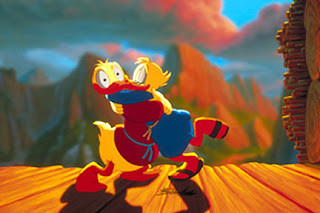
The greatest romance of all time?

My least favorite segments are the ones where unconvincing computer animation is showcased or mixed with classic animation. The grandiose of The Pines of Rome doesn't quite come through with stupid-looking CGI whales flying into heaven. The Tin Soldier segment looks so horrible that I can't even bear to watch it. It's a miracle this was made the same year as Toy Story 2. It also isn't a particularly good idea to recycle The Sorcerer's Apprentice to the new film, as it makes the audience see the difference of the grace and emotion of the classic 40's Disney showcased against some of its modern, soulless incarnations. The final segment – the aforementioned Tree spirit segment – lacks the punch it should have as the finale. All in all, the music played by The Chicago Symphony Orchestra is of course fantastic, but it seems that only half of the animated segments on display here can keep up with it. Perhaps Disney should have been developed this a few years more instead of rushing it to be released at the turn of the millennium.

★★★

Wednesday, 4 April 2012

Finnish Cult Movies, part I


Today is the Finnish premiere day of the eagerly awaited Finnish science fiction epic, Iron Sky. Although the film didn't really work for me, it has produced enough enthusiastic buzz that I'm convinced we are witnessing either a major break through hit for the film industry in this country, or at the very least, the birth of an international cult hit. But Finland also has a long film history, alongside which many different kinds of films fit, some of which have a cult status among this country, some of which don't yet even though they would deserve it. I for one would love to raise awareness in Finnish cult cinema, so I'll start this series. I had a lot of candidates on which to write about, so rest assured. There's still a lot more to come.

Star Wreck: In The Pirkinning (2005)
Director: Timo Vuorensola


It actually pains me to compare this comedy with some actual movies, but numbers don't lie: 10 million downloads say that currently the most watched Finnish film ever made is this fan-made amateur film. When looked as a movie, it's not very good. But as a home made project it's actually more interesting. The film's special effects are impressive for being made in someone's mom's basement. And like witnessed in Iron Sky on a bigger scale, these tech students from the city of Tampere are some sort of geniuses in selling their unfinished ideas on the Internet and thus raising money, help and extras to help complete the film.

Due to his previous adventures, Captain Pirk of the spaceship C.C.P. Potkustartti (Samuli Torssonen) is stranded in the 21st century with his crew. Times are desperate since he can't even get laid. But Pirk comes up with a plan to invent the tools they need to get back home, and alter history. When they get back, Pirk is the unquestioned Emperor of the Earth. But once Pirk has conquered the planet, he gets greedy and sets his eyes on more. This leads to a war-declaration on the space fleet led by the ship Babylon 13.

As sci-fi nerds can guess, film's plot exists to put together space fights between star ships from Star Trek and Babylon 5. But like the bad parody makers the film's four writers are, they base their creations around original characters and concepts too tightly. For a viewer not familiar with Star Trek: The Next Generation or Babylon 5, the function of characters and settings taken for granted are left in the dark. There's a huge cast of characters, and only Pirk (Samuli Torssonen) and Babylon 13 Captain Sherrypie (Atte Joutsen) get any serious screentime nor arcs. The film would benefit from a better central character besides the all-around hateable and annoying Pirk. And of course, since the film stars mostly amateurs and crew members and their close relatives, the acting is, simply put, atrocious.

There are a couple of chuckle-worthy gags in this film, that mostly involve shooting someone with a ray gun. But I wouldn't recommend sitting through the film just to see those few bits. In fact, I find it nothing short of a miracle that someone outside Finland would find any interest in the film. The film is strictly for the hardcore tech-nerds and sci-fi overdosers.

-

Ruusujen aika (1969)
Director: Risto Jarva


Iron Sky and Star Wreck are not by far the only sci-fi movies ever produced in Finland. And not the best, either. Director Risto Jarva tried his hands on doing a prediction about the future already in the 1960's, and he set his film about 50 years from then, to 2012. The film starts out as a what if-scenario, but turns more and more interesting as it goes along. Jarva was interested in the media philosophies of Marshall McLuhan, and thus made a film that wouldn't look too much out of place in David Cronenberg's filmography.

Unlike many other futuristic films at the time, Jarva pictures the future as democratic. Or at least claiming to be democratic when in fact what you can do measures who you are in the society. Historian and documentary maker Raimo Lappalainen (Arto Tuominen) is at the top of his game. After producing a number of highly acclaimed films about the past, he aims to recreate the history of a time period 50 years before. He figures the bast way to accomplish this is to tell a story of a contemporary individual, and chooses Saara, a young woman who died tragically. He picks the beautiful young athlete Kisse Haavisto (Ritva Vepsä) to play her, and starts to go through her life events with her in real life. The director also develops a relationship with his starlet, which may jeopardize the whole project.

The film has some bitter comments about documentarists who claim to be objective observers of their subjects. Raimo thinks he's almost an invisible force behind his work, but in reality his underlying preconceptions, ideas and emotions drive his work. Because he can't come to terms in admitting this, he also acts coldly and matter-of-factly in his life. In other words, the maker gets tangled in the media for which he's producing content, making him and his film inseparable. Borrowing from Hitchcock's Vertigo, his raising obsessions also make him manipulate and transform his loved one into something he truly desires. In this case it's an idea of the past that never existed in the first place.

The film's technology is decidedly 60's, as is the extended "documentary" sequences showing how world developed to this point. Jarva does acknowledge in his work that films about a different time period are always tied to the concepts of the time it was created. But he still had some very apt ideas about the future, which came to pass, such as the importance of information, telecommunication and hand-held devices. Too bad the free sexuality and steamy swinger ball games haven't also made it to our day.

★★★★

Sensuela (1973)
Director: Teuvo Tulio


Think the concept "Nazis on the moon" makes a weird movie? Or "an archeological dig reveals an evil Santa Claus that starts to kidnap children"? Neither of those movies can hold a candle in weirdness for the swan song of the acclaimed melodrama director Teuvo Tulio. The film spent 10 years in the making and thus forced the director into some pretty creative solutions in attempting to hide the fact. The end result is equal parts a travel advertisement to Finland and a skin flick. It is 100% bonkers and mere words can't even describe how much so. If one film from this post would deserve to break big into the hearts of lovers of camp and cult cinema everywhere, it is this.

During World War II, the German pilot Hans (Mauritz Åkerman) crash lands into Lapland. A group of Sami reindeer herders rescue him from the wreck, and the beautiful Laila (Marianne Mardi) nurses him back to health. During the following weeks, Laila begins to develop a crush to Hans, much to the dismay of his strict, old-fashioned father Aslak (Ossi Elstelä). But since the course of the war turns, Hans must soon flee for his life, leaving his helpers behind. After years and years (though no one seems to get a day older), Hans suddenly returns, now as a successful photographer, and persuades Laila to come with him to Helsinki. They run off together, to the anger of Aslak.

In Helsinki it turns out that Hans is living in a world of decadence. He's having odd orgies where swingers dress up as skeletons and jump around. And some sex is being had as well. The maltreated Laila can't handle such a life, and escapes. She falls to the factory worker Pekka (Ismo Saario), but doesn't tell him anything about Hans. But for one poor choice, this natural child has wrecked her entire life and things soon fall apart like dominoes. Aslak will have his brutal vengeance on the one who betrayed the purest of loves – and it's a scene so odd that the viewer's jaw will surely drop to the floor.

Okay, for a list of things hilarious in this film, let's start with the film's minimal budget. It can be seen from oddly minimalistic sets such as an aeroplane's cockpit that looks like a couple of drapes with a chair and a steering wheel in the front. Or from the use of stuffed animals alongside archive footage in the reindeer-herding scenes. Even more odd is the dubbing, which even in Finnish sounds oddly tacked on. Tulio seemingly shot the film silent and had actors dub in lines years later – and not necessarily even the same actors. Even many sound effects and animal sounds are made by people. The music consists of familiar classical pieces by Tchaikovsky and Sibelius, but never quite fitting on what's going on on screen. This makes in particular the love-making scenes oddly uncomfortable because they have a gloomy, rumbling classical score to them. And boy, there is a lot of sex scenes in this. They rarely show anything below the navel, but women's breasts in particular are shown more often than not. For foreign people admiring the nudity, the film has also a lengthy, and frankly useless, scene set in a sauna.

The film can't decide whether it's set in the 40's, 50's, 60's or 70's, and elements of all decades show in the film. To top the illogical plot, the film's editing sometimes intercuts two things that have nothing to do with each other. Thus, for instance, it seems Aslak is looking worriedly at Laila having sex with Hans when the love-making pair should be in Helsinki and Aslak in Lapland. The dialogue is simply hilarious, stating obvious facts and arising odd reactions no real human being would have. The acting is hilariously over-the-top, particularly Elstelä's constantly raging Aslak.

With all these flaws altogether, the film is oddly psychedelic. Tulio doesn't concern himself on minute detail (or would want to hire assistants who would), he just wants to put colorful visions (that are cheap at the same time) on screen. It is a film about the loss of innocence, but since it seems like it was made by people as innocent as not having any idea of what happens in orgies or bordellos, the message is quite underwhelming.

★ or ★★★★★


Young Love (2001)
Director: Arto Lehkamo


There's been a lot of Teen films made in Finland during the last few decades, and with almost all of them rotten. And this is about a case in point. For the fans of hilariously awful, there's this Romance film, that manages to be fundamentalist christian and perversely voyeuristic at the same time.

The 13-year-old Jukka (Joonas Nordman) moves into a new city with his mother. Mummy dearest is having her hands filled with work while at the school Jukka is called names and bullied. But he discovers his father's old camera and becomes interested in photography. The school's gay communist art teacher(!), Martti (Pekka Lukka) helps him become started, teaching him about zooms. And as a 13-year-old is won't to do, Jukka uses his camera's zoom to spy on a girl through his window. This girl is the late-teenaged Johanna (Saija Lentonen), who likes to strip in front of a window and admire herself from the mirror until her stepfather comes home drunk and beats her. One night, Johanna catches Jukka spying on her, immediately figures out where he lives, and comes to the door to demand for him to stop. But Jukka suggests to her to become a model. As this has been her dream, the duo shake hands and Jukka begins as her manager and trusted photographer. They aim to enter her in a Miss Teen pageant, but Jukka also begins to blossom into love with his partner.

For any viewing experience of Young Love, the making-of feature on the DVD of the movie is an essential addition. That clears up a little of the thick fog surrounding the question: what the hell was the director thinking? On the documentary, Lehkamo seems pleased of having snuck in some of his own messages in his film. This is shown in the scenes where the gay Martti is dying (presumably of AIDS) and renounces his wicked communist-homosexual ways and embraces God. This has little to do with the rest of the plot, as do the lingering shots of the teenaged Lentonen stripping. These scenes are lingered on so lovingly and for such a long time that even the most perverted audience members start to feel uncomfortable. Sadly, these few amazingly awful scenes happen in a movie that's mostly just bland and thoroughly mediocre. Lehkamo clearly has no idea about how teenagers talk, act, or what they do, and also on how to attract them to see his film. A music video-like scene with the band Kemopetrol playing in the end didn't cut the cheese and the film flopped quite badly.

Lehkamo himself went into politics after that but was kicked out from the Christian Democrats party for having way too fundamentalist views on politics. Nordman came a stand up comedian when he grew up.

★★ (★ or ★★★★★ with the making of-documentary)

The Hangover (Baksmälla, 1973)
Director: Jörn Donner


Long before The Wolf Pack was first conceived, Finnish culture multitalent Jörn Donner tangled with an idea that starts out similar. But it turns out to be something different altogether, and Donner uses the cheesy set-up to ponder about the nature of relationships, as well as have some t&a on screen (so the film could be sold as Scandinavian erotica), and to have fun with the film he's making. Donner is one of the finest filmmakers in Finland, which is why it's so strange he has had little respect inside or outside of Finland for his films. He's better known for his books, politics, starting the Finnish film archive and for producing some of his friend Ingmar Bergman's more well-received films.

The director plays Leif, as clear as Donner's own alter-ego as all of the characters he plays. Leif is a used car salesman, who wakes up in a weird house after a night of heavy drinking from which he remembers nothing. But looking at his ring finger he soon finds that he's been married to a woman, Lena (Dianne Kjaer). He then walks around her house, trying to remember. Leif discovers another woman sleeping in another room, and finds out he's already cheated on his new wife with her. Leif trying to stay on top of the situation is intercut with the new married couple talking about their former romantic life and disappointments therein.


Baksmälla (1973) UK TRAILER by klubbsuper8

Donner's film takes a very carnevalistic approach to the subject, and it is very funny. The film is filled with things repeating themselves over and over again, mundane and silly alike. For instance, an aeroplane takes off repeatedly, which has little to do with anything. The film's timeline is skewered and anti-linear. In fact, thanks to this it may be the first arthouse film to be watched while having a massive hangover, when one isn't necessarily the most observing. It's hard to call the film a farce, though. Because of the film's tone, it is all the more surprising when it strikes with surprisingly melancholic pieces on loves lost and unrequited. Leif does attempt to build a spine and a pair during the film if only because he doesn't want to hurt his new wife badly again. Hijinks ensue, and popular comedian-singer Vesa-Matti Loiri has a cameo.

★★★★

Laulu (1986)
Directors: Arto af Hällström, Janne Kuusi


A real cult classic is hard to find, and beloved by those few that have seen it. A reason for this can be that the film is different from anything else and thus quite hard to describe. On top, this film seems to be a documentary about Nightlife in Helsinki, framed by the live performances of the band Sielun veljet. But there are also acted sequences such as the actor Kari Väänänen playing a drunk telling random people his views about the facts of life. And there's an interview with a scientist (named Paavo like my name!) who has utopistic views about the future. In fact, the film represents neorealism, a pseudo-documentary that sums up the artistic feelings in Finland in the 80's. The film was a production by Ryhmäteatteri, a theatrical group looking to break boundaries in the early-to-mid-80s. The result is a true underground film.

It's hard to figure out anything to say about Laulu, because it isn't the sort of film that comes to any conclusions. It raises thoughts, but they come from the person viewing them, the makers are not spoon feeding any ideas. The film objectively just shows a series of various things happening at night time, whether entertaining, cultural, or borderline illegal. Even the off cross-cutting or jumping isn't meant to compare these events, it's just to keep the viewer on his or her toes. The impressions come from within the scenes themselves. The music scenes are sweaty and intimate, or in the case of the scene depicting the humor rock band Lapinlahden linnut, oddly contrasting lowbrow humour with it's rich elitist audience. The film mostly concerns little people and little moments in more poor places. The overall mood is quite gloomy and melancholic. Paavo's future scenarios don't seem all that plausible in a city where drunken people brawl and a taxi ride from the East to downtown doesn't reveal any people but only the dark, rain washed streets. This would be an utopia for only Travis Bickle.

★★★ 1/2

NOOOOOOO!

Tuesday, 27 March 2012

Punk on Film

 
This intro should be quick and go to the point like a kick to the balls. The central rules of punk rock state that we need to be LOUD, FAST, RUDE, AND TAKE NO PRISONERS! Gabba Gabba Hey! It's Punk on Film!

Rock 'n' Roll High School (1979)
Director: Allan Arkush


The legendary producer Roger Corman came up with the idea of making money doing a Musical Comedy for teenagers, but initially thought to tap into the Disco craze of the time. Director Allan Arkush, however, had a longer sight and suggested to make a Rock Comedy. The seminal New York Punk band The Ramones were chosen as the leads, not because they were popular, but because they were cheap. But nevertheless, it was a match made in heaven. The brutal, to-the-point and black humour-filled Ramones lyrics fit like a leather jacket on a quickly paced comedy. Like The Ramones themselves, the film gained quite a large cult reputation through the years.

One of the most iconic things about the film is it's hand drawn poster, drawn in the style used in MAD Magazine. There are millions of small details and the overall image of total chaos. It's style would go on to be imitated in billions College comedies including Animal House, but with that one exception, rarely bettered. Arkush's film is also a lot like a movie parody comic on the pages of MAD would be. Jokes come thick and often, there's a lot of stuff going on at the background, and the film is filled with colorful characters. The Ramones themselves can't act worth a penny, but happily they mostly just need to look cool and do their unique, manic performances.

Ramones audience.
The plot involves a new, strict principal Miss Togar (Mary Woronov) taking over Vince Lombardi High School. She believes that at the root of the student's disobedience is their love for loud Rock 'N Roll, and thus begins a crusade to ban the music altogether. This insidious plot includes forbidding any students attending a concert by The Ramones. Ramones' No. 1 fan, the rebellious Riff Randall (P.J. Soles) has other ideas, and sneaks into the concert with her friend Kate Rambeau (Dey Young). She gains the Ramones' attention because she's written a song for them called Rock 'N Roll High School. The star-struck Randall then begins to plot an uprising in the school with the help of her favorite band.

I like very much that most of the film's most visible and capable characters are all women. Soles is a convincing lead, being at the same time cunning, rebellious, a little naïve and cute enough to be lovable. Most of the film's men can't keep up with her, including the hapless Tom Roberts (Vincent Van patten), who would like to get in her pants, although she only has eyes for The Ramones. The scenes between Tom and his suave nerd mentor Eaglebauer (the always-silly Clint Howard) venture dangerously close to common teen comedy areas, yet Arkush as well as the perfect casting manage to keep things interesting. With such a big cast, Arkush (as well as uncredited co-director Joe Dante) manage to build comical, yet believable arcs and have enough focus on each one. With its machine gun fast comedy timing, it's a clear predecessor of the ZAZ comedies such as Airplane! and The Naked Gun. And there's also plenty of rocking scenes, which made the film's soundtrack popular to this day. This film has truly earned its cult reputation.

★★★★ (Film)
★★★★★ (Music)

The Great Rock 'N Roll Swindle (1980)
Director: Julien Temple


Malcolm McLaren managed to put Punk on the map (as well as name the whole phenomena) by discovering The Sex Pistols, the original UK punk rock band. Of course, punk's roots go way back longer than that but still The Pistols' effect on music can't be overemphasized. As The Pistols weren't a natural unit, and McLaren made sure that they hated each other, too, their reign would not last long. But since McLaren loved money, he wanted to put his protegés on film fast. The project was originally to be directed by boobsploitation maestro Russ Meyer. Meyer didn't last long with the quarreling Pistols, and left due to creative differences. The aspiring young documentarist Julien Temple was assigned to pick up the pieces.

The reason I dwell so deep into the process of making this film is because it explains why the result is such a confusing mess. The former title "Who Killed Bambi" (as well as presumably its plot) was scrapped, but the film still features a lengthy sequence where Sid Vicious plays a movie theatre usher singing the title over and over again for no reason. Instead, the film chronicles the history of The Pistols in a way that includes animations, dwarves, revolting peasants, McLaren in a fetish rubber suit and other quite random material. Although it's hard to make heads or tails about the film as a whole, it is undeniable that individual scenes in the film manage to be striking, odd, and way off the viewer's comfort zone. So, in a way, it represents the Pistols' music quite well. But Temple would do better later on with a full-scale documentary The Filth And The Fury.

★★ 1/2 (Film)
★★★★★ (Music)

Rude Boy (1980)
Director: Jack Hazan, David Mingay


Another major UK punk band who opted for the pseudo-documentary route was The Only Band That Matters, The Clash. Rude Boy follows one young punk, played by Ray Gange. He quits his job at a Porno Store when he sees The Clash perform at a small club at London. So he decides to become a roadie for them. Along the way, the band gets bigger, whereas Rude Boy has some ideas that Clash with the views of The Clash members themselves and as he isn't much good for the technical side, either they grow a dislike to him, but still allow him to hang around. The film is framed against some of the events surrounding England from 1977-80, such as the rise of Thatcherism, riots, parades against racism and The Clash's career.


Sadly, for everything the film has going for it, the mostly improvised film is quite boring. Gange's main character doesn't quite manage to captivate the audience in following him, and the grey, slow documentary style fits kitchen sink dramas better than a punk film. Inter-cut within it are various documentary pieces without comments. We would need something as fierce and in-your-face as The Clash was at the peak of their power. Lucky, then for the live performances of the band, which are so good that one can't take one's eyes off them even to blink. It is only a representation what it was like to go to a Clash show at the turn of the 70's and 80's, yet it is still a lot more fun than most actual live performances today. The energy, the enthusiasm, the skill, the message. All is top notch! Luckily, the DVD of the film features the porn-like feature of skipping the plot altogether and watching only The Clash.

★★ (Film)
★★★★★★ (Music)


Urgh! A Music War (1981)
Director: Derek Burbridge


Of course punk didn't stay pure for long and soon developed further into New Wave and various other music genres. The strength of punk was that anyone could do it, even freaks and weirdoes. That's why many punk and New wave bands did make a big deal of their differences and came up with various gimmicks. Also, as The Clash proved, punk and New Wave were extremely adaptive with also other style of music, be it reggae, rockabilly, funk, or even the dreaded disco. This British concert movie features a good cavalcade of various punk-spunned acts. The variety doesn't cover everything, but it gives a good idea of how much difference these bands developed.

The film's bands are being led by The Police, one of the biggest names of that time. Sting's band begins and ends the film with their hit songs. Other bands and artists featured include Oingo Boingo, Echo and the Bunnymen, Klaus Nomi, Joan Jett, Devo, the Gang of Four, 999, X and The Dead Kennedys. The stage acts aren't shot with any special innovation, and mostly take a step back to just feature the bands doing their thing. Not even the concert venues are common to all, since the film has been shot during two months in New York, Paris, London and Los Angeles. Even though the film is quite long, I don't think any viewer will be entirely satisfied with it, wanting to remove some acts and emphasize other styles or bands. But as it is, it's a good period piece of what was happening in music at the start of the 1980's.

★★★

The Punk Syndrome (Kovasikajuttu, 2012)
Directors: Jukka Kärkkäinen, Jani-Petteri Passi


But hey, punk really isn't actually dead yet! Its flame is being kept alive by the last people you would expect, a group of developmentally disabled Finns. But they won't let their disability stop them. The band Name Day, or Pertti Kurikan Nimipäivät to use it's finnish title, consists of four adamant, strong personalities that assume quite familiar band roles. There's the band leader, Pertti, a troubled songwriter who suffers from mood swings. There's the political guitarist, Sami, who campaigns for the Finnish Center Party, and often awakens anger in his band mates. The bass player Kari is the ladies' man, but figures he's done enough fooling around and plans to get hitched with his girlfriend. And the drummer Toni is an awkward young man taking his first steps towards freedom and moving away from his parents' house.

The quartet announces in their songs rebellion of having to live in an institution, fight spirit against the authorities, and also mundane stuff like having a cup of coffee and taking a dump. The documentary follows each of the players in their everyday life and their own problems, and on their first European tour. The film raises some questions about how the society treats the handicapped, but it isn't preachy and doesn't rub the viewer's face with them. One also gets a few good laughs at the silly stuff the punk rockers are up to, such as the race Kari loses when he drops his pants, or when the group gets a little too excited with the strip club windows in Hamburg's Reeperbahn.The groups's chief assistant Janne is left a little to the background, but he's having to deal with four rock stars who each have their own wants and needs, as well as having to deal with becoming a father. But the spotlight is kept promptly on the band, and rightfully so. They are people to easily identify with, to laugh and cry with. The biggest strength of the film is the same as with the band: it feels very real, as opposed to staged. It's a real slice of life with its ups and downs, highs and lows.

★★★★

LinkWithin

Related Posts Plugin for WordPress, Blogger...