Showing posts with label underground. Show all posts

Wednesday, 3 June 2020

Three laughs: Crazy World


It is hard to rate some trashy films. Films can be really good entertainment in spite of the quality of the filmmaking. In fact, it might be even harder to create unique trash that keeps surprising you than most "quality" films with which you know what you are going to get. It certainly is an even better pleasure to watch them. My friend says that he knows a trash film is worth something if it gets three laughs out of me. I mean proper, good belly laughs when you just can't believe what the film is showing to you, scene after scene. That's as good a rating as any for these movies. Any film that has these three laughs has a special place in my heart. 


Three laughs case file #25:
Crazy World (Ani Mulalu? - Crazy World), Uganda 2019
Director: Nabwana I.G.G.

Times are tough and what the world needs now is some mirth and laughter. A gathering of the world's most prestigious film festivals are currently having a streaming festival called We Are One. Most of the festival's programme doesn't exactly capture my fancy, execpt when I noticed that Toronto International Film Festival has presented us a new "supa action" movie straight outta Wakaliwood, Uganda. It was Crazy World Time!

Now, one might need a bit of background of these films. In the poor village of Wakali a group of local filmmakers have taken it to themselves to create movies with what they have. Thus these movies put on screen every villager from small kids to elders, and have some very creative solutions in terms of technics. They never take themselves too seriously, as every movie also includes a VJ, a video joker, making fun of characters and scenes as a running commentary. That's also how one doesn't feel like laughing at people living in the 3rd world, but rather, sharing a joke with some people from a totally different background. It's no wonder Wakaliwood has found fans all over the world.

I'd also like to add that the films keep also getting more inventive and have some clever in-joking as well. The 4th wall is blown up in gags so inspiring, they remind me of the ending of Mel Brooks' Blazing Saddles. The first worldwide sensation was Who Killed Captain Alex?, then came Bad Black and now Crazy World. Each of these movies also touches upon more serious aspects of life in Uganda, including militarization, organized crime and kidnappings. But these ideas are more made fun of and thus also laughed at the poor image Uganda may have in western eyes. It's not hard to fall in love with Wakali with its sense of community and love for filmmaking after viewing these.


Three laughs (SPOILERS)

1. The star of this film is Isaac Newton Kizito, as noted by the VJ, the son of the director. Together with some other small kids they form Wakas Stars United! In the film's plot, they are kidnapped children plotting for their escape from the Tiger Mafia. But this plot is only needed to showcase the kids throwing kung fu kids at gun-toting adults. It is clear they are having the time of their lives.

2. There's an anti-piracy PSA in the middle of the movie. In a radar they notice that someone somewhere is pirating the film, and thus they send out the robotic Piracy Hunter to capture them. After some bloody inserts of Piracy Hunter getting rid of fans out in Canada and Paris, it turns out that the culprit is actually the film's director himself, showing his creation to his family. Piracy Hunter doesn't feel any remorse, though.

3. In one scene a gangster discovers that the big wad of money is only colored from the other side. The VJ gives a memorable one-liner to this: "See kids, adults, too, can be stupid."

Monday, 2 September 2013

Hey, Cartoonist!


Last week saw the 70th birthday of Underground Comix legend Robert Crumb, master of hilarious, perverted, crazy, borderline insane, subtle, life-like and musical comics - using often many of these stylistic choices in the same strip. That's why I thought it would be kind of cool to pay tribute by taking a look at two comic book movies about underground artists - one a documentary, one fictional, that's still a part documentary. Crumb is of course featured in both of them.


I got to say, I'd like to see more underground comic book movies. Let's hope someday the Fabulous Furry Freak Brothers stop motion animation movie Grass Roots will be completed.

Crumb
USA, 1994
Dir. Terry Zwigoff


Terry Zwigoff's extensive R. Crumb doc is held in high esteem, and for a good reason. Not only does it provide insight on the mind of an artist, it also features characters colorful enough that the feel like they would've jumped out of Crumb's own comix. The most interesting ones are Robert's two eccentric brothers, Charles and Maxon, reclusive and tragic figures who resemble some aspects of their brother and his neuroses, but whose life took to entirely different paths. The film is called Crumb and it certainly doesn't just refer to the famous one, but the whole family.


The movie is dedicated to the memory of Charles Crumb, who died prior the release, but is interviewed here. He had immense artistic talent as a young boy, maybe even moreso than his brother. His odd obsessions with Treasure Island are dealt with, as well as his more and more obsessive behavior, which results to his art getting too experimental for its own good. Interviewed here, Charles is a husk of a man, a mama's boy who never managed to become his own man. It's tragic that a promising artist never takes off, and doubly so if it results in bitterness and melancholy for the rest of his life.


The film was not an easy shoot, and took six years to make. Zwigoff had stress about funding, but his friendship with the main character helped to pull him through. It also shows on the screen. R. Crumb himself is also a bit of an introvert, and probably wouldn't have been as open with another director. But here he is frank and honest about his work, process and life in general.

And also that time he posed with women for a porn magazine shoot.

We deal with the most famous R. Crumb comix and characters pretty quickly. The film is driven more by the character, a constantly doodling gawky jazz-fan, who views the modern life and pop culture in general more or less with contempt. Crumb's sex drive is also discussed, and his most controversial works are shown in a new light. Art critics, feminists, peers, fans and journalists discuss their merits, but there's no conclusion. It doesn't feel like a fan film, and I would imagine it to be interesting even to people who don't care that much about comics, underground or not. Go check it out.

★★★★

American Splendor
USA, 2004
Dirs. Shari Springer Berman, Robert Pulcini


Crumb also does collaborations from time to time, and the most famous of these is illustrating the scripts written by his friend, the bitter file clerk Harvey Pekar. His comics always tell about one thing and one thing only: Harvey Pekar. Pekar is a complete contrast to your superheroes or high adventurers of typical comics, as he lives a somewhat mundane life and just does observations and musings on that. He does manage to make good humor out of that, and make his ordeals feel identifiable. The title American Splendor may be ironic, but in some ways, it is also perfectly apt.


Pekar is the furthest from being a sell-out cartoonist this side of Bill Watterson. The film feels like his story, in that it's your regular A-B-C life story. The basics are there, but in addition to that, there are small skits from the pages of the comic, animated sequences, the viewpoint goes over to his nerdy friend Toby for a while, and most confusingly, there are documentary bits with the real-life Harvey Pekar and his wife. These scenes have some retrospective views on the things just shown in the main storyline. Most of the movie Harvey's being played by Paul Giamatti.


The comics in this film are an outlet for the neurotic Giamatti to let off some steam and come to terms with things. A key scene features Harvey and Toby (Judah Friedlander) arguing over the merits of the college comedy Revenge of the Nerds. Do the downtrodden need a story which allows them to be the heroes for one day, even if the movie is by-the-numbers lint? Is the need to identify oneself so strong? (For the record, I like Revenge of the Nerds)


This gives an idea of a chaotic film, but there is weird synchronicity here. The grumpy Pekar just does his thing, bit by bit. That's why he wouldn't want to have a moral on his story, but the film does make one. Even though life may seem boring, chaotic, unobtainable and hard, looking at the long run, all the various patches and places do form some sort of a story. It may not be a grand, adventurous story of making a change or doing something spectacular, but then most of us are everymen. It is interesting to hear about another one once in a while. Particularly if the movie is funny to boot. Which this is.

★★★1/2

Wednesday, 26 September 2012

Finnish Cult Movies II

 
The first ever Finnish Film Affair opened today at Love & Anarchy. At the same time the Finnish Film Week presents festival-goers with Finnish films from the last year or so. I wrote about several of my favorite Finnish cult films a while ago, so since this period seems to be ripe with anticipation for Finnish films, I figure it's about time to do a sequel. This time around, the films circle around the archetypal Finnish males. Usually, they are a silent bunch, like their alcy-hol and are prone to do stupid things and make total fools of themselves by being too shy to say no. I know because I present this type myself.

The Dudesons Movie (Duudsonit elokuva, 2006)
Directors: Jarno Laasala, Tuukka Tiensuu


One of the most successful Finnish concepts abroad, The Dudesons were doing Jackass stunts before Jackass was even conceived. Basically it's about four buddies dare each other to do hurtful things to each other in the middle of nowhere, Finland.

There are several ways of making documentary-style real-life slapstick. Whreas Jackasses often rely on high production values and elaborate planning, the Dudesons are more down-to Earth, improvised and more self-satisfied. One could say the spirit is also a bit meaner, although this is merely a question of nuances.

The primary function of the Dudesons movie is to present the dudes to wider audiences abroad. It can also be said that the film works as a sort of pilot for their TV series. The guys speak English and there are cameos by familiar Jackasses, such as Bam Margera, Steve-O and such. Way too much time is wasted also on the Dudesons talking about each other to make themselves familiar with the viewer. This is absolutely futile. All we need to know about them are that they are idiots who like to hurt themselves for our amusement. One doesn't go to see a film like this to identify with the protagonists or anything.

Fortunately, the stunts themselves happen to be surprisingly funny. A baseball bat to an unsuspecting sleeper's crotch or testicles to a mouse trap are so cruel ideas they can't help but create glee in my inner sadist. Fun is also them picking on their neighbour, dubbed Mr. Hitler, by shitting on his mailbox or digging a big pit and covering it with leaves to get his car to fall down. With it being the Dudesons, some absolutely childish actions such as dicking around a supermarket at night or setting fire to their house, fall utterly flat. They attempt to emphasize their stupidity a bit too much.

It's a bag of hit-and-miss gags, but with enough good ones for me to give this a pass. It's a lot better than Dirty Sanchez to say the least.

★★★

The Wedding Waltz (Katsastus, 1988)
Director: Matti Ijäs


One of the purest examples of a Finnish cult movie is this originally made-for-TV movie. Not too many people know about it, but those who have seen it, worship it to almost fanatical points. The VHS version of the movie used to be always stolen from Finnish libraries. The newer DVD of the film comes with a copy of the script for Katsastus fans to read aloud to their friends to annoy them.

The film is about a group of middle-aged men in a small northern town, who act immaturely even at the beginning of their autumn years. The film begins as Viltteri (Vesa Vierikko) is celebrating his wedding to Mallu (Kaija Pakarinen), who is at her last stages of pregnancy. En route to the reception, Viltteri's car brokes down and he spends most of the night trying to fix it. While he's under the hood, his friends Öövini (Sulevi Peltola) and Junnu (Markku Mallasmaa) get heavily drunk. And Mallu goes into labour, taking a cab to the hospital. When Viltteri gets his car fixed he doesn't go to see his new bride and newborn, but takes the guys out cruising in the town center. The next day he and Mallu take off to Sweden to get the car properly fixed.

The film displays men who care a lot more about their cars than their women. Viltteri is a bit dumb and it's hinted he's been pressured into marrying Mallu even though she isn't carrying her child. When the child is born malformed Viltteri asks whether it could be taken to a carage to get fixed.  Later in the movie, he and Jannu come across another pair with a fate similar to Viltteri and Mallu. The husband is far more intrigued by mundane things and can't come to even fathom when her wife is giving birth to a new child. The blooming Midlife crisis manifests itself by the men being in a constant state of denial. When attached to the fact they act like trouble-making teenagers, comedy gold is born.

The pointless racing and cruising around in their old cars is a suitable metaphor for this sort of arrested development. A lot of the actions the men do, dumb or otherwise are done just to get a laugh out of one's pals. There's a weird fierce rivalry between cab drivers and our protagonists that's never explained but is bad enough for Öövini to lose his teeth in a fight. In one of the best scenes he's shown having trouble eating soup at a cafeé, while older people shunning his way of life around him, so he has to use a straw. If that's not a good depiction of hungover paranoia, I don't know what is. The film altogether is essential viewing for trying to figure out the Finnish national mentality.

★★★★

Damned Radicals (Saatanan radikaalit, 1971)
Directors: Heikki Huopainen, Timo Nissi, Heikki Nousiainen, Paavo Piiroinen


In Finland we had this Spede. Suffice to say, he produced a lot of movies, mostly comedies. It's good that he was able to get cheapo movies made when all other organizations funding films failed and thus he helped launch a large number of young talents. Sort of like a more comedic, Finnish Roger Corman, then. 

In this case this is a comedy written, directed and starring a quartet of young and eager actors; Heikki Huopainen, Timo Nissi, Heikki Nousiainen and Paavo Piiroinen. It is clear that these minds behind this loved the breaking of rules by the cinematic New Wave and underground cinema of those times. There's a sense of destroying any Finnish value held valuable at that time. A little anarchism could be nice and it sure hasn't been on display often in Finnish films.

Satan (Heikki Savolainen) is having trouble running hell, since all the Finns in there enjoy the warmth and use the whole place as a giant sauna. So the Prince of Darkness harbors a plan to get rid of the worst four of them, Pave, Hese, Timppa and Viiksi (the directors with their own nicknames). He offers the Finns a briefcase full of money and sends them into the world. But the Devil insists the money should not be used for honest living, which is why things soon go off the rails for the boys. He also takes away their ability to enjoy alcohol or women, just out of evilness.


The money case is soon lost. Due to these desperate circumstances, the quartet soon turns to crime and start to plan a bank heist. Soon, after them are not only the police, but angry motorists, clergymen and women as well. Things might have been easier had they decided to stay in hell.

For a movie with four directors, who also inhabit the main roles, it's no wonder the film is so inconsistent. Mostly the loose plot hinges on a single idea. The crew seems to have filmed any idea for the scene that popped into their head with little in the way of anything holding the thing together. The jazzy improvisational music emphasizes this.At least the film is mercifully short, stopping soon after the one hour mark.

Yet there are flashes of brilliance in the film as well, such as character actor Leo Jokela popping by to read the main credits aloud. Jokela is such a funny actor he can make reading names off a list hilarious - and this film proves this is no exaggeration.

★★

Naisenkuvia (1970)
Director: Jörn Donner


Jörn Donner is about as atypical as a Finnish man can be: smooth, flirtatious, sophisticated, good at making films, and brave enough to say whatever's on his mind. He's also willing to parody himself, his inflated ego and obsession to beautiful women and sex. Naisenkuvia is not only a razor-sharp, ponderous film, and a good time machine to the turn of the swinging 60's and 70's, but it's also hilarious as all hell.

Pertti (Jörn Donner) is a porn film producer, who secretly harbors a hope to create a truly artistic film within that genre. Yet he has plenty of troubles with the officials and the film censor board who don't understand his art. Pertti also lives like he's a character in one of his films, wooing the ladies and disposing of them afterwards. While scouting for a female lead for his ultimate masterpiece, he comes across Saara (Ritva Vepsä), a biology teacher. After they begin to have an affair, Saara agrees to play the role. But to his horror, Pertti starts to develop feelings for Saara, and thus jeopardizes his own vision.

Donner in the 60's and 70's was a fairly controversial figure in the already-narrow art circles of Finland. The officials did treat his art rather badly, and the general public didn't quite get his ideas. Naisenkuvia is more notorious in Finland for featuring an image where Donner's naked erect penis is shown than for its indubitable artistic merits. To this day Donner hasn't revealed whether it's really his johnson in the film (which would mean he's rather gifted in one more area) or whether the thing is merely a prop.

The film is a challenge against censorship for the free expression of everyone, however they might want to express themselves. Naturally, since expression is often based on feelings, the center romance carries much of the film. Yet there's also plenty of Nordic erotica for the raincoated men looking at Swedish films at porn theaters. The film repeats itself a lot, but there's a sort of inventiveness and joy in shooting ever more different copulation scenes that it more than merits for itself.

To me, the film is worth watching just for the scene where Donner berates with his sharp tongue a faux-arty sex scene, which is one of the most hilarious things ever done in Finnish cinema. The movie also heavily inspired an internet favorite, a redubbed porn video named Aitoa menoa, which heavily parodies Donner's persona and public image. Search that out, since for decency I'm too bashful to link to it here.

★★★★

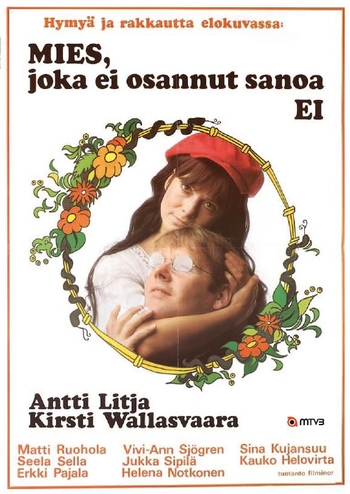
The Man Who Couldn't Say No (Mies, joka ei osannut sanoa ei, 1975)
Director: Risto Jarva


Risto Jarva was one of the most humane, quirky, inventive and smart directors this country has ever seen. He made a string of comedic films with his trusted actor Antti Litja, who was just perfect as a bit stiff, slow, shy, but nice everyman. And a total Finnish stereotype at that. The duo's films together had warmth and heart in them. Many of Jarva's movies have devoted followings. But since I myself saw this film as a child and liked it then, this is my preferred one. The film in question is a romantic comedy, but with a colorful, almost fairytale like storytelling.

Narrated by a horse, the film tells a story of the young reverend Aimo Niemi. Just out of the clergy school in America, he moves back to his old home neighbourhood of Kivimäki in Helsinki (a fictionalized version of Vallila), only to see it to be quite different yet at the same time quite the same. There's a feud going on of whether old wood houses should be torn down in the way of more modern buildings. Niemi's old friends and acquaintances are settled on both sides of the quarrel.

The most important is Niemi's childhood friend Milla Kurki (Kirsti Wallasvaara), taking an active role in the fight against losing all local flavour. Tough as Milla may be, she secretly harbors a crush and the hope to be Aimo's wife and for the pair to start a middle-class life together. But this is torpedoed by Niemi's bumbling, good-hearted nature and his obliviousness of her feelings for him. This is not a very gender-liberating by its script in any way. Yet Wallasvaara's performance is so sweet and adorable, one can't help but to fall for her a little. The other cast is as good as the leading pair with plenty of memorable characters throughout.

Jarva makes no mistakes about the fact that this is your basic farce in that a lot of comedy is mined about snowballing misunderstandings.  Litja's difficulties of saying "no" to any suggestion leave him in a lot of trouble. But even though the center of the movie is sweet, Jarva also has some jokes to be bit naughty and even shows off some skin. Yet he never crosses the line of being too raunchy so the film's tone is consistent.

Jarva was at the edge of the times with the theme of warm nostalgic togetherness put against cold, selfish progress. At that time, due to architects preferring functionalism to beauty, plenty of ugly concrete blocks of flats rose to Finnish cities while old-time neighborhoods disappeared. The film was well-received and rose discussion about maintaining Vallila as it was. Luckily, much of that particular part of the city has stayed looking the same as it did then.

★★★★

Sheep Eaters (Lampaansyöjät, 1972)
Director: Seppo Huunonen


Leo Lastumäki and Heikki Kinnunen play the main roles in this buddy comedy, based on the novel by beloved Finnish author Veikko Huovinen. The result is so much a cult movie, it's basically the Finnish equivalent of Easy Rider or Rocky Horror Picture Show. Back in the day it was made, screenings were constantly attended by fans who would shout out the lines to the screen while watching the film.

Valtteri and Sepe are businessmen in Helsinki, but when their summer vacation comes, they head off to the countryside to have their own sort of a road trip. They are true culinarists and believe that the best meal they could have would be a roast of lamb stolen from a herd and slowly cooked underground like old-time thieves used to do. While they commit their crimes and drive around they speak about things on their mind, about life, the universe, drinking and women.

If there's a pattern in the very best Finnish films it's that they have a very strong and funny script. But this movie also has a sort of New Wave sort of cinematic style, with a very loose plot thread, surprising jumps in time and space, and very improvisational style of dialogue scenes. It certainly also helps that Kinnunen and Lastumäki are both at career-best form here - and they aren't actually lightweight actors to begin with.


The film doesn't pester it's watchers by any morale or catharsis in the end. It is just an entertaining time with a couple of funny guys talking about this and that. It is sort of like going to a bar with friends, seeing as this film may also leave one intoxicated afterwards.

★★★★


Thursday, 23 August 2012

Old Old School Hip-Hop


On the streets of late 70's New York, poverty reigned and crime was at an all-time high. But the seedy athmosphere did create the whole hip hop culture, with rap, graffiti and breakdancing becoming different aspects of the urban culture. Even though it began as an underground, barely legal subculture, by the early 80's it became so popular that movie makers eager to catch on to the latest trend, started churning out movies. Of course this helped feed the culture even more and to turn the subculture into mainstream. But the fact that these movies present the post between these two parts of the phenomena, make them all the more interesting.

Wild Style (1983)
Director: Charlie Ahearn


The film which is most famous of first depicting hip hop culture to mainstream audiences, mixes documentary footage of the New York subculture in South Bronx with acted dramatic material. Real-life hip hop cultural icons play similar characters to themselves, and the film's plot is somewhat based on reality.  The underground rap gigs, the dancers and the taggers are to some extend filmed as they actually happened, on tiny underground clubs and behind fences events. There's also a whiff of hustling, such as illegal card flip games, in the film. Real social problems, such as alcohol, drugs or underage sex aren't dealt with, however. But in any case, it's a good period piece on how underground culture was in New York once everybody and their granny had heard of punk rock.


Zoro (Lee Quinones) is a graffiti artist, well known by reputation, but less so by appearance. He hangs around with a girl, Rose (Sandra Fabara), who he's secretly harboring a crush. He teaches her everything he knows, how to make good street art, where to strike, and how not to get caught. Zoro wants to express himself, but he also wants something more from his life. Not figuring out what it could be, he sort of drifts along, tormented. When Rose gets her shit better together, and gets acceptance from the New York art circles, their relationship becomes more strained. Most of the time, however, is spent on just depicting the culture as it unfolds.


You might be a famous and undeniably talented graffiti artist or rapper, but that doesn't make you a good actor. The dramatic parts of the film are ludicrously horribly acted. Luckily most of the time the movie plays it cool and keeps up with its authenticity. Not only the street art is impressive in this film, the rap scenes also feature mad improvisation skills and wicked mixing with old-school equipment. Ahearn's movie doesn't explain everything about the sub-culture from the ground up to anyone. You either get it going in or don't. It is what it is, which is why this is a clear cult movie. The soundtrack of this film is almost equally famous to the film, since it features rap artists the likes of Busy Bee, Fantastic Freaks, Fab 5 Freddie, and Grandmaster Flash and The Furious Five.

It turned out there were more than plenty of eager-minded people who did get it. The movie proved to be successful enough to make movie producers take notice.


★★★

Beat Street (1984)
Director: Stan Lathan


The following year, there were two other hip hop movies aimed for bigger audiences. The other was a straight-out dramatization of the things presented in Wild Style, the other focused on Breakdancing and became the bigger hit. The former, which was the better film, also took into focus graffiti artists, yet also emphasized rap music more, and works more or less as a musical. The film's soundtrack, starring the likes of Grandmaster Melle Mel, Kool Moe Dee, Us Girls and Rock Steady Crew, is perhaps even better than Wild Style's.


Kenny "Double K" (Guy Davis) and Ramon (Jon Chadriet) are best friends, and graffiti artists living in the seedy parts of New York. Ramon is more down-to-earth of the duo, but respects his art more than anything and wants to spraypaint a train that would take his graffiti out for all of New York to see. Kenny has rap skills and dreams of becoming a famous MC, playing at the hottest clubs of NYC. He meets Tracy (Commando's Rae Dawn Chong), who comes from a better neighborhood and upper class, but still becomes interested in music and breakdancing. The two start to get interested in each other, which inspires Double K also to aim his ambitions high.


As musicals tend to be, this is quite a melodramatic story. But not so much concerning the love story, more on Double K's troubles with his background and ambitions, the conflict between his family and his hobbies, and his relationship with his friends. Still, there's a clear West Side Story vibe here, with dueling gangs and such. The main villain turns out to be a sort of vandal to the vandals, an asshole who messes huge artistic graffiti murals by spraypainting all over them. Whatever one's stance on street art is, I think we can all agree that that's not a nice thing to do.

Warning! While the rap performance in this clip kicks ass, it also contains major movie spoilers.


"If art is a crime, may God forgive me". - Ramo

★★★ 1/2

Breakin' (a.k.a. Breakdance, 1984)
Director: Joel Silberg


Whereas the two other hip hop films were still fresh and more or less authentic-feeling, it didn't take long before the first cash-in on the phenomenon appeared. And it came from Cannon Group of all production companies. Not known from their subtlety, this effort takes the largest page from the West Side Story book in that, it's basically a street fighting film with the fighting switched to dancing. It's a formula that can still be seen in films such as Step Up! or You Got Served. A big difference is also that Breakin' takes place in LA instead of NYC. Somehow, New York represents to me striving to rise from poverty and squalor, whereas LA only represents surface, fake smiles and proper image.


Ozone (Adolfo Quiñones) and Turbo (Michael Chambers) are talented breakdancers, who work at the local supermarket and dream of hitting it big. The dancers have a bitter rivalry with a competing group Electro Rock. The buddies usually display their moves for some tourist cash on the streets of Malibu. They meet a young and aspiring Jazz dancer Kelly (Lucinda Dickey), who becomes interested in the breakdance culture. She gets the name Special K and starts to practice with the boys. But her strict instructor doesn't like her hybrid style that starts to infuse moves she learned from the street. Special K will prove him wrong as she will lead the Dance trio to the top and bring breakdance to the mainstream at the same time.


Of course, the film is Super Cheesy. There's not a hint of authenticity in any of this, and particularly the overly 80's fashions in the film are over-the-top and hilarious. Even the movie's breakout star, Ice-T (playing a Club DJ) considers this to be wack. And knowing what kind of films Ice-T has made in his career, that's saying something. Alongside Mr. Ice, the Soundtrack includes the likes of Kraftwerk, Rufus and Chaka Khan, and The Bar-Keys. The film did capture something of the zeitgeist since it proved to be popular. But the producers already were certain of it. They were so sure of it's success it even advertized its direct sequel in the closing credits. Today, the movie series is probably best known for the ridiculous name of part II. But Breakin' 2: Electric Boogaloo is a story for another time.

★ or ★★★★★

Wednesday, 4 April 2012

Finnish Cult Movies, part I


Today is the Finnish premiere day of the eagerly awaited Finnish science fiction epic, Iron Sky. Although the film didn't really work for me, it has produced enough enthusiastic buzz that I'm convinced we are witnessing either a major break through hit for the film industry in this country, or at the very least, the birth of an international cult hit. But Finland also has a long film history, alongside which many different kinds of films fit, some of which have a cult status among this country, some of which don't yet even though they would deserve it. I for one would love to raise awareness in Finnish cult cinema, so I'll start this series. I had a lot of candidates on which to write about, so rest assured. There's still a lot more to come.

Star Wreck: In The Pirkinning (2005)
Director: Timo Vuorensola


It actually pains me to compare this comedy with some actual movies, but numbers don't lie: 10 million downloads say that currently the most watched Finnish film ever made is this fan-made amateur film. When looked as a movie, it's not very good. But as a home made project it's actually more interesting. The film's special effects are impressive for being made in someone's mom's basement. And like witnessed in Iron Sky on a bigger scale, these tech students from the city of Tampere are some sort of geniuses in selling their unfinished ideas on the Internet and thus raising money, help and extras to help complete the film.

Due to his previous adventures, Captain Pirk of the spaceship C.C.P. Potkustartti (Samuli Torssonen) is stranded in the 21st century with his crew. Times are desperate since he can't even get laid. But Pirk comes up with a plan to invent the tools they need to get back home, and alter history. When they get back, Pirk is the unquestioned Emperor of the Earth. But once Pirk has conquered the planet, he gets greedy and sets his eyes on more. This leads to a war-declaration on the space fleet led by the ship Babylon 13.

As sci-fi nerds can guess, film's plot exists to put together space fights between star ships from Star Trek and Babylon 5. But like the bad parody makers the film's four writers are, they base their creations around original characters and concepts too tightly. For a viewer not familiar with Star Trek: The Next Generation or Babylon 5, the function of characters and settings taken for granted are left in the dark. There's a huge cast of characters, and only Pirk (Samuli Torssonen) and Babylon 13 Captain Sherrypie (Atte Joutsen) get any serious screentime nor arcs. The film would benefit from a better central character besides the all-around hateable and annoying Pirk. And of course, since the film stars mostly amateurs and crew members and their close relatives, the acting is, simply put, atrocious.

There are a couple of chuckle-worthy gags in this film, that mostly involve shooting someone with a ray gun. But I wouldn't recommend sitting through the film just to see those few bits. In fact, I find it nothing short of a miracle that someone outside Finland would find any interest in the film. The film is strictly for the hardcore tech-nerds and sci-fi overdosers.

-

Ruusujen aika (1969)
Director: Risto Jarva


Iron Sky and Star Wreck are not by far the only sci-fi movies ever produced in Finland. And not the best, either. Director Risto Jarva tried his hands on doing a prediction about the future already in the 1960's, and he set his film about 50 years from then, to 2012. The film starts out as a what if-scenario, but turns more and more interesting as it goes along. Jarva was interested in the media philosophies of Marshall McLuhan, and thus made a film that wouldn't look too much out of place in David Cronenberg's filmography.

Unlike many other futuristic films at the time, Jarva pictures the future as democratic. Or at least claiming to be democratic when in fact what you can do measures who you are in the society. Historian and documentary maker Raimo Lappalainen (Arto Tuominen) is at the top of his game. After producing a number of highly acclaimed films about the past, he aims to recreate the history of a time period 50 years before. He figures the bast way to accomplish this is to tell a story of a contemporary individual, and chooses Saara, a young woman who died tragically. He picks the beautiful young athlete Kisse Haavisto (Ritva Vepsä) to play her, and starts to go through her life events with her in real life. The director also develops a relationship with his starlet, which may jeopardize the whole project.

The film has some bitter comments about documentarists who claim to be objective observers of their subjects. Raimo thinks he's almost an invisible force behind his work, but in reality his underlying preconceptions, ideas and emotions drive his work. Because he can't come to terms in admitting this, he also acts coldly and matter-of-factly in his life. In other words, the maker gets tangled in the media for which he's producing content, making him and his film inseparable. Borrowing from Hitchcock's Vertigo, his raising obsessions also make him manipulate and transform his loved one into something he truly desires. In this case it's an idea of the past that never existed in the first place.

The film's technology is decidedly 60's, as is the extended "documentary" sequences showing how world developed to this point. Jarva does acknowledge in his work that films about a different time period are always tied to the concepts of the time it was created. But he still had some very apt ideas about the future, which came to pass, such as the importance of information, telecommunication and hand-held devices. Too bad the free sexuality and steamy swinger ball games haven't also made it to our day.

★★★★

Sensuela (1973)
Director: Teuvo Tulio


Think the concept "Nazis on the moon" makes a weird movie? Or "an archeological dig reveals an evil Santa Claus that starts to kidnap children"? Neither of those movies can hold a candle in weirdness for the swan song of the acclaimed melodrama director Teuvo Tulio. The film spent 10 years in the making and thus forced the director into some pretty creative solutions in attempting to hide the fact. The end result is equal parts a travel advertisement to Finland and a skin flick. It is 100% bonkers and mere words can't even describe how much so. If one film from this post would deserve to break big into the hearts of lovers of camp and cult cinema everywhere, it is this.

During World War II, the German pilot Hans (Mauritz Åkerman) crash lands into Lapland. A group of Sami reindeer herders rescue him from the wreck, and the beautiful Laila (Marianne Mardi) nurses him back to health. During the following weeks, Laila begins to develop a crush to Hans, much to the dismay of his strict, old-fashioned father Aslak (Ossi Elstelä). But since the course of the war turns, Hans must soon flee for his life, leaving his helpers behind. After years and years (though no one seems to get a day older), Hans suddenly returns, now as a successful photographer, and persuades Laila to come with him to Helsinki. They run off together, to the anger of Aslak.

In Helsinki it turns out that Hans is living in a world of decadence. He's having odd orgies where swingers dress up as skeletons and jump around. And some sex is being had as well. The maltreated Laila can't handle such a life, and escapes. She falls to the factory worker Pekka (Ismo Saario), but doesn't tell him anything about Hans. But for one poor choice, this natural child has wrecked her entire life and things soon fall apart like dominoes. Aslak will have his brutal vengeance on the one who betrayed the purest of loves – and it's a scene so odd that the viewer's jaw will surely drop to the floor.

Okay, for a list of things hilarious in this film, let's start with the film's minimal budget. It can be seen from oddly minimalistic sets such as an aeroplane's cockpit that looks like a couple of drapes with a chair and a steering wheel in the front. Or from the use of stuffed animals alongside archive footage in the reindeer-herding scenes. Even more odd is the dubbing, which even in Finnish sounds oddly tacked on. Tulio seemingly shot the film silent and had actors dub in lines years later – and not necessarily even the same actors. Even many sound effects and animal sounds are made by people. The music consists of familiar classical pieces by Tchaikovsky and Sibelius, but never quite fitting on what's going on on screen. This makes in particular the love-making scenes oddly uncomfortable because they have a gloomy, rumbling classical score to them. And boy, there is a lot of sex scenes in this. They rarely show anything below the navel, but women's breasts in particular are shown more often than not. For foreign people admiring the nudity, the film has also a lengthy, and frankly useless, scene set in a sauna.

The film can't decide whether it's set in the 40's, 50's, 60's or 70's, and elements of all decades show in the film. To top the illogical plot, the film's editing sometimes intercuts two things that have nothing to do with each other. Thus, for instance, it seems Aslak is looking worriedly at Laila having sex with Hans when the love-making pair should be in Helsinki and Aslak in Lapland. The dialogue is simply hilarious, stating obvious facts and arising odd reactions no real human being would have. The acting is hilariously over-the-top, particularly Elstelä's constantly raging Aslak.

With all these flaws altogether, the film is oddly psychedelic. Tulio doesn't concern himself on minute detail (or would want to hire assistants who would), he just wants to put colorful visions (that are cheap at the same time) on screen. It is a film about the loss of innocence, but since it seems like it was made by people as innocent as not having any idea of what happens in orgies or bordellos, the message is quite underwhelming.

★ or ★★★★★


Young Love (2001)
Director: Arto Lehkamo


There's been a lot of Teen films made in Finland during the last few decades, and with almost all of them rotten. And this is about a case in point. For the fans of hilariously awful, there's this Romance film, that manages to be fundamentalist christian and perversely voyeuristic at the same time.

The 13-year-old Jukka (Joonas Nordman) moves into a new city with his mother. Mummy dearest is having her hands filled with work while at the school Jukka is called names and bullied. But he discovers his father's old camera and becomes interested in photography. The school's gay communist art teacher(!), Martti (Pekka Lukka) helps him become started, teaching him about zooms. And as a 13-year-old is won't to do, Jukka uses his camera's zoom to spy on a girl through his window. This girl is the late-teenaged Johanna (Saija Lentonen), who likes to strip in front of a window and admire herself from the mirror until her stepfather comes home drunk and beats her. One night, Johanna catches Jukka spying on her, immediately figures out where he lives, and comes to the door to demand for him to stop. But Jukka suggests to her to become a model. As this has been her dream, the duo shake hands and Jukka begins as her manager and trusted photographer. They aim to enter her in a Miss Teen pageant, but Jukka also begins to blossom into love with his partner.

For any viewing experience of Young Love, the making-of feature on the DVD of the movie is an essential addition. That clears up a little of the thick fog surrounding the question: what the hell was the director thinking? On the documentary, Lehkamo seems pleased of having snuck in some of his own messages in his film. This is shown in the scenes where the gay Martti is dying (presumably of AIDS) and renounces his wicked communist-homosexual ways and embraces God. This has little to do with the rest of the plot, as do the lingering shots of the teenaged Lentonen stripping. These scenes are lingered on so lovingly and for such a long time that even the most perverted audience members start to feel uncomfortable. Sadly, these few amazingly awful scenes happen in a movie that's mostly just bland and thoroughly mediocre. Lehkamo clearly has no idea about how teenagers talk, act, or what they do, and also on how to attract them to see his film. A music video-like scene with the band Kemopetrol playing in the end didn't cut the cheese and the film flopped quite badly.

Lehkamo himself went into politics after that but was kicked out from the Christian Democrats party for having way too fundamentalist views on politics. Nordman came a stand up comedian when he grew up.

★★ (★ or ★★★★★ with the making of-documentary)

The Hangover (Baksmälla, 1973)
Director: Jörn Donner


Long before The Wolf Pack was first conceived, Finnish culture multitalent Jörn Donner tangled with an idea that starts out similar. But it turns out to be something different altogether, and Donner uses the cheesy set-up to ponder about the nature of relationships, as well as have some t&a on screen (so the film could be sold as Scandinavian erotica), and to have fun with the film he's making. Donner is one of the finest filmmakers in Finland, which is why it's so strange he has had little respect inside or outside of Finland for his films. He's better known for his books, politics, starting the Finnish film archive and for producing some of his friend Ingmar Bergman's more well-received films.

The director plays Leif, as clear as Donner's own alter-ego as all of the characters he plays. Leif is a used car salesman, who wakes up in a weird house after a night of heavy drinking from which he remembers nothing. But looking at his ring finger he soon finds that he's been married to a woman, Lena (Dianne Kjaer). He then walks around her house, trying to remember. Leif discovers another woman sleeping in another room, and finds out he's already cheated on his new wife with her. Leif trying to stay on top of the situation is intercut with the new married couple talking about their former romantic life and disappointments therein.


Baksmälla (1973) UK TRAILER by klubbsuper8

Donner's film takes a very carnevalistic approach to the subject, and it is very funny. The film is filled with things repeating themselves over and over again, mundane and silly alike. For instance, an aeroplane takes off repeatedly, which has little to do with anything. The film's timeline is skewered and anti-linear. In fact, thanks to this it may be the first arthouse film to be watched while having a massive hangover, when one isn't necessarily the most observing. It's hard to call the film a farce, though. Because of the film's tone, it is all the more surprising when it strikes with surprisingly melancholic pieces on loves lost and unrequited. Leif does attempt to build a spine and a pair during the film if only because he doesn't want to hurt his new wife badly again. Hijinks ensue, and popular comedian-singer Vesa-Matti Loiri has a cameo.

★★★★

Laulu (1986)
Directors: Arto af Hällström, Janne Kuusi


A real cult classic is hard to find, and beloved by those few that have seen it. A reason for this can be that the film is different from anything else and thus quite hard to describe. On top, this film seems to be a documentary about Nightlife in Helsinki, framed by the live performances of the band Sielun veljet. But there are also acted sequences such as the actor Kari Väänänen playing a drunk telling random people his views about the facts of life. And there's an interview with a scientist (named Paavo like my name!) who has utopistic views about the future. In fact, the film represents neorealism, a pseudo-documentary that sums up the artistic feelings in Finland in the 80's. The film was a production by Ryhmäteatteri, a theatrical group looking to break boundaries in the early-to-mid-80s. The result is a true underground film.

It's hard to figure out anything to say about Laulu, because it isn't the sort of film that comes to any conclusions. It raises thoughts, but they come from the person viewing them, the makers are not spoon feeding any ideas. The film objectively just shows a series of various things happening at night time, whether entertaining, cultural, or borderline illegal. Even the off cross-cutting or jumping isn't meant to compare these events, it's just to keep the viewer on his or her toes. The impressions come from within the scenes themselves. The music scenes are sweaty and intimate, or in the case of the scene depicting the humor rock band Lapinlahden linnut, oddly contrasting lowbrow humour with it's rich elitist audience. The film mostly concerns little people and little moments in more poor places. The overall mood is quite gloomy and melancholic. Paavo's future scenarios don't seem all that plausible in a city where drunken people brawl and a taxi ride from the East to downtown doesn't reveal any people but only the dark, rain washed streets. This would be an utopia for only Travis Bickle.

★★★ 1/2

NOOOOOOO!

Thursday, 9 June 2011

EKEK 2011

So I closed my festival season (it's all year, baby) by visiting an underground festival which promised a full night of seven movies. The catch was that these movies were not announced to the audience before they were screened, so you had a chance see anything. I have heard rumours that films such as Enter the Void and Antichrist actually got their finnish premieres in this festival in years past. Sadly, no big must-see films were around this time around, but the  festival was at least as surprising as I had hoped.

Karamoja! (1955)
Director: William B. Treutle


Back in the days of exploitation, mondo documentaries were a way of showing nudity and violence on screen. In the everyday life of certain foreign peoples and tribes there are more than enough and thus low-brow tastes could be camoflagued under the cover of doing a documentary about a native tribe. In actuality these films are colonialistic and treat their subject with racist contempt.

Karamoja is a sort of forebearer to this sleazy phenomenon, but at the very least it is much nicer towards its subject, almost uncharacteristically for its time period. The film merely comments of what is on screen, not how it seems compared to the western point of view, yet has a little patronizing attitude. It does have a flimsy plot of a sort, about a dentist dying from cancer  and seeking to travel during his final months. Telling the audience this has no real purpose as the film is solely about the lives and habits of the people of the Karamoja tribe in Africa. Thus it is shown how they hunt, farm, play, dance and have a wedding. It's the kind of film one wouldn't make any more from the same kind of viewpont at least, but the subject is interesting and it does not feel streched.

Fun fact: The film is also known as Wang, Wang. Not to be confused, of course, to Weng Weng.

★★★

Otley (1968)
Director: Dick Clement


I've started to suspect that I may actually have something against London in the swinging '60s. People kepp telling me how great the films based to that time and place are, yet I still find them mostly boring. Aside from the shagadelic birds in mini skirts, of course. But at the very least what doesn't get to me is the sense of humour of that time period.

Gerard Arthur Otley (Tom Courtenay) is a swinger that stumbles drunk to stay over at his friend's house one night. When he wakes up in the morning, he finds out his friend has been murdered and he's wanted by the police for that. This publicity, in turn gets him mixed up in the affairs of international espionage, criminal organizations and defence organizations. Otley always manages to escape from a close shave to another trouble. Yet the film really doesn't have too big ups and downs, it's all played at the same flat intensity. The main character is unlikeable and the comedy isn't the least bit funny (although a wonderfully weary 8-year-old has one good scene in the beginning). Really, actually the swinging set of '60s is the best thing about this. Who says I hate that period now, when I'm willing to give this film a whole extra star just for that?

★★

Virus (Fukkatsu no hi, 1980)
Director: Kinji Fukasaku


The first really good film of the night came from the director of Battle Royale. Virus is supposed to be an US-centric catastrohy film about the spread of a deadly virus across the globe. Yet only a Japanese director would approach the subject with as crazy solutions as these! The film manages to surprise me a time and time again, and it certainly doesn't tread on the same tired plot formula of most catastrophy movies. I'm going to discuss the exquisit plot in the next two paragraphs, so if you wish to remain unspoiled, feel free to skip them.

The fast-moving story begins in West Germany as an espionage thriller. A vat of deadly, artificially made virus enhancer gets stolen. Then, the spies crash their plane in the Alps. Come next summer, in Italy there are flocks of dead cows. The disease as well as panic soon spreads to Japan and to the United States. In the latter, the president of the United States (Glenn Ford) is trying to figure what to do to save his country, as one of his generals (Henry Silva) wants to just nuke other countries, to be on the safe side. This goes on until the president and the general are the last people alive in the US. When the president dies, the general arms the nuclear weapons to be active for use.

The only surviving people live in the research stations in the Antarctic. They have a submarine but are afraid to go back to other continents for fear of getting the disease. But since there's nothing else to do, they solve all of science's biggest problems in months. These include the knowledge of how to predict earthquakes precisely, how to develop an antidote for the virus which earlier in the film had no possible antidote, and how to get women to put out (elect them each to do a duty of 100 men a year by unanimous male vote). But as they learn of a nuclear threat, they must journey to stop it to Washington DC itself!


The film is cheesier than a ploughman's sandwich (to paraphrase the brits) and it's hilariously large plotholes are big enough to drive a submarine through. Many scenes don't seem to have anything to do with the main plot, the Japanese scenes being the prime example. The action scenes excessively use stock footage and the precence of George Kennedy as the leader of the Antarctic UN does make this feel almost like a ZAZ movie where laughs come non-stop. Just like catastrophy movies should, it is also littered with big stars in small roles (Edward James Olmos! Bo Svenson! Sonny Chiba!). This instantly became one of my favorites of the genre.

★★★★

Clown (Klovn: The Movie, 2010)
Director: Mikkel Nørgaard


In Denmark there is a popular Office-like single-camera sitcom about the hapless Frank and his rude friend Casper called Clown. I have only seen one episode of the series, but it seems that much of the comedy comes from the shared sense of shame as the viewers symphatize themselves with the protagonist Frank who tends to screw up royally again and again. Well, the movie version has some of that, but mostly it goes completely off the rails. As a result, I laughed harder at this than in years watching an actual comedy in a movie theatre.

Frank (Frank Hvam) hears at a party that his girlfriend is pregnant. She hasn't told him yet because she's not sure whether he's ready to be a responsible father. If the child doesn't get that, she's willing to have an abortion. Frank sets out to prove he's a good father candidate by agreeing to take care of his 12-year-old nephew Bo (Marcuz Jess Petersen) for a week. As the first night goes badly when Frank leaves Bo at the mercy of burglars, he decides to take Bo with him to a canoing trip with his friend Casper (Casper Christiansen). The problem is, Casper was trying to just get away from his wife to visit a famous brothel and to score with teenaged girls at a music festival. Tour de Fis!

Road trips are a popular source of comedy, and Clown does steal many of its cues from more popular American comedies. Yet if the Nordic cinema has one advantage over that is that we are not in the least bit shy about nudity and sex unlike the Americans. So in terms of obscenity, the film actually goes past The Hangover and such gross-out comedies by miles. Honestly, I'm surprised that the climatic slide-show ever got past any sort of film boards. The main characters aren't really that likeable as their stupidity borders on insanity, but the unreal and outrageous solutions which they have for their problems makes it all the more funny. And really, who doesn't love a good sleazebag moron like Casper?

★★★★

He-Man and She-Ra in: The Secret of the Sword (1985)
Directors: Friedman, Kachivas, Lamore, Reed & Wetzle

For many, the harderst film to watch during the whole night was this 1,5 hour toy commercial.  I myself got through it by help from a tactical bathroom break. The "film" is more or less five totally similar episodes of Masters of the Universe smashed together. They all involve someone getting kidnapped by bad guys and He-Man and She-Ra teaming up to rescue them. They probably got a five-year-old to write this just by giving him the same toys.

For those that don't know, He-Man is a swordsman and a superhero living in the land of Eternia. For adults, the funniest thing about him is the blatant homosexuality of his pink-dressing alter ego Prince Adam. In the film he sure likes to shake hands with moustached musclemen who have a picture of a heart on their chest, and then ride behind them on the same horse to their forest hideout. When Adam raises his sword and shouts: BY THE POWER OF GREYSKULL! I HAVE THE POWER!, his clothes swith to bondage gear and a fur diaper, and he adapts the name of He-man. Yet no one (save She-Ra) ever knows or guesses who he is. There's also a lot of bad guys that He-man must fight to keep Eternia free. She-Ra is He-Man's sister from another dimension who has pretty much the same qualities as well as problems. She is also a pretty blatant attempt to sell MotU toys to girls, as she rides a unicorn pegasus, lives in a land where everything is of rainbow colors and is friends with a goofy team of witches who resemble Smurfs in their appearance.

The film's plot really consists on just new characters popping up all the time to stand around, and after explaining what they are about to do, and finally using their special fight powers. You know, like presenting what a new toy can do. The toy family seems to have quite a few branches. The film's animation is as cheap as possible as every sort of animated movement is used multiple times, and usually the only thing moving is the character's mouths. The best thing in the whole He-Man franchise, his nemesis Skeletor, comes in way too late to completely save this, but at least his misogynism and diary-writing habits keep things funnier for the about 70 different endings this has.

★★

Death Smiles on a Murderer (La morte ha sorriso all'assassino, 1973)Director: Joe D'Amato


I slept through most of this and thus am not qualified to give a proper review. If I find it, however, I'll promise to return to it in the second part of my Giallo post.

Marked for Death (1990)
Director: Dwight H. Little


These festivals have a reputation of saving a really kick-ass action flick for last. Marked for Death is certainly one of Steven Seagal's finest films, and brutal enough for the title as well. For in the 90's, movie audiences didn't feel catharsis at the end of action films unless the villain was murdered several times in a row, every time a bit more violently.

It was also the time that Seagal didn't need to play an "ex" anything. He plays a current DEA agent that is just on a vacation to visit his sister's family and his old friends. His fight against drugs in Colombia, however, has earned him a reputation which is like a target on his masisve forehead for ruthless Jamaican drug dealer Screwface (Basil Wallace). This is emphasized when Seagal kills some of his men on his spare time. When his family is in danger, of course it calls for drastic measures on behalf of Seagal.

The film builds itself up for a final showdown, and Seagal isn't even superhumanly invincible this time around and Screwface does get a blow or two in. But as we know, nothing can really break his spirit and make him make another face. Seagal gets his vengeance by first decapitating Screwhead's twin brother. When Screwface finally appears again later on,  Seagal first presses his eyes to his sockets, then kicks him through a wall to an elevator shaft and finally drops him to be impaled on a a bar on the roof of the lift. Now THAT'S Justice, as Charles Bronson says in Kinjite.

★★★ 1/2

Tuesday, 22 March 2011

Tampere Film Festival report 2011


I visited the industrial city of Tampere to go to the short film festival they had. The fact that the festival is mostly for short films provides some problems on how to cover it in this blog. I don't want to analyze each of the shorts I saw seperately. So I decided to do a review on only the full-length films and the winning films I saw.

One of my most eagerly awaited happenings of the festival were the compilations of old 16 mm films collected by the American film freak Dennis Nybacka. These were showed at three seperate screenings that were organized by their respective themes. The first one I saw was called the Age of Oil and focused on the relationship America has with its Black Gold. The films from this screening were the most versatile and also the most interesting of the bunch. The screening featured first a few old educational fims about how useful oil is and where does it come from (1952,1953). The interests of the oil companies behind these older films are almost too obvious, looking at them from the modern perspective. Yet the film Toast (1974) is more illustrative - it shows just how much oil we waste to toast a single slice of bread. The show included also a couple of old one-reel comedies that revolved around the subject.  The W.C. Fields one, California Bound, was almost too fast for me to comprehend but still pretty funny. The more interesting one was It's A Gift (1923), a silent film by the forgotten comic Snubb Pollard. At his prime he used to be a rival for Buster Keaton and Harold Lloyd. The film was about an inventor that had an alternative for expensive oil usage - using magnets to hitch a ride from passing cars. Some of the inventions by Pollard were almost uncannilly reminiscent of the ones seen in Charlie Chaplin's Modern Times.


Although the second screening, Kill A Commie For Christ had a more provocative title, the films were a lot duller. The screening focused on the Cold War from the American perspective, yet didn't feature any outrageous anti-communist films but rather some of the Newsreels from that time. While it's certain that American newscasters at that time weren't FOR communism, the perspective isn't so over-the-top as to be funny. Yet the final film, All About Fallout (1961), grimly saved the day. On the same day as the earthquake in Japan damaged its nuclear power plants to the point of crisis, the festival audience got to see the most ludicrous "educational" film about shielding from atom bombs since Duck and Cover. Granted, it focused on just the Nuclear Fallout. Yet I do doubt that a single jacket would be enough to save oneself from it, even if one brushes it afterwards. Nor do I believe that one can eat nuclear potatoes by just peeling them, nevermind drink from polluted rivers as "water washes itself". But the most outrageous claim of the film is that "nuclear fallout disappears pretty fast, so one can come out from the Nuclear shelter after a week". Should an atom bomb be dropped and I survive in a bomb shelter, I wouldn't be so certain to come out if it wasn't necessary. Let's hope no one Japan doesn't have to make that choice.

The final screening was saved for the club Freaky Horror Night so that everyone could be able to get drunk and extra ironic on that one. It was called Good Intentions and featured old educational films for youngsters, and they all attempted to scare them straight. That's why we got to see teenagers suffer the consequences of such feats as drinking and driving, dropping LCD and shoplifting. They are pretty slow-moving by today's standards but the most hilarious thing about them is the wallowing in the tragedy that follows. The films usually have a main character that has an inner monologue filled with self-pity: Why Oh Why Did I Have To Do It?! What will my mother think? All of the films go on for far too long and at point I was certain we would get to follow the protagonist all the way into the grave, rotting away regretting the abrupt end of his life. Freaky.

Willliam S. Burroughs: A Man Within 
Director: Yony Leyser
USA, 2010


I wonder if it's hip to be a beanik again these days. In addition to the film Howl about Allen Ginsberg we have a brand new documentary about the author of Naked Lunch, William S. Burroughs. The film itself has an indie background. The director Yony Leyser started to make the film by just going around to talk to people who knew Burroughs personally. Everyone was happy to oblige and he also uncovered a lot of rare footage from these people - simple home videos that happen to feature the author. Eventually the project began to grow over as a full feature film. Leyser may be a first time director, but the documentary itself doesn't seem a drop cheaper or more simple than bigger-budget documentaries. Leyser even got RoboCop himself, Peter Weller, to host the documentary and Sonic Youth to provide for the soundtrack.

The film's strengths lie on the archive footage and the few fantastic ideas that create an inspirational feeling for the film. These include dividing the film into seperate subjects rather than following a chronological timeline. It's also a cool idea to feature a strange stop-motion animation made out of iron wire at the beginning of each of these chapeters. But this division is also a weakness as themes from Burrough's life don't get to overlap each other but are divided into seperate portions. If one is not too familiar with the author (like me), one can get a pretty clear idea of what makes him such an interesting character. Yet the chronology of his life and to some extent the cause and affect is lost on us. Burroghs met numerous tragedies and a lot of sorrow in his life, which must have taken its toll in his behaviour. I'm just not quite sure how.

There is also the fact that there are too many interviewees. While it's impressive to see the likes of David Cronenberg, Iggy Pop, John Waters, Genesis P-Orridge and Jello Biafra talk about their idol, it really undermines the interviewees who have a lot of the more deeper insights about the man, such as his former lovers. Leyser does get some emotion out of some interviewees and it becomes quite apparent that Bourroughs was a man who couldn't really handle the relationships he had. It is an intimate documentary, with the literary work taking the backseat, but getting the right amont of time to shine too. If anything, it awoken my interest to finally reading Naked Lunch, which has waited for me in my shelf for a while.

★★★

Fall of the House of Usher (La chute de la maison Usher)
Director: Jean Epstein
France, 1928


This was already the second time I saw Jean Epstein's silent film provided with modern rock being played simultaneously for its soundtrack. This time the sound was provided by the Finnish punk band Radiopuhelimet. The band is great, but it seems that they weren't quite up for the task. They couldn't create the kind of athmosphere needed for such an eerie film, nor could even rock it out as hard as they could've. The end result was nice but not earth-shattering.

As for the film itself, it tells about a man called Allan (Charles Larmy) traveling to The House of Usher, a place that the locals call cursed. Allan has been summoned by the house's owner, his old friend Roderick Usher (Jean Debaucourt) who is growing desperate over his wife's illness. He is painting a picture of her that is actually an attempt to preserve her alive as long as possible.  This leads to supernatural phenomena and eventually, the Fall of the actual House.

The film is not actually one of my favorite silent horror films. The classic horror story by Edgar Allan Poe is not one to suit any adaptation very good anyway as the horror is created by mostly lingual and methaphoric ways rather than with something you can picture on canvas. But nevertheless, Epstein does a valiant effort. The athmosphere is created with care and the dark and striking imagery, while not exactly unforgettable, services the darkness of the story well. The shortcomings come from having such a flimsy plot. And the ending actually feels oddly anti-climatic and doesn't really resolve the main plot in a satisfyng way. I refuse to believe this is because of some Haneke-like anti-establishment postmodernism rather than just sloppy screenwriting.

★★★

Freaks
Director: Tod Browning
USA, 1932


Freaks was played at the festival in a club called Freaky Horror Night. I am very fond of the film and thus don't feel the background of drinking beer, listening to music and chatting with friends at the same time was of service for the film as much as it could've been. The film and it's deformed cast were used as a kind of sideshow for the club, planning to gather glances from the distracted club audience. This undermines the film's strong humanistic message about equality among people.

The first half of Freaks mostly just depicts the life of dwarves, pinheads and such other sideshows behind the scenes of a travelling circus. They are not the actual freaks of the title. That title goes to the "regular" people that mock and abuse those different from them, refusing to accept they are also human beings. One of such human monsters is the beautiful trapeze artist Venus (Leila Hyams). Initially she makes fun of the dwarf Hans (Harry Earles) that is in love with her, but when he learns that the little man is rich, she agrees to marry him. The other deformed sideshow performers good-naturedly accept Venus to their tight group. But she actually has an affair with the circus strongman Hercules (Henry Victor) and they plan to poison Hans to run off with the money.

The film's director Tod Browning used to work in a circus himself and thus the film is apparently based on his real experiences with working with those that are different. The character of Phroso the clown (Wallace Ford) may be something of an alter ego to Browning as his role is mostly to stand up for the sideshows and give them emotional support at times of need. It is impressive how Browning didn't resort to makeup or tricks to recreate his beloved circus world, but rather gave work to actual sideshows. By that time's (pre-Hayes code) standards this is a very noble film. By depicting the everyday life of the sideshows, Browning casts them in a natural light. They have the same small pleasures and nuicances in life as we all. For once we get to see them in their own terms, not in the middle of a circus, being cast in the light of being different. Browning is also wily enough to answer such questions as how does a man without arms or legs light up his cigarette, so the film is actually far from being a complete bleeding-heart humanistfest.

Not counting the final few minutes, Freaks is almost more like a film noir in a circus setting than a real horror film. The main character is almost destroyed by a treacherous woman and her schemes. Yet for a film about a community it also has a dark edge. One who decides to betray the trust of the closest of groups must pay a price.

★★★★★

The winning films:

The External World - Winner of Best Animation
Director: David O'Reilly. Germany 2010. 15 min.


The film is a compilation of skits where the rules of animation make anything possible. The film has a dark sense of humour and parodies our urban lives where the mundane enviroment mixes up with the colourful lives we follow in the media. To achieve this with large-eyed cuddly cartoon characters just adds to the punch this delivers.

How To Pick Berries (Miten marjoja poimitaan)- Winner of Best Documentary
Director: Elina Talvensaari. Finland 2010. 19 min.


The documentary depicts the views people in Lapland have for (and against) people from Thailand coming every year to pick berries from the wilderness to earn small wages from the local jam factory. The film mostly lets its images tell the story of the environment and let the voices of the interviewees tell that part. It is beautifully shot and perfectly realized, and tells a lot about the actual mindset of us Finns.

Silent River (Apele Tac) - Chosen As European Film Academy Nominee Tampere
Director: Anca Miruna Lazarescu. Romania 2011. 30 min.


Again I must look with admiration how a nation with such a small film industry as Romania can produce brilliant cinema year after year. This is another tale of the dark totalitarian Ceaucescu years, this time about two men and the other's pregnant wife who attempt to defect to Serbia. The storytelling is nothing short of brilliant - in such a small amount of time the director manages to fully flesh out the characters and to grippingly bring out the tensions, large and small. The end has the most thrilling suspense moments I've witnessed in years. Highly recommended.

The Tongueling (Kielitietty) - Winner of the Youth Jury Prize
Director: Elli Vuorinen. Finland 2010. 4 min.

The Tongueling is a one-gag animation. The gag itself is sweet and funny enough, even if it is a tad predictable.

Sweet Mov(i)e - Winner of the Risto Jarva Prize by the Finnish Film Foundation
Director: Jan Ijäs. Finland 2010. 4 min.

The experimantal short features a split screen where young women and men practice their fuck-moves in their underwear. The film is so banal from the use of music to the grainy black-and-white photography, that it works as a sort of parody from over-sexualized advertizing. Some jean commercials are not too far from that. Except they would probably choose better music over the cheesefest playing in the background of this great short.

The Illustrated City (Kuvitettu kaupunki) - Winner of Main Prize, Less Than 30 Minutes
Director: Jan Andersson. Finland 2010. 5 min.

Probably the most political of the films features a wall which is filled with graffitis and then painted over. Over and over again. The film seems to suggest that the unrelenting fighting against street art leads later on to fascism and a dystopian future. It really doesn't trust security cameras to say the least. Yet the film is beautifully animated and is a hoot to watch nevertheless.

Incident By A Bank (Händelse Vid Bank) - Winner of the Grand Prix, Winner of Best Fiction, Winner of the Audience Award of the International Competition
Director: Ruben Östlund. Sweden 2010. 12 min.


The biggest pile of prizes went to this very inventive and entertaining Swedish film. It depicts a bank robbery progressing, shot from the street in real time and with a single take. The director has taken a page from the films of Jacques Tati and utilizes various depths within the image inventively. It also has an unmistakable swedish sense of humour that is at once deadpan, realistic and quite silly. It also has a certain melancholic side to it and comments our times where the people witnessing the robbery rather set up their cell phones to shoot a video than call the police. Supposedly based on actual events, the filmmakers themselves got into trouble while shooting. Featured above is the cell phone footage shot by a character in the film.

I didn't get a chance to see The Painting Sellers (Finland 2010) - The Winner of Main Prize for Films Over 30 Minutes. But I promise you to do something to review the film once the DVD comes out. I'm very intrigued about that.

LinkWithin

Related Posts Plugin for WordPress, Blogger...