Showing posts with label stunts. Show all posts
Wednesday, 26 September 2012
Finnish Cult Movies II
The first ever Finnish Film Affair opened today at Love & Anarchy. At the same time the Finnish Film Week presents festival-goers with Finnish films from the last year or so. I wrote about several of my favorite Finnish cult films a while ago, so since this period seems to be ripe with anticipation for Finnish films, I figure it's about time to do a sequel. This time around, the films circle around the archetypal Finnish males. Usually, they are a silent bunch, like their alcy-hol and are prone to do stupid things and make total fools of themselves by being too shy to say no. I know because I present this type myself.
The Dudesons Movie (Duudsonit elokuva, 2006)
Directors: Jarno Laasala, Tuukka Tiensuu
One of the most successful Finnish concepts abroad, The Dudesons were doing Jackass stunts before Jackass was even conceived. Basically it's about four buddies dare each other to do hurtful things to each other in the middle of nowhere, Finland.
There are several ways of making documentary-style real-life slapstick. Whreas Jackasses often rely on high production values and elaborate planning, the Dudesons are more down-to Earth, improvised and more self-satisfied. One could say the spirit is also a bit meaner, although this is merely a question of nuances.
The primary function of the Dudesons movie is to present the dudes to wider audiences abroad. It can also be said that the film works as a sort of pilot for their TV series. The guys speak English and there are cameos by familiar Jackasses, such as Bam Margera, Steve-O and such. Way too much time is wasted also on the Dudesons talking about each other to make themselves familiar with the viewer. This is absolutely futile. All we need to know about them are that they are idiots who like to hurt themselves for our amusement. One doesn't go to see a film like this to identify with the protagonists or anything.
Fortunately, the stunts themselves happen to be surprisingly funny. A baseball bat to an unsuspecting sleeper's crotch or testicles to a mouse trap are so cruel ideas they can't help but create glee in my inner sadist. Fun is also them picking on their neighbour, dubbed Mr. Hitler, by shitting on his mailbox or digging a big pit and covering it with leaves to get his car to fall down. With it being the Dudesons, some absolutely childish actions such as dicking around a supermarket at night or setting fire to their house, fall utterly flat. They attempt to emphasize their stupidity a bit too much.
It's a bag of hit-and-miss gags, but with enough good ones for me to give this a pass. It's a lot better than Dirty Sanchez to say the least.
★★★
The Wedding Waltz (Katsastus, 1988)
Director: Matti Ijäs
One of the purest examples of a Finnish cult movie is this originally made-for-TV movie. Not too many people know about it, but those who have seen it, worship it to almost fanatical points. The VHS version of the movie used to be always stolen from Finnish libraries. The newer DVD of the film comes with a copy of the script for Katsastus fans to read aloud to their friends to annoy them.
The film is about a group of middle-aged men in a small northern town, who act immaturely even at the beginning of their autumn years. The film begins as Viltteri (Vesa Vierikko) is celebrating his wedding to Mallu (Kaija Pakarinen), who is at her last stages of pregnancy. En route to the reception, Viltteri's car brokes down and he spends most of the night trying to fix it. While he's under the hood, his friends Öövini (Sulevi Peltola) and Junnu (Markku Mallasmaa) get heavily drunk. And Mallu goes into labour, taking a cab to the hospital. When Viltteri gets his car fixed he doesn't go to see his new bride and newborn, but takes the guys out cruising in the town center. The next day he and Mallu take off to Sweden to get the car properly fixed.
The film displays men who care a lot more about their cars than their women. Viltteri is a bit dumb and it's hinted he's been pressured into marrying Mallu even though she isn't carrying her child. When the child is born malformed Viltteri asks whether it could be taken to a carage to get fixed. Later in the movie, he and Jannu come across another pair with a fate similar to Viltteri and Mallu. The husband is far more intrigued by mundane things and can't come to even fathom when her wife is giving birth to a new child. The blooming Midlife crisis manifests itself by the men being in a constant state of denial. When attached to the fact they act like trouble-making teenagers, comedy gold is born.
The pointless racing and cruising around in their old cars is a suitable metaphor for this sort of arrested development. A lot of the actions the men do, dumb or otherwise are done just to get a laugh out of one's pals. There's a weird fierce rivalry between cab drivers and our protagonists that's never explained but is bad enough for Öövini to lose his teeth in a fight. In one of the best scenes he's shown having trouble eating soup at a cafeé, while older people shunning his way of life around him, so he has to use a straw. If that's not a good depiction of hungover paranoia, I don't know what is. The film altogether is essential viewing for trying to figure out the Finnish national mentality.
★★★★
Damned Radicals (Saatanan radikaalit, 1971)
Directors: Heikki Huopainen, Timo Nissi, Heikki Nousiainen, Paavo Piiroinen
In Finland we had this Spede. Suffice to say, he produced a lot of movies, mostly comedies. It's good that he was able to get cheapo movies made when all other organizations funding films failed and thus he helped launch a large number of young talents. Sort of like a more comedic, Finnish Roger Corman, then.
In this case this is a comedy written, directed and starring a quartet of young and eager actors; Heikki Huopainen, Timo Nissi, Heikki Nousiainen and Paavo Piiroinen. It is clear that these minds behind this loved the breaking of rules by the cinematic New Wave and underground cinema of those times. There's a sense of destroying any Finnish value held valuable at that time. A little anarchism could be nice and it sure hasn't been on display often in Finnish films.
Satan (Heikki Savolainen) is having trouble running hell, since all the Finns in there enjoy the warmth and use the whole place as a giant sauna. So the Prince of Darkness harbors a plan to get rid of the worst four of them, Pave, Hese, Timppa and Viiksi (the directors with their own nicknames). He offers the Finns a briefcase full of money and sends them into the world. But the Devil insists the money should not be used for honest living, which is why things soon go off the rails for the boys. He also takes away their ability to enjoy alcohol or women, just out of evilness.
The money case is soon lost. Due to these desperate circumstances, the quartet soon turns to crime and start to plan a bank heist. Soon, after them are not only the police, but angry motorists, clergymen and women as well. Things might have been easier had they decided to stay in hell.
For a movie with four directors, who also inhabit the main roles, it's no wonder the film is so inconsistent. Mostly the loose plot hinges on a single idea. The crew seems to have filmed any idea for the scene that popped into their head with little in the way of anything holding the thing together. The jazzy improvisational music emphasizes this.At least the film is mercifully short, stopping soon after the one hour mark.
Yet there are flashes of brilliance in the film as well, such as character actor Leo Jokela popping by to read the main credits aloud. Jokela is such a funny actor he can make reading names off a list hilarious - and this film proves this is no exaggeration.
★★
Naisenkuvia (1970)
Director: Jörn Donner
Jörn Donner is about as atypical as a Finnish man can be: smooth, flirtatious, sophisticated, good at making films, and brave enough to say whatever's on his mind. He's also willing to parody himself, his inflated ego and obsession to beautiful women and sex. Naisenkuvia is not only a razor-sharp, ponderous film, and a good time machine to the turn of the swinging 60's and 70's, but it's also hilarious as all hell.
Pertti (Jörn Donner) is a porn film producer, who secretly harbors a hope to create a truly artistic film within that genre. Yet he has plenty of troubles with the officials and the film censor board who don't understand his art. Pertti also lives like he's a character in one of his films, wooing the ladies and disposing of them afterwards. While scouting for a female lead for his ultimate masterpiece, he comes across Saara (Ritva Vepsä), a biology teacher. After they begin to have an affair, Saara agrees to play the role. But to his horror, Pertti starts to develop feelings for Saara, and thus jeopardizes his own vision.
Donner in the 60's and 70's was a fairly controversial figure in the already-narrow art circles of Finland. The officials did treat his art rather badly, and the general public didn't quite get his ideas. Naisenkuvia is more notorious in Finland for featuring an image where Donner's naked erect penis is shown than for its indubitable artistic merits. To this day Donner hasn't revealed whether it's really his johnson in the film (which would mean he's rather gifted in one more area) or whether the thing is merely a prop.
The film is a challenge against censorship for the free expression of everyone, however they might want to express themselves. Naturally, since expression is often based on feelings, the center romance carries much of the film. Yet there's also plenty of Nordic erotica for the raincoated men looking at Swedish films at porn theaters. The film repeats itself a lot, but there's a sort of inventiveness and joy in shooting ever more different copulation scenes that it more than merits for itself.
To me, the film is worth watching just for the scene where Donner berates with his sharp tongue a faux-arty sex scene, which is one of the most hilarious things ever done in Finnish cinema. The movie also heavily inspired an internet favorite, a redubbed porn video named Aitoa menoa, which heavily parodies Donner's persona and public image. Search that out, since for decency I'm too bashful to link to it here.
★★★★
The Man Who Couldn't Say No (Mies, joka ei osannut sanoa ei, 1975)
Director: Risto Jarva
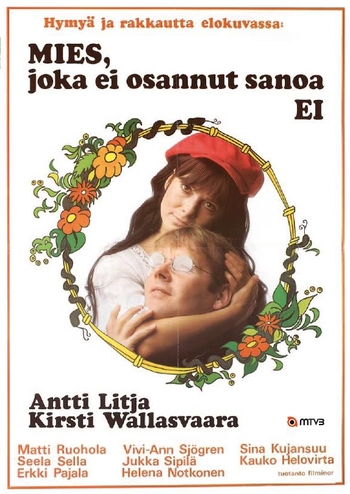
Risto Jarva was one of the most humane, quirky, inventive and smart directors this country has ever seen. He made a string of comedic films with his trusted actor Antti Litja, who was just perfect as a bit stiff, slow, shy, but nice everyman. And a total Finnish stereotype at that. The duo's films together had warmth and heart in them. Many of Jarva's movies have devoted followings. But since I myself saw this film as a child and liked it then, this is my preferred one. The film in question is a romantic comedy, but with a colorful, almost fairytale like storytelling.
Narrated by a horse, the film tells a story of the young reverend Aimo Niemi. Just out of the clergy school in America, he moves back to his old home neighbourhood of Kivimäki in Helsinki (a fictionalized version of Vallila), only to see it to be quite different yet at the same time quite the same. There's a feud going on of whether old wood houses should be torn down in the way of more modern buildings. Niemi's old friends and acquaintances are settled on both sides of the quarrel.
The most important is Niemi's childhood friend Milla Kurki (Kirsti Wallasvaara), taking an active role in the fight against losing all local flavour. Tough as Milla may be, she secretly harbors a crush and the hope to be Aimo's wife and for the pair to start a middle-class life together. But this is torpedoed by Niemi's bumbling, good-hearted nature and his obliviousness of her feelings for him. This is not a very gender-liberating by its script in any way. Yet Wallasvaara's performance is so sweet and adorable, one can't help but to fall for her a little. The other cast is as good as the leading pair with plenty of memorable characters throughout.
Jarva makes no mistakes about the fact that this is your basic farce in that a lot of comedy is mined about snowballing misunderstandings. Litja's difficulties of saying "no" to any suggestion leave him in a lot of trouble. But even though the center of the movie is sweet, Jarva also has some jokes to be bit naughty and even shows off some skin. Yet he never crosses the line of being too raunchy so the film's tone is consistent.
Jarva was at the edge of the times with the theme of warm nostalgic togetherness put against cold, selfish progress. At that time, due to architects preferring functionalism to beauty, plenty of ugly concrete blocks of flats rose to Finnish cities while old-time neighborhoods disappeared. The film was well-received and rose discussion about maintaining Vallila as it was. Luckily, much of that particular part of the city has stayed looking the same as it did then.
★★★★
Sheep Eaters (Lampaansyöjät, 1972)
Director: Seppo Huunonen
Leo Lastumäki and Heikki Kinnunen play the main roles in this buddy comedy, based on the novel by beloved Finnish author Veikko Huovinen. The result is so much a cult movie, it's basically the Finnish equivalent of Easy Rider or Rocky Horror Picture Show. Back in the day it was made, screenings were constantly attended by fans who would shout out the lines to the screen while watching the film.
Valtteri and Sepe are businessmen in Helsinki, but when their summer vacation comes, they head off to the countryside to have their own sort of a road trip. They are true culinarists and believe that the best meal they could have would be a roast of lamb stolen from a herd and slowly cooked underground like old-time thieves used to do. While they commit their crimes and drive around they speak about things on their mind, about life, the universe, drinking and women.
If there's a pattern in the very best Finnish films it's that they have a very strong and funny script. But this movie also has a sort of New Wave sort of cinematic style, with a very loose plot thread, surprising jumps in time and space, and very improvisational style of dialogue scenes. It certainly also helps that Kinnunen and Lastumäki are both at career-best form here - and they aren't actually lightweight actors to begin with.
The film doesn't pester it's watchers by any morale or catharsis in the end. It is just an entertaining time with a couple of funny guys talking about this and that. It is sort of like going to a bar with friends, seeing as this film may also leave one intoxicated afterwards.
★★★★
Wednesday, 29 December 2010
The Best of 2010 - Part I: The Films

Another year over, and what have you done? Well, watched a load of films, which means that I'm contractually obliged to give out a top 10 list of the best films the 2010s have seen so far. So here it is, a look back on the best films of the year. This list is based on the films which peremiered in Finland during 2010. Thus you may find a number of 2009 films also included.
It was a very good year for film. I had real difficulties on what to include on the list and what to leave out - plenty of good films were left out (even from the bubbling under-section), and I still had to divide this post into two. I have to do various other Year-best lists, yet as I get the instructions later, I'll put it out early next year. I'll also put in a list of the best DVD releases as a compensation, then. But now, let's just have the top 10 Theatrical Releases:
Bubbling Under: Armadillo, A Good Heart, Inception, Rare Exports, The Town.
10. Enter The Void
Director: Gaspar Noé

There are a number of faults in Gaspar Noé's latest film. It is way overlong and promotes a little too much the Buddhist philosophy on which its story is based on. But damn it, if it isn't one of the most captivating movie theatre experiences I've had probably ever. A real trip, and I wouldn't reccommend anyone to watch it anywhere else than a movie theatre. If you can turn your gaze away from the screen, you will. It's part of the Trip to accept these hard-to-watch moments as well. If 2001: A Space Odyssey had only a trippy end, Enter the Void is something like that from beginning to end.
The story is about the drug-shooting Oscar (Nathaniel Brown), who drifts along the streets of Tokyo, making drug deals and reading Buddhist philosophy. When a friend sells him out, the main character gets killed during the first half hour. The rest of the film he begins a Buddhist Spiritual Journey, looking back on his life and the world without him. Oscar's mournful and long Journey is cast heavily in japanese neon-lights with dirt and grit. Not to mention the unique directing style which is unmistakably Noé, and wouldn't benefit from me trying to explain it any more. He's treated the camera as a character before as well, and now uses this idea in the story as well. The film is nerve-wrecking, and seizure-causing and repetitive. yet it is also hauntingly beautiful and probably the ugliest movie about the beauty of life I've ever seen.
9. Jackass 3D
Director: Jeff Tremaine

Every time a new Jackass film is announced, I feel like the joke has gotten too old, as have the stunt performers. Yet when I see the final film, I can't help but laugh. I feel like Jackass 3D might be the best of the trilogy. I at least got the best laughs this year watching this. A film which makes Bam Margera cry can't be a bad one.
It is also probably the only film this year, where the 3D feels appropriate. It shows that many scenes are shot with expensive, high-def cameras. Besides that we get cool slo-mo impact shots when people get a fist to their face, we get to realize just how far away a jet turbine throws a football. We have then a good idea of the force which sends the football to the groin soon afterwards. I think the jet turbine prank with the clumsy waiter might be the best skit. Or, of course, the money shot that is the poop shoot in 3D. Or can music tame the wild beast one. Or, or, there are many good ones to choose from.
8. A Prophet (Un Prophete)
Director: Jacques Audriard

A Prophet is one of the most brutal prison movies ever made. Not so in violence, but because in its world prisons rather create and inspire criminals than cure them. A shy boy is sent to prison for reasons never explained. There he must run tasks for a mob boss in order to survive. This game he is forced to play soon starts to rot him to the core. It is a sort of Godfather story build inside four walls. It's not the first time Audriard takes ideas from an American crime classic and turns it into something undeniably French.
The violence itself is disturbingly realistic. The murderer is left shaken, stirred and changed forever. It might give him the vivid nightmares which come to earn him the nickname Prophet. Respect in criminal world still does only come from carnage. The base of criminal operations is not even limited to the prison. As the prisoners goes outside for vacation now and then and spread the Prison gospel of crime and murder there as well. As the main character's emotions are usually not that clear, one can easily reflect their own emotions there. It's not so much a character as an Avatar or a vessel for us to project ourselves in the same situation. Prison has been depicted as the ultimate place where the rules of survival of the fittest goes for us humans. A prophet shows us there is a way to make it, even if you are not physically strong, if at least you are quick-witted and ready to do bad things. But the cost is of course your whole former identity. Once you are ready to play along the Animal rules, you have to become one as well.
7. Four Lions
Director: Chris Morris

Four Lions shouldn't work. It is a comedy about a group of bumbling terrorists planning a major suicide bombing. Yet the film never feels like it tackles this difficult subject just to be edgy, nor treats its characters as one-dimensional Jihad-monsters. Maybe wisely director-screenwriter Chris Morris downplays the religious aspect of the terrorists to avoid discussion on irrelevant subjects. It's not by any menas a film about a war between religions. It is a film about humanity in general, and a search for a cause.
The terrorists are as multi-dimensional characters as any one of us. They could come from any background, and as a matter of fact they do too in the film. They make a lot of mistakes, and are also seriously misguided, trying to channel their various emotional traumas and hardships into something destructive. On the journey some of them find the joy of living again, but some get even more thirsty for blood because of the previous failures. As the subject isn't an easy one, there isn't also an easy way out for our characters. It is a comedy-faced tragedy, which feels especially bad as you've both laughed at and with these characters during the course of the film. Chris Morris is an infinetily skillful as both writer and director and I for one can't wait what he'll come up with next. Probably something completely different.
6. Kick-Ass
Director: Matthew Vaughan

OK, mostly this is just here because it is a kick-ass movie. Matthew Vaughan is a good genre director, and directing action he knows to use just the right amount of awesome, ridiculous, and ridiculously awesome. Most action films are so pussy these days that the action feels like something you're forced to sit through to get to the meaty part (like in, say, Iron Man 2 or A-Team). Not so in here. Guns, clubs, canes and swords are swung and they cause actual wounds and bruises and burns, oh my. It's a really violent film in case you didn't know. But damned entertaining at that. The perfect casting of both silly archetypes, and over-the-top specialities helps immensively as well.
Kick-Ass is a story about a regular nerd deciding to become a vigilante superhero, which means to beat people up for justice. He soon finds out he's taken a larger bite than he can chew. Kick-Ass is also a really postmodern super-hero film. The characters have also seen Spider-Man and act accordingly. The parody goes as far as the viral internet campaigns of superhero films. As a fan of the genre it is fun to see its pretty formulaic plot patterns, costumes and even dialogue mocked. As a parody, it is one that moves to be ever more outrageous. It starts pretty realistic but soon develops into an actual nerd-boy power fantasy, yet made to be so over-the-top that one can't help but to smile. The only part which doesn't quite fit the part is the romantic and sexual awakening, which I feel was in the end too close to the formula. Maybe Vaughan will pick up the pieces in the sequel. Good job for comic creator Mark Millar's world. Now, if we could only get a film as faithful to the ideas of Garth Ennis...
5. Bad Lieutenant: Port of Call New Orleans
Director: Werner Herzog

There was much fighting going on before the release of Werner Herzog's latest, about who has the rights to a classic film. Abel Ferrara famously disowned this film because he felt it tainted the legacy of his own 1992 film, Bad Lieutenant. Luckily, Herzog is smart enough to take an entirely different path on a familiar story. It is not a religious redemption story of a black sheep gone astray, but rather a black comedy about someone who should screw everything up, but in the end comes out of every mess victorious. The end result stands on its own and is different enough that one can easily embrace both films.
In Nicolas Cage Herzog has found the closest Hollywood representative of the manic acting style of his departed muse Klaus Kinski. Cage plays the loony Lieutenant Terence McDonagh who is seen as something of a hero, despite he doing things pretty impulsively due to him being high on painkillers and various other drugs pretty much all the time. The scene where he threatens an old lady is a classic in its own right. Herzog's pitch-black sense of humour hasn't gotten such a good channel for a while now, and it's nice to see the maestro kick back with absurd imagery. True, it also has a few hard-handed metaphors, but then Herzog has never been one to rely solely on deep metaphors. Instead, we get a layered piece that still has an air of mystery around it - like is Val Kilmer's character actually real? He only seems to appear to torment McDonagh to do the wrong thing, yet those moments the only time he decides to do the right thing and gets rewarded. Bad Lieutenant can only exist if there is an even badder one to defy. Much like the film itself.
4. The Social Network
Director: David Fincher

I had nearly no expectations about this one. I felt like Fincher had sold himself off by making the dreadful Benjamin Button film, and that the idea of making a film about the finding of Facebook was probably the dullest idea for a film that I had ever heard. Shows what I know. The end result is a class act all the way, from Aaron Sorkin's great machine-gun dialogue script to the performances of great young cast who fit to their roles prefectly. The film is not so much about developing technology as it is about the modern times, where we use websites to maintain our relationships. As much as Facebook creator Mark Zuckerberg is (portrayed as) a withdrawn, lonely and socially inept figure, he has turned us all into his own image.
This could've so easily been a film where a nerd gets a taste of the sweet rich life, but in the end learns a valuable lesson in friendship and such. Instead, the characters are like Seinfeld characters: however extraordinary their adventures are, none of them learn anything from any of that. They start out with claiming to wnat money and fame. Some get it, some don't. All want more. Even if they wreck their own relationships, they are essentailly the same characters from beginning to end. The film tries to tell that if we freeze our social experience online, there shall not be any room more to develop it. It is clearly the best film about turning yourself inwards I've seen in a long while.
3. Toy Story 3
Director: Lee Unkrich

Another film, about which I was a tad nervous beforehand. Pixar shall one day make another lacklustre film like Cars (Cars 2 next year?), but I sure as hell am glad this is not it. I've heard a wise reading of the Toy Story films (probably in Empire) in that they are all essentially about working life. The first one is about a new co-worker who you fear will replace you. The second one is about getting a promotion you don't want. And this third one is about retirement, whether you have served your purpose during your life and watching children grow up. Andy's toys, featuring Woody, Buzz and Rex, decide they won't go quietly to spend an eternity in the attic, but rather to investigate the retirement possibilities at a local Daycare Centre.
True, it repeats some themes from TS2, but this happens mostly at the beginning of the film. Even if the cast is packed to the rafters with caharacters old and new alike, the balance between all of the ingredients is handeled masterfully. The film is also incredibly swift in changing its tone, but it never feels forced that it does so. So, we get a good hour and a half of excitement, character-based drama, plotting, thrills, laughs, shock and horror and finally the best goodbye a film franchise could ever have. I didn't cry like I did watching Up and Wall-E, but I sure got misty-eyed and walked out of the theatre happy-sad. Well played, Pixar, well played.
2. The White Ribbon (Das Weisse Band)
Director: Michael Haneke

Were things really so good in the olden days? Seems like people's lives were much narrower and pre-set, not to mention living constantly in fear of parents, priests, officials, the law and of course, God. The Evil That Men Do lives on and on, as Iron Maiden so wisely put. Haneke seems to suggest that the Evil within also increases generation by generation. By setting his story before the First World War, he is essentially telling a story about the childhood of the Nazi Generation. No wonder the children here are so cruel.
The film is called to be one of the easiest Haneke film to access. I'd say in fact, that at least this time the director restrains from giving straight answers and spelling things for the viewer along the way. The black-and-white colour as long as the setpieces are as traditional as can be, yet the viewer's attention never goes astray. Haneke also handles his ensemble cast very well; there may seem to be multiple stories going on in the village at the same time yet it is all part of the bigger picture. As is usual for the director, there is no easy ending with a catharctic climax. This just leaves a more hauntic taste in the viewer's mouth. Multi-layered, thought-provoking, brilliant. It's The White Ribbon.
1. Somewhere
Director: Sofia Coppola

I've just realized that this list begins and ends on highly dividing arthouse films. Well, I'd say Somewhere deserves all the acclaim the film got at the Venice Film Festival, and then some. Sofia Coppola brings us another story about a loss of identity, getting lost in the modern society and a redemption which is highly reminiscent of her earlier masterpiece, Lost in Translation. But Coppola is a good enough artist to take two similar premises and deliver something intriguing both times. The slowly unravelling story is aabout the middle-aged actor Johnny Marco (Stephen Dorff) who feels bored and lost in the middle of all his playboy antics. Everyone knows fame and wealth surely doesn't bring happiness, but it's hardly ever been pictured as clear and matter-of-factly as it is here. The slow storytelling and repetitive scenes are in favour of thescript here. I love how the usual macho Hollywood thrills such as fast cars and beautiful women are portrayed as mundane, even sleep-causingly boring in the near silent opening sequences. That is some of the most unerotic stripping I've ever seen on screen. A life where you can get anything just for yourself doesn't have big thrills, however you look at it. Marco's attempts to handle his life on a here-and-now basis don't really lead to anything (or at best, just some meaningless sex), like when he tries to follow a lady in a convertible.
However, when his twelve-year-old daughter (Elle Fanning) comes to visit, he starts to get a new grip on life. The moment when Dorff watches her ice-skate is the first time he shows any emotion in the film. And it comes just after another boring striptease scene, which emphasizes that the feminity in his pre-teen daughter is already stronger than in two money-hungry strippers who don't have any identity whatsoever, save for their names, which tend to get mixed up.
Coppola might have highly obvious symbolism in her film, but it is handeled with such confidence that it can't help but to bring a smile to one's face again and again. For example, in one scene Marco gets cast into plaster to create a make up for his upcoming film. Both the viewers and the actor wait ages for the plaster to be removed and out emerges an old man. Life can get by pretty fast if all one is concerned is yourself. Happily, Somewhere is an optimistic film and Marco does seem to have a chance to make his life worthwhile yet.
Much is being read into the relationship Coppola had with her own father, the acclaimed director Francis Ford Coppola. I myself am not that interested in such trivial matters. Somewhere is a film about finding one self's worth and will to live. It isn't in material and shallow things we usually lust for, but rather finding little adventures with your loved ones, and maybe create them for ourselves as well. That's why I think this is the best film of the year.
The Best New Release of An Old Film
I realize this category might not have too many contestants each year. But I figured it shouldn't be on any of the other lists and I want to mention it. Hayao Miyazaki's Princess Mononoke got its theatrical premiere in Finland in 2010.
Like Miyazaki tends to do, he tells another story about the relationship between men and nature. The story is pretty epic and rough and thus aimed more clearly to older children and adults. Yet it might also be the biggest canvas of Miyazaki's creativity alongside Spirited Away. Visually, the film is nothing short of breathtaking. Miyazaki is at least on par with Satoshi Kon's Paprika in creating uniquely vivid animation. The forest gods, pixies, the fortress of ladies. The whole shebang leads to the pretty good question on why we humans tend to waste our vast resources on futile things like war and not to learn live more peacefully with nature and among ourselves.
Top 11 Festivals & Not yet in Programme
I'm gonna let these pass without a bigger comment, because most of these are already introduced in posts such as the HIFF-introduction. I'll return to them if there is any need to.
10. Winter's Bone
9. Mother
8. Animal Kingdom
7. Exit Through The Gift Shop
6. Symbol
5. Dogtooth
4. The Illusionist
3. Love Exposure
2. Sons of Cuba
1. Black Swan
High-rated films I didn't get to see in time:
Fantastic Mr. Fox, Heartbeats, How to Train Your Dragon, In A Better World, The Other Guys, Shutter Island, Submarino, Up in the Air
The Worst Film:

I actually didn't see anything really bad this year. However, I can tell what the most overrated film is: I Am Love. Even though I do love Somewhere, there is a fine line on how much drama I can take from the lives of the rich and the priveledged on film. If the characters are not right, the whole thing feels tedious, forced and all around uninteresting. All the characters in I Am Love might as well be replaced with planks. Tilda Swinton plays a rich housewife who begins an affair and blah blah blah yawn. This overlong episode of a daytime soap opera is never as steamy or clever as it think it is. Milan is an overrated city, yet the landscapes pictured in the film are the only thing of the remotest interest I could get from this. I really just couldn't get critics who put this drivel into their best-of-the-year lists. Maybe I should be an upper-class housewife to learn to understand this. The film wipes us in the face with its metaphor of making food = making love. Christ, everything else in our life is already sexualized. At least let us eat, drink and shit without having to constantly think about sex!
So here it is. I wish you A Happy New Year, and stay tuned for more hijinks here at the Last Movieblog!
Subscribe to:
Posts (Atom)


