Showing posts with label monsters. Show all posts

Saturday, 31 October 2020

Z is for Zombies


Happy Halloween! It used to be a tradition at this blog to each year take a look at a particular movie monster and talk about movies where they appeared. I never got to do the Zombie one, partly because everyone knows which ones are the good ones. George Romero's Dead Trilogy, Return of the Living Dead, 28 Days Later, Shaun of the Dead and the like. I would've liked to do top 10 more obscure zombie pictures, but never had the time to do enough research. But now I can talk about Italian zombies!

Most of the best Italian zombie movies use the walking dead pretty sparingly, as in Lucio Fulci's The Beyond. But that's not to say Romero's Dawn of the Dead wasn't really popular, and a major influence that showed how to do effective thrills on limited resources. Italians never really bothered with the light social commentary (we have Demons movies for that), they just liked the zombies as a cheap way of showing blood and gore. So, let's take a look.

Zombie Flesh Eaters (Zombi 2, 1979)
Director: Lucio Fulci


The grandaddy and best pure zombie flick Italians managed to do was marketed as a straight-up sequel to Dawn of the Dead (also known as Zombi). Fulci had the idea of doing a horror movie set on a remote island even before the premier of DotD, but relented in adding New York scenes in the beginning and end that can be seen of tying to Romero's film. One thing to note is that Italian films seem to have a better tie to the origins of zombie mythology in the voodoo culture... but use it mostly just to have insensitive depiction of natives and their savage ways. Zombi 2 is not the worst in this regard, it came later with movies that cashed in both the Cannibal movie craze and zombies, such as Zombi Apocalypse (a.k.a. Dr Butcher, M.D.)

Fulci's film is a rollicking good adventure, starring an adventure seeker named Peter West (Ian McCulloch) and a spunky reporter Anne Bowles (Tisa Farrow), who embark on a dangerous mission after investigating a mysterious boat in New York's harbor. Fulci had an excellent eye for set-pieces and planty of them linger on in your memory forever after seeing them, even if they are only tangentially related to the plot. The best among them are an incredible fight between and underwater zombie and (a real) shark, and a woman's eye being slowly pulled towards a sharp wood splinter (eat your heart out, Un chien Andalus).


While the zombies in Romero's movie were just cartoonish actors facepainted blue, here they are actually very creepy looking, wormy and worn-down corpses. I think the scene of the dead rising from their gravces is exceptionally creepy, with Fabio Frizzi's incredible score creating the necessary chills. Fulci's best skills are as a visualist, and this film started something of a golden age on his filmography (which we will take a closer look at soon enough).

★★★★

Zombie Flesh Eaters 2 (Zombi 3, 1988)
Dirs. Lucio Fulci, Bruno Mattei, Claudio Fragasso


A lot of unrelated films were sold as "Zombi 3" during the 1980's, but by the end of the decade, the aged Fulci was also lured to do an actual sequel. But the collaboration with the screenwriter Claudio Fragasso didn't work out that well. Due to creative differences, Fulci was let go and Fragasso finished the film with his regular collaborator, Bruno Mattei. Fulci later called the movie as made by "a bunch of idiots".

I think Fragasso was trying to do a more ambitious version of his previous movie, Zombie Creeping Flesh (more on which below) and he needed Fulci's visual eye to achieve this. The end result is actually pretty okay entertainment, even if it's pretty easy to spot the visually nice and athmospheric scenes as being done by Fulci, and the cheaper shots by the Mattei/Fragasso team. Tonally they can't even keep up with what the zombies can do, whether they can run, wield machetes or even speak... at... a.. very.. slow... rate...


A deadly virus gets loose from a research center and the military is employed to stop the spreading throughout Pacific Islands. There's also a group of rich dorks on a holiday that are on the way of the zombies. There's a lot of characters to follow, but never mind, most of them are zombie food anyway. There are some very memorable scenes, as one sees a zombie head fly out of a refrigerator and another a zombie baby burst out of its mother's belly, like a scene from Alien. The entire film is hosted by a radio DJ, who, in the end, is revealed to be a zombie himself. SURPRISE?

There are two other movies that are usually told to be official Zombie Sequels, After Death (1989) and Killing Birds (1988). Both are cheap, cheesy and not terribly exciting in any way, though the first one has a voodoo cult and ninja-looking masked zombies, and the latter some zombie birds attacking people in the vein of Hitchcock (although so does Zombie 3). So that's enough of them at this point.

★★★
 

Zombie Creeping Flesh  a.k.a. Hell of the Living Dead (Virus, 1980)
Dirs. Bruno Mattei, Claudio Fragasso


This cheapo Virus movie presents something Mattei always excelled at; marrying two very unrelated movies. As a deadly zombie virus takes over a military research center, most of the movie follows a group of soldiers of fortune travelling around Papua New Guinea. The film used mondo movie footage from Akira Ide's movie called L'isola dei canibali, and stole the score from Dawn of the Dead and Buio Omega. It's so shameless one has to give the edge out to it when compared to the more sleek Zombi 3.

But for a film made on such a shoe string budget, it had some ambitious gore scenes such as tearing out a woman's tongue and then grabbing the brain through the mouth with eyes bulging out. Also rare for a Mattei film, the plot moves along surprisingly briskly and keeps surprising the viewer. Of course, most of it is driven by the characters acting like total jerks or making the dumbest decisions the entire time. 

 One has to love Fragasso's ear for dialogue:
"Up your ass. Lt. Mike London, Shit Creek. The year is now."

★★★ 1/2


Burial Ground (Le notti del terrore, 1981)
Dir. Andrea Bianchi


For my money, however, the silliest of Italian cash-grab zombie pictures is this one, which tries to match Fulci's zombies in their creepiness, but just ends up having worm-faced mummy guys crawl out of flower beds and slowly stumble to grab the nearest overacter screaming their lungs out. Burial Ground is something of a morality take, as a swinger's weekend of debauchery in a secluded mansion takes a violent turn.
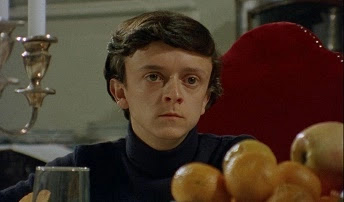

There's some very fucked up things going on in the family, particularly with the 12-year-old Michael (Peter Bark) who doesn't want to die a virgin so he tries to achieve his long-time dream and nail his own mother before the zombies get to him. It's one of the Italian films that uses the legendary Etruscan people as a source of ancient terrors, but neglects to include much of actual Etruscan culture to go with it. Nevertheless, we get a healthy amount of zombie monks, too.


It's a great film to watch during boozy nights with friends, as the actors themselves seem to be quite relaxed as well. I love how when cast member become zombies, they seem to be quite happy with the development.

★ or ★★★★★


Wednesday, 7 October 2020

Three laughs: Gamera vs. Guiron

 
It is hard to rate some trashy films. Films can be really good entertainment in spite of the quality of the filmmaking. In fact, it might be even harder to create unique trash that keeps surprising you than most "quality" films with which you know what you are going to get. It certainly is an even better pleasure to watch them. My friend says that he knows a trash film is worth something if it gets three laughs out of me. I mean proper, good belly laughs when you just can't believe what the film is showing to you, scene after scene. That's as good a rating as any for these movies. Any film that has these three laughs has a special place in my heart.  

★ or ★★★★★


Three laughs case file #39:
Gamera vs. Guiron (Gamera tai daiakuju Giron Japan, 1969)
Director: Noriyaki Yuasa

Compared to the more famous and glamorous Godzilla, Daei Studios' space turtle Gamera was an also-ran. Still, he has plenty of fans that swear on his name. The kaiju adventures were aimed more to smaller children, and thus Gamera also has a easily sung theme song and usually Earth children to protect from pesky aliens bent on conquering the world. 

The thing that makes Gamera movies so intriguing is that even though they clearly have budgetary restrictions and are basically kids' movies, they still up the ante on gore and brutality. Sure, Gamera bleeds green blood, but it still burtsts out of him when he faces the knife-headed fiend Guiron. The film was the fifth entry into the series.

Two small boys find a flying saucer and decide to take a trip in it. They are taken to a strange planet where an alien base is being protected by the nasty giant monster Guiron. Two sexy alien ladies reveal their plan is to get information from the kids' brains in order to take over the Earth. So, it's up to Gamera (established at this point to be a friend to children and a protector of our world) to defeat Guiron and save the children.


Three laughs (SPOILERS):

1. The amount of non-chalantness the main characters display here is something quite amazing by itself. Seeing a spaceship from a telescope? Wow! Finding the flying saucer out in the open? Wow! Taking off in to space? Wow! Seeing a giant turtle being propulsed by jet beams crushing asteroids from your way? Better sing the Gamera theme song. The creature effects are somehow super funny, all the monsters look to be either drunk or extremely hungover.

2. In order to establish the threat of Guiron, the filmmakers go to the obvious route: have it defeat a character that used to be a strong opponent for Gamera himself. In this case it's the pterodactyl-like Gyaos. Gyaos tries to shoot Guiron with a laser beam, but it reflects on his knife-head and shoots Gyaos's leg clean off. The fight ends with Guiron chopping Gyaos into neat purple slices.

3. The thing that's funny about the creature effects is how there are noticeable seams from guys in suit to animatronics to smaller-scale models. The final fight begins with Gamera lying unconscious on an ocean floor. What makes him wake up is a boulder dropping and hitting him in the jaw. The spinach to Popeye is getting hit to Gamera. As he rises he's also showing off his gymkata skills by spinning around and around a chinning bar. It doesn't do much good against Guiron, but at least it startles it for a bit, probably? In the end Guiron's limbs are blown off with a missile. JUSTICE FOR GYAOS!

Tuesday, 6 October 2020

D is for Demons! Demons!


Last month I missed out on doing any posts about Italian genre cinema, but October gives us the perfect time to catch up. And unholy monsters from hell gives us a perfectly seasonal adversaries to base a blog post on. In the late 80's, demons started to get the spotlight zombies used to have with a couple of fresh-faced directors.

Demons (Démoni, 1985)
Director: Lamberto Bava


The son of Mario Bava, Lamberto, started out as a assistant director in his father's films, but got to start his own directing career from the late 1970's onward. In the early 80's he was a ward of Dario Argento, who produced and co-wrote this 4th-wall-breaking movie to him. The artist also known as John Old Jr. considers this to be his best movie and probably is not wrong there.

Shot in Berlin, a group of different people have won a ticket to a film premiere in a brand new movie theatre. The showing is to be a horror movie that has effects never before seen on the big screen. The event soon turns to a nightmare as it turns out the group is trapped inside the theatre and blood-hungry demons start slaughtering them one by one. 


The film can't be said to be entirely serious. It has a sense of irony of having one of the cinema-goers be a blind man. Also the main theme from the soundtrack is probably the craziest composition Goblin's Claudio Simonetti ever did. But the film has a good eye for set pieces, a decent budget that paid for a lot of really expensive effects and a willingness to forget about certain details, such as the plot, in order to get going. The younger Bava never could quite match his old man's style, but still he was gifted as a creator of suspense and putting unique visions on screen. Not to mention gore, that comes bountifully. It was not actually a preference of Bava himself, so I expect Argento had his fingers in the game.


If there's a downside to this coked-up fever dream it's that Demons basically work too much like zombies, in that they can turn people into one of their own kind. That's why the apocalyptic ending seems way too familiar from plenty of zombie movies, Italian or otherwise, that show the disease spread to the entire world. But that was the 1980's when people had a common fear of an illness bringing about the end of the world.


★★★★

Demons 2 (Dèmoni 2... l'incubo ritorna, 1986)
Dir. Lamberto Bava


Like the Die Hard films, it seemed the Demons movies also were going to be set on bigger and bigger settings. This one sees an entire high-rise become a battlefield when Demons attack! This time they won't step out of the movie screen, but come from your TV sets standing in the most sacred places of your own homes.


The film has a new set of stock characters with their flimsy character arcs, or just colorful deaths. It feels the script is even more haphazard than the first one as a lot of set-up is just forgotten along the way. It's not bad, but it all just feels so uninspired. Almost all good ideas of the movie were already done in the first one.

There's still some points of interest in this. Fans of architecture in Italian films may get a kick on how the film moves between different apartments. It's critiques of modern living and entertainment are also somewhat similar to the mayhem seen in Gremlins 2 four years later, but it doesn't really go far enough into these to reach the same dizzying heights.
 

★★ 

The Church (La chiesa, 1989)
Dir. Michele Soavi

 Along the way, Argento had a falling out with Bava, opting rather to work with his own second unit director, Michele Soavi. The man also called last great giallo director had debuted with Stage Fright.  Reportedly, Soavi thought the Demons films to be "pizza shlock" and wanted to make a more sophisticated horror movie rather than a continuation. Still, his second film was sold to some audiences as Demons 3, as well as his next movie The Sect as Demons 4.

The Church is interesting in just how Catholic it is. Past bloodletting done in the name of the Church comes to haunt modern librarians and priests trying to work in a building built on the blood of innocents. In Italy in particular, it seems a lot of the most bitter agnostic attacks against the power of religion came from horror movies, which is probably why they were seen so subversive back in the day.

 
Soavi digs a hole for himself by having a too good, brutal and savage prologue set in the Crusades. The opening scene reads like something out of the catalogue of Paul Verhoeven, another critic of the violence done by institutions. But after the opening, the film lulls in athmosphere a bit too long. The Church itself with its dark corridors and ominous statues is a very nice environment, but after enough camera drives and crash zooms where scarcely nothing happens makes the audience groan for the movie to roll along. At this point Soavi wasn't that skillful in building up tensions, part of the reason being that his characters are always so paper-thin as to be boring to follow.


The film's music is an odd cocktail of Goblin, Keith Emerson and some Philip Glass compositions that seem to be taken straight out of Koyaanisqatsi. It's a good measuring stick on how Soavi has problems establishing a clear thoroughline for the film. Visually, though, it's very striking with magnificent effects work by Sergio Stivaletti. The gore and creature scenes in particular are nasty and memorable, so the film has plenty to offer for fans of Soavi's style, even if the film as a whole somewhat creaks at the seams.

★★★
 

Cemetary Man (DellaMorte DellAmore, 1994)
Dir. Michele Soavi


Since we are covering double D's, I have to throw in also Soavi's probably most popular and unique movie. Loosely based on the fumetti comic Dylan Dog, Dellamorte Dellamore is a kind of unique little gem in the horror comedy genre, a sort of match between the general skewed worldview and sense of humor of Danger: Diabolik and the hysterical antics of Evil Dead 2.


Rupert Everett
plays a lonely but cynical cemetary groundskeeper Francesco Dellamorte who has a surprising amount tof work on his hands. The cemetary turns the dead back to life after three days so he has to make sure the zombies stay underground. But the lovelorn young man can't help to fall for either widows or corpses of  young women, which is harder to combine with his line of work.


The film has a autumny visuals where it's all shades of brown and grey, down to earth, which contrasts nicely the cartoony aspects of the story and performances on screen. The film has a episodic nature, where it does resemble the comic books it is adapting. Likewise in the amount of sex and violence on screen, although to contemporaries like Braindead, the film seems downright tame.


Not only about the duality of love and death, the film also depicts the longing to escape a small town and its repetitive cycles. Dellamorte goes through the same loops every night, but refuses to learn or to move on. His mute partner Gnaghi (François Hadji-Lazaro) fares better, and genuinely falls in love, albeit to a severed head. The movie, as outrageous a premise as it has and dry humor, is actually in favor of enjoying life and seeing as much of it as one can.

★★★★

Thursday, 20 August 2020

Joe D'Amato triple feature


As a preview of next month's ABC's of Italian genre cinema post, I thought I'd take an opportunity to take a couple of monster movies that didn't make the cut for that one. Moreover, this post is to write a bit about Joe D'Amato (1936-99), born Artistide Massaccesi.

He's often seen as one of the more banal Italian genre film director, making shlock from popular cannibal and zombie genres. Yet I don't particularly find his movies "so-bad-they're-good". While he is not a brilliant horror director in disguise, I do find his films to often be more original and suspense-driven than their reputation suggests.

Probably what ruined his reputation was the moralistic fact that he also worked on Adult films, producing first the Erotic films like the Black Emmanuelle series, and then moving on to hardcore pornography (like making the notorious Porno Holocaust). But I have selected here three horror films that perhaps shed a light a bit on why D'Amato was an unique director after all, if not entirely successful.

Antropophagus: The Beast (Antropophagous, 1980)


Italian film fans know the character actor George Eastman, often playing nasty brutes, from films like 2019: After the Fall of New York and Warriors of the Wasteland. He had a fruitful work relationship with D'Amato, working with multiple genres and even co-directing 1983's 2020 Texas Gladiators. But with Antrophagus, he had a role of a lifetime. He also worked as one of the film's screenwriters.

Most of the film concerns a group of young vacationers exploring a mysteriously empty Greek island. It's as if all the occupants therein had died or fled. To spoil a little, it turns out a cannibalistic and mute killer with a scarred face (played by Eastman) lurks there.


The film builds up very slowly, which is partly impressive for a film deemed a Video Nasty, but also partly a bit boring as the puzzle pieces don't seem to reveal themselves. Nevertheless, as D'Amato started out as a cinematographer, he manages to create an unsettling vastness of the island, and claustrophobic interior scenes with ease.

The film's most memorable part comes when we get a flashback on the tragic events that made Eastman's character lose his mind and all sort of reasoning. D'Amato seems to have a point that we are only one bad day away from reverting back into cavemen and killing everyone within our territory.

★★★

Absurd (Rosso Sangue, 1981)


A sort-of sequel to Antropophagus, except it actually has an entirely different backstory. But Eastman looks and acts the same way. The actor worked as a screenwriter in this one as well. This time, Eastman's mute killer surfaces on the mainland, killing people that happen on his way, and seeming impervious to bullets.

It turns out the killer has escaped from a medical facility. He battles a motorcycle gang and some cops, but ends up in the houselhold of a seemingly regular family, The Bennetts, who have to fight for their life against the unremorseful killer. The film is a bit darker, utilizing night scenes and the fear of the unknown within a city setting to its advantage. It includes all the basics of a slasher movie, with its unfeeling and unstoppable force coming out of nowhere to intrude on a normal family life.

Compared to the previous one, this is more eventful, but also a bit confusing, as pieces don't seem to add up the same way to a big reveal as before. The violence is particularly brutal here, with plenty of gore and a particularly nasty scene where Katya Berger's head is being burned in an oven. This film turned out on the list of the notorious Video Nasties as well.

Massacessi used the pseudonym Peter Newton this time around. It might be that since he had directed ten Erotic movies in the year between these two movies, the name D'Amato started to wear out.

★★★

Beyond the Darkness (Buio Omega, 1979)


As much as those two monster pictures had some nasty and disgusting shades, they pale in comparison with D'Amato's best horror work. It is a thoroughly disturbing serial killer movie that cares not of the boundaries of taste and reason. It has some shades of black comedy as well, that were later more realized in purely comedic films such as DellaMorte DellAmore. It also takes ideas presented by films such as Psycho to their logical extremes.

Frank Wyler (Kieran Canter) loses his girlfriend to an illness. But instead of letting go, he decides to dig up the corpse and embalm her. The family villa houses this secret, but multiple people stumble upon the scene by accident and meet their grisly fate as punishment for this. Iris (Franca Stoppi), the strange housekeeper is culprit on all of this, finding also suitable victims for his young master and helping dispose of the corpses.


The film is a gruesome remake of The Third Eye, but also revels in the historical knowledge on stuff such as how mummies were used to be embalmed (we can see this in all gory detail). While the film centers around necrophilia, it also includes cannibalism and gory dismemberments. It seems the effects budget for this was considerably bigger than in most of D'Amato's other works.

While the film may seem to have so many tasteless elements in order to irate cencors and decency activists, it also has a very perculiar and odd sense of wonder in all this. The human mind in its most crazed can be oddly creative and logical in its illogicalities. It's not an easy movie to predict the next scene and it keeps surprising the viewer. The images are sterile and unmoving, which makes for an odd experience to follow such depravity.


On the worse side, the ending seems rushed and a bit clichéd compared to the rest of the movie. It had some ingredients that could have made it a serial killer classic, but now it stays more or less just a curiosity for those that can stomach its contents. It has a very cool Goblin soundtrack, though.

★★★ 1/2

Monday, 20 April 2020

Three laughs: King Kong Escapes

 
It is hard to rate some trashy films. Films can be really good entertainment in spite of the quality of the filmmaking. In fact, it might be even harder to create unique trash that keeps surprising you than most "quality" films with which you know what you are going to get. It certainly is an even better pleasure to watch them. My friend says that he knows a trash film is worth something if it gets three laughs out of me. I mean proper, good belly laughs when you just can't believe what the film is showing to you, scene after scene. That's as good a rating as any for these movies. Any film that has these three laughs has a special place in my heart.


Three laughs case #18:
King Kong Escapes (Kingu Kongu no gyakushû, 1967)
Director: Ishiro Honda

About time to talk about giant monsters in this column. One of my favorites of the genre comes from the deal of the Toho company to have King Kong fight Godzilla. They did an independent sequel/spin-off after that which sees Kong take on a Mecha-Kong, 7 years before Godzilla met his own robotic doppelganger. I think the idea was to have Kong fight against a giant Frankenstein's monster. Ol' Frankie did later get his own two Japanese kaiju movies, but without Kong, whose rights reverted back to Universal.

Nevertheless, this one is fun precisely because, even though Kong is a King, he tends to be a very vunerable character in his fights, even more so than Godzilla, which creates some more excitement. But here much of the fun is due to the grotesque ape costume they have on the main character with its droopy eyelids and sharp brown teeth. And wobbly way of moving.

The villainous doctor and builder of the giant ape robot is named Dr. Who, in a probably another copyright-infringement I seem to love so much. The robot, which has Kong's famed abilities, is used to drop bombs in a crack in the Antarctic in order to obtain some radioactive material. But the radioactivity makes the robot malfunction, and thus Who must scheme a group of scientists heading to Skull Island to grab King Kong to do his dirty work for him. But Kong does not like to be held captive...


Three laughs (Spoilers):

1. On Skull Island, things are same as always. When a really grumpy-looking dinosaur growls a bit at a woman, we get the first glimpse of the film's hero. Glassed-over eyes slowly opening, staggering around and revealing its rotten teeth, this Kong is a thing to behold. After a tender moment with the blonde, he soon gets into a drunken brawl with T-rex, though. The japanese have some extra flourish in their monster mashes, though, like when the dying T-rex starts foaming at the mouth.

2. Later, helicopters arrive to dose Kong with sleeping gas, but it just makes it seem like ten beers and six vodka shots did the guy in as his eyes start drooping. And as with these kinds of cases, he has to be carried away from the bar, I mean, island. When he wakes up in a ship's hull he even seems appropriately hungover.

3. I takes a while, but we finally learn excatly what Dr. Who wants with Kong, and it's his world-famous digging skills, of course! One could have thought Kong wouyld be more famous climbing, though he gets to do that on the famed Tokyo Radio Tower late in the film, too. But long arms appear to be as useful as any machine when it comes to tunnel-digging. Swirling his arms away at the Earth's crust he still acts as mind-numbingly clumsy that he seems as drunk as ever. In-story, he's drifting in and out of sleep. A fun drinking game would be to take a drink every time the film shows a close-up of his golfball eyes. One would be as drunk as Kong in no time!

Thursday, 6 February 2020

Three laughs: Thunder of the Gigantic Serpent


It is hard to rate some trashy films. Films can be really good entertainment in spite of themselves, and it is an even better pleasure to find some trash that keeps surprising you than watching most quality films. My friend says that he knows a trash film is worth something if it gets three laughs out of me. I mean proper, good belly laughs when you can't believe what the film is showing to you. That's as good a rating as any for these movies. Any film that has these three laughs has a special place in my heart.

Thunder of the Gigantic Sepent (Hong Kong, 1988)
Director: Godfrey Ho (as Charles Lee)

If Bruno Mattei is known for combining two movies' worth of stolen ideas into one movie, then Hong Kong's maestro Godfrey Ho does that literally. He used to buy film stock and combine multiple films into one with English dubbing. Mostly these are Ninja pictures, which have main characters that never meet, and more abandoned plot threads left unexplored than the last seasons of Lost and Game of Thrones combined. But Ho really did also test out which movies sold.

Case in point he bought out a Korean giant monster movie and combined it with a spy thriller. The end result is Thunder of a Gigantic Serpent, a title which sounds like an euphemism of farting before having to go to the bathroom. As you can imagine, much of the pleasure of this film comes from trying to combine a gritty crime thriller leaving plenty of corpses behind, and a silly family comedy of a pet snake growing into impossible size. But you know, some of the Godzilla movies were pretty violent, too. Somehow it all stays together.

Three laughs (SPOILERS):

1. The titular Gigantic Serpent starts out small, as a tiny snake that befriends a little girl. As the girl is asking on what to call her new pet, the snake waves its head first horizontally in disapproval, then vertically when the girl comes up with a name. She decides to call it Mozlov. The snake is in parts played by a rubber hose on a string, other times by an actual snake. Either way, the boneheaded way of having it nod or shake its head gives out a giggle each time.
2. The dubbing in general in this film is kind of hilarious. The main little girl sounds like a British lady talking with a very soft voice. The main bad guy seems to try out a voice somewhere between Cobra Commander and a cartoon vampire. The voices of his minions, gangsters and criminals are trying to sound as tough as they can. This includes swearing, which works to further destroy the illusion that this is supposed to be a family movie. "He lost the fucking formula!"
3. Once Mozlov the snake gets electrocuted with a groth ray, we enter the phase of the rubber puppets. The snake has a really irritating parrot-like scream. The sitcom-like comedy of a little girl trying to hide a huge snake in her room seems to have some Freudian undertones. I also love the scenes of the snake helping the girl out to win a roller-ski race pushing her around are to be seen to be believed.

One must add that the titular Thunder the Gigantic Serpent makes once the gangters start to threaten the little girl, is as underwhelming as they come. Just rattle a few bridges and skyscrapers and that's it. But being denied of your expectations is all part of the charm of these VHS-era clunkers. I wish we could have had a proper dvd or blu-ray release of this.

Saturday, 11 July 2015

Christopher Lee in Memoriam


On June 7th, the world lost one of the greatest living screen legends and a personal favorite actor of mine, Sir Christopher Lee. Much as everyone would´ve expected him to turn 100, he left this realm at the ripe age of 93. He certainly had a long and amazing life, and no one could deny his love for the craft, since he was working until the end. And a good thing too, because his recognizable baritone could liven up the most dire of blockbusters. He´s one of my all-time favorite actors precisely because there´s no thrash film so rotten that he wouldn´t improve it just by with his immense charisma and serious speech patterns.

I am a bit late with this post, but I couldn´t have a better reason to get this blog running once again than to start out by reminiscing some of Sir Christopher´s work. This isn´t necessarily a listing of his greatest roles (might I direct you to this post about The Wicker Man for that), but these are some of his most iconic performances, with some curiosities thrown in for good measure.

Horror of Dracula (1958) 
Dracula: Prince of Darkness (1966)
Dir. Terence Fisher


Of course, the role that made him famous, and a cornerstone in his career was the defining portrayal of Count Dracula in numerous Hammer Studios´ films, starting with this one. As it is, it´s surprising to see just how little we see of the old count in Horror of Dracula, and even in the following film, Dracula: Prince of Darkness. But Lee is such a perfect embodiment for otherworldly evil, as well as a sexy outsider, that he leaves an immediate impact.

As Hammer films tend to have, this one also has top-notch sets, music and a foggy athmosphere you could cut with a knife. The cast is very good, but the acting is still very theatrical. Later on, Hammer directors eased out on acting-direction, but sadly this coincided with the scripts getting worse and worse. At this point they were still eager to try their claws with classic horror stories and giving them an unmistakably English twist.


In The Horror of Dracula, the most notable problem is the same one as in Stoker´s book (from which the film otherwise takes notable liberties). While the opening scenes of Jonathan Harker traveling to castle Dracula and realizing that the man he thought to do real-estate business is in fact an undead monster, are exciting, feverish and threatening. But once the action settles on patriarchal Victorians trying to solve the case of women enjoying sex, the film jars to a halt. Never mind that the obsessive, cold and violent Van Helsing as portrayed by Peter Cushing is one of the best portrayals of that character.


Lee hated the role of Dracula so much, that he refused to say any of his lines in the first sequel, PoD. That film was made to keep the struggling hammer Films afloat, so Lee had to grudgingly accept. The resulting pantomime performance emphasizes the character´s otherwordliness, and the surrealism feels much more like the live-action reprisal of Nosferatu than Werner Herzog´s actual remake could ever manage.

Dracula: ★★★ 1/2
Prince of Darkness: ★★★ 1/2

The Hound of Baskervilles (1959)
Dir. Terence Fisher


Lee played in many different versions of Arthur Conan Doyle´s Sherlock Holmes stories, managing to play Holmes twice and his brother Mycroft once (in Billy Wilder´s The Private Life of Sherlock Holmes. I have a lot of fondness for that role). Curiously, he was never cast as Professor Moriarty, but perhaps that would´ve been way too obvious. This Hammer Films version of perhaps the most famous Holmes story deserves merit because it takes the opposite direction, casting Lee as Sir Henry Baskerville, with his best friend Peter Cushing as The Great Detective.

Lee´s Sir Henry is something of a buffoon, a very self-important aristocrat that is introduced complaining about his missing shoes and mistaking Holmes as a servant. Lee´s no-nonsense charisma and a sort of anger seethe through a man who´s deadly afraid, but can´t manage but to try to keep up appearances. A scene with a killer tarantula for instance reveals the cracks in his facade, making him totally freeze up in fright.


It´s always a pleasure to see Cushing and Lee play off each other (which makes it such a shame they have so little interaction in Dracula films or, for instance Curse of Frankenstein). They are a pair for the ages, usually having one of them be the straight man, voice of reason, and the other the passionate character, fringing on the edges of madness. It´s evident that the pair got on off-screen as well.

★★★

The Bloody Judge (1970)
Dir. Jesús Franco


If Lee´s career in the 1950´s and early 60´s was emphasized by the films he made with Terence Fisher and Hammer Films, in the late 1960´s and early 70´s his most frequent working partner was the Spanish schlockmeister Jesús Franco. In many ways, Franco had a way of continuing on with some of the work Hammer started, such as taking on their Fu Manchu films with a couple of movies of the Diabolical Doctor of his own. It seems Lee had a fondness for Franco, since he could even convince him to play The Lord of the Vampires once more for 1970´s Count Dracula. Lee has gone on record to praise that film, probably because it gave him dialogue straight from Bram Stoker´s novel, a feat which none of the Hammer movies could manage to do.

Another of Franco´s films that pleased Lee was this historical thriller about the 17th century Lord Chief of Justice Jeffries, who was known for public executions. One must say that Franco was riding on the wave of the wave of British horror of the day, releasing this film between such films with similar subject matter as The Witchfinder General and Blood on Satan´s Claw. Cynical looks at the bloody and unfair history of England were all the rage then.


However, like Franco´s films tend to be, this one is thin on story and oddly uneven. Scenes of torture and nude women were inserted to the finished film in order to gain notoriety. Thus also Lee´s performance disappears from the film from time to time. As Jeffries, he does tremendous work, with his burning gaze and reasoning that he is serving the kingdom by killing people he sees as threats. Lee could make Franco´s films a lot better than they had any right to be, and this one is certainly watchable, if nothing to really write home about.

★★★

The Man with the Golden Gun (1974)
Dir. Guy Hamilton


Of course, the work Lee did in the 70´s weren´t all zero-budget horror films. He was a particularly apt choice for a Bond villain, playing the assassin Scaramanga. He happened to be a distant cousin of 007 creator Ian Fleming, and actually was his first choice to play the agent way back when. While Lee could´ve pulled off both Bond´s ruthless side as well as the more gentlemanny traits with ease, in the films we´ve got, he wouldn´t really have worked.

This particular film is from the most silly period of Roger Moore´s agent, featuring things like Nick-Nack the killer midget, comic relief Southern Sherriff J.W. Pepper and a Funhouse assissation arena. Bond films play for the tastes of that day with some kung fu action thrown in the mix. Yet Lee´s Scaramanga still feels like a genuine threat, never mind that you couldn´t really kill anyone with golden bullets (I´m not sure about the gun, though. It would be very heavy and soft, though).


The character of Scaramanga would prove to be one of the first of Bond´s "dark reflections" (of course Robert Shaw in From Russia With Love being the first). As such, it´s a pity they couldn´t mine some more substance out of that dynamic, resorting to quips about superfluous nipples and bikini girls instead. But this has been a well from which the Bond producers have returned to with every iteration of the character since.

★★★

Mask of Murder (1988)
Dir. Arne Mattson


Now, a lot of Finnish media tended to tell about how much Christopher Lee loved Finland. he came here to fight as a volunteer in the Winter War, after all. Also, as he loved J.R.R. Tolkien´s works, he also appreciated the Finnish language. But he never did act in a Finnish movie. This is something the Swedes got and we didn´t. For Lee had a sizable role in the Swedish thriller maestro Arne Mattson´s English-language film mask of murder, which saw the actor in a Swedish setting.

As far as plots go, this is not really something to write home about, and certainly not one of Mattson´s finest. The Swedish town of Uppsala is here representing a desolate Canadian village. Murders of women start to occur, and it´s at first up to Lee´s Chief Supt. Jonathan Richto solve them, but then he´s suddenly wiped off the game and the case left to his assistant Supt. Bob McLaine, played by Rod Taylor. They have their own skeletons in the closet, and the film has a very cynical outlook in the small town police force as a whole.

I´m going to admit it´s a pleasure mostly because of the setting of an obviously Swedish town, as well as it´s nice to see the nicely mustached Lee and Taylor thinking. The violence is surprisingly stark, owing to the slasher films of the day. Horror fans despise the film, perhaps because it delivers very little in the way of actual horror and that the end twist is easily guessable. But there´s surprisingly lot of Lee in the film, and he gives a fine, subdued performance so I´d say it´s worth checking out.

★★★

The Hobbit: Battle of the Five Armies (2014)
Dir. Peter Jackson


I have to mention this last, since it was the last time I saw Christopher Lee on the screen. On Jackson´s bloated prequel trilogy, there are very few things on screen that feel tangible, realistic or even emotionally resonant. Lee´s Saruman the White fighting Ringwraiths is of course horrendous as an idea for a Tolkien fan, but it´s also the only offering of fan service in the films that I actually enjoyed. That´s kick-ass, even if it is a stunt double most of the time, and a better fight scene than Lee got in either of the Star Wars prequels he appeared in.

Many people complained that Saruman´s trechery was telegraphed too plainly in the first Hobbit movie. I thought that Lee portrayed him as Tolkien suggested, arrogant and pompous, with a love for his own voice. Again, while the material he had may not have been up to standards, Lee made it his own, and with his extensive knowledge of literary sources, made it even more accurate. As such, he is the best part in that movie, too.

★★

So in conclusion, rest in piece, sir Christopher. I know you´ll be coming back, because that´s the way you work, but try to come back as a benevolent spirit, guiding us to reach to be as awesome as you were in life.

LinkWithin

Related Posts Plugin for WordPress, Blogger...