Saturday, 3 November 2012

Night Visions MH12: The Future of Law Enforcement


Just when you thought it was safe to take it easy with festival movies and go early to bed, comes once again the devastator of minds and sleeping rhythms. But this year Night Visions Festival is clearly bigger, faster and stronger than ever before. The greatest genre classics and the most interesting new films come thick and often, so who needs sleep?

This year has also seen its share of incredible guests, the most notable being the legendary directors John waters and Paul Verhoeven, both of whom were nice enough for their fans to switch a few words with me, shake my hand and pose for a picture.

I'm currently preparing for the traditional all-nighter, during which I aim to watch a whopping nine films, from 4PM's End of Watch to the ending film The Seeding of a Ghost, set to start at 8.45 AM. It gives me time to reflect on the two futuristic police satires that served as the opening of the festivities.

RoboCop (1987)
Director: Paul Verhoeven


The warm-up show for the festival was arranged around Paul Verhoeven's visit to plug his book Jesus of Nazareth. Which was all the more fitting to show the uncut original version of his sci-fi action masterpiece for the first time on Finnish screens. Verhoeven calls the film both his "American version" of the life of Jesus, and also his best success while making films in Hollywood.

The futuristic Detroit is a city ruled by rich executives, while regular people live in squalor. Crime rates are through the roof, and the city's small police force can't handle all the heat. That's why they resort to private funding for a new kind of, more effective law enforcement. Yet Dick Jones (Ronny Cox) has cut corners with the design of his robot ED-209, and it kills everyone in its path, whether committing a crime or not. The young opportunist yuppie Bob Morton (Miguel Ferrer) has an idea to create a cyborg, half-man half-machine, to get better results.

Meanwhile, young police officer Alex Murphy (Peter Weller) attempts a massive drug bust on his first day working at a new precinct. But the precinct is ruled by crime boss Clarence Boddicker (Kurtwood Smith) and his gang, who don't like cops. While Murphy's partner Anne Lewis (Nancy Allen) manages to escape relatively unscathed, Murphy is brutally shot to pieces and left fighting for his life. He dies on the operating table, but Morton saves him by adding cybernetic parts to him. He also erases his memory to allow a computer program to take over his thoughts. He becomes RoboCop, the scourge of crime in Detroit and the unemotional law-giver, the ultimate straight man cop.


So the meat of the film is Murphy slowly starting to fight his program and recalling his past life. It is a quest for humanity, and fighting against corporate powers attempting to make a profitable product out of an individual. At the same time the more Murphy regains his consciousness, the more he is willing to step outside the boundaries of law to get brutal revenge on Boddicker, the man who already once killed him.


Verhoeven directs with a firm tongue-in-cheek, as evidenced by the satirical television programmes of the future, that sadly are not that far-fetched from our reality. News anchors gloss over horrible items with a smiling face to make time for commercials that make family time fun out of nuclear war and make a car's huge size (and presumably high gas mileage) it's most alluring attribute. The best satiric touch is the crass, Benny Hill-like comedian Bixby Snyder, enjoyed immensily by the lower class, while being hilariously stale and repetitive even with the few second-long glimpses we witness.

"I'd buy that for a dollar!"

For an action film, Verhoeven's big money scenes are usually over quite quick and very, very violent and bloody. He gleefully shoots various kinds of massacres where one side can't hold their own against and overwhelming enemy. The long camera drives move with almost a robotic fashion. It's funny that the film has so few sets, with three major scenes taking place in abandoned factories (it's not entirely clear whether it's the same factory). These are issues of budgetary limits, but Verhoeven certainly works them for his advantage.

Since in Detroit everything is in ruins, and blue-collar workers are put up against the wall, Verhoeven also finds time to ponder the issues of privatization and strike-driven union activities. His main sympathies lie among the working guys, the cops, yet he also manages to give them a whiff of fascistic following of orders since they are willing to attempt to kill a fellow officer on grounds of a say-so. Verhoeven develops some of the ideas he would later have for Starship Troopers here, including the unisex locker-rooms and showers, though glimpsed only for a second.

By contrast, the upper-class yuppies are as slimy as they come, only caring about upping their own position, cocaine and whores. They have no regard for the smaller pawns and don't care if their aiming for their own goals causes a major strike that allows crime to flourish all across the city. Hell, crime is what makes them money! Verhoeven's satirical ideas of power have grown even fresher by today's neo-liberal climate.


Last but definitely not least, the film is perfectly cast. Allen's Officer Lewis is for once a great strong female lead that gets along while not being sexualized, or having a romantic tie to her partner Murphy. they are just friends, pulling together because if they don't the world gets them. Likewise Weller is excellent as a man torn between the roles of a TV cowboy he's emulating and a feeling human being, a good father and a husband, and later a man who has lost it all, even his memories. he also has the proper chin for the part, as well as a flat, laconic sound of his voice to shout lines like "Your move, creep".

The best however, is Kurtwood Smith in a career-best turn in the most hilariously dickish main villain put to film. Whether he's discussing with accomplishes or taking care of his enemies, he usually does a small asshole move at the same time, like sticking his gun to a glass name plate or dipping his fingers into his business partner's wine glass and sniffing them. His anger, ruthlessness and risregard for human life in general and to all sorts of decency ensure that he goes far even while being too low-class to work with the yuppies rather than behind the curtains.

Bitches leave!

Oh, Verhoeven also can't resist to have a Troma movie sort of toxic waste mutation scene in the movie, for no other reason but to gain laughs for all the gore.

This is a masterpiece. Thank you for your co-operation.

★★★★★

Dredd (2012)
Director: Pete Travis


RoboCop has a certain cartoonish quality to it, even though it wasn't based on any comic book. A high inspiration, however came from the british comic book 2000AD and it's headlining hero Judge Dredd. He is the toughest law-giver in the futuristic Mega-City 1. With five billion people in the densely populated area, crime rates are through the roof. That is why the policing Judges have the privilege to hand out judgements on field. Basically every law-breaker either gets years of isolation in prison cubes, or a death sentence.

While the cheesy Sylvester Stallone vehicle in 1995 pissed on the legacy of the character, it is actually not that bad (or rather, not among the worst) of the 90's Stallone movies. But clearly a rethink was in order, and the new super-violent filmatization finally gives the fans what they want. Karl Urban's leaner, stringier Dredd reminds more of the character in his original late-70's, early-80's adventures than the mountain of muscle from the 90's. He also has the scowl right, but to my taste his voice is quite not tough enough.


In the new, 3D Dredd, our favorite Judge is paired with a rookie Judge Anderson (Olivia Thrilby) to evaluate her, and to determine whether she has what it takes to be a Judge. Anderson has psychic qualities, which has made the higher-ups disregard a few of her previous misgivings. While investigating a triple homicide, Dredd and Anderson get locked up in the huge city complex of Peach Trees. On the top floor lurks the crime boss Ma-Ma (Lena Headey), who rules the entire building. Dredd must fight floor by floor to reach the top and to apprehend the villain or perish. So far, so Raid: Redemption.


Dredd also has a near-future that mostly looks like our modern day. Stallone's Judge Dredd did have quite astonishing city shots, where it seemed Mega-City 1 was crawling with life everywhere. In the concrete behemoths of Dredd, it seems most of the citizens tend to hide in their apartments, and not go out. A bot more dwelling into the city would've done marvels, since all the best Dredd comics tend to have him as just an observer of the odd micro- and macrocosmos of habits, events and phenomena in the gigantic city.


The film is superbly violent, however, particularly a scene early on, where Dredd's bullets pierce hoodlums in super slow-motion. But the best set-pieces are used in the beginning and the climax itself is oddly underwhelming and repeating things already seen. Nevertheless, it's good that the film doesn't take a too big a bite to chew on Dredd's first adventure, like having Judge Death or Judge Child in the film. A single small crime boss suffices very well for now. It's a sad thing this has been somewhat of a flop, so we probably won't get to see any more. Drokk.

★★★ 1/2

Wednesday, 31 October 2012

Werewolves through the ages


Happy Halloween! Today is a very special day because Night Visions Maximum Halloween Film Festival officially starts today. We've had two special occasions for the visits of directors John Waters and Paul Verhoeven, but the main programme starts today. Whether intentional or not, this year's films feature a small retrospective of Werewolf movies with three films to be displayed, including Joe Dante's The Howling.

Doing a special post celebrating a type of monster on Halloween is beginning to be sort of a tradition here, so what better time to look at our lycanthropic friends. After all, there was a magnificent full moon yesterday.

A werewolf is a creature from ancient legends and has originally been involved in the fear of unknown in nature and the feel that ancient spirits can live on in animals and even possess them. When we fear werewolves, we to some extent fear nature. Thus, the archetype is surprisingly common characters appear all over the world (as do vampires). So it makes sense that this vein has been mined for cinema for years and years. Though there hasn't been a definitive take on the monster (although The Howling, and another werewolf picture made on the same year, come close), they more or less follow similar formulas: A goody two-shoes main character starts to get strange urges, spurts hair and goes out to kill. These werewolf films may not be the best, but they are chosen to reflect on the times on which they were made, which is why they gave weight to different things.

The puberty metaphore is quite clear, which is also why so many werewolf pictures have been made for teenagers. But through the decades there has also been various social changes that have made people doubt whether they are really as civilized as they claim to be. So grab your beast within, wer'e going in.


1930's
Werewolf of London (1935)
Director: Stuart Walker

The first major werewolf picture followed on the heels of other 30's Universal horror classics such as Frankenstein, Dracula and The Invisible Man. Yet it didn't become as big a classic as them. Why not? Well, for one, the star Henry Hull lacked the charisma of your Bela Lugosis, Claude Rainses and Boris Karloffs. Add that to the fact that he decided not to wear the make up assigned to create a believable werewolf, rather choosing a more modest approach. While that might have been as creepy, it didn't really look all that wolf-like or iconic. Luckily the make up had a chance for another run later on.
The American attitude of the 30's was to isolate themselves from all the war and carnage going on elsewhere in the world, largely because the Great Depression ensured there was enough problems back home. As such, the film reflects isolational views to stay out of foreign places and their businesses. The werewolf curse is caught by a scientist attacked studying flowers in the mountains of Tibet. The beastly ways of the foreigners are contrasted by, what else than Victorian stuck-up British people, that are sickeningly polite and down-to-earth, not giving any space to superstition or fantasy in their lives whatsoever.

The tragedy of the story is that the werewolf's condition keeps him away from his wife, while he stays locked up in rooms in an attempt to control his blossoming rage. This can also be seen as a sort of sexual frustration. The film is not too shabby, although quite theatrical in style, but it's central themes have also been done better multiple times since, which is why it's a little more obscure than some of its peers.

1940's
The Wolf Man (1941)
Director: George Waggner

It seems Universal itself wasn't that happy with how The Werewolf of London turned out (although it was a moderate hit). They made another film, this time set on a countryside villa and its dark forests rather than in an urban setting such as London. The themes are more along questioning the power of heritage, and family. Can a son bent on violent outbursts and losing control of his personality be considered a proper heir?Screenwriter Curt Siodmak was a Nazi concentration camp survivor, and his cynical outlook on people and their underlying brutality is reflected on his work. Jack Pierce's original make up designs are unleashed this time with wonderful results.


Lon Chaney Jr. brings great tragedy to the title role, and he is supported by the likes of Claude Rains, Bela Lugosi and Ralph Bellamy. This time the lycantrophy is a curse much like a disease, spreading from one person until the next until the owner is killed. Symbols and various iconic items are emphasized in the story and in the cinematography. The eerie music choices also underline the strange athmosphere and poetic imagery. Poems are in an important role in the storyline as well:

"Even a man who is pure in heart and says his prayers by night, may become a wolf when the wolfbane blooms and the autumn moon is bright."

While the film runs quite predictably, the true and tested Universal style keeps the film afloat. 

1950's
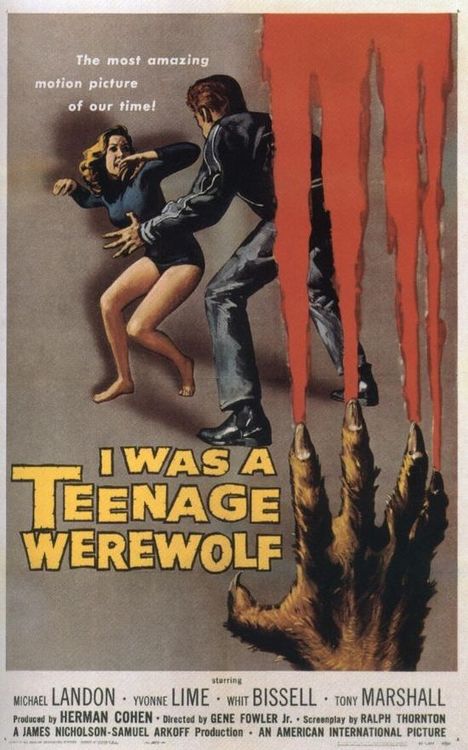
I Was A Teenage Werewolf (1957)


When teenagers started to spend more and more of their allowance on pop culture, also going to the cinemas, some wise guy had the bright idea to develop popular monster films by adding some teenaged drama into the mix. This film was the first of its kind, and the clear werewolfism metaphor ensures it's well remembered even today. as for the quality, oh brother.
Like many teen pictures at that time, this one is designed to lecture first and bore second. The star Michael Landon is a trouble-making teen, who gets experimental hypnotic treatment. This unleashes the wolf-manners in him, without him knowing it at first. The film builds very slowly and slowly. There's precious few werewolf action and quite a lot more of Landon trying to get answers from authority figures such as parents and doctors on what's happening to his body. The society being prudish, he is of course denied valuable information before it's too late.

Quite boring, but an interesting curiosity of the time. You'll find this is a common theme in this post.

1960's
Curse of the Werewolf (1961)
Director: Terence Fisher


The British Hammer productions jumped at the chance to do new adaptations of all classic horror tropes from Universal's back lot. But sadly not every film could be their Dracula, and many of their monster films were aggressively average. Among these is the production company's foray into werewolf pictures, which had the good idea of having Oliver Reed play the main role. Sadly, although the role would be one the actor would seem to be born to play, he can do little to salvage the film. For starters, the werewolf looks like this:

Run! It's the sideburns monster!

Hammer's approach was to bring back some of the conservatist themes acquainted with the old horror films, yet up the gore and nudity at the same time. This is a story of a boy who more or less grows up to be a werewolf, and thus can be seen as a metaphor for alcoholism / puberty / sex addiction. Bad habits go in the family, you know. Yet the film is stuffy, too slow unraveling its thin story and has little to be frightened or even feel a bit uneasy with. The transformation effects are of course better than in Universal's films but still look dated today. But the sets, costumes and music are all top-notch. This could've worked better as a no-nonsense costume drama set in the old Spain, than as a werewolf picture.

1970's
Werewolves on Wheels (1971)

However, Hammer's classical approach still fares a lot better than the more liberal approach. WWOW is another werewolf movie that seems great on paper is this exploitation pic that had the bright idea to combine then-popular biker flicks to horror movies. Yet rather than to have the goofy fun with the subject the magnificently silly poster implies, the resulting film is a mess in every sense of the word.


The hippie era came to a screeching halt with the Manson murders, and people started to get frightened about Satanist views and youth gangs, such as bikers. At the same time the outsider imago of these groups drew youngsters to cinema seats which explains why a film called Werewolves on Wheels is more about Satanism than lycanthropes.


These bikers are trouble but not enough trouble to lend their shared girlfriend into Satanic sacrifices. But evil monks have set a demon loose, which possesses the lady and turns her into a werewolf whenever it's dark enough that the audience can't see shit happening on screen. On their run from the law across America, the Satanic monster wipes the freewheelers out one by one. No wonder the hippies lost the War for Peace On Earth.

1980's
An American Werewolf in London (1981)
Director: John Landis


The later 70's and early 80's are a sort of a silver age of genre filmmaking. Visionary directors found funding more easily and vastly improved physical effects look stunning even today. John Landis's horror-comedy is one of a rare breed that works equally good in both categories. Since the werewolf curse plagues a young man (David Naughton) and happens parallel to him getting acquainted and interested in a nurse (Jenny Agutter), it's not hard to read sexual undertones into this. Hell, one of the key transformational scenes takes place in a porno theater.


Landis has the good sense of showing very little of his central monster until the very final minutes. The goofy wolf-mask isn't near as scary as the bone-breaking and twisting transformational scenes, or the scene where a terrified British gentleman flees the monster in empty and endless subway tunnels, which barely shows the beast.

Today, the film is best known for its painful-looking transformatinal scenes.
Yet at the same time Landis isn't above the surprise nazi zombie attack, undead mauled bodies of best friends past asking for a piece of toast, or a superbly dumb sex film called "I'll call you next wednesday". The final few minutes revel in destruction and explosions, but lack in impact. If they were a little better this would be a full-fledged horror classic. Now it's just a stellar performance and still one of the best werewolf movies ever made.

1990's
Wolf (1994)


The 90's saw a boom of "erotic" thrillers. And at that time that usually meant an even more sex- and violence-obsessed American films with perhaps even a quick flash of a nipple. This was due, of course, the scare of AIDS and various other STD's killing straight and gay people alike, as well as the tabloidisized news looking for juicy sex scandals and drowning the media revelling in them anyway. Wolf also followed revisionist horror films such as Bram Stoker's Dracula and Mary Shelley's Frankenstein, attempting to update classic stories to scare Generation Xers. As one can see looking at the films today, to little avail. They now seem a bit ludicrous, and clearly products of their time. Jack Nicholson, for instance, still was considered young and virile.


Actually this might just be a more boring, werewolf version of Nicolas Cage's Kiss of the Vampire. Another white-collar worker (played by Nicholson) has a supernatural run-in and his worsening condition makes him act more and more crazy at work. But as a thin yuppie culture parody, it works and he's doing fine. At the same time he fantasizes about sex with about every woman he runs into. He soon gets his wish because his beastlike qualities make women fall for him, but the attraction just may be too fatal for them (see what I did there?).


2000's
Cursed (2005)
Director: Wes Craven

Horror director Wes Craven had such a big hit with Scream in 1996 that he has more or less spent his entire career since to try to recapture lightning in the bottle. The same goes (even more strongly) for screenwriter Kevin Williamson, who never really was nearly as clever as he himself thought. He merely put horror movie nerd's thoughts and gripes into his thin screenplays. The hook gets thin after a while. One example is this update with teenaged siblings sharing a deadly crime of hitting a man while driving around at night. But it's OK since he didn't die and was in fact a werewolf. But it's not OK since he attacks them and runs away, giving them all the curse of lycantrophism.


So these teenagers must do the most forbidden thing in their lives to get rid of the curse, which is to kill an adult. Which is all they dream about! Well that and having sex with each other. Which they do, too! Isn't Williamson a hoot? To be fair, there are a few decent jokes scattered here and there to not make this a total waste of time. But it all seems so played out it's a wonder a man as talented as Craven ever bothered.

As for the creation of werewolves it's bad. Horrible, even. With computer effects, all the elegance had completely vanished from horror films. Since you could do transformational scenes in full daylight, there was little of the poetism that worked around the limits of what old technology could achieve. as such, it's also harder and harder to get sucked in the movie's world and care for the protagonists. Since they are chased by bad CGI or rubber wolves all the time, with sound turned UP, there is little suspense. This what horror films have come to. Bad movies have been made in every decade but rarely has the whole genre been so overwhelmed with mediocrity.

Well, actually there is this new Spanish werewolf movie called A Game of Werewolves. But I'll tell you all about it some other time.

Sunday, 28 October 2012

HIFF 2012: Horrors For Halloween


Although this wasn't the best year for genre cinema, Love & Anarchy still managed to show several films worthy of your ravenous hunger for Halloween-related films. Hell, the film's poster had a ghost in it. Woo-oo-oooo.

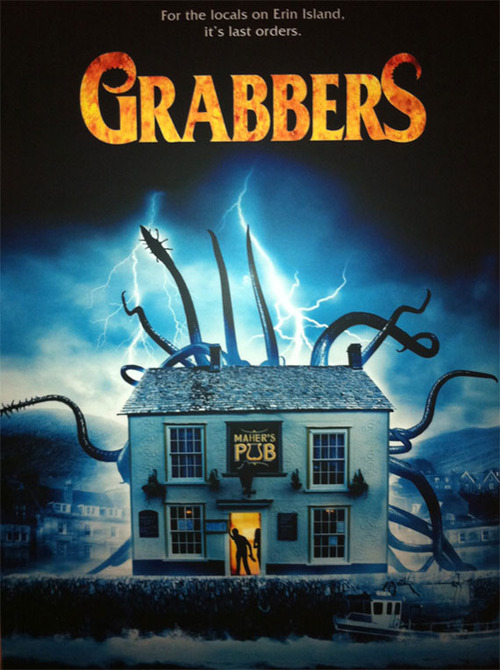
Grabbers (Ireland)
Director: Jon Wright


If there's something the Irish can do it's take the piss. Ahem, in more ways then one. But the occupants of the Green Island are known not only by their high alcohol consumption, but also their good-natured sense of humor and willingness to laugh at themselves. thus, it makes sense that the following high concept would stem from these people: vampiric aliens attack a small village. While they feed on human blood, they are allergic to alcohol, so everyone must start drinking to stay alive through the night. A concept can't get much better than that.

But let's look at the film a bit more closely. Having a strong affection to 80's comedic genre films such as Gremlins, An American Werewolf in London and The Evil Dead, Jon Wright's film's style heavily reminds viewers of last year's Attack The Block. In both an alien invasion makes unexpected heroes of an archetype you'd believe to be as unsuitable for the role as they come. Rather than pre-teen gangsters, however, this time our hero is the bored and alcoholic Erin island policeman Ciarán O'Shea (Richard Coyle)


As in numerous buddy cop movies before, O'Shea is on the edge and gets a new no-nonsense, by-the-book partner. This time it's Dubliner Lisa Nolan (Ruth Bradley). Unsurprisingly, extreme conditions make both of them smoothen the edges of their personas and they meet in the middle ground. But rather than with the leads, the film shines more brightly when concerning its bit-characters. They are also somewhat stock characters from countryside TV dramedys, but since you don't often get to see the vicar getting pissed in a pub, they work wonders here.


As for the aliens themselves, they are suitably icky creatures, a little bit like blue octopuses or starfishes with suitable grabbing tentacles. They provide a good enough threat to create some suspense into this thing, and it often seems our heroic Gardas are battling overwhelming odds. While the film can't be called a splatter by any means, the sudden bursts of violence have much more effect.

All in all, the film is silly, but doesn't overemphasize its ridiculousness. It's a bit more clearly a comedy than Attack the Block, but still not really a laugh-riot. Since that film (which I could have given more stars to, BTW) was as urban as they come, it feels apt that this one has a clear countryside vibe. All in all, it feels authentic and considering it's a quite stupid genre piece, it's quite an achievement.

★★★ 1/2

Shopping Tour (шопинг-тур, Russia)
Director: Mikhail Brashinsky

A lot of Russian tourists do short shopping trips to Finland, although I've never quite understood why. Our shops are not even near anything you'd call cheap and I'd figure most of everything we have is also available in Russia. Perhaps the shoppers are looking for some sort of status symbols, expensive luxury items to brag to their friends. Anyway, a horror film featuring a Russian shopping team coming to Finland for bargains but finding only carnage sounded like another great idea on paper.


Shopping Tour is another one of the handheld camera footage boom. A middle-aged woman (Tatyana Kolganova) takes her teenaged son (Timofei Eletsky) to a fateful one-night tour to Finland. The pair have their own quarrels, and we learn that it's not been long since the family's father has deceased. In Finland, the tourists are informed that they get to be the very first ones to shop at a brand new electronics supermarket, which is open all night. But once the Russians are packed in the store, the doors are locked. The cannibal feeding frenzy of ravenous Finns can begin.


This is quite a cheap film, and it shows. While the two lead actors are quite good in their roles, it becomes apparent (to a native Finnish speaker at least), that all the extras have been hired on a pittance. Nothing else could explain the horrendous acting in Finnish on display here. The script isn't too sharp, either. Exposition and back story is spurted at very unlikely moments when people should be fighting for their lives. Still, this is a one-joke movie and at least I find that joke funny. To delve into it deeper is to SPOIL so look away for the last chapter, sensitive ones.

There's no big reason for the Finns to start eating Russians. They aren't worshipping Satan, or secret vampires or zombies or anything. Rather, it is just a tradition, and one which we Finns hold as dear as a Sauna and a cottage on Midsummer's Eve. Some light fun is poked at the fact that Finland tends to come on top of all the lists of the best societies and best places to live, yet our people are sad and suicide-prone. Mean humor is often the best humor.

★★

Crawl (Australia)
Director: Paul China


The dubious honor of being the only Love & Anarchy film I wished I would've skipped goes to this Australian shocker. I mean, I probably would've walked out but I had some time to pass before the next screening. As it is, Crawl is a dire attempt to capture some of the slow-building tension and macabre bloodshed of several new wave horror films (such as Ti West's House Of The Devil, and from non-horror, The Coen Brothers' No Country For Old Men). It attempts to make some sort of statement about gender politics, but comes off just misogynistic. And not in a fun way.


The sleazy bar owner Slim Walding (Paul Holmes) is tired of an accomplice that hasn't paid back a shady loan. Thus, he turns to a quiet Croatian hitman, known only as The Stranger (George Shevtsov) to finish the guy off. But The Stranger has plans of his own, and plans to turn the tables on Slim. The young waitress Marilyn (Georgina Haig), who has plans to quit working for Slim gets caught in the battle of wills. She is soon taken hostage and must fight for her life to survive.


True to its name, Crawl moves very, very slowly forward. Director Paul China, a former cinematographer, likes to keep things quiet and THEN SHOCK SCARE YOU WITH LOUD NOISES. The imagery is OK, but can't hide how cheap this has been made. The sets in particular look like they have been recovered from a failed stage play. Shevtsov's performance is a bit ominous, yet it takes a bit more than long shots of a quiet drowsy-eyed hitman to make up a good performance. As a contrast, ost of the other cast are just abysmal. The film feels like it has been dropped from teh cliché tree and hit every branch on the way down. It makes a lot more sense to just stay home and watch Blood Simple on DVD. There's nothing on display here that that movie wouldn't have done 10 times better already.

★ 1/2

LinkWithin

Related Posts Plugin for WordPress, Blogger...