Sunday, 9 December 2012

Coping With The Cloud


So after the smoke has cleared and the world has been devastated by nuclear holocaust, what then? Should society be rebuilt as it was, or should the remaining mankind adapt to the situation in a wholly new level? There are a number of ways the world might turn up after the drop of the bomb, but unfortunatelly they are mostly not very fun. Mostly.

Damnation Alley (1977)
Director: Jack Smight


Taking place in the futuristic year of 2012, Damnation Alley is based on Roger Zelazny's 1967 novel, which has been seen as an important predecessor to all sorts of post-apocalyptic stories since. In the book, a ragtag group of survivors take the role of pioneers and drive across America's radioactive wasteland. The loose film adaptation however, released on the same year as Star Wars, is more of an old-fashioned adventure romp than a truly horrifying cautionary tale with barbarian motorcycle tribes. Nevertheless, it does have several quite effective scenes.


First, we have a lengthy opening scene that explains the background of the holocaust of World War III. Lieutenant Tanner (Jan-Michael Vincent) and Major Denton (George Peppard) of the US Air Force see incoming missiles on their radar and launch a nuclear counter-attack. The nuclear apocalypse turns the weather unpredictable and mutates the flora and fauna all across the continent. The world turns increasingly hostile against mankind.


Two years later, Tanner and Denton, still surviving in the Southern California military base, have been waiting for a radio signal to give sign of any other survivors. They finally manage to capture one in Albany. As an explosion destroys most of the base and kills most survivors, they, along with Airman Keegan (Paul Winfield) equip a truck to take them through "Damnation Alley" all the way to Albany. On their way they face numerous dangers and various survivors.


Most of the film is spent (cost-effectively) in the cockpit of the military truck with the survivors arguing. This is not very intersting to follow. But bits here and there make the film worth your while. We meet Tanner two years after the holocaust as he drives a dirt bike across attacking hoardes of giant radioactive scorpions, and lures them away by dropping a decoy woman among them. Later on, there's a particularly nasty scene featuring a swarm of flesh-eating roaches. The story has cannibal mutant hillbillies involved! And a very young Jackie Earle Haley! And we get to see post-apocalyptic Las Vegas (much like the Vegas of our time, except the people).

The special effects are also noticeably striking for their time, particularly the odd-colored and deadly nuclear storms on the sky. It's a fairly entertaining film, but the setting of the thing post-Apocalypse is incidential at best. It could be a space tale, featuring the new pioneers just as well.

★★★

On the Beach (1959)
Director: Stanley Kramer


In the late 1950's, as Hollywood's studio system had started to crumble, and the Cold War about to reach its peak, even major ensemble Hollywood films could be surprisingly dark and morbid. Case in point is this film about the holiday village at the end of the world, which somehow also reflects some features of WWII-era romances but turns their optimism completely upside down. This is a movie with a message, and it's not afraid to rub the audience's face in it.


An Australian harbor town hosts the last surviving Americans after an apocalyptic nuclear war. The American nuclear submarine USS Sawfish comes to the shore. The vessel's commander Towers (Greogory Peck) still harbors hope that his family had survived the nuclear war. He meets the lonely old maid Moira Davidson (Ava Gardner), the owner of a nearby farm. Even though the pair start to harbor feelings for eacho other, Towers can't come to terms with his past and his wife and children's death. At the same time it dawns to the surviving scientists that the Nuclear cloud is heading to Australia and wiping all life in a mere month. This news is taken the worst by the Australian Lt. Holmes (Anthony Perkins), whose wife is expecting their firstborn child.


As post-apocalyptic stories go, this one seems to be adamantly of the opinion that even the most extreme conditions won't disrupt well-worn societal structures. Even with the certain Apocalypse looming in, the rich go to their gentleman's club to enjoy vintage wine, and to be served by common folk. Also military ranks remain, and the end of the world has no effect on their work shifts, nor the respect they receive from the people. Only on the last day of his life, does the faithful butler dare to take a sip of fine wine himself.

As a holiday resort for the damned, the people have the opportunity to do everything that they ever wanted, such as the race car-building and competing Julian Osborne (Fred Astaire). At the same time the looming doom does bring down spirits in even the happiest occasions. There's an odd feeling of uncertainty all through this film, which creates quite an unusual mood to surround it.


Moreso than any season of Lost, this is a movie where it's easy to come to the conclusion that between the lines all the characters are already dead and just spending time in limbo before their final judgement.

★★1/2

Akira (Japan, 1988)
Director: Katsuhiro Ôtomo


Of course, the petty western fears of nuclear annihilation can't hold a candle to horrors in the Japanese subcosciousness. That country is the still only one that has suffered through actual nuclear attacks. The most visually stuning representation of life under the threat of atomic annihilation is of course this classic anime film, based on director Katsuhiro Ôtomo's own multi-part manga series. Whereas the manga series featured gigantic nuclear explosions after another in pretty much every volume of its run, the film has to keep things more streamlined. It's a good decision, since it places more weight on the megalomaniacal explosion that does occur.
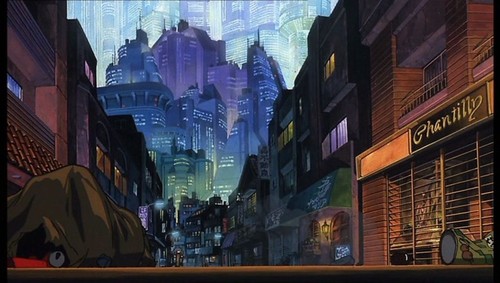

Neo-Tokyo has been rebuilt from the rubbles of a gigantic explosion that totally vanquished it 30 years prior. In 2019, the city is still military led, that at least attempts to keep a society together. In reality, however, the city belongs to criminals, juveline delinquents and their bike gangs. The leader of the Capsules, Kaneda keeps a tight leash on his best friend Tetsuo. While the gang is fighting their rivals, The Clowns, Tetsuo is kidnapped by government agents.


It turns out Tetsuo has powerful psychic skills, which has been caused by a government project to create mind weapons even stronger than nuclear weapons. Akira, the child-god that caused the destruction of Tokyo in 2019, was such a weapon. Unfortunatelly, drunk with power, Tetsuo sets out to search and awaken Akira from his hibernation. It's up to Kaneda and the young revolutinary Kay to stop him.


Despite Hollywood's best efforts, Akira is really a story that can only belong in 80's Japan. The dark, nihilistic world-view is connected to the growing fears of nuclear war in the Reagan era. The film's body horror caused by biotechnological fusion also shows that being blown to molecyles isn't really the most frightening thing about nuclear holocaust. The mutating survivors would envy the dead. The film is also very unremoreseful, killing people in a massive scale.


As a teenager when first viewing this classic, I didn't care for the main character, the frankly quite assholish Kaneda. But Ôtomo's strength as a storyteller comes from the fact he's not doing a straightforward hero's journey story. Rather, the case is a little like it is with Clockwork Orange: the youth is fucked up. We can't do anything about it, but the future will belong to them no matter what we do. In both, the sociopathic, druggy individual is the creation of the society that surrounds it. Stronger, militaristic grip on the little people just creates starker resistance. As the government, also the people opposing give as many shits about collateral damage while fighting against it.

There's only one thing this pill-popping fiend really cares about.

So this decay may be the biggest thing to fear in the case of societal collapse: a lot worse than any radioactive cloud or radiation disease.

★★★★

Thursday, 6 December 2012

Finnish Cult Movies III


Today is the Finnish Independence Day, and as promised, here is another installment of our ongoing look into Finnish films. The word "cult" on use here, is highly problematic, as most of native films have no following of any kind quite. But this time, there are at least fewer films that are obscure to us natives as well. This installment deals mostly with Finnish comedies, funny or not, and how they reflect our national identity. Happy Independence Day!

Numbskull Emptybrook (Uuno Turhapuro, 1973)
Director: Ere Kokkonen


The longest-running and perhaps the best-loved comedy characterin Finland's history is the loitering Numbskull Emptybrook (henceforth referred to in this text with his original name of Uuno Turhapuro), played by the legendary Vesa-Matti Loiri. The character debuted in the TV programme Spede Show in 1971, and proved to be so popular that co-creator Spede Pasanen as well as his go-to director Ere Kokkonen soon transformed the best sketches into a full-scale movie.

As with James Bond, the still-quite-tame first adventure tends to be forgotten when contrasted with flashier bigger adventures (such as (unofficial titles) Uuno in Psain, Uuno gets a job in the Army or Uuno as the President of Finland) steal the spotlight in people's minds. Uuno represents everything every spineless finnish male dominated by his stronger wife dreams to be: a master in his own rights, a man who survives in any situation and is pleased with little. The first Uuno movie was a massive hit of it's time, gathering over 600 000 viewers.


The formula of the movie is easily explained. Uuno (Loiri) is superbly lazy, greedy and hungry. His wife Elisabeth (Marjatta Raita) is cold, grumpy and bossy, the complete contrast. So, in order to get to eat, have some fun, or to get some loving, Uuno resorts to long-winded explanations and speeches that work within their own internal logic. We see Uuno try to survive through a diet, try to get out to go drinking with his pal Härski (Spede), and to go to his summer cottage.

The old sketches are repeated through two first acts. The last act deals with another of Uuno's main attributes: despite his piggish manners and ghastly appearance, he can be the master in anything when he so chooses. So, in this one it turns out Uuno is a master-class violinist, which is something his greedy neighbor Kotkala-Hammaslärvänen (Juhani Kumpulainen) attempts to exploit.


The early sketches feature some of the funniest Uuno material out there, but there's no hiding the fact that this is cut-and-paste filmmaking. The focus is also lost completely in the final act, which turns out to be quite dull. But the main actors are perfectly cast, even if the Turhapuro family hadn't yet cast some of its best players (such as Uuno's father-in-law, usually played by Tapio Hämäläinen). The scale of the film is refreshingly down-to-earth, mostly dealing with the relationship between one stereotypical married couple. Plus, there are several actually smart visual gags, such as Elisabeth piling up a pyramid of empty beer bottles during her introduction scene, which tells heaps on the conditions she lives in.

Sadly, the success of the first Uuno also changed the course of the careers of Spede and Ere. Where previously they had created quite inventive, unexpected and well-crafted comedy together, from there on out they relied in repeating gags and bits that people already knew. It also didn't help that they started to get less and less money for their projects. Uuno would go on to have 18 more cinematic adventures until the last one debuted in 2004.

★★★

Ripa ruostuu (1993)
Director: Christian Lindblad


The 80's and early 90's in Finnish cinema history were notorious times for two reasons. First and foremost, the country suffered from the tightest cencorship board in the whole Europe, which was notoriously bad for getting any movies featuring sex and violence released. For the finnish filmmakers, the National Film Foundation was a bigger problem, since it adamantly refused to give money to any project it deemed unworthwhile. All in all, it was a time when officials and authorities decided what was suitable as art and what wasn't. This Aki Kaurismäki-produced film stems from these problems.

Christian Lindbland's brainchild takes its form from the artiest of films. It is shot on grainy black-and-white tape and at times uses fast-cut collages or montages to advance its plot. Yet the film also ingrates within itself the shunned sex and violence, and a pulp fiction-styled story in a quite clever way. And also a year before Tarantino's big break! At the same time it is a film about filmmaking, which is balancing between the line of art and entertainment anyway.


The sleazy deadbeat Ripa (Sam Huber) wants to be a film director. Yet all his scripts are turned down for having too much sex and violence. He owes a large sum of money to his ex-wife, who pesters him about it constantly. But he also has no other source of income, so he's growing more and more desperate. But at the same time he's quite the ladies' man. A beautiful young bank clerk (Mari Vainio)
falls for him, but he is more interested in solving his monetary problems than to constantly have sex with her.

The film acknowledges it's debt to old film-noir classics when in reality it is more akin to being a Neo-New Wave film. But it manages not to fall into the pit of being too analytical or fancy-pants. It's first and foremost a tale of decadence, a bohemian life that destroys all artistic ambitions one may have. The sleaziness of Depression-era Finland, and common pulp archetypes are brought to life with a confident hand. The prize for the most hilarious character goes to Vesa-Matti Loiri, cameoing as Ripa's businessman father.


Telling anything more about him would be spoiling the film, so seek it out!

★★★ 1/2

Olympian Holiday (Loma, 1976)
Director: Risto Jarva


Of the final three of Jarva's comedies, Loma has been my least favorite. There's actually nothing wrong with the film itself, in fact I find it fairly accuratelly depicts what happens when you have a group of regular finnish folks on a vacation. And that disgust me at some extent. In the 70's mass tourism became more affordable for all finns, and thus Torremolinos, The Canary Islands and Madeira in particular had to suffer through hoardes of backwards finnish folk, warts and all.

The bank clerk Aimo Niemi (Antti Litja) plans to head off to the Innsbruck Winter Olympics on his holiday. But there's a mix-up at the airport and he flies to the Greek Island of Rhodes. He finds out he's been mixed with a woman that shares his surname and thus has been booked to share a hotel room with the cranky woman reporter Marjukka (Tuula Nyman). She rejects Aimo at the get-go, figuring he's up to some tricks to bed him. Aimo hower attempts to enjoy his accidental vacation, even though his suitcase is filled with winter clothes. He just needs to rely on some scissors and a lot of creativity.


Jarva as a filmmaker relies on not telling everything but leaving certain key points somewhere between the images. He trusts the audience to grasp what's going on fairly quickly, and spends more time on the holiday imagery and build-up to embarrassing situations. Litja is great as the quiet, timid and a little spineless archetype of a finnish man, who can't bring himself to complain even when others fumble and mix up things for him. He also gets caught in a triangle drama, since he starts to pine for a Greek woman he sees as a Goddess. At the same time his recluctant roommate slowly starts to warm to him.

But as I said, the main thing that I get from this is how being abroad can really bring up how much the Finns can be jerks. They sing in choir nationalistic Finnish songs all the time, insist on eating Finnish foods and demand to do things the Finnish way. The hard-drinking, partying way isn't depicted here so strongly, the viewpoint is decidedly middle-aged. I had to double-check the film takes place in Rhodes, since the tourist village featured in the film could have been shot anywhere in the world.

★★★

Sixpack Movie (Pussikaljaelokuva, 2011)
Director: Ville Jankeri


Only a year old, but since this film is based on the cult novel by Mikko Rimminen, about loitering 20-somethings, it has already gained a following. Rimminen's novel makes it a point to be mostly about nothing, just three buddies nearing 30 drifting along one day in Helsinki's Bronx, Kallio. The book's biggest problem is that every character in it sounds more or less like Mikko Rimminen. There's not a lot of diversity in speech patterns or anything. The book also relies much on long strains-of-thought which could be problematic in another medium. But the film adaptation manages to fix many flaws and work around the problems caused by the flimsy source material.


The tired Marsalkka (Jussi Nikkilä) would just want to sleep in his shoddy apartement, seething in self-pity. Yet his friends Lihi (Ylermi Rajamaa) and Henninen (Eero Milonoff) insist him to venture outside with them, have a few beers and perhaps shoot some dice. Something has also occured in the apartement above Marsalkka's which doesn't make him want to stay home. The trio goes around drinking, talking about this and that, trying to pick up some girls, looking for shoes and earning the anger of a pair of assholish police officers.


The film does reach at times the feeling of the early Seinfeld seasons, where it's about nothing, yet feels comfrotably familiar and is funny at the same time. The motivation for the dudes drifting around is given at certain points the search for an environment to shoot dice, sometimes the need to get away from Kallio. In both cases it does seem like the main characters aren't really trying. The questions on whether these unemployed men have it all right in their lives, is wisely not undelined that much and mostly left to the watcher's imagination.


The three main characters are perfectly cast, and all three make Rimminen's text sound like it could be actually spoken aloud by living persons. Not all the characters are as well-acted and particularly the young girls in the film give at times cringe-worthy performances. The real star of the film is however the neighborhood of Kaillio, a place where a lot of young folks live in seedy apartements and go to pubs in search for cheap beer. The milieu is lovingly shot, even if the geography doesn't make a lick of sense at times. The film can be seen to be a true experience for certain members of the same generation,

★★★ 1/2

Lapland Odyssey (Napapiirin sankarit, 2010)
Director: Dome Karukoski


Two years ago, this comedy was the most watched film in Finnish theatres so it might be too mainstream to warrant a "cult" status. But since somehow this has generated some interest abroad as well (it just received a release in Russian cinemas), it pays to deal with it anyway. At the film's core there is a want to bring a message abroad on how Finns are like, and how Lapland is like, anyway.


Janne (Jussi Vatanen) is a bit dim, jobless young man living in a small town in Lapland. His girlfriend Inari (Pamela Tola) demands that he goes to buy them a digital TV box to view television transmissions. As he just uses the money he's received on beer, Inari tells that she's had enough of his spinelessness and moves out of their home. Jussi promises that he will get a digibox before the night is over. He sets off with his friends Kapu (Jasper Pääkkönen) and Räihönen (Timo Lavikainen) to get such a gizmo from her father in Rovaniemi. But the night is long and the men face various incidents before they can get their hands on the box.


The film's biggest problem which it can't overcome is the fact that the film's central romance doesn't work. Janne is a dumb asshole, with a mean streak (like peeing in his rival's wine bottle) that no one in their right mind would want to succeed. Inari is no more symphathetic, as she's dumb enough to put her whole future and her relationship on such a trivial thing as whether she gets something or not. She harbors a certain secret which would be a lot more comfrotable to talk about face-to-face than to make up quests and send his man there. The film's gender views are aggressively conservative.


Karukoski shoots Lapland and the whole film in particular like ist's a plastic snow-globe, all back lit, colorful and fake-snowy. The rivalry between the main characters and "the wankers" from Kittilä seems to be stolen from The Wedding Waltz, yet is not even the tenth of as funny.


There are still various bits in the film that somewhat work, and are even funny. The momma's boy Räihönen tends to play a show-yer-tits arcade game at a local pub, and later happens to meet the model posing in the pictures at a bar. Marjukka (Miia Nuutila) is desperate enough to agree to have sex with a 20-something virgin creeper, but the pair is seperated because of Jussi's own needs. This sub-plot is quite funny, and would have made a good short film. It's too bad one has to take a lot of wannabe-O Brother Where Art Thou crap before that thing can comfrotably continue.

★★

Makkarakalakeittoa, sano Tympee Huttunen (1988)
Director: Kaarlo Kortelainen


On the most obscure part of this article is this straight-to-VHS sketch comedy that has seen by very few, and can't be said to really have a following, "cult" or otherwise. But dang if it isn't one of the strangest Finnish films, comedies or otherwise, I've ever come across.

The film stars Leo Lastumäki, best known from Sheep Eaters, dealt within this blog's last Cult Movies post. His major role here is "Tympee" Huttunen, a grumpy old man living in an almost desterted village in the middle of nowhere. Whatever happens to him, he describes it to be "Dreary" ("Tympeetä"). The movie's sketches showcase him and the other eccentric occupants of his village (played by such names as Aake Kalliala, Tuija Piepponen and Martti-Mikael Järvinen).

The film seems like it was shot by a number of friends during one drunken weekend at a summer cottage. It does have more professional people involved than that, but the whole thing is as badly scripted, acted and cut. The musical scenes take long, but the music is godawful. Many times the narrator's speak is put over characters talking, and the mumbling by itself is so quaint, one can't often tell what anyone is saying. That's probably for the best since the film's skits are horrible if you get them. When you can't tell what's going on, the film becomes almost surreal.

Huttunen watches his wife's butt as she's kneeling to pick some berries from a bush. The man sees bikini-clad ladies waving for him instead of his old lady. The next shot is the wife being tied and gagged on the back of a mini-tractor Huttunen uses to drive around the field. End skit. There's a musical number about rushing over to say hi to one's neigbors which as a looooong take of an actor saying hi to the camera by lifting each of his arms at times. End skit. Three different scenes of Leo Lastumäki berating a waitress in various ways at the local pub, back-to-back. End skit. Aake Kalliala playing a doctor who harrasses his secretary. Cut these along with very odd reaction shots about various characters that had nothing to do with the sketch, and you have the kind of disgusting sausage-fish-soup the film is named after.

These odd goings-on have nothing to do with each other, so when not understanding the sketch, this becomes an almost lynchian nightmare on how the deserting countryside breaks the last occupants' minds and spirits. That's why they become to act in feverish, odd ways. It may be just a Finnish country comedy at its worst, but it is so poorly made, it makes for all kinds of new interpretations.

★ or ★★★★★

Saturday, 1 December 2012

Night Visions Maximum Halloween 3012


Night Visions Maximum Halloween 3012. Even writing the name of the festival makes me tremble. It was very, very cool. I wrote several extensive reviews already for the Elitisti web magazine, so check those out if you happen to know Finnish. But since I hadn't the time or the resources to write about every single film I saw at that festival, I'll leave the scraps here. But never fret, for since the festival's quality this year was nothing short of brilliant, there were plenty of interesting new genre pieces to go here, too. This year at Night Visions saw a rise of thrillers that didn't quite fit the regular horror form the festival is known for, but won audiences over by their sheer inventiveness and quality.


Berberian Sound Studio (Great Britain, 2012)
Director: Peter Strickland


This Italian-shot Brit thriller had plenty of positive buzz surrounding it. And I was both disappointed and satisfied with the resulting film simultaneously. Director Strickland plays with the sort of mental breakdown story that horror fans know by heart from the films of classic directors from Polanski to Cronenberg. The difference here is that Strickland isn't twisting the screw of suspense as tightly as those two masters. But audio-visually his film is on par with those masterpieces.

The timid sound engineer Gilderoy (the sublime Toby Jones) is summoned to Italy to work on a movie he knows nothing about beforehand. The middle-aged man is still a real mama's boy, and pines for peace and nature. But his work requires him to stay at an artificial environment at all times, working with artificial sounds. To top all that, he finds the Italian film producers, led by Francesco (Cosimo Fusco) sleazy and unpleasant. The film he is working turns out to be a simple-minded torture-porn, all squishes, slashes, burning flesh and screaming young ladies. So Guilderoy's sanity slowly begins to crumble.


The film homages the old genre films made in the 70's. For fans of giallo and other violent Italian film, there are plenty of references to classics. But generally, the film resembles more artistic thrillers such as Blow Out or The Conversation, as the plot moves forward very slowly, and at first only tiny, almost insignificant little signals hint that something is very wrong.

The film tricks the viewer himself by mixing up timelines, fact and fiction and various layers of the story. These methods bring to mind Oliver Assayas's Irma VepBerberian is very confidently handled, and in a way that doesn't give any sense of catharsis or ending. This leaves the viewer hugely unsatisfied, which makes for the biggest flaw and the biggest strength of the film at the same time. Sometimes we need something to irk ourselves a little.


In the end technology destroys the nature-minded main character. He begins to infuse together with the very machines he works with. Mark Kermode compared the film to Videodrome. This comparison didn't cross my mind watching the film because there are so many more obvious (visual) inspirations. But that comparison is in fact perfectly apt. In both films, our subconscious, it's worst fears and greatest desires fuse together with an obsession to the means of a technology to create a hideous mutant.


Subsequent viewings may raise this film's score considerably in my mind. One thing is clear, the audio-visual strength on display here is so powerful, it is a pure waste of time to even attempt to watch this anywhere else than at a proper cinema.

★★★ 1/2

Tulpa (Italy, 2012)
Director: Federico Zampaglione


From one tribute to old Italian horror cinema to the other. Whereas Berberian attempts to say something about old movies and their technology, Tulpa is more pure regurgitation. It has the same inherent sadism than the films of the likes of Lucio Fulci, and the same obsessions with sexual perversions, laced with violence. But story-wise it fumbles up even worse.


Lisa Boeri (Claudia Gerini) is a tough-as-nails business woman by day. At night she likes to head off to an underground sex club to bang masked strangers. But it appears that a mysterious black-gloved stranger is following the club patrons home, and murdering them in the most brutal fashions. Ever-growing worry of her own survival starts to ruin Lisa's daily businesses, and she attempts to find out the identity of the killer before she gets offed too.

The film has at times a very odd, dreamlike quality, best presented by the creepy thin butler of the club (Nuot Arquint). This is contrasted by the very violent, pitch-black humour and sadism-laced murders. the best among them is a young lady's horrible merry-go-round trip around a ball of barbed wire. Even the strongest violence does have a surreal quality and doesn't feel like sheer torture-porn.


But the film loses steam as it goes along. The final act is a mess, with nothing remaining to hold the audience's interest in the mystery.

The film had it's first screenings at this year's FrightFest and Sitges festivals. After those screenings, the film was reported to be ludicrously bad, with its hokey dialogue and inexplicable plot-holes. After a frantic re-cut, the movie is mostly just dull. I probably would have greeted the stupider and sillier version more warmly.

★★

The Seasoning House (Great Britain, 2011)
Director: Paul Hyett


A feminist thriller from the Balkan war would seem to fit Love & Anarchy or Artisokka better than Night Visions. Still, the resulting film was still one of the most suspenseful of this year's lineup. The film is the feature debut of special effects wizard Paul Hyett, and very surprisingly it relies more on stark characterizations, moods and athmosphere than buckets of gore or any supernatural scares. The film is very realistic in all its violence, which makes it all the more scary.


In 1996, soldiers have locked the young ladies of a occupied village into a house where they come to rape them. The captive girls are kept under strict order by the house's master Viktor (Kevin Howarth), so as to please their clientele. But there is one girl that Viktor has spared form sexual violence, the deaf and mute Angel (Rosie Day). Viktor hasn't got anything good in store for her either, he just likes to torment her and keep her in fear as to when he will violently pop her cherry. But Angel has got an ace up her sleeve, she is small enough to fit into the ventilation shafts and crawlspaces of the house.

Much of the time the silent Angel goes around offering to help her fellow captives however she can. They are tortured, tied to beds and brutalized on a constant basis. As Viktor and the visiting soldiers get more and more ruthless and brutal, she makes up her mind to have her bloody vengeance on the lot.


Hyett utilizes the blueprints and the cross-cut of the house rather brilliantly. The viewer follows Angel through wall-busting transitional shots. The character moves from being a victim to being a vengeful, unreachable ghost to become hunted like an animal. Hyett's cynical and gray-scaled photography is hopless and cynical. The film piles up ghastly things so thickly and often that the viewer becomes numb to its horrors before the end. But the film is still very close of becoming a future classic. The only thing stopping it is that a film this harsh and brutal isn't one anyone would want to return to.

★★★ 1/2

Shogun Assassin (Japan/USA 1972/1980)
Directors: Kazuo Koike, Robert Houston


Roger Corman's film releasing company bought the rights to Kazuo Koike's classic Japanese samurai/ninja series Lone Wolf & Cub in the late 70's. Producers David Weisman and Robert Houston realized a super-violent serial hinging so tightly in Japan's history, and so purposefully repeating itself, wouldn't be a success in the west. So they had a bright idea to cut the first two films of the series into a new one, thus giving the film more of a dramatic ark and making it resemble a revenge western more. The film was also laced with modern synthesizer music and English dubbing. Against all odds, the end result was quite good, and became a classic among gore-hungry action fans.


The small boy Daigorō (Akihiro Tomikawa) narrates the story of how his father became a wandering ronin, a samurai without a master, home or honor. The executioner Ōgami Ittō (Tomisaburo Wakayama) is the right hand of the shogun of the Yagyu clan. The cruel, power-hungry shogun brings hundreds of prisoners of war for him to kill, but at the same time becomes fearful of his servant's skills and brutality. He orders his ninja assassins to kill Ōgami  but they only manage to murder his wife. The furious Ōgami makes his infant son Daigorō choose between life and death. Since the boy chooses the way of the sword, Ōgami doesn't gain straight revenge on his former master which would be suicidal. Instead, he sets off to walk around Japan and live by accepting the odd assassination job. The shogun's pursuing henchmen he can off one by one if he has to. And he is totally able to, too.


The cinema hasn't really seen a protagonist as bad-ass as Wakayama before or since. The stoic, chubby man appears to be always carrying grudges, yet can have surprising scenes of tenderness and care when taking care of his son. At the same time he suffers no remorse in cutting his enemies into tiny pieces and letting blood flow like geysers  The comically overblown amounts of splatter and inventive fight scenes make the film exciting. But the real value is in the surprisingly poetic, quiet scenes just before the slaughter. The film thus shares something with the films of Sergio Leone.

In the end, like in a true serial, Ōgami's exploits have no proper end. The wandering knight and his son just wander on to new adventures, on their never-ending walk to hell.

★★★★

Seeding of A Ghost (Zhong gui, Hong Kong 1983)
Director: Chuan Yang


At first glance, this year's final film of the festival didn't seem to be as insane and hilarious as previous Night Visions closers. But this Shaw Brothers horror classic gets crazier and crazier as it goes on, to the point where the oddity is so mind-blowing one has trouble keeping up with all its twists and turns. The early screening after a night of staying awake might be to blame. But more probably it's the fact that this film is so sprawling with ideas that the viewer has no time to recover until the next one comes from out of nowhere.

Why hello there! Am I delirious or is this really happening?
A regular Hong Kong taxi driver Anthony Fang (Norman Chu) hits a man while driving in a dark and gloomy street. He is relieved to see the man survived, but then the victim reveals himself to be an evil sorceror and promises that Anthony is cursed from there on. Anthony shrugs this off since he has a beautiful young wife (Mi Tien) to go home to. But soon, she grows ever more restless and embarks on a relationship with the card shark Fong (Norman Tsui). Coming home from her lover, she ventures into a dangerous neighborhood and is raped and murdered by hoodlums.


The broken Anthony seeks the evil sorceror to help him. The wizard promises to bring her back to life, but swears to use dark forces with will fare badly on the man already jinxed with bad luck. Anthony doesn't care. So, the wife is brought back as a supernatural zombie, but she's not particularly happy about it. The evil magic zombie starts to have her revenge on everyone who irked her, as well as their whole families, her former lover first and foremost. The resulting havoc destroys everything it comes across.


While the first half of the film is sold on ridiculous soft porn sex scenes, and stupidly melodramtic romance, the real fun begins when black magic comes properly into the picture. The resulting fight between the forces of good and evil are nothing short of spectacular, and feature a lot of actually quite good effects work. Blood and guts are pumped out ridiculous amounts. The film also develops the then-popular themes of body horror by featuring plenty of odd mutilations and human body parts turning into bloody, monstrous appendixes.

The film plays a lot on the presumed fairy take ending of love and goodness triumphing over hate and vengeance. But the film packs a mean punch, and its final scene in particular is deliciously wicked. I am not an expert on Chinese folklore, but I would have to say, if this represents it, the country is a lot more insane than I ever imagined.

★ or ★★★★★

So that was that. I hear the theater itself is calling me to return again and again. It's saying... I've always been at Night Visions.

LinkWithin

Related Posts Plugin for WordPress, Blogger...