Friday, 24 June 2011

Midsummer with Coffin Joe

Image from Soiled Sinema

We Finns celebrate the brightest time of the year by having the Midsummer's eve (this Friday) off from work to go to our summer cottages to get drunk. All sorts of mysticism is connected to this magical evening, yet to my knowledge no horror movies are based on this date. But there's one character that lurks around midnight to possess your soul and would enjoy the free love and bright nights of Summery Finland: Coffin Joe!

Coffin Joe is the trademark horror character of brazilian director/actor José Mojica Marins, originally known in the Portuguese-speaking world as Zé do Caixão. The long-nailed bearded undertaker usually wants to secure his bloodline and thus seeks to impregnate girls and sadistically kill their husbands. And is dressed stylishly in a black cloak and a top hat doing so. The "official" Coffin Joe canon consists of a trilogy of movies written, directed and starring Marins. Like many popular characters tend to, Coffin Joe too lent himself to do a little unofficial moonlighting. The surprising thing is that Marins himself appeared in several of these and even directed some off-canon work. The final part of the Coffin Joe saga, Embodiment of Evil only recognizes the first two films as canon. As I happened to have access to one of the rip-offs, I'll include it here, too.

At Midnight I'll Take Your Soul (Á Meia-Noite Levarei Sua Alma)
Director: José Mojica Marins, 1964


Coffin Joe is the sort of character that can only come from a devotedly Catholic country, such as Brazil in the psychedelic '60s. His first appearance is a sort of cautionary tale of renouncing the fundementals of Christianity. Joe (or Zé) is still a mortal man, albeit being nasty, violent, and a total misogynist pig. And a sort of anti-hero too, of course, as Marins seems to have a blast playing him.

Zé is the undertaker of a brazilian village. One Sabbath he demands to eat meat, altough his wife insists it's a sin. Zé gets his will, but his murderous disdain for his wife grows. It is revealed that Zé is obsessed of having a son, yet his wife can't bear one. Zé starts to court Terezinha, the wife of his friend Antinio, but is refused. Thus, he comes up with several fiendish plans to concieve a son, and is not afraid to kill people to achieve this.

I dig that at the beginning of the film, Zé is a respected entrepeneur in his village. As he acts like a total evil bastard right from the start, it's a wonder that Antonio is his friend in the first place or that the villagers haven't chased Zé down with pitchforks and torches years ago. Yet in Marins's world the supernatural is commonplace and prophecies and such tend to come true. This creates a nice aura of mystery over the whole film. Coffin Joe gets what he desrves by the end, but that won't keep him from coming back.

★★★ 1/2

Tonight I Will Possess Your Body (Esta Noite Encarnanei no Teu Cadáver)
Director: José Mojica Marins, 1967


Like a good horror sequel should, the second installment in the saga of Coffin Joe forgets Joe's fate in the previous movie quick (but not entirely) and soon returns to the status quo. The citizens of Zé's village are quite forgiving for his murder spree, I must say. Zé exploits some basic horror clichés and acquires a hunchbacked henchman, Bruno, to do his bidding. Zé is still looking for a bride to concieve a son with. That's why he kidnaps six women and runs various tests on them to see which one of them is worthy. Kind of like the horror film version of The Bachelor reality series, but less scary, more funny. (What timely jokester I am!)

Zé gets pretty close to achieving his goal, with having a suitable woman fall for him, but the men in the village of course interfere. Murder and mayhem soon follows. I think the sequel is more sure-handedly made for Marins to fully experiment on his crazy ideas. And they are entertainingly cool all the same. The eye-popping colored section in an otherwise black-and-white film, where Hell comes to Earth, is unforgettable in all its psychedelia. Zé, or Joe, himself acts more like a classic horror monster than a total asshole that's enounced Christianity now. The punishment of his crimes is much harsher this time around, so much so that Marins actually has him become a born-again Christian in his final moments. Many see this as a needless turnaround for such an evil character, but I see that Joe actually is such a slimy rogue, that he's willing to jump the ship when all chips are down. This spinelessness just makes Joe all the more endearing to me.

★★★★

The Bloody Exorcism of Coffin Joe (O Exorcismo Negro)
Director: José Mojica Marins, 1974


The Exorcist was a huge hit in 1973, and one of the most blatantly imitated films ever made. The following year José Mojica Marins himself came to feed on the carcass and reserructed Coffin Joe in the process. Quite interestingly Marins actually has a double role in the film: he plays himself as well as Coffin Joe. If this meta-level story twist sounds familiar, one must be thinking about 1994's New Nightmare, where Robert Englund played himself as well as his signature horror character, Freddy Krueger. Truly, Marins was a pioneer in the postmodern horror filmmaking field.

It's a pity the rest of the movie isn't up to the idea. In the story, Marins, the famous movie star, arrives to his friend Alvaro's house to spend Christmas with his family. Marins doesn't initially believe in Coffin Joe's existence, but his arrival triggers a series of weird phenomena in the house. First, Alvaro's father becomes possessed for a while and proclaims he's out to collect the whole family. Lamps explode, books fly at Marins and, hilariously, the Christmas Tree decorations turn to a python and some spiders. This prompts a truly terrible child actor to stand in her place, point at the tree and cry: "An Animal!" It turns out the family's eldest daughter Vilma, is adopted and actually the daughter of an evil witch. The with is triggering the events and tries to get the family's mother to give her older daughter back to be wed to Coffin Joe himself.

Image courtesy of Cinema of the Worlds
Joe isn't his old self in the film. He barely speaks, let alone has a single maniacal monologue he's so famous for in the previous films. Here he simply represents the ultimate evil, and is merely Marin's way of exploiting his previous reputation. The film has a few good moments, but mostly it just drags, is shoddily acted and poorly staged. It is clear vintage b-movie stuff, so if one likes that, there are far worse films to spend some time with. but of course, with the original Coffin Joe trilogy, there are better ones as well.

★★

The Embodiment of Evil (Encarnação do Demônio)
Director: José Mojica Marins, 2008


After years of imprisonment (!) Coffin Joe is released to the world. The years haven't changed Joe one bit, so he still seeks a woman to be a mother to his unborn son. At long last everyone knows what Joe is up to and he is a feared character. He gains a following of cultists in the film, and at the same time two vengeful policemen on the edge are out to stop him. The police are also being assisted in their pursuit of Joe by a fanatic Christian priest.

This is what Evil looks these days. Image courtesy of Coffin Joe Wiki.
It's to see that the nearly-octogenerian Marins hasn't watered the character of Joe down one bit, even if his beard is grey and has some extra baggage. Au contraire, Joe answers the trends of modern horror films by doing a lot more torturing this time around. In one memorable scene he cuts of a woman's buttock and feeds it to her. Marins must have been reading Voltaire.

But for all his sadism, the sins of the past come back to haunt Joe (and nicely recall the events from earlier movies to newcomers). Marin's knack for visual style is well served by having black-and-white clips serve as ghosts in a colored background. The further exploits of Joe aren't exactly as black and white as before in theory, too, as Joe opposes corrupt police forces and religious fanatics. However, the modern age of cinematic wonders have made the whole deal seem far less impressive, and the film does repeat itself at times. For a sequel 40 years after the previous movies, it is still a fine piece of work.

★★★

So a good Midsummer's night to all my readres. Remember, Coffin Joe is just a legend, but what ever you do, don't say the name of Candle Jac-

Thursday, 16 June 2011

The Directors: Ethan Coen (Part 2/2)

Ethan Coen - not pictured: Joel
Read the first part of my epic Coen brothers retrospective here.

I don't know what it is about these Director posts, but I love to plan them but when it comes the time to write them, it feels like a chore. So that might explain why this installment is so late (like all its predecessors).

Ethan Jesse Coen (1957-) is the younger of the two brothers. He first got the credit for his directing from The Ladykillers, but in fact he's been behind the camera as much as Joel from Blood Simple on. Because of SWG regulations, he's had to suffice to a mere Producer credit before. One would expect brothers to have quarrels over their projects, but surprisingly no actor working with the Coens has ever seen them argue. It seems the Bros. almost always agree on how things are to be done to create their brand of films. Perhaps it's this hive-mindedness that makes the Coens so great. After all, if there would be another one of you, it would be easier to notice the mistakes you're about to make and to enforce the strengths in your work.

O Brother, Where Art Thou? (2000)
The State: Mississippi


Like they did with Fargo, the Coens messed again with audience expectations by declaring right off the bat that this film, set in the Deep South around the days of the great depression, was based of Homer's Odyssey. And the film's title, of course was borrowed from a Preston Sturges film, also set to the same area and period but having little more to do with the resulting film.

The Coens actually didn't base the film's plot to the Odyssey any more than any other film that features some sort of a quest for the protagonists. Of course, they can't resist throwing in a couple of jokes about the matter into the film, with both character names and having such things as a one-eyed villain and some alluring ladies by the water, that allude to the mythical creatures such as cyclopses and sirens.

Ulysses S. Everett (George Clooney), Pete (John Turturro) and Delmar (Tim Blake Nelson) are three fugitives on the run from the chain gang. They seek way back to Everett's wife, Penny (Holly Hunter) and to recover the stolen booty they hid before their capture. Along the way they have a wide array of misadventures, that sees them for instance become hit bluegrass artists. Like an old prophet warns them, however "the treasure they find is not the treasure they seek".

The basis of the movie is to have a sort of road film to places where there are no roads. The Coens are visibly having fun with everything old-time-Americana and with the stupidity of their protagonists. The film does have great jokes and set pieces, and with many other directors, this would bring the film to their greatest accomplishments. The Coens, however, are special, and it still does feel like something important is missing. Maybe the problem is the ending, which is a little too Hollywoody for its own good. The film had an important impact, as it brought the world its fine soundtrack full of old-timey bluegrass and folk music. The record went on to become a huge seller, particularly in the US, and brought the music to a whole new generation.
"Damn, we're in a tight spot!"

★★★★

The Man Who Wasn't There (2001)
The State: California


The Coens then started their three-film and six-year slide, which made all film fans nervous about their career. None of the films from this perios were bad per se, but previously the Coens had never had two underwhelming films in a row, let alone three. And all of them are from genres they should excel in. The first was film noir. The Coens actually shot the film in black and white (and my DVD is for some strange reason re-colorized).

In Santa Rosa, a barber called Ed Crane (Billy Bob Thornton) grows weary of his work, as he doesn't talk much and the job requires him to be chatty. He ventures on a business deal with one of his customers, who is looking for a partner in his dry cleaning business. Ed decides to get the starting money by blackmailing his friend Big Dave (James Gandolfini) who he suspects is sleeping with Ed's wife Doris (Frances McDormand). But this small act snowballs its way into Ed's life and wrecks everything in its path. The laconic Ed still only shrugs.

The Man has a feeling of being a sort of testing ground for the brothers. The Coens have done so fast-paced films in the past that this one is positively snail-like in its slow storytelling. Even the dialogue has long, awkward pauses. The film is also mixed with some pulp mystery material of the time, which, I think, is another way of fucking with audience expectations. They suspect a traditional noir, where the hapless hero slings one-liners and is in control, and the dames are clever and dangerous, but really all of them aren't that smart by a long shot. It's all well and good, but The Man has actually boring parts altough the storytelling doesn't actually drag at any part. The whole movie is just too laconic.

★★★

Intolerable Cruelty (2003)
The State: California (yes, again!)


The Coens had never done two sequetive films that were set in the same state, but California seemed to be as good a place for any for the story. It is, after all, a modern romantic screwball comedy featuring beautiful women and handsome men embarking on some witty word exchange. But somehow, the end result may be the most tired of the Coens whole resumee. It's still not exactly a bad film, just disappointing.

Miles Massey (George Clooney) is a famed divorce attorney, that gets a job to handle the divorce of a wealthy real estate developer Rex Rexroth. But the soon-to-be ex-Mrs Rexroth (Catherine Zeta-Jones) proves to be more than a match for him. The pair embarks on a flirtatious affair, where each of them can betray the other with a beat of an eyelash.

Oddly, with this comedy it seems that the Coen's funnybone is out of date. They can create good characters, but don't really find enough to do with them (Geoffrey Rush is particularly wasted). The banter between Clooney and Zeta-Jones isn't that interesting and it's only up to the final minutes to salvage the film with some truly unimitable plot turns. But the time before that mostly drags and doesn't really get one's hopes up, which is why it comes as such a pleasant surprise. As it seems that not even the Coen brothers can truly save the traditional romantic comedy, it just feels like another nail to the coffin of the genre.

★★★

The Ladykillers (2004)
The State: Mississippi


Many would argue The Ladykillers is the worst Coen film. I myself understand this view, but I've had an affection for the film ever since I saw it, even though I recognize it's flaws. For The Ladykillers made me laugh, and once I'm amused, it's hard for me to turn my back on the film that succeeded in doing so. It's an update of a classic British comedy, and the Coens turn it so Americanized, it's almost a parody of American comedies. There are plenty of fart jokes in this one.

An innocent-seeming professor Higginson Dorr (Tom Hanks) rents a flat from an elderly woman (Irma P. Hall) and asks, whether he could use the space for his band's practice. In reality, the professor and his accomplishes are planning to break into a Casino vault. But it seems that a feisty old southern lady
is more than a match for even a gallery of rogues, and their plans keep backfiring.

By far the best thing about the film is character actor J.K. Simmons, who really should be in more of Coen brothers' films. His character has the ridiculous name of Pancake, and he suffers from an irritable bowel syndrome, thus providing the aforementioned fart jokes. He also quarrels a lot with the gang's inside man, former casino worker Gawain (Marlon Wayans of all people). I did see the original British film after this one, and it certainly has more dry humour as well as it's darker in tone. In the Coens' film, as you'd guess, all the robbers are huge idiots and thus partially responsible for their fates. It's not as clear in the British one, as even clever people who turn their skills to the wrong antics tend to get unlucky. But as Irma P. Hall's granny is highly religious, loud-mouthed and not that likeable, the Coens do thread a lot of grey area and it's not as clear, who's good and who's bad. That may be a problem with mass audiences (at least in comedy) and the film was a flop.

★★★
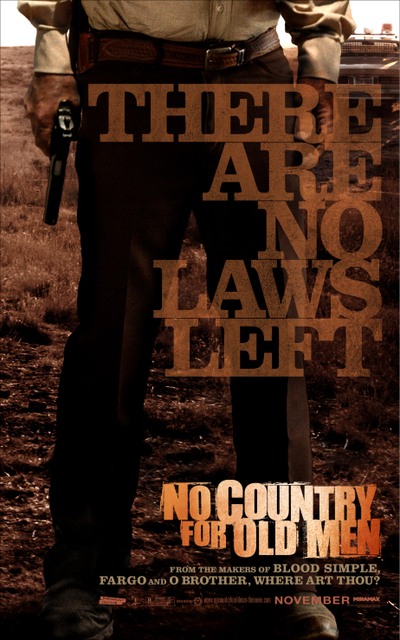
No Country For Old Men (2007)
The State: Texas


The Coens took a few leap years (in which they only did a segment in the episodic film Paris, je t'aime) and came back with a bang. And sweeped the table from Oscars from their trouble in perhaps the best big gong winner of the last decade. It's a wonder the usually conservative Academy voters were so keen on such a dark and multilayered film about the decline of America. Texas somehow always brings the darkest to surface from the Coens.

Hunter Llewelyn Moss (Josh Brolin) comes across a number of dead mexican drug dealers. Among all the bodies he finds a briefcase with millions of dollars contained. Convinced no one saw him took it, he runs off with the money. But actually the case contained a homing device and a freshly escaped hitman Anton Chigurh (Javier Bardem) starts to relentlessly hunt the hunter down. Chigurh believes only in chance, and has no value for human life save for the chance one might survive an encounter with him. An elderly sherrif Ed Tom Bell (Tommy Lee Jones) follows the trail of blood well behind the pair, horrified of such disregard for any old-fashioned decent values.

Based on the novel by Cormac McCarthy, the midwestern Texas is depicted almost like a postapocalyptic field of war. And in this field Chigurh is the Terminator, tirelessly and unstoppably hunting down his target. He isn't in the game for the money, he's in because he is fascinated how human life is so frail it could end in a fraction of a second by chance. And his job provides him with plenty of chances to test this idea. He's cunning enough to preserve his own life, too, so the question eventually becomes whether he could be stopped even by chance? The ending of the film doesn't give much hope, and the plague-like trail of death is sure to go on. The only decent people left are at the end of their journey for sure, and already have dreams of leaving the hellish realm of the living. Maybe in the afterlife one could get another chance.

★★★★ 1/2

Burn After Reading (2008)
The State: Washington D.C./Virginia


After their Oscar success, the Coens returned to the comedy genre they had so lacklustre success with earlier the same decade. The film is still wobbly, and perhaps suffers from having too well-known cast, but is still a marked improvement and very funny to boot.


Gym workers Linda (Frances McDormand) and Chad (Brad Pitt) come across a disc containing the memoirs of a disgrunteled ex-CIA worker Osborne Cox (John Malkovich). They intend to blackmail him for the money, but as Cox was a mere pencil-pusher, he refuses. The gym workers also try to get the Russian embassy to buy out the secrets, but as they too refuse, they realize they need to dig up more dirt on Cox to have a prayer. At the same time Cox's wife is having an affair with Harry Pfarrer (George Clooney), a State Departement Marshall, who gets tangled up to the blackmail plot in several ways.

The film is initially about a bunch of middle-aged people dissatisfied with their lives and waiting for something turn them around. They see their opportunity in blackmail, cheating on their spouses, drinking heavily and excercising. Unfortunately, the only thing driving their "grand adventure" is their own and other peoples' stupidity. The film also lightly mocks the modern foreign affairs, that have become so complicated, they need excessive bureaucracy and have no secrets worth keeping. A simple layman doesn't have any idea of the actual power structures. The great characters (the hilarious Brad Pitt especially) and unexpected plot turns keep the film fun for a while, but there's actually not that much to return to. 

★★★ 1/2


A Serious Man (2009)
State: Minnesota


To underline their middle-aged crisis, the Coens made next a lot more ponderous film about the same age period, but this time kept it in a strictly Jewish point-of-view. It's one of their most brain-twisting films, but I feel the mysteries are just another way of them to hoax the viewers. The questions they present don't really need elaborate answers (altough they probably have them), one only needs to focus to the central ideas of the film.

Physics lecturer Larry Gopnik (Michael Stuhlbarg) has a miserable life that goes from one ordeal to another. He's a serious man and a devout jew, but still his children are no-good, his wife wants a divorce and his troublesome brother stays over indefinately. He is also confronted with the problem when one of his student's father offers him a bribe to give him a better grade. The Coen's smart and layered writing works like a charm with no famous Hollywood actors around. Their humour is a lot more dry this time around, and nearly as black as in No Country.

Larry tries to search for a meaning for all of this from mathematic impropabilities and religion, seeking multiple times to consult a God-like all-knowing Rabbi. He is refused, and only his son gets to hear words of wisdom from him on his bar mitzvah day. The Coens also suggest that all of this may be due to a family curse by having a weird prelude about a jewish monster that may have taken the form of a Rabbi. But, once again, I would see this as playing with the audience expectations, and the real aswer being somewhere within "bad luck" and Larry's own behaviour. It's not a coincidence that the film is set on the eve of the Vietnam war.
“I think, really, the Jolly Roger is the appropriate course of action.”

★★★★1/2


True Grit (2010)
The State: Choctaw territory (Mississippi, Florida, Alabama and Louisiana)


Hats off to the Coens by not playing too postmodern games with their first true western. Indeed, True Grit is pretty traditional for its genre, but it is a feisty one and not to be swallowed too easily. For this is a film about memories, as is presented in the very first scene. We shouldn't take our narrator's point of view for granted. The film is also a story of feistiness and guts that don't ask for an age or gender. But the film had the poor chance of coming out the same year as an arguably even better film about the same qualities and a similar central character in an even harder situation, Winter's Bone.

The 14-year-old Mattie Ross (Hailee Steinfeld), a farmer's daughter, loses his father to a drunken farmhand Tom Chaney (Josh Brolin). Seeking vengeance, Mattie comes to town to hire the toughest available sherrif to lead her to an expedition to find Cheney, who's joined a gang of outlaws led by the notorious Ned Pepper. She settles for Rooster Cogburn (Jeff Bridges), an old drunk, who has a habit of delivering wanted men to the judge more dead than alive. But things get complicated as also a Texas Ranger LeBoeuf (Matt Damon) wants to capture Pepper, and is willing to work with Cogburn but not with Mattie.

The film does have it's share of clichés, and not everything about the storytelling flow of the source novel (by Charles Portis) has trangressed smoothly. In fact, the basic Hollywood structure of quarrel and redemption at a crucial moment reminds of the films of Executive Producer Steven Spielberg. But the Coens do a great job in bringing the novel's down-to-earth and character-based humour as well as grittiness to the big screen. I suspected the Coens would be the perfect directors for the source material and was certainly not wrong. The bittersweet ending of pining and realizing the cost of living one's life with true grit as guidance is a billion times better than the one in the previous adaptation.

★★★★
Joel and Ethan Coen score 3,93.

Thursday, 9 June 2011

EKEK 2011

So I closed my festival season (it's all year, baby) by visiting an underground festival which promised a full night of seven movies. The catch was that these movies were not announced to the audience before they were screened, so you had a chance see anything. I have heard rumours that films such as Enter the Void and Antichrist actually got their finnish premieres in this festival in years past. Sadly, no big must-see films were around this time around, but the  festival was at least as surprising as I had hoped.

Karamoja! (1955)
Director: William B. Treutle


Back in the days of exploitation, mondo documentaries were a way of showing nudity and violence on screen. In the everyday life of certain foreign peoples and tribes there are more than enough and thus low-brow tastes could be camoflagued under the cover of doing a documentary about a native tribe. In actuality these films are colonialistic and treat their subject with racist contempt.

Karamoja is a sort of forebearer to this sleazy phenomenon, but at the very least it is much nicer towards its subject, almost uncharacteristically for its time period. The film merely comments of what is on screen, not how it seems compared to the western point of view, yet has a little patronizing attitude. It does have a flimsy plot of a sort, about a dentist dying from cancer  and seeking to travel during his final months. Telling the audience this has no real purpose as the film is solely about the lives and habits of the people of the Karamoja tribe in Africa. Thus it is shown how they hunt, farm, play, dance and have a wedding. It's the kind of film one wouldn't make any more from the same kind of viewpont at least, but the subject is interesting and it does not feel streched.

Fun fact: The film is also known as Wang, Wang. Not to be confused, of course, to Weng Weng.

★★★

Otley (1968)
Director: Dick Clement


I've started to suspect that I may actually have something against London in the swinging '60s. People kepp telling me how great the films based to that time and place are, yet I still find them mostly boring. Aside from the shagadelic birds in mini skirts, of course. But at the very least what doesn't get to me is the sense of humour of that time period.

Gerard Arthur Otley (Tom Courtenay) is a swinger that stumbles drunk to stay over at his friend's house one night. When he wakes up in the morning, he finds out his friend has been murdered and he's wanted by the police for that. This publicity, in turn gets him mixed up in the affairs of international espionage, criminal organizations and defence organizations. Otley always manages to escape from a close shave to another trouble. Yet the film really doesn't have too big ups and downs, it's all played at the same flat intensity. The main character is unlikeable and the comedy isn't the least bit funny (although a wonderfully weary 8-year-old has one good scene in the beginning). Really, actually the swinging set of '60s is the best thing about this. Who says I hate that period now, when I'm willing to give this film a whole extra star just for that?

★★

Virus (Fukkatsu no hi, 1980)
Director: Kinji Fukasaku


The first really good film of the night came from the director of Battle Royale. Virus is supposed to be an US-centric catastrohy film about the spread of a deadly virus across the globe. Yet only a Japanese director would approach the subject with as crazy solutions as these! The film manages to surprise me a time and time again, and it certainly doesn't tread on the same tired plot formula of most catastrophy movies. I'm going to discuss the exquisit plot in the next two paragraphs, so if you wish to remain unspoiled, feel free to skip them.

The fast-moving story begins in West Germany as an espionage thriller. A vat of deadly, artificially made virus enhancer gets stolen. Then, the spies crash their plane in the Alps. Come next summer, in Italy there are flocks of dead cows. The disease as well as panic soon spreads to Japan and to the United States. In the latter, the president of the United States (Glenn Ford) is trying to figure what to do to save his country, as one of his generals (Henry Silva) wants to just nuke other countries, to be on the safe side. This goes on until the president and the general are the last people alive in the US. When the president dies, the general arms the nuclear weapons to be active for use.

The only surviving people live in the research stations in the Antarctic. They have a submarine but are afraid to go back to other continents for fear of getting the disease. But since there's nothing else to do, they solve all of science's biggest problems in months. These include the knowledge of how to predict earthquakes precisely, how to develop an antidote for the virus which earlier in the film had no possible antidote, and how to get women to put out (elect them each to do a duty of 100 men a year by unanimous male vote). But as they learn of a nuclear threat, they must journey to stop it to Washington DC itself!


The film is cheesier than a ploughman's sandwich (to paraphrase the brits) and it's hilariously large plotholes are big enough to drive a submarine through. Many scenes don't seem to have anything to do with the main plot, the Japanese scenes being the prime example. The action scenes excessively use stock footage and the precence of George Kennedy as the leader of the Antarctic UN does make this feel almost like a ZAZ movie where laughs come non-stop. Just like catastrophy movies should, it is also littered with big stars in small roles (Edward James Olmos! Bo Svenson! Sonny Chiba!). This instantly became one of my favorites of the genre.

★★★★

Clown (Klovn: The Movie, 2010)
Director: Mikkel Nørgaard


In Denmark there is a popular Office-like single-camera sitcom about the hapless Frank and his rude friend Casper called Clown. I have only seen one episode of the series, but it seems that much of the comedy comes from the shared sense of shame as the viewers symphatize themselves with the protagonist Frank who tends to screw up royally again and again. Well, the movie version has some of that, but mostly it goes completely off the rails. As a result, I laughed harder at this than in years watching an actual comedy in a movie theatre.

Frank (Frank Hvam) hears at a party that his girlfriend is pregnant. She hasn't told him yet because she's not sure whether he's ready to be a responsible father. If the child doesn't get that, she's willing to have an abortion. Frank sets out to prove he's a good father candidate by agreeing to take care of his 12-year-old nephew Bo (Marcuz Jess Petersen) for a week. As the first night goes badly when Frank leaves Bo at the mercy of burglars, he decides to take Bo with him to a canoing trip with his friend Casper (Casper Christiansen). The problem is, Casper was trying to just get away from his wife to visit a famous brothel and to score with teenaged girls at a music festival. Tour de Fis!

Road trips are a popular source of comedy, and Clown does steal many of its cues from more popular American comedies. Yet if the Nordic cinema has one advantage over that is that we are not in the least bit shy about nudity and sex unlike the Americans. So in terms of obscenity, the film actually goes past The Hangover and such gross-out comedies by miles. Honestly, I'm surprised that the climatic slide-show ever got past any sort of film boards. The main characters aren't really that likeable as their stupidity borders on insanity, but the unreal and outrageous solutions which they have for their problems makes it all the more funny. And really, who doesn't love a good sleazebag moron like Casper?

★★★★

He-Man and She-Ra in: The Secret of the Sword (1985)
Directors: Friedman, Kachivas, Lamore, Reed & Wetzle

For many, the harderst film to watch during the whole night was this 1,5 hour toy commercial.  I myself got through it by help from a tactical bathroom break. The "film" is more or less five totally similar episodes of Masters of the Universe smashed together. They all involve someone getting kidnapped by bad guys and He-Man and She-Ra teaming up to rescue them. They probably got a five-year-old to write this just by giving him the same toys.

For those that don't know, He-Man is a swordsman and a superhero living in the land of Eternia. For adults, the funniest thing about him is the blatant homosexuality of his pink-dressing alter ego Prince Adam. In the film he sure likes to shake hands with moustached musclemen who have a picture of a heart on their chest, and then ride behind them on the same horse to their forest hideout. When Adam raises his sword and shouts: BY THE POWER OF GREYSKULL! I HAVE THE POWER!, his clothes swith to bondage gear and a fur diaper, and he adapts the name of He-man. Yet no one (save She-Ra) ever knows or guesses who he is. There's also a lot of bad guys that He-man must fight to keep Eternia free. She-Ra is He-Man's sister from another dimension who has pretty much the same qualities as well as problems. She is also a pretty blatant attempt to sell MotU toys to girls, as she rides a unicorn pegasus, lives in a land where everything is of rainbow colors and is friends with a goofy team of witches who resemble Smurfs in their appearance.

The film's plot really consists on just new characters popping up all the time to stand around, and after explaining what they are about to do, and finally using their special fight powers. You know, like presenting what a new toy can do. The toy family seems to have quite a few branches. The film's animation is as cheap as possible as every sort of animated movement is used multiple times, and usually the only thing moving is the character's mouths. The best thing in the whole He-Man franchise, his nemesis Skeletor, comes in way too late to completely save this, but at least his misogynism and diary-writing habits keep things funnier for the about 70 different endings this has.

★★

Death Smiles on a Murderer (La morte ha sorriso all'assassino, 1973)Director: Joe D'Amato


I slept through most of this and thus am not qualified to give a proper review. If I find it, however, I'll promise to return to it in the second part of my Giallo post.

Marked for Death (1990)
Director: Dwight H. Little


These festivals have a reputation of saving a really kick-ass action flick for last. Marked for Death is certainly one of Steven Seagal's finest films, and brutal enough for the title as well. For in the 90's, movie audiences didn't feel catharsis at the end of action films unless the villain was murdered several times in a row, every time a bit more violently.

It was also the time that Seagal didn't need to play an "ex" anything. He plays a current DEA agent that is just on a vacation to visit his sister's family and his old friends. His fight against drugs in Colombia, however, has earned him a reputation which is like a target on his masisve forehead for ruthless Jamaican drug dealer Screwface (Basil Wallace). This is emphasized when Seagal kills some of his men on his spare time. When his family is in danger, of course it calls for drastic measures on behalf of Seagal.

The film builds itself up for a final showdown, and Seagal isn't even superhumanly invincible this time around and Screwface does get a blow or two in. But as we know, nothing can really break his spirit and make him make another face. Seagal gets his vengeance by first decapitating Screwhead's twin brother. When Screwface finally appears again later on,  Seagal first presses his eyes to his sockets, then kicks him through a wall to an elevator shaft and finally drops him to be impaled on a a bar on the roof of the lift. Now THAT'S Justice, as Charles Bronson says in Kinjite.

★★★ 1/2

LinkWithin

Related Posts Plugin for WordPress, Blogger...