Thursday, 2 June 2011

A Tale of Three Thors


Verily, I say at thee mortals in the realm of Midgard. Aye, today it beyeth Thursday, the day we honor the Son of Odin, Thor! Some Christian villains would have you celebrate Ascension of their sole god on this day, but I say thee Nay! The industry of moving images has served Asgard well, producing fine filmic evidence of the God of Thunder himself. Have at thee!

Thor (2011)
Director: Kenneth Branagh
Thor played by Chris Hemsworth


In the land of America, far beyond the seas the mightiest viking warriors have traveled, the Marvel comics version of Thor is far more well-known than the actual Scandinavian legend. The character is one of Marvel's finest, being both one of the universe's most powerful heroes, being a quite hilariously a viking in a world devoted to high-tech industry, and of course being a really pompous Shakespearean trash-talker and swashbuckler. That being said, it was by no means a given that this outlandish premise would translate well for the big screen.

I most eagerly awaited how Shakespearean director Kenneth Branagh would play the dialect and the betrayals within the family of gods on the big screen. I should've known that it usually matter, who's behind the camera in a big summer blockbuster. For my money, Thor could've just as easily been directed by Jon Favreau or Louis LeTerrier, who did the previous official Marvel Universe films. The strengths in the film lie far beyond directing, in the action scenes, actor choices and set design.

The world of Asgard doesn't stem from the viking legends, but rather from the pen of Jack Kirby. It does look awesome on screen (although I would imagine 3D doesn't add anything), even if it is a bit barren, distant and cold. I would like to see Asgardian extras in other scenes than with banquets and coronations and such. But the main charceters are mostly well-realized. Chris Hemsworth has the charisma and strength of a god, but is also more quick-tempered than his comics counterpart, which is a good choice for the story. I was happily surprised to find that Thor's friends Lady Sif and the Warriors Three made it to the movie. I would gladly cough up more money to see the further adventures of just these four. "Xena, Jackie Chan, Robin Hood..." The most awesome of all characters would be Idris Elba's Heimdall, who is huge and otherwordly and thus threatening-seeming, but actually honorable, noble and willing to fight for what's right.
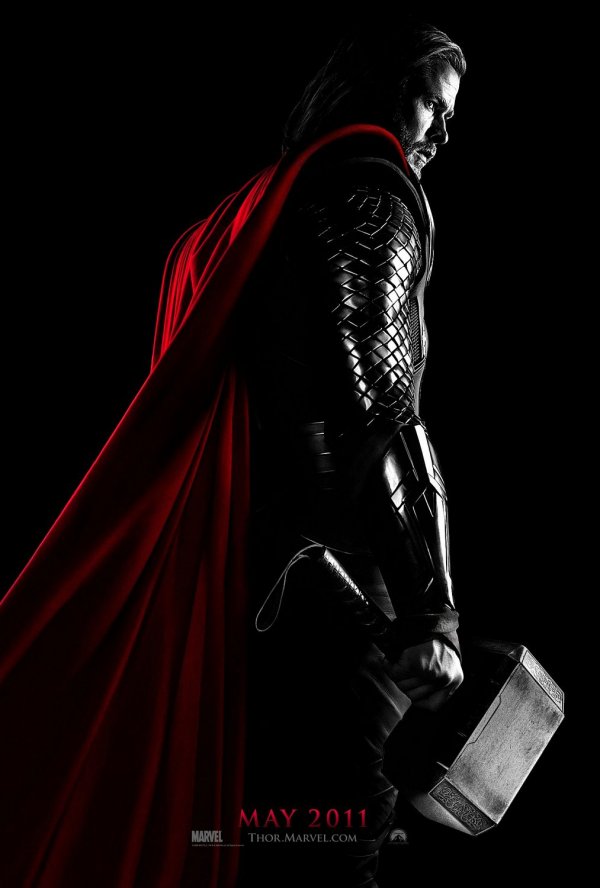


Thor is a fish-out-of-water story that mostlt deals with a god cast in a regular American small town. I found the film's humour to work pretty fine, on par with the Iron Man films. It's good that these films don't take themselves way too seriously, even though films like The Dark Knight might tempt them to do so. But in real world, I would like to see a couple of more strong scenes for Natalie Portman, who does little more than swoons for Thor's abs in the film. Kat Denning's Darcy is a lot more endearing version of the same female horniness, but with better one-liners and none of the awkwardness.

The action is huge and one gets plenty of bang for one's buck. Thor also isn't portrayed as too invunerable to work as a character the audience can emphasize with. He mostly does struggle without his powers, but when hammertime arrives, it does so with a bang. The film's biggest fault is the main villain, Tom Hiddleston's Loki, who's too much of a sniveling bastard child than a mischievous master planner. I think I went too far when comparing him with other failed on-screen Marvel villains such as Dr. Doom, Venom and Elektra, as he does have an arc and his motives are somewheat believable. But his powers aren't that well-realized and his final plan is heisty and borderline stupid, something I wouldn't expect from the God of Mischief. But as Thor will be back next summer in The Avengers, I hear Loki will too, and this time it seems he has a much grander plan, according to the after-credit scene at least.

★★★ 1/2

Almighty Thor (2011)
Director: Christopher Ray
Thor played by: Cody Deal


The happy thing about Thor the ancient god of thunder is that he's a public domain character and thus anyone can make their own movie based on him. Particularly happy about this must've been the schlock-company Asylum, that makes its money by conviniently bringing out similarly-named low-budget films with every release of a major blockbuster. This time Thor at least got an "Almighty" adjective in front of it (Sherlock Holmes in 2009 wasn't so lucky). I was intrigued by this as I had heard Thor wields a machine gun in this. I was less intrigued as I heard it was produced by the SyFy channel, who have a knack of making films that seem awesome in theory (Mammoth - a film about a zombie mammoth with a soul-sucking trunk, anyone?) but simply make them so bad that such promising ideas are utterly demolished.

Luckily, Almighty Thor isn't at that level. One would exprct that such a film would over-emphasize the beginning and then run out of steam, but actually Almighty wisely saves its biggest bangs to the final reel. In this film Thor is but a youngling, not yet a true warrior. The evil wizard Loki attacks Asgard with his army of giant space coyotes and later dinosaurs, which makes the Allfather Odin launch an all-out attack against him. But even though Odin has The Hammer of Invincibility at his use, Loki manages to trick him to kill his other warriors and subsequently, Odin himself.  But Odin manages to cast the hammer to Midgard before his death, and Thor promises to retrieve it to defeat Loki. But then things get confusing as Loki suddenly seeks to destroy the Tree of Life, but still goes after Thor and his latino valkyrie sidekick. What follows is a small training period and then a never-ending parade of different fight scenes between Loki and Thor.

But the legends are still true.
The film does get boring, but it still has a few good ideas up its sleeve, which grow interest in the film all over again. The big-budgeted Thor movie could take notes for the sequel from this. At the beginning I thought Almighty's action was limited first to a forest and then to an unnamed city's back alleys because they were cheap shooting locations. I think I'm right to a certain extent, as the money is spent elsewhere. Almighty has to have a tiny CGI-budget but it still manages to throw in almost Emmerich-sized scenes of destruction in the city as Thor and Loki fight late in the film. In the other Thor, the Destroyer merely destroyed a small New Mexican town, and it never really seemed like ordinary people or our world was in any serious threat. It's handled better here. The best thing about the film is that altough the acting is often porn- or underground movie- level bad, the actors more often than not just scream their short sentences. LOKI! ODIN! THOR! I SEE YOU! And as the screamers include wrestler Kevin Nash as Odin and every A Night At The Roxbury fan's favorite Richard Grieco, we're at good hands here. And it does contain a scene where Thor pounds his own hammer in hell with his fists. AWESOME.

★★

Thor - The Rock Opera (2011)
Director: John Cody Fasano
Thor played by Jon Mikl Thor


Finally, we have the most testosterone-filled epic of them all. Little more than a streched music video for the Canadian hair metal band Thor (or T.H.O.R. as it's spelled in the credits), the film is about 40 minutes of pure ass-kicking. I've heard rumours that there would be a lot longer director's cut available on DVD, so I might check that out at some later point too. The film itself is a combination of old music videos, live gig footage and new digicam footage that seems to be shot in a nearby park. The props are all visibly made from rubber. The film's story is told by a narrator, as the images alone only confuse the audience trying to get the plot of this thing.

The film is directed and written by the son of the director of Rock 'n Roll Nightmare, John Cody Fasano and Thor band frontman Jon Mikl Thor. It's based on the Thor band comic book, which I haven't read but if I had, it probably would've cleared a thing or two for me about the very confusing plot. What I understood from it is this: The film starts as young Thor descends to Earth from a spaceship. He battles some evil dudes running toward him in a hallway, wielding his magic hammer. After his victory, Thor decides to spred the message of Rock 'n Roll for years. METAL! But then, a cult worshipping a hilarious deep-voiced giant snake god kidnaps Thor's wife (Police Academy and Devil's Rejects star Leslie Easterbrook) and turns her into a superpowered witch. Thor can change her back but then for some reason he has to kill her. It was her dying wish, you see. Then Thor goes and beats up one of the servants of the serpent and the movie ends there. Huh?!

The most kickass thing about this would be the closeups on 70's Thor' muscles. They are best emphasized on a scene where he punches through a concrete wall and flexes his biceps through the crack. Also, the rubber snake in one point shouts "SILENCE!" to his annoying Australian accomplice and bites his head.

The film works perfectly as the opening act for Thor's gigs as it's completely cheesy but at the same time oddly honest. Plus, it contains more than its fair share of scenes where the viewing rock warriors can hoot and cheer together. You just know watching this that the main event is yet to come. And you get just the right shot of adrenaline to prepare for it.

★★★★★ (or if you're Loki or some other motherfucker, ★)

Thursday, 26 May 2011

Giallo, Krimi, Policier, pt. 1

 
I'm really into Italian horror movies that work more as hugely visual mood pieces than rational stories. The term Giallo is thrown often to describe this genre but actually it only covers half of the truth. Giallo, which means yellow in Italian, is originally used to describe cheap pulp novels one could get from his local piazza's newsagent. Because of the literature genre, giallo really covers also detective stories, crime and vigilantist thrillers and sexploitation besides horror. In Helsinki tehere was a brilliant retrospective of the genre in the National Film Archives. For this first post of this three-part series, I reflect on some of the thrillers and horror films I saw during the spring.


Death Laid an Egg
(a.k.a. Plucked / La morte ha fatto l'uovo, Italy/France 1968)
Director: Giulio Questi


I put the films to this post in chronological order and it seems that perhaps the most difficult and avant-garde of these films was the first to be produced. I had real trouble comprehending the plot and the content of this movie. I later found out that this was the so-called American cut of the film that is more based on the spiralling madness of a hen-house owner's husband. The Italian cut reportedly has more exposition, consumer critique and comedy. Either way, the film can hardly be said to be straight-forward. It is often psychedelic and scenes seem to have few connections to each other.

So the story seemingly is that the farm owner's husband Marco (Jean-Louis Trintignant) has real jealousy issues towards his wife, Anna (Gina Lollobrigida). He manifests this by brutally murdering prostitutes in a hotel room. Anna, not knowing of this, starts to renovate her farm to become a more efficient meat-producing plant and hiring a beautiful new secretary Gabrielle (Ewa Aulin). But they both are in grave danger when Marco begins to give more and more to his primal emotions.

All of the blood work is contrasted with the modern chicken-house where the life of feeling animals has little value anyway and the efficiency just adds up to the brutality of it all. The mutant chickens without a head or wings sadly predict pretty much where meat-processing has actually lead us to.

The stars for the film comes from me not knowing whether this is utter garbage or real art. It is not an entertaining trash-film, although it has plenty of really weird scenes. I will need to see the different cut of this film to make up my mind. It seems that it at least has a pretty humane message, which of course can balance it a bit more to the art side.

★ or ★★★★★

Double Face
(A doppia faccia, Germany/Italy 1969)
Director: Riccardo Freda


Klaus Kinski, that old bastard, plays the wealthy John Alexander in his first leading role. Alexander loathes his wife Helen (Margaret Lee). However, when Helen dies in a freak accident, John is devastated. It seems someone murdered her, and John isn't sure whether it was him or not. He comes across a seedy party in Soho, where LSD is consumed and finds out there is a lesbian porn film seemingly starring his late wife. And then it seems Helen also rises from the dead. Has someone decieved him or is he really losing his mind?

Double Face has all the ingredients of an awesome movie. I could watch Kinski even cutting his toenails for an hour and a half and he does very good work here. Us viewers are kept on the edge of our seats about whether he is the film's villain or not. Thus the confusing plot structure also works fine, and the drug-parties in swinging '60s London create a fine point-in-time athmosphere. Yet the plot unravels way too slowly and there are plenty of dragging parts and repetition. There are also problems with the film's limited budget, which results in pretty visible models being used in the car crash in the beginning and the end of the end. The overall plot is a little clumsy and the actors ham it up occasionally, but that's all part of the deal, of course.

★★★

Hatchet For the Honeymoon
(Il rosso segno della follia, Italy/Spain 1969)
Director: Mario Bava


Mario Bava's filmmaking is one of the cornerstones of giallo cinema. I'm sad I didn't get a chance to see Blood and Black Lace on the big screen. The other Bava film in the retrospective was a little more modest but still a lot of fun. Bava seems to have created a Patrick Bateman-like character moe than 20 years before the publishing of American Psycho. But Bava also guarentees his anti-hero won't get away with his actions as easily.

A sadistic and narcisstic bridal gown stylist John Harrington (Stephen Forsyth) loathes his wife Mildred (Laura Batti) although she repeatedly tells him that she won't agree to file for a divorce. So, John brutally murders her as that is nothing new to him. He has made a habit of murdering brides-to-be because of a mysterious drama that keeps bugging him. But these traumas multiply by tenfold as Mildred herself still refuses to let John go and haunts him.  Harrington also has the trouble of the Colombo-like Inspector Russell (Jesús Puente) always returning to ask him one more question about the death of Mildred.

The film's story is not that special as we've all seen the guilt-bothered murderer crack up a billion times before. But Bava's skills as a filmmaker can't be denied. His way of flying the camera up and down and sometimes focusing on little details, is almost worthy of Kubrick. A well-realized '60s cinematography helps a lot, too. The main actors also pull their roles very well. If the film had more of a subtext beyond its conventional story, this could be a masterpiece. Now it's just a very entertaining giallo film, but that's really all we need.

★★★ 1/2

The Forbidden Photos of a Lady Over Suspicion
(Le foto proibite di una signora per bene, Italy/Spain 1970)
Director: Luciano Ercoli

 
This film is like a sister-piece to both Double Face and Hatchet for the Honeymoon.  It stars the stylish young lady, Minou (Dagmar Lassander), who's just married the wealthy businessman Peter (Pier Paolo Capponi). She gets a blackmailing phone call that tells that Peter has killed a man and unless his demands are met, the info will leak to the police. Believing Peter to have done the deed because he was forced to, Minou tries to meet the demands and agrees to meet the caller. But the caller won't settle for a sum of money, and rapes Minou. He won't even stop calling after this, as his calls get ever more threatening and he blackmails Minou with photographs from the affair.  The growing terror of the stalker getting ever more aggressive drives her to the brink of madness. Will it consume her or can she pull herself together to fight her nemesis?

Besides a growing fear and blackmail, this film is all about sex. Even for a film made in the afterglow of the swingin' 60's, it's quite progressive filmmaking. For one, it features a bisexual femme fatale Dominique, who is hinted to having been (and maybe still being) the lover of both Peter and Minou. It's just sad that the film doesn't really do anything interesting about this info but rather keeps it as a mere possibility. The female point-of-view is refreshing, but the film itself threads on a bit too familiar paths for the genre. The villains have schemed a plot that's way too similar to other earlier giallo films. But the style and cinematography as well as the snappy storytelling at least keep this interesting.

★★★

Don't Look Now
(a.k.a. Decembre rosso shocking, Italy/UK 1973) 
Director: Nicholas Roeg


The most widely acclaimed film of the retrospective is without doubt Nicholas Roeg's magnum opus, which was recently selected as the best british film of all time by Time Out Magazine. Pretty good for a film half made in Italy. Personally, I love the film but don't even consider it to be Roeg's best, let alone the whole country's.

The sorrow of the death of their oldest daughter shadows the trip to Venice of John (Donald Sutherland) and Laura Baxter (Julie Christie). John is in the city for business, as he's restoring a canvas in a church. Laura meets two sweet old ladies who claim to be psychic and tell her they can see their lost daughter. But they don't bring mere happy news from the afterlife, they also have a grave warning for the couple to leave the town. Can they be trusted or why can John also see a familiar-looking little girl running around the town? And who is the mysterious serial killer wreaking havock around the town?

The film uses a lot of little, subtle things to bring out a crushingly bleak athmosphere. John and Laura don't see the beauty of the city, they only see dirt, dark tiles and evidence of death surrounding them. Laura is eager to cling on to any sort of shred of hope as John tries to maintain a rational facade. The couple is drifting apart by this even though they themselves may not realize it. It is also evident in the famous sex scene, which is cross-cut with the couple already dressing up. It is a film that has inspired countless filmmakers from its striking visual world to the thematics (Von Trier's Antichrist reheats many of the themes). Plus, it has a whopper of an ending. a true classic.

★★★★★


The House With The Laughing Windows
(La casa dalle finestre che ridono, Italy 1976)
Director: Pupi Avati

 
The most perfect giallo experiment from the films of the retrospective was this masterpiece by the Italian director Giuseppe "Pupi" Avati, who is most known for his teen films and screenwriting work. In fact, Avati contributed to the script of the all-round outrageous film Saló, or the 120 Days of Sodom. The same kind of blasphemy and turning conventional and familiar customs to twisted obscenities. The Catholic imagery and ethos in particular is on line to be demolished by Avati's film.

The young art expert Stefano (Lino Capolicchio) is summoned to a small Italian town to restore an old fresco of Saint Sebastian. He is told that the original fresco was the work of a raging lunatic. He most often liked to paint mages of peope in agony or about to die, yet is long dead by this point. Stefano stays at the house of the artist's two sisters. This legend seems to come to life as more and more villagers are brutally killed. Stefano and his girlfriend Francesca (Francesca Marino) must find out the truth before they're next in line.

The film is one of those delirious films that have an imagery that seemingly mixes truth and reality. The athmosphere creeps in slowly and slowly yet keeps the viewer interested enough to be on the edge of his seat for the whole duration of the film. It achieves quite a lot with very little bloody effects or such that other Italian directors spur excessive amounts in their films. The cinematography of House also utilizes the violence in old icons depicting the violent deaths of various saints. However, the film keeps its best surprises to the final moments where the madness really overcomes. Some imagery won't leave the viewer for weeks.

★★★★1/2

Tenebre
(Italy 1982)
Director: Dario Argento


The works of Dario Argento are of course essential to giallo. This retrospective focused on two pieces from his silver age in the early- to mid-80's. I will look at some of his earlier works in other parts of this series. Tenebre, however should be put in its place at the point in Argento's career, where he's becoming self-conscious about his direction. It is a story about a brutal serial killer running loose in Rome, in which Argento has placed a lot of self-observed viewpoints to his own life and perhaps an alter-ego as well. The killer seemingly bases all of his murders on the works of a popular horror novelist Peter Neal (Anthony Franciosa). When Neal arrives in Rome for the publicity tour for his latest novel, the killer begins to taunt him and to pull him into the investigation.

As is appropriate for many of Argento's film, Tenebre is absolutely brutal, yet at the same time gorgeously beatifully shot. The fine film print also emphasizes all the stark color schemes and the terrible imagery. Tenebre is not one of Argento's haunting masterpieces, and doesn't play with mood or expectation as much as it could. Anyway, it is a very good slasher that has a neat enough twist.

★★★ 1/2

The New York Ripper
(Lo squartatore di New York, Italy 1982)
Director: Lucio Fulci

 
Every good retrospective should have one film by Lucio Fulci, but not one more. His films are not consistent or in any way rational, but unlike Argento or Bava, he really can't create a threat-filled athmosphere but rather likes to play with excessive amounts of gore. New York Ripper is one of his most notorious films. 

The film follows Lt. Fred Williams, a burnt-out cop who likes prostitutes. He's facing the challenge of a lifetime as a weird murderer starts offing young girls in New York and making phone calls talking with a Donald Duck voice.

The film's New York is clearly the same as in Taxi Driver, so it's filled with filth and scum. Even the police aren't above this, but are still a million times better than the twisted maniacs that stalk the streets. Fulci does have one or two fine-looking scenes but mostly the film is just dire guessing of who the serial killer might be or nastily violent kills. Only for gorehounds.

★★

Phenomena
(Italy 1985)
Director: Dario Argento


I've had a soft spot in my heart for Phenomena ever since I first saw it on TV years ago. As those were the early days of digital broadcasting, the subtitles didn't work, but I watched the whole thing in Italian anyway. And as many know, in Argento's films the plot or dialogue is often insignificant. And none more than in this, an operatic sendoff to his most prolific and masterful giallo era.

If the plot does interest someone, it involves the young Jennifer (Jennifer Connelly), a new student in a ballet school in Switzerland. Jennifer doesn't get along with her classmates very well and feels more akin to the insect kingdom. She also befriends the wheelchari-bound professor John McGregor (Donald Pleasance) living nearby. McGregor has been assisting the police investigating a series of murders that have happened nearby with his knowledge of the insect larvae. He encourages Jennifer to also look into the mystery as she seems to have a supernatural power of controlling the insects by her will. But will even that be enough to protect her from the murderer?

Phenomena is one of the most dividing films in Argento's career. Most arguments against the film pick up the film's score as a complain. For such an athmospheric mood-piece that even begins with a sole image of the wind gushing in the countryside treetops, Phenomena uses a lot of heavy metal in its soundtrack. Personally, I think it is kind of kick ass, and more often strenghtens the delirious athmosphere, rather than wrecks it. In addition to Iron Maiden and Motörhead, the film also has probably the best theme of all time, by Goblin and Claudio Simonetti:


Nothing makes much sense in Phenomena, but it is a sort of stream of consciousness film. Thus it has such memorable imagery as a chimp wielding a razor blade, a bath with rotting corpses full of maggots, and of course the murderer himself, which I won't spoil here. Suffice to say, some good ideas seem to go round in the giallo circle and come back even more twisted and weird as before. This is a good place to stop and start waiting for the next installment. Pleasant dreams!

★★★★

Sunday, 22 May 2011

The Arnold Project Part II: Arnold the Barbarian


The recent news have implied that Arnold may not be returning to our screens any time soon. As much of a downer this is, it at least may have spared us from a pensioner Terminator. Robots can't age, and at 64, Arnold really couldn't pretend to be the same killing machine from 1984. His real-life sex scandal that produced an illegitimate son also proves that he's more of a loving machine. And no other of Arnold's characters is such a stud as Conan the Cimmerian, a fortune-seeking barbarian in the Hyborian era.


Now, Arnold certainly brought a lot of his own image to the character and thus may not be the perfect incarnation of Robert E. Howard's legendary pulp fiction character. But at least he's the right size and charismatic and intimidating enough to convince us, which is a lot more than you can say about the first impression of Baywatch actor Jason Momoa. The more I see about the upcoming 2011 remake, the less interested I am, but at least we have this bunch of films from the good old '80s.

Conan the Barbarian (1982)
Director: John Milius


A pillaging gang of thugs led by Thulsa Doom (James Earl Jones) storm a Cimerrian village and brutally murder the parents of young Conan. He grows up in slavery, but as he starts developing huge muscles, he is sold into being a gladiator. When he eventually gets his freedom he sets off to various adventures to gain his revenge on Doom, who has since become the leader of a snake-worshipping occultist cult.

The film, produced by Dino DeLaurentiis himself, is a huge epic that might go amiss when being viewed from a home DVD. This is a film where the material really demands a cinematic athmosphere. Everything, starting from the score by Basil Poledouris, is meant to be as big as possible. My viewing experience of the film as one of last year's final screenings of the movie theater Bristol, was one of the most magnificent of my life. A theatre filled wth Arnold fans cheered and cherised every frame of the film with all their passion. It really raised the film's quality in my eyes too.

As the director John Milius is well-known for being one of the most right-wing directors in Hollywood, it is no surprise that the film is positively Nietzschean in its portrayal of an übermensch. Now, this may not be as racist as it can seem, but neverthelss Conan is shown to have a superior will-power and adaptility to anyone else to rise up to become the toughest there is. But he won't have it easy as even as an infant he's forced to push a gigantic wheel and later on he survives a crucifiction and kills a hungry vulture by biting its neck off. As in Howard's books, the times were tough, and to adapt a man should keep his pleasures positively Spartan:
"Crush your enemies, see them driven before you, and hear the lamentation of their women"

This macho attitude, so common in the '80s, is well served by Milius's and Oliver Stone's script. The conciderably left-wing Stone probably keeps the film's supremacy-bullshit at a tolerable level. Conan is something of a freedom-fighter and a liberator from oppression from religious cults (that act a lot like Soviet communism), too. Unlike many other action-adventures, Barbarian is also economical with its special effects. Conan doesn't need to be attacked by a monster or a wizard's fireball every five minutes, as well-armed swordsmen are enough of a challenge to him, too. The special effect scenes that are used, feel all the more special. One of the main reasons the film still feels so fresh today is so few effects. If one seeks to find flaws in this performance, one really don't need the scene where Doom changes into a giant snake. It doesn't have a purpose in the story and only creates confusion on why he doesn't change into one in the climatic battle.

The ending would promise us a whole franchise, but really we only got one official sequel. I would've loved if Conan became a character like James Bond, with a new installment every couple of years, as the possibilities for his adventures are really grand. Sadly, the character is also easy to get wrong, which just adds to the kudos for Milius and Stone for nailing it.

In theatre: ★★★★★
From DVD: ★★★★


Conan the Destroyer (1984)
Director: Richard Fleischer


Fleischer's sequel feels to suffer from a budget-loss from its predecessor. It feels more of a product of its time, as is evident from the amounts of bad special-effect creatures here. It's also clear that the script isn't as good. Conan might have been a brutal and ruthless man driven by a will of revenge in the first, but he was no foll and had a certain philosophy of his own as well as a moral code. The second film maintains the moral code, and some nuggets of character-building from the first film (Conan still mourns for his lost love), but mostly he's just a big dumb oaf. The film suffers also from having too many sidekicks joining Conan's quest. As awesome as characters like Grace Jones's amazon woman or the more prominent Mako as the Wizard are, they eat screen time from each other and as a result, none of the supporting cast really gets time to shine.

Conan's quest this time is to obtain a magic crystal that can revive the dead. On the way, Conan and his team get tangled up to various wizards planning world domination by awakening an ancient god (that is not Cthulhu). Actually, the film's script uses more elements from Howard's stories than its predecessor. That might be because it was co-written by Roy Thomas and Gerry Conway from Marvel's Conan comic book. The film does have a more loose, comic-booky tone with more humor. I would prefer to have these films completely serious, but I can't deny that the film isn't still a lot of fun.The stand-out scene is the completely ridiculous fight against an ape-man in a hall of mirrors where Conan is being spiralled round and round from his leg.

★★★

Red Sonja (1985)
Director: Richard Fleischer


Red Sonja (Brigitte Nielsen) is the female equivalent of Conan, a treasure-hunter and a thief seeking revenge for the death of her family and the destruction of her home village. The person responsible is the evil queen Gedren (Sandahl Bergman), who attempts to conquer the world using a notorious magic talisman (again). Sonja is joined by Prince Kalidor, the former keeper of the talisman, who attempts to find it before it is destroyed and all evil gets loose in the Hyborian world. Reportedly, Arnold himself has thought of this as being a quite bad one. Said Arnold:

“It’s the worst film I have ever made. Now, when my kids get out of line, they’re sent to their room and forced to watch Red Sonja 10 times. I never have too much trouble with them."

Personally, I wouldn't be that hard on the film. Fleischer is an OK director with a good eye for what works on screen. Thus the sets are huge and vivid, and remind me a little of this year's film Thor. The film also has another good score this time by Ennio Morricone himself.

But the film does have big problems and the biggest one is the casting. Brigitte Nielsen is no lead actress unless we are referring to the heavy metallic element. Her accent is probably even worse than Arnold's, and it's hard to understand anything she's saying. I don't consider her to be that good-looking, either, but at least she can swing a sword. Arnold himself doesn't play Conan anymore, he's King Kalidor, a thinly veiled stand-in for the real one. This is probably done to avoid copyright payments, although the tale of Red Sonja is based on the Conan comic books. Kalidor is a good-hearted pussy compared to the strength, power and few words of Conan. Crom!

But the worst offense is to break the #1 rule of adventure films: don't have an annoying kid sidekick who whines all the time. A lot of screentime that could be featuring Arnold kicking ass is spared for an annoying little moppet named Prince Tarn (Ernie Reyes, Jr.). He's contantly ordering people around, demanding stuff, bragging how great a fighter he is (he isn't) and generally being an annoying little asshole. I wish Arnold could've thrown him into boiling-hot mud when he had the chance.

One has to wonder why the producers thought they needed someone for the kids to relate to as the film is too violent for them anyway. Presumably they figured kids would watch the film anyway as He-Man and The Masters of the Universe was the hottest thing back then. And as everyone loving film- and toy-based trivia knows, that toy line was created when the original Conan was deemed too violent for the kids, only after ordering a huge batch of action figures based on it. The solution was to give Conan a fruity blonde Beatle-wig, and to switch Thulse Doom's head with a skull. Thus, He-man and Skeletor were born. But that's another story.

★★ 1/2


These were the films that first made Arnold a star. But that might have been a dead-end to his career by itself. As his wife Maria Shiver said after seeing Red Sonja:
"If that doesn't kill your career, nothing will"
Arnold as Conan is after all equally iconic as Christopher Reeve as Superman. He would need another iconic character in his stable to become a bona-fied superstar.

LinkWithin

Related Posts Plugin for WordPress, Blogger...