Showing posts with label nature. Show all posts

Thursday, 20 September 2012

25th helping of Love & Anarchy

Festival poster circa 1993. Image Source: http://www.hiff.fi 

Helsinki International Film Festival opens today! This year, the festival is celebrating a quarter-century of Love & Anarchy. For a person my age (i.e. only a year or few older than the festival) it's hard to imagine the film-going climate of the days before. While it's a myth there weren't any interesting art house flicks and such in theatres, the fact was that they came from a pretty thin slice of the world. Love & Anarchy changed all that way back when.

The very first HIFF movie poster.
Due to the festival, we have today film distribution companies that will bring us some real treats from around the world, even if DVD's have taken over much of our movie-watching customs and there aren't that many theaters around any more. Since Love & Anarchy itself celebrates it's history with a retrospective of various treats from the years back, I thought this would be a good chance to preview several older films to be shown at Love & Anarchy's retrospective series. After all, I already did one post about tips, and other blogs have been tooting the same horn ever since. Besides, this is a rare opportunity to do a retrospective and a preview at the same time.

The Killer (Hong Kong, 1989)
Director: John Woo


As mentioned, Love & Anarchy used to be the first and only place to see some of the Greatest Hits of Asian movies in the whole Finland. One of the festival's most important imports is the action cinema of Hong Kong director John Woo. Woo himself also visited the festival in the early 90's. His best film is still this action tale, pondering the morality of a violent hit man, and the code of ethics he has in the job.

The deadliest mob enforcer/assassin on the business, Ah Yong (Chow-Yun Fat) accidentally blinds the nightclub singer Jenny during one of his jobs. Feeling guilty, he dedicated his life to take care of her and vows to quit his line of business. But in order to get Jenny a surgery to restore her eyesight, he has to take on one last assignment. But it turns out the Triads don't want him to stay alive and the mission turns out to be a trap. With his skills, Ah Yong survives the first encounter with Triad thugs, but there wlll be more after his head. He makes a deal with the hot shot detective Li Ying (Danny Lee) to bring down the mob bosses. Li Ying learns to trust his foremost worst enemy and starts to see the warm heart beating inside an unstoppable killer.

Like many of Woo's films, at it's core it's about friendship and almost a wartime brotherhood type of relationship with two men facing overwhelming odds and billions of bullets. Woo perfected his shooting scenes with almost ballet-like choreography and utilized stuff like slow-motion and symbolic imagery that broke into mainstream American cinema a decade later after The Matrix. But Woo is a true original. There's no way around it, this is a cornerstone in action movie cinema altogether. And thus also warrants its place in Love & Anarchy's retrospective, no matter how many times you may have seen it already.

★★★★

Chungking Express (Hong Kong, 1994)
Director: Wong Kar-Wai


Sometimes the greatest films come from a little impovisation. In the early 90's, melodrama maestro Wong Kar-Wai was on a roll. While making Ashes of Time he took a two month vacation but couldn't calm down and just be still. He decided to make a movie based purely on his gut instinct. Thus was born a gripping tale of loneliness, everyday romanticism and bittersweet emotionalism. And Chungking Express is at least among, if not the best of Wong's films.

Chungking is basically an episode film in that it features two stories that are similar, yet don't have much in common with each other. In the most densely populated areas of Hong Kong, two lovelorn policemen each on their own, never meeting, try to overcome a broken heart and fall in love again.

First, we have a young 24-year-old cop (Takeshi Kaneshiro), whose first love with an unseen woman named May is going to pieces. He gives her one year to change her mind, until his 25th birthday, and remains adamant that they will get back together, bordering on obsessive. He becomes pedant to the point where he starts to collect tin cans with the same expiration date as his relationship. But the day comes and May doesn't contact him in any way. He goes to a bar to drink and decides to falls for the first woman he sees. She turns out to be mysterious blonde woman (Brigitte Lin) who, unknown to him, just so happens to be a notorious drug smuggler. But she too is broken and alone and finds a kindred spirit in him, even if her bad business won't allow her to become attached.

The second story is similar, as it concerns another cop (Tony Leung) trying to get over the break up with his airline stewardess girlfriend. He eats every day at a small noodle shop at a station, where he is spotted by the quirky noodle-saleswoman (Faye Wong). She falls in love with him and decides to help him get over the breakup, and starts following him around.

The universality of the tales is underlined by the fact that character names aren't used. Hong Kong is only shot in neon light at night, and particularly in the second story, likened with Los Angeles, California. Both are full of broken dreams, and are seething with crimes and broken promises, yet have a melancholic loneliness at the hearts of many of its occupants at the same time. Wong develops his stunning visuals (realized by cinematographer Christopher Doyle) from scarcely-lit noir films old and new. Even though the stories concern policemen, they aren't solving crimes nor doing much police work.

As melodramas come, Wong doesn't trust to worn-out plots nor hammy acting. Instead, the film barely has a plot and will remain frustratingly unresolved for those waiting for happy endings that tie all loose ends together. But Wong respects his audience's intelligence more and keeps things subtle while the imagery just seeths with the emotions he wants to come across. Every lonely person on the planet who wants to believe in love but is too much of a realist to accept a hokey Hollywood love story to come true, will find his or her true love with this film. 

★★★★★

Naked Lunch (Canada/UK/Japan, 1991)
Director: David Cronenberg


Cronenberg's love letter to the beat novel by William S. Burroughs is by far not everyone's cup of tea. I hardly understood the novel way back in the day. Upon first viewing, I deemed the film to be a shallow adaptation, doing weird stuff for weirdness' sake. Yet Cronenberg is rarely simple and a subsequent viewing is often more than handy. The Canadian author has stated his film is based more on his personal experience of Burroughs' writing rather than a straight adaptation (which would be somewhat impossible, given the novel's rambling style, jumping from one thing to another with seemingly little effort).

This is a movie that has a constant theme, which is William S. Burroughs. Several aspects of the man pop up from unexpected places, most notably his urge to write, his ambivalent homosexuality, his tendency to binge on hard drugs and liqueur. Some of the most dramatic parts of his life, such as the accidental homicide of his wife by trying to shoot a glass on her head, are also main plot points.

If you need to know more about the plot, it's about the exterminator William Lee (Peter Weller) who finds that the powder he uses to kill bugs is also a powerful hallucinogenic drug. This gives the uptight man new purpose in life, as he rediscovers his passion for writing. But the drug also causes him to act in strange ways and possibly kill his wife Joan (Judy Frost). He travels to the Islamic port to get to the bottom of his wife's disappearance and to make amends with two dueling creatures inhabiting his various type writers.

So, this is a delirious account, where there's a strong sense of anything being possible. It's a film that delves into the human subconscious and brings up some of our most grotesque fears. Disgusting creatures and body modifications appear here and there. There's no one better to do this than Cronenberg. Bright colors make this almost cartoonish, or more accurately, instantly looking like the cover of a 50's pulp fiction novel. Burroughs' text is recited in several scenes with characters telling stories. I think the author himself was proud of how respectful this is, while at the same time unmistakably a product of the feverish imagination of its director.

★★★★

Hana-bi – Fireworks (Japan, 1997)
Director: Takeshi Kitano


Another notable presence in the festival throughout the years has been the Japanese "Beat" Takeshi Kitano. He shares Wong Kar-Wai's knack for melancholy, but whereas Wong makes strong, vivid melodramas, Kitano makes calm, poignant, and slowly moving genre films, most notably crime films. Renowed for his almost zen-like yakuza trilogy, Kitano surprised the world when he took some elements of his previous work, and made with the same tools his most touching film.

Yoshitaka Nishi (Kitano) is a police officer who quits the force. His reasons are personal in two levels. First, he's struggling with the guilt over the crippling of his partner Horibe (Ren Ohsugi) in a shootout. Second, he needs time off to care for his wife Miyuki (Kayoko Kishimoto), who is dying of leukemia. He will do anything for her, even break his morals. But one brick builds on top of another and Nishi eventually gets indebted to the yakuza. He must sacrifice more and more for those he loves, and this altruism will start to threaten his very life.

As with his best work, Kitano uses silence to great avail and lets us viewers often figure ourselves what's going on through the heads of his main characters at several given times. The film is deeply personal, since it's Kitano's first film after surviving a near-fatal car accident. The suicidal feelings of the wheelchair-bound Horibe must have come across the auteur's mind before. Like himself, characters are seen using art as a therapy method.

But while the film deals with traumas, guilt and sacrifice, it's main message is none of these. The film tells us simply of how beautiful and precious life is. Miyuki is a beautifully realized character, appreciating art, and wind at the beaches as she's nearing her end. While Nishi may be altruistic and self-sacrificial, she is the true role model of the story as she spends none of the time in self-pity or wallowing in past pains but enjoying the little things during the few moments she has left.

★★★★

Elephant (USA, 2003)
Director: Gus van Sant


A big part of Love & Anarchy's programme has been to bring both major award winners and American independent films to screens before anyone else has had the chance to. So was the case with the Palm d'Or -winning Elephant, one of Gus van Sant's finest. The film has been made in the aftermath of Columbine high school massacre, but sadly, it's perhaps even more poignant today as such mindless carnage has grown more common all around the western countries.

While suggesting how the film ends may be regarded as a spoiler, it is by no means hard to guess. All in all, it adds poignancy to van Sant's approach to the subject. His camera tours around a seemingly-regular high school in Portland one day, stopping at various teens talking about their problems, plans or other mundane things. But at the same time two sad, lonely, fucked-up teens, Alex (Alex Frost) and Eric (Eric Deulen), who are preparing for their own ultimate solution. These guys are humanely also shown as dumb, naïve and (deeply) flawed young persons as they are, not as some vicious killing machines born to do harm to others.

To call the film melancholic would be an understatement. No matter how mundane things van Sant's teens deal with, there's a string of finality in them. It's as if his characters were already dead, trying to get through their final day and having their last conversations. Van sant has a deep understanding of teenagers and his dialogue is natural, unforced and realistic. Much of his film's young cast appear with their own first names.

The tragic hero of the film, John (John Robinson) is randomly spared by Alex and Eric just before they start their shoot-out. He tries his best to first stop people from going to school, but is not taken seriously since he's seen as a geek. Then he attempts to alert parents and authorities, but this has little effect on how the things go down and many of his friends die.

As for the somewhat cryptic title, I see it as a fairly clear metaphor: Elephants never forget, so we should not forget the victims of surprising and cruel mass murders either.

★★★★

Grizzly Man (2005)
Director: Werner Herzog
 

One of the best movies of the 2000s (yes, way up there) is this Werner Herzog's oddball documentary, which at face value repeats much of the director's basic themes, such as an eccentric individual dismissing the rules of a society and man's relationship with uncontrollable forces of nature.

This is truly a story too weird to be fiction. Timothy Treadwell was a natural conservenatiotist who loved the great outdoors and spent whole summers in the wilderness. More troubling was his love towards animals, particularly bears. He viewed them as his peers, friends and companions. Treadwell didn't get along well with many people and started to sink deeper and deeper into his own world he saw nature. In actuality his vision of nature was warped by his own mind. Treadwell was also a major narcissist, shooting endless tapes of himself ranting about nature and his sightings.

Ultimately, Treadwell's life ended in a tragedy as he was mauled and eaten by a hungry grizzly bear. Years later, Herzog attempts to find and capture this free-spirit's soul. His film mostly consists of clips from Treadwell's own tapes. But our German documentarist/narrator also does some leg work and travels to meet persons who knew something of the spirit of Treadwell.

The movie is all about kindred spirits. Treadwell felt bears were his, until nature's cruelty made it's point clear. Yet this also extends to Herzog who sees something similar in the ranting, but smart and poetic Treadwell, as he did with his muse Klaus Kinski. Herzog's own scenes, particularly one where hears the audio of Treadwell's death tape are almost as chilling and memorable as Treadwell's own.

The movie arises multiple points to ponder till the conservationatists come home. Where actually is one man's place between unforgiving nature and society, where the most original, poetic individuals may be shunned and not allowed to grow freely. It’s a beautiful movie, very poetic and yet a really sinister spiral into madness.

★★★★★

Taxidermia (Hungary/Austria/France, 2006)
Director: György Pálfi


This offbeat and grotesque Hungarian movie satirizes the Hungarian national psyche and history. It is an episodic film showcasing three generations of men from the Balatony family. It's also not much of a plot-driven movie, rather than a mood piece that showcases the perversity, greed and madness of each generations focus person.

WWII-era soldier Morosgoványi Vende (Csaba Czene) is a figure sort of like a sex-crazed Woyczeck. Slow-minded, he's constantly berated and belittled by his commanding officer Lieutenant Balatony Lajoska (Marc Bischoff). He has chosen to give Morosgovány shelter, but makes him sleep in the pigsty. He has vivid sexual desires towards Lieutenant's teenaged daughters and even his obese wife.

In the 1970's Morosgoványi's bastard son Balatony Kálmán (Trócsányi Gergõ) is a world-class competititor at speed eating. He falls for the women's speed eating champion Aczél Gizi (Stanczel Adél), much to the chagrin of his coach and foster-uncle. Distracted by love, he has a horrible accident while competing.

In the modern day, Kálmán has grown to be a morbidly obese mountain of lard. He lives with his son Balatony Lajoska (Marc Bischoff), who is a taxidermist, whom he despises. For Lajoska is thin as a stick, and a major disappointment in the eyes of his father. After the death of his wife, the only thing he can love are his three huge cats. Lajoska takes his father's insults and verbal violence calmly, but in secret harbors a plan to get back at him and also to get himself recognition all over the world.

Taxidermia is surely a one-of-a-kind movie. Filled with the blackest humour imaginable and with scenes unbelievably disgusting and delirious, mere text doesn't do it justice. It's like the British comedy series The League of Gentlemen or Monty Python's The Meaning of Life - on acid. Only splatter fans and truly twisted individuals can value the film at face value, but then, we find mountains of things to love here. Particularly the suberbly odd final punch.

But the film does go a little deeper. To get to the core one should know a little bit about Hungarian history and society. Suffice to say, history hasn't been kind to Hungarians, which explains why each generation has their own traumas and crosses to bear. Pálfi takes the faults caused by these traumas and takes them to ridiculous extremes. So, when people fight to survive, comes strong sexual urges. When food is scarce and people are hungry, comes overwhelming greed and gluttonous food orgies. And when one looks past these days, when things are finally better, one finds a need to still concerve some of these horrible sins rather than to move on.

★★★ 1/2

The rest of Love & Anarchy's retrospective after the festival. Right now I'm in a hurry to get to the screening opening film, Beasts of the Southern Wild. Hope to see you at the festival!

Saturday, 24 March 2012

The Directors: Terrence Malick


When talking about enigmatic film directors, the Illinois-born Terrence Malick (1943-) undoubtedly comes up. The overly shy director is known as a recluse, refusing to do any interviews or publicity for his films. In fact, there are even precious few photographs about the man. Malick is also a notoriously slow worker, having produced a body of five films during the course of almost 40 years.

But for a man we know next to nothing about, Malick's films are strongly personal and speak for their creator. They are strong, philosophical films, which ponder large questions about existence with almost poetic photography. Malick has strong connections to both nature and religion, and both are often represented in various situations in his films. His refusal to do straight-forward stories and broad-stroked art style has also earned a number of haters for his style. It is easy to think thickly voice-overed, highly symbolic films as pretentious, but every single image has a purpose and is all part of a big jigsaw puzzle of different symbols and their readings. This style of filmmaking has also been highly influential among arthouse directors, although few can make films as captivating in their mysteriousness as the grand old man. This is why I consider Malick to be one of the most important filmmakers alive today.

It's hard, even impossible to rate Malick's unique body of work with stars, so I won't attempt it here. Suffice to say, I consider two of them to be true masterpieces and the other three still pretty darn good.

Badlands (1973)


Malick could easily have been a member of the same movie brat generation that many of his age peers did, like Scorsese, Coppola and DePalma. His debut film is a incredibly powerful film, but still reflects much of the era when it was made and has Malick's usual vivid philosophication marginalized. The film is loosely based on a real life case of a young man and a woman going on a killing rampage through the American Midwest. However, Malick's film is not a thriller, a crime flick, a heist flick or even a chase flick. It can loosely be seen as a romance or a study on morale. But the fact of the matter is, that Malick did make a wholly unique film on his first try, and it's hard to fit it in any previously made categories.

Kit Carruthers (Martin Sheen) is a young punk, who doesn't quite fit into the society. He's working as a garbage man, when he meets the sweet young Holly Sargis (Sissy Spacek). Kit begins to court the girl, much to the dismay of her parents. Her father (Warren Oates) shoots her dog as a punishment for running off with Kit one time too often. The conflict culminates to the point where Kit sees no other option but to shoot Holly's father and escape with her to the wilderness. The pair look for a chance to be in peace at nature, at a farm and at a rich man's house, but they always get hounded by the police, and Kit has to resort to killing a lot more people.


It may sound like Kit is a total sociopath, and he does get over murdering people with a shrug. Yet at the same time he's a charming, witty and friendly man, and he's seen making friends with ease. It's the sort of normal-seeming young man that were sent to murder people by the thousands at that time in Vietnam. While Malick doesn't address this issue directly, there is some pondering on where the nation's youth is going. Holly herself is also smitten with Kit, although she's also shown to be so young and naïve that she doesn't fully realize her emotions, or make sense of the disturbingly sinister centre of Kit's facade. Her narration of the film likens her love to a story found in a cheap romance novel, and Kit himself to a rock star.

For a love story, Malick shoots his film coldly and tells the story matter-of-factly. He doesn't resort to melodrama, but rather lets the images tell story. At this point Malick was still more interested in the postures and expressions of his actors than the landscape they inhabit. The pop-culture grown youth attempt to go back to living in the nature as Adam and Eve, but can't manage to shake off neither their suburban habits nor the police on their tail. The scenes in nature look like they were shot in a park rather than a forest, which may very well be the point. There's no isolation, no true wilderness. There is some sense of melancholy in this realization that you can't go back again. Also depending on the kindness of friends and even strangers doesn't work for Kit and Holly's favor, yet they themselves only seem to think it's their forbidden love that has turned them into outcasts rather than the carnage they leave behind. This is a film about people who think they have figured life all out but in their shallowness and confusion are actually more messed up than anyone. And Malick seems to suggest that this kind of thing is not rare in the world.

Days of Heaven (1978)


Malick likes to develop his themes further in subsequent films he makes. Thus, his second feature film is another take of a couple on the run. This time, it concerns the hot-headed Bill (Richard Gere), his lover Abby (Brooke Adams) and their daughter Linda (Linda Mantz). Bill starts out as a factory-worker, but runs afoul with his foreman, and accidentally kills him as a result. The family runs away far to Texas, where Bill starts working as a hand in the harvest in the fields owned by The Farmer (Sam Shepard). The rich Farmer is terminally ill, and the prognosis is that he won't live to see another harvest. Initially the family tell nothing about their identities. But Bill sees an opportunity when The Farmer falls for Abby, and comes up with a plan to pose as brother and sister, and go on living in the farm. He plans for Abby to marry The Farmer, and thus gain all his money once he dies. But the love of Abby makes The Farmer last a lot longer than expected, never taking a turn for the worse. Thus, also the seeds of jealousy are planted.

The tale is narrated by the young Linda, and in that it seems like a film set inside a person's memories, much like Malick's later Tree of Life is. Days of Heaven is Malick's first Epic, with huge shots of fields with the tall farm house rising in the middle like a medieval tower. A lot of weight is also given to Ennio Morricone's wonderful score. The film is set in the beginning of the 20th century, yet there is so much vivid imagery that could also be interpreted to be Malick's own memories of his childhood in the countryside of Illinois. Malick also intercuts peaceful images of fields, where wind is playing, to swarms of locusts attacking and eating the crops, and farmhands burning the entire field, when his characters' feelings come into the surface and more and more intense.

This time around, Malick would offer his characters a peace of mind, but having them be deceitful, jealous and greedy, they ruin it altogether. Harmony can not be achieved when people are driven by their flaws. The bright young Linda is the one who has the best hopes for the future, as is shown in the final scene of the film.

The Thin Red Line (1998)


Malick broke 20 years of reclusiveness to film a war novel about World War II in the Pacific by James Jones for the second time. The resulting film, however was something wholly unique, unlike any other previous war films. It is a key film in Malick's career in that he evolved to being more and more interested in philosophy, such as metaphysicality, and man's relationship with nature. That's why more than battles, he likes to shoot light flickering at treetops or wind playing at the grass of a field. The film is laced with the voiceovers of soldiers pondering at their place in a world gone mad.

The film can roughly be divided into three parts. The first shows deserted soldiers living in harmony with the nature and the natives on a paradise island, until a ship comes by and the deserters are returned back on duty. The second part shows a major battle, as the marines must take out the Japanese troops stationed on the hills of a Pacific island. A major attack ensues and after a bloodshed, the men appear victorious. Yet their commandants can't even provide them with water and push them on more and more. The final part sees the tired soldiers in the jungle, not knowing where to head and where the enemy is. One patrol in particular gets into a sticky situation and have to escape the attacking enemy.


The theme of losing one's individuality is strong here. The soldiers follow the orders from clueless, merciless generals, who in turn have little concern for anything but reaching their set goals. Yet that idea is one seen in many a war movie before. More interesting is how Malick cross-cuts the war with a man's relation to nature. In the first battle scenes, it seems like Mother Nature is disapproving of the soldiers breaking its harmony by harming the peaceful landscape with their running, shouting and explosives. A key image is of a snake hissing at a pair of soldiers taking cover by a grassy knoll. But as the film progresses, Malick shows that nature doesn't really care. It just observes, like a swarm of fruit bats at the treetops. At the same time the jungle-set paradise by the water from the film's beginning has turned from to a living hell where the struggle of life and death is a reality. The cold mindset of a soldier is kill or get killed, so in actuality they get to experience nature as it is, as cold and ruthless, rather than just reaping its benefits.

Malick, if anyone, is a director whose films are born in the cutting room. The original cut of the film ran for six hours. When the film had to be cut into less than three, Malick didn't hesitate to cut certain major movie stars out of the picture, and reducing some others' roles considerably. The director doesn't want to over-emphasize any given soldiers, it is a story about humanity in general. Also, Malick willingly breaks every Hollywood war movie cliché and convention he can find. His war is a total mess, confusing, loud and raw. At war really are harmony and chaos, or empathy and nature. The same fighting pair Malick would ponder on later with The Tree of Life. But The Thin Red Line is more subtle, more thought-provoking, and perhaps even more beautiful.

The New World (2005)


Like said, Malick likes to amplify his last movie's themes with every subsequent film he makes. The New World was his first film that really split even the arthouse audience in two. At it's core is another battle between natural children and civilization. The western civilization is depicted as a cold, heartless place, whose residents are emotionally distant. At the same time the natives living in the middle of the nature are capable for mercy and love – to a point. Malick stages this conflict to the time of the first English settlement on American soil. He also has a sort of a plot to hang his thoughts to, taken from history books.

The English explorers come across the Atlantic ocean to what they conceive as West India, and build the settlement of Jamestown. Supplies are few, and many of the men are not too eager about their new habitat. Captain Christopher Newport (Christopher Plummer) agrees to set free Captain John Smith (Colin Farrell), a mutineer waiting for the death penalty, on the condition that he shall remain loyal. But the immigrants start having trouble with the curious American natives, and this culminates one of the "Indians" being shot. This drives both of the groups to an edge, and leads to Smith getting captured. But just as he's about to get executed (again) the beautiful young daughter of the Tribe leader saves his life. The young girl (Q'Orinka Klicher) comes known first as Pocahontas. She attempts to build peace between the two groups and grows fond of Smith. But Smith doesn't enjoy being in America and schemes about getting away. I'm about to dwell a little more on the plot (because while that's really not the key concern for Malick, it brings out the film's themes better), so look away from the next paragraph, if you don't wish to be spoiled any further.


Malick has a sort of one-sided romance going on during his film. No matter how much mercy Pocahontas shows, how much she helps the English, she doesn't get the love that she deserves from John Smith. After the distrust between the English and the natives culminates again to a brutal battle, she's banished from her Tribe, and starts living as a Pariah in Jamestown. A newly arrived recruit, John Rolfe (Christian Bale) falls for her and attempts to build her a common bourgeois life of being the wife of an English farmer. They build a house, a farm, give her English clothes and teach her manners. Finally, she is given a Christian baptism, and named Rebecca. But she still pines for the more adventurous Smith. Eventually, she is taken to England, where she comes to terms with her part in life and the fact that Smith didn't care for her. Rebecca insists she is happy within grey skies and tightly cut bushes and lawns that bear no resemblance to her native nature any more. The bittersweet ending also tells of her demise at childbirth.

So, at central, the film is a melancholic look at a paradise lost. Pocahontas' sense of connection with nature starts to dwindle during the course of the movie. She grows from a beloved child that wonders the moon and the stars, and runs across the grassy fields at dawn mist, to just another droll English midwife. She sacrifices it all by chasing a dream that was never there. It may be wondrous to her when she first arrives to London, of seeing so many people she couldn't imagine, but in the end she still seems to end up lonely and unfulfilled. Although Malick alludes heavily to the Christian concept of rebirth, it can not be seen to be only a good thing here. This sort of thing should be noted by those who see Malick's recent work of just pushing Christian values to their face. Malick doesn't see the religion per se as the savior. Rather, the individual also needs to find his or her own sense of mercy, a connection to nature, and of course ableness to stuck to the moment when they are the happiest.

Personally, I find the film a bit too long and repetitive, but it is still a lot more interesting than a lot of other filmmakers make during their entire careers.

The Tree of Life (2011)


Malick's latest film may be his most personal or perhaps not. However, it is clearly his most dividing film. Some viewers criticize Malick dropping the ball by going too far into naïve christian pseudo-philosophies, and pretentiousness. Others see a vivid, even poetic film that's bustling with ideas and multilayered symbolism. All can agree that this is a one-of-a-kind film that's made with an amazing visual style. Malick's central idea is that everyone on Earth must follow one of two paths in their life: either they follow nature and do things from selfish reasons, or they follow mercy and do things out of love. Cinematographer Emmanuel Lubezki's beautiful, iconic imagery spirals around the film's main themes. The film may entirely take place inside the architect Jack O'Brien's (Sean Penn) head as he struggles against feelings of depression and worthlessness. He doesn't know his place in the world and inside God's grand plan. All the film's scenes are laced with how Jack experiences them, from his angelic mother (Jessica Chastain) to his strong father (Brad Pitt), a man with few words but a loving heart.

So, the film's plot is flimsy and serves as only the faintest thread with which to tie Malick's world-explanations. First, we follow the grief in an American family as one of their three boys has died from reasons not explained. From the grief we take off to the beginning of life itself billions of years ago in the sea. One-celled organisms eventually become dinosaurs, complicated creatures who rise from the life-giving sea and suffer for it. But for suffering, they also seem to conceive the concept of mercy (!). With a quick stop at brooding adult Jack's glistening, artificial city surroundings, we're back with the O'Brien family in the 50's or early 60's, before the upcoming tragedy. The eldest child Jack (Hunter McCracken) lives and plays with his two brothers in the nature, often somewhere near water. His mother and father embody the two life paths, and try to get young Jack to follow them.

Either way you choose, life may have infinite sadness and suffering in store. Life branches to unknown paths, just like God's Divine plan for the universe. We as a people may have difficulty seeing the whole of it. But Malick does offer hope with the ending. Everyone will get a chance for redemption and coming to terms with the past. Too bad it's presented so banally in the film it makes the whole thing a little cheesy. Altough Malick has a lot of christian iconography in the film, his concepts of mercy and redemption are more spiritual than belonging to any given religion. Nevertheless Malick and underlines this religious reading way too much, particularly in the final scene. If not for that, one could read the Tree to be whatever one likes.

It is widely suspected that Malick is taking a look back at his own childhood and suffering of over his brother's death. We know little about the author, and since he doesn't give interviews nor gives out guides how to read his films, one can take these claims however one likes. Nevertheless, much of the film taking place inside Jack's memories are full of vivid boyhood games with a reasonably nostalgic look at growing up. The film really shines with these warm and affectionate scenes. It is also undeniable that Malick is searching for reasons and coping methods for past tragedies (whether for his characters or for himself) through religion and a poetic approach on the Earth's development. 

Warts and all, Tree of Life is a jaw-droppingly unique vision of cinema by a true auteur. When the viewer leaves the theatre, he most likely has his head all blurry from this whole cornucopia of unforgettable images, unique ideas, colorful boyhood nostalgia, great underplayed acting, and, in two words, pure cinema.


It has been rumored that Malick would have another film ready for this year, known to some circles as Voyage of Time. There are also a few other films reportedly at various stages in production, as well as a 3,5 hour cut of The Tree of Life. I'll believe when I see them. Malick is notoriously slow worker, having edited ToL for years because he was not happy with the result. And we haven't even seen the longer cut of The Thin Red Line, like promised. But if they do exist, I am more than eager to see them.

Saturday, 23 April 2011

Easter Special - Killer Bunnies

 
Tonight, if you're lucky, the Easter Bunny might make a visit to your house. He'll leave behind chocolates and colorful eggs no doubt stolen from somewhere. The media would portray him as a sort of modern day Robin Hood when he should be above the pigs from Angry Birds in the list of Public Enemies. As is often the case with these sort of holiday mascots, the truth is far more disturbing than we usually would like to think. Bunnies are bloodthirsty animals as evidenced by these three films.

Monty Python and The Holy Grail
UK, 1975
Directors: Terry Gilliam, Terry Jones


If one should watch one Python movie on Easter, it should be Life Of Brian. People have walked astray from remembering that the holiday is actually for honoring the martyrdom of The Leaver of the Sandal, no matter what those traitors from Judean People's Front would have you believe. Nevertheless, the first proper Python film does have an Eastery message of itself: never trust cuddly rabbits.

As aficionados of the film well know, The Dread Rabbit of Caerbannong is no ordinary rabbit. Underestimating this vile beast who lives in the midst of bones of its previous victims came to be the fate of Sir Bors and an assorted selection of other valiant knights. The only thing able to slay the beast is the Holy Hand Grenade of Anthioc.

As one might've noticed, I am a bit of a Python fan. Nevertheless, Holy Grail is actually only my third favorite of their films. While it contains some of the best gags from their film career, the ones that don't work as well don't have the visual whizz-bang of The Meaning of Life, nor help the story roll along á la Life of Brian. The film as a whole does seem like a collection of sketches. Still, the Terry duo of directors keep the athomsphere oddly sinister (suitable for the Dark Ages), yet have various cartoony setpieces that lighten the mood of dread. The patented Python way of comedy of very silly (but smart) absurdities and utterly destroying the believability of all authority figures, is at its peak here. The film is also admirable for it's anarchistic ideas about storytelling about an Arthurian legend. The ending in particular is such a big "fuck you" to the audience that even the slightest involment in the film's story, the likes of which have probably never been seen before or since. Never mind that it is clearly the result of running out of money or patience to write anything more satisfactory. Still a hilarious film and highly reccommended.

★★★★ 1/2
Watership Down
UK, 1978
Director: Martin Rosen


Watership Down is considered one of the most traumatic films ever made, and for good reason. Generations of children have been willfully subjected to this film, which suits them about as much as news footage from the Palestine. No wonder so many have gotten ightmares and irrational fears as a result. For while Watership Down is a film about talking animals, they actually are and act like animals (besides the crapping and the mating). And nature, as we all know, is cruel as hell. Oh yes, there will be blood.

The story is about a group of individuals looking for a promised land where they can live free from danger and tyranny. You can probably make your own parables from this. But this search does not actually end that happily as in a rabbit's life, violence is always just around the corner. And not only from predators or people, but also coming from other rabbits, who have formed warring coalitions.

Watership Down has a decidedly European feel to it. The animation is pretty and the hand-painted backgrounds remind of a children's storybook. There's no futile disneyfication and the result is dark and edgy enough for cynical adults as well. The film opens with a myth about the world's creation from the rabbit's point of view. This would probably be told time after time to rabbits questioning why they are so presecuted yet considerably different from others. It's a fascinating idea that animals would have legends such as this, which are so closely relatable for our human stories made to answer the same kind of questions. Yet this spiritual portion of the film comes through mostly in annoying scenes that are accompanied by Art Garfunkle's horrible song "Bright Eyes". I've always hated that song.

Also the comic sidekick seagull is annoying and possibly a bit racist.

★★★ 1/2


Night of the Lepus
USA, 1972
Director: William F. Claxton


The biggest rabbit problem of all time has got to be in this film where a huge pack of flesh-eating giant mutant rabbits terrorize a small town. The events begin from trying to develop a humane method of keeping rabbits away from one man's ranch. But Roy Bennett (Stuart Whitman) is the wrong man to get to develop the system as he tries to accomplish this by pumping the rabbits full of hormones. Instead of sterilizing the rabbits like Bennett planned, the creatures grow to a monstrous size and escape to underground caverns where they will surface from time to time. 

By the early 70's, film producers were really scraping the bottom of the barrel to create sci-fi or catastrophy B-movies based on real world threats. Someone had the bright idea of drawing the inspiration from Australia where the rabbit problem had become a threat to the whole ecosystem and agriculture of the continent. The rabbits had no predators over there and thus could reproduce as much as they wanted, eating away all the crops they came along. But of course cuddly rabbits wouldn't suffice as a movie villain and thus they needed to be giant mutants. Who eat horses and cattle. Probably people as well.

Otherwise Night of the Lepus is pretty much your run-off-the-mill B-movie. Needlessly long of the film's running time is donated for giving its ludicrous plot a somewhat scientific explanation, and of B-list actors (Janet Leigh, Rory Calhoun, DeForest Kelley etc.) looking worried and discussing about what they should do about the problem. The extra star comes from me digging women having the familiar terrified scream while seeing cuddly rabbits (who do growl!), and the effective end scene where the rabbits are exterminated.

★★
Happy Easter from The Last Movieblog!

Friday, 7 January 2011

The Best of 2010 - Part II: Everything


So here it is, the exciting second part of my look back at that movie year of 2010. This one's for the people that gave us the experiences we had while seeing films this year.

First, let's take a moment to look back on the movie people we lost. If the year was a pretty good one for cinema, it was also a sad one as a lot of legendary filmmakers passed away. I'm sorry I can't do proper justice to write an article about each one, but I hope this text will help their spirts to Rest In Peace.

RIP 2010:

Eric Rohmer 1920-2010. (Director, My Night At Maud's, Autumn Tale)
Corey Haim 1971-2010. (Actor, The Lost Boys, Silver Bullet)
Erich Segal 1937-2010. (Screenwriter, The Yellow Submarine, The Love Story)
Jean Simmons 1929-2010. (Actress, Spartacus, The Big Country, The Egyptian)
Helge Herala 1923-2010. (Actor, Raid, Noin 7 veljestä, Uuno Turhapuro armeijan leivissä)

Peter Graves 1926-2010. (Actor, Airplane!, Mission: Impossible)
John Forsythe 1918-2010. (Actor, Charlie's Angels, Dynasty, The Trouble with Harry)
Dennis Hopper 1936-2010. (Actor, Blue Velvet, Apocalypse Now, Super Mario Bros., Director, Easy Rider, Legend, The Last Movie)
Harvey Pekar 1939-2010. (Actor, American Splendor)
Ronald Neame 1911-2010. (Director, The Poseidon Adventure, Scrooge)

Tom Mankiewicz 1942-2010. (Screenwriter, Dragnet, Live And Let Die)
Patricia Neal, 1926-2010. (Actress, Hud, The Day the Earth Stood Still)
Claude Chabrol 1930-2010. (Director, La cérémonie, Le boucher)
Kevin McCarthy 1914-2010. (Actor, Invasion of the Body Snatchers, Innerspace)
Sally Menke 1953-2010. (Editor, Pulp Fiction, Kill Bill vol. 1 & 2)

Arthur Penn 1922-2010. (Director, Bonnie & Clyde, Little Big Man)
Tony Curtis 1925-2010. (Actor, Spartacus, Sweet Smell of Success)
Satoshi Kon 1963-2010.
Johnny Sheffield 1931-2010. (Actor, Tarzan Finds A Son!)
Gloria Stuart 1910-2010. (Actress, Titanic, The Invisible Man)

Roy Ward Baker 1916-2010. (Director, Quatermass & the Pit, Asylum)
George Hickenlooper 1963-2010. (Director, Hearts of Darkness, Casino Jack)
Luis García Berlanga 1921-2010. (Director, El verdugo)
Dino De Laurentiis 1919-2010. (Producer, La Strada, Conan the Barbarian, Death Wish)
Ingrid Pitt 1937-2010. (Actress, The Wicker Man, Countess Dracula)

Martti Pennanen 1923-2010. (Actor, Jäniksen vuosi, Vodkaa, komisario Palmu)
Leslie Nielsen 1926-2010.
Irvin Kershner 1923-2010. (Director, The Empire Strikes Back, RoboCop 2)
Jean Rollin 1938-2010. (Director, The Night of the Hunted, Living Dead Girl)
Blake Edwards 1922-2010. (Director, Breakfast at Tiffany's, A Shot In the Dark, The Party)
Grant McCune 1943-2010. (Miniature Effects, Star Wars, Speed, Rambo)

Best Actors of the Year:

I should mention that as these lists are made for movie magazine Episodi, the only people legible for voting were the actors in films released in Finland in 2010. So, especially in the ladies' list, there is a large number of great performances of 2010 missing such as Natalie Portman from Black Swan and Jennifer Lawrence from Winter's Bone. They'll appear on these lists next year for sure.
It seems that in the case of men, 2010 was the year when a number of hunks surprised me by showing that they actually could act.

10. Ben Affleck (The Town)
9. Mark Ruffalo (The Kids Are All Right)
8. Justin Timberlake (The Social Network)
7. Pierce Brosnan (The Ghost Writer)
6. Nicolas Cage (Bad Lieutanant)
5. Brian Cox (A Good Heart)
4. Andrew Garfield (The Social Network)
3. Ryan Reynolds (Buried)
2. Colin Firth (A Single Man)
1. Stephen Dorff (Somewhere)

Best Actresses:

The case of women is always the hardest for me to judge. Many pretty great films have barely any females in them (like The Social Network, which basically has only one female character and all the other women are throphies more than people). Those films that do have plenty of female roles, most often tend to be Sex & the City 2 -style schlock I wouldn't touch with a 10-meter pole that was sharpened at the end. So please forgive me if my list of best female actresses is lacking. You can see that the last ones down the top 10-list were a little far-fetched. But at least it seems already that 2011 will be a year for strong female performances and characters both.

10. Louise Bourgeoin (The Extraordinary Adventures of Adèle Blanc-Sec)
9. Eva Mendes (Bad Lieutenant)
8. Mo'Nique (Precious)
7. Chloe Moretz (Kick-Ass)
6. Maggie Gyllenhaal (Crazy Heart)
5. Olivia Williams (The Ghost Writer)
4. Annette Bening (The Kids Are All Right)
3. Julianne Moore (A Single Man)
2. Elle Fanning (Somewhere)
1. Gabourey Sidibe (Precious)

The Best Soundtrack:
Scott Pilgrim vs. the World

Scott Pilgrim's soundtrack has been one of my favorite records of 2010 so yeah. The film introduced me to such great indie bands as Plumtree, Blood Red Shoes and Metric and re-ignited my love for Beck. This is one area where the film shines brighter than in the original comics, as Scott's band Sex Bob-Omb was described there to be "pretty sucky". And Beck coudn't do sucky in his sleep. No wonder in the film version they got an actual recording deal, what with songs like Launchpad McQuack (sorry, We Are Sex Bob-Omb), Treshold and Garbage Truck. Oh, and the soundtrack also includes classics from T. rex and The Stones as well as a chiptune version of Treshold. What's not to love? Not Metric of course, because the feeling I have for the song Black Sheep is something greater than mere love.


The Best Score:
Inception

Hans Zimmer does too many scores as most of them tend to sound a bit too much alike. But when he gets a project that really gets his creative juices flowing, the result is something great. Last time it was with Sherlock Holmes. I doubt Inception will lose Zimmer the Oscar this time. It's tremendously clever, like for example how it uses also the slowed-down version of Non, Je Ne Regrette Rien. The score can be exciting, and goes well with the scenes where things keep exploding. It can also be strikingly beautiful to go with those mourning scenes.


Best Scripts:

Judging scripts might also be a little stupid as I haven't actually read any of the texts from which the movies have been filmed. Direction is easier to judge from the film itself. But sometimes a good writer really shines through, such as Aaron Sorkin with The Social Network. No-one can quite write as fast and as snappy dialogue like him. Well, maybe Tarantino, but he didn't make a new film this year. The criteria for choosing the scripts includes how memorable characters the film created, the dialogue and why things keep happening. And of course humour. Mustn't forget that.

10. Juuso & Jalmari Helander (Rare Exports)
9. Lisa Cholodenko, Stuart Blumberg (The Kids Are All Right)
8. Sofia Coppola (Somewhere)
7. William M. Finkelstein (Bad Lieutenant)
6. Jane Goldman, Matthew Vaughan (Kick-Ass)
5. Christopher Nolan (Inception)
4. Thomas Bidegain, Jacques Audriard (Profeetta)
3. Michael Arndt (Toy Story 3)
2. Chris Morris, Jesse Armstrong, Sam Bain (Four Lions)
1. Aaron Sorkin (The Social Network)

Best Directors:

Some directors might do a tremendous job, but because of a clichéd or otherwise flawed script, they didn't get their films to my top 10. But at least this one helps a lot. Somehow this seems easiest for me to judge. You can always tell a great artist from his/her work. Bonus points for a visionary style or risking life and limb (like Janus Metz) to make a film.

10. Ben Affleck (The Town)
9. Matthew Vaughan (Kick-Ass)
8. Jalmari Helander (Rare Exports)
7. Roman Polanski (The Ghost Writer)
6. Janus Metz (Armadillo)
5. Edgar Wright (Scott Pilgrim vs. the World)
4. Chris Morris (Four Lions)
3. Gaspar Noé (Enter the Void)
2. Sofia Coppola (Somewhere)
1. Michael Haneke (The White Ribbon)

Top 10 DVD Premieres in Finland

The meat (hopefully) of this later post is to include a list of films that didn't get a premiere on the big screen at all in 2010, but went straight to DVD. Many british films had this fate, when lesser films like Harry Brown got to the screens. Don't worry, Harry. You'll get yours, pretty soon. Many of the films are popular from film festivals, and some have even been shown at several. If you'll excuse me, I'll write a little less of films I've mentioned before.

10. American Swing (2008)
Director: Jon Hart, Mathew Kaufman

Do you think Americans are sexually repressed? I think that although they might act like that, nothing could be further from the actual truth. A case in point is this groovy documentary about the swingin' 70's, when a popular swingers' joint Plato's Retreat opened. The story of the days of decadence is an exciting, hilarious but also a little sad. A place too free-minded like that is bound to either be destroyed or destroy itself. Which is what did happen. The documentary is well made, with good interviews and just the right amount of authentic footage.

9. Whip It! (2009)
Director: Drew Barrymore

Drew Barrymore's debut film was a flop at the USA, so no wonder we never got it on our big screens. Shame, because it is an actually good sport film, about a sport not enough used on canvas - roller derby. And at the same time, it's a story about growing up. The teenaged Bliss Cavendar (Ellen Page) starts doing the derby secretly from her demanding mother. As the sport demands toughness, Bliss starts to develop into a person who is more in charge of herself. The film is funny, it's got attitude, and while it follows pretty worn-out patterns, it doesn't always go where the path is most trampled.

By the way, the Finnish title for this is "Roller-Girl", which makes it seem like a spin-off film from Boogie Nights.

8. Kabuli Kid (2008)
Director: Barmak Akram

We all know Afghanistan from the headlines, but life in Kabul is a lot more than just dodging bombs all the time. The greatness of fictional films as a medium is that they might take you to such a place safely, to see what everyday life is like for the regular inhabitants. We get thrown into the story as an Afghan taxi driver gets stuck with a baby, left by a mysterious woman in a full-body burkha. What follows is a search all through the city. I like how Kabul is actually one of the main characters in this film. It is a wise film, telling a lot about the Afghan attitude to life after years of neverending war and its subtle touches to western ways of life. I love the scene where an old beggar finds a Coca-cola bottle full of milk and takes a drink, for instance. This one was a Love & Anarchy treat from a previous year (2009 I think).

7. The King of Kong: A Fistfull of Quarters (2007)
Director: Seth Gordon

It was about time to see this documentary about competitive gaming at our northern home country. It's a true only in America -style situation where grown men train to become the best there is at playing the Donkey Kong Arcade game. Not only is the subject interesting per se, Gordon directs his documentary to be a real American if-you-got-one-shot drama. Never mind how much of this is really true, Gordon truly has his Rocky and Apollo Creed in the story. But I'd imagine the craziest country in the world, Japan, must have some pretty hardcore gamers who'll probably sleep with a joystick in their hands. If we ever get a sequel, that's probably where the story's Ivan Drago will come from.

6. Centurion (2010)
Director: Neil Marshall

I like everything that Marshall has done, and this may be my favorite film of his after The Descent. A really thrilling men-on-a-run story, with scarcely time to catch one's breath. It is also awesomely set in the Roman era, and pretty violent. I wrote a little bit more about it at my Espoo Ciné report.

5. In The Loop (2009)
Armando Iannucci

In the Loop was so good, I retroactively added it to my list of best comedy films of the 2000's. This was the year when I discovered the genius of Iannucci's work, as he has worked with the cream of british comedy, from Chris Morris to Steve Coogan. And today most political satire is too neutered anyway, so it's a true delight to see this spin-off from the TV series The Thick of It work so beautifully on its own. The script moves too fast to be summarized here, but suffice to say the film is mostly about Malcolm Tucker (Peter Capaldi), the most innovative swearer there has been since Captain Haddock. He's working for the British Prime Minister now and he's plenty of pissed on how the other morons fuck up their work. F * * * Cunts.

4. Lebanon (2009)
Director: Samuel Maoz

Personal war stories often make the best war films, and Samuel Maoz brings us one that has barely no glory at all. War in his world is a claustrophobic nightmare, wherethe only reason is to destroy beauty and to make everyone as miserable as possible. Still, he keeps a tiny thread of hope among all this chaos. I wrote a little bit more about it at my Espoo Ciné report.

3. Fish Tank (2009)
Director: Andrea Arnold

Fish Tank has been one of the most talked-about british films of late, and so it's really strange that it debuted on DVD here. There must be some strong anti-brits in Finnish distribution companies. That, or no-one would see them if they did release them, no matter how good the films are. At least plenty of people have seen this gem at Love & Anarchy. Not me, though. I saw it only recently.

The film in question is about the teenaged Mia Williams (Katie Jarvis), living in a small Essex village. Her mum and sister usually ignore her and she doesn't have many friends. Mia keeps the boredom away by hip-hop dancing and trying to set free starving horses. Her life loses its balance when her mum brings home a new boyfriend (Michael Fassbender), who might be a father figure, or a potential first crush.

Mia is an interesting, complex character. A strong female, that does as she wants to, but also has a juvenile way of showing her mind when she doesn't get what she wants. Also her relationship with the other members of her family can change drastically upon what kind of mood she happens to be on. So she's like a real teenager, then. Unlike many other stories that would concern the walls of small-town life crashing on an individual would be a lot darker. Fish Tank isn't a ray of sunshine by any means but it can find a delicate balance between teenaged frustration and good-hearted humour.

2. The Disappearance of Alice Creed (2009)
Director: J Blakeson

A truly surprising and gripping story about a couple of kidnappers. There's no perfect crime, but in this film there is little I didn't like. Read more at my Night Visions Maximum Halloween 3010 report.


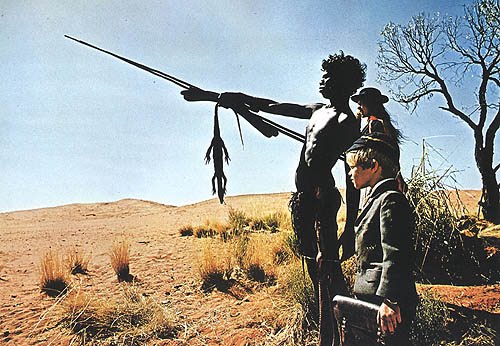
1. Walkabout (1971)
Director: Nicholas Roeg

I was truly surprised that one of the biggest masterpieces in Nicholas Roeg's career has never had a premiere in Finland. This makes me notice that the problem that many notable films slip through the cracks and all we get is schlock on the silver screen, is by no means a new one. If anything, because of the media gives enough buzz we have better chances of seeing great movies. I'm glad that today we at least have good chances of seeing whatever we want by various ways. Not so in 1970's Finland.

Hey, would you believe the film is another teenaged female coming-of-age story? I know, right. This time the girl (Jenny Agutter) is stranded with her little brother (Luc Roeg) in the middle of the Australian outback. They happen to find a Aboriginal boy (David Gupou) doing his rites of manhood by having a Walkabout in the desert. The white-bread children come to depend on the dark boy to get them through alive. But cultural differences as well as the inability to find a common language stop the the children from truly understanding the meaning of a Walkabout. At the same time, the sexual awakenings of different cultures and sexes are contrasted with the surrounding nature.

Visually Walkabout is probably one of the most magnificent motion pictures ever made. So much so, that it comes almost comical of how much this looks like a nature documentary at times. Roeg is willing to shoot every various lizard that lives on the desert and landscapes for minutes at an end. It is truly not a film for the impatient. But the landscapes tell plenty of the story as there actually is very little dialogue. Even character names are never revealed. Viewers are allowed to reflect their own feelings and experiences on Roeg's grandiose canvas. It is a highly symbolistic film and my favorite of all the coming-of-age story the history of cinema has ever seen.
Man, this movie should really be enjoyed in a cinema environment.

Wednesday, 5 January 2011

Review: 127 Hours

127 Hours (c) 2010 Pathé

So I'm staying true to my New Year's promise and will do a review on a film which I saw at a press screening. If I'll see the stats for the post will be good, I'll do a couple more of these. If not, I'll still do a little more reviews than before, but only about one a month.

Danny Boyle is a filmmaker who I rather appreciate than flat-out love. Granted, I haven't seen Trainspotting and I really like 28 Days Later... but usually I find his films to be a bit over-indulgent and hyperactive. The same goes to 127 Hours, which is the survival story of a guy (James Franco) who has his hand jammed between a rock.

Boyle begins and ends his movie with scenes which show large masses of people going through their daily races, praying, at a basketball game, etc. It is made clear that the main character Aron Ralston is just one among the masses. He's an everyman, who happens to like to wander in the canyons in Utah. Him being alone out there in the nature creates a contrast to the rest of Aron's life. Every major point in his previous life have all happened while he has been surrounded with a lot of people. One Christmas with the family that woke his interest in wandering in the wild. A girl first confessing him she loves him in a car full of naked people. And the same girl leaving him in the middle of a crowded basketball game.

So what happens is Aron gets stuck alone in the bottom of a canyon with his right hand being jammed between a huge boulder. What begins is a study of the human mind in such a desperate condition. Aron reminiscens old events and makes confessions to his digital camera. As Boyle allows his camera to fly far away to show the vast landscapes without a soul around, the real claustrophobia of the situation is somewhat lost. One can't help but to compare the film to the similar Buried, which lost at realism, but created at least a better claustrophobic feeling. The audience was kept at toes whether the rescue team arrives on the spot or not. With 127 Hours everyone probably knows that the only way Aron can get out of this mess is to cut off his own hand. Those scenes are not for the squeamish. But Boyle suggests that every single one of us could do the same to survive. And importantly, as people and not regressing as animals. Aron acts pretty reasonably through and through, save for a few little fury scenes and babbling nonesense to the camera.

The story is based on the experiences of a real Aron Ralston (who is shown during the end credits) and is of course a gripping one. But Boyle tries a little too hard to connect the one story to the whole human experience. Thus he sees nonexistent Scooby-Doos and dreams about major life points which could be from anybody's life. James Franco as the lead does very good work. His Aron is at once an everyman and a survivalist determined to make out alive. Aron is not a clear cut hero and has made mistakes before and probably will make them again. He is easy to root for and at the same time easy to identify with. Also the way Boyle shoots landscapes is very pretty. I just hope he would've restrained himself from too many split-screens, fast editing and crowd scenes and kept the story more intimate.

★★★

127 HOURS
USA/UK, 2010
Director: Danny Boyle
Screenplay: Danny Boyle & Simon Beaufoy, based on the novel by Aron Ralston

Tuesday, 30 November 2010

The Documentary 00's

The Best Documentaries of the 2000s - Part IX of a series

The Fog of War (c) 2005 Sony Pictures Classics


The 2000s treated the Documentary genre quite good. In fact, the genre had a certain resurface, as the films are quite cheap to make and there are plenty of interesting true stories to be told. So it's no wonder inventive filmmakers, both old and new, tend to take the opportunity to do a documentary. I even had to drop out music documentaries and some war documentaries from the list (they will probably appear in later lists). This time around doing a mere Top 10 proved to be hard, so here's a Top 15.

The 3 Rooms of Melancholia (Melancholian 3 huonetta, 2004)
Director: Pirjo Honkasalo

One of the most acclaimed Finnish films of the decade was this documentary by the veteran filmmaker Honkasalo. On the surface the film is about the war in Chechnya told from three different perspectives. Yet there is quite little narration and Honkasalo allows her strong imagery to do most of the storytelling. The end result is actually a film more about mood than story, which is quite a rare feat for a documentary. The athmosphere is very intense all through and one could even compare this piece of art to certain other anti-war art pieces, such as Picasso's Guernica. Both give the strong impression of grief, chaos, fear and death lurking around every corner during the wartime.

Bigger, Stronger, Faster (2008)
Director: Chris Bell

A Michael Moore -like populistic documentary about American steroid abuse. The twist is that the film is not actually against the use of steroids per se. Rather it takes on the mindview that makes people want to grow big, phony medical firms, and two-faced politicians and athletes. It brings up some important questions such as what is considered cheating, and is funny at the same time. The whole movie even starts with Hulk Hogan beating the Iron Sheik. What's not to love?

Bowling For Columbine (c) 2002 Dog Eat Dog Films Inc.

Bowling for Columbine (2002)
Director: Michael Moore

Say what you will about Moore, it's a good chance someone has already said it. At least his example brought documentaries to multiplexes and revitalized the political agenda in films. As such, he may be one of the most important directors of the 21st century (so far). I myself am a Moore-apologists, although I do recognize he has a tendency to go over the top at times. Not so here, his most balanced work which takes on the American mindset of fear as a explanation of the nation's obsession with guns. One would be amiss to think of the film as journalism. This is a pure pamphlet, although entertainingly told and very funny to boot. And this time Moore still had the ability to go around unbothered to ask annoying questions to the people in power. Okay, the much-maligned bothering of Charlton Heston is maybe a point where Moore goes too far. But people keep forgetting that the demented old man, looking almost symphatetic, was an extremely powerful frontman of one of the biggest lobby groups in America, which had even power over legistlation. Why shouldn't he be asked some hard questions?

Capturing the Friedmans (2003)
Director: Andrew Jarecki

While Moore's filmmaking style is to start searching for proof to his presupposed answers, Jarecki stumbled upon his own story while attempting to do a film about birthday clowns. The end result was a film about a normal-looking American family. The Friedmans appear regular to the point of boredom until it's revealed that there is evidence that the family's father and son have committed cruel perversive acts with small children. Jarecki's film is one of the most equal towards its interviewees I've ever seen. Everyone gets a turn to speak their mind, whether they believe the Friedmans are guilty or just framed. Everyone can make their own mind what to think about the charactera. At the same time the story is a clear tragedy happening before our eyes. The Friedman family is slowly disintegrating as the tensions grow and the final judgement seems imminent.

The Cove (2009)
Director: Louie Psihoyos

I've always said that the measure of a good movie is how big emotions it wakes up in the viewer. The Cove made me furious. And I expect I'm not the only one. The documentary about the mass-murder of the second-most intelligent creatures on the planet for altogether petty reasons should have awoken a number of activists. I'm glad they won the Academy Award for the film so that the message will get across. This is essentially another pamphlet-like documentary, but one which destroys every argument the opposing side has with a clear, unnegotiatable argument. The Japanese fishermen are depicted as brutal and ruthless, yet the film wisely has time to interview also regular Japanese people that are as appalled at the treatmen of dolphins as the filmmakers (and the viewers). The world of humans is shown to be ugly and dirty, yet the underwater shots are amazingly peaceful and beautiful. The message is clear: as people have destroyed their own habitat on land, they will move on to destroy the life on the sea. I probably won't go to any dolphinarium as long as I live. If I'll ever have children, I'll make sure thay won't either.

The Fog of War: Eleven Lessons From the Life of Robert S. McNamara (2003)
Director: Errol Morris

Man, oh man, is it hard for me to think of anything to say about this wonderful film that wasn't just said in Helsingin Sanomat in a column about this film. So you'll excuse me if I have some similar arguments.

There are a couple of movies on this list that feature only one old man talking about their life. They all are fascinating looks back and tell a lot about the past times and the world itself at the same time. Morris's film focuses on the former Secretary of defense Robert S. McNamara. He was an extermely controversial figure, with having planned military operations in WWII and Vietnam which killed a lot of people. Yet in the documantary can be seen that he was an extemely intelligent man who just happened to be put to these hard decision points. McNamara was the kind that learned from his mistakes and used working methods again. Thus he's just the right man to tell about lessons in war. It's obvious that it's not easy to make decisions that kill people, and McNamara takes his responsibility and is even moved by some painful memories. All in all, the film is a fascinating look behind the curtains of some of the biggest decisions in the military history in the 20th century.

Grizzly Man (2005)
Director: Werner Herzog

This is truly a story too weird to be fiction. A man loved bears with all his heart and lived with them every time he could. Eventually he became too trustful and one of the wild animals killed and ate him. Chillingly, the movie makes you ponder whether the worst thing a man could do to an animal is to treat it as a fellow human. And what about man's relationship with nature? If one tries to be one with it, will he destroy his mind first and eventually his whole life? This is a very unexpectional film, which dares to ask these hard questions.

Werner Herzog utilizes much of the material left behind by Timothy Treadwell. There is a strange beauty and poetry to Treadwell's images. Yet at the same time the film material portrays a really sinister spiral into madness. It's clear why Herzog has chosen him to be a worthy main character for a film. The man has so many times depicted men with obsessions which come to overtake them as well as the ultimate power of nature over man. In Treadwell's madness there is something Kinski-like, which Herzog himself confesses in his narration. Gold.

Jesus Camp (2006)
Directors: Heidi Ewing, Rachel Grady

From one man's madness to a whole community's. Jesus Camp is a film that may be seen as a hilarious comedy or the most spine-chilling horror film of the decade. It takes us to children's camp in mid-America. The kids are brainwashed there by one-sided opinions and charismatic evangelist speakers. I don't care what your religious stand is. When one subject dominates your life in every category and is the only thing which you think about when reasoning, it is dangerous. And one shouldn't pass this narrow-mindnessness to children. Yet this is a film that addresses some of the core issues of being an American. As such it's much more than the chance for a liberal European to laugh at the stupid white trash.

The Kid Stays in the Picture (2002)
Directors: Nanette Burstein, Brett Morgen

Another documentary that has an old man speaking. Yet for anyone interested in the history of Hollywood, this is a must-see. For the man interviewed is Robert Evans, one of the most important figures in the 60-70's revitalization of American film industry. The man produced, both individually and as a studio chief, classic films such as The Godfather, Rosemary's Baby, Chinatown, Love Story, Marathon Man and the Odd Couple. Yet like the case usually is in these sort of cases it's a Rise and Fall story. Evans is a very likeable main character in that he doesn't shy away from his weaknesses. He has a certain amount of regret for doing mistakes, yet it is clear that this is a man who lived for his work and the results can be seen in a wonderful filmography. The film material in the film itself is good too, and although nothing shocking or particularly new isn't shown, it suits Evans's speech well. It doesn't feel flat and obvious like someone like even Errol Morris can sometimes fall into.

Murderball (2005)
Directors: Henry Alex Rubin, Dana Adam Shapiro

I'm not a sporting man and don't usually like sports movies. Yet I'll have to say this film was quite captivating. It's about the world of full-contact rugby for paraplegics. Even though these guys don't have functioning legs, they are every bit as macho (maybe even more so) than any other athletes. The will to win is big. The film follows American sport-hero Joe Bishop who has jumped to coach the Canadian team, which is seen as betrayal by many fans and athletes themselves. Joe himself just wants to prove himself, which he felt he couldn't do back in the American team. The paraplegic-stuff is handeled pretty early on. The rest of the movie the viewer is just captivated by the sporting drama unfolding before his (or her) eyes. Like in the world of sports, I imagine one can have their own hero in the film which one can root for. It is a good sign of the documentary's quality that one is allowed to do so. There are no real villains here, save for the natural competitiveness of people.

The Pervert's Guide to Cinema (2006)
Director: Sophie Fiennes

This is an unresistably charming entry gate to the world of Slavoj Žižek. The film features just the undeniably charismatic old communist-philosopher Žižek talking about the way to interpret films via psychoanalysis and sexuality. It may jump from one subject to another quite quickly, but the interpretations are very clever and the film gives a great deal of why-the-hell-didn't-I-think-of-it-like-that -moments. I could listen to Žižek talking for hours, which is good because the film is a bit long. Yet it doesn't feel a minute too long and the viewer is kept at the edge of his (or her) seat to hear all this wonderful analysis.

The White Diamond (2004)
Director: Werner Herzog

Herzog again, and once again with a tale about both aviation and the jungle. For doing so much films about similar themes, Herzog is an incredibly inventive filmmaker. Every one of his films has something unforgettable. This one tells the story of an attempt to build a blimp in the middle of the jungle to shoot the treetops and caves. The film has the luxury of a great main cast from the friendly main character who carries a lot of guilt over his friend's death and ambition to do things properly this time around. The supporting cast of exentrics is memorable too, the highlight being Marc Anthony, the rooster-owning family man. Herzog himself is also prominently a character here too, going so far as to affecting the outcome of some situation just so he could get to shoot his film. And great shots he does achieve, from the weird and wonderful nature of the jungle to the technicity of blimps to a crew member dancing like Michael Jackson with the majesticity of waterfalls behind him. The emotional centre however, is the confession of the tragic events that happened previously near the film's end.

The Winged Migration (Le Peuple Migrateur, 2001)
Directors: Jacques Perrin, Jacques Cluzaud, Michel Debats

An extremely impressive nature documentary. The French filmmakers decided to follow birds on their migration flight. This required an insane amount of time and the construction of a huge number of complex flying cameras. Not to mention getting the birds used to being photographed. But the end result is nothing short of breath-taking. To see the birds in the air one feels like flying himself, so I would recommend watching this on a canvas a sbig as possible. Time is also spent on following the bird's life on the ground. Although these scenes aren't bad themselves, they are more of the regular nature documentary stuff.

Workingman's Death (2005)
Director: Michael Glawogger

Yet another documentary without narration. As Glawogger also trusts a lot of his storytelling on his strong images, this list has gone a clear circle from Honkasalo to here. Glawogger has toured the Earth to find places and occasions where work is still the activity which creates and defines a man. People go to weird extremities just to do their work from a sulphur mine in Asia to a meat-market in Africa. This all is contrasted when we finally come back to Germany, where an old factory building has been put to museum use, and children are playing among the once-dangerous machinery and platforms. I don't know whether the documentary is nostalgic towards old times or hints that the western countries make the poorer countries do all the actual dangerous work. Yet it is a powerful piece of filmmaking however one wishes to interpret it and a terrific mood-piece as well.

Bubbling under:

The King of Kong - A Fistful of Quarters (2007)
Man on Wire (2008)
Not Quite Hollywood: The Wild, Untold Story of Ozploitation! (2008)
Standard Operating Procedure (2008)
Viva Zapatero! (2005)

To be seen:

Darwin's Nightmare, Hell House, The Staircase, Stevie, Wings of Hope

LinkWithin

Related Posts Plugin for WordPress, Blogger...