Showing posts with label animal attack. Show all posts

Sunday, 11 October 2020

Three laughs: Birdemic - Shock and Terror


It is hard to rate some trashy films. Films can be really good entertainment in spite of the quality of the filmmaking. In fact, it might be even harder to create unique trash that keeps surprising you than most "quality" films with which you know what you are going to get. It certainly is an even better pleasure to watch them. My friend says that he knows a trash film is worth something if it gets three laughs out of me. I mean proper, good belly laughs when you just can't believe what the film is showing to you, scene after scene. That's as good a rating as any for these movies. Any film that has these three laughs has a special place in my heart.  

★ or ★★★★★

 
Three Laughs Case File #40:
Birdemic: Shock and Terror (USA, 2010)
Director: James Nguyen

If you've noticed, I like to do a little something special every time this column reaches even tens. So, it was about time to get the other movie that gives The Room a run for its money for sheer ineptitude. The fun of Birdemic is that its director James Nguyen obviously had lofty standards. It's the sort of self-serious film that takes a major issue (in this case, global warming) and trying to hammer the audience in the head with it in the guise of an easy to watch thriller movie.

The movie has obvious reference points, the main one being Hitchcock's The Birds, which is given a shout-out several times. Nguyen goes so far as to bill Tippi Hedren third in the end credits for using a clip of her performance in Julie and Jack. It should be obvious, but Birdemic doesn't get anyone to change their minds about global warming, but the way it sets out to achieve this task makes for a bizarre and beffling journey.

Rod (Alan Bagh) is a software salesman, living his daily life albeit ominous news of melting glaciers, heat waves and forest fires. Rod meets his old flame Nathalie (Whitney Moore) and they begin dating. But one day, everything changes and angry eagles start attacking and killing people. It's up to our (pretty useless) heroes to get to the bottom of what's causing the birds to attack, save children and bring balance back to nature.


 Three laughs (SPOILERS):

1. After the seemingly endless opening credits where the short main theme loops about three times, we get our first proper scene and it gives us a very good idea on what to expect. The sound mixing is terrible, making every line jump terribly and making it feel like you're watching a skipping record. About everything that's possible to be wrong about a quick scene of a man walking to a restaurant and being seated, is worng. The actors are hokey, the editing giving the scene odd emphasis and everything in general feeling awkward and weird. These kinds of bad movies are very good at revealing how odd our daily interactions may be, and as an entertainment it's something you don't get to see every day.

2. The dating scenes between Rod and Nathalie seem to go on and on, but there are occasional bright parts, like the one where they attend a R&B gig at a bar. The song "Hanging out with my Family" has hilariously bad lyrics, and it's cut to Rod and Nathalie doing the most hilariously awkward, white bread dancing. The next scene is the sex scene, so at least it worked for them.

3. The most famous terrible thing about the movie has got to be the special effects. The first scene of the birds attacking illustrates their hilarious ineptitude best. Shrieking GIF-animated birds fly up and about, with explosion GIFs added over the city (maybe the eagles are carrying TNT and kamikaze striking?). The high-pitched whine the birds keep making is also totally hilarious. Like everything else in the movie, it just keeps going, and going, and going...

Saturday, 25 April 2020

Three laughs: Eega


It is hard to rate some trashy films. Films can be really good entertainment in spite of the quality of the filmmaking. In fact, it might be even harder to create unique trash that keeps surprising you than most "quality" films with which you know what you are going to get. It certainly is an even better pleasure to watch them. My friend says that he knows a trash film is worth something if it gets three laughs out of me. I mean proper, good belly laughs when you just can't believe what the film is showing to you, scene after scene. That's as good a rating as any for these movies. Any film that has these three laughs has a special place in my heart.


Three laughs case #19:
Eega / The Fly (India, 2012)
Director: S.S. Rajamouli

A lot of western people have stereotypes about films produced in India, even though it's a huge country with multiple huge film industries producing movies for different language regions. One of particular note is the Tamil area based in Tennai. Their action movies in particular tend to be more over the top and violent than ones under harsher Bollywood restrictions.

The film discussed today is an action movie that does have its share of triangle dramas and dance sequences. But in other ways it's one of the more out there cases I've seen. Since it's part of its elevator pitch, I have to spoil stuff a little. The film's protagonist is killed 30 minutes in and reborn as a common house fly.

What follows is a good case on why Tamil cinema is often more inventive than what you would get from Hollywood. Every scene tops the previous one and there are more ideas at play here than in a season of Dexter. Everything is based around the idea on how a small fly can revenge the death of his former incarnation and kill the man responsible. The film treats its ridiculous premise fairly seriously, but at the same time it keeps its tongue firmly in cheek and gives good physical gags in vein of some classic Looney Tunes vibes. It has the qualities of a Sam Raimi or Joe Dante flick, with some nice effect work and camera trickery also used.


Three laughs (SPOILERS):

1. As said, the first 30 minutes of the film are fairly conventional triangle drama material. It's surprisingly bleak to see Nani's main character strangled to death by the villainous Sudeep. But what emerges is a sort of scene like in superhero movies when the costume is first put on. "He's back!" chants the soundtrack. Yet he is a CGI fly. Learning the ropes of fly lifestyle, Eega has to run a gauntlet from getting stepped on to getting caught in a soap bubble and finally ending inside the villain's chai drink. Dark music notes play as he recognizes his nemesis.

2. The height of the film comes after Eega has revealed himself to his loved one Bindhu (Samantha). They begin to to plot on how to murder Sudeep. What follows is a training montage which has Eega lifting Q-tips, running on a C-cassette tape and practicing flying, while Sudeep has his goons deliver as many dead flies to him as they can. At the same time, the fly also almost kills him by disturbing a barber about to shave him, putting pesticide in his beer and lighting his bed on fire with a cigarette. Of course we also get to see the fly's dance moves during this sequence.

3. Probably the most bizarre scene in the film has the increasingly desperate Sudeep resort to black magic. The wizard bewitches two sparrows into becoming demonic hell-birds. The ensuing chase in particular utilizes the smaller scale and everyday objects in the house in a pretty inventive and interesting ways, while still keeping the pace going. And even this is topped by the film's explosive finale, which is something you should go out and see for yourself.

Thursday, 16 April 2020

Three laughs: Uninvited


It is hard to rate some trashy films. Films can be really good entertainment in spite of the quality of the filmmaking. In fact, it might be even harder to create unique trash that keeps surprising you than most "quality" films with which you know what you are going to get. It certainly is an even better pleasure to watch them. My friend says that he knows a trash film is worth something if it gets three laughs out of me. I mean proper, good belly laughs when you just can't believe what the film is showing to you, scene after scene. That's as good a rating as any for these movies. Any film that has these three laughs has a special place in my heart.

Three laughs case #17:
Uninvited (1987)
Director: Creydon Clark

We've had killer rats, now let's try killer pussy. Pussy cat, that is. For this straight-to-video clunker features the ingenious high concept: what if some gangsters, some horny teenagers and a runaway mutant cat were stuck on a yacht together? It's probably much of a spoiler to tell that the cat starts to kill people. For from within its mouth emergers a smaller, more vicious cat or similar critter. The cat looks in parts like a plush toy, in parts like a wet rat. And also the cat's bite is poisonous.

It's probably safe to say that this film borrowed a lot from Alien, but as far as aliensploitations go, this has got to be among the most bizarre ones. Much of the film's budget went to the casting of some B-name actors such as Alex Cord, Clu Gulager and of course George Kennedy, who I have trouble seeing every time and not think of police chief Ed from the Naked Gun movies. Some more money could have been used here and there, the film's miniature boats are quite funny as they look like toys in a bath tub. Cash should have been shed also on gore scenes, since the film pussies out of them pretty fast. But even so, for a gorehound this is quite fun to watch.


Three laughs (SPOILERS):

1. Good monster movies take their time to reveal their monster. Here, it's shown in the very first scene in a laboratory setting, where a sinister corporation has created the mutant for some reason. Whenever it's seen walking around, it's just an ordinary orange cat, not unlike Garfield. But when it's cornered by some scientists in hazard suits, it opens its mouth where a smaller kitten emerges, and apparently kills everyone. Whenever it's shown a bit more it appears to be more like a cute muppet-like little monster, like they have in the Critters series. The cheesy synthetisizer music seems to belong more to a comedy, but in these scenes it at leat tries its hardest to create something resembling suspense. It fails, of course.

2. After the cat runs away from the scientists, he is being fed by a kindly stranger at a gas station. Who then gets immidiately mobbed. Luckily, the cat is familiar with the concept of revenge and attacks the attackers on their pickup truck. Which is then ran off the road into a river. In slow motion!

3. I did mention how George Kennedy makes me crack up. Most of the movie, his gangster character is a bit lackluster and uneasy while talking to his fellow mobsters about their ideas of taking spring break kids along for their cruise in order to distract authorities. But he gets slowly madder and madder and the scene where he finally boils over is a hoot. He comes out blasting, trying to kill the teen boys, but is stopped when the cat again protects his favorites and bites off his achilles heel. Too bad he doesn't get a proper death scene, here he's screaming his mouth off, but the cat's poisonous bite gets the best of him off-sceen and he's soon buried at sea.

I got to add, as far as it's-not-dead moments in horror movies go, this one has a really funny one.

Saturday, 4 April 2020

Three laughs: Roar


It is hard to rate some trashy films. Films can be really good entertainment in spite of the quality of the filmmaking. In fact, it might be even harder to create unique trash that keeps surprising you than most "quality" films with which you know what you are going to get. It certainly is an even better pleasure to watvh them. My friend says that he knows a trash film is worth something if it gets three laughs out of me. I mean proper, good belly laughs when you just can't believe what the film is showing to you, scene after scene. That's as good a rating as any for these movies. Any film that has these three laughs has a special place in my heart.


Three laughs case #14:
Roar (1981)
Director: Noel Marshall

Everyone is all about Tiger King these days. But the original morally dubious story of living with large cats is of course Noel Marshall's utterly bonkers Roar. It has the clean-cut outer image of a Disney-like adventure movie for the whole family, and a nice message is living in harmony with animals as well. But somehow, the movie had 48 crew members injured with over 70 injuries over the two-year (!) shooting period. And, boy, it shows!

Film stars Noel Marshall and Tippi Hedren used to have a wild cat sancturaty where they spent time with large lions. But there's a difference between having wild animals in safari parks and as housecats. In the film, Marshall himself plays a bit wacked-out hippyish dad in Africa, whose house is overrun by, not only lions, but also tigers and pumas (not native to Africa), leopards, and some rather nasty elephants.

It's one thing to risk one's own, or even your spouse's life in order to have them act in your crazy lion movie, but Marshall also cat his real-life sons and daughter Melanie Griffith to the film. Griffith needed facial reconstructive surgery due to her injuries on set. Photographer Jan DeBont lost his entire scalp. Marshall got the blunt of tooth and claws, and the film actually features footage where he gets wounded. It's a wonder a film like this got made, it's a wonder a film like this got lost in the streams of time, and it's a wonder a film like this can be watched and awed today. Nothing like this will never again get made.

Three laughs (SPOILERS):

1. The first laugh comes from the opening credits of the film "Since the choice was made to use untrained animals and since for the most part they chose to do as they wished, it's only fair they share the writing and directing credits". As far as film plots go, this one is so disjointged and hard to grasp, it's no wonder it was co-written and directed by Robbie, Gary and Togar the lion.

2. The lions don't seem too happy to be kept inside a smallish farm, and especially the males keep fighting in rather brutal-looking fashion. Marshall should get a medal from outstanding stuntwork for seeing fights break out between lions and tigers and running to break it up as a referee. I can't make out if he's actually as mad as his character, but he can't be far off.

3. Marshall talks to the lions as if they are children, insisting they are just playing. That's why the film also has plenty of scenes where he's broken off between talking and run to the ground by lions. Most other movies would cut these kind of materials off, but in here, they're the bread and butter of the entire thing.

Thursday, 6 February 2020

Three laughs: Thunder of the Gigantic Serpent


It is hard to rate some trashy films. Films can be really good entertainment in spite of themselves, and it is an even better pleasure to find some trash that keeps surprising you than watching most quality films. My friend says that he knows a trash film is worth something if it gets three laughs out of me. I mean proper, good belly laughs when you can't believe what the film is showing to you. That's as good a rating as any for these movies. Any film that has these three laughs has a special place in my heart.

Thunder of the Gigantic Sepent (Hong Kong, 1988)
Director: Godfrey Ho (as Charles Lee)

If Bruno Mattei is known for combining two movies' worth of stolen ideas into one movie, then Hong Kong's maestro Godfrey Ho does that literally. He used to buy film stock and combine multiple films into one with English dubbing. Mostly these are Ninja pictures, which have main characters that never meet, and more abandoned plot threads left unexplored than the last seasons of Lost and Game of Thrones combined. But Ho really did also test out which movies sold.

Case in point he bought out a Korean giant monster movie and combined it with a spy thriller. The end result is Thunder of a Gigantic Serpent, a title which sounds like an euphemism of farting before having to go to the bathroom. As you can imagine, much of the pleasure of this film comes from trying to combine a gritty crime thriller leaving plenty of corpses behind, and a silly family comedy of a pet snake growing into impossible size. But you know, some of the Godzilla movies were pretty violent, too. Somehow it all stays together.

Three laughs (SPOILERS):

1. The titular Gigantic Serpent starts out small, as a tiny snake that befriends a little girl. As the girl is asking on what to call her new pet, the snake waves its head first horizontally in disapproval, then vertically when the girl comes up with a name. She decides to call it Mozlov. The snake is in parts played by a rubber hose on a string, other times by an actual snake. Either way, the boneheaded way of having it nod or shake its head gives out a giggle each time.
2. The dubbing in general in this film is kind of hilarious. The main little girl sounds like a British lady talking with a very soft voice. The main bad guy seems to try out a voice somewhere between Cobra Commander and a cartoon vampire. The voices of his minions, gangsters and criminals are trying to sound as tough as they can. This includes swearing, which works to further destroy the illusion that this is supposed to be a family movie. "He lost the fucking formula!"
3. Once Mozlov the snake gets electrocuted with a groth ray, we enter the phase of the rubber puppets. The snake has a really irritating parrot-like scream. The sitcom-like comedy of a little girl trying to hide a huge snake in her room seems to have some Freudian undertones. I also love the scenes of the snake helping the girl out to win a roller-ski race pushing her around are to be seen to be believed.

One must add that the titular Thunder the Gigantic Serpent makes once the gangters start to threaten the little girl, is as underwhelming as they come. Just rattle a few bridges and skyscrapers and that's it. But being denied of your expectations is all part of the charm of these VHS-era clunkers. I wish we could have had a proper dvd or blu-ray release of this.

Friday, 24 January 2020

Three laughs: Rats - Nights of Terror


It is hard to rate some trashy films. Films can be really good entertainment in spite of themselves, and it is an even better pleasure to find some trash that keeps surprising you than watching most quality films. My friend says that he knows a trash film is worth something if it gets three laughs out of me. I mean proper, good belly laughs when you can't believe what the film is showing to you. That's as good a rating as any for these movies. Any film that has these three laughs has a special place in my heart.

Rats: Nights of Terror (Rats - notte di terrori). Italy, 1984
Director: Bruno Mattei

It is Chinese New Year and now starts the Year of the Rat. What better time, then, to revisit probably the most coherent film in the filmography of the schlock maestro Bruno Mattei. We might meet him in this column again a couple of times. Usually, he makes films that are cheap rip-offs of popular Hollywood movies. The fun comes from his ineptness in recreating working scenes on one hand, his inventiveness in mashing up two flavours and making his super-cheap budget work for him on the other.

A lot of fans of crappy movies absolutely detest Mattei. But usually even they make an exception with Rats. It is a sort of rip-off of The Warriors, Night of the Living Dead and your basic animal attack -movie. A group of young post-apocalyptic bikers seek shelter in a house that happens to be a breeding ground of super-intelligent and super-violent rats. The apocalypse hasn't hardened these kids too much, they are shaking in their boots the whole time. Most of the movie is shot pitch black, in order to hide the fact that Mattei really has no skills at his disposal to actually direct rats to do what he wants to. Troll 2 bad-movie maestro Claudio Fragasso worked as a co-director.

Three laughs (SPOILERS!): 

1. I am against animal cruelty, and feel strongly that even rats used in movies need to have rights to prevent them from being harmed. But anyhow, I am not a good enough person to not laugh when scenes come on where rats supposedly jump and attack characters, since basically they all just look like a guy off-camera (perhaps above them) is just throwing bagloads of rodents at them. If it's any consolation, I bet a big percentage of those are just stuffed animals, since live rats tend to cost more. And rats always land at their feet.

2. Since the rats don't actually move that much, the actors try their best to sell they are in mortal danger. But the hamming it up just comes across that they are scared in the Scooby-Doo sense. They are a cartoonish bunch anyhow, with each having a stock characteristic or a skill. And of course they seek to boink the girls of the group in the hilariously seedy mansion, not caring even if they are in the same room as their friends, who are actively trying to avoid eye contact.

Also the film's rats seem mostly want to avoid people, no matter what Mattei tries to sell us. Particularly any scene in a staircase where characters try to avoid any proximity to rats makes them seem hilariously fragile for supposedly hardened outlaws. Since rats won't just move towards the main characters, there is also a scene where some sort of cut-outs are clearly put onto a conveyer belt in order to advance menacingly.

3. The biggest laugh comes at the very end of the film, and is a surprise of the kind that I would really advise to see the film before reading this.

BIG SPOILER FOLLOWS

It turns out, Mattei had a twist ending on his mind, the like of Planet of the Apes or irony in the vein of Night of the Living Dead. As it has been a bit on the edge on why this film was set post apocalypse in the first place, the answer is given when dawn rises and our two survivors meet on with radiation-suited exterminators on city streets. When one of them removes their mask, we gat to see that they weren't human at all. They were some sort of wookiees, or gerbil-men. Or rather, I think what the film is trying to show us, is a man-sized rat who have taken over the world from the humans and are here now to exterminate even the last survivors. How's that for a twist, Mr. Shyamalan?

Tuesday, 7 January 2020

Three Laughs: Tammy and the T-rex


So, I'm going to start detailing trashy films that would be hard to give stars to. Basically, these are the movies that would get ★ or ★★★★★ here. My friend says that he knows a trash film is worth something if it gets three laughs out of me. I mean proper, good belly laughs when you can't believe what the film is showing to you. That's as good a rating as any for these movies. Any film that has these, has a special place in my heart.

Tammy and the T-rex (USA, 1994)
Director: Stewart Raffill

This is a really goofy teenaged romantic comedy where Denise Richards and Paul Walker (both before they really got famous) play lovebirds, where Romeo gets his brain fused into an animatronic Tyrannosaur. Just because. The film was reportedly scrambled together when the filmmakers got free access to a good dinosaur puppet that used to be a amusement park sideshow in Eastern Europe.

The film has been available for years as a VHS hacked to pieces. The original film had some really bloody gore parts, which were removed in order to market this to Jurassic Park -starved audiences. Vinegar Syndrome has since reinstated the missing bits. But it's still really weird to think, which audiences was this really aimed at? The director Stewart Raffill is also known from the horrendous E.T.-ripoff Mac and Me.

I think it has a sense of weirdness on the level of Troma, where it throws everything but the kitchen sink at you in order to get cheap laughs. The difference is that with a Troma film you know exactly what you get, whereas this film is all over the place, taste-wise, and thus more unpredictable (and funny!).

Three laughs (SPOILERS):

1. Paul Walker's character is inexplicably killed by taking him to a safari park to be mauled by lions. As the entire film was shot within 25 minutes from Raffill's house, one has to wonder, is he living in a Roar-like house filled with man-eating lions?
2. The cheapest laugh of the film comes when The Mad Doctor Wachenstein (Terry Kiser) pokes around with Walker's dead body and his brain. He gets a visible rise (ahem) out of him. Shame to let such a well-endowed body go to waste.
3. The gore effects are always fun, with the T-rex getting rid of most of the villains in 10 minutes or so. But the real fun is with T-rex's tiny front legs. Thus, it's silly fun to see him talk on the telephone or filp the bird with those adorable hands. But yeah, the third laugh is for T-rex ripping someone's head off with guts galore.


Sunday, 15 December 2013

Your Sister was a Werewolf and your Father Smelled of Elderberries!


Don't ask why, but I felt like writing about something and that something happened to be a variety of werewolf movie sequels from the 80's. And why not, it's not as if this blog's format wouldn't allow for me to fulfill such urges.

The Howling 2: Stirba the Werewold Bitch (USA/UK, 1985)
Director: Philippe Mora


There are several names for the sequel for Joe Dante's tongue-in-cheek cult film, and I of course use the one which I prefer. This film is also known as The Howling II: Return and The Howling II: Your sister is a Werewolf, which, while an actual quote from the film, doesn't quite have the same catchiness to it.

This is one of those cheapo films where they somehow had tricked Christopher Lee himself to act in, of which the legendary actor has felt nothing but regret since. Lee is one of my very favorite actors of all time, since there isn't a title so lowly that he couldn't liven it up with his undeniable charisma, grace and style. The film returns the favor by having him go to a punk rock club incognito and dressing him up in silly new wave sunglasses. The film is perhaps even a bit more clearer a comedy than its predecessor.


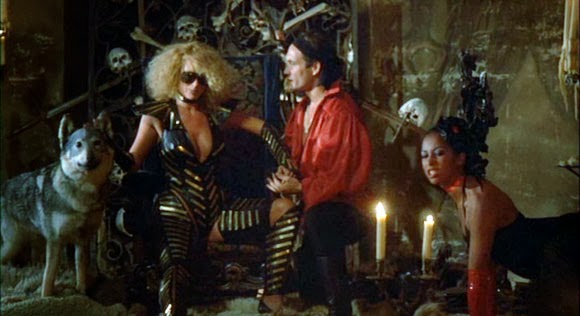
The film begins with the funeral of Karen White, the main character from Dante's film. Karen's brother Ben (Reb Brown) hears the truth from an attending werewolf hunter, Stefan Crosscoe (Lee). He convinces Ben to travel to Transylvania, along with his new girlfriend Jenny (Annie McEnroe) to kill the werewolf pack alpha bitch, the 10,000-year-old Stirba. She (in the form of Sybil Danning) hosts occult bisexual orgies at her castle and spreads werewolfism around the globe. Unless she's destroyed, she'll take over the world!

There's no denying this film's cheesiness, but there's a lot of an endearing quality to it. The film views all of the Balkans as a backwater area, where people still live like in Mediaval times and have an ethnic festival going all year. There's a good Euro-sleaze athmosphere going on in the scenes taking place in Stirba's castle.


There's lesbian undertones, dwarves, spanking, a horrible giant bat effect and other craziness going on all around. It's all in good fun and one can't help being entertained by all these horror tropes done suitably well and rolling along in a fast enough pace. The actors (sans Lee) are of course atrocious. Just as you think the film has ended and ran out of ideas, they have a final one in their bag: As the post-punk band Babel reprises their song The Howling during the end credits, footage of Sybil Danning revealing her massive breasts, cut next to various characters in the film reacting in humorous ways. Incredible.

★ or ★★★★★

The Howling III: The Marsupials (Australia, 1987)
Director: Philippe Mora


It seems Philippe Mora still had plenty of more ideas on where to take his werewolf franchise. It also seems he may have had too many ideas about the matter. The third Howling is shot entirely in good ole Australia, and in the patented ozploitation style.

While the werewolf population of Earth suffered a massive blow in the previous installment, some still survive. Case in point is Australia, which has evolved a wholly seperate population of werewolves that have pouches. The anthropologist Professor Harry Breckmeyer (Barry Otto) sees odd wolf-like creatures in old-time footage of aborigine rituals. So he naturally goes to The President Of United States to tell his suspicions of a weird, wolf-like tribe living in the bush.


Meanwhile, among the real wolf tribe, a young girl named Jerboa (Imogen Annesley) flees to Sydney. She catches the eye of a movie producer Donny (Lee Biolos) and is soon picked as a lead for a cheap horror movie. Jerboa and Donny fall in love. But she has to flee again as he realizes she's a bit hairier than he originally saw.

All sorts of crazy bullshit goes on. The film has poor grasp of a central story and there's ever-more left-wing twists to take the film to unsuspected territories. It gives an expression of a formless blob of a movie rather than a quirky comedy with surprises. While there are many fun parts early on (like the movie shoot and wrap-up party), sadly the film's additional scenes are often boring, such as the extended time jump of a werewolves raising a family in the woods. The final scenes bring the film full circle, but it's a bit too little, too late.


The film is admirably crazy, though and at least it's closer to Dante's original than either the first or second sequel in the same series.

★★


The Howling IV: The Original Nightmare (USA, 1988)
Director: John Hough


Let's not even go there. Attempts to be a more serious werewolf affair, fails in almost every aspect. Save for a puddle-based transformation scene, a total waste of time.


★

Teen Wolf Too (USA, 1987)
Director: Christopher Leitch


Rather, let's talk about the sequel to Michael J. Fox's on-the-nose puberty metaphor movie, shall we? It is considered to be one of the worst sequels of all time, and it's not hard to see why. For a comedy, it sure is an unfunny affair, and often doesn't seem to be trying that much.

The movie follows the cousin of Fox's Scott, Todd Howard (Jason Bateman). Everyone is aware that the Howards are werewolves, his uncle Harold (James Hampton) for instance being rather open about it. Rather than fearing the undead, unholy bloodthirsty beasts, this awakens curiosity and enthusiasm in normal people. Todd has gotten a college scholarship in order to bring the Hamilton University's boxing team some fame and glory. But Todd would rather just focus on his studies to become a veterinarian.

Yeah, the puberty undertones aren't that under in this one, either.

For one, the film forgot to add any jokes into its supposedly funny set-up. Scenes have incredibly poor comic timing. Often times it seems that the set up is going towards a punchline, but since the writers couldn't come up with anything humorous, the cast members just react a while and the scene moves on to the next one. It is a bit silly seeing Jason Bateman as a teen heart-throb and a lot of space is given shooting his cute smile spreading to his face. Less funny are the rubberfaced antics of his buddy Chubby (Mark Holton) that soon grow tiresome. John Astin as the cruddy old dean comes across as creepy as he can for no proper reason.


Boxing is an odd choice for the sport to be featured in a college comedy. Here it functions basically the same as in the Rocky movies: all punches, little moving around or blocking. The matches themselves feel like re-hashes of Karate Kid movies with their snooty rivals and whatnot, and not even the good ones. The most memorable thing about the movie is the godawful female mullett on Kim Darby, playing Todd's professor.

★★

Sunday, 23 December 2012

The Arnold Project, Part X: Mas


I haven't done anything to advance the Arnold Project for more than a year now. As a penance (gift-hungry children must do penance to get out of the Naughty list by Christmas, right?), it's more than fitting to take a look at the one movie often held as the very worst Arnold ever did: 1996's holiday classic Jingle All The Way!


Jingle All The Way, directed by Brian Levant, comes from the notorious period in Arnold Schwarzenegger's career when he tried his hand in playing the everyman in several family movies and comedies. And since Arnold isn't as much an actor as a presence, this was a horrible idea to begin with. He is as ordinary as a purple hippo dressed as Batman using the subway.

In this one, Arnold "plays" Howard Langston, a career dad who's never there for his son Jamie (Jake Lloyd, the worst actor ever to play Darth Vader). When Howard misses his son's important karate practice, he has to resort to making thin promises to win him back. In this case, he promises to get Jamie an action figure based on his favorite television super hero, Turbo Man, for Christmas.

The Finnish title for this film translates as "My Father is Turbo Man". FYI.

But as it happens, he doesn't remember the whole thing until Christmas Eve. He rushes to get the doll, even though he had promised his family to take them to the annual Christmas Parade. While Howard is gone, his sleazy next-door neighbor Ted (Phil Hartman) moves in to woo his wife Liz (Rita Wilson). Howard finds almost every departement store cleared out, since the action figure has been a major hit. Along with another desperate dad, Myron Larabee (Sinbad), they find a drastic measure after another to get their claws on the figure. But their quarreling and fighting over it foils the plan for the both of them again and again.

This is a very zaccharine-coated, plastic Hollywood dreck at its worse. But even though it's constantly annoying, it is also quite entertaining. Phil Hartman (RIP) could do funny in his sleep, and his considerable talents keep any scenes with Ted afloat, even if he hams it up. At least hartman seems like he's having fun. Arnold grunts and moans his way through. It is always fun to see Arnold in pain, and there's plenty of comical violence to go around here.


This is a film where there's two scenes where Arnold punches a midget so hard he flies all across the room. Arnold also fights mall santas, super villains, and punches Sinbad plenty of times. If he'd also kick Jake Lloyd's ass in some point then this parade of Arnold vs. considerably weaker opponents would be perfect. (He also fights a giant Super Santa played by WWE wrestler Big Show) The money shot is when he knocks out a reindeer. In the next scene he's feeding his neighbor's hot-tempered, certainly dangerous reindeer some beer. Y'know, because alcohol certainly soothes the wild soul.

At some point during the writing process of the movie the point must have been satirizing the commercialization of Christmas. The most astonishing thing, and simultaneously the most interesting thing about the film in general, is how the final product totally dismisses this idea. So while the film features adults fighting tooth-and-nail over the possession of a mass-produced, branded toy, the film doesn't give any alternative as to why they shouldn't be doing this. Instead, Howard feels remorse as to not have been a well enough father to spend his money on corporate Christmas presents earlier.


The measure of a good father in the movie is how good one keeps his promise. So, when one promises to give a certain branded, mass-produced action figure for Christmas, nothing else will suffice. So, in other words, if the child doesn't get exactly what he wants, it's the fault of the parents and they should feel guilty. I have a feeling Howard's kid will grow up to be kind of an asshole.

I detest many American Christmas movies, because they give such a plastic, saccharine, disgustingly commercial coating to a holiday that should be about love. The message of love is always ham-fistedly put to the film in the most obvious way possible, when it's clear that the shiny lights and wacky, easily sellable hijinks are what's the emphasis.


The oddity of the film makes it certainly watchable, and ironically funny as well. I'm not sure if I'd recommend it for anyone, but it's certainly in the same league as Batman & Robin as Arnold movies so terrible you have to see them to understand how tasteless film entertainment can be.


★ or ★★★★★

Merry Christmas from The Last Movieblog! Stay Classy!

Sunday, 11 November 2012

Review: Rust & Bone


Happy father's day! What better way to celebrate than to take a look at a recent film featuring, among other things, a man learning how to be a father? Jacques Audiard's latest film was screened as the Closing film of this year's Love & Anarchy - Helsinki International Film Festival. It is also on the programme of Pimedate ööde filmfestivaal - PÖFF, or the Tallinn International Film Festival, opening tomorrow.

So, as in many of the director's previous movies, Audiard's new protagonist is a man of few words, that is more used to violence than being a normal member of the society. Ali (Matthias Schoenaerts) is a man arriving to Paris to try to make a living supporting his 5-year-old son and staying at his sister's house. The man is struggling to get by, since he isn't too good working at normal jobs, but since he is imposingly large, he gets hired to be a bouncer at a night club.

One night at work he meets Stéphanie (Marion Cotillard), a whale trainer at the local dolphinarium, who also has a tempered violent side. When she gets kicked out of the club, Ali sees her safe back home to his boyfriend. Both sides have a small romantic crush on each other. Stéphanie's boyfriend, however, has had enough of her hard-drinking ways and leaves.


Trying not to spoil too much, but Ali and Stéphanie will eventually become even closer due to a horrific accident that cripples her for life. A major problem, however is that Ali isn't a very emotional individual, and sees no problem screwing around with every woman he encounters. All the while taking care of Stéphanie. The man will eventually learn to take part in brutal underground boxing matches to earn some better money.

For quite a long time, it seems that Audiard is attempting to build a portrait of a true sociopath who is incapable for any feelings whatsoever. Ali doesn't seem to care much for his son, and beats him up for misbehaving. While he connects with Stéphanie on a surface level, can't figure out her deeper feelings for him. But Audiard is a director capable of surprising the audience and by the end it becomes clear Ali does have his sensitive side.

The film's title refers to its themes of disfigurement, while Ali and Stéphanie both have serious personality defects that eventually cause harm to their bodies. He has the willpower and the physical strength, while she has the emotional, even spiritual side. Together they resemble more of a complete person, as evidenced by the scene where Ali takes her swimming by carrying her on his back. But the title may also refer to the emotional side, on how the film's themes may go way beyond of the surface level all the way to the core.

The film also contrasts the human tendency to tame nature and how it problematizes our way to behave. While Stéphanie's attempts to tame a killer whale are futile, she also grows to believe that taming a wild, uncontrollable muscle machine such as Ali is as impossible. But she won't give him, because of the hot, hot sex they're having. Thus she begins to communicate with him only through a very short acronym text message or through body language.


It is a very physical film, shot at times as naturally as to be almost like a nature documentary about the hard knock lives of these people. Audiard is as masterful in compressing everything that needs to be said in just a few sentences as Aki Kaurismäki. One also has to give due to the magnificent actors. Cotillard and Schoenaerts are at career-best form here, taking their abilities for emotional performances and imposing physicality (respectively) to whole new heights.

For those awaiting a clear love story, the film might be too distant, even cold. For those awaiting for the brutally violent boxing matches, they are quite sidelined and only featured in two bigger scenes. But for anyone looking for a good drama that makes one ponder about the human vunerability, and how it affects our own humanity, this is a bullseye.

★★★★


DE ROUILLE ET D'OS
France/Belgium, 2012

Language: French
Director: Jacques Audiard
Screenplay: Jacques Audiard, Thomas Bidegain, Craig Davidson
Cinamatography: Stéphane Fontaine
Starring:
Marion Cotillard, Matthias Schoenaerts, Armand Verdure, Céline Sallette, Corinne Masiero

Wednesday, 31 October 2012

Werewolves through the ages


Happy Halloween! Today is a very special day because Night Visions Maximum Halloween Film Festival officially starts today. We've had two special occasions for the visits of directors John Waters and Paul Verhoeven, but the main programme starts today. Whether intentional or not, this year's films feature a small retrospective of Werewolf movies with three films to be displayed, including Joe Dante's The Howling.

Doing a special post celebrating a type of monster on Halloween is beginning to be sort of a tradition here, so what better time to look at our lycanthropic friends. After all, there was a magnificent full moon yesterday.

A werewolf is a creature from ancient legends and has originally been involved in the fear of unknown in nature and the feel that ancient spirits can live on in animals and even possess them. When we fear werewolves, we to some extent fear nature. Thus, the archetype is surprisingly common characters appear all over the world (as do vampires). So it makes sense that this vein has been mined for cinema for years and years. Though there hasn't been a definitive take on the monster (although The Howling, and another werewolf picture made on the same year, come close), they more or less follow similar formulas: A goody two-shoes main character starts to get strange urges, spurts hair and goes out to kill. These werewolf films may not be the best, but they are chosen to reflect on the times on which they were made, which is why they gave weight to different things.

The puberty metaphore is quite clear, which is also why so many werewolf pictures have been made for teenagers. But through the decades there has also been various social changes that have made people doubt whether they are really as civilized as they claim to be. So grab your beast within, wer'e going in.


1930's
Werewolf of London (1935)
Director: Stuart Walker

The first major werewolf picture followed on the heels of other 30's Universal horror classics such as Frankenstein, Dracula and The Invisible Man. Yet it didn't become as big a classic as them. Why not? Well, for one, the star Henry Hull lacked the charisma of your Bela Lugosis, Claude Rainses and Boris Karloffs. Add that to the fact that he decided not to wear the make up assigned to create a believable werewolf, rather choosing a more modest approach. While that might have been as creepy, it didn't really look all that wolf-like or iconic. Luckily the make up had a chance for another run later on.
The American attitude of the 30's was to isolate themselves from all the war and carnage going on elsewhere in the world, largely because the Great Depression ensured there was enough problems back home. As such, the film reflects isolational views to stay out of foreign places and their businesses. The werewolf curse is caught by a scientist attacked studying flowers in the mountains of Tibet. The beastly ways of the foreigners are contrasted by, what else than Victorian stuck-up British people, that are sickeningly polite and down-to-earth, not giving any space to superstition or fantasy in their lives whatsoever.

The tragedy of the story is that the werewolf's condition keeps him away from his wife, while he stays locked up in rooms in an attempt to control his blossoming rage. This can also be seen as a sort of sexual frustration. The film is not too shabby, although quite theatrical in style, but it's central themes have also been done better multiple times since, which is why it's a little more obscure than some of its peers.

1940's
The Wolf Man (1941)
Director: George Waggner

It seems Universal itself wasn't that happy with how The Werewolf of London turned out (although it was a moderate hit). They made another film, this time set on a countryside villa and its dark forests rather than in an urban setting such as London. The themes are more along questioning the power of heritage, and family. Can a son bent on violent outbursts and losing control of his personality be considered a proper heir?Screenwriter Curt Siodmak was a Nazi concentration camp survivor, and his cynical outlook on people and their underlying brutality is reflected on his work. Jack Pierce's original make up designs are unleashed this time with wonderful results.


Lon Chaney Jr. brings great tragedy to the title role, and he is supported by the likes of Claude Rains, Bela Lugosi and Ralph Bellamy. This time the lycantrophy is a curse much like a disease, spreading from one person until the next until the owner is killed. Symbols and various iconic items are emphasized in the story and in the cinematography. The eerie music choices also underline the strange athmosphere and poetic imagery. Poems are in an important role in the storyline as well:

"Even a man who is pure in heart and says his prayers by night, may become a wolf when the wolfbane blooms and the autumn moon is bright."

While the film runs quite predictably, the true and tested Universal style keeps the film afloat. 

1950's
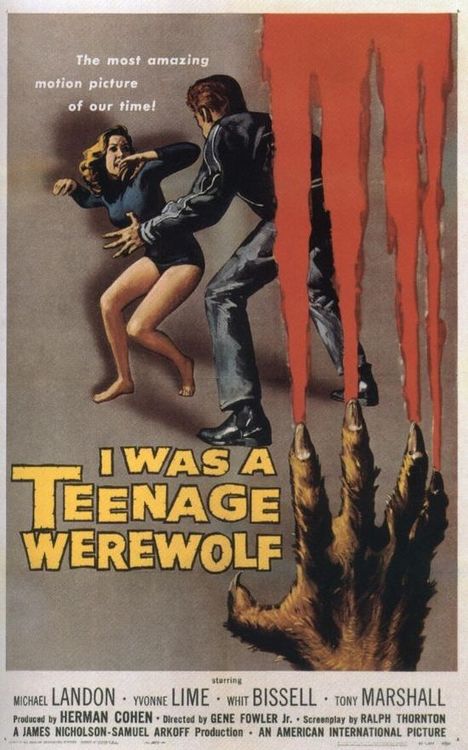
I Was A Teenage Werewolf (1957)


When teenagers started to spend more and more of their allowance on pop culture, also going to the cinemas, some wise guy had the bright idea to develop popular monster films by adding some teenaged drama into the mix. This film was the first of its kind, and the clear werewolfism metaphor ensures it's well remembered even today. as for the quality, oh brother.
Like many teen pictures at that time, this one is designed to lecture first and bore second. The star Michael Landon is a trouble-making teen, who gets experimental hypnotic treatment. This unleashes the wolf-manners in him, without him knowing it at first. The film builds very slowly and slowly. There's precious few werewolf action and quite a lot more of Landon trying to get answers from authority figures such as parents and doctors on what's happening to his body. The society being prudish, he is of course denied valuable information before it's too late.

Quite boring, but an interesting curiosity of the time. You'll find this is a common theme in this post.

1960's
Curse of the Werewolf (1961)
Director: Terence Fisher


The British Hammer productions jumped at the chance to do new adaptations of all classic horror tropes from Universal's back lot. But sadly not every film could be their Dracula, and many of their monster films were aggressively average. Among these is the production company's foray into werewolf pictures, which had the good idea of having Oliver Reed play the main role. Sadly, although the role would be one the actor would seem to be born to play, he can do little to salvage the film. For starters, the werewolf looks like this:

Run! It's the sideburns monster!

Hammer's approach was to bring back some of the conservatist themes acquainted with the old horror films, yet up the gore and nudity at the same time. This is a story of a boy who more or less grows up to be a werewolf, and thus can be seen as a metaphor for alcoholism / puberty / sex addiction. Bad habits go in the family, you know. Yet the film is stuffy, too slow unraveling its thin story and has little to be frightened or even feel a bit uneasy with. The transformation effects are of course better than in Universal's films but still look dated today. But the sets, costumes and music are all top-notch. This could've worked better as a no-nonsense costume drama set in the old Spain, than as a werewolf picture.

1970's
Werewolves on Wheels (1971)

However, Hammer's classical approach still fares a lot better than the more liberal approach. WWOW is another werewolf movie that seems great on paper is this exploitation pic that had the bright idea to combine then-popular biker flicks to horror movies. Yet rather than to have the goofy fun with the subject the magnificently silly poster implies, the resulting film is a mess in every sense of the word.


The hippie era came to a screeching halt with the Manson murders, and people started to get frightened about Satanist views and youth gangs, such as bikers. At the same time the outsider imago of these groups drew youngsters to cinema seats which explains why a film called Werewolves on Wheels is more about Satanism than lycanthropes.


These bikers are trouble but not enough trouble to lend their shared girlfriend into Satanic sacrifices. But evil monks have set a demon loose, which possesses the lady and turns her into a werewolf whenever it's dark enough that the audience can't see shit happening on screen. On their run from the law across America, the Satanic monster wipes the freewheelers out one by one. No wonder the hippies lost the War for Peace On Earth.

1980's
An American Werewolf in London (1981)
Director: John Landis


The later 70's and early 80's are a sort of a silver age of genre filmmaking. Visionary directors found funding more easily and vastly improved physical effects look stunning even today. John Landis's horror-comedy is one of a rare breed that works equally good in both categories. Since the werewolf curse plagues a young man (David Naughton) and happens parallel to him getting acquainted and interested in a nurse (Jenny Agutter), it's not hard to read sexual undertones into this. Hell, one of the key transformational scenes takes place in a porno theater.


Landis has the good sense of showing very little of his central monster until the very final minutes. The goofy wolf-mask isn't near as scary as the bone-breaking and twisting transformational scenes, or the scene where a terrified British gentleman flees the monster in empty and endless subway tunnels, which barely shows the beast.

Today, the film is best known for its painful-looking transformatinal scenes.
Yet at the same time Landis isn't above the surprise nazi zombie attack, undead mauled bodies of best friends past asking for a piece of toast, or a superbly dumb sex film called "I'll call you next wednesday". The final few minutes revel in destruction and explosions, but lack in impact. If they were a little better this would be a full-fledged horror classic. Now it's just a stellar performance and still one of the best werewolf movies ever made.

1990's
Wolf (1994)


The 90's saw a boom of "erotic" thrillers. And at that time that usually meant an even more sex- and violence-obsessed American films with perhaps even a quick flash of a nipple. This was due, of course, the scare of AIDS and various other STD's killing straight and gay people alike, as well as the tabloidisized news looking for juicy sex scandals and drowning the media revelling in them anyway. Wolf also followed revisionist horror films such as Bram Stoker's Dracula and Mary Shelley's Frankenstein, attempting to update classic stories to scare Generation Xers. As one can see looking at the films today, to little avail. They now seem a bit ludicrous, and clearly products of their time. Jack Nicholson, for instance, still was considered young and virile.


Actually this might just be a more boring, werewolf version of Nicolas Cage's Kiss of the Vampire. Another white-collar worker (played by Nicholson) has a supernatural run-in and his worsening condition makes him act more and more crazy at work. But as a thin yuppie culture parody, it works and he's doing fine. At the same time he fantasizes about sex with about every woman he runs into. He soon gets his wish because his beastlike qualities make women fall for him, but the attraction just may be too fatal for them (see what I did there?).


2000's
Cursed (2005)
Director: Wes Craven

Horror director Wes Craven had such a big hit with Scream in 1996 that he has more or less spent his entire career since to try to recapture lightning in the bottle. The same goes (even more strongly) for screenwriter Kevin Williamson, who never really was nearly as clever as he himself thought. He merely put horror movie nerd's thoughts and gripes into his thin screenplays. The hook gets thin after a while. One example is this update with teenaged siblings sharing a deadly crime of hitting a man while driving around at night. But it's OK since he didn't die and was in fact a werewolf. But it's not OK since he attacks them and runs away, giving them all the curse of lycantrophism.


So these teenagers must do the most forbidden thing in their lives to get rid of the curse, which is to kill an adult. Which is all they dream about! Well that and having sex with each other. Which they do, too! Isn't Williamson a hoot? To be fair, there are a few decent jokes scattered here and there to not make this a total waste of time. But it all seems so played out it's a wonder a man as talented as Craven ever bothered.

As for the creation of werewolves it's bad. Horrible, even. With computer effects, all the elegance had completely vanished from horror films. Since you could do transformational scenes in full daylight, there was little of the poetism that worked around the limits of what old technology could achieve. as such, it's also harder and harder to get sucked in the movie's world and care for the protagonists. Since they are chased by bad CGI or rubber wolves all the time, with sound turned UP, there is little suspense. This what horror films have come to. Bad movies have been made in every decade but rarely has the whole genre been so overwhelmed with mediocrity.

Well, actually there is this new Spanish werewolf movie called A Game of Werewolves. But I'll tell you all about it some other time.

LinkWithin

Related Posts Plugin for WordPress, Blogger...