Showing posts with label Espoo Cine. Show all posts

Wednesday, 28 August 2013

Espoo Ciné 2013


The annual international film festival at Espoo didn't have a very interesting programme this year, but I still managed to miss several of the most interesting films on display there. Oh well, if they really are good, I'm sure I'll come by them eventually. I managed to catch a number of films there, most of which were rather good, so it certainly was worth the bus trip there.

Blue Jasmine (USA)
Dir. Woody Allen


The most notable premiere of the festival was the new Woodsy Allen movie. I've never been a big fan of the bespectacled auteur, although I do like a few of his best, and his films of recent years which I've caught in the recent years have been cute but dismissible fluff at best. So color me surprised that he still managed to deliver a fine movie with some gravitas.


At its core Blue Jasmine is a modernization of Tennessee Williams' A Streetcar Named Desire, with Cate Blanchett as Blanche, Andrew Dice Clay as Marlon Brando (if you can believe that) and San Fransisco as New Orleans. But it strays from the material enough to able Allen to be in the race for the "best original screenplay" at next year's Oscars. It's a story of losing everything and deluding yourself that it's just a phase before a new step back up. An important part of the movie are flashbacks to old days where Blanchett's Jasmine turns a blind eye to her husband's (Alec Baldwin) shady business deals and sex-hungry flirtation with other women for her own luxury and idle happiness. In the modern day, Jasmine slowly loses her mind over dating issues, seething hate for her sister's boyfriend, and most of all her newly found poverty. The two timelines run parallel to each other, coming to her breaking point at the same time.


The acting in the film (particularly the incredible Blanchett) is top-notch, and at best points a little rough around the edges to feel more authentic. Actors stammer and sob in their anger. Yet the visual side with its golden autumn-colored visual world is a tad tired. The film is staged as if it's a stage adaptation, perhaps deliberately, but doesn't entirely work to underline the performances as probably intended. At least Allen doesn't take us through sheer tourist-baiting cityscape porn this time around. The story is touching and somewhat topical. And the bittersweet comedy oftentimes makes the audience cringe and giggle at the same time. Nicely done.

★★★ 1/2

The Paradise Trilogy (Austria/Germany/France 2012-2013)
Dir. Ulrich Seidl

The festival screened the entire Austrian trilogy of pining and crushing disappointment back-to-back. They each are fine films in their own right, but together they form symmetries of how human beings are at lost with their emotions and lives, whatever their problem, age or worldview is. It's a story of one family, each film following one female member struggle through life.

Paradise: Love (Paradies: Liebe)
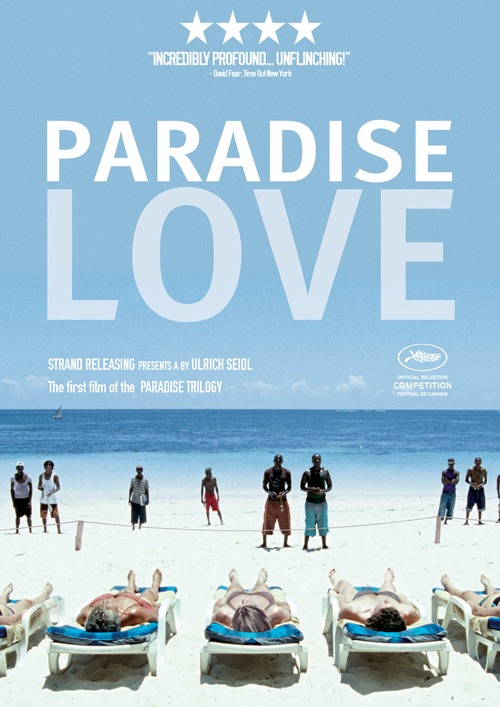


The entire trilogy begins with a shot of physically challenged persons driving around in bumper cars in an amusement park and this sums pretty aptly what all three films are about. Looking for love, or any content to life, is like bumbling around in the dark, and you might easily be hurt. Love concerns the love-lorn middle-aged Teresa (Margarete Tiesel) going to a holiday in Kenya. Yet she is not so much interested in Safaris or games at the hotel poolside than finding a boyfriend from the local men.


Teresa's friend compliments her holiday boy-toy and she becomes curious for some local meat as well.  Teresa has a low self-esteem and opens up to men complimenting her looks and dismissing her age. Even though she is after sex, she wants her boyfriends to be interested in her because of her personality, not her wallet. And thus she finds crushing disappointments time and again. The poor local people are only after monetary support from rich white ladies, not an equal relationship. Seidl doesn't shy away from any aspect of these unequal, partially racist interactions, spicing his film with plenty of black humor and cringe-worthy scenes.

The problem with the trilogy opener is pretty much the same as with all Paradise films. They are clear arthouse films, slow-moving and aesthetically strong. While the ideas and the message are incredibly easy to get and understand, there aren't any layers or anything to ponder afterwards. And once you figure out the central ideas of the movie, the rest is sort of inevitable and at times even a drag. Love has plenty of nice, static shots of tourist beaches and African reality so it's at least easy to look at but sometimes feels like a way too personal holiday diorama. It's a nice film but hardly a groundbreaking masterpiece.

★★★ 1/2

Paradise: Faith (Paradies: Glaube)


Nurse Anna Maria (Maria Hofstätter), sister of Terese, is a hardcore Catholic. Hardcore, as in she whips herself in front of a crucifix, and goes around the houses of immigrants and the unemployed to deliver statues of the Virgin Mary and to talk about (her interpretation of) the Bible. It's not an easy job, as many of her "customers" are dismissive or otherwise hard to deal with. But AM's life becomes even more difficult than that, when his paralyzed (and randy) ex-husband (Nabli Saleh) comes to stay at her place.


Making fun of devout Christians is something akin to shooting fish in a barrel. But Seidl isn't so much interested in mocking (although AM's obsessiveness does generate plenty of laughs), but rather in the hopelessness to try to keep a strict set of rules one sets to yourself and the world. One won't come out a decent human being, no matter how hard one tries.


What sets this installment above the rest of the trilogy is the grotesque cast of characters. Particularly memorable is Herr Rupnik, an obese man who tends to misplace his pants and lives in an apartment akin to a huge pile of garbage. Maria's sanity is put into question several times, as her obsession deepens, so does her affection to Jesus, represented by a big crucifix. Perhaps the reason she detests Nabil so is the fact that he's a Muslim. All in all, it's a trashy, borderline uncruciable account of becoming too blind on one's own acts and too focused on one view into the world.

★★★★

Paradise: Hope (Paradies: Hoffnung)


The final film sees Terese's teenaged daughter Melanie (Melanie Lenz) go to a Fat Camp to lose weight. But being a girl in a delicate age, she's not that interested in the daily exercise routines, but rather talking about sex experiences with her campmates, stealing food, alcohol and cigarettes, and running away to go to a club.


But the thing she is most interested is the middle-aged doctor (Joseph Lorenz) of the camp. She soon develops fake symptoms to go see him every day, much to his delight. Lorenz plays the Doc suitably sleazy and creepy. One is not quite sure whether he's going to act out on his instincts or not. One scene sees her follow her into the woods like the wolf following Red Riding Hood. They end up hugging. Or at least that is what is shown on screen.

Seidl has veered a little close to familiar patterns with his previous films, and this one veers a bit too close into the well-trodden coming-of-age path. As I implied, many of the films most interesting parts are the ones you don't see. Indeed, it is about a half-hour shorter than the other Paradise films. Yet it does feel equally long, so perhaps the storytelling isn't quite as leisurely forward-moving here. The film feels a bit fractured, and it is its greatest asset as well as its downfall. The acting, again, is superb.

In this case, it is not quite as clear as what the Hope in the title refers to. Melanie doesn't seem too interested in the Hope of becoming thin, after all. The Hope of becoming a woman? Perhaps this left a bit more to ponder about than its predecessors, after all.

★★★ 1/2

I Am Divine (USA)
Dir. Jeffrey Schwartz


It's about damn time the legendary drag queen actor/disco music star got her own documentary! It's one of those subjects that is so interesting in itself that it's hard to fail, at least with the right audience. As a documentary, this is far from perfect, but it's still a really fun ride alongside one of the most outrageous figures in pop culture.


Jeffrey Schwartz's film was funded by crowdraising the money. The lack of budget shows off here and there, since several photographs pixelate visibly when zoomed into (not that zooming into photos repeatedly isn't a tired cliché in documentaries anyway). However, all the right people are interviewed, including John Waters, Mink Stole, Mary Vivian Pierce and even Divine's dear old mother. One would have hoped to hear some more outrageous, weird and wonderful stories from those that knew him best, but the film is a bit shy on them, whether it's because of respect for the deceased star or for a lower rating.

Still, it's a heartfelt retread of the life of a huge icon with several rather moving testimonies from family and friends. It offers little new information for connisseurs (some longer clips from early, rare John Waters shorts would have been fine, too), but it works as a passable introduction to the world of Divine.

★★★

Blancanieves (Spain)
Dir. Pablo Berger


I found this film's title impossibly difficult to remember until I watched the movie and found out what the title meant. Basically, this is a story of an orphaned girl who follows on her father's footsteps into becoming a popular matador, bullfighter. Any mythological parallels are hidden a bit deeper.

There are dwarves, though.

This is also a brand spanking new silent movie, much in the vein of The Artist. This tries to be charming and touching, like that film, but ultimately left me cold. There are bits and pieces to be enjoyed for sure, and visually it doesn't look half-bad. But I had problems identifying with the main character, who kind of bumbles through weird mishaps without a proper arc or a character to speak of. It also doesn't help that the main characters are bullfighters, which I find to be kind of horrible assholes. Anyone who thinks it's sort of glamorous to slowly butcher and torture an animal to death, deserves to be murdered by a gold-digging witch.


Unlike The Artist, which dealt with the development of cinema anyway, there's scarcely a good reason for this to be a silent pic other than to cash in on the success of others, and to utilize a nifty trick to gain attention to a hallow shell of a movie. The main villainess (Maribel Verdú) is kind of cute, though. She kind of looks like Bérénice Béjo.

★★

Byzantium (UK/USA/Ireland)
Dir. Neil Jordan


Neil Jordan has gained reputation along the years to be a feminist genre movie director. His latest film could be seen as a response to the Twilight crowds, who crave bloodsucker romance so hard they forget that the female characters in it are virtual non-entities. Jordan has plenty of good ideas and tricks up with his sleeve on this one, but somehow lacks any grip on the direction, so the end result is a boring and shapeless mess.


Two women seek refuge to a small coastal town. Clara (Gemma Arterton) gains money from prostituting herself, while the younger Eleanor (Saoirse Ronan) helps euthanize elder people and goes to the local schools writing class to show off her skills. The latter falls for a classmate, Frank (Caleb Landry Jones), and reveals that they are actually Lhiannan Shee, vampire-like creatures who survive during the day but need blood to live.


The character of Eleanor is way too dull for the role of the protagonist. Thus, when the film spends the most time developing her and Frank's relationship, the audience falls into a coma. All flashbacks to ye olden tymes are infinitely more interesting, even if they slowly start to form a picture which I certainly didn't quite understand or manage to put the pieces together. Plenty of the most interesting elements of the film are woefully underutilized, including Arterton's sexier and more femininely threatening spirit, and the pursuers of the pair. The final act of the film takes on a whole new gear, but still offers little new to a market packed to the rafters with monster-romances. Jordan is so much in love with his idea of a blood-filled waterfall that he uses it plenty of times, never mind that the water is more pink than blood red, and that that welcomes unwelcome comparisons to the elevator shot in The Shining.


Watching the movie, I came up with several good ideas on how some of the central ideas could be utilized to make a more interesting film. When this inevitably gets remade in 5-20 years, Hollywood, you know who to call.

★★

Wednesday, 29 August 2012

Espoo Ciné 2012

The restored version of Méliès's A Trip to the Moon was one of this year's highlights. Sadly, I missed the film.
There was a mighty fine film festival in Espoo this year. While the programme boasted less obvious picks, the overall quality of the festival was as high as ever. I, once again, saw some of the most interesting films from Europe and around and here's what I thought of them.

The Opening Film:
Amour (France/Austria)
Director: Michael Haneke


With this film, Haneke bacame one of the prestigious few who have won the Palm d'Or at Cannes twice. And it is a real corker. While Haneke remains faithful to his cold, sterile, analytic style, the film still revals surprisingly humane sides of the grumpy Austrian auteur. Like the title states, this is about love, but Haneke-style.

In the spotlight of the film are an elderly couple of wealthy music teachers, Georges (Jean-Louis Trintignant) and Anne (Emmanuelle Riva). They live together in a vast flat in the middle of Paris, where most of the film is also set. But then, their everyday routines are threatened when Anne has a stroke and her health starts to falter. Georges takes care of his bed-ridden wife as best he can. Their worried daughter Eva (Isabelle Huppert) comes to visit and suggest that Anne could get better treatment at a hospital. Georges is adamant that she'll be best off in their home, and makes effort to get the very best treatment and care for her as he can.


It seems odd that so few movies dare to deal with the Autumn years of peoples' lives. It is the time when lives may be changes in a flick of a wrist, and may hang by a thread. Watching Amour is utterly devastating and hard. One doesn't need flashy melodrama and luscious over-the-topness to tell about us as people. This is as honest and down-to-earth as one can get, never spoon-feeding the viewers with anything. As is often the case with Haneke, this is less a story, more a study of emotions and situations. The director's characterization is precise and is helped tremendously by the excellent cast. Also faithful to the director's style, he devastates upper-middle-class living, where the appearence of the situation may be the most important thing. As precious of his wife is to him, Georges can't stand the thought of humiliating her by allowing just anyone to treat her. All the possessions the rich pair owns eventually turn into empty relics at a tomb. We know from the beginning how the thing will play out, which adds to the hoplessness and emotional punch of the film. It's a near masterpiece, although I'm not quite sure what to make of the final scene that seems to be at odds with everything else on display here.

★★★★ 1/2

Brave (USA)
Directors: Mark Andrews, Brenda Chapman


Is Pixar the victim of its own success? Everyone seemed to wait a sort of second coming or a cinematic masterpiece from the next film produced by the studio that last did Cars 2, and the reviews this little gem has got reflects those. But that's not how studios work, even though Pixar still works as a sign of quality. Had Brave been released as a Walt Disney Animated Classic (tm), it would've been hailed as that studio's best effort in ages. Brave does feel to have more in common with Disney's tradition of animated movies rather than Pixar's.


This is an old-fashioned fairytale, concerning a princess, this time in ye old Scotland. Merida (Kelly Macdonald) has been prepared her whole life by her mother Elinor (Emma Thompson) to choose a suitor and get married. Her father Fergus (Billy Connolly) would rather have scraps and feasts, but humors her wife and calls off the three biggest clan leaders of his kingdom to present their sons for Merida to pick a husband. But Merida opposes the plan, and runs away from home. In a forest, she stumbles upon an old witch, and persuades her to do a spell that would change her mother. But the spell changes more than she bargained for, and soon both the daughter and the mother have to fight for survival.

If the story seems to consist of familiar elements, it might be, but they are mixed so as to feel fresh. It is good to see a fairy tale animation after a long while that has almost none cute postmodernism, winking at the audience or anachronistic modern jokes. There is a little less humor than usually in Disney/Pixar films, although the comical scenes play well. One would've wanted some more of the bonkers carver witch and the three mute, red-headed rascal wee 'uns, which is always a good sign. 


Essentially, this is a story about a quarrelling family, and even more precisely, a relationship between a mother and her teenaged daughter with very different interests. The film argues that real bravery is not in any fight skills or archery, but in the care for others and willingness to put her- (or him-) self in jeopardy just to save those that one loves. Where does changing oneself go, is the film's real conflict. Such ideas are universal. It also helps that the film is easily Pixar's most gorgeous. The fog, the dark natural light, the elements at play. They help create an athmosphere akin to the one in early 1940's, a bit "darker", Disney fables, such as Pinocchio and Fantasia. It's also almost as exciting.

★★★★

Hell (Germany/Switzerland)
Director: Tim Fehlbaum


While everyone knows how Roland Emmerrich loves to destroy the Earth in his own movies, he has for a change also produced a little more down-to-earth take on the Apocalypse in his native Germany. Hell seems like an intriguing concept, a cautionary tale about Global Warming, and an exciting tale of what happens when humanity is pushed to a corner. But sadly, the film plays it way too safe and takes whole pages on better realized post-apocalyptic films.

So Global Warming has raised the Earth's temperature by 10 degrees. Some developments in the sun have made the athmosphere even more scorching, so people can't survive outside any longer. Water has become scarce and the most valuable commodity. Two sisters, Marie (Hannah Herzsprung) and Leoni (Lisa Vicari) travel with Tom (Stipe Erceg) in his run-down car to mountains, where there is rumoured to still be sweet water. But along the way there are also other people who need to kill in order to survive themselves. When the group is ambushed, Marie will stop at nothing to save her sister.


So the road trip come study of a relationship with two blood relatives in a world-in-ashes undoubtedly brings in mind Cormac McCarthy's book and John Hillcoat's film The Road. Hell is almost a carbon-copy of the film's imagery and features a very similar hopeless mood. The most interesting dynamics come in the very beginning as the uneasy relationship between the sisters hint that Marie is only having an affair with Tom so they can ride with him and try to find safety. The unrelenting heat and constant peril also work well in the setting. Unfortunately the film forgets most of its rules as it goes along. The ending turns into just another backwoods survival story where people run away from inbred cannibals. And run away outside, where just a few moments ago was declared to be too hot to even go without wrapping oneself in blankets and moving very slowly. As the film also has very few original ideas, it is quite tedious and boring to watch. A pity.

★★

Moonrise Kingdom (USA)
Director: Wes Anderson


One filmmaker that few dared to hope to grow up, is certainly the indie boy darling Wes Anderson. He's been held back by his trademark style of overwhelming quirkiness for about a decade. But while he still doesn't let go of his well-tested tropes, Moonrise Kingdom ranks among his very best films for one clear reason: In it, the characters come first, the quirks second. This is a love story between a misfit and a rebel, and everything else in the film is built to reflect on the fact.


In a small New England island in the 1960's, everyone knows each other. The orphaned Sam (Jared Kilman) has been let out of a correctional institute to join the Eagle Scouts, led by Scout Master Ward (Edward Norton). But in secret Sam has been planning to run away with a girl he met a year ago while sneaking into the dressing room of a church play, Suzy (Kara Hayward). Suzy is the daughter of two quarreling lawyers (Bill Murray and Frances McDormand). As she is starting to show signs of puberty her sudden mood swings go from violent to mellow and her parents are clueless as to how to handle her. But she finds a kindred spirit in Sam and they go off exploring the lesser-known parts of the island, finding a reclusive spot on the beach.

Anderson's nostalgic look at a tiny town in the 60's makes it seem like the film was somewhat based on actual childhood experiences. Indeed, Sam seems to be a sort of alter ego to the director. Two understanding father figures try to reach Sam, firstly Ward representing the authority-led community. The more important male character is the melancholic police officer Captain Sharp (Bruce Willis), who is a loser in his life and love. His affair with Suzy's mother isn't going too good, but being fundamentally broken can help him build both Sam and himself from the ground up. The worst thing that can happen to Sam is being punished of the crime of being young and reckless by being taken away from the heartless (and namely, faceless) Child Services (Tilda Swinton). By contrast, the worst thing to happen to Suzy could be to stick with what her parents tell her, and wind up in a similarly unhappy marriage where the only thing to discuss with one's spouse is work matters. During the course of the film the erstwhile rebels start to awake sympathy from all around the cast, fed up with their rat race lives.

The Eagle Scouts are basically The Dirty Dozen or any other war movie unit.
As always, Anderson places a lot of attention to seemingly minute details. That era's record players, cheap romance novels, and scout supplies such as maps and swiss army knives play an important role, as does the will of exploration and to create art. Anderson's melancholic but absurdly silly take works perfectly for this bittersweet but hope-filled tale.

★★★★

Crulic – The Path to Beyond (Crulic - drumul spre dincolo, Romania/Poland)
Director: Anca Damian


This innovative animated movie is fact-based, but not quite a documentary, since it has no actual interviews. Some archive material is intervowen with the animation, though. Claudio Crulic, a 33-year-old Romanian man withers away and dies of hunger in a Polish prison. The man starts to narrate his life story from beyond the grave. The Kafkaesque story has a missing wallet in the wrong country lead to ungrounded accusations of stealing credit cards. Crulic has to endure cruel mistreatment from authorities.

The innovative film runs with a quick pace. The animation makes photos and pictures (from crude sketches to beautiful watercolor- and pastelle paintings) come to life. The vivid, constantly switching style is smartly made to service the story as well. The gross injustice faced by a single Romanian may be told from only one perspective, but it still makes the viewer ponder whether the European justice system really works as well with everyone.

 ★★★ 1/2

Monsieur Lazhar (Canada)
Director: Philippe Falardeau


This drama in the French language was one of the Oscar nominees for Best Foreign Film. And rightly so. It is a uplifting tale of coping with loss, shock, and sadness. In a Montréal Elementary School, the teacher of a class of small children commits suicide during the break in the classroom. Afterwards, when the principal is trying to find a suitable substitute to teach the class, the Algerian immigrant Bachir Lazhar (Mohammed Fellag) arrives in her office and convinces her to hire him on the spot. Lazhar wants to help the little children cope with the death of a close person, but this enthusiasm also has other reasons not entirely altruistic. For Lazhar's own tragic past also features loss, and Lazhar needs the children to teach him as well as he will them.

The slowly progressing film manages to tell about inner turmoils very subtly. The film emphasizes how unpredictable life is without spoonfeeding the audience and stops to consider the emotions of it's characters. Fellag in particular is excellent in his multi-dimensional portrayal of a broken man, who nevertheless attempts to keep his sunny side up and dearly loves the children he's teaching. Almost as good are the child actors who range from the class clown to the troublemakers and the A+ scoring smart girls.

★★★★

Anton Corbijn Inside Out (The Netherlands/Germany/UK/Italy/Sweden)
Director: Klaartje Quirijns


The documentary about the legendary Dutch portrait photographer-come film director takes us to the life of Anton Corbijn. The crew follows him around in his daily duties, from collecting a prestigious photo award, to doing a photoshoot with U2, to seeing how the photos are improved on a computer, to showing finished pictures to Lou Reed and Metallica, to popping by at the film shoot of The American, and later, the red carpet premiere. But considering how much glitz, glamour and Hollywood there is in that sentence, the film makes it clear that it is about a person rather than a star.

Corbijn may lay on his couch, trying to take a nap while chatting about his youth and family. Family members are also interviewed, including Corbijn's sister who gives a teary-eyed testimony while cooking for both of their families. Also some rock stars Corbijn has built his career shooting get a chance to talk about him, most notably Bono and Depeche Mode's Martin Gore. The film, however intimate it aims to be, only manages to scratch the surface when discussing Corbijn, and there's actually little new to learn about him. So rock stars think he does great work, big deal. Anyone can figure that without the film. Like any artist, however, it may be better not to explain too deeply about his past, inspirations and conception. The mystery is more interesting.

★★★

Lawless (a.k.a. The Wettest County, USA)
Director: John Hillcoat


John Hillcoat, particularly partnered with his screenwriter/composer Nick Cave, is a good filmmaker when depicting western-like films that take place in wide outbacks where the law is only practiced through individual's morality. That's why it was intriguing to see what the pair could do with a Prohibition-era gangster tale. It turns out, a fine-looking gangster tale that has plenty of good scenes, but as a whole feels lacking and pointless.

The Bondurant Brothers, Jack (Shia La Beouf), Forrest (Tom Hardy) and Howard (Jason Clarke) run a successful, and ever-widening, bootlegging operation in Franklin County, Virginia. The boys dream of a luxurious life and openly admire a notorious gangster, Floyd Banner (Gary Oldman). Forrest in particular has both the brains and the daring to get their moonshine to thirsty people, and bribing the police to do so. As they gain success, the boys also start romances, never taking the easy road in. Jack tries to woo a mormon girl Bertha (Mia Wasikowska) and Jack falls for the hard-luck waitress Maggie (Jessica Chastain). But while  the boys take more and more risks and get more and more successful, it all happens much to the chagrin of FBI agent Charlie Rakes (Guy Pearce). The obsessed, unrelenting Fed wants to see The Bondurants dead and their operations wiped out off the face of the Earth. And he isn't afraid to to get brutal and kill a lot of people to achive this.


The biggest problem with the film may be that it's characters are so one note. Pearce in particular is so evil and seething with hatred all the time that his performance borders on comical, he's a true pantomime villain. Oldman is only in the film for two short scenes. Of the main cast members, Hardy does the best work, while La Beouf is as wood-faced as ever. There's still little to make the viewer care about the film's protagonists and their survival. The script of the film feels fractured and is laced with a poor representation of time passing. For the life of me, I couldn't tell whether the film takes place within one month, a year, a couple, or the whole prohibition. The period setting is carefully built, and looks absolutely fantastic. But just admiring the film's look doesn't quite cut it when it often is so boring to watch.

★★ 1/2


Several films I saw were also on the programme of Love & Anarchy so I will return to them when the time comes. Until then, Adios Amoebas!

Tuesday, 30 August 2011

Espoo Ciné 2011


The festival season began again by me taking a bus (or a couple) to visit the neighboring city of Espoo. The annual Espoo Ciné festival offered once again a solid set of the best cinema from Europe and elsewhere, as well as a couple of fine genre films I'll deal with soon enough. But in the meantime, here's what I gathered from the more "arthouse" wing of the program: 

The Opening Film:
The Tree of Life (USA)
Director: Terrence Malick


The new film by the hermit director Terrence Malick is always a big deal, and this was surely one of the most awaited films of the year among true cinema buffs. It's actually been made relatively fast, as it's only been six years since Malick's last film. Although the film has won the prestigious Palm d'Or award at Cannes film festival, it has still divided audiences. Some critizice Malick from going too far into christian pseudo-philosophies, and having the message of the film fall flat. Others see a vivid film that's bustling with ideas and deep symbolism, and is ambitious enough to explain the entire universe with it. All can agree that this is a one-of-a-kind film that's made with an amazing visual style.

It is a bit hard to summarize the film's plot. Everything in it is connected to an idea that everyone on Earth must follow one of two paths in their life's every decision: either they follow nature and do things from selfish reasons, or they follow mercy and do things out of love. First, we follow the grief in an American family as one of their three boys has died from reasons not explained. From the grief we take off to the beginning of life itself billions of years ago in the sea. One-celled organisms eventually become dinosaurs, which concieve the concept of mercy (!). We come to the modern day where the architect Jack O'Brien (Sean Penn) broods and thinks about his past. Then we're back with the O'Brien family in the 50's or early 60's, before the upcoming tragedy. The eldest son Jack (Hunter McCracken) lives and plays with his two brothers in the nature, often somewhere near water. His strict but loving father (Brad Pitt), and gentle mother (Jessica Chastain) embody the two life paths, and try to get Jack to follow them.

Either way you choose, life may have infinite sadness waiting for you. The reason is never explained to you, as only God knows how it all fits in his Divine plan. But Malick does offer hope with the ending. Everyone will get a chance for redemption. Too bad it's presented so it makes the whole thing a little cheesy and underlines the religious reading of the film. Otherwise one could read the Tree to be whatever one likes.


While Tree of Life might not be the best work from Malick, it is surely his most ambitious. It's no wonder the film has mostly been compared to 2001: A Space Odyssey, that's the only other film that dares to tell the story of the entire human development. But no one else but Malick would have the idea to connect his autobiographical childhood nostalgia to various christian dogmas and multilayered symbolism. When the viewer leaves the theatre, he most likely has his head all blurry from this whole cornucopia of unforgettable images, unique ideas, colorful boyhood nostalgia, great underplayed acting, and, in two words, pure cinema.

★★★★


The Closing Film:

The Kid With A Bike (Le gamin au vélo, France/Belgium/Italy)
Directors: Jean-Pierre & Luc Dardenne


The Belgian Dardenne brothers make engaging films about drifting lower class people. Their films contain no music and are often shot with a hand-held camera. They are among the best portrayers of social realism working today. The brothers are also true Cannes festival darlings, having won the top gong twice, and now picking up the Grand Prix with their last effort. And deservedly so, because their latest film is nothing short of brilliant.

The young Cyril (Thomas Doret) has been abandoned by his father, who has also sold Cyril's beloved bicycle. The kid lives in a learning institution, from which he escapes, and eventually gets his bike back. Cyril gets a chance for happiness when the kindly hairdresser Samantha (Cécile de France) agrees to give him a home during the weekends. But Cyril's having a hard time adjusting, and he's still pining for his father. When Cyril eventually finds him, dad (Jérémie Renier) tells him that he wants to start a new life without his son and thus doesn't want to see him again. The broken Cyril meets the nice-seeming juvenile criminal Wes (Egon di Mateo) and falls to the wrong tracks.

Altough the film's plot as laden out here resembles an after-school special, it is actually played out a lot smarter. There's a good reason Cyril is driven to each bad decision he makes. He's not a pure victim, but actually a pretty admirable character as he's relentless, tenacious, and ready to fight for his own rights. He just doesn't always understand what's best for him. The understanding extends to most other characters as well, who are well fleshed out with the time they are given. They have three-dimensional motifs, and more than a hint of tragedy in them. The film's plot moves steadily forward, and manages to be both exciting, and truly surprising at times. It's neither a moral lesson, nor a feel-good film, but works in so many levels, it can easily pass as either.

★★★★★


Special Screening:
When You're Strange (USA, 2009)
Director: Tom DiCillo


There was an outdoor screening of the Johnny Depp-narrated documentary about the legendary band The Doors. The film's catch is the recently discovered rare footage, that frontman Jim Morrison shot  himself. As one can imagine, the film is much more about Morrison and his persona, than The Doors as an entity or the other members of the band. The over-emphasis of Morrison's importance married to a lack of criticism of his horrible poetry make this a bit kiss-ass to my taste. Some critical voices of Morrison't behaviour towards the other band members are heard, but it is marked as a quirk of a struggling artist, who's having it rough. After 40 years of personal worship, wouldn't it be about time someone took a more critical, or even neutral approach to the whole Morrison persona? But anyway, I knew little about Doors before seeing this documentary and it did manage to spark interest in some of the band's back catalogue. There's nothing wrong at the film's pace and the story itself is interesting, warts and all. The new footage itself is pretty cool, but wouldn't you know it, it's used to build Morrison's legend and to imply that he might've faked his death and still be alive.

★★★

Tales of the Night (Les Contes De La Nuit, France)
Director: Michel Ocelot


Michel Ocelot is a French animator who makes films that don't really resemble any other animations I've seen. Their style is somewhere between silhouette animation and Flash animation. His latest work has been made in 3D, which is a bad decision. Ocelot's style is to have flat characters, and bringing depth into their environment diminishes this style. There are a couple of nice-looking wide shots, such as a tree reflecting from water, but mostly 3D in here is just a waste of everyone's time.

Tales of the Night is about a strange (movie?) theatre during one night. Inside the theatre a boy, a girl, and an elderly animator are working. They come up with several stories during the night, coming from all over the world, and act them out in a stage. All the stories have familiar fairy tale elements, whether they are about werewolves, wizards, talking horses or magic drums. Usually they are about a boy and a girl falling in love and the boy overcoming the obstacles for the pair to be together.

The biggest problem with the film is that the stories feel too familiar, and thus there are too many. Four stories would still be fine, five is pushing it, but the sixth feels boring already. As the stories work well alone, it is no surprise that most of them are actually episodes of a TV series Dragons et princesses. Thus also the scenes in between them start to feel really repetitive. The whole thing would probably work better as a TV series. Nevertheless, the stories, uneven as they are, have big amounts of charm and have cute ideas. My favorite is the one set to Jamaica, where the boy feeds a giant bee, iguana and mongoose in order to gain entrance to a wizard's castle, only to get caught and sentenced to death. The animals then help our hero out to escape and to win the princess's heart. But in the end lurks an actually pretty surprising reveal.

★★★


David Wants to Fly (Germany)
Director: David Sieveking


This German documentary about Transcendental Mediatation is made in the style of Morgan Spurlock, in that the director is the main character in the film. We see what happens to his personal life during his search for answers. That is not a style that works for everyone. It is also the film's biggest downfall, but luckily, the rest of it is from an interesting subject.

I've been wondering about transcendential mediation at one point myself. The meditation seems to do a whole lot of good for one's peace of mind, yet the TM association only allows for you to learn the proper skills by purchasing a preposterously expensive course. The film reveals just to what extent the study branch started out by Maharishi Mahesh Yogi is a money-making scheme. The young documentarist David Sieveking starts out by listening to the praise for TM given by director David Lynch. As Sievekind becomes interested, he starts to dig deeper into the subject. Lynch's image as a wise teacher of meditation is soon shattered. He's shown as just a brand, promoting the bigger corporation. And make no mistake, the international TM movement is a multinational corporation, putting up brances all over the world and getting celebrities to sing their praises. The most hilarious parts of the film reveal that they offer courses costing a million dollars, that are claimed to teach flight to the meditators. TM has also built an expensive model village as a so-called centre for their way of thought. It is also proven scientifically that the patented TM is no better way of relaxation than any other way of meditation.

The film is more a story of the nerdy Sieveking's difficult relationship with his girlfriend, than a revelatory document about cashing in on people's search for inner peace. I'm not really that interested on finding out why the couple breaks up and eventually comes together again. But Sieveking does have a nice dry sense of humour, and even dares to make fun of the most emotional scene of the movie. Still, most of the film feels like filler to the real meat. The main message is still that the ways to achieve peace of mind should be given, not sold like any merchandize.

★★★

Aurora (Romania)
Director: Cristi Puiu


Director Cristi Puiu is notorious from making mammoth-length films. It's not that the films' stories are so epic that they need three hours to be told. Quite the contrary, the films have very simple stories, but time is an essential element in how they are told. The audience is constantly lulled into feeling a false security by showing long, ordinary commonplace events. But then the sudden bursts of violence, turning points, or great dialogue comes from out of nowhere. If one is not an ADD case (like me), these are highly reccommended for the long-winded. Of course even I liked this.

Aurora is a story about Viorel (Cristi Puiu himself), an estranged father of two young children in modern Bucharest. We follow him around in his mundane, day-to-day routines. He takes his children to daycare, has sex with the woman next door, and argues with his ex-wife. Somewhere along the way, one gets the feeling that everything is not all right with Viorel. He's loading a big shotgun, and then proceeds to murder two people in a parking carage. And he has plans to do a lot more, too.

The pulsating city of Bucharest is an important character itself. It is portrayed as a seedy and gloomy place, holding in violent thoughts and deep depression. Not even the childlike innocence of little children can redeem the evil that builds inside here. But the resulting film really isn't as dark as you'd imagine. The Romanians seem to have a knack for dry, black humour, which comes through from little things, such as a bath tub flowing over or a policeman trying to symphatize with a criminal. Altough the dialogue is scarce, it is very well written. But I won't lie, there are boring parts, and I even fell asleep for a while, during which nothing happened.

★★★★

Amnesty (Amnistia, Albania/Greece/France)
Director: Bujar Alimani


By contrast to Aurora, the albanian Amnistie is told in the speed of a train. But it requires even more attention from the viewer, as one needs to fill in gaps between some scenes himself. It is a film about passions and love, a bit like In the Mood For Love in that it concerns a lonely man and a woman, who are both married, but their spouses are away. In this case, they are in prison.

So, Elsa (Luli Bitri) and Sheptim (Karafil Shena) meet in a waiting room while going to meet their spouses every month. The monthly meeting allows for marital couples to carry out the carnal part of their union. Yet neither Elsa nor Sheptim are satisfied by this. Sheptim spends his time at his house watching porn and masturbating, while Elsa is a real cold fish in the sack, and rather uses her time caring for her children and doing the laundry. The two lonely souls start to slowly find each other. Yet, fate has an ironic twist to the affair, as the government allows pardon for a large number of prisoners.

The irony of the situation does become apparent pretty soon. However, director Alimani has a wicked storytelling style, that goes in the style of a spiral. So, repeating the same kind of situations, the whole thing seems more and more desperate and ludicrous at the same time. As it happens, such a love story can never work out, and the bitter end leaves one wordless.

★★★★

Route Irish (UK/France/Italy/Belgium/Spain)
Director: Ken Loach


Ken Loach's latest film doesn't represent him at his best. It is still a solid pseudo-thriller, but one gets the feeling someone else could've also directed it. Fergus (Mark Womack) and Frankie (John Bishop) have always been best friends and done everything together. When they served time in Iraq it eventually led to Fergus leaving and Frankie staying. When Frankie is killed during his service, the devastated and angry Fergus refuses to believe the official explanation of his friend's death. He sets to get to the bottom of the things what happened.

Conspiracy thrillers involving soldiers in the war against terrorism are becoming somewhat of a cliché. Loach does carry the familiar story with enough virtuoso skills, and an eye to the local side of the war, to keep things relatively interesting. But the best thing about the film are the way relationships between Fergus and Frankie, and Fergus and Frankie's widow Rachel (Andrea Lowe) are presented. They all border somewhere between utter love and ultimate contempt towards each other, and it's intriguing to see their tides shift back and forth. The backstory of the characters is told in the lines, not in flashbacks, and they colors the entire story in such a way that everything in the films feels more tragic for it. Loach overdoes this in the end, as a little more open ending would've made the thing a lot more devastating.

★★★ 1/2

Sleeping Sickness (Schlafkrankheit, Germany/France)
Director: Ulrich Köhler

 
An idealistic german doctor Ebbo Velten (Pierre Bokma) is recluctant to go home as his command in Cameroon is coming to an end. He wants to cure the entire village of sleeping sickness, whatever the cost. His family doesn't enjoy Africa, and begs him to come home to Germany with them. But Velten quickly finds also multiple other excuses to not return to Europe: humanitarian, financial, natural, etc. He simply likes it too much in the tropic and starts to detest Europe. He even goes so far as to not care whether his family is breaking up as long as he can stay.  Three years later the new doctor Alex Nzila (Jean-Christophe Folly) arrives to the same village, but is finding it hard to adjust. Eventually he finds Velten as well. But being mentally torn between his old and new home has damaged Velten's mind.

The film won a Silver Bear at the Berlin Film Festival for best directing. I find the film to be uneven, altough it has a few flashes of brilliance. There is light symbolism, and an unpredictable story arc. The film really doesn't have as strong a humanitarian subtext as one would think. The result is rather a modern version of Heart of Darkness: an European man getting lost inside his head in the Darkest Africa. Nzila is Velten's opposite in every way: black, gay, prissy and French, but his discomfort in Africa helps him keep his head cool. The film raises questions about the European identity, but I feel it could've amounted to a lot more with its running time. All the ingredients for a really multi-layered story are present, after all.

★★★


The Mountain (Fjellet, Norway)
Director: Ole Giæver 


The Mountain is a minimalistic film with only two actors. The story is told bit by bit, never emphasizing anything. I'm telling this in the forehand, because probably the best way to enjoy this film is to know as little as possible before watching it. So, you can skip the next chapter, which deals with the film's plot.


Two women are hiking the mountains in the Norwegian Lapland. Solveig (Ellen Dorrit Petersen) is grumpy, and has disdain towards the entire trip. Nora (Marte Magnusdotter Solem) insists that they go on to reach the mountain they are headed. Bit by bit we learn a little of why the couple are there. They are a lesbian couple who had a small child with them in their previous hiking trip to the same mountain. That trip ended tragically, scarring both. Nora wants them to come to terms with their past and to pick up the pieces of their crumbling relationship. They need to do it, because Nora is pregnant for their second child.


The performances by the women carry this film, and both manage to create convincing multilayered personalities. Small gestures tell a lot about them. The majestetic nature around them turns colder at the same time as the women's feelings towards each other do too. Still, the lofty mountains and the vast landscapes make the grieves of people seem petty. What is one brief human life, when compared to an eternal mountain?


★★★★

Short Films:

Garcia Ibarra: Protoparticulars
A fun and innovative film about a man that has turned to prime matter and is thus confined in a diver's suit. The film has an air of melancholia as death in that form is invevitable, but it's reaffirming to see the main character continue living as he was in the meantime. The film won an Méliés d'Argent award for best short film in the festival.

Wessels: Valdrift 
A cute shortie about an accident that moves a normal office drone's point of gravity. Eventually he starts to become horizontal in stead of vertical. Altough he starts out hopeless from his situation, he finds that even such a desperate situation has its up-sides (or should I say, side-sides? (No.))

Rosenlund: Sudd
A creepy as hell silent black-and-white film that plays like a survival horror film. Only in this case it's not the zombie virus that's destroying the world, it's a sort of pencil-doodle that spreads around. The only way of destroying it is to use an eraser, which are desperately scarce. The weird premise is played suitably straight-faced, and it manages to give the chills. The end scene is still odlly beautiful.

Sunday, 29 August 2010

Espoo Ciné 2010 report


I got my first accreditation to a film festival to this year's Espoo Ciné. It's the third most important international film festival in Finland, yet I hadn't visited it before. They had renovated their main theatre, Kino Tapiola, which was in its cave-likness perfect for various genre pictures. In fact, uring the festival a jury awarded the Mélies d'Argent award for the best european fantasy movie of the year. The winner this year was Amer, more on which later. I'll do a short review on each of the eight films I saw.

The extraordinary adventures of Adéle Blanc-sec
(Les Aventures Extraordinaires d'Adèle Blanc-Sec)
Director: Luc Besson

Besson used to be the hope for european genre films, but since The Fifth Element, very few of his films have even sounded interesting enough for me to check them out. According to the reviews, I've been ignoring him rightfully. But his latest film at least sounds good on paper. In early 20th century Paris, a feisty reportress is trying to solve the mystery of a loose Pterodactyl and trying to revive an egyptian mummy to revive her deceased sister. Why she wouldn't just revive her sister straight away isn't exactly clear, but then again this film has plot holes big enough for a giant Pterodactyl to fly through.

French comedies are certainly not my cup of tea, as their sense of humour is second only to the germans in badness. The jokes in Adéle Blanc-sec are particularly cringe-worthy. It also doesn't help that the characters aren't that lovable, but rather selfish types who'll thrive towards their own goal without having any consideration for the others. Particularly bad is Mathieu Almaric's (who is masked to look exactly like a Trash Humper) loony professor, who'll revive a dinosaur just for the hell of it even if it does kill people and run havock. And he's supposed to be a good guy. The film has certain fun ideas, such as the cute revived mummies close to the end of the film. Also nice is to see the 19th century Paris, but I love the city itself more than its depiction in films.

The film is based on a somewhat obscure cartoon (I love european comics but hadn't even heard of it before). I might check them out for the premise.

★★

Centurion
Director: Neil Marshall

If films like 300 had any ambition, this is what sort of historical action films we would get to see more. In the 2nd century, Romans are fighting the picts in Scotland. A group of Romans gets caught behind enemy lines and tries to make their way back home before they are all brutally slaughtered. Essentially, this is a film about a group of uber-machos who get de-masculinated by two strong female characters in two different ways. It's also a metaphor for the Afghanistan-Iraqi wars. I know the latter has been done a few times already, but this at least show both blame and goodness in both sides and in the end, the mighty attacker might be a whole lot worse than the savages they are trying to fight.

Neil Marshall is the same kind of filmmaker as Tarantino and De Palma. This means that he's willing to steal entire scenes from other films, but crucially, can make them work differently on his own context. It's also nice that he has time in the beginning to show the characters happy in introduction. The fact that most of them won't make it will give a bigger emotional punch this way. Of course, showing threatening situations is Marshall's best skill. It's a very gory and violent film, but it doesn't linger on the carnage. It's over as fast as it started, leaving behind only the corpses. Those were violent days and there's no need to sugar-coat it. The despair of the main characters just shows through better. Yes, I'd say this is the best Marshall flick after The Descent. And I like all of his films. I can't wait what he'll come up with next.

★★★★

Toy Story 3
Director: Lee Unkrich

I was wrong to be worried. While TS3 starts off by mirroring some themes and settings of TS2, it soon shifts to its own gear. Yeah, I think it's the best of the three. On Pixar's whole catalogue, it's the third ot fourth-best. Which isn't bad at all. In the story, Andy's toys are divided between staying loyal to their (now grown up) owner and finding a new place to get played with. This has more adult themes than would first appear. In fact, if one would replace "playing" with "having sex", this could be a melodramatic relationship drama. Woody feels guilty by being played with someone else than his owner, even if he likes it. And that's just in the first 30 minutes. The second 30 are a kick-ass prison movie, not unlike Chicken Run, but at least equally funny. And the last 30 minutes are the best part, from a truly scary climax to a heartfelt ending notion. It's good to see that the philosophy of the previous films hasn't changed anywhere, even if the beginning got me a bit worried.

Toy Story 2 lingered a bit too close to the human world. I'm glad they didn't have the toys interact with humans (other than with kids playing). This one peeks more closely to the Toys' secret society in a Kindergarten. The amount of characters is overwhelming, yet the film can concentrate on the ones we care most sufficiently. And it's also funny to boot. I had the misfortne of having some heckling kids in the same screening. Even they were quiet during the last few minutes of life moving on. I didn't cry this time, but got misty-eyed. I also began to wonder that these Pixar films might be too good for children. Oh well, as I'm still not seeing Cars 2 next year, it'll be a long wait for the next animation as good as this.

★★★★

The Door (Die Tür)
Director: Anno Saul

This german sci-fi film has a lot of interesting themes and poses relevant questions. David, played by the always-charismatic Mads Mikkelsen, is screwing around. One afternoon when he's supposed to watch for his daughter, he goes to his next-door neighbour. When he comes back from this booty call, the kid has drowned in his pool. Five years later his life is a wreck and his ex-wife hates him. But he finds a cave that takes him five years back. He can now save his daughter's life. The only problem is that timeline's other David.

The time-reaveling with its paradoxes mixed to the cold, naturalistic and character-driven european film style brings to mind the spanish masterpiece Timecrimes. This isn't quite as good, as it lingers too long in the middle. The end brings up a lot more fucked-up ideas, which is a little too much a little too late. It is still a quite fun little morality tale. Changing the past won't work without victims, you know.

★★★

The Lake (Un lac)
Director: Philippe Grandrieux

I have to be very careful when reviewing art films I don't quite get. Usually I at least find some particularly good part where to build up some good points about the film's quality. Not so with this. At the risk of being ignorant I'll have to say that this was not a very good film. In fact, The Lake feels more like a parody of an art film than one.

This isn't a film about a plot, it barely even has one. The dialogue is minimal and when there is some (every ten minutes), it's just very flat clichés, like "the cold wind goes through my heart". This sentence is then met with a single tear from another person. There isn't any music. The film is shot on either close-up shots or blurry close-up shots. There is a couple of wider shots, but they rarely show any characters, only boring snowy landscapes. Thus, it is often hard to tell who does what.

It's not totally rubbish, as the opening sequence of a lone boy cutting down a tree with the camera shaking with each blow is quite effective. But I would just like to warn people that like movies as an entertainment as well as an art, that this is something pretentious film-buffs will probably bring up in a conversation. It is as bad as many finnish art films.

★★

Vampires
Director: Vincent Lannoo

Vampires are pop right now and I for one am sick of the blood-suckers in media. Both as emo-boys and as CGI-generated video game monsters. This belgian mockymentary shows promise in its depiction of the creatures of the night. The silly opening sequence where vampires trick a couple of fimmaking crews to feed off, is quite hilarious. It's too bad the rest of the film can't follow it too well.

We meet a normal vampire family, who have the mummified corpse of clown in their house (hilariously underplayed "the previous owner of the house"), a refridgerator (a russian prostitute kept alive to get constantly blood to drink) and a childless pariah vampire couple living in their basement. Too bad the films jokes are either stolen (the family's daughter, wearing pink and wanting to kill herself "like humans" is straight from the pages of Terry Pratchett) or flat (vampires order takeaway and get African immigrants delivered to their door). In the mockumentary style jokes should be underplayed, but in this, it's hard to tell there is even supposed to be any jokes at all. The audience in the screening laughed precious little.

★★

Amer
Directors: Héléne Cattet, Bruno Forzani

Ah, good old italian giallo-style. How I've missed thee. Amer makes even the films of Dario Argento and Mario Bava look mundane, so frantic is the mixture of the greatest hits of italian pop-cinema's iconography. As is suitable for these sort of films, it's clearly style-over-substance. Iconography is everything, dialogue is scarce and the characters wafer-thin.

Amer tells the story of a young girl's growth to a sexual being. As it happens, it goes as bad astray as it can. From the strict mother to the death of her grandfather, she connects sex with death and violence early on. The film plays with various sensual situations later on, making the athmosphere almost unbearable. It's a hot and heaving picture with very little actual sex, but some gruesome violence to counter-balance that. The problem is that most of this has been already done before. It's a very good pastiche, and works well enough, so I'm willing to let that pass.

★★★ 1/2

Lebanon
Director: Samuel Moez

Lebanon is also coming to the Helsinki International Film Festival this September so consider this my second recommendation from the programme (the first being Scott Pilgrim vs. the World). The director Samuel Moez was fighting for Israel in the first Lebanese war in 1981. He has had trouble living with the horror of these experiences ever since, so he decided to make a movie out of it. The film takes mostly place in a single tank. A group of Israeli soldiers are sent to an easy search mission to a small town, which turns into total carnage later on.

Moez certainly has a strong mission in his work. In fact the horribleness of war threatens to go overboard from time to time. It is a very melodramatic movie, but luckily it also depends on the dynamic between the men in the tank. They have various views on the war from fear to anger and apathetic. The film doesn't go quite to the depths of the superior Waltz with Bashir, but for fans of Das Boot, this is something definately worth checking out. Even if it does leave a world-weary feeling.

★★★★

LinkWithin

Related Posts Plugin for WordPress, Blogger...