Monday, 12 November 2012

Best Finnish Films of All Time


The Finnish national broadcasting service YLE recently asked a number of film journalists and bloggers to pick their favorite Finnish films - including yours truly. The results came back today. According to the professionals, the best Finnish film of all time is the 1960 crime/mystery Komisario Palmun erehdys ("Inspector Palmu is mistaken"). The whole list as following (the link takes to each film's IMDb page:
  1. Komisario Palmun erehdys (1960, Director: Matti Kassila)
  2. Drifting Clouds (Kauas pilvet karkaavat, 1996. D: Aki Kaurismäki)
  3. The White Reindeer (Valkoinen peura, 1952. D: Erik Blomberg)
  4. The Unknown Soldier (Tuntematon sotilas, 1955. D: Edvin Laine)
  5. Eight Deadly Shots (Kahdeksan surmanluotia, 1972. D: MIkko Niskanen)
  6. The Man Without a Past (Mies vailla menneisyyttä, 2002. D: Aki Kaurismäki); Frozen Land (Paha maa, 2005. D: Aki Louhimies)
  7. The Year of the Hare (Jäniksen vuosi, 1977. D: Risto Jarva)
  8. Sensuela (1973, D: Teuvo Tulio)
  9. Calamari Union (1985, D: Aki Kaurismäki); The Earth is a Sinful Song (Maa on syntinen laulu, 1973. D: Rauni Mollberg); The Unknown Soldier (Tuntematon sotilas, remake, 1985, D: Rauni Mollberg)
Inspector Palmu inspecting a suspect.
Now, as it is when national heritage is concerned, this list woke some heated discussions. Commenters attacked the "elitist" critics choices, even though reader polls have raised more or less the same films to the top, excluding several popular comedies. Among the critics themselves, the most controversial has been the position of Sensuela in the 9th place. Personally, it's my favorite Finnish film ever made and I'd rather watch that again than just about any of the other fims mentioned in this post. Yet I can't with good conscience compare its unintentional humour, misguided nostalgia and fashion choices or camp humor with some films that are actually well-made. It is an unforgettable film experience all the same, so every critic has had every bit the right to vote for it.


Personally, I think all of the films listed are good, or even great. To truly know Finnish cinema, one should watch each and every one of them (although there's two I've missed, myself. I won't tell you, which). Yet if one would want to list the truly best films Finland has ever made, I personally prefer to pick leftfield choices, films that dared to break norms and did not reach for the wide audience acceptance. Thus Mollberg's version of the Unknown soldier is the only one I picked myself. Here's my list, as well as a few words on why I made each pick. The list is in chronological order.

1. Käpy selän alla (1966, D: Mikko Niskanen)

One of the very few new wave films made in that time period. But Niskanen's film isn't tedious or pretentious, it showcases a group of young people out camping in the wild, who run into relationship problems with each other. It is ponderous and silly at the same time, sexy and awkward, beautifully shot, perfectly acted and very smartly realized. The basic ideas behind the film are grim as the grave:
"If being young is this difficult, however can we survive growing old".

2. Naisenkuvia (1970, D: Jörn Donner)

I wrote about this in the last Finnish cult movies post. Back then I wrote:

"(Jörn Donner) is willing to parody himself, his inflated ego and obsession to beautiful women and sex. Naisenkuvia is not only a razor-sharp, ponderous film, and a good time machine to the turn of the swinging 60's and 70's, but it's also hilarious as all hell."

And:
"The film is a challenge against censorship, for the free expression of everyone, however they might want to express themselves."

3. Crime and Punishment (Rikos ja rangaistus, 1983. D: Aki Kaurismäki)

The obligatory Kaurismäki. There are several of his films I could've picked, but I have a soft spot for this Dostoyevsky adaptation, that transforms the story to then-modern day Helsinki. And it's the best way my home town has been pictured on film before or since. The homely camera shots just lick up the streets and transform the quiet city into a character of its own, not judging, not commenting, just watching our main protagonist.

It is also the first feature-length fictional movie Kaurismäki made, so it's benefits also include allowing the auteur to develop his trademark laconic style, which is used to full effect here. You don't need melodrama, overacting or loads of dialogue to tell a story. Stone-faced, half-silent Finns allow you to adapt the story in your head, just like in a great novel.

4. The Unknown Soldier (Tuntematon sotilas, 1985. D: Rauni Mollberg)

The original 1955 Independence Day classic is too nationalistic for my tastes, and does little more than adapt Väinö Linna's book as it is written. It's not a bad film by any means, but over-emphasized in these sort of lists.

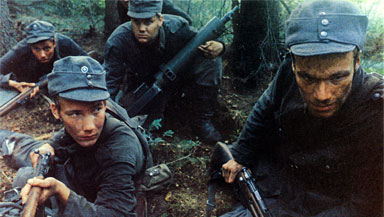
For a truly harrowing experience, Mollberg's remake, a more realistic vision of WWII raging in the Finnish forests, packs a lot more power. Mollberg brilliantly directs a cast of mostly amateurs, teenagers who perfectly encapsulate the futility of war, wasting away a generation before their prime. The book's name also finally gets its due by the horrific final image of dead bodies being loaded into a carriage.  

5. Back to the USSR (Takaisin ryssiin 1992, O: Jari Halonen)

We Finns have had a disturbing history living next to the Soviet Union, and it's politics have influenced us more than we care to admit. It's fall in particular took us off balance. A truly provocative satire by master teaser Halonen perfectly encapsulates the difficulty for any attempt towards Socialism in an agricultural capitalist country. Back in April 2011 I wrote:

"The anarchistic fim has been made with a pittance, but with so much imagination and inventiveness that it turns its downsides to its benefits. Thus the main village is built with shoddy houses that can fall apart in the middle of shenanigans. There's mud and filth everywhere and the society where everyone is bourgeoise can't be seen as any sort of ideal anyway. But communism is hardly a remedy."


Of course, being who I am, those five films weren't enough for me. So I also wrote out five bubbling underers. These were The Diary of A Worker (1967),  The Wedding Waltz (1988), Feast by the Sea (1963), It is written in the stars, Inspector Palmu (1962) and Sensuela, of course.

The list only took fictional films, which torpedoed some of the utmost worthy candidates chances to be crowned the Best Finnish Fim of All Time. I picked five noteworthy documentaries for Twitter. These were Yksinteoin, Reindeerspotting: Escape From Santa Land, Perkele! Images From Finland, The 3 Rooms of Melancholia, and Kovasikajuttu.

Only in recent years have I begun to appreciate the Finnish film legacy more. Our movie history is by no means as impressive as with the Danes or the Swedes, but there certainly is a lot of interesting stuff out there. I find it troublesome that so little of it circulates our TV screenings often, but luckily there are a few festivals and screenings at the National Film Archives that remedy the situation. Rest assured, this listing has taught me a lot of interesting new Finnish films to chack out and I intend to do so by Independence day (December 6th) with another installment of Finnish Cult Movies. Now, I'm off to watch Numbskull Emptybrook.

Yle's news about the matter (in finnish)

Sunday, 11 November 2012

Review: Rust & Bone


Happy father's day! What better way to celebrate than to take a look at a recent film featuring, among other things, a man learning how to be a father? Jacques Audiard's latest film was screened as the Closing film of this year's Love & Anarchy - Helsinki International Film Festival. It is also on the programme of Pimedate ööde filmfestivaal - PÖFF, or the Tallinn International Film Festival, opening tomorrow.

So, as in many of the director's previous movies, Audiard's new protagonist is a man of few words, that is more used to violence than being a normal member of the society. Ali (Matthias Schoenaerts) is a man arriving to Paris to try to make a living supporting his 5-year-old son and staying at his sister's house. The man is struggling to get by, since he isn't too good working at normal jobs, but since he is imposingly large, he gets hired to be a bouncer at a night club.

One night at work he meets Stéphanie (Marion Cotillard), a whale trainer at the local dolphinarium, who also has a tempered violent side. When she gets kicked out of the club, Ali sees her safe back home to his boyfriend. Both sides have a small romantic crush on each other. Stéphanie's boyfriend, however, has had enough of her hard-drinking ways and leaves.


Trying not to spoil too much, but Ali and Stéphanie will eventually become even closer due to a horrific accident that cripples her for life. A major problem, however is that Ali isn't a very emotional individual, and sees no problem screwing around with every woman he encounters. All the while taking care of Stéphanie. The man will eventually learn to take part in brutal underground boxing matches to earn some better money.

For quite a long time, it seems that Audiard is attempting to build a portrait of a true sociopath who is incapable for any feelings whatsoever. Ali doesn't seem to care much for his son, and beats him up for misbehaving. While he connects with Stéphanie on a surface level, can't figure out her deeper feelings for him. But Audiard is a director capable of surprising the audience and by the end it becomes clear Ali does have his sensitive side.

The film's title refers to its themes of disfigurement, while Ali and Stéphanie both have serious personality defects that eventually cause harm to their bodies. He has the willpower and the physical strength, while she has the emotional, even spiritual side. Together they resemble more of a complete person, as evidenced by the scene where Ali takes her swimming by carrying her on his back. But the title may also refer to the emotional side, on how the film's themes may go way beyond of the surface level all the way to the core.

The film also contrasts the human tendency to tame nature and how it problematizes our way to behave. While Stéphanie's attempts to tame a killer whale are futile, she also grows to believe that taming a wild, uncontrollable muscle machine such as Ali is as impossible. But she won't give him, because of the hot, hot sex they're having. Thus she begins to communicate with him only through a very short acronym text message or through body language.


It is a very physical film, shot at times as naturally as to be almost like a nature documentary about the hard knock lives of these people. Audiard is as masterful in compressing everything that needs to be said in just a few sentences as Aki Kaurismäki. One also has to give due to the magnificent actors. Cotillard and Schoenaerts are at career-best form here, taking their abilities for emotional performances and imposing physicality (respectively) to whole new heights.

For those awaiting a clear love story, the film might be too distant, even cold. For those awaiting for the brutally violent boxing matches, they are quite sidelined and only featured in two bigger scenes. But for anyone looking for a good drama that makes one ponder about the human vunerability, and how it affects our own humanity, this is a bullseye.

★★★★


DE ROUILLE ET D'OS
France/Belgium, 2012

Language: French
Director: Jacques Audiard
Screenplay: Jacques Audiard, Thomas Bidegain, Craig Davidson
Cinamatography: Stéphane Fontaine
Starring:
Marion Cotillard, Matthias Schoenaerts, Armand Verdure, Céline Sallette, Corinne Masiero

Saturday, 10 November 2012

All Cops Are Bastards

Or are they?
One curious theme on this year's festivals is the overflow of gritty crime films which look at the never-ending struggle between the police and thieves, hooligans, gang members, drug trafficers and terrorists. Some have bad policemen working in a morally grey area, while some are just ordinary workers doing the best they can in tough situations. It's not easy to match the smartly built world and explosive action of Tropa de Elite — the go-to modern classic of the genre. But that didn't mean that these films weren't captivating to watch. I already reviewed No Rest For The Wicked from Love & Anarchy, which would also otherwise be included here.

A.C.A.B. - All Cops Are Bastards (Italy/France)
Director: Stefano Sollima
Love & Anarchy - Helsinki International Film Festival 2012


Not that many interesting films come from Italy these days (I wonder if this could be because someone has a monopoly on all media and won't fund movies unless they are made for his own TV networks). Occasionally, when a decent one comes around, it's a news item in itself. When the director is also the son of the legendary Leftist spaghetti western director Sergio Sollima, everyone pays twice as much attention.


Nevertheless, the story of riot cops could perhaps find no better setting than modern Italy. With the economy in shambles thanks in large parts with the insider deals of fat cats, the hot-headed Mediterranean national character, and the large-spread passion for football, makes a riot police force's job more than necessary in a day-to-day basis. Yet as it is often with autorities, these cops are also more than willing to misuse their power, take down people who they don't like and reap other benefits attached to their job. We know from the news that for instance the 2001 Genoa G8 meeting resulted in large-spread police brutality around protesters. The movie challenges the viewer to ponder whether there is truth in the name of the film.


Thus we are also thrust into the world by the viewpoint of a rookie, Adriano (Domenico Diele). An idealistic young cop, he at first idolizes the more experienced members of his new squad. Cobra (Pierfrancesco Favino), Nero (Filippo Nigro) and Mazinga (Marco Giallini) are a tight-knit group that doesn't allow outsiders, and who are used to do things their way without anyone telling them to soften up. Adriano must choose whether to corrupt himself as another force-using aggressive power abuser, or to stand the contempt and wrath of the rest of the group. Or die.


The film depicts the riot police to be sort of the society's garbageman, being sent out to take care of major social and structural problem by hitting angry people on the head. The cops have to endure open hatred, for example in a football match where everything that's available to throw at them, is threwn at them. The film doesn't pick favorites among cops and rioters, but makes it clear on why either of them is working the way they do. The film is a tad too long and obvious, without major surprises. It's also a major draw that the societal critique seen through the eyes of a tough-as-nails police unit was so perfected by Tropa de Elite, that while this covers a bit of a different area, comparisons are inevitable.

★★★

End Of Watch (USA)
Director: David Ayer
Night Visions Maximum Halloween 3012


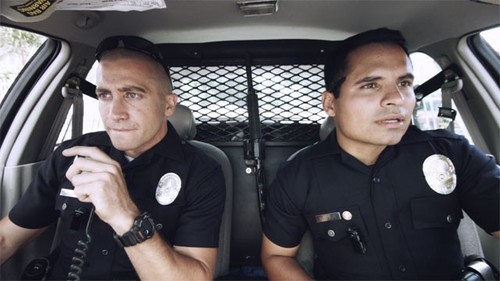
For a lot more positive portrayal of cops, there's the first feature film of the screenwriter of Training Day, David Ayer, seen (a bit surprisingly) at Night Visions Festival. Brian Taylor (Jake Gyllenhaal) and Mike Zavala (Michael Pena) are policing partners that are also best friends in their civilian lives. As anyone who has listened to their share of west side gangsta rap knows, the restless area around South Central L.A. is ruled by gangs and mexican drug cartels.


We follow the two cops around as they do their best to catch dangerous people around the area, usually who hate cops right down to their bones. In the middle Taylor and Zavala bicker, and talk about their love lives and mundane things. The single Taylor is starting to get involved on a new girl (Anna Kendrick) and their relationship is deepening. But once, on a routine call Taylor and Zavala stumbe upon an old house that hids brutally murdered bodies and major amounts of dope. Reporting on the place makes them heroes, but gets them on the Mexican drug cartel's Most Wanted list.

The film starts out by being based on the material that the cops themselves are shooting, whether for a TV show or whatever the in-story purpose. The actual purpose of Ayer is clear, to depict the police as both ordinary people, who live and laugh and love. And on the other hand, as heroic people who are willing to risk their neck out protecting the innocent, and doing what is morally right. These ideas are manufactured to give resonance on the tragedy about to unfold. It's a bit sad that Ayer cops out (har, har) on the last minute to make the ending a real gut-punch.


There's not much on display here that hadn't been done as good or better in numerous modern quality TV cop shows. Taylor and Zavala are quite well-rounded characters that have their good and bad sides, and are expertly acted out by Gyllenhaal and Pena. It's sad that the script over-emphasizes their heroism, and for instance the scene where they risk their lives rushing into a burning building to rescue children, goes a little over-the-top.

Along the way, the camera as an element within the story is more and more forgotten, we get fewer scenes of the characters talking straight to us, and more clearly directed angles. But the most important element in hand-held camera footage movies, the immersion tho the film's world and characters, has already been achieved.

★★★

Policeman (Ha-shoter, Israel)
Director: Nadav Lapid
Love & Anarchy - Helsinki International Film Festival 2012 


The most innovative police thriller I've seen in a while comes from Israel of all places. It's an action movie without a single action scene. It's also a two-sided movie, telling two vastly different but interlaying stories that comes together in the end. Many of the major scenes are not shown, but left to the audience to deduce. Most people walking in on a cop thriller would probably not expect such an intellectual, almost Haneke-styled approach, but it is very refreshing to see a genre movie thet relies on the intelligence of its audiences.


The first act of the film introduces us to the cops. Most of the time with them is spent at a barbecue with their families, or recreational activities, all smiles and happiness. Once in a while a racist comment pops up which makes it clear the speaker would like to shoot Arabs, but no one bats an eyelid. The cops clearly have rubber-band morality, since even with all the happiness of their family lives they are sex-hungry enough to go pick on random girls they encounter. It's revealed that one of them is having trouble with the higher-ups due to an act of violence on the job that is not specified. But all of them stick together and in the hearing all the other defend the accused. They all are eagerly awaiting for their next assignment, as they are the anti-terrorist assault squad.


The next act features ideological (Jewish) young people getting together to discuss the state of the world, how capitalism is ravaging the society, and their disdain for authorities. The youngsters are nice to help out a man playing guitar in the street corner by busting out some jams. They harbor secret crushes to each other. They seem like well-rounded nice people until it becomes clear that they idolize the Beider-Meinhof Complex. They are planning an act of terrorism, to kidnap several people at a rich woman's wedding and execute them if their radical leftist demands are not met.

In the third act, this plan is carried out, and the scenario followed to the end.

Policeman is an amazingly mature work from a first-time director, Nadav Lapid. The cold approach to major issues emphasizes a world where discussion is rueld out from the get-go and both sides believe the excessive use of force is the only way to get things across. The camera follows around coldly, only getting more dynamic in the very end, which makes the ending even more harrowing. This is a depiction of a society in a cul-de-sac, but it works. As such, it would deserve a less generic english name, though.

★★★★

LinkWithin

Related Posts Plugin for WordPress, Blogger...